




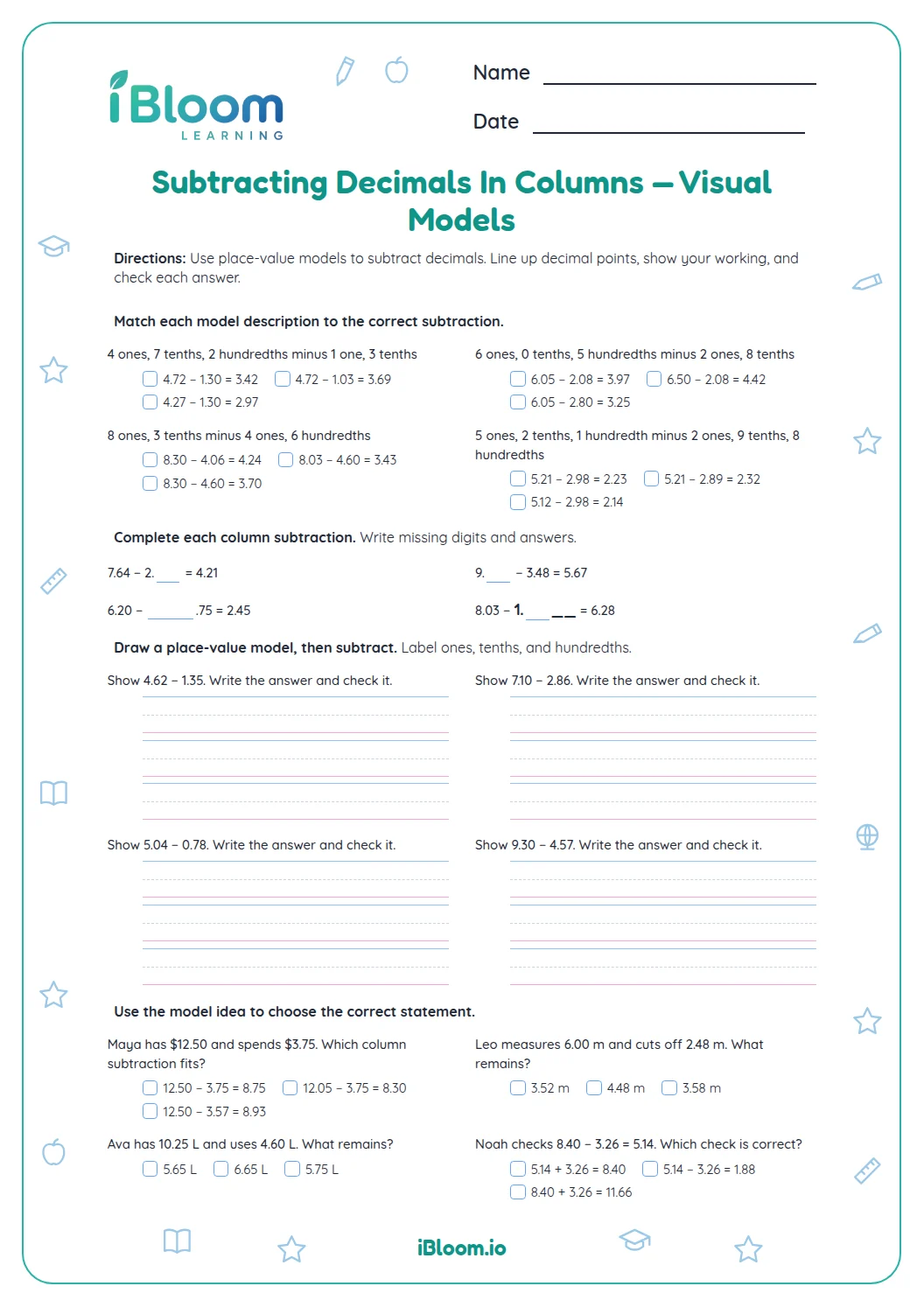
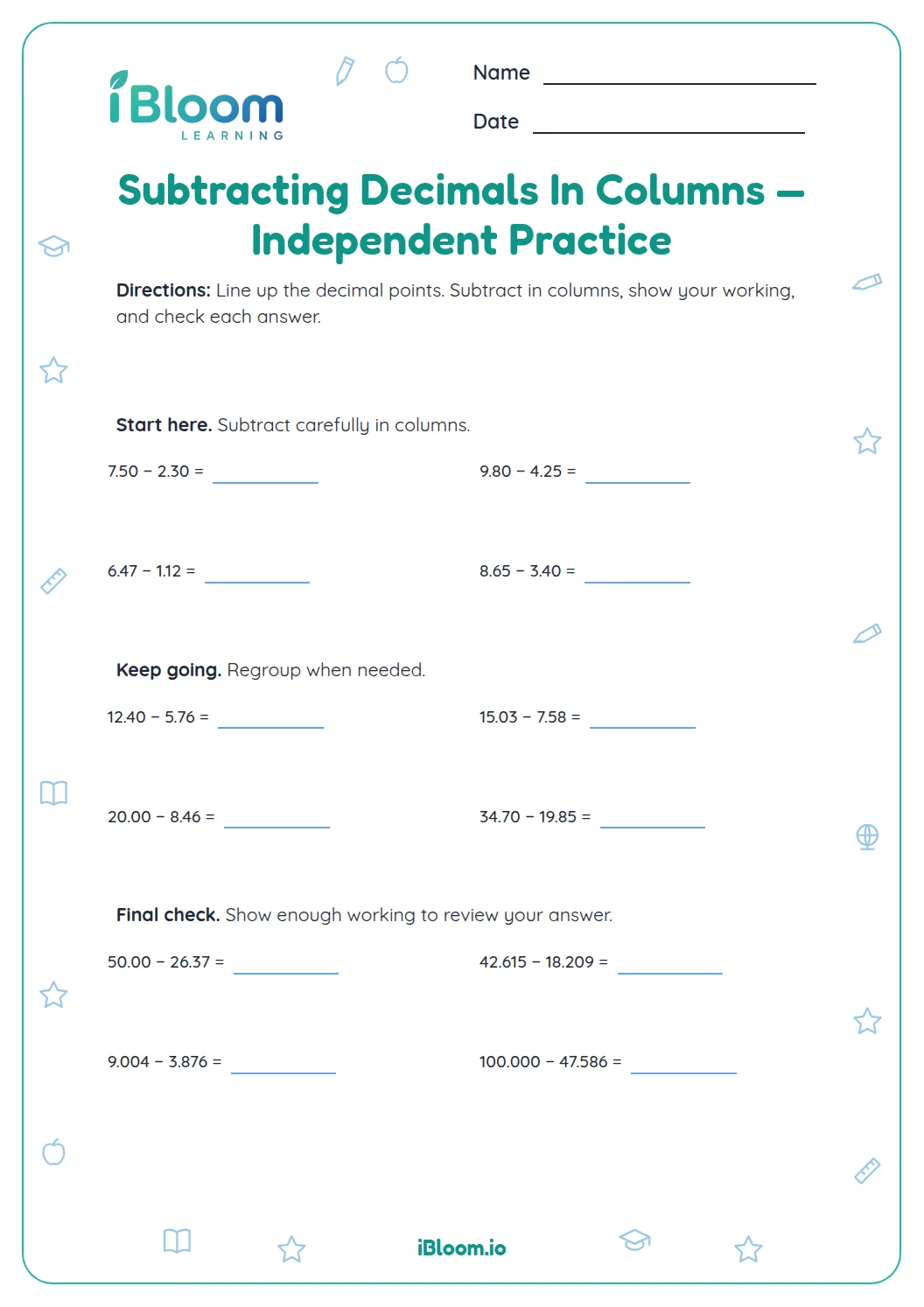
About this worksheet
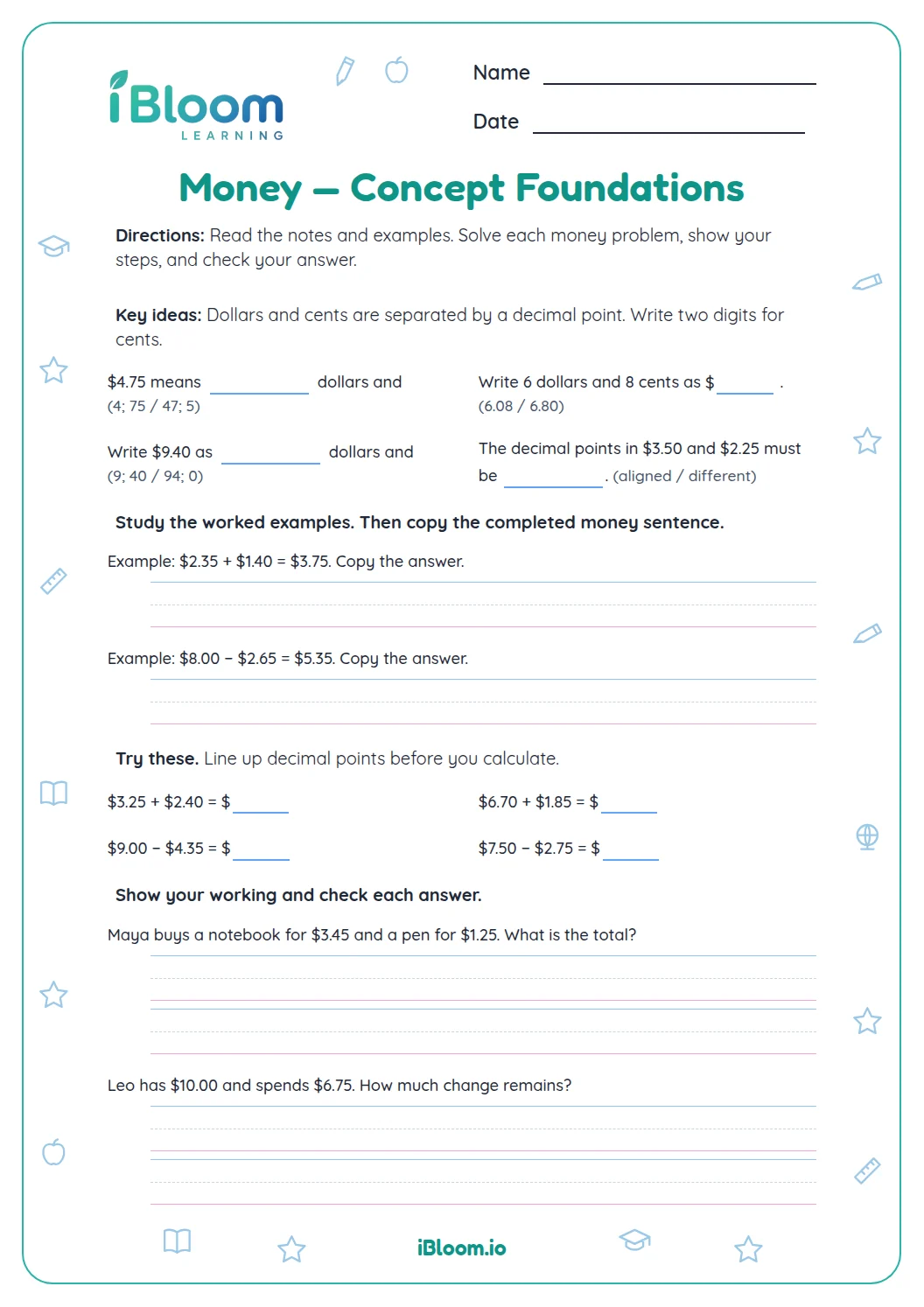
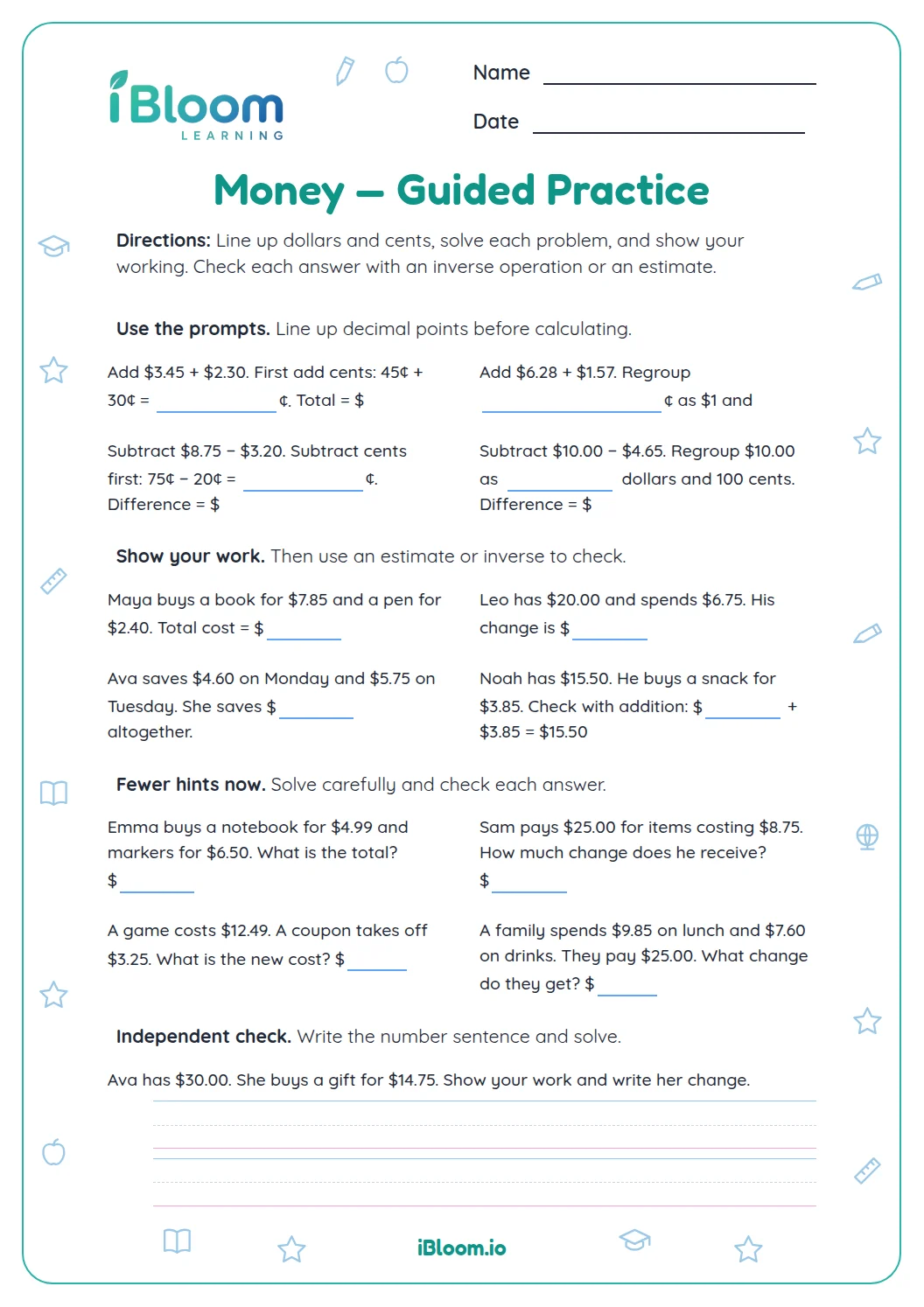
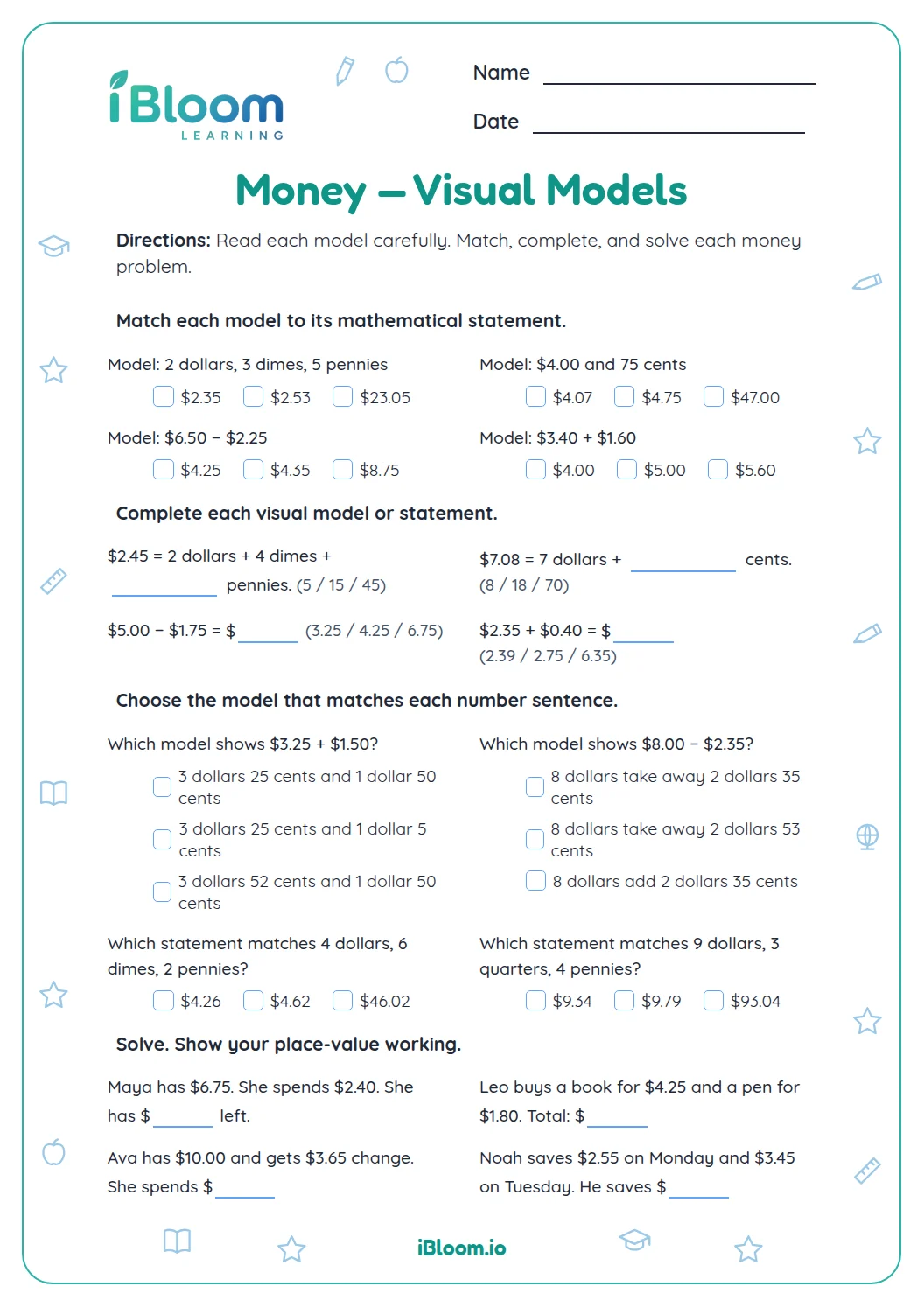
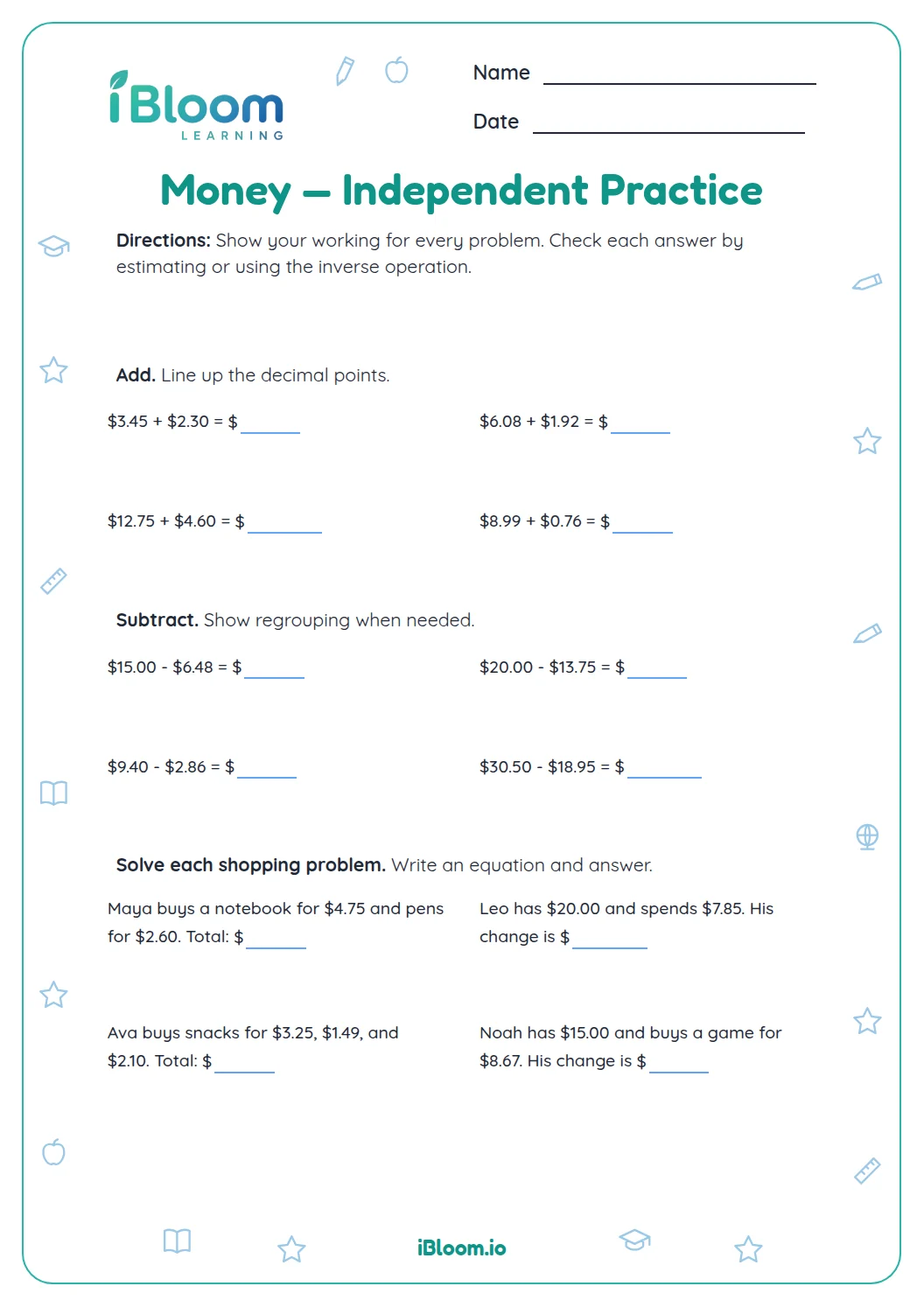
This Grade 5 worksheet applies decimal addition and subtraction to everyday money situations. Fourteen problems ask children to find totals, compare money available with a price, and calculate change or a remaining balance. Every amount is written in dollars and cents, giving practice with decimal place value in a useful context. It aligns with CCSS 5.NBT.B.7. A separate answer key is included.
Aligned to 5.NBT.B.7
What kinds of money problems are included?
The 14 problems mix totals, change, and remaining balances. Some totals combine two prices and one combines three; subtraction finds money left after spending or change from a payment.
How should decimal amounts be added or subtracted?
Keep the decimal points in one vertical line so ones, tenths, and hundredths stay aligned. Add a zero placeholder when an amount has no hundredths. Then check that the result fits the story.
- 1Notebook: $2.45; folder: $1.30
- 22.45 + 1.30 = 3.75
- 3Total cost: $3.75
How can children check a money answer?
Estimate before calculating. A total must be greater than each price being added. Change must be less than the payment and equals payment minus cost. For a remaining balance, subtract the spending from the starting amount; adding the cost back should recover the starting amount.
How to use this worksheet
- 1Circle the words that show what is being asked: total, left, or change.
- 2Write the amounts with decimal points aligned.
- 3Add zeros to make each amount show cents.
- 4Calculate and include the dollar sign.
- 5Estimate or use the inverse operation to check.
Common mistakes and quick fixes
The mistake
Misaligning decimal points.
The fix
Write dollars over dollars, tenths over tenths, and cents over cents.
The mistake
Dropping a zero in a cents place.
The fix
Write $10.00 when a problem gives ten dollars.
The mistake
Subtracting the price from the amount paid in the wrong order.
The fix
Change is amount paid minus the purchase cost.
Common Core alignment
This practice connects the listed grade-level standard to short, focused worksheet tasks.
Add and subtract decimal amounts to hundredths in money situations.
On this sheet: Every story problem requires adding or subtracting dollar amounts to the nearest cent.
Show the official wordingHide the official wording
Add, subtract, multiply, and divide decimals to hundredths, using concrete models or drawings and strategies based on place value, properties of operations, and/or the relationship between addition and subtraction; relate the strategy to a written method and explain the reasoning used.
What to practice next
Make more practice
Further reading
Questions parents and teachers ask
How many problems are included?
There are 14 money problems across two worksheet pages. The set includes totals from two or three prices, change after a purchase, and balances after spending. Each answer is in dollars and cents, and the separate answer key lists the correct amount for each situation.
Do children need to use a calculator?
The worksheet provides space to show written decimal calculations. Children can line up decimal points, add or subtract by place value, and estimate to check whether the answer makes sense. A calculator is not needed to complete the printed problems.
Why are decimal points lined up?
Digits with the same place value must be in the same column: dollars with dollars, tenths with tenths, and hundredths with hundredths. Aligning the decimal points keeps those places together during addition or subtraction and helps produce a correctly written money amount.
What does the answer key show?
The key lists a dollar-and-cent answer for all 14 problems. For example, question 1 combines the notebook and folder prices for $3.75. The worksheet leaves room to write calculations, so children can compare both their result and their method with an adult.
How can children tell whether to add or subtract?
Add when the story asks for a combined cost or total of purchases. Subtract when it gives an amount paid or starting balance and asks what remains after the cost. For change, subtract the price from the payment; for a balance, subtract spending from the starting amount.