









About this worksheet
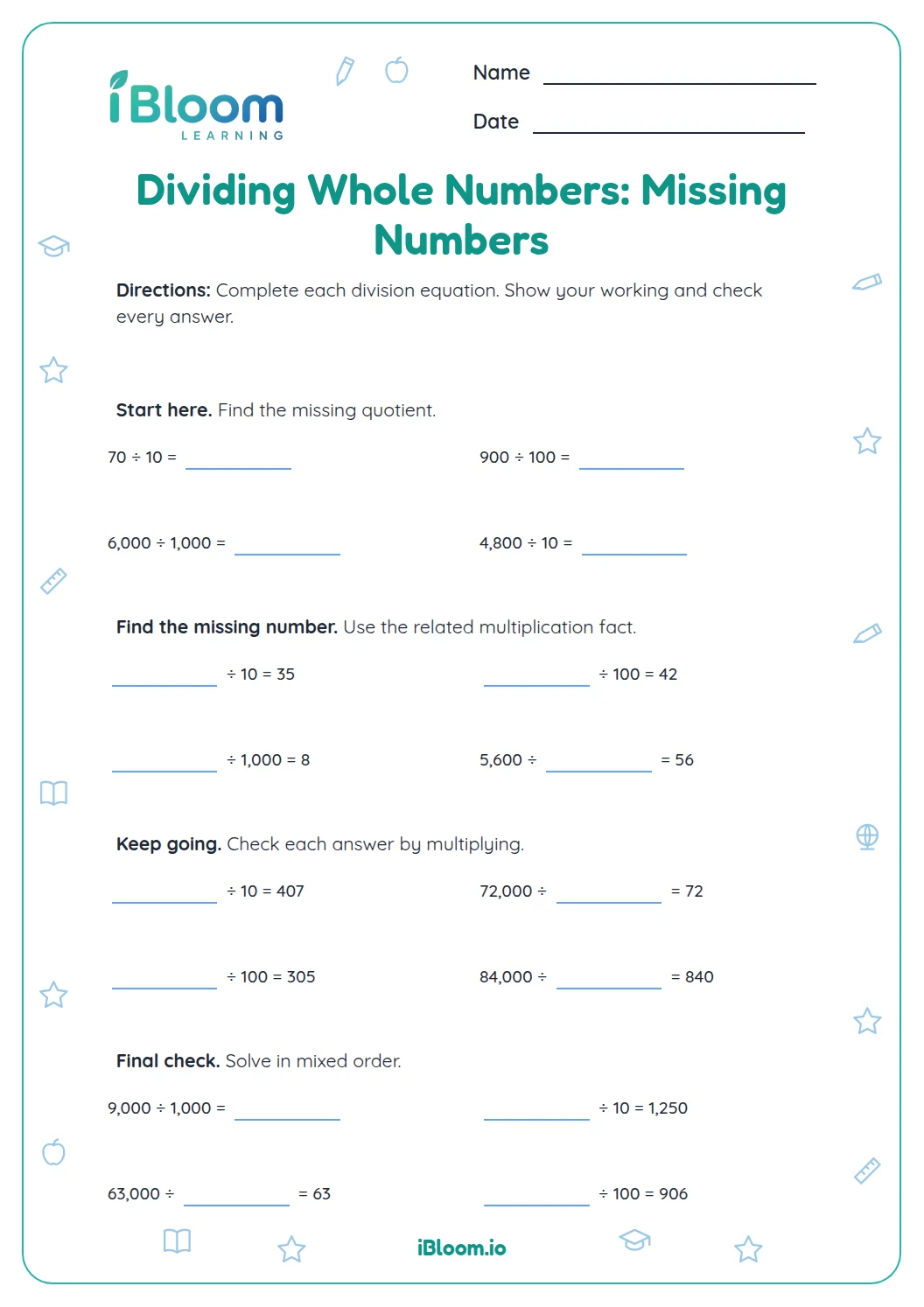
This free printable Grade 5 worksheet is a reasoning challenge on dividing whole numbers by 10, 100 and 1,000. Instead of only computing, students find missing numbers (___ ÷ 100 = 53), decide where three classmates went wrong, compare two quotients without long division, and check an answer with multiplication. Five questions involve decimals (9,600 ÷ ___ = 9.6, ___ ÷ 100 = 0.37, 720 ÷ ___ = 7.2, ___ ÷ 1,000 = 2.5, and a 350 cm string that is 3.5 meters long), so students must place the decimal point as well as count zeros. It practices Common Core 5.NBT.A.2 and the place-value idea behind it, 5.NBT.A.1. A separate two-page answer key is included.
Aligned to 5.NBT.A.2
What happens to a number when you divide it by 10, 100 or 1,000?
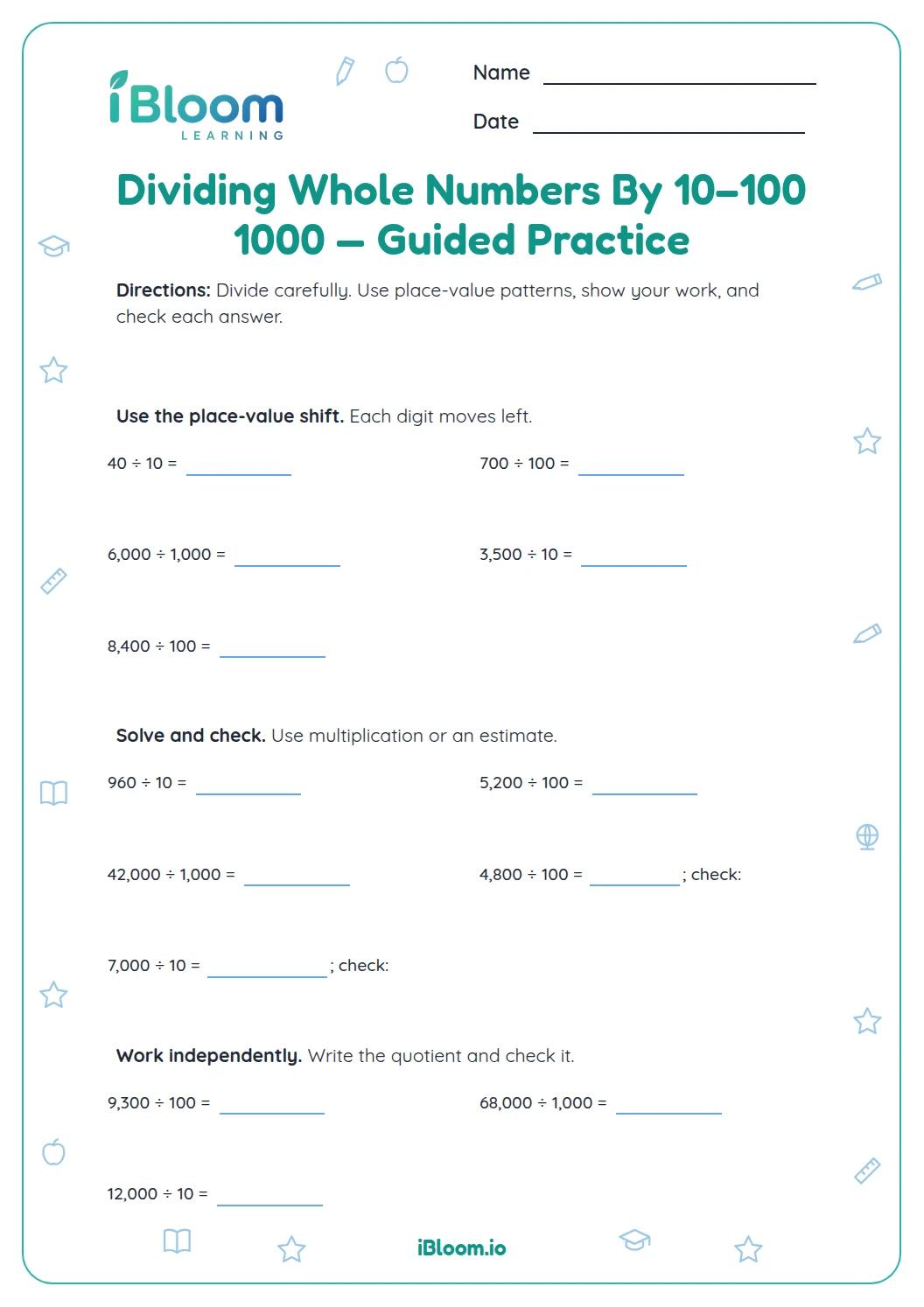
Dividing by 10 makes every digit worth one tenth of what it was, so each digit slides one place to the right. Dividing by 100 slides it two places, and dividing by 1,000 slides it three. That is why 4,800 ÷ 100 = 48 and 7,000 ÷ 1,000 = 7.
Many students learn this as "cross off zeros," which works only when the number ends in enough zeros. It breaks down on 350 ÷ 100, where there is only one zero to remove. Thinking about place value gives the right answer, 3.5, every time. This sheet keeps asking students to use that idea, not just a trick.
How do you find a missing dividend or divisor?
Undo the division with multiplication. If ___ ÷ 100 = 53, the missing number is 53 × 100. If 9,600 ÷ ___ = 96, ask what you multiply 96 by to get 9,600. Multiplying also gives a quick check, because a correct answer always works backward.
- 1___ ÷ 100 = 53
- 2Undo the division: 53 × 100 = 5,300
- 3Check: 5,300 ÷ 100 = 53 (each digit moves two places right)
- 4Answer: 5,300
What kinds of reasoning does this challenge ask for?
Part A shows three wrong answers. Maya wrote 4,800 ÷ 100 = 480, which is what you get from dividing by 10, so students name the mistake. Ava wrote 630 ÷ 10 = 6,300, and students multiply back to test it: 6,300 × 10 is 63,000, not 630, so her answer cannot be right.
Part C asks students to compare 9,000 ÷ 100 with 900 ÷ 10 (both are 90) and to spot the one true sentence among three that use different powers of 10. Part D asks students to correct Sam's answer, 360, and prove it with a multiplication check: 36 × 1,000 = 36,000. The last question applies the skill by changing 350 centimeters to meters.
- Part A: 3 questions, find the mistake
- Part B: 6 questions, missing dividends and divisors, four with decimal quotients
- Part C: 2 questions, compare and choose
- Part D: 2 questions, check an answer by multiplying and convert a length
Why do some answers on this sheet have decimal points?
Dividing a whole number by 10, 100 or 1,000 does not always give a whole number. In Part B, 9,600 ÷ ___ = 9.6 needs 1,000, ___ ÷ 100 = 0.37 has the missing number 37, and 720 ÷ ___ = 7.2 needs 100, and ___ ÷ 1,000 = 2.5 has the missing number 2,500. The quotient is a decimal even though the missing number is whole. In Part D, a 350 cm string is 3.5 meters long.
These questions practice the second half of 5.NBT.A.2: explaining where the decimal point lands when you divide by a power of 10. Students who rely only on removing zeros get stuck here, so they are a good test of real understanding.
How to use this worksheet at home or in class
- 1Warm up by writing 48 on paper and asking what 48 ÷ 10 and 48 ÷ 100 are. Draw an arrow for each place the digits move.
- 2Have your child work Part A first and say each wrong answer aloud: "Maya divided by 10 instead of 100."
- 3For Part B, ask your child to write the multiplication that undoes each division before filling in the blank.
- 4Let your child finish Parts C and D alone, using the working space for the multiplication check and the length conversion.
- 5Check with the answer key. For any miss, ask your child to multiply the answer back and see whether it returns to the start.
- 6Stretch it: ask your child to write a new find-the-mistake question about 2,500 ÷ 100 for you to solve.
Common mistakes and quick fixes
The mistake
Moving the digits the wrong number of places, for example writing 4,800 ÷ 100 = 480.
The fix
Match zeros to places: 10 has one zero, so one place; 100 has two, so two places. Write the number in a place-value chart if needed.
The mistake
Moving the digits left, or adding zeros, as if multiplying. A child might write 630 ÷ 10 = 6,300.
The fix
Ask: should dividing make the number bigger or smaller? Then check by multiplying back: 6,300 × 10 is far more than 630.
The mistake
Crossing off zeros when there are not enough, writing 350 ÷ 100 = 35.
The fix
Use place value instead. Two places right from 350 is 3.50, so the answer is 3.5. A meter stick makes it concrete: 350 cm is three and a half meters.
Common Core alignment
Most US states use the Common Core standards or a close state version, so this sheet fits Grade 5 decimal and place-value units in most classrooms.
Explain where the digits and decimal point land when you divide by 10, 100 or 1,000.
On this sheet: Main standard: every question divides by 10, 100 or 1,000 and asks students to reason about where the digits land.
Show the official wordingHide the official wording
Explain patterns in the number of zeros of the product when multiplying a number by powers of 10, and explain patterns in the placement of the decimal point when a decimal is multiplied or divided by a power of 10. Use whole-number exponents to denote powers of 10.
What to practice next
Make more practice
Further reading
Questions parents and teachers ask
What is the rule for dividing by 10, 100 and 1,000?
Each digit moves right: one place for 10, two for 100, three for 1,000. In 4,800 ÷ 100, the 4 moves from the thousands place to the tens place, so the answer is 48. If the digits move past the ones place, the answer is a decimal, like 350 ÷ 100 = 3.5.
Why is removing zeros not a good rule?
Removing zeros works only when the number has enough of them. It gives 45,000 ÷ 1,000 = 45 correctly, but it fails on 350 ÷ 100, which is 3.5, not 35. Place value works for every number, so this sheet builds that understanding and treats zero-counting as a shortcut.
What are the answers to the missing-number questions?
Part B answers are 640, 5,300, 1,000, 37, 100 and 2,500. To find them, undo the division with multiplication: 64 × 10 is 640, 53 × 100 is 5,300, 9.6 × 1,000 is 9,600, and 0.37 × 100 is 37. The answer key shows all thirteen answers.
Why do the find-the-mistake questions help?
Spotting an error makes students explain the rule, not just apply it. When Maya writes 4,800 ÷ 100 = 480, a student has to see that she divided by 10. That kind of reasoning is the habit 5.NBT.A.2 asks for, and it carries over to later grades.
Is this worksheet too hard for my child?
It is a challenge version, so start with the plainer sheet on dividing whole numbers by 10, 100 and 1,000 if your child still miscounts places. If most of that sheet is easy, this one is a good next step, because it adds missing numbers, decimal quotients and explanations.
How long does it take, and is there an answer key?
Most Grade 5 students finish in about 15 to 20 minutes, a little longer if they show a full multiplication check in Part D. Yes, a separate two-page answer key gives every answer, including the corrected value for Sam's problem, so a parent can check quickly.