

About this worksheet
This free printable worksheet gives Grade 5 students real-world practice with a missing factor in a decimal multiplication story. Each problem tells a total and one decimal factor, such as $7.20 spent on apples at $1.20 per pound, and asks for the other factor. In Part A students choose the equation that fits a story, check a division with multiplication and spot a mistake, and in Part B they solve four stories and label each answer with its unit. It practices Common Core 5.NBT.B.7, multiplying and dividing decimals to hundredths. A two-page answer key is included.
Aligned to 5.NBT.B.7
What is a missing factor in a decimal story?
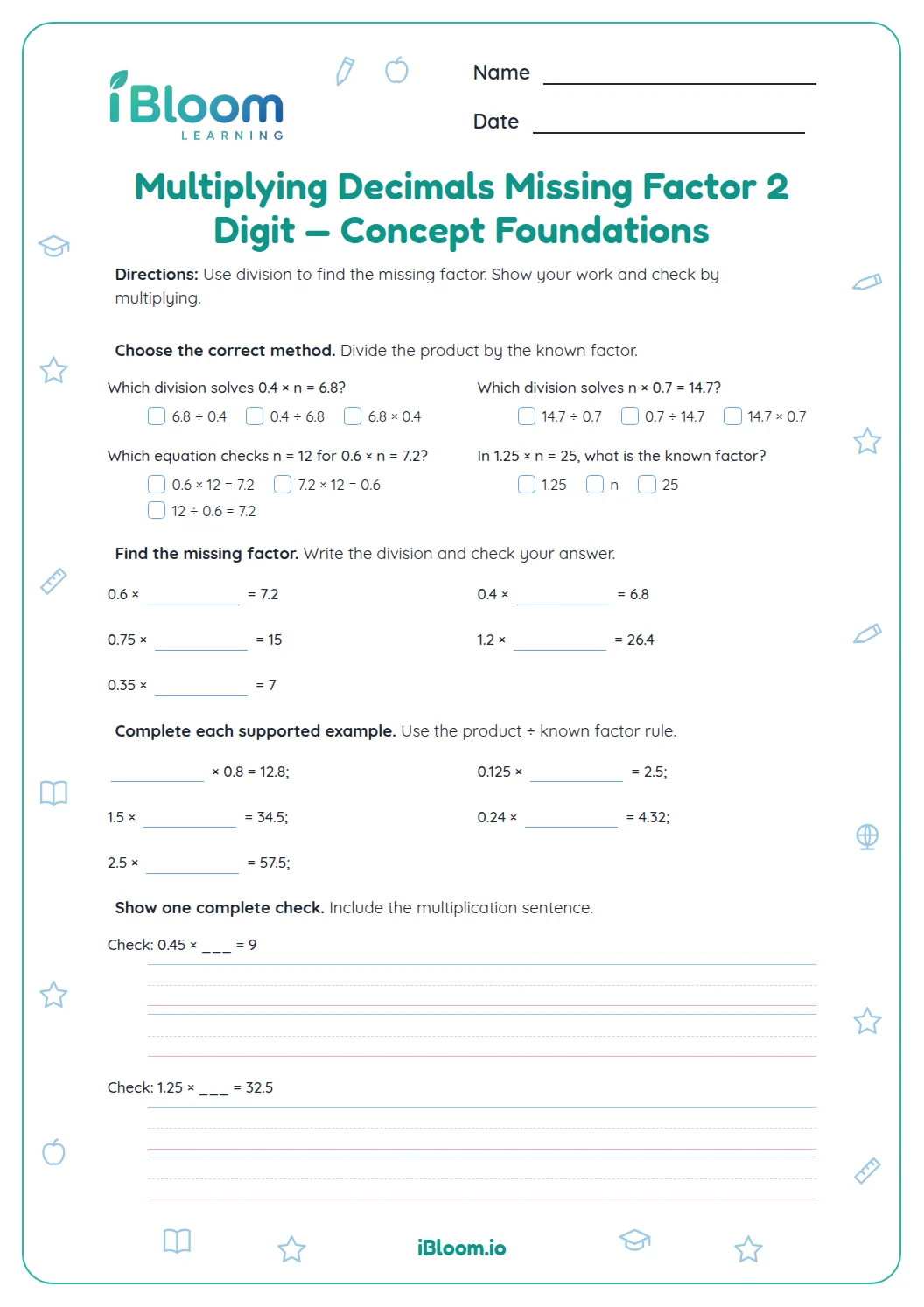
Many everyday problems are multiplication with one number hidden. Ribbon costs $0.75 per meter, Maya pays $3.00, and the question is how many meters she bought. The story says 0.75 × ? = 3.00, so the unknown is a factor, not the product.
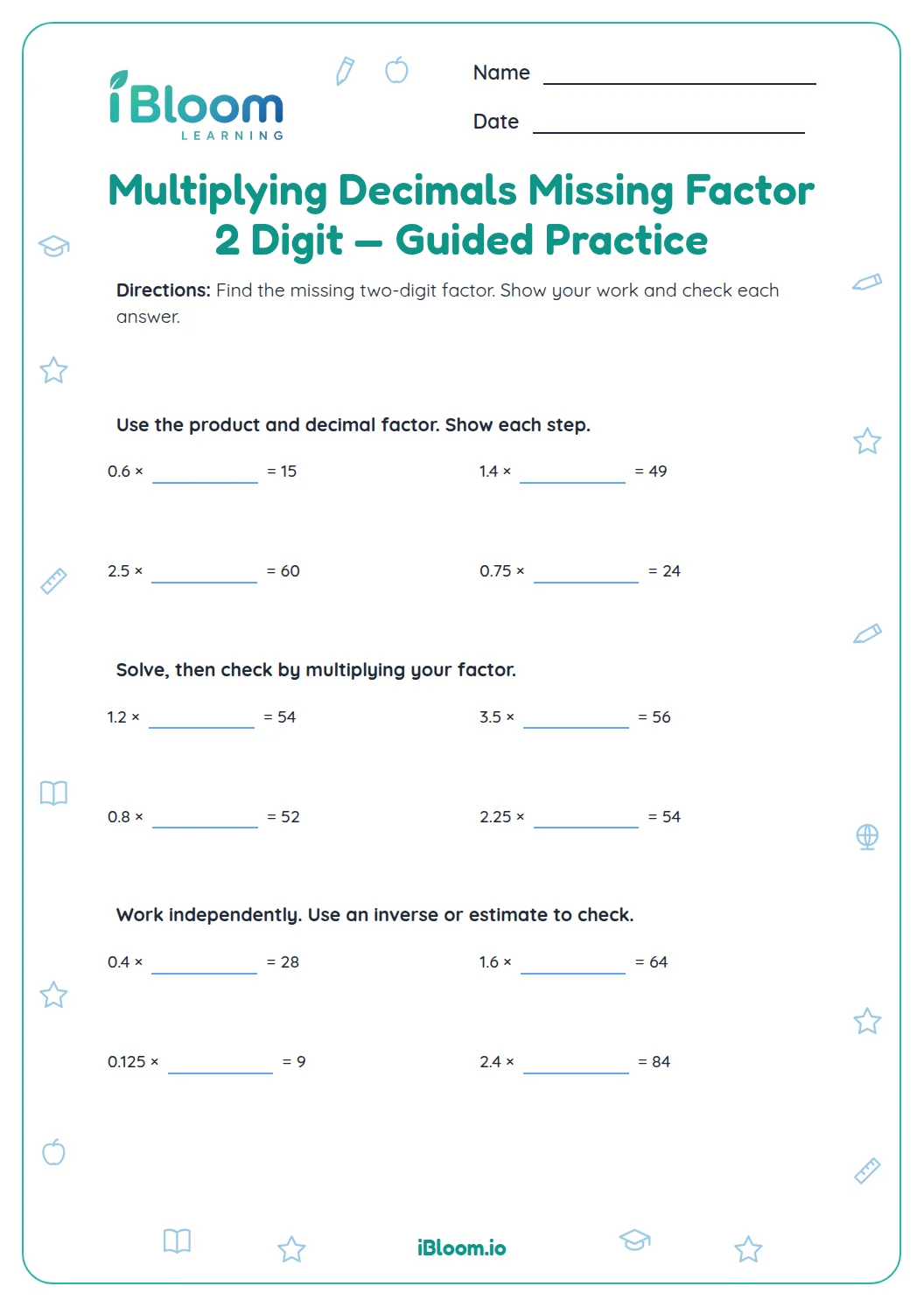
Because multiplication and division undo each other, a missing factor is found by dividing the total by the factor you know. The new difficulty at Grade 5 is that the divisor is a decimal, like 0.75 or 1.2.
How do students divide by a decimal divisor?
One reliable method is to scale both numbers by the same power of ten until the divisor is a whole number. Multiplying 7.20 and 1.20 by 100 turns 7.20 ÷ 1.20 into 720 ÷ 120. Both numbers grew by the same factor, so the answer is unchanged.
Another method is to think in smaller units. $7.20 is 720 cents and $1.20 is 120 cents, so the question is how many 120s fit into 720. Either way, students should check by multiplying the answer by the known factor.
- 1Emma pays $7.20 for apples at $1.20 per pound.
- 2Equation: 1.20 × ___ = 7.20
- 3Divide: 7.20 ÷ 1.20
- 4Multiply both numbers by 100: 720 ÷ 120 = 6
- 5Check: 6 × 1.20 = 7.20
- 6Answer: 6 pounds
Why estimate and check the answer?
Moving a decimal point the wrong way gives answers that are ten times too big or too small. Question 5 shows this: Emma uses 5.6 cups of flour in 0.7-cup batches and says she makes 80 batches. Since 5.6 is close to 6 and 0.7 is close to 1, the answer should be near 6 to 8, not 80.
Question 4 practices the check itself: if 8.4 ÷ 1.2 = 7, then 7 × 1.2 must equal 8.4. That fact family link is what makes division a way to find a missing factor.
What is on this worksheet?
Nine questions in two parts, one part per page. Every total and factor has at most two decimal places, and each answer works out exactly. In Part B, three answers are whole numbers and one is 7.5 minutes.
- Part A, Choose and check: three stories where students pick the matching equation, such as 0.75 × n = 3.00, then one multiplication that checks a division and one mistake to find (questions 1 to 5)
- Part B, Find the missing factor: four stories to solve with an equation, working space and a labeled answer (questions 6 to 9)
- A matching two-page answer key
How to use this worksheet at home or in class
- 1Warm up with a whole-number story: 4 packs cost $12, so what does one pack cost? Then say the multiplication and the division it gives.
- 2Do question 1 together. Ask your child to say which numbers are known and which is hidden before choosing the equation.
- 3Let your child finish Part A, then compare answers and explain why the other equations do not fit the story.
- 4Before Part B, talk through question 5: ask your child to estimate the number of batches and say why 80 cannot be right.
- 5In Part B, ask for the equation first, then the division. Encourage scaling both numbers by 10 or 100 to make the divisor whole.
- 6Have your child label every answer with its unit, then use the answer key. For any miss, multiply the answer by the known factor to see whether it gives the total.
Common mistakes and quick fixes
The mistake
Multiplying the two numbers in the story. In question 6, 7.20 × 1.20 gives 8.64, which is far more pounds than $7.20 could buy.
The fix
Ask whether the total is the answer or one of the numbers given. The total is a product, so the missing factor comes from dividing.
The mistake
Moving the decimal point in one number only. Changing 7.20 ÷ 1.20 into 72 ÷ 1.20 or 720 ÷ 12 gives 60 pounds instead of 6.
The fix
Scale both numbers by the same power of ten. 7.20 and 1.20 both times 100 gives 720 ÷ 120.
The mistake
Dividing the smaller number by the larger one, as in 0.6 ÷ 4.2 for the fabric question in question 7.
The fix
The total (4.2 yards) is the amount being cut into flags, so it goes first. Ask, "How many 0.6s fit into 4.2?"
Common Core alignment
Most US states use the Common Core standards or a close state version. The Grade 5 standard covers dividing decimals to hundredths using models and place value, which is what the scaling method here applies.
Divide decimals to hundredths to find a missing factor in a story, and check by multiplying.
On this sheet: Main standard: every problem is solved by dividing decimals to hundredths, and question 4 uses multiplication to check.
Show the official wordingHide the official wording
Add, subtract, multiply, and divide decimals to hundredths, using concrete models or drawings and strategies based on place value, properties of operations, and/or the relationship between addition and subtraction; relate the strategy to a written method and explain the reasoning used.
What to practice next
Make more practice
Further reading
Questions parents and teachers ask
What is a missing factor in decimal multiplication?
It is the number that is hidden in a multiplication sentence. In 0.75 × ___ = 3.00, the missing factor is 4, because 0.75 times 4 is 3.00. Students find it by dividing the total by the known factor, here 3.00 ÷ 0.75, and check by multiplying.
How do Grade 5 students divide by a decimal?
They divide decimals to hundredths with models, place value and written methods (5.NBT.B.7). On this sheet they scale both numbers by 100, so $7.20 ÷ $1.20 becomes 720 ÷ 120 = 6, then check by multiplying. Every number stays within hundredths.
Why does scaling both numbers by 100 keep the answer the same?
Because division compares two amounts, and multiplying both by the same number keeps the comparison the same. 7.20 ÷ 1.20 asks how many 1.20s are in 7.20. Using cents, 720 ÷ 120 asks the same thing, and both equal 6.
What are the answers to the Part B word problems?
Emma buys 6 pounds of apples, Sam can make 7 flags, the tub fills in 7.5 minutes, and Noah buys 8 pencils. Each comes from dividing the total by the known factor. The answer key lists every answer, including the five in Part A, in order.
My child gets the wrong answer by moving the decimal wrongly. What helps?
Estimate first, so a wild answer shows itself. Then use the money model: 7.20 and 1.20 become 720 cents and 120 cents, so both decimal points move the same two places. Multiplying the answer by the known factor is a quick final check.
How long does it take, and is there an answer key?
Most Grade 5 students need about 20 minutes, because Part B asks for an equation, working and a labeled answer. Yes. A two-page answer key follows the worksheet, so you can hand out the worksheet alone and keep the key for checking afterwards.