




About this worksheet
This Grade 5 printable turns fraction subtraction into 14 short real-world situations involving ribbon, recipes, walking distances, and supplies. Students subtract fractions with like denominators, keep the unit attached, and work with mixed numbers in the later questions. The sheet practices CCSS 5.NF.A.2, which applies fraction operations to word problems. It includes a separate answer key.
Aligned to 5.NF.A.2
What stays the same when denominators match?
The denominators name equal-sized parts. Subtract the number of parts in the numerators, then simplify if useful. For question 1, 7 eighths minus 3 eighths leaves 4 eighths, or 1/2 yard.
- 17/8 yard − 3/8 yard = 4/8 yard
- 24/8 yard = 1/2 yard
How do mixed-number stories work?
Subtract the fractional parts when possible, then subtract the whole numbers. For question 6, 1 5/8 − 3/8 leaves 1 2/8, which simplifies to 1 1/4 yards.
Why should the unit stay in the answer?
The story asks for a length, amount, or weight. Writing yards, liters, cups, or miles makes clear what the fraction measures. A quick reasonableness check confirms the remainder is less than the starting amount.
How to use this worksheet
- 1Underline the starting amount and the amount taken away.
- 2Check that the denominators match.
- 3Subtract the numerators and keep the denominator.
- 4For mixed numbers, subtract the fractional parts and whole numbers.
- 5Simplify the fraction if possible.
- 6Write the unit and check that the remainder is smaller than the start.
Common mistakes and quick fixes
The mistake
Subtracting denominators even though the parts match.
The fix
Keep the shared denominator and subtract only the numerators.
The mistake
Dropping the unit from a story answer.
The fix
Copy the unit named for the measured amount.
The mistake
Leaving an equivalent fraction unsimplified.
The fix
Check whether numerator and denominator share a factor.
Common Core alignment
The story problems apply fraction subtraction to measurements and other real-world contexts.
Solve word problems involving addition and subtraction of fractions.
On this sheet: Each item models subtracting fractions or mixed numbers from the same measured whole in a story.
Show the official wordingHide the official wording
Solve word problems involving addition and subtraction of fractions referring to the same whole, including cases of unlike denominators, e.g., by using visual fraction models or equations to represent the problem. Use benchmark fractions and number sense of fractions to estimate mentally and assess the reasonableness of answers.
What to practice next
Make more practice
Further reading
Questions parents and teachers ask
What denominators appear on this worksheet?
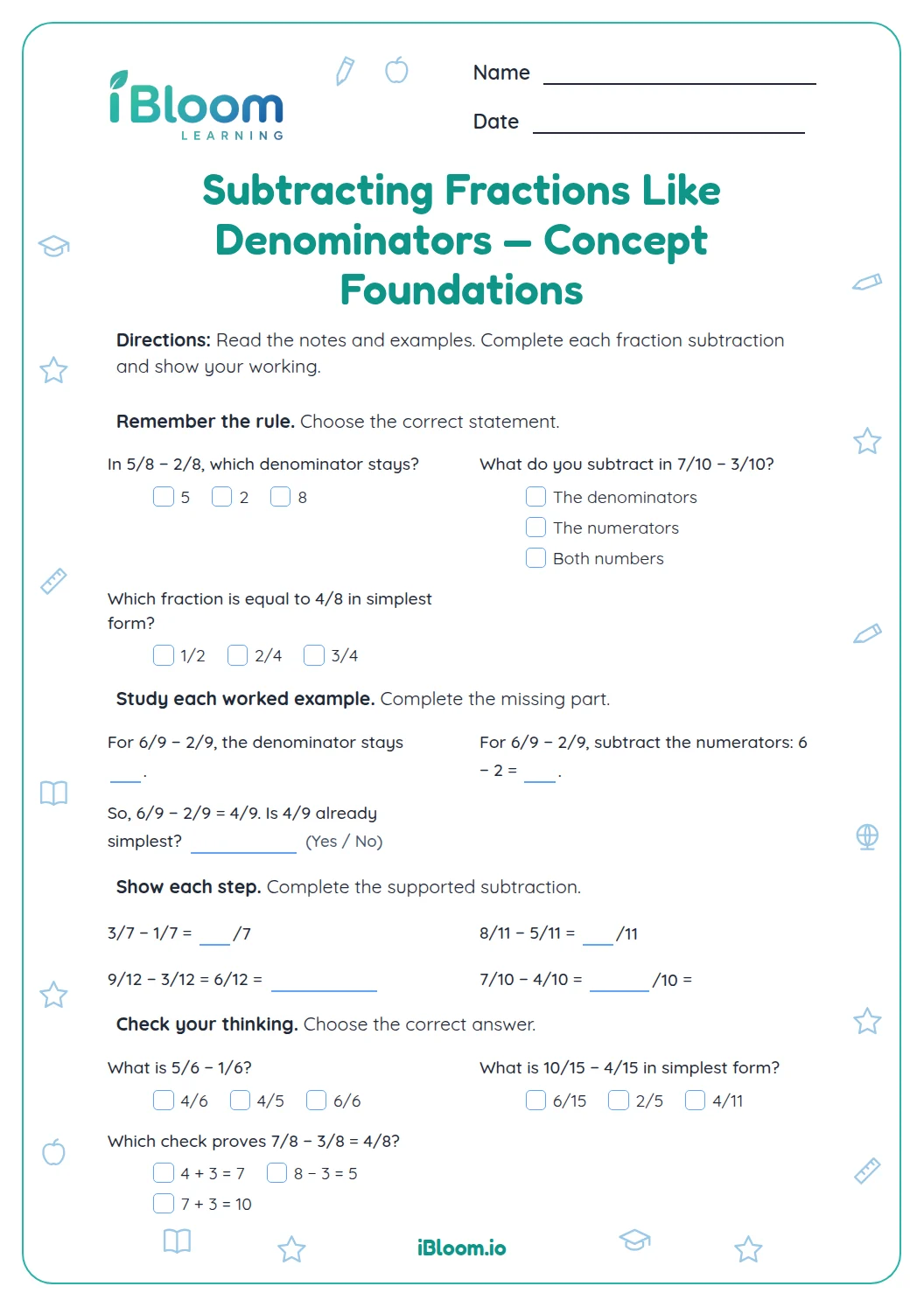
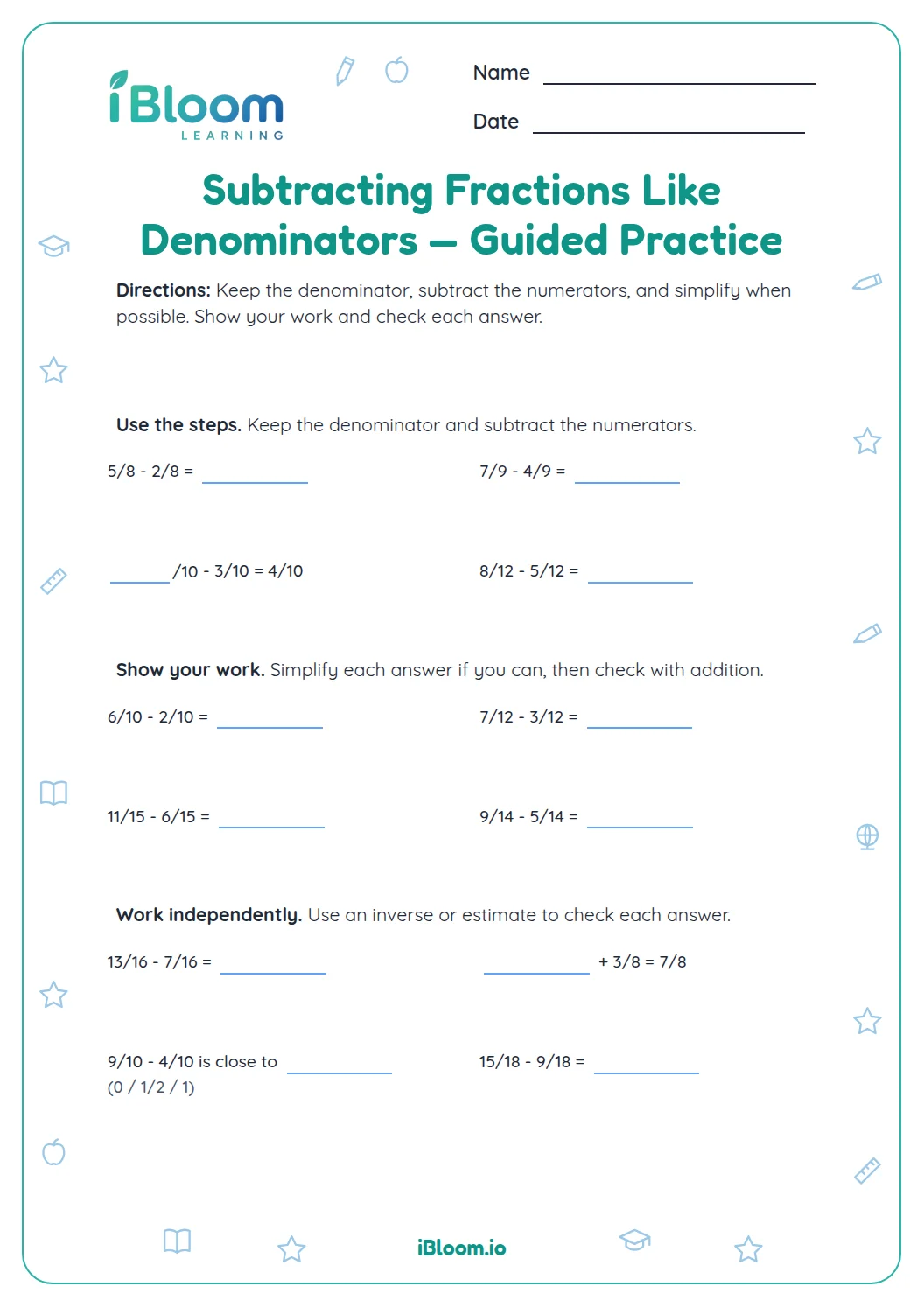
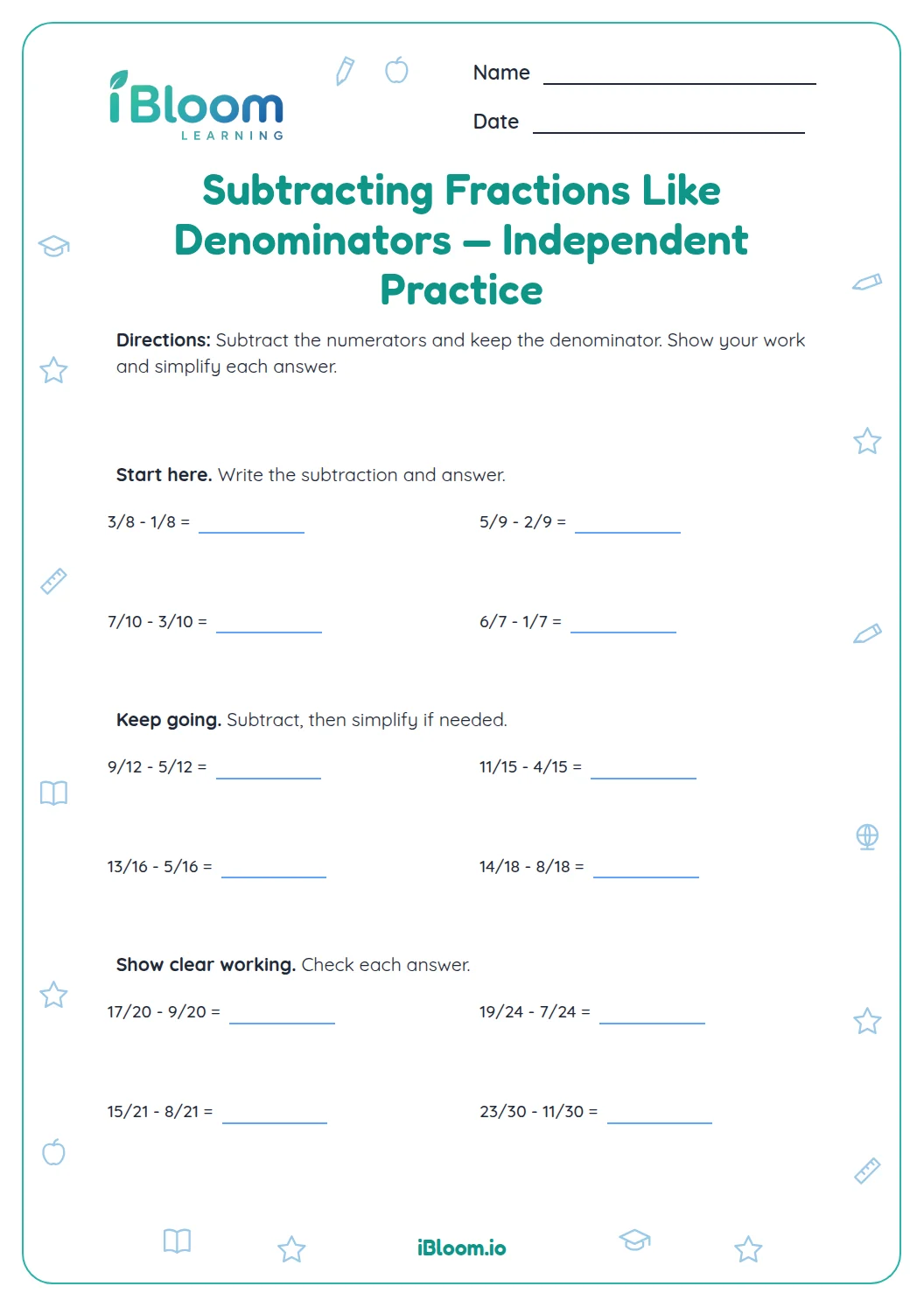
The problems use like denominators such as eighths, sixths, tenths, and twelfths. Each subtraction keeps the same-sized parts, and some answers can be simplified. Read the measurement unit in each story and include it in the result. The answer key also shows simplified equivalents where useful.
Are mixed numbers included?
Yes. The second part includes mixed amounts such as 1 5/8 yards and 2 7/10 liters. Students subtract the fractional parts and retain the units from the stories. They can check that each result is less than its starting amount.
Should students simplify answers?
Simplifying makes an equivalent fraction easier to read. For example, 4/8 yard is the same amount as 1/2 yard, so the key uses the simpler form when appropriate. The value stays the same even when the numerator and denominator change.
Why does the answer need a unit?
The unit tells what the answer measures, such as yards of string, liters of lemonade, or miles of a trail. Keep it with the fraction so the result is clear. A quick check also confirms that the amount left is smaller than the starting amount.
Is there an answer key?
Yes. The key gives the remaining amount and its unit for all 14 questions. Students can check both the subtraction and whether the answer is smaller than the starting quantity. Some answers are written in simplified form. The key is organized in question order for checking.