





About this worksheet
This Grade 5 printable begins with four familiar stories about ribbon, biking, flour, and savings, then gives ten compact mixed-number subtraction equations. Learners find common denominators, regroup when needed, simplify, and label story answers with units. The practice applies CCSS 5.NF.A.1.
Aligned to 5.NF.A.1
How do you subtract unlike fractional parts?
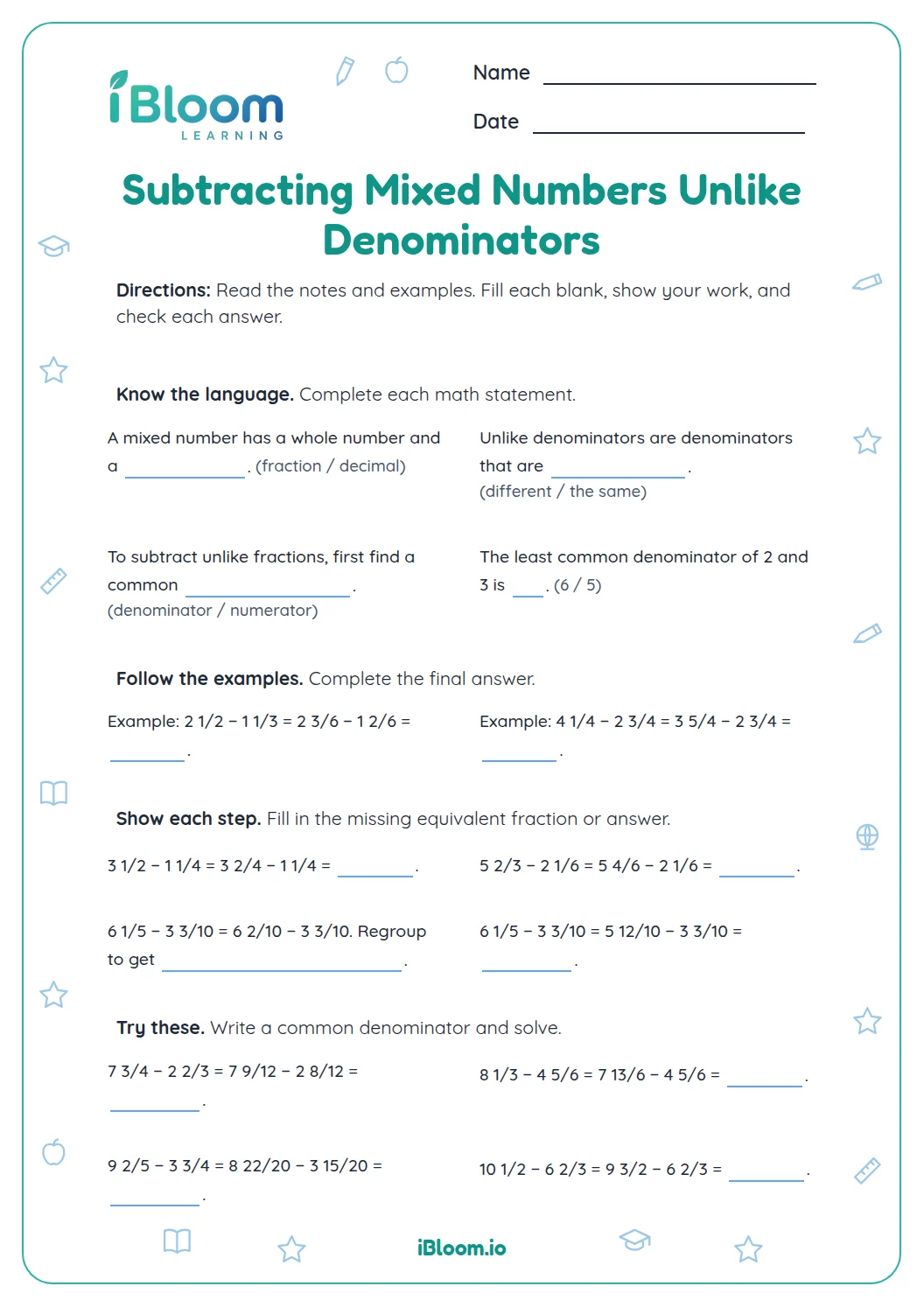
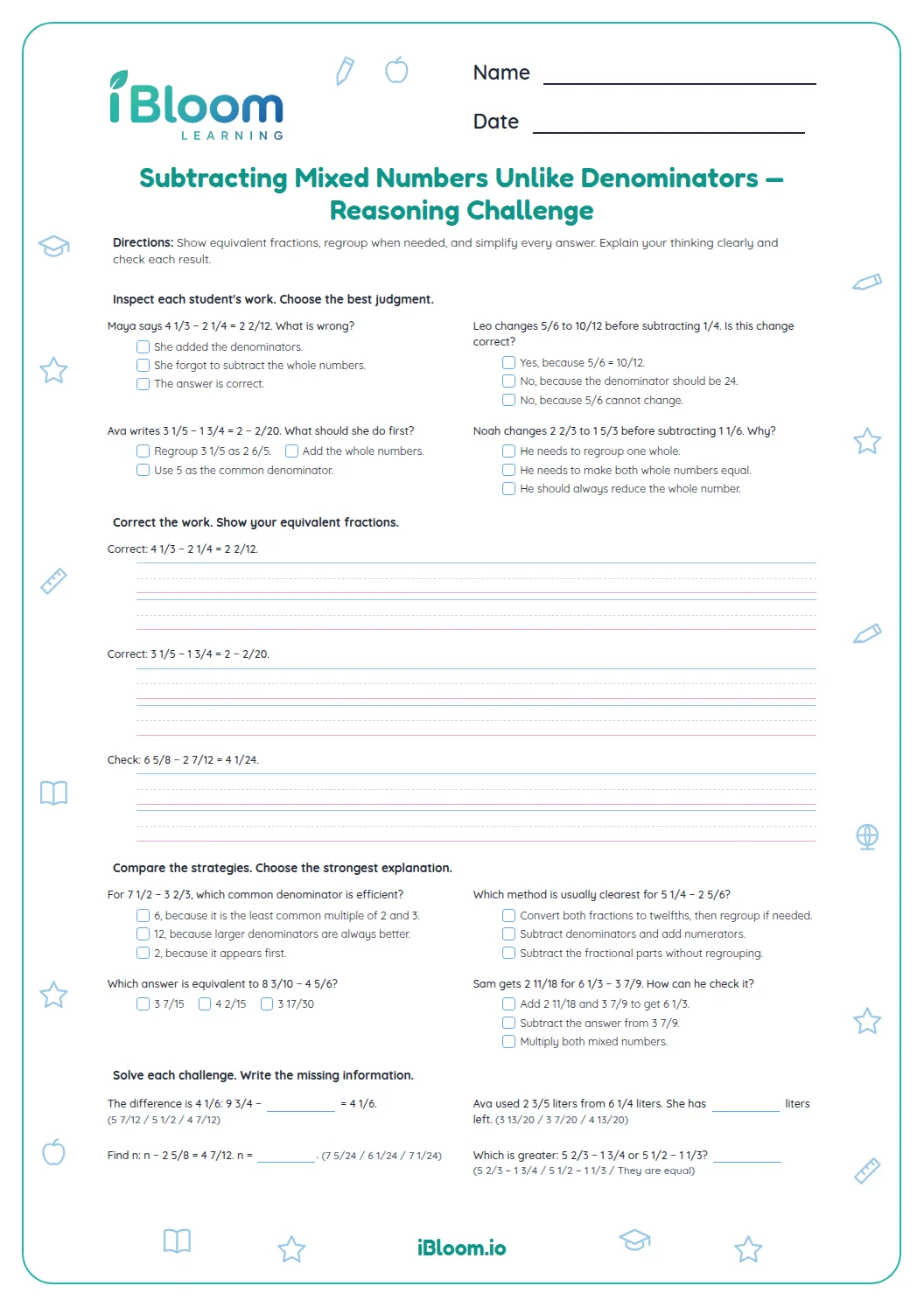
The fractional parts must name equal-sized pieces. Find a common denominator, rewrite both fractions, and subtract the whole numbers and fractional parts. If the top fraction is too small, regroup one whole as a fraction.
Question 1 uses 5 1/2 − 2 1/3. Sixth parts work because 1/2 = 3/6 and 1/3 = 2/6, so the difference is 3 1/6.
- 15 1/2 − 2 1/3
- 25 3/6 − 2 2/6
- 3(5 − 2) + (3/6 − 2/6) = 3 1/6
- 4The ribbon has 3 1/6 yd left.
What situations does the sheet use?
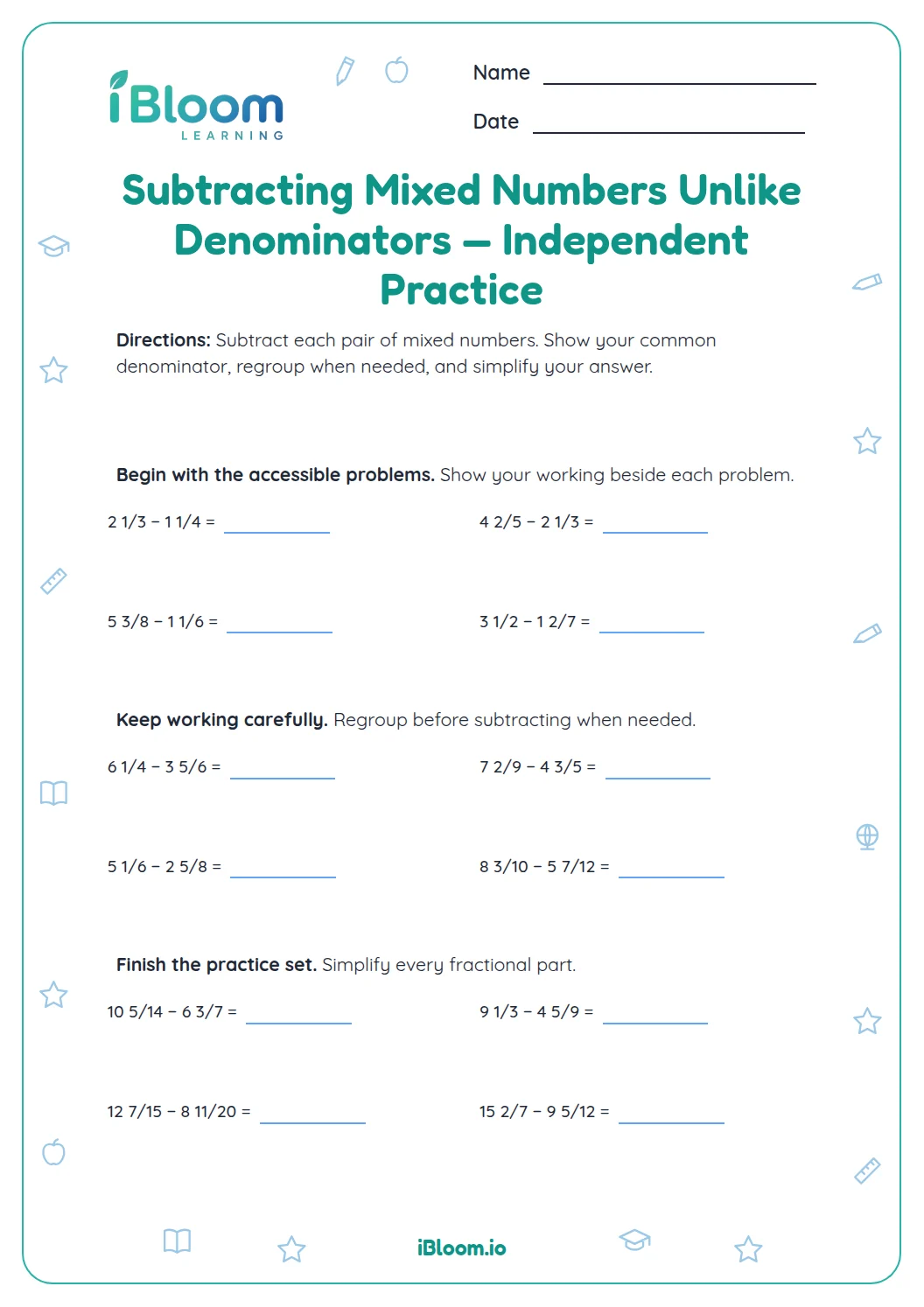
The first four prompts use ribbon, biking, flour, and savings situations. Ten short equations then keep attention on mixed-number subtraction and common denominators. Answers can be checked with the separate key.
- Part A uses four familiar measurement and savings stories.
- Part B practices mixed-number subtraction in compact equations.
- Part C continues with unlike denominators and regrouping.
When should a learner regroup?
Regroup when the fractional amount being subtracted is greater than the starting fractional amount. For instance, in 4 3/4 − 1 7/8, rename 4 3/4 as 3 14/8. Then subtract 1 7/8 to get 2 7/8. Keep the whole that was renamed in the calculation.
How to use this worksheet
- 1Read the unit and identify the starting amount and the amount used.
- 2Write a subtraction sentence using the two mixed numbers.
- 3Find a common denominator for the fractional parts.
- 4Regroup one whole when the fraction being subtracted is larger.
- 5Subtract, simplify, and label the answer with its unit.
- 6Check that the remainder is less than the starting amount.
Common mistakes and quick fixes
The mistake
Subtract numerators before making denominators alike.
The fix
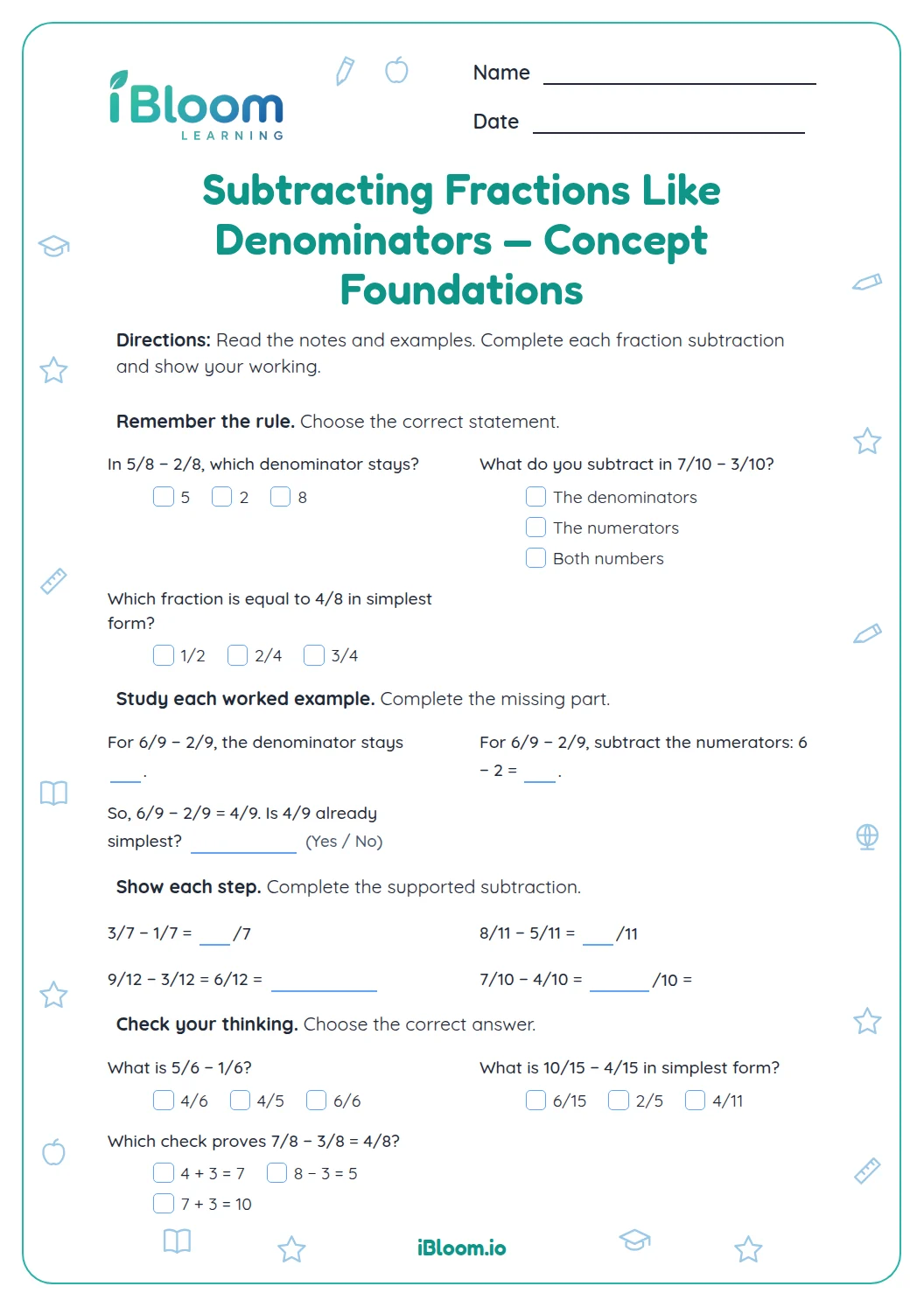
Rewrite both fractions using a common denominator, then subtract the equivalent numerators.
The mistake
Regroup without reducing the whole number.
The fix
Change one whole into the denominator’s number of parts before subtracting.
The mistake
Leave an unsimplified or unitless result.
The fix
Reduce the fraction when possible and copy the unit from the question.
Common Core alignment
This worksheet gives focused practice with the standard below.
Find equivalent fractions to add or subtract fractions with unlike denominators.
On this sheet: The problems subtract mixed numbers with unlike denominators and simplify the remaining amount.
Show the official wordingHide the official wording
Add and subtract fractions with unlike denominators (including mixed numbers) by replacing given fractions with equivalent fractions in such a way as to produce an equivalent sum or difference of fractions with like denominators. For example, 2/3 + 5/4 = 8/12 + 15/12 = 23/12. (In general, a/b + c/d = (ad + bc)/bd.)
What to practice next
Make more practice
Further reading
Questions parents and teachers ask
Why must the denominators match?
A common denominator gives both fractional parts the same-sized pieces. For example, halves and fourths can be renamed as fourths before subtracting. Once the pieces match, subtract their numerators and then simplify the remaining mixed number. Write the regrouping and equivalent-fraction steps in the margin before recording the final result.
When is regrouping needed?
Regroup when the fraction being subtracted is larger than the starting fractional part. Rename one whole as a fraction with the common denominator, subtract the fractions, and then subtract the whole-number parts. Several items can be solved without regrouping. Write the regrouping and equivalent-fraction steps in the margin before recording the final result.
How should units appear in answers?
Copy the measurement unit from the story to the answer, such as yards, liters, miles, or cups. The unit identifies what quantity remains after the subtraction. For a money question, include the dollar sign with the amount. Write the regrouping and equivalent-fraction steps in the margin before recording the final result.
What does question 1 show?
Question 1 uses Maya’s ribbon: 5 1/2 yd − 2 3/4 yd. Rename 1/2 as 2/4, regroup one whole, and subtract to find 2 3/4 yd left. The answer line is compact, so show any scratch work beside the sheet. Write the regrouping and equivalent-fraction steps in the margin before recording the final result.
How many questions are on this sheet?
The worksheet has 16 story questions about measurements, recipes, savings, and travel. The first eight keep characters and situations from the earlier sheet; the later items give more practice subtracting mixed numbers with unlike denominators. Write the regrouping and equivalent-fraction steps in the margin before recording the final result.
Is an answer key included?
Yes. The printable includes a separate answer key with a result for each question. Use it after solving to check the subtraction, simplification, and unit. If an answer differs, compare the equivalent fractions and regrouping step. Write the regrouping and equivalent-fraction steps in the margin before recording the final result.