

About this worksheet
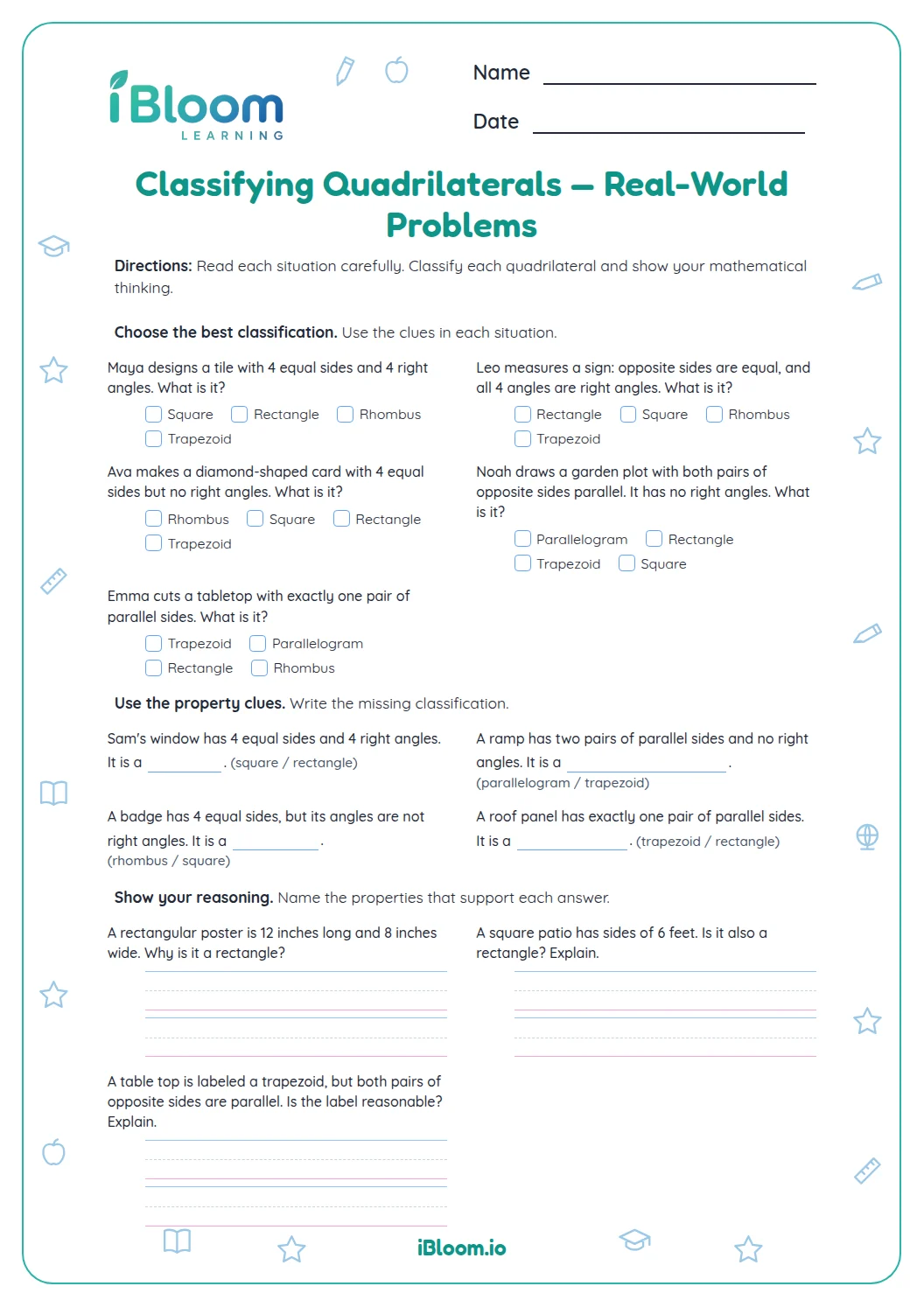
This Grade 5 geometry worksheet presents five labeled quadrilaterals and asks learners to classify them using their attributes. Follow-up questions review side counts, right angles, equal sides, and parallel sides, then ask how categories overlap. It includes 14 questions and a separate answer key. The property reasoning supports CCSS.Math.Content.5.G.B.3.
Aligned to CCSS.Math.Content.5.G.B.3
What properties are practiced?
The opening drawing labels five quadrilaterals, and question 1 asks learners to name shape A. The remaining 13 multiple-choice items use side count, equal side lengths, right angles, parallel sides, and category membership.
How do the main quadrilateral names differ?
A rectangle has four right angles. A rhombus has four equal sides. A square has both sets of properties, so it is both a rectangle and a rhombus. A parallelogram has two pairs of parallel opposite sides; the trapezoid convention here is exactly one pair.
Why can one shape have two names?
Classification depends on properties, and a shape can meet more than one definition.
- 1Can a square also be called a rhombus?
- 2A rhombus has four equal sides.
- 3A square has four equal sides, so yes: it is a rhombus too.
How do shape categories connect?
When one category has all the attributes of another, it can belong to that larger family too. Checking each defining property is more reliable than judging a shape by how it looks or by its orientation.
How to use this worksheet
- 1Count the sides to confirm a quadrilateral has four.
- 2Check for right angles and equal side lengths.
- 3Look for one or two pairs of parallel sides.
- 4For “always true,” choose a property required by the definition.
- 5Explain category overlap by naming the shared property.
Common mistakes and quick fixes
The mistake
Assuming a square is not a rectangle
The fix
A square has four right angles, so it meets the rectangle definition.
The mistake
Using appearance instead of properties
The fix
Check the stated sides and angles; a turned shape keeps the same attributes.
The mistake
Mixing up one and two pairs of parallel sides
The fix
Trace both opposite side pairs: parallelograms have two; this sheet’s trapezoids have exactly one.
These activities connect the practice to the listed learning goals.
Carry a shape category’s attributes into its subcategories.
On this sheet: Students classify drawn quadrilaterals and use shared properties to reason about subcategories.
Show the official wordingHide the official wording
Understand that attributes belonging to a category of two-dimensional figures also belong to all subcategories of that category. For example, all rectangles have four right angles and squares are rectangles, so all squares have four right angles.
What to practice next
Make more practice
Further reading
Questions parents and teachers ask
How many sides does a quadrilateral have?
A quadrilateral has four sides. That is the first check in Part A before learners use more specific properties to name a square, rectangle, parallelogram, trapezoid, or rhombus. The side count narrows the choices first; properties then distinguish the specific shape names.
Can a square belong to more than one category?
Yes. A square has four equal sides, so it is a rhombus, and it has four right angles, so it is a rectangle. The worksheet asks children to use those defining properties to support the classification. Squares meet both definitions because they combine four equal sides with four right angles.
What does “parallel” mean in these questions?
Parallel sides stay the same distance apart and do not meet, even if extended. A parallelogram has two pairs of parallel opposite sides. The trapezoid drawings and questions use exactly one pair. A pair of lines is parallel when the gap between them stays constant and they never meet.
What does the shape drawing show?
The drawing labels five quadrilaterals, and question 1 asks learners to name shape A. The other 13 questions use written property descriptions and category relationships. The labels make the first classification task concrete before the worksheet turns to the defining properties of the shape families.
How many questions are on this page?
There are 14 questions: one visual identification and 13 multiple-choice items. The questions review side counts, equal sides, right angles, parallel sides, and how square, rectangle, and rhombus categories overlap. A separate two-page answer key marks the expected response for each question.