


About this worksheet
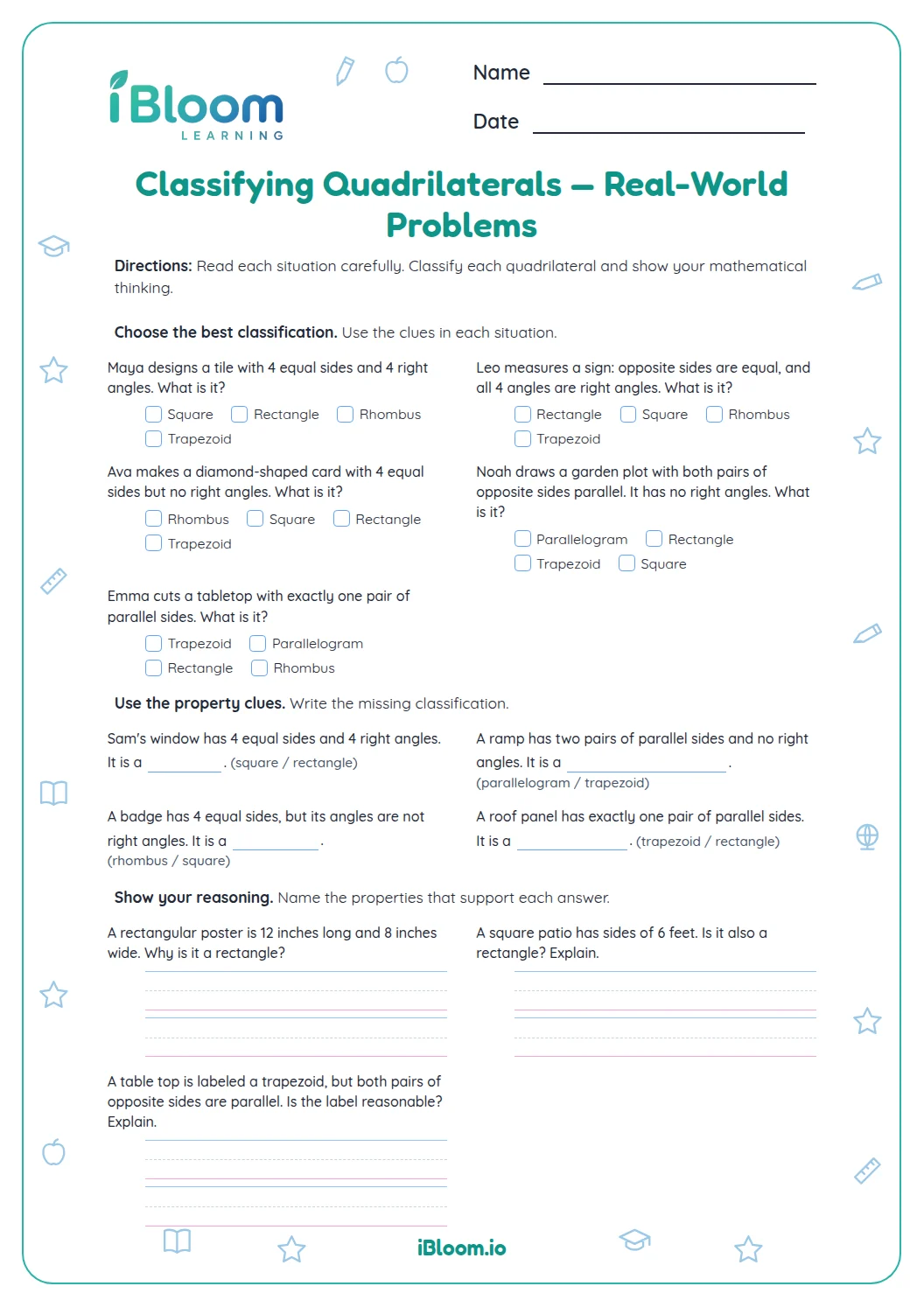
This free printable classifying quadrilaterals worksheet is for Grade 5 learners. It focuses on classify quadrilaterals by parallel sides, equal sides, right angles, and category relationships and includes 15 original practice questions across 2 parts, plus a separate answer key. Each question presents one marked quadrilateral and asks for a defining property or category relationship. The sheet progresses across parallelograms, trapezoids, rhombi, squares, and kites. It aligns with 5.G.B.3.
Aligned to 5.G.B.3 and 5.G.B.4
How can a learner work through classifying quadrilaterals?
The questions focus on trapezoids, parallelograms, rhombi, squares, rectangles, and kites. Learners read marked figures, identify defining properties, and consider how categories overlap.
A square has four right angles and four equal sides. It is also a rectangle (four right angles) and a rhombus (four equal sides), so it belongs to both categories.
- 1Check the marks on the shape.
- 2Match each mark to its property.
- 3A square fits both rectangle and rhombus categories.
What will the worksheet ask the learner to do?
The sheet has 15 questions in 3 parts: read marked figures, identify properties, and connect quadrilateral categories. The answer key lists each choice and gives sample explanations.
How can an adult support this practice?
Read the direction for each part, then ask the learner to explain one choice or calculation. Use the answer key to discuss the method as well as the final answer.
How to use this worksheet
- 1Count the sides to confirm the figure is a quadrilateral.
- 2Read the side and angle marks.
- 3Identify only properties guaranteed by the marks or category.
- 4Use category relationships to check whether a shape belongs to a larger group.
- 5Check each answer against the key.
Common mistakes and quick fixes
The mistake
Calling every four-sided shape a parallelogram.
The fix
Check for two pairs of parallel sides; a trapezoid has exactly one pair.
The mistake
Assuming a rectangle must have four equal sides.
The fix
A rectangle guarantees four right angles; equal side lengths are not required.
The mistake
Treating a square as outside the rectangle category.
The fix
A square has four right angles, so it also fits the rectangle category.
Standards alignment
This page connects the worksheet practice to the standards listed below.
Use properties shared by a figure category and its subcategories, such as squares within rectangles.
On this sheet: Learners identify properties of quadrilaterals and apply category relationships.
Show the official wordingHide the official wording
Understand that attributes belonging to a category of two-dimensional figures also belong to all subcategories of that category. For example, all rectangles have four right angles and squares are rectangles, so all squares have four right angles.
Classify two-dimensional figures in a hierarchy based on their properties.
On this sheet: Questions sort quadrilaterals by the properties that define related categories.
Show the official wordingHide the official wording
Classify two-dimensional figures in a hierarchy based on properties.
What to practice next
Further reading
Questions parents and teachers ask
What makes a quadrilateral a parallelogram?
A parallelogram has two pairs of parallel sides. The worksheet asks learners to connect this property with related categories, including rectangles, rhombi, and squares. Learners can use the side and angle marks to check each choice and explain which defining property supports the classification.
Can a square also be a rectangle and a rhombus?
Yes. A square has four right angles, so it meets the rectangle property, and it has four equal sides, so it meets the rhombus property. The categories can overlap. Learners can use the side and angle marks to check each choice and explain which defining property supports the classification.
How should a learner use the marks?
Side ticks show equal lengths, parallel arrows identify parallel sides, and corner squares mark right angles. Read those marks before choosing a property; the appearance alone can be misleading. Learners can use the side and angle marks to check each choice and explain which defining property supports the classification.
Why distinguish a trapezoid from a parallelogram?
In this worksheet a trapezoid is drawn with exactly one pair of parallel sides, while a parallelogram has two. Counting pairs avoids treating every slanted quadrilateral as the same type. Learners can use the side and angle marks to check each choice and explain which defining property supports the classification.
Does the worksheet include an answer key?
Yes. The separate answer key lists the correct choice for each of the 15 questions and gives sample explanations for the written reasoning. Review the defining property named in any missed answer, then compare it with the other quadrilateral categories.