


About this worksheet
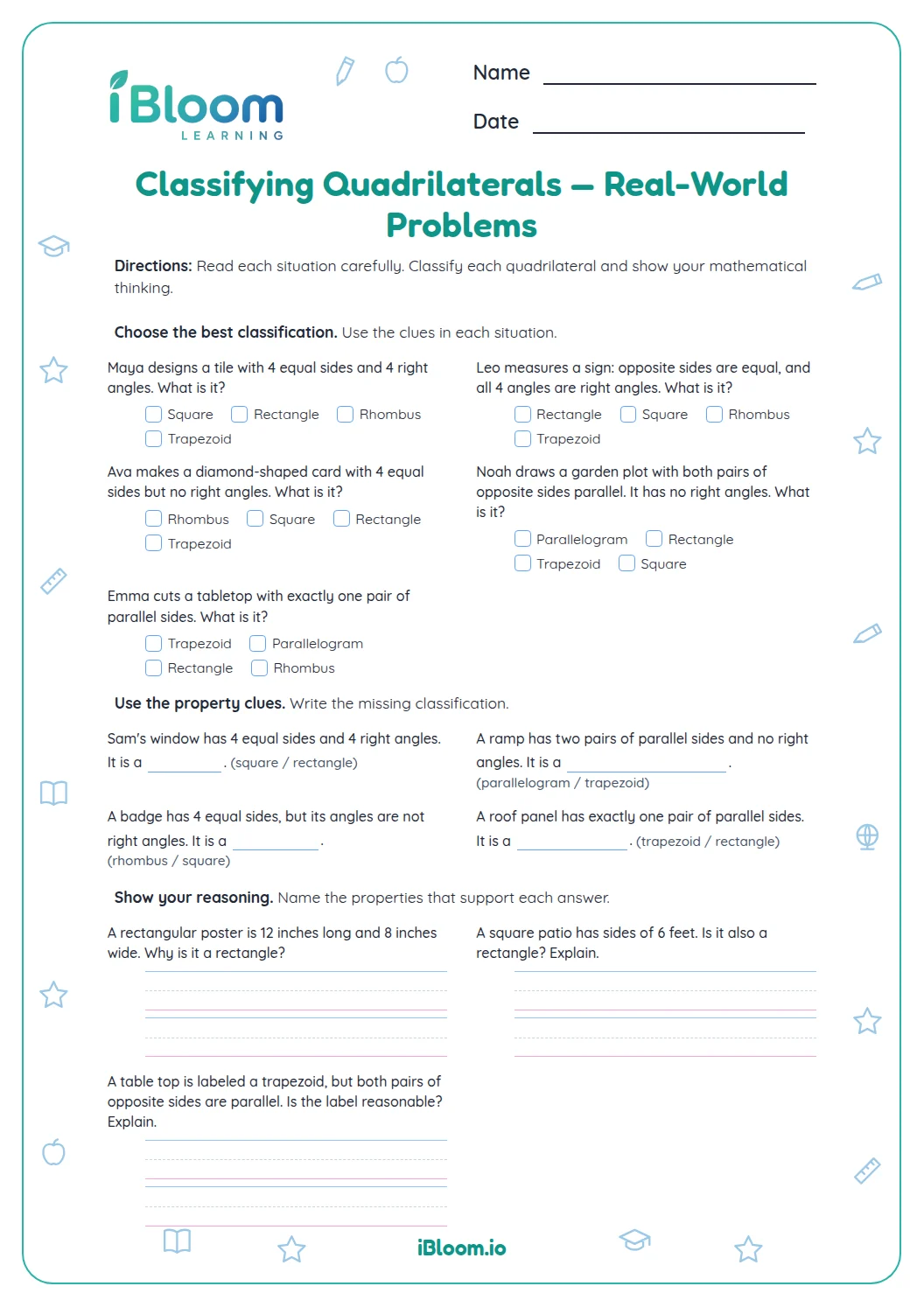
This Grade 5 printable guides learners through 14 questions about quadrilateral properties and family relationships. They identify squares, rectangles, rhombuses, parallelograms, and trapezoids using equal sides, right angles, and parallel pairs. A short property legend supports the classifications. It practices CCSS 5.G.B.3.
Aligned to 5.G.B.3
What do the marks tell you?
The brief legend defines common geometry marks: matching ticks mean equal sides, matching arrows mean parallel sides, and a small square marks a right angle. The questions then state properties in words, so learners can focus on the family relationships.
- 1Look for four right-angle marks.
- 2Check that adjacent side lengths are unequal.
- 3The figure is a rectangle and not a square.
How can a figure belong to two families?
A square has four right angles, so it is a rectangle. It also has four equal sides, so it is a rhombus. These are not competing names: one describes its right angles and another its equal sides.
This worksheet uses the common school definition that a trapezoid has exactly one pair of parallel sides.
What will learners practice?
All 14 items are short choices about side and angle properties, including the relationship between squares, rectangles, rhombuses, and parallelograms. A final question asks which property shows that every square is a rectangle.
- Part A identifies figures from concise property descriptions.
- Part B applies quadrilateral family relationships.
How to use this worksheet
- 1Read the prompt and find the matching figure or property.
- 2Use each set of matching ticks and arrows as a clue.
- 3Check for right angles before choosing rectangle or square.
- 4Remember a square is also a rectangle and a rhombus.
- 5Choose the classification that fits every stated property.
- 6Write one property in each final response.
Common mistakes and quick fixes
The mistake
Naming a shape from its appearance alone.
The fix
Use the marks and stated properties; drawings are not always to scale.
The mistake
Thinking a square cannot be a rectangle or rhombus.
The fix
Check the definitions: a square has both four right angles and four equal sides.
The mistake
Calling any quadrilateral with a parallel pair a trapezoid here.
The fix
This worksheet defines a trapezoid as having exactly one pair of parallel sides.
Common Core alignment
This worksheet gives focused practice with the standard below.
Use a figure’s properties to classify it and its subcategories.
On this sheet: The questions classify quadrilaterals by shared and inherited properties.
Show the official wordingHide the official wording
Understand that attributes belonging to a category of two-dimensional figures also belong to all subcategories of that category. For example, all rectangles have four right angles and squares are rectangles, so all squares have four right angles.
What to practice next
Make more practice
Further reading
Questions parents and teachers ask
Do the marks give away each classification?
No marks appear beside the questions. Instead, each prompt names properties such as equal sides, right angles, or parallel pairs, and learners connect those clues to a family. For instance, four right angles and unequal adjacent sides identify a rectangle. Use the definitions stated in the choices.
Can a square have more than one name?
Yes. A square has four right angles, so it is a rectangle, and four equal sides, so it is a rhombus. A figure can belong to several families when it has all of their required properties. Use the figure’s defining properties, rather than its orientation or apparent size, to choose.
Which trapezoid definition is used?
The sheet defines a trapezoid as a quadrilateral with exactly one pair of parallel sides. Use that definition consistently when choosing among the answer options, since some textbooks use a broader definition. Use the figure’s defining properties, rather than its orientation or apparent size, to choose.
What property proves a square is a rectangle?
A square has four right angles, which is the defining angle property of a rectangle. Its four equal sides add another property, so it is also a rhombus. Use the figure’s defining properties, rather than its orientation or apparent size, to choose.
How many questions are on this sheet?
The sheet has 14 multiple-choice questions about quadrilateral properties and family relationships. The short legend explains the tick, arrow, and right-angle symbols used in geometry lessons; the prompts describe those properties in words so the page stands alone. in this two-page printable.
Is an answer key included?
Yes. A separate answer key gives the correct letter or property for each item and a sample response for the written question. The sample is one valid explanation; other statements that correctly identify the required property also work. Use the figure’s defining properties, rather than its orientation or apparent size, to choose.