


About this worksheet
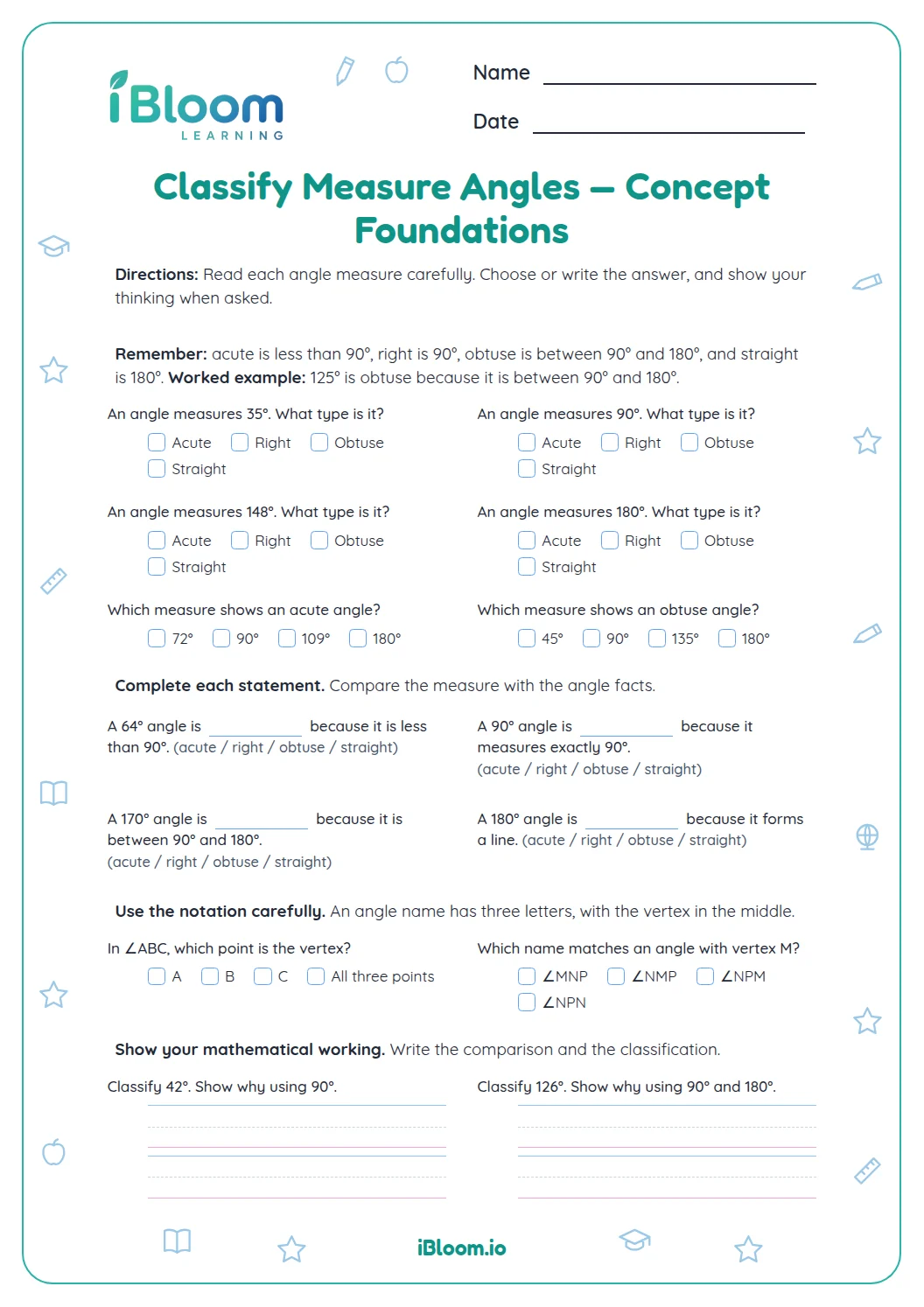
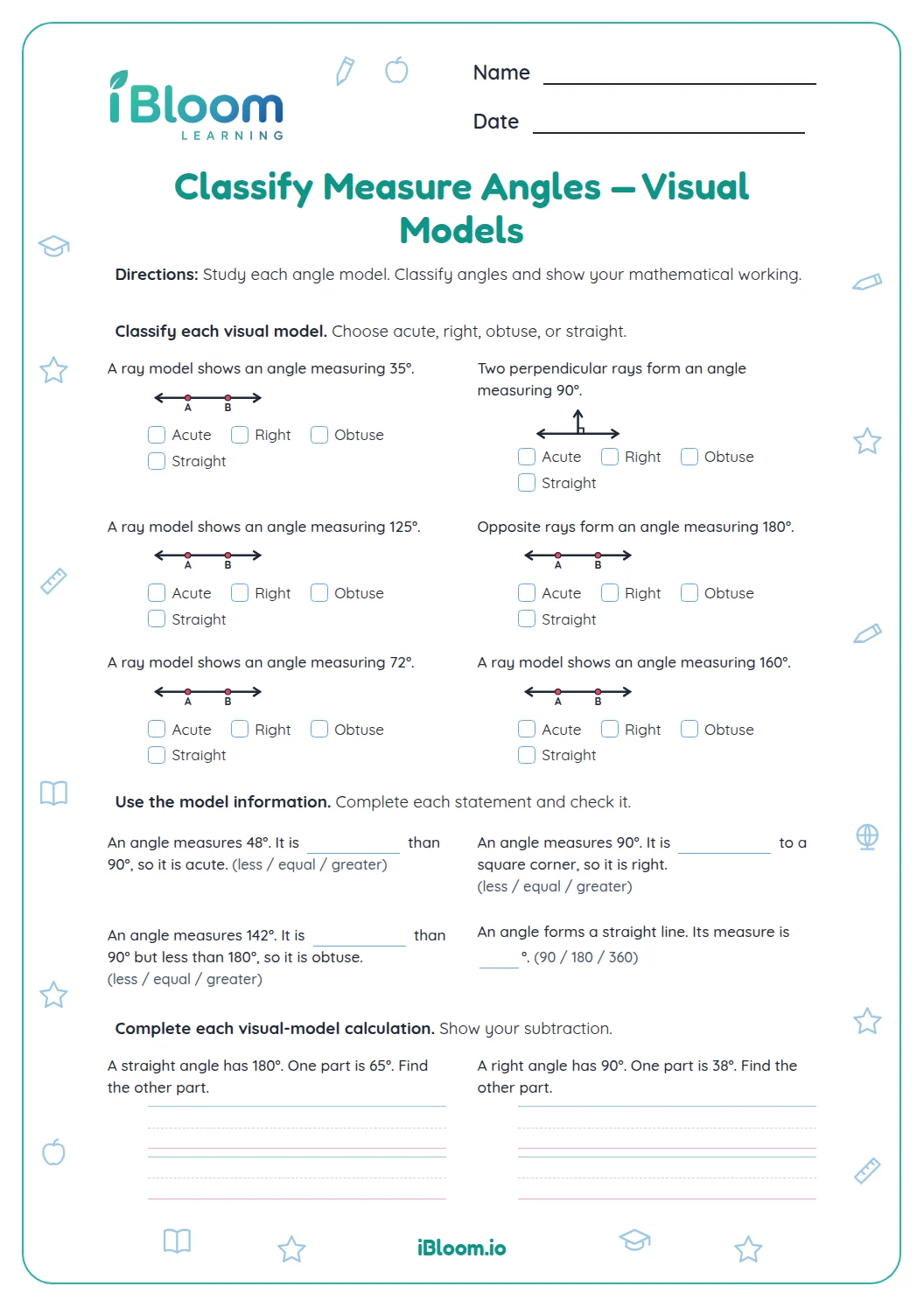
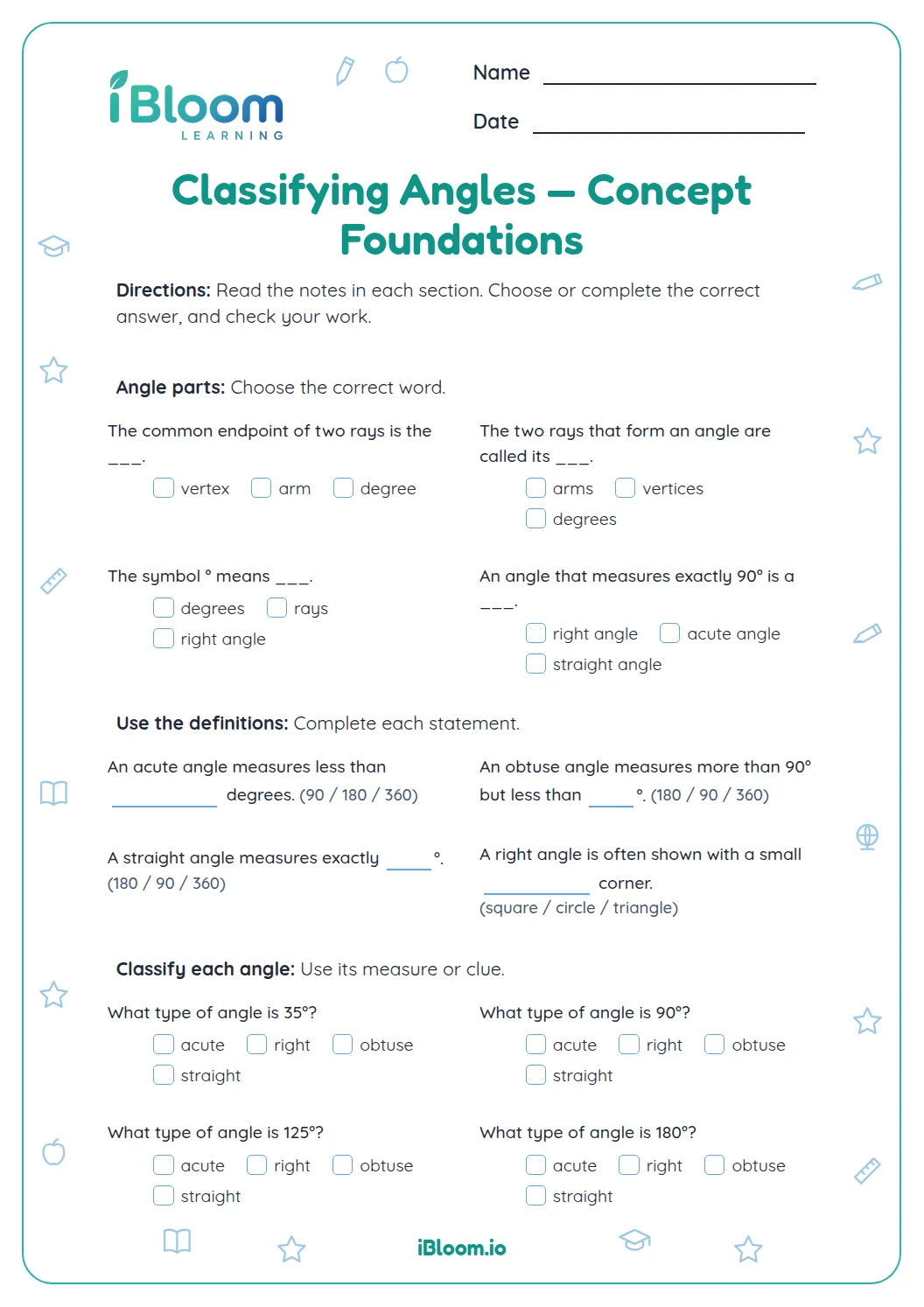
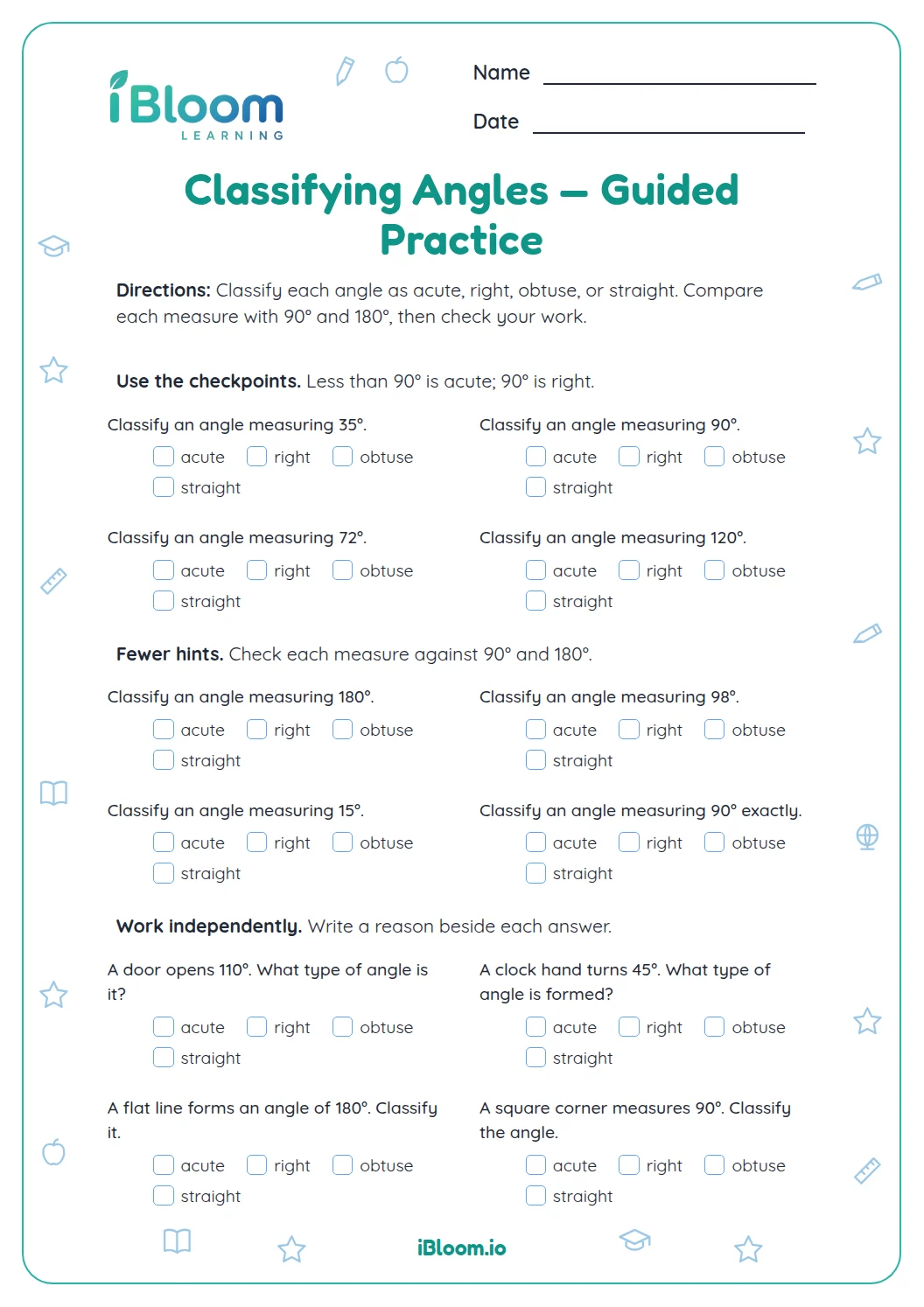
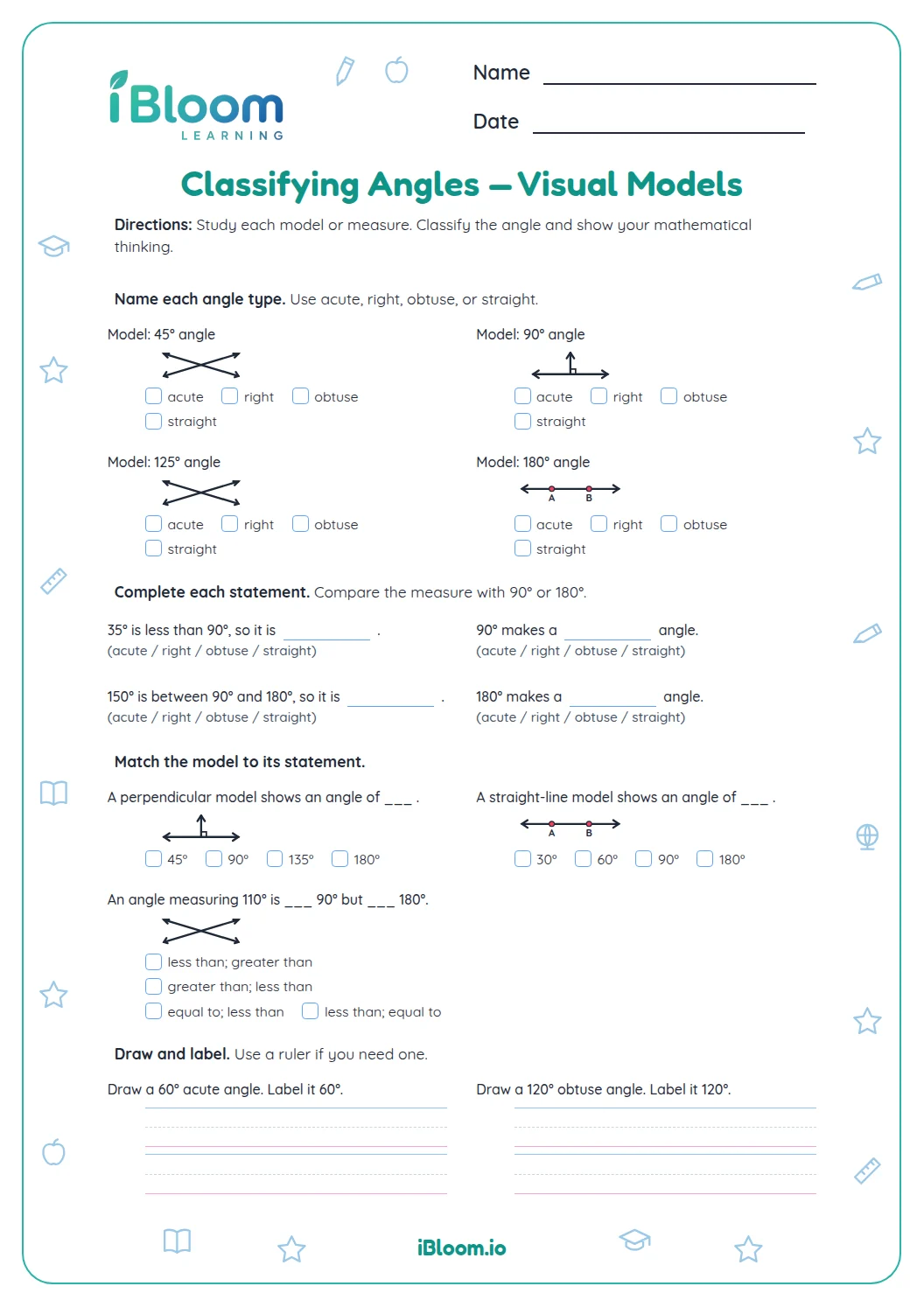
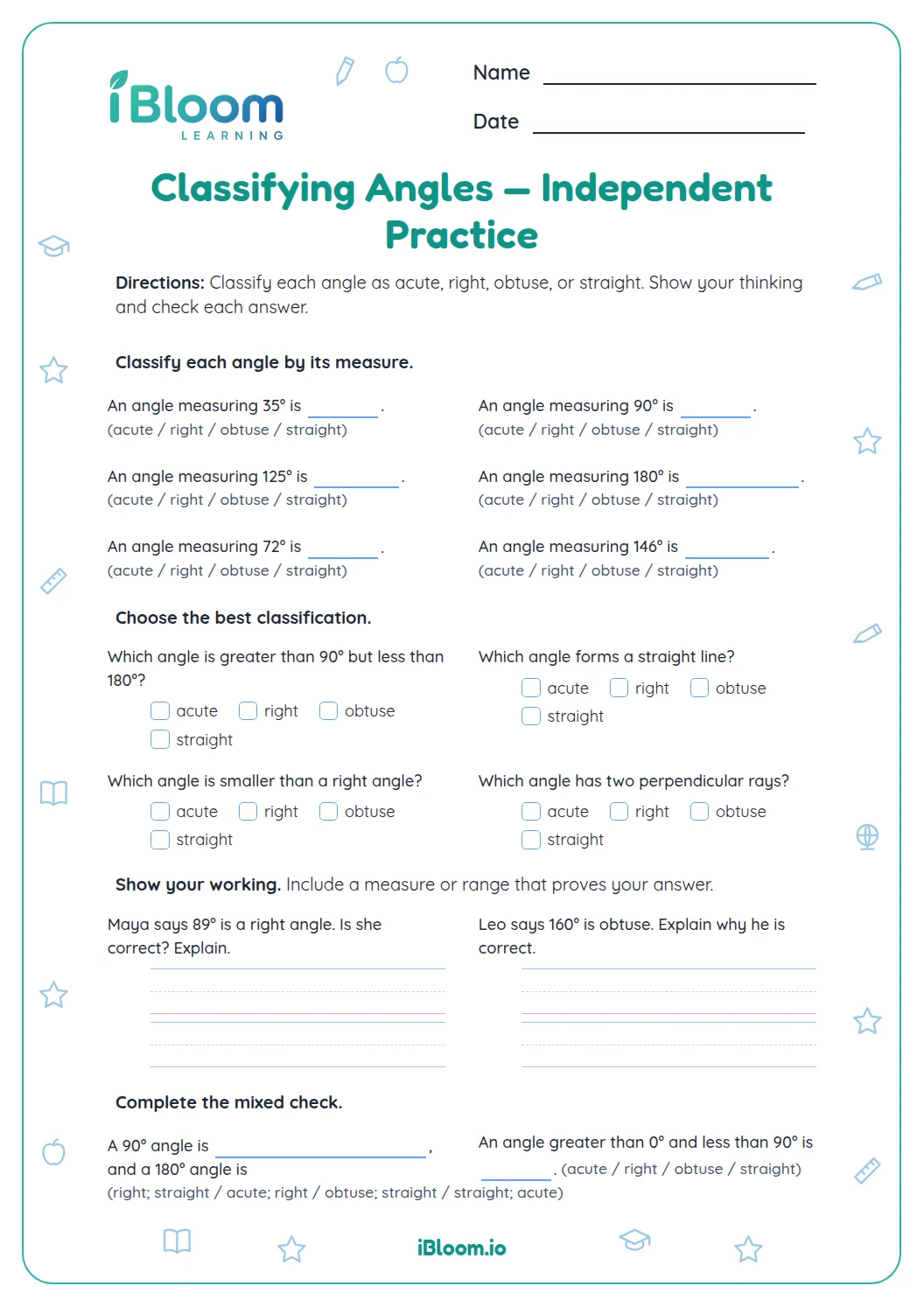
This free two-page worksheet gives Grade 5 students guided practice classifying and measuring angles. Students decide whether a measure is acute, right, or obtuse, then read the degree labels represented by drawn angle models. The two question types connect benchmark measures to angle names and practice CCSS 4.MD.C.5. A separate answer key gives all 16 responses.
Aligned to 4.MD.C.5
How do you classify an angle by its measure?
Compare the degree measure with 90° and 180°. A 35° angle is less than 90°, so it is acute. A 90° angle is right, and a measure greater than 90° but less than 180° is obtuse.
The first twelve questions name the measure and ask for the angle type. This lets students practice the classification rule before reading the drawn models.
- 135° < 90°
- 2So a 35° angle is acute.
How can you read a drawn angle model?
An angle is formed by two rays with a shared endpoint. Look at the opening between the rays, then identify its degree measure. The last four questions show angle drawings with their measures represented in the model.
For example, the model in question 14 is a right angle, which measures 90°. Naming the measure links the visual opening to the degree value.
What is included in the guided practice?
The 16 questions are organized in two parts across two worksheet pages. Part A classifies twelve stated angle measures; Part B asks students to read four drawn angle models. The separate answer key lists the classifications and measures.
Students can check that acute measures are below 90° and obtuse measures fall between 90° and 180°. A 180° straight angle is a useful upper benchmark, even though this page focuses on acute, right, and obtuse examples.
A routine for classifying and measuring
- 1Find the degree measure stated in the question or represented by the drawn angle.
- 2Compare it with 90° to decide whether it is acute, right, or wider than a right angle.
- 3For an obtuse angle, check that it is still less than 180°.
- 4Use the ray opening in a drawn model to read its measure.
- 5Write the classification word or degree measure requested.
- 6Check each answer with the key and revisit any benchmark comparison that was uncertain.
Angle errors to catch
The mistake
Calling 90° acute because it is not obtuse.
The fix
A 90° angle is exactly right; acute angles are less than 90°.
The mistake
Calling a 128° angle straight.
The fix
Straight is 180°; 128° is between 90° and 180°, so it is obtuse.
The mistake
Reading the angle’s label as its measure.
The fix
Use the opening represented by the rays and report its degree measure.
Common Core alignment
The questions connect the angle shape formed by rays with the concept of measuring its opening.
Recognize that two rays sharing an endpoint form an angle with a measurable opening.
On this sheet: Students classify measures and read the measure represented by angle models.
Show the official wordingHide the official wording
Recognize angles as geometric shapes that are formed wherever two rays share a common endpoint, and understand concepts of angle measurement.
What to practice next
Make more practice
Further reading
Questions parents and teachers ask
What is an acute angle?
An acute angle measures less than 90°. For example, question 1 gives 35°, so students classify it as acute. The worksheet also includes right angles at 90° and obtuse angles between 90° and 180°. The classification questions use degree values so the benchmark comparison is explicit.
What is the difference between a right and an obtuse angle?
A right angle measures exactly 90°. An obtuse angle is wider than a right angle but smaller than a straight angle, so its measure is greater than 90° and less than 180°. Compare the given degree measure with both benchmarks.
How many questions are on this angle worksheet?
There are 16 questions in two parts across two worksheet pages. Twelve questions ask students to classify a stated degree measure, and four ask them to read a measure from a drawn angle model. The answer key is a separate page.
Do students use a protractor on the worksheet?
The drawn angle items ask students to read the degree measure represented by each model; the page does not provide a printed protractor. Students practice connecting the angle opening with its measure and can use the answer key to check.
Does the worksheet have an answer key?
Yes. A separate answer-key page lists each classification and the degree measure for every model. Students can review whether their answer fits the benchmark: acute below 90°, right at 90°, and obtuse between 90° and 180°. Each model has a degree value represented in the drawing.
Which standard is practiced?
The worksheet practices CCSS 4.MD.C.5, recognizing angles and understanding angle measurement. Students classify examples by measure and read the degree values represented by angle drawings. The standard describes the angle shape and the idea of measuring its opening. Students use both ideas here.