



About this worksheet
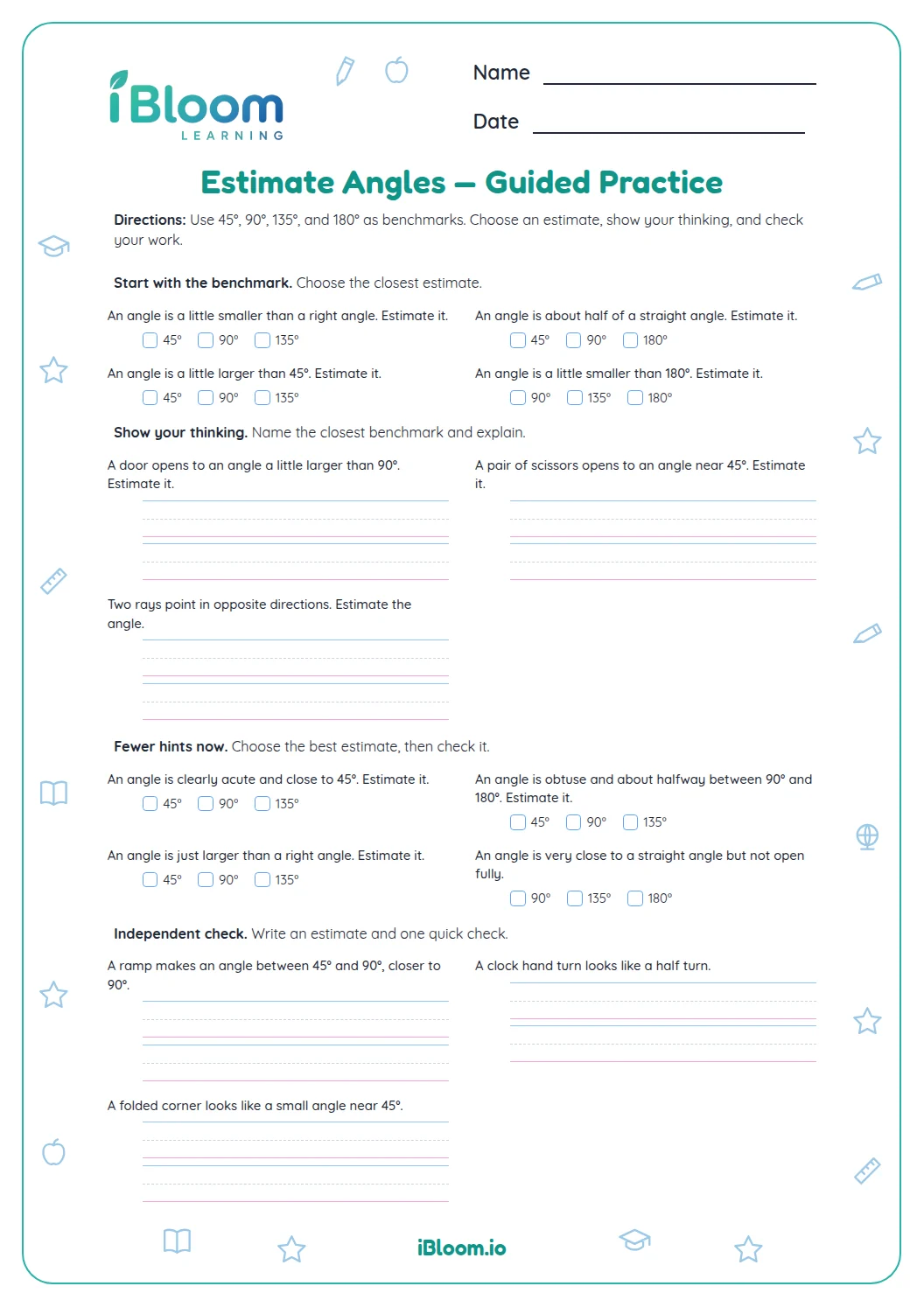
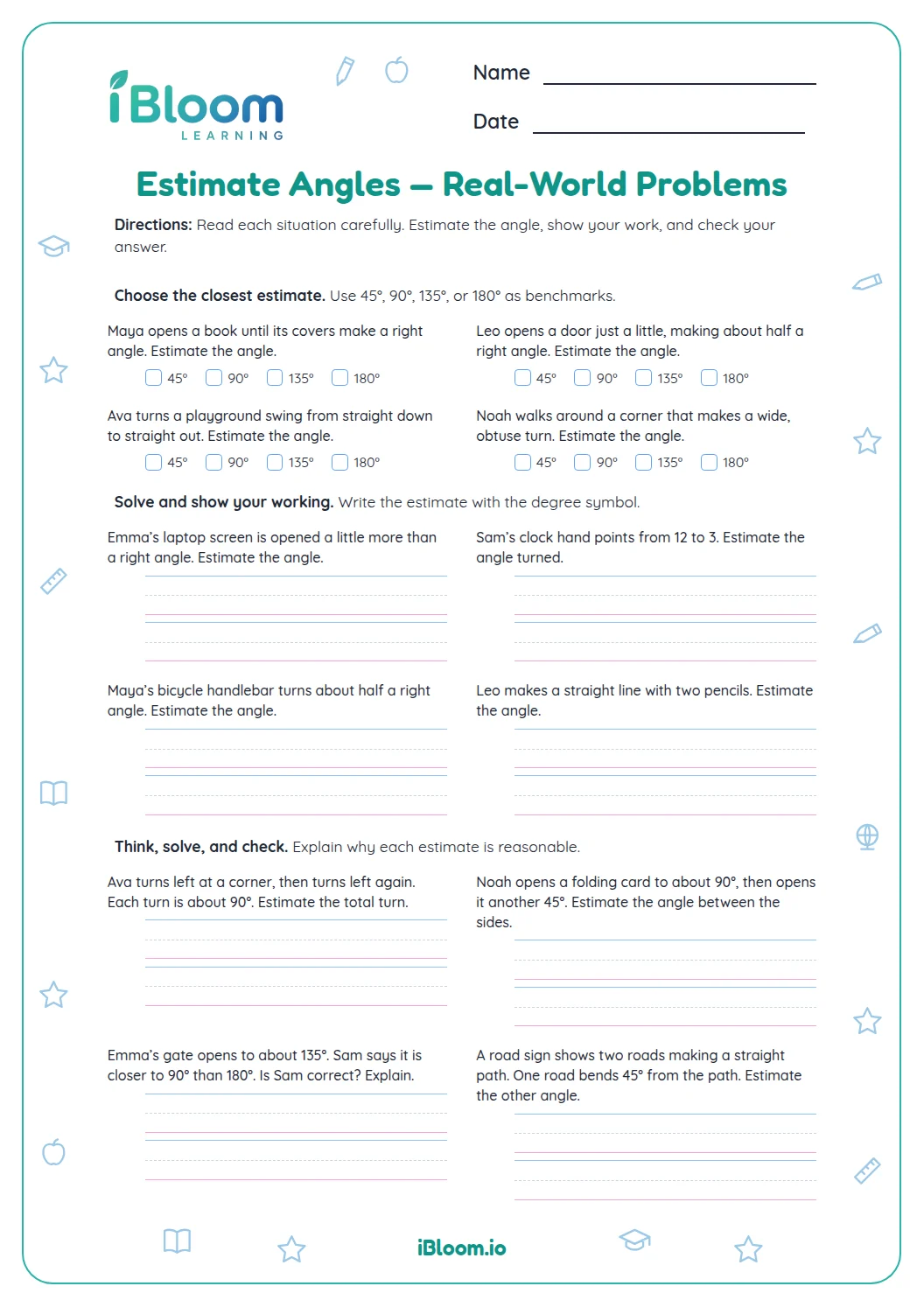
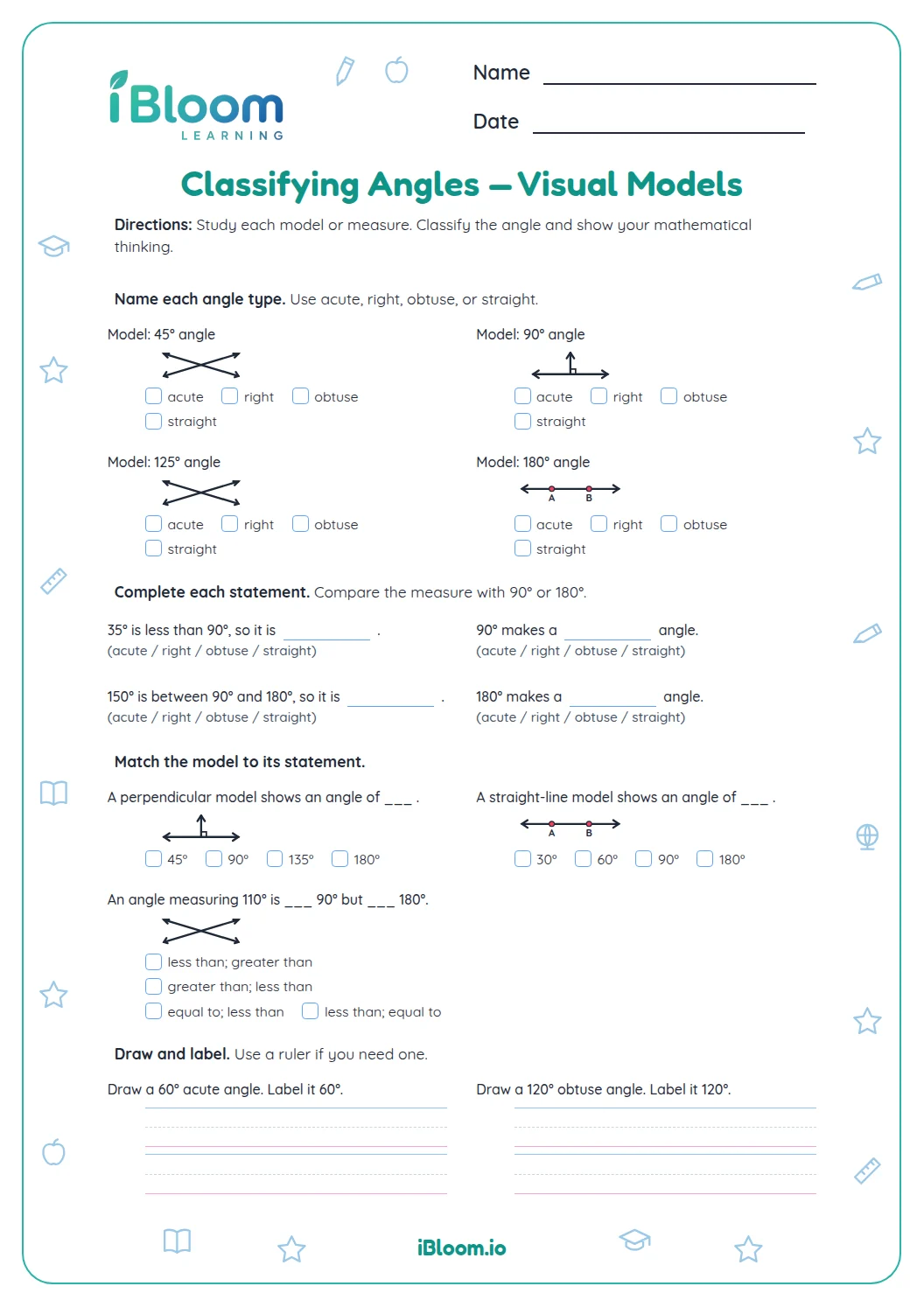
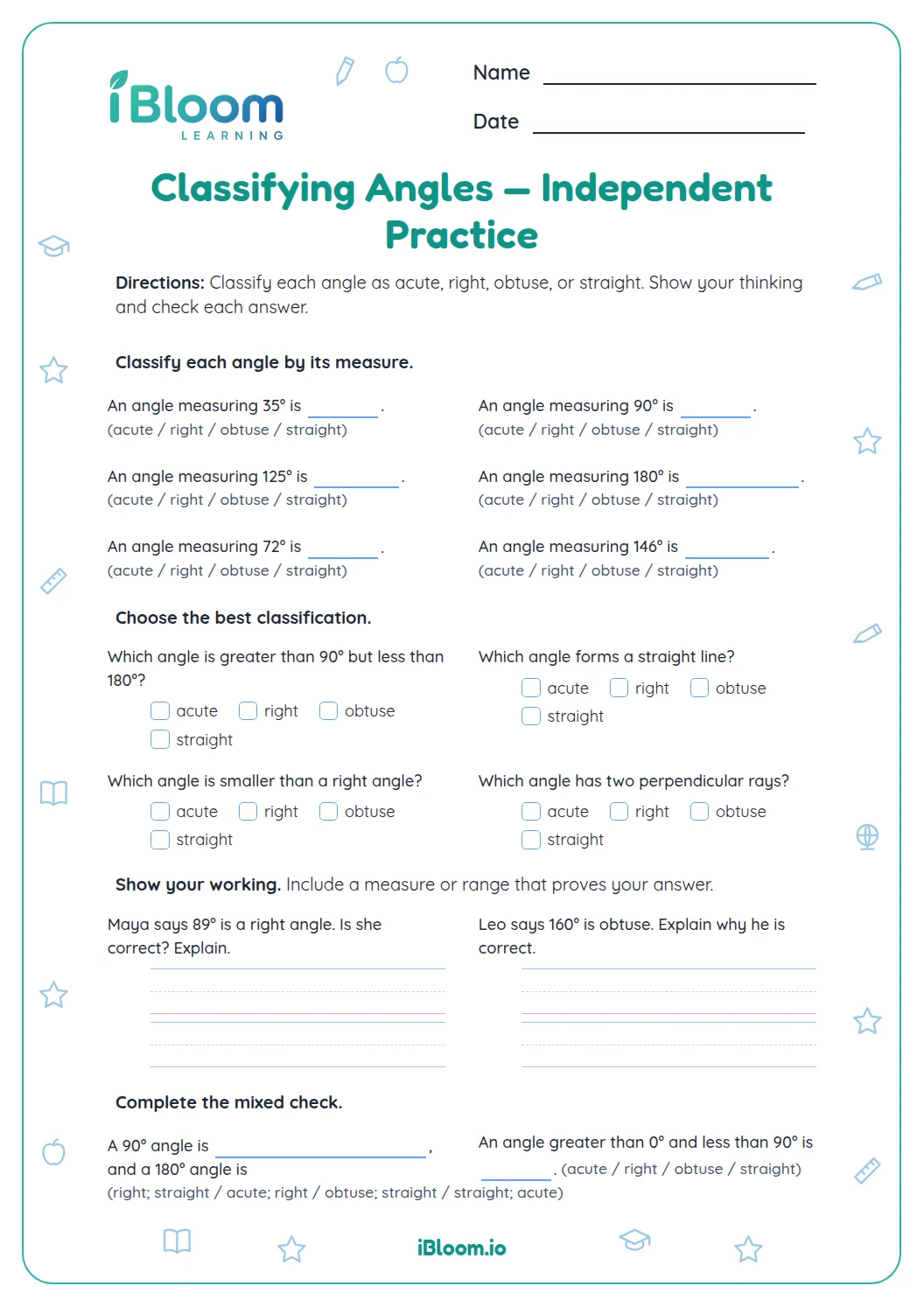
This Grade 5 visual worksheet gives children 14 angles to estimate. For each model, they select the closest degree measure and compare the opening with benchmarks such as a right angle or straight angle. The separate answer key lists the intended estimates.
How do benchmarks make estimates easier?
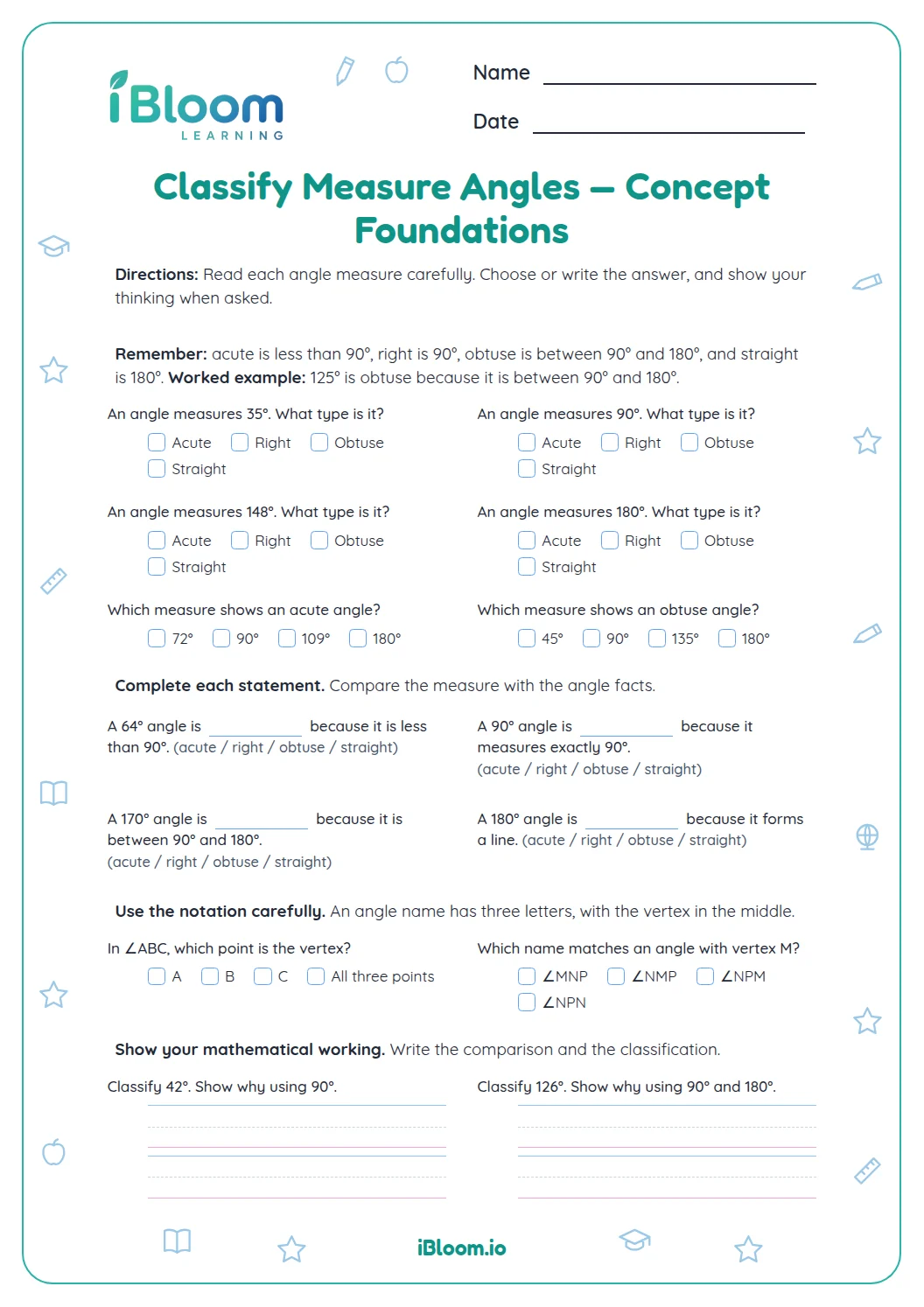
A right angle is 90°, and a straight angle is 180°. Compare the drawn opening with those familiar turns before choosing a nearby measure.
Question 1 is 32°, a little more than one third of a right angle, so 30° is the closest estimate.
- 132° is close to 30°
- 230° is the closest choice
How should children choose a close estimate?
In Part A, compare each opening with a right angle and decide whether it is smaller or larger. Part B adds wider openings, where the 180° straight angle is a useful reference.
What is on the page?
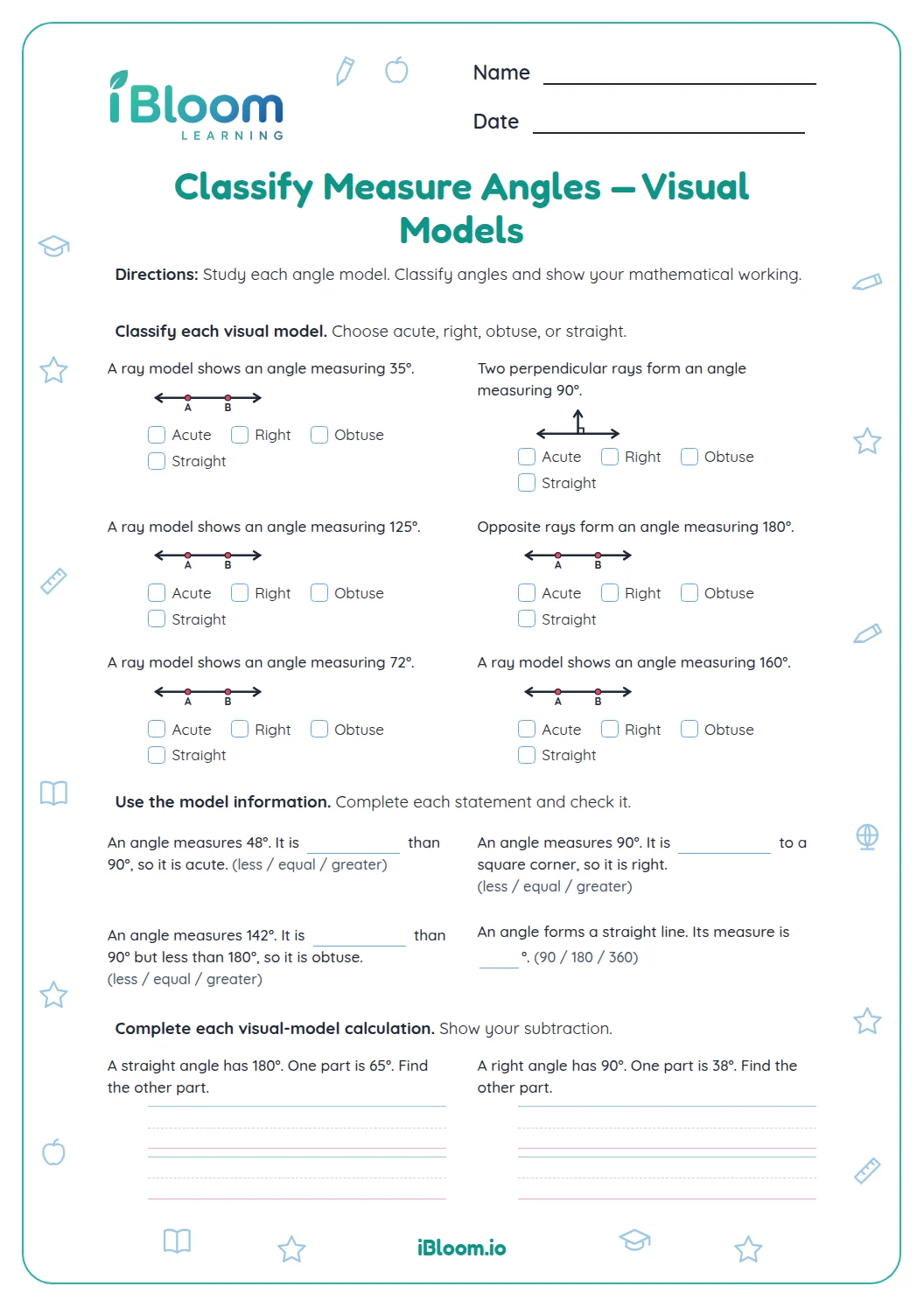
Fourteen labeled angle drawings appear in two parts, each with three nearby choices. The answer key gives the closest estimate for each item.
How to use this worksheet
- 1Find the vertex and follow each ray outward.
- 2Imagine a 90° corner beside the angle.
- 3Decide whether the angle is smaller or larger than 90°.
- 4Compare with 180° when the opening is wide.
- 5Choose the nearest degree option.
Common mistakes and quick fixes
The mistake
Treating every wide angle as 90°
The fix
Use the right-angle benchmark: an obtuse angle opens past 90°, while a straight angle reaches 180°.
The mistake
Choosing a larger degree value for a smaller opening
The fix
Compare both openings from the same starting ray. The wider turn has the greater measure.
The mistake
Picking a choice without comparing benchmarks
The fix
Place an imagined 90° corner beside the angle, then compare with 180° if the opening is obtuse.
What to practice next
Make more practice
Further reading
Questions parents and teachers ask
What does this angle worksheet practice?
It gives children 14 drawn angles to estimate. For each one, they choose the closest degree measure and compare the opening with benchmarks such as a right angle or a straight angle. The answer key lists the intended estimate for every model.
How many angle models are included?
There are 14 angle models in two parts. Each item has a labeled drawing and three nearby degree choices. Children can use a right angle or a straight angle as a reference before choosing, and the separate answer key shows the closest estimate for each drawing.
How can a straight angle help with estimating?
A straight angle measures 180° because its rays point in opposite directions. A model close to a straight line should have an estimate near 180°. Question 14 shows an angle of 179°, so 180° is the closest choice. The benchmark gives a useful reference for this wide opening.
What is the difference between an estimate and an exact measure?
An estimate is a nearby value chosen by comparing the opening with familiar benchmarks. An exact measure uses a protractor. This page focuses on selecting a reasonable estimate from three close choices, and the key shows the intended choice. A nearby choice remains an estimate rather than a measured result.
Is an answer key provided?
Yes. The separate answer key marks the closest estimate for all 14 angle drawings. Children can compare a choice with the 90° and 180° benchmarks, then explain which reference helped them judge the angle. It also keeps the model labels beside the selected estimates.