



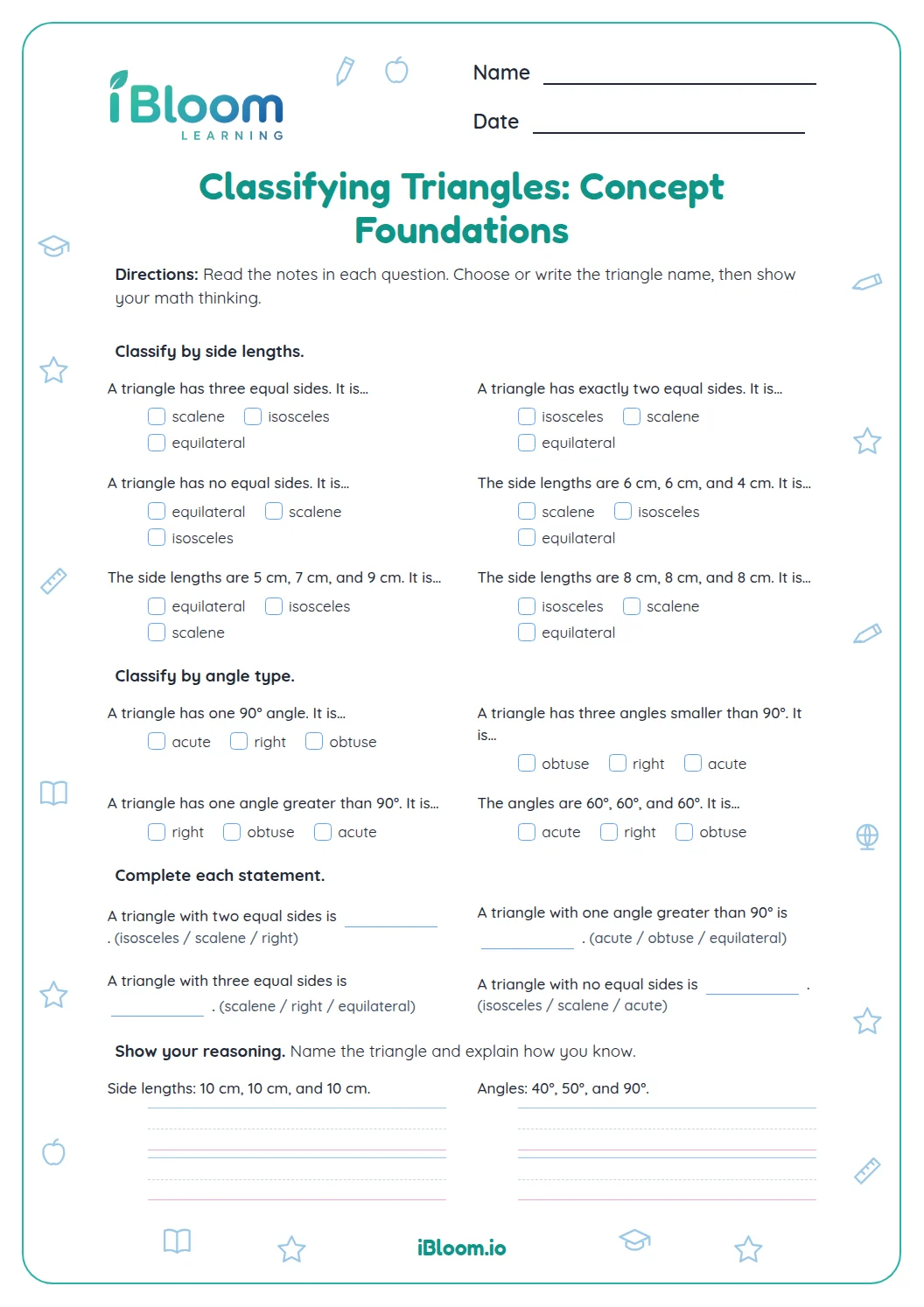
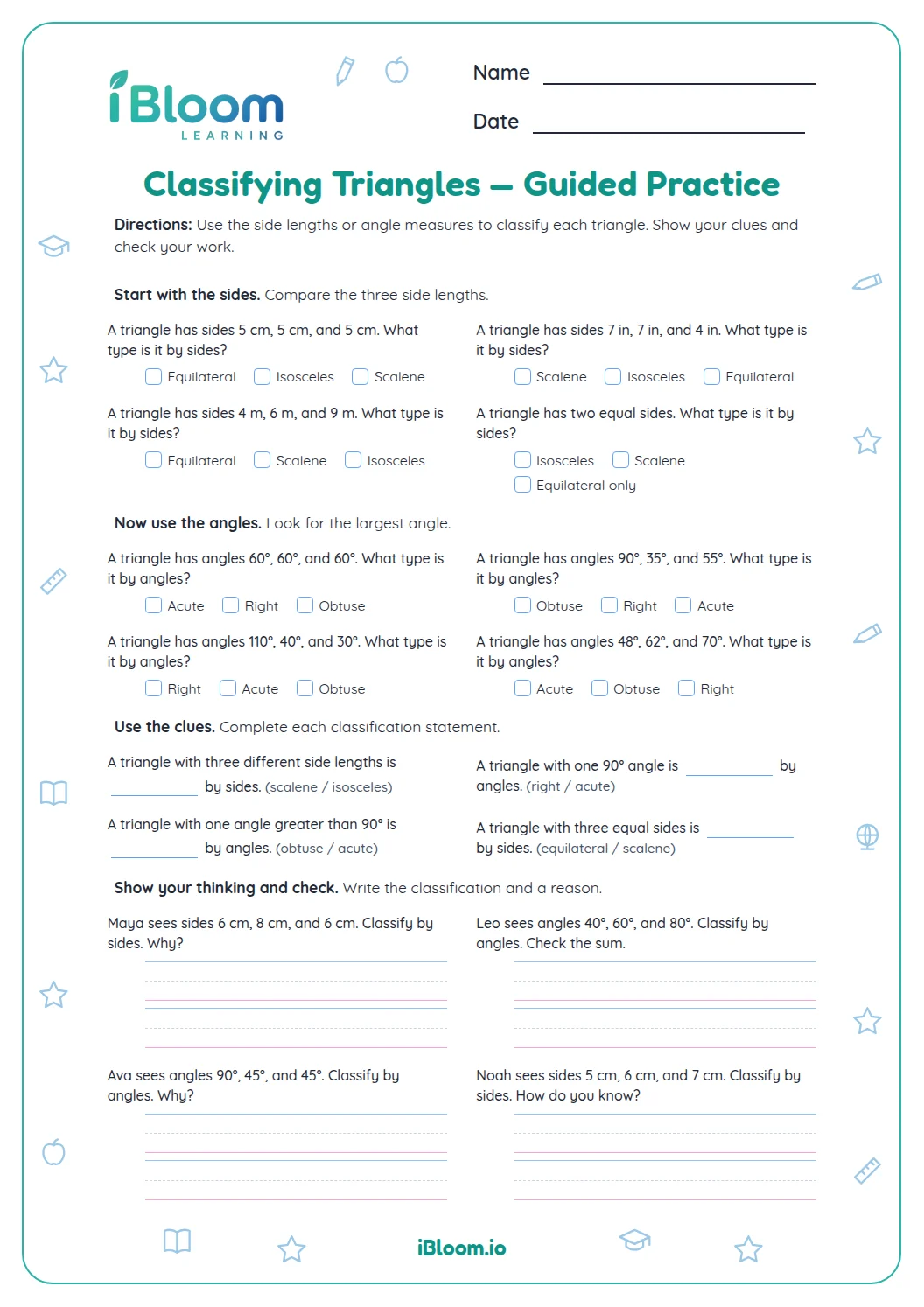
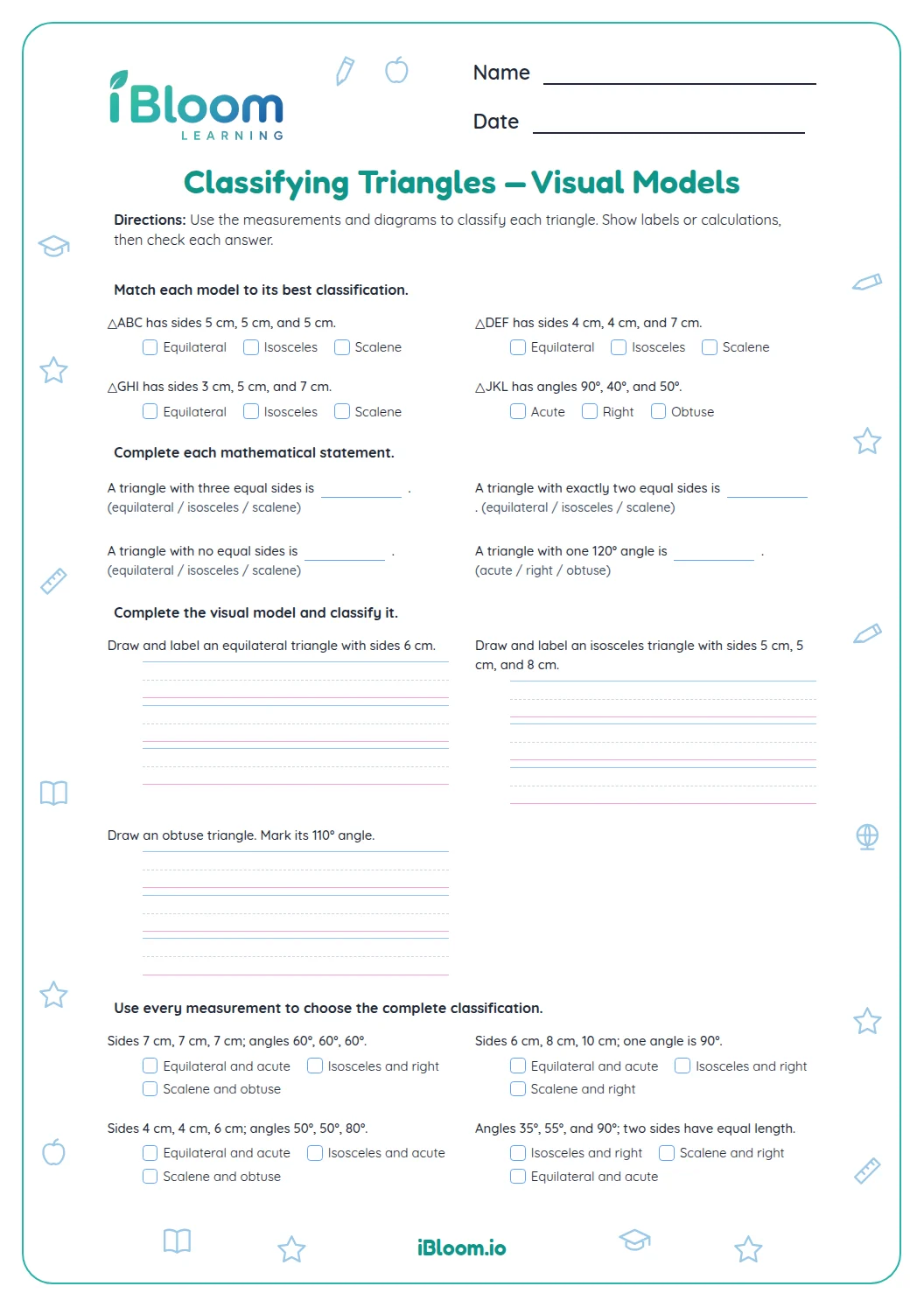
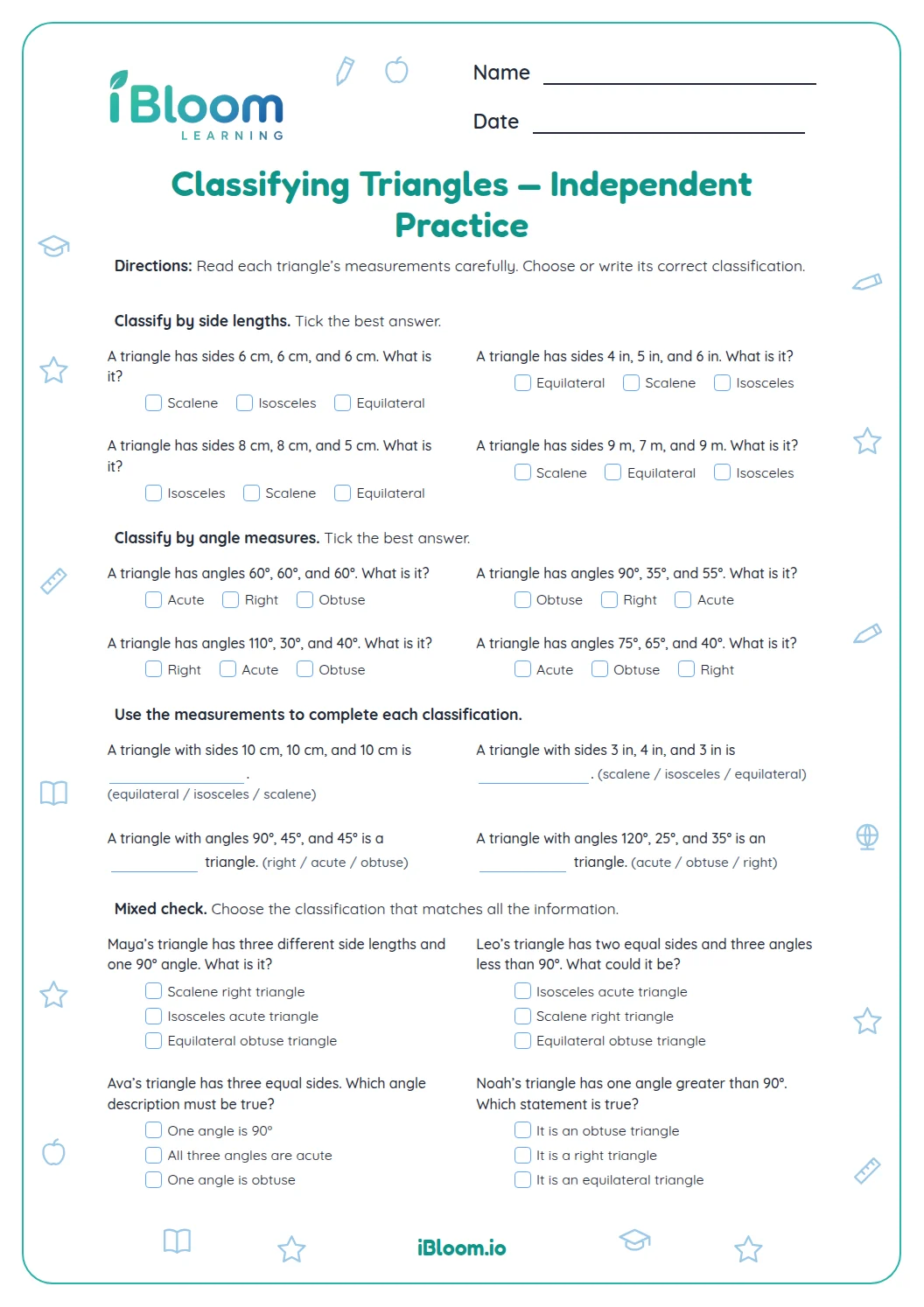
About this worksheet
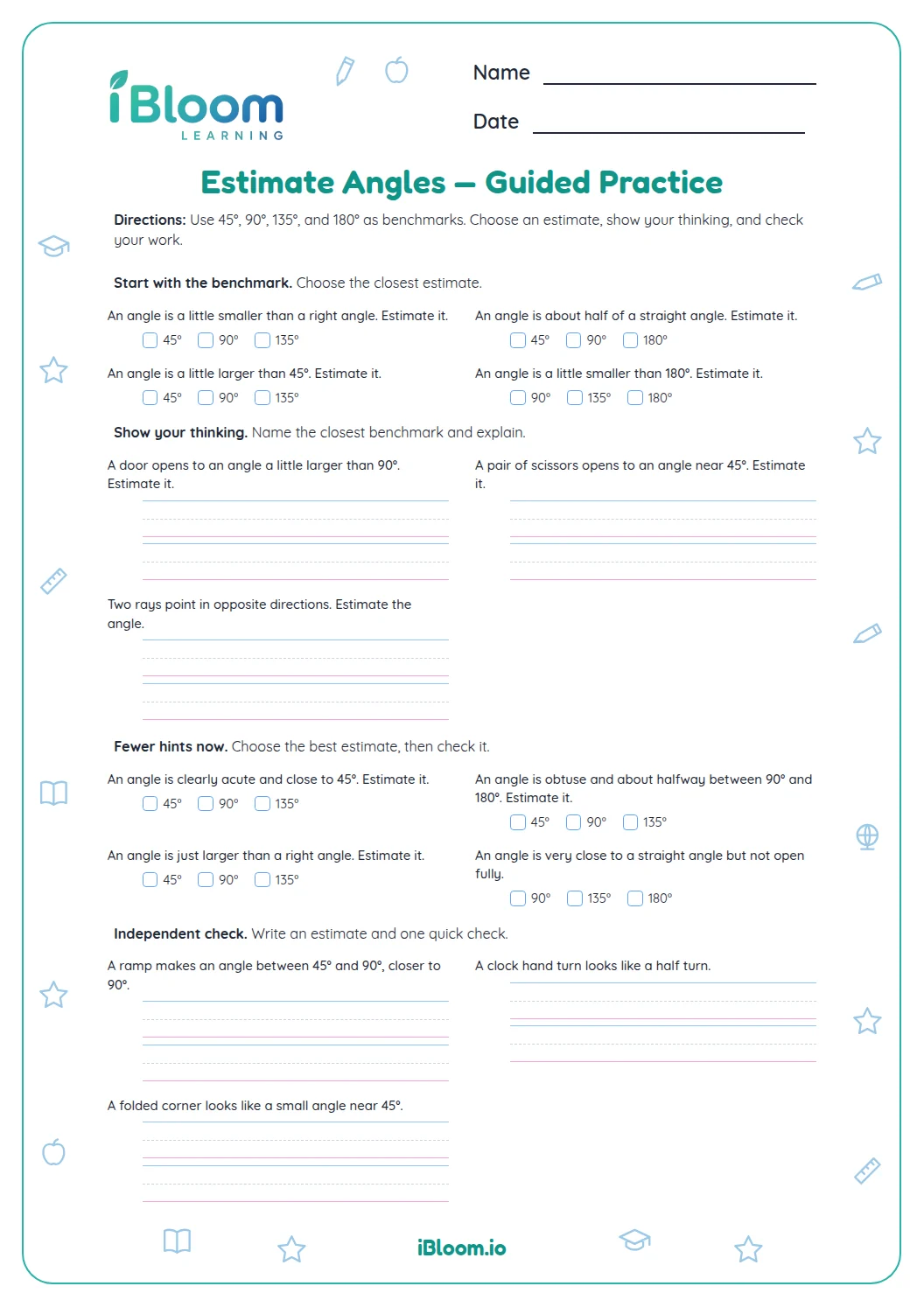
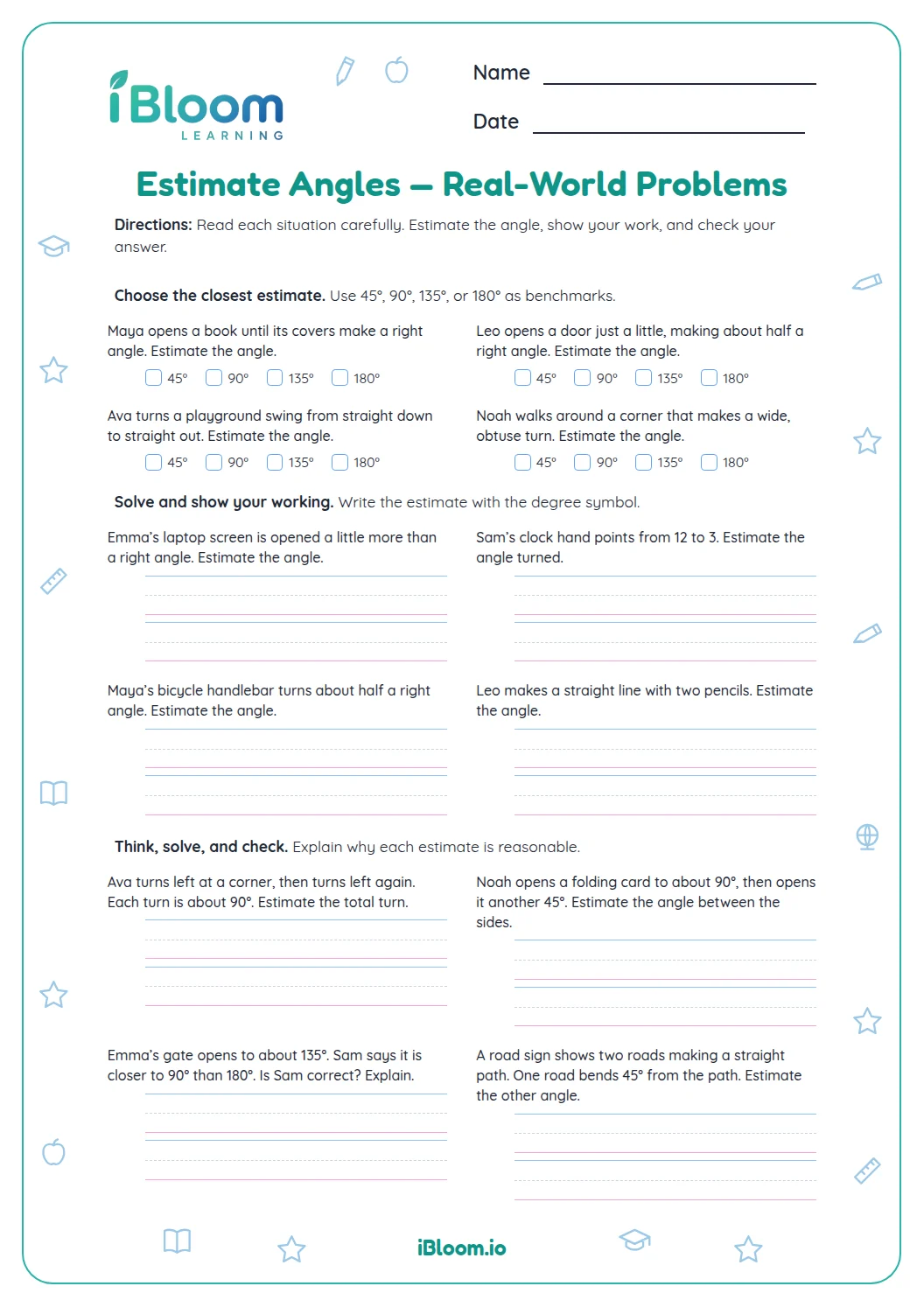
This free printable worksheet gives Grade 5 students independent practice at estimating angles. Every angle is drawn with an arc and a letter, and students compare it with four benchmarks: 45°, 90°, 135° and 180°. Part A asks for the nearest benchmark for four angles. Part B gives four measures, such as 142°, to round to the closest benchmark. Part C asks for the best estimate from four choices, and Part D names two angles acute, right or obtuse. It practices Common Core 4.MD.C.5 and 4.G.A.1 and comes with a two-page answer key.
Aligned to 4.MD.C.5 and 4.G.A.1
What is on this worksheet?
Twelve questions in four parts. Eight of them show a drawn angle, lettered A to H, with an arc marking the opening to judge. The other four give a measure in degrees and ask for the nearest benchmark.
Page 1 holds Part A and the start of Part B; page 2 finishes Part B and adds Parts C and D. The answer key marks every choice and fills in each benchmark.
- Part A, Nearest benchmark: angles A to D, each with the choices 45°, 90°, 135° and 180° (questions 1 to 4)
- Part B, Closest benchmark: 88°, 142°, 52° and 168° to round to a benchmark (questions 5 to 8)
- Part C, Best estimate: angles E and F, each with four estimates spread far apart (questions 9 and 10)
- Part D, Acute, right or obtuse: angles G and H to classify (questions 11 and 12)
How do benchmark angles help you estimate?
Four angles are easy to picture: 90° is a square corner, 45° is half of that, 180° is a straight line and 135° is halfway between a square corner and a straight line. Any other angle sits between two of them, so an estimate starts with “Is it more or less than a square corner?”
Angle C in question 3 opens just past a square corner. It is much nearer 90° than 135°, so 90° is the nearest benchmark.
- 1Is it wider than a square corner? Yes, so it is more than 90°.
- 2Is it close to a straight line? No, so it is less than 180°.
- 3It opens about halfway between the two.
- 4Nearest benchmark: 135°.
How do you decide which benchmark is closest?
When the measure is given, subtract to find the gap to the benchmark on each side and pick the smaller gap. This is what Part B asks for.
Part C uses the same idea without numbers to subtract. The four choices are spread far apart, so students decide first whether angle E or F is smaller or larger than 90°, which rules out two choices straight away.
- 1142° lies between 135° and 180°.
- 2142 − 135 = 7, and 180 − 142 = 38.
- 37 is the smaller gap, so 142° is closest to 135°.
How can benchmarks help name an angle?
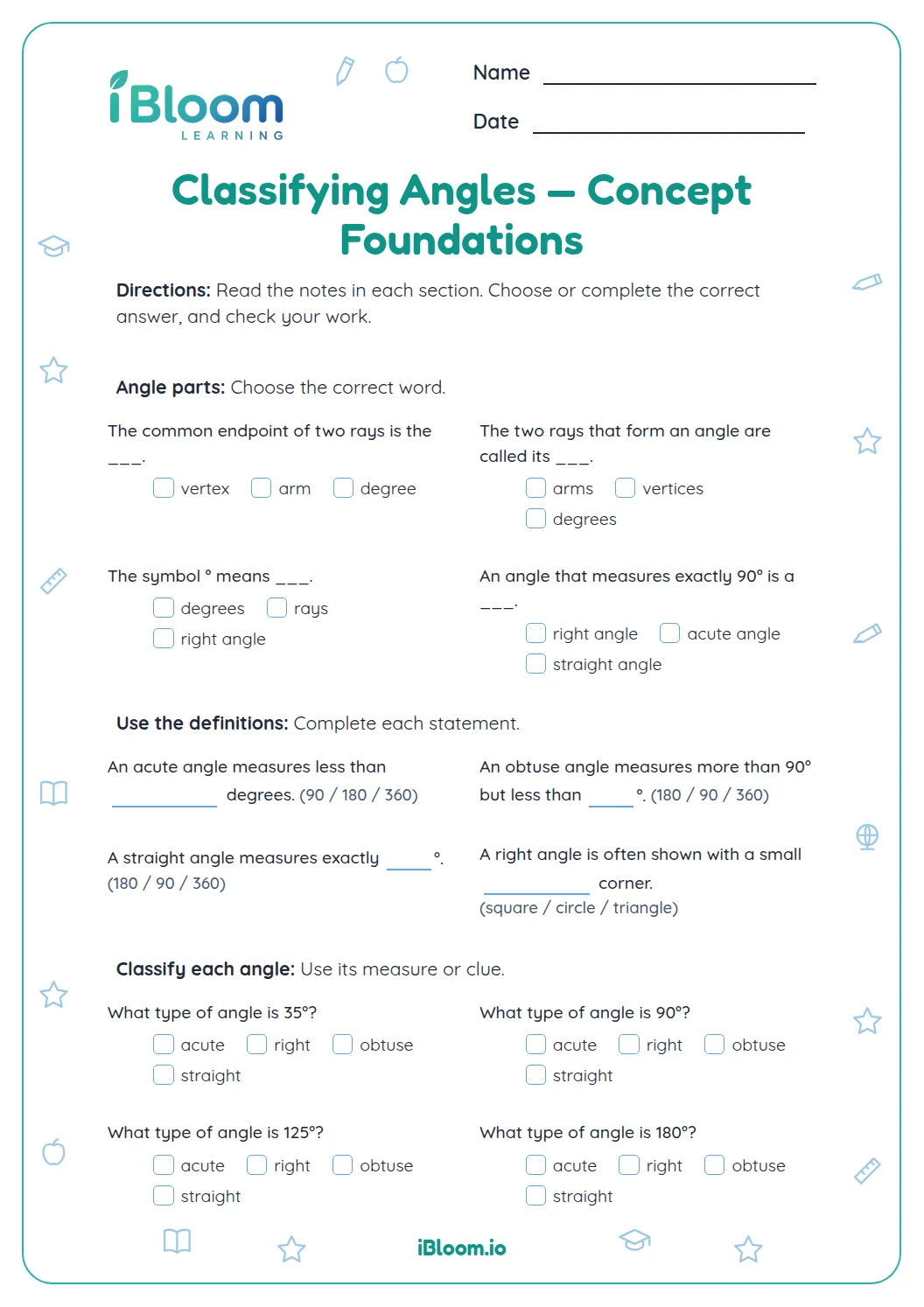
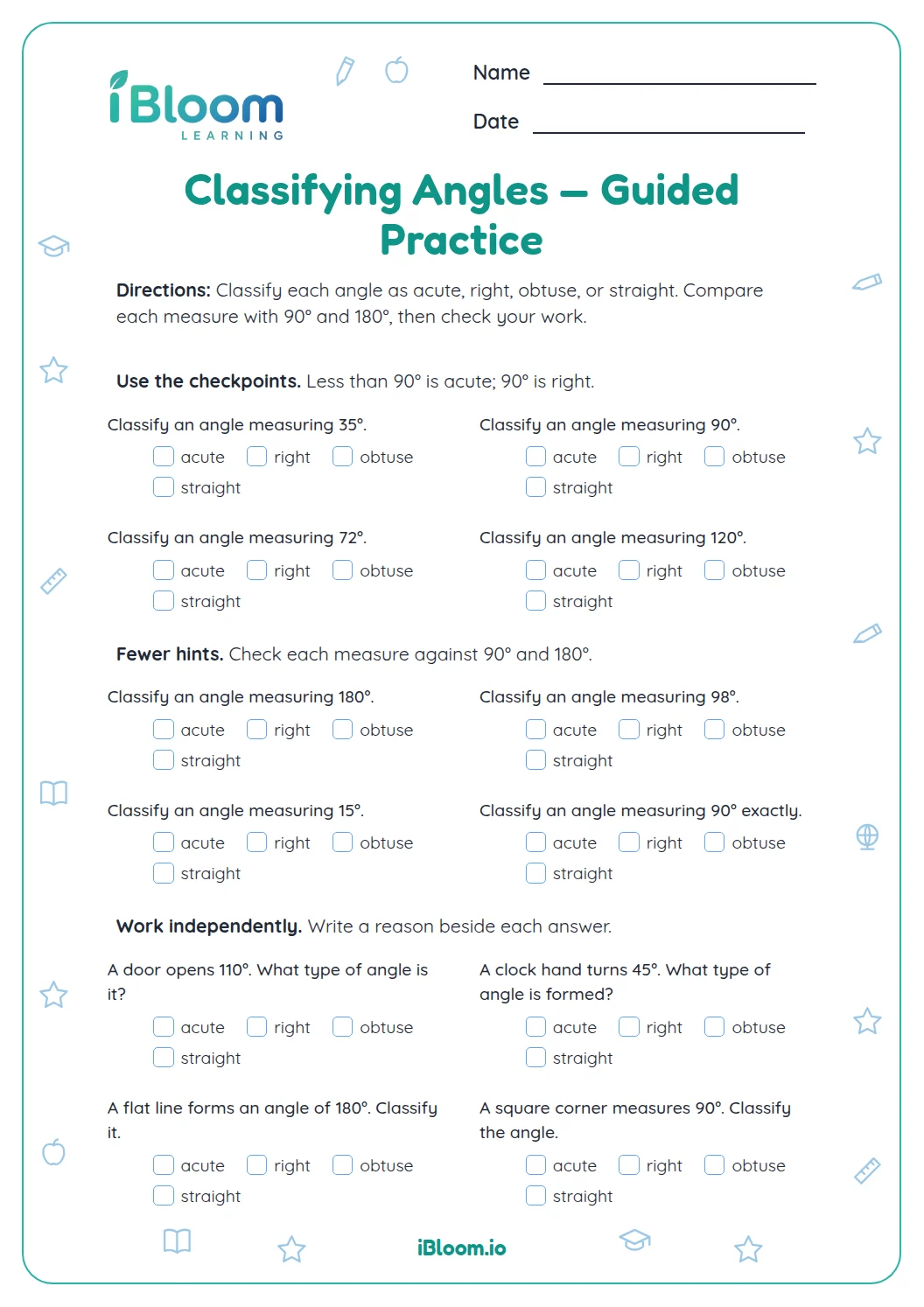
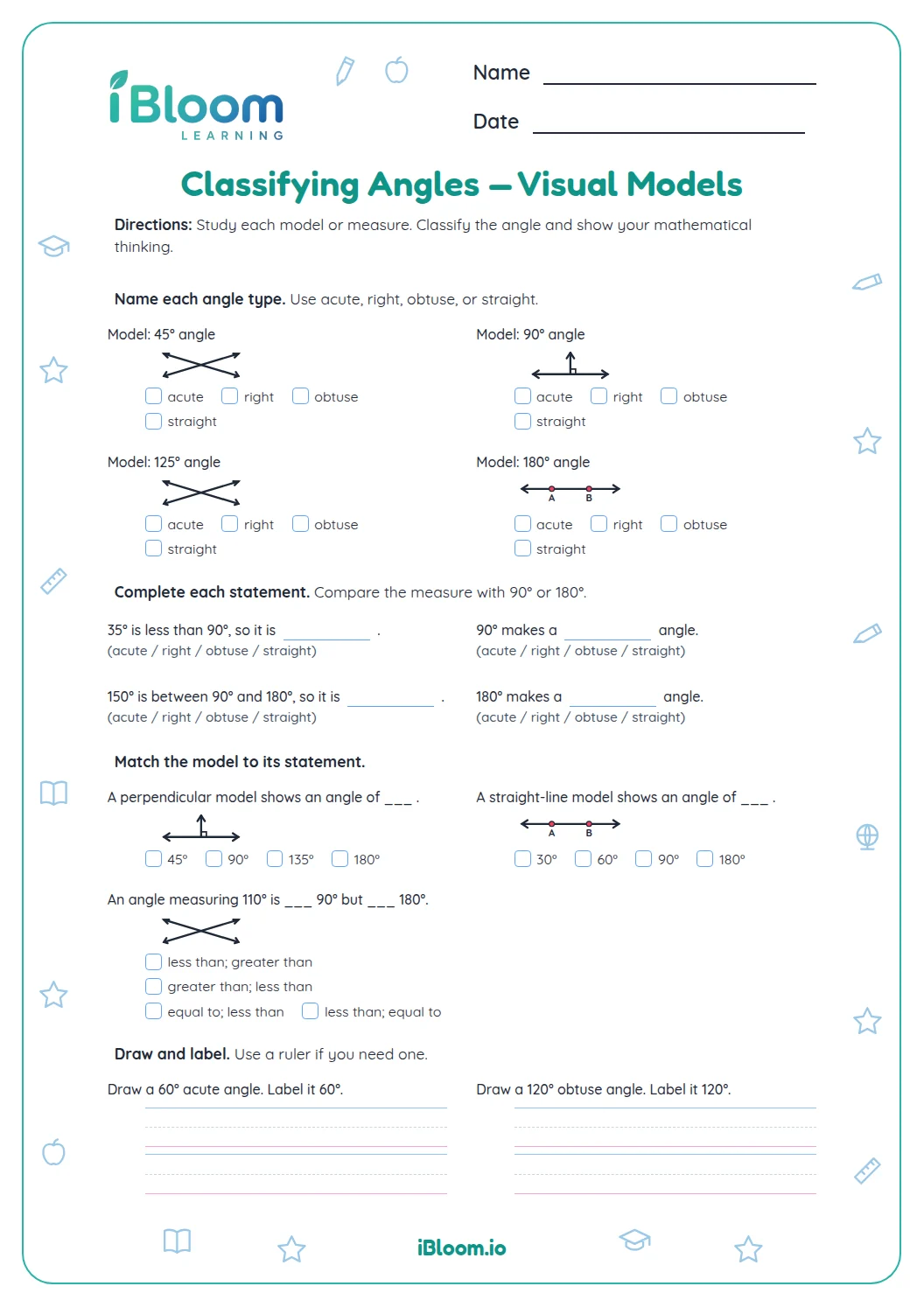
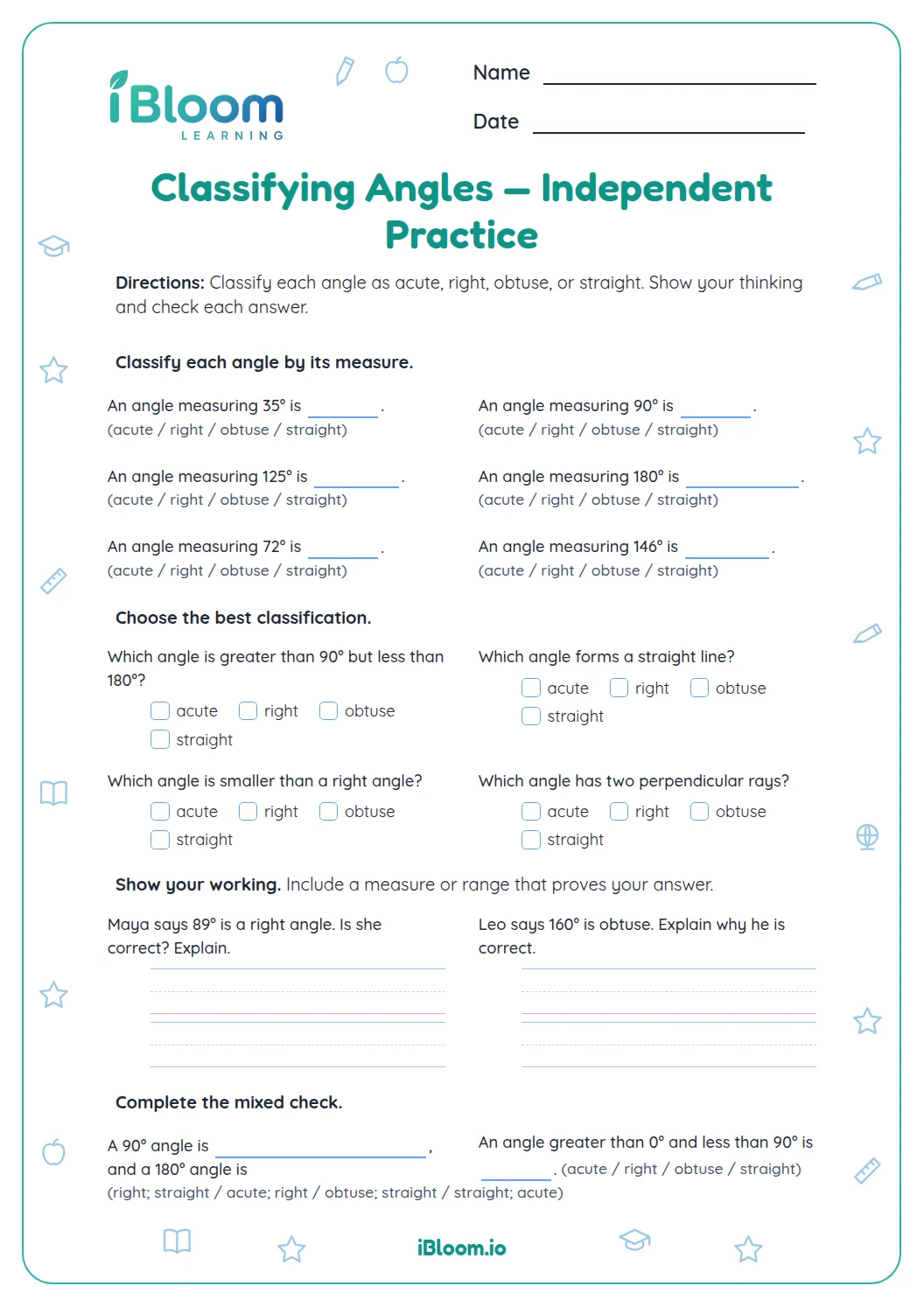
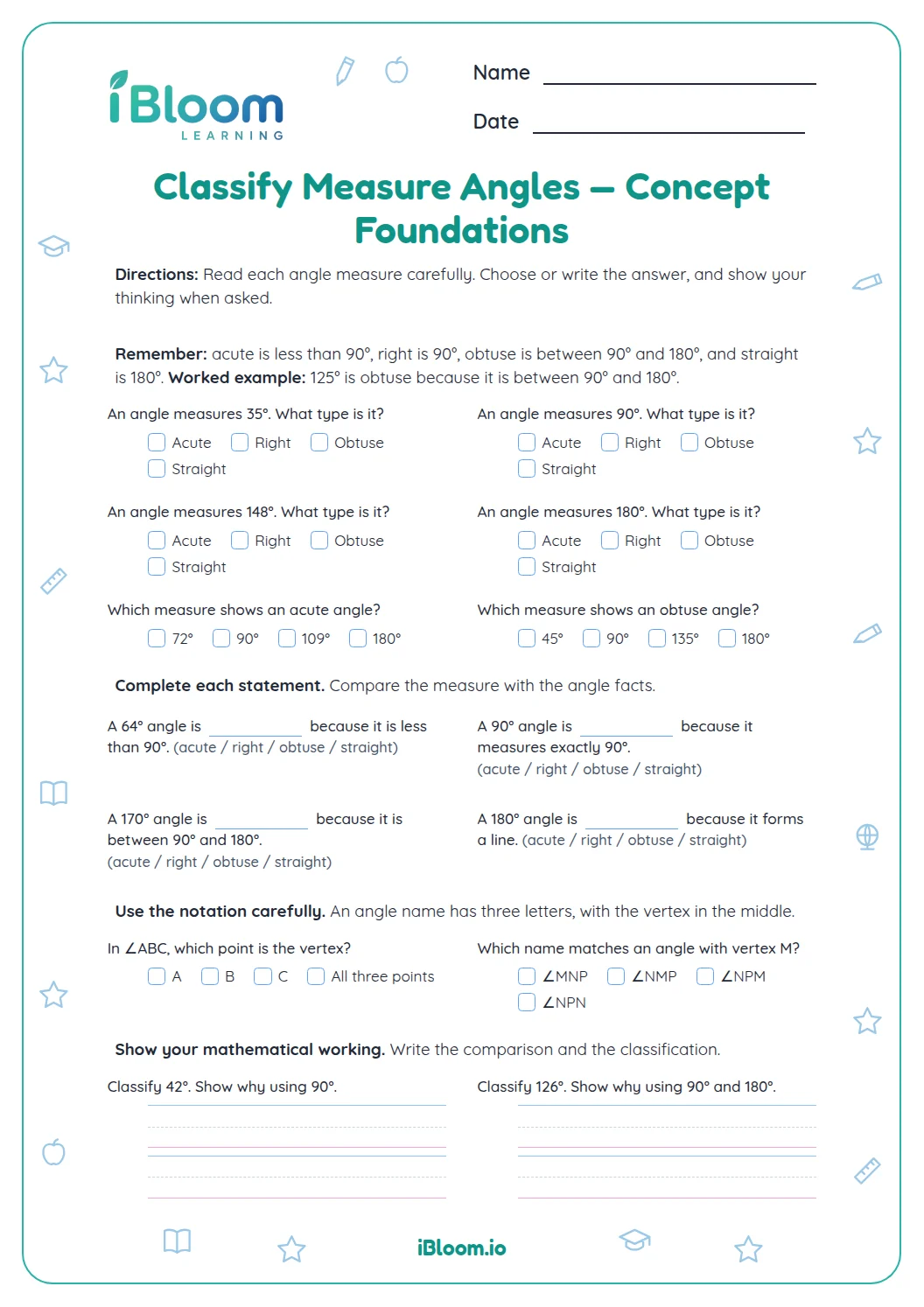
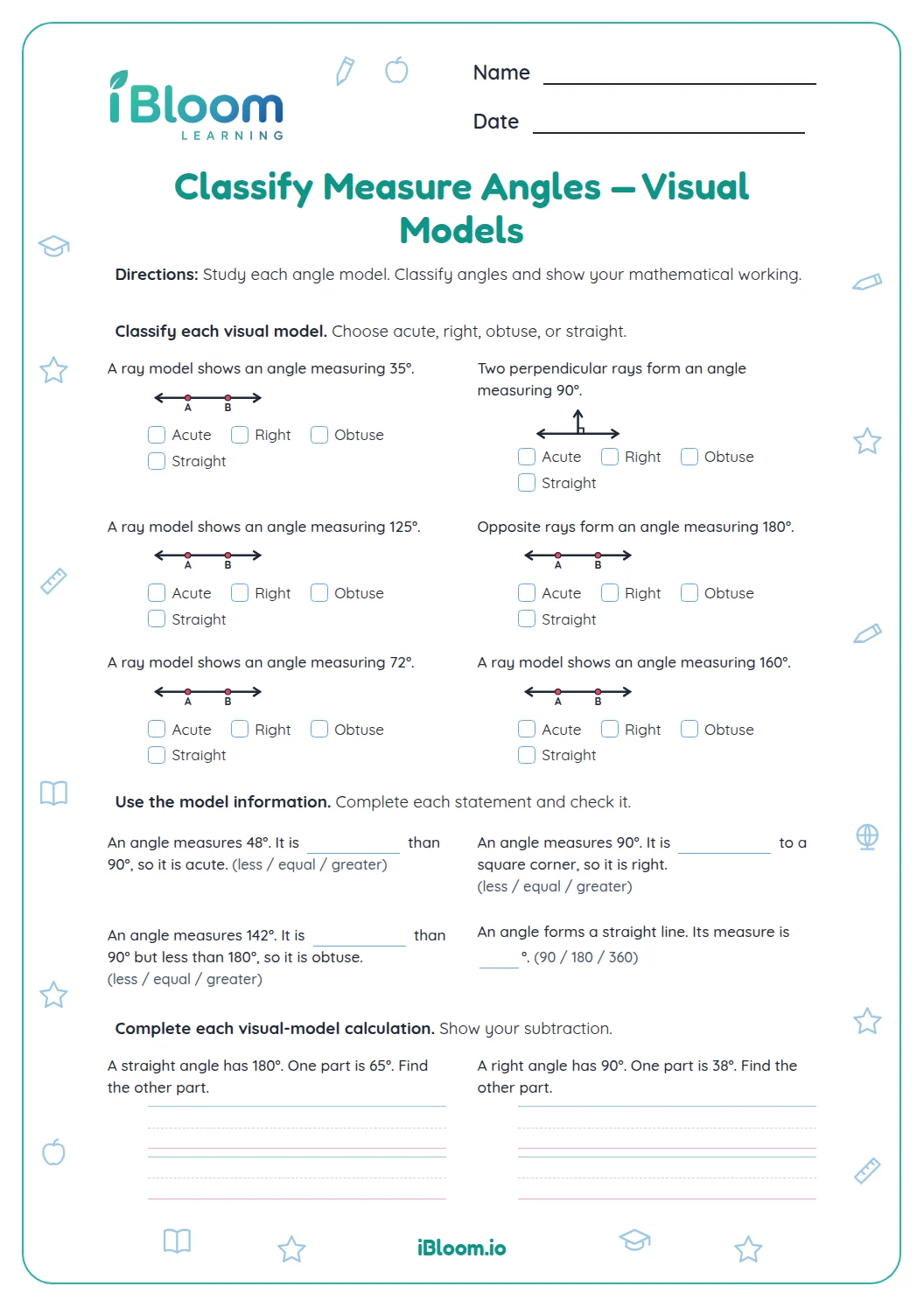
A right angle is exactly 90°. An acute angle is smaller than 90°, and an obtuse angle is larger than 90° but smaller than 180°. So the 90° benchmark is all students need to classify an angle.
Angle G in question 11 is narrower than a square corner, so it is acute. Angle H in question 12 opens wider than a square corner, so it is obtuse.
How to use this worksheet at home or in class
- 1Fold a sheet of paper to make a square corner (90°), then fold it again to make 45°. Keep both folds nearby.
- 2Do question 1 together: hold the 45° fold against angle A and decide whether it is close.
- 3Let your child finish Part A alone, using the folds only to check.
- 4For Part B, have your child write both gaps next to each question, as in 142 − 135 = 7, before choosing.
- 5In Parts C and D, ask “Smaller or larger than a square corner?” before your child looks at the choices.
- 6Check with the answer key, and hold the paper corner against any angle that was missed.
Common mistakes and quick fixes
The mistake
Judging an angle by how long its arms are, so a long-armed narrow angle seems bigger.
The fix
Look only at the opening between the arms, marked by the arc. The length of the lines does not change the angle.
The mistake
Choosing the larger benchmark every time, such as 90° for 52° in question 7.
The fix
Find both gaps: 52 − 45 = 7 and 90 − 52 = 38. Pick the smaller gap, so 52° is closest to 45°.
The mistake
Calling angle H acute because it opens only a little past a square corner.
The fix
Hold a paper corner in the angle. If the arms open past the corner, even slightly, the angle is obtuse; if they stay inside it, it is acute.
Common Core alignment
Most US states use the Common Core math standards or a close state version.
Understand angles as turns around a point, measured in degrees of a circle.
On this sheet: Students judge each drawn angle's size in degrees by comparing it with 45°, 90°, 135° and 180°.
Show the official wordingHide the official wording
Recognize angles as geometric shapes that are formed wherever two rays share a common endpoint, and understand concepts of angle measurement:
Identify right, acute and obtuse angles in figures.
On this sheet: Part D names drawn angles as acute or obtuse by comparing each with a right angle.
Show the official wordingHide the official wording
Draw points, lines, line segments, rays, angles (right, acute, obtuse), and perpendicular and parallel lines. Identify these in two-dimensional figures.
What to practice next
Make more practice
Further reading
Questions parents and teachers ask
What does it mean to estimate an angle?
To estimate an angle is to say about how large it is without measuring it exactly. Students compare the angle with benchmarks they know, such as 90° for a square corner, then choose the nearest one. A good estimate is close enough to tell an acute angle from an obtuse angle and to catch a protractor mistake.
What are the four benchmark angles?
The benchmarks are 45°, 90°, 135° and 180°. A right angle, like the corner of a page, is 90°. Half of that is 45°, a straight line is 180°, and 135° sits halfway between 90° and 180°. Parts A and B use only these four numbers as answers.
Do students need a protractor for this worksheet?
No. Every question can be answered by comparing an angle with a square corner and a straight line, and the Part C choices are spread far enough apart to choose by eye. A protractor is useful afterward, to check an estimate and see how close it was.
How do I know whether an angle is acute, right or obtuse?
Compare it with 90°, the corner of a sheet of paper. An angle smaller than 90° is acute, exactly 90° is a right angle, and an angle between 90° and 180° is obtuse. A right angle is drawn with a small square in its corner instead of an arc.
How long does the worksheet take, and is there an answer key?
Most students need about 15 minutes. The two-page answer key matches the worksheet page for page, with every correct choice filled in and each benchmark written in its blank, so you can print the worksheet alone and check it together afterward.
How can students practice estimating angles at home?
Look for angles around the house: a door opened partway, a laptop screen, scissors or a slice of pizza. Ask whether each is nearest 45°, 90°, 135° or 180°, then check with a protractor. Clock hands work well too: at 3:00 they make a right angle.