


About this worksheet
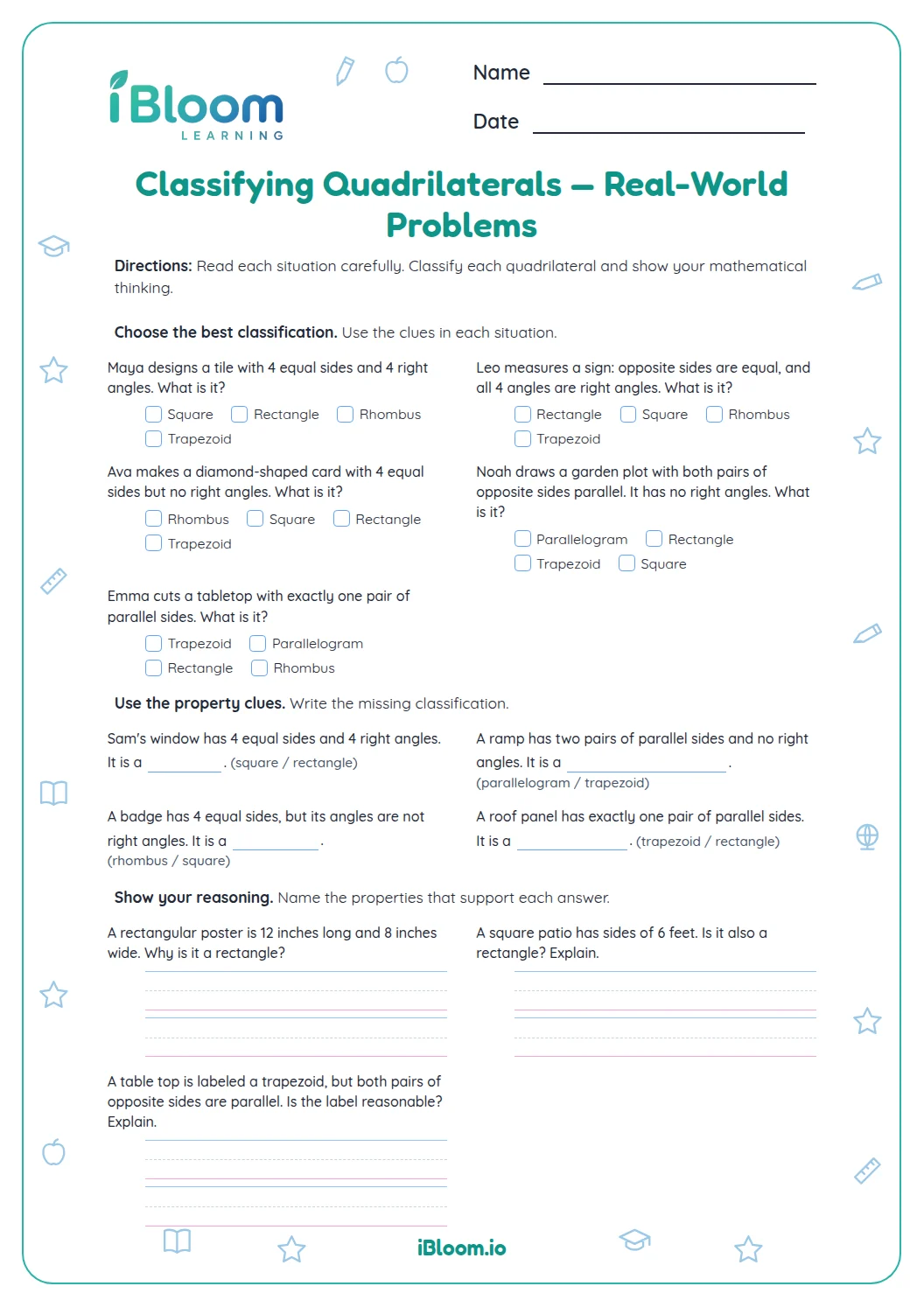
This free printable worksheet helps Grade 5 students classify quadrilaterals by reading the marks on drawn shapes. Every shape carries textbook marks: ticks for equal sides, arrows for parallel sides and small squares for right angles. In Part A children give the most specific name for a rhombus, a trapezoid and a parallelogram. Part B asks whether four family statements, such as “Every square is a rectangle,” are true or false. Part C shows three rows of five lettered shapes and asks which are parallelograms, which have 4 equal sides and which have 4 right angles. It practices Common Core 5.G.B.3 and 5.G.B.4, with a two-page answer key.
Aligned to 5.G.B.3 and 5.G.B.4
What is on this worksheet?
Ten questions in three parts, all answered by filling in a bubble. Every shape is drawn with its properties marked, so children work from what the drawing shows rather than from how the shape looks at a glance.
Page 1 holds Parts A and B. Page 2 is Part C, where each question has its own row of five lettered shapes, so children check every shape against one property at a time. The answer key fills in the correct bubble for all ten questions.
- Part A, Name each shape: a rhombus, a trapezoid and a parallelogram, each with four names to choose from (questions 1 to 3)
- Part B, True or false: four statements about shape families, such as “Every rhombus is a parallelogram” (questions 4 to 7)
- Part C, Find the shapes: three rows of five shapes; pick the parallelograms, the shapes with 4 equal sides and the shapes with 4 right angles (questions 8 to 10)
How do you read the marks on a shape?
Sides with the same number of ticks are equal in length. Sides with the same number of arrowheads are parallel. A small square in a corner means a right angle. A side with no tick tells you nothing about its length, so children should not assume sides are equal just because they look close.
Question 1 is a good place to practice. All four sides have one tick, both pairs of opposite sides have arrows, and there are no right-angle squares.
- 1Ticks: all 4 sides match, so 4 equal sides.
- 2Arrows: 2 pairs of parallel sides, so it is a parallelogram.
- 3No right-angle squares, so it is not a square.
- 4Most specific name: rhombus.
Why can one shape have more than one name?
Quadrilaterals belong to families. Anything true of every parallelogram is true of every rhombus, rectangle and square too, because each of those is a parallelogram. That is why “Every square is a rectangle” in question 4 is true: a square has 4 right angles, which is all a rectangle needs.
The statement does not work backward. Question 5, “Every rectangle is a square,” is false, because a rectangle such as shape D in question 8 has two long sides and two short sides.
How should children sort a row of shapes?
Take one property and test each shape from A to E, writing a quick check or cross under each letter. Only then read the four choices. Skipping a shape is the easiest way to pick a choice that is almost right.
In question 8 the square, rhombus and rectangle (A, C and D) are all parallelograms. The trapezoid, B, is drawn with exactly one pair of parallel sides, and the kite, E, has none, so the answer is A, C and D.
- 1A trapezoid: no right-angle squares ✗
- 2B parallelogram: no right-angle squares ✗
- 3C rectangle: 4 right angles ✓
- 4D kite: no right-angle squares ✗
- 5E square: 4 right angles ✓ → C and E
How to use this worksheet at home or in class
- 1Before starting, draw a quick square on scrap paper and add the three kinds of marks together: ticks, arrows and right-angle squares.
- 2Do question 1 together, saying each mark out loud before choosing a name.
- 3Let your child finish Parts A and B alone. For each true-or-false statement, ask them to picture a shape that might break it.
- 4In Part C, have your child write a check or a cross under every letter before looking at the choices.
- 5Check with the answer key. For each miss, point to the mark that decides it.
- 6Finish by asking your child to explain, out loud, why every square is also a rectangle.
Common mistakes and quick fixes
The mistake
Naming the shape in question 1 a square because all four sides have one tick.
The fix
Look for the small corner squares. Four equal sides without right angles make a rhombus; a square needs both.
The mistake
Choosing “A and D” in question 8, leaving out the rhombus because it is slanted.
The fix
A parallelogram only needs two pairs of parallel sides. Shape C has arrows on both pairs, so it counts, slanted or not.
The mistake
Marking “Every rectangle is a square” as true because squares and rectangles are related.
The fix
Test it with one shape. A long, thin rectangle has 4 right angles but not 4 equal sides, so not every rectangle is a square.
Common Core alignment
Most US states use the Common Core standards or a close state version. These two Grade 5 geometry standards describe the work on this page.
What is true of a category, such as rectangles, is also true of its subcategories, such as squares.
On this sheet: Part B asks which family statements are true, such as every square being a rectangle.
Show the official wordingHide the official wording
Understand that attributes belonging to a category of two-dimensional figures also belong to all subcategories of that category. For example, all rectangles have four right angles and squares are rectangles, so all squares have four right angles.
Sort quadrilaterals into groups by their sides and angles.
On this sheet: Parts A and C name and sort drawn quadrilaterals by their marked sides and angles.
Show the official wordingHide the official wording
Classify two-dimensional figures in a hierarchy based on properties.
What to practice next
Make more practice
Further reading
Questions parents and teachers ask
What does “most specific name” mean?
Many quadrilaterals have more than one correct name. The shape in question 1 is a parallelogram and also a rhombus. The most specific name is the one that uses every mark on the drawing: four equal sides plus two pairs of parallel sides make it a rhombus, so that is the answer.
What do the ticks, arrows and corner squares mean?
They are the standard textbook marks. Sides with matching ticks are the same length, sides with matching arrows are parallel, and a small square in a corner shows a right angle. Children should name each shape from these marks, not from how long the sides look on the page.
How is the trapezoid drawn on this sheet?
The trapezoid in questions 2, 8 and 10 has arrows on its top and bottom only, so it is drawn with exactly one pair of parallel sides. Its answers stay the same whichever trapezoid definition your child's class uses, because it is never asked to count as a parallelogram.
Is a square really a rectangle and a rhombus?
Yes. A rectangle is a quadrilateral with 4 right angles, and a rhombus is one with 4 equal sides. A square has both, so it belongs to both families. Questions 4 to 7 build on this idea, and question 9 includes the square among the shapes with 4 equal sides.
Why is a kite not always a rhombus?
A kite has two pairs of equal sides that sit next to each other, like the kite in question 9, with one tick on its top sides and two on its bottom sides. A rhombus needs all four sides equal. So question 7, “Every kite is a rhombus,” is false.
What should we do after this worksheet?
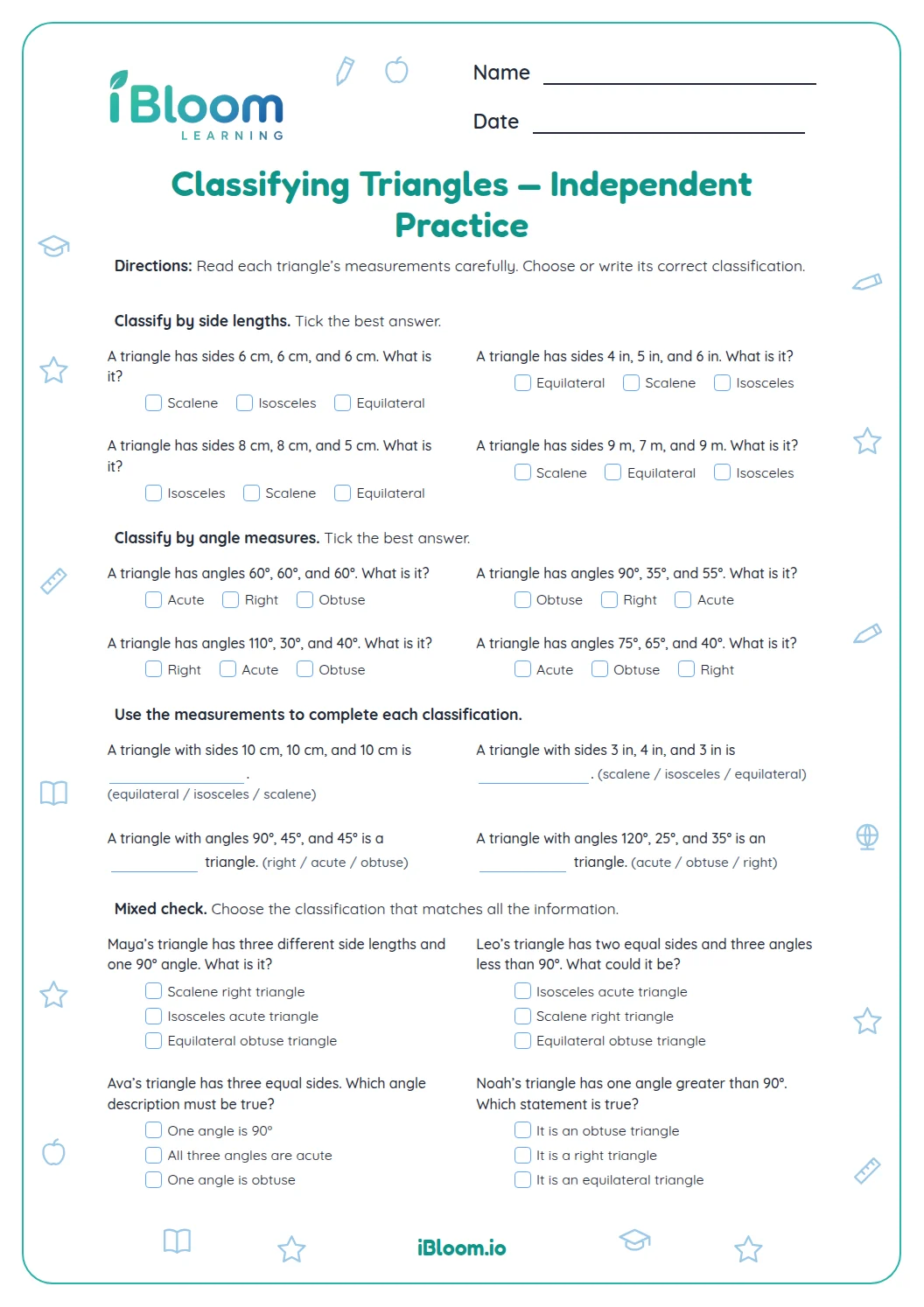
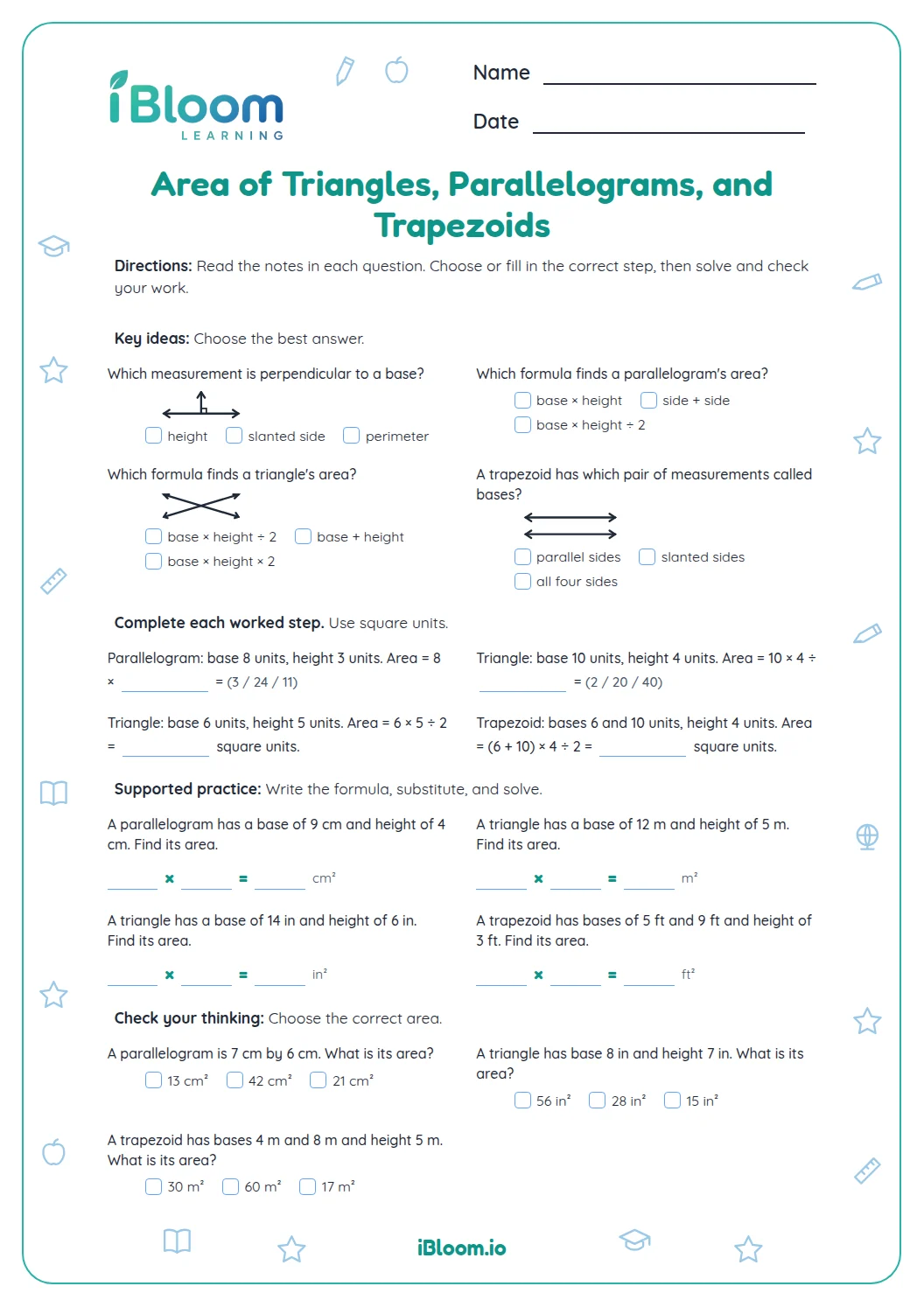
Try the Classifying Triangles worksheets, which use the same habit of reading marks for equal sides and right angles. Then move on to the area of parallelograms and trapezoids. At home, ask your child to name a four-sided shape on a window, tile or book and say which marks it would carry.