


About this worksheet
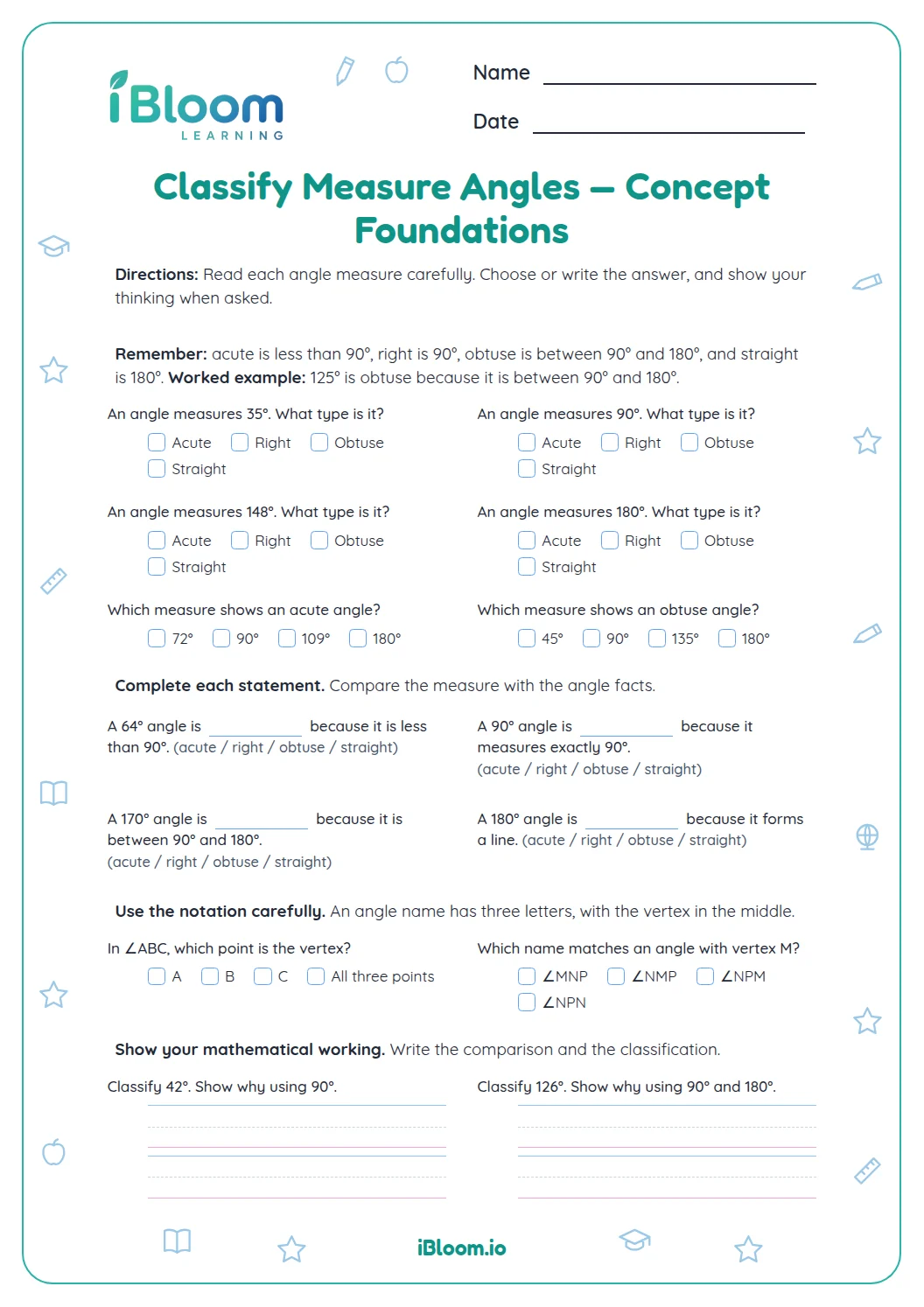
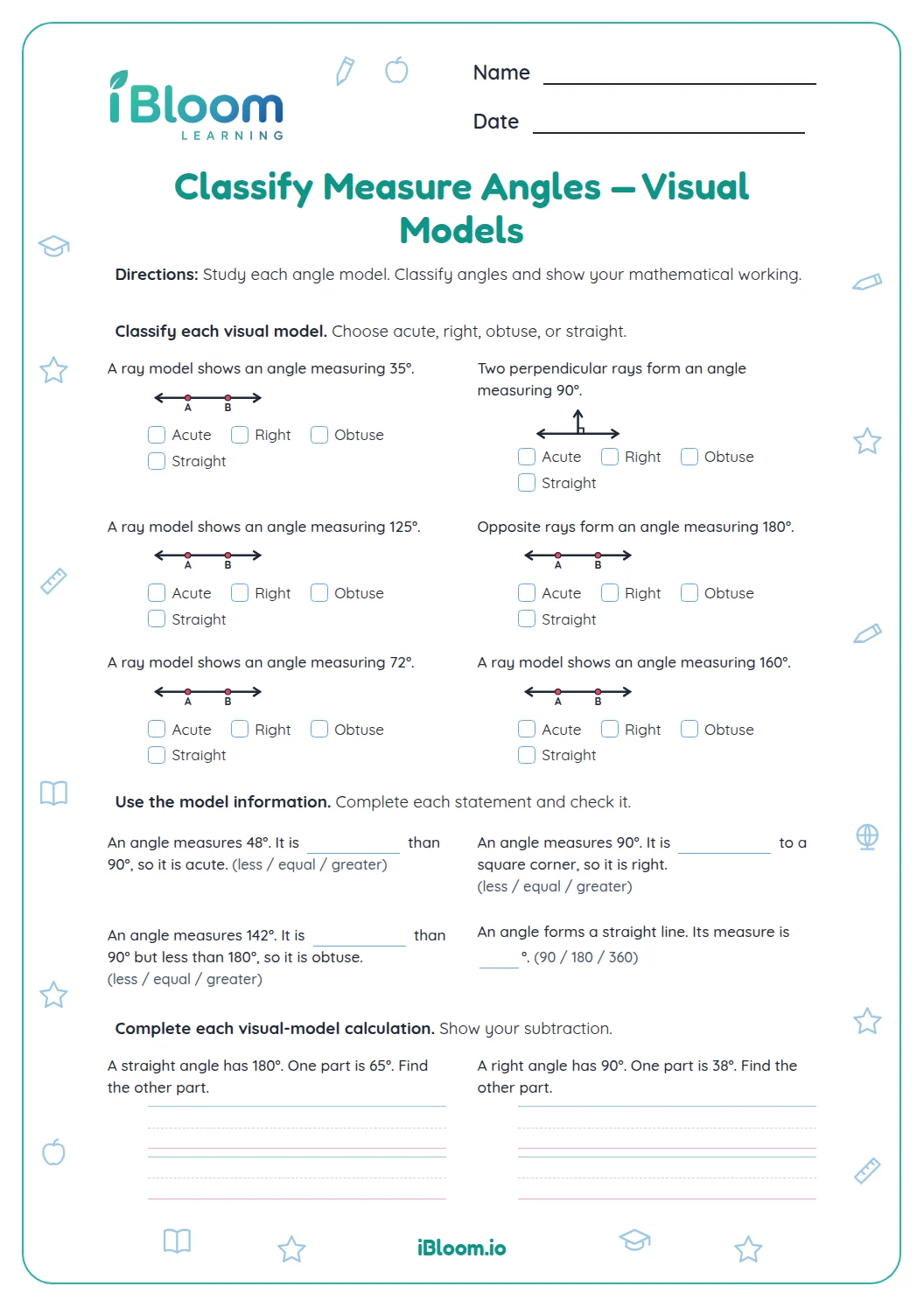
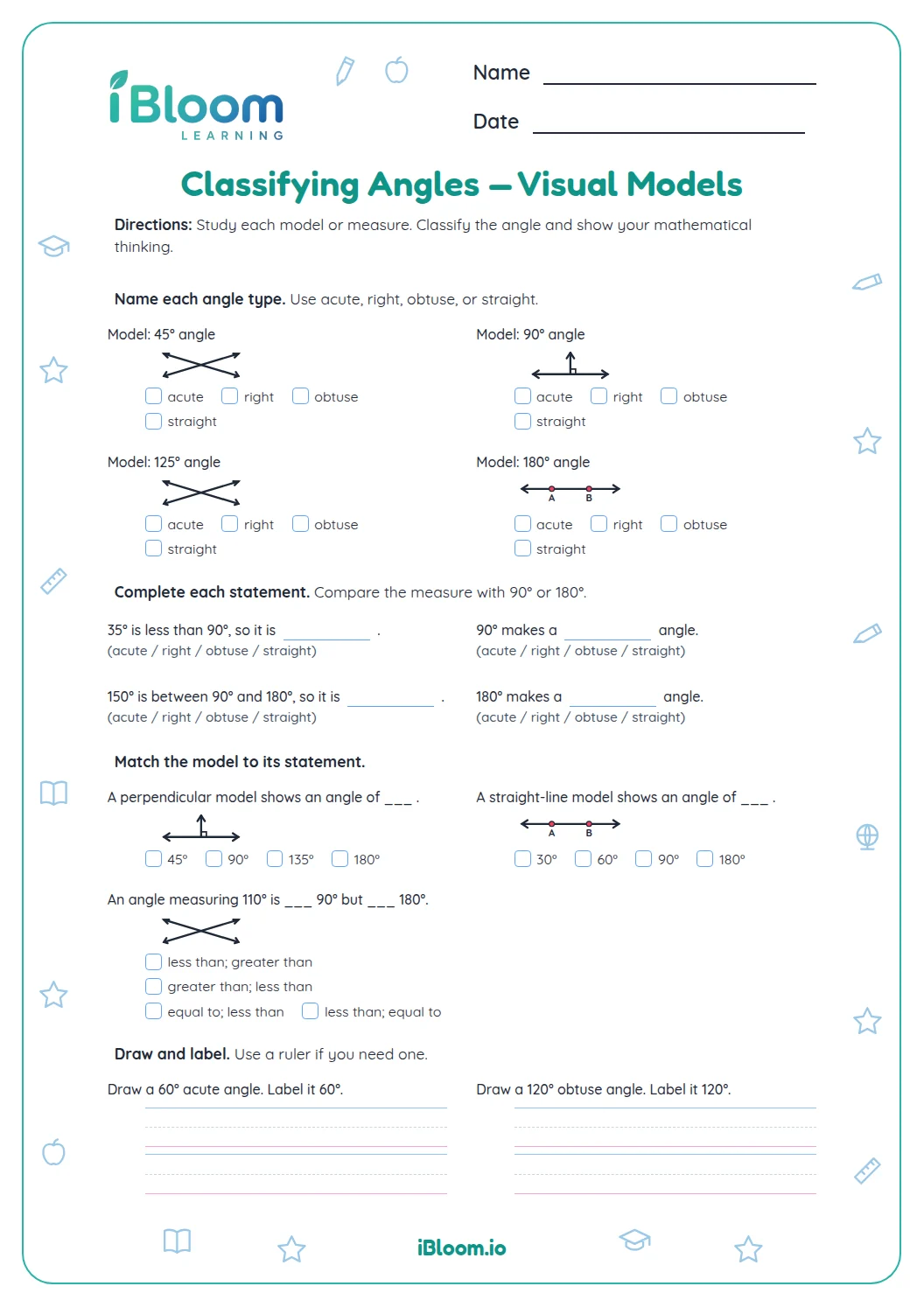
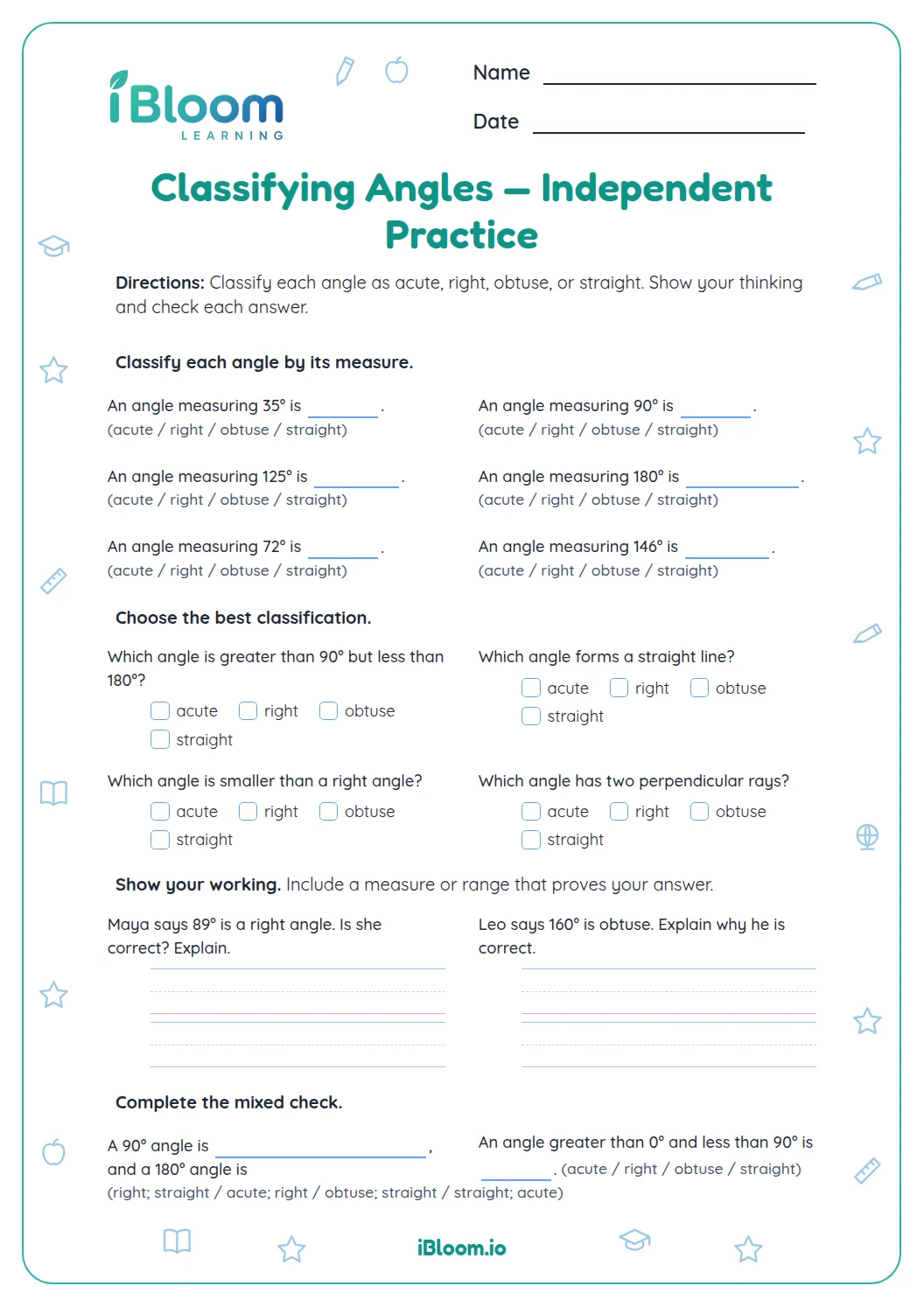
This Grade 5 angle reasoning worksheet replaces the old correction and explanation set with 16 focused questions. Children classify four drawn angles, use 90° and 180° to find missing measures, compare angles with a right angle, and correct a misconception. A separate answer key includes the numerical results and concise reasoning.
Aligned to 4.MD.C.7
What kinds of angle questions are included?
Part A classifies acute, right, obtuse, and straight angles. Part B uses 90° and 180° to solve for an unknown measure. The final questions ask children to compare measures and correct an incorrect classification.
For example, a straight angle split into 73° and x° gives 73 + x = 180, so x = 107°.
- Classify four angles shown in drawings.
- Find missing parts of right and straight angles.
- Explain which classification or comparison is correct.
How do you classify an angle?
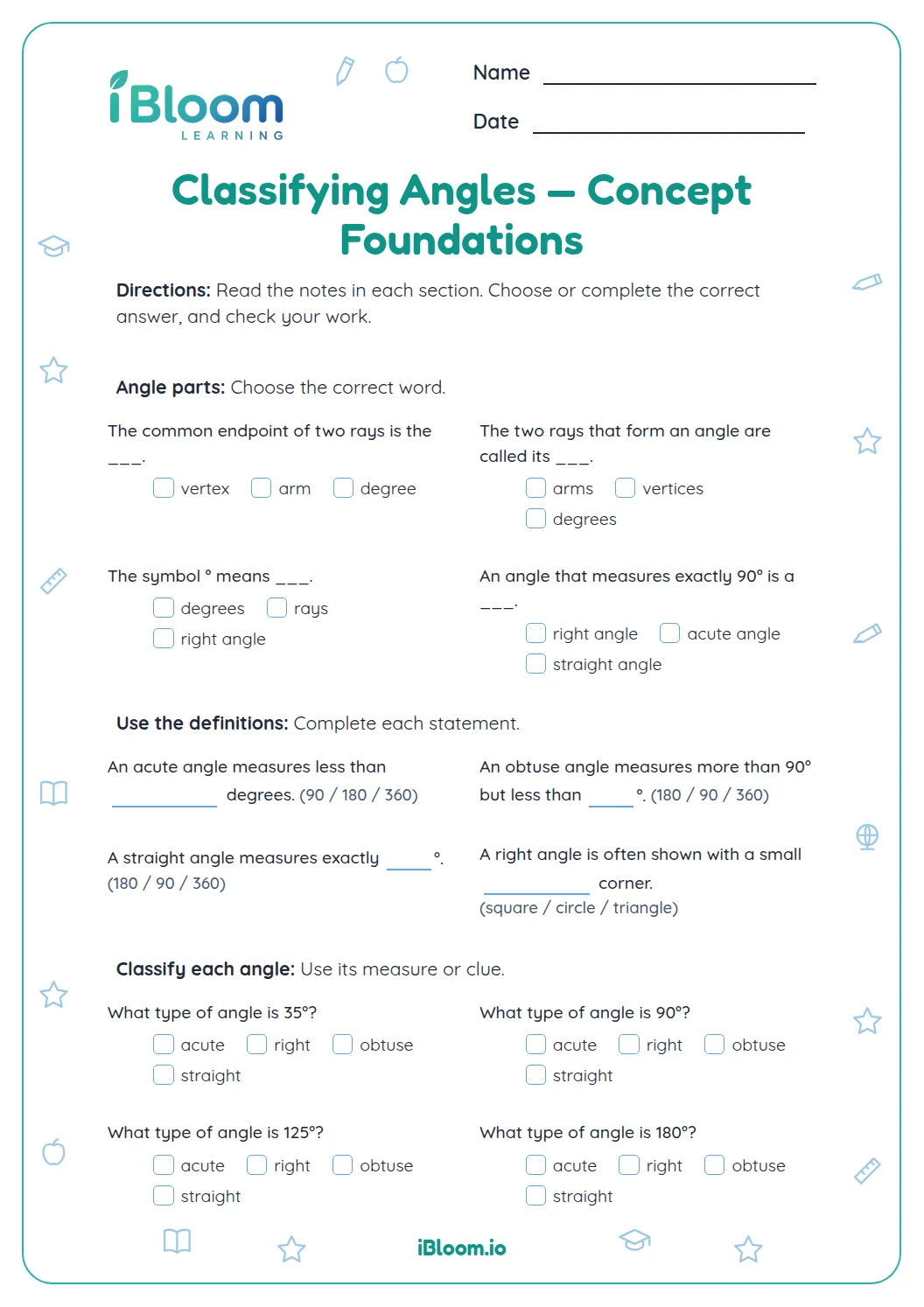
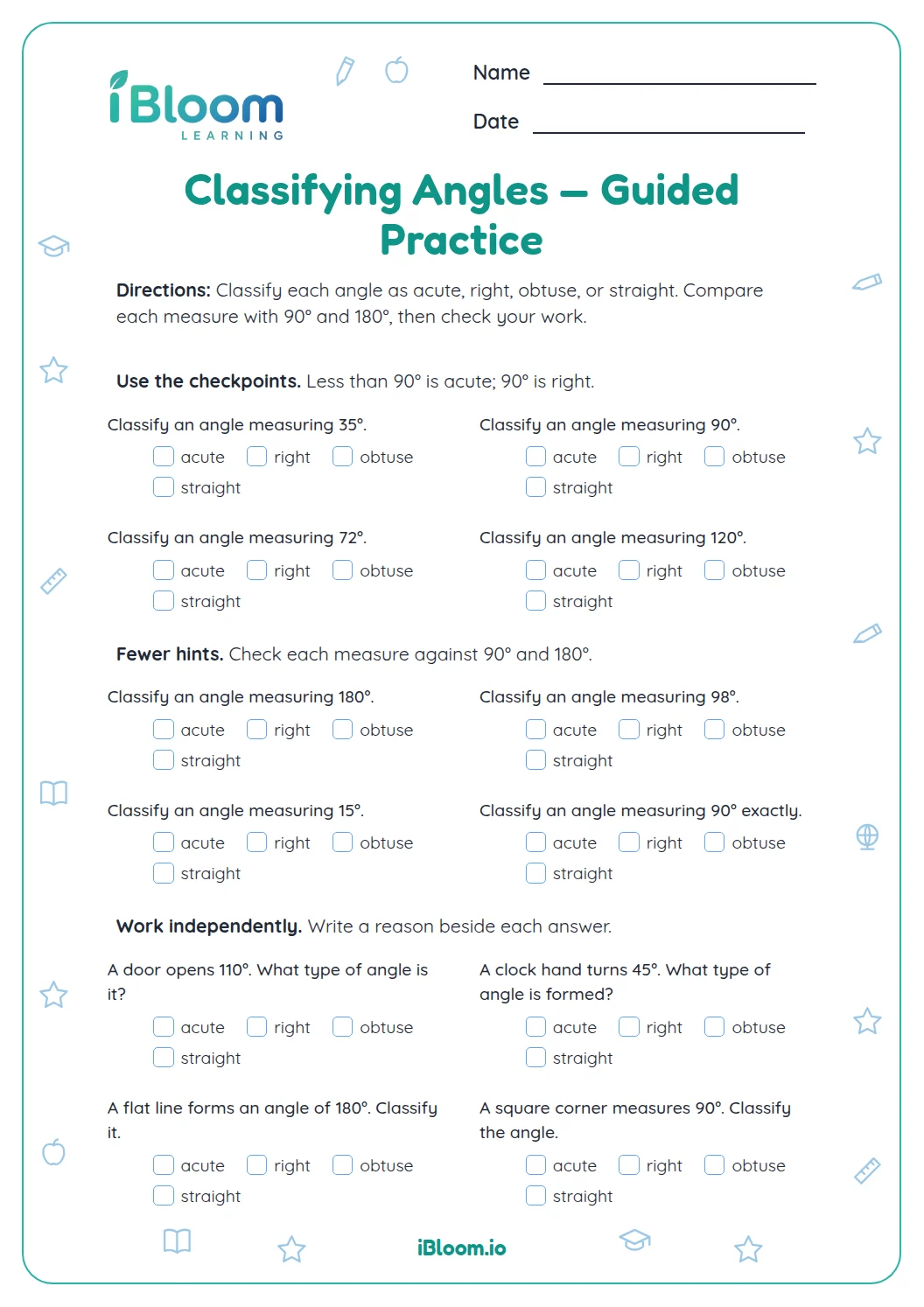
Compare its measure with 90° and 180°. Acute angles are less than 90°, a right angle is exactly 90°, obtuse angles are between 90° and 180°, and a straight angle is exactly 180°.
How can you find an unknown angle measure?
Use the total angle measure and subtract the part you know. Parts of a right angle add to 90°; parts of a straight angle add to 180°. Write an equation first to keep the relationship clear.
How to use this worksheet
- 1Review the boundaries at 90° and 180°.
- 2Classify the four drawn angles.
- 3Write 90° or 180° as the total for each split angle.
- 4Subtract the known part to find the missing measure.
- 5Check each classification against its measure and use the key.
Common mistakes and quick fixes
The mistake
Calling 90° acute because it is not wide.
The fix
Remember that exactly 90° is a right angle.
The mistake
Using 90° as the total for a straight angle.
The fix
A straight angle measures 180°.
The mistake
Finding the missing measure but not its type.
The fix
Compare the result with 90° and 180° before classifying it.
Common Core alignment
This worksheet gives practice with use angle addition to find unknown angles on a diagram in real-world and mathematical problems.
Use angle addition to find unknown angles on a diagram in real-world and mathematical problems.
On this sheet: Use angle addition to find unknown angles on a diagram in real-world and mathematical problems.
Show the official wordingHide the official wording
Recognize angle measure as additive. When an angle is decomposed into non-overlapping parts, the angle measure of the whole is the sum of the angle measures of the parts. Solve addition and subtraction problems to find unknown angles on a diagram in real world and mathematical problems, e.g., by using an equation with a symbol for the unknown angle measure.
What to practice next
Make more practice
Further reading
Questions parents and teachers ask
Which angle types appear on this worksheet?
The sheet practices acute, right, obtuse, and straight angles. Four questions pair each classification with a drawn angle. The remaining questions use these categories while children find missing measures, compare angles, or correct a mistaken classification. Each drawing is labeled with its angle measure.
How do I find a missing part of a right angle?
A right angle measures 90°, so subtract the known part from 90°. For example, if one part is 27°, the other is 90° − 27° = 63°. The worksheet uses this relationship along with the 180° total for straight angles. It also includes four angle drawings and a separate answer key for checking each response.
Does the worksheet include an answer key?
Yes. The separate key gives the classification or missing measure for each question. For reasoning questions, it provides a concise model response that can help a child explain why a classification fits the angle measure. Check the measure first, then compare it with 90° and 180°.
What is the difference between obtuse and straight?
An obtuse angle is greater than 90° but less than 180°. A straight angle measures exactly 180° and forms a straight line. Compare the measure with both boundaries to tell the two types apart. The key includes the exact result and a short explanation where reasoning is requested.
How long should this angle worksheet take?
Allow about 20 minutes for 16 questions, including the calculations and reasoning. A child may work faster on the classification items and spend longer explaining a correction. The answer key can be used after the full set or section by section. The boundaries help distinguish all four angle types clearly.