

About this worksheet
This Grade 5 printable gives learners 14 angle questions in real-world settings. The first eight ask them to classify drawn and described angles as acute, right, or obtuse. The last six use addition and subtraction to find unknown angle measures in turns and openings. A separate answer key lists each answer.
How can learners classify an angle?
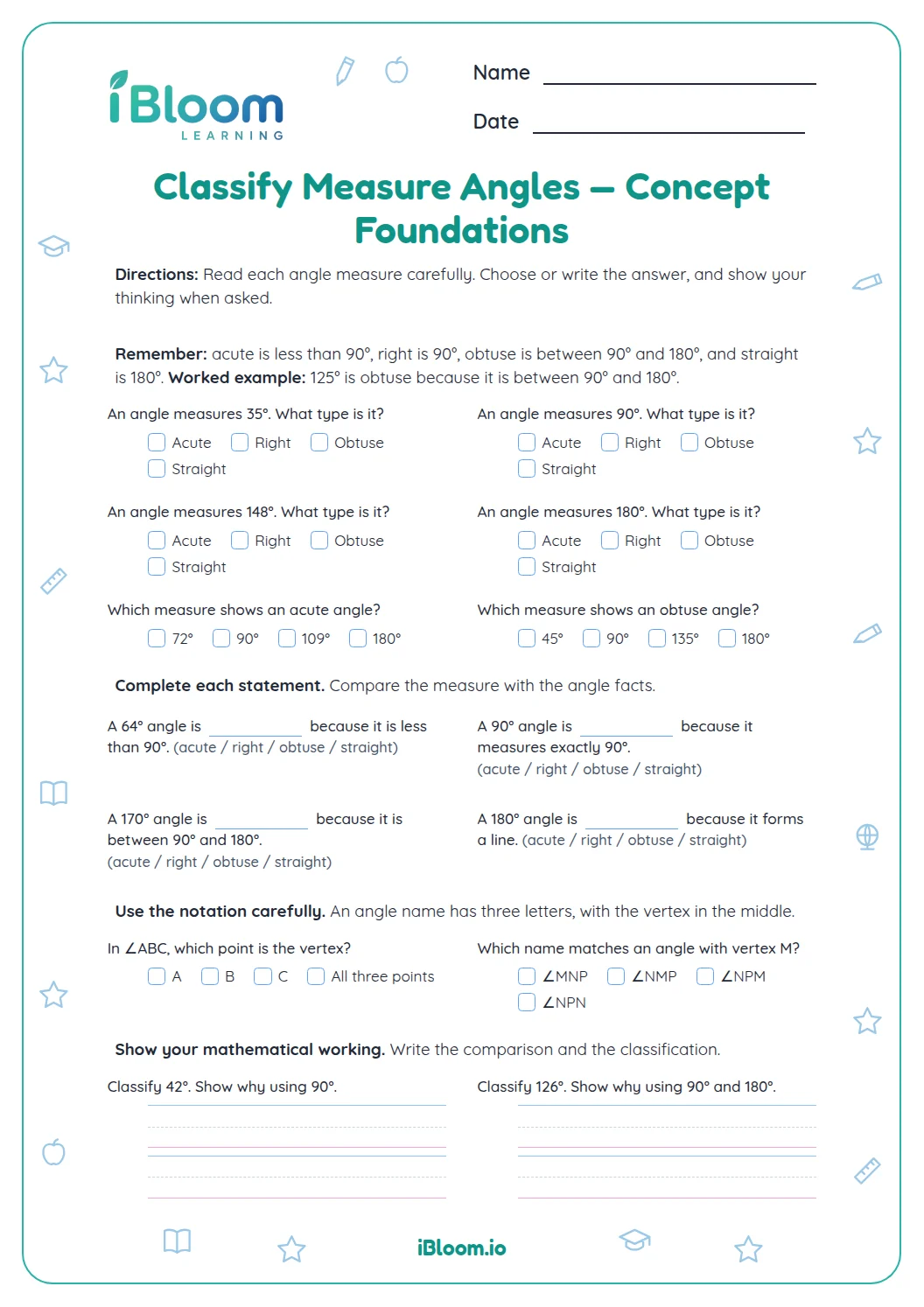
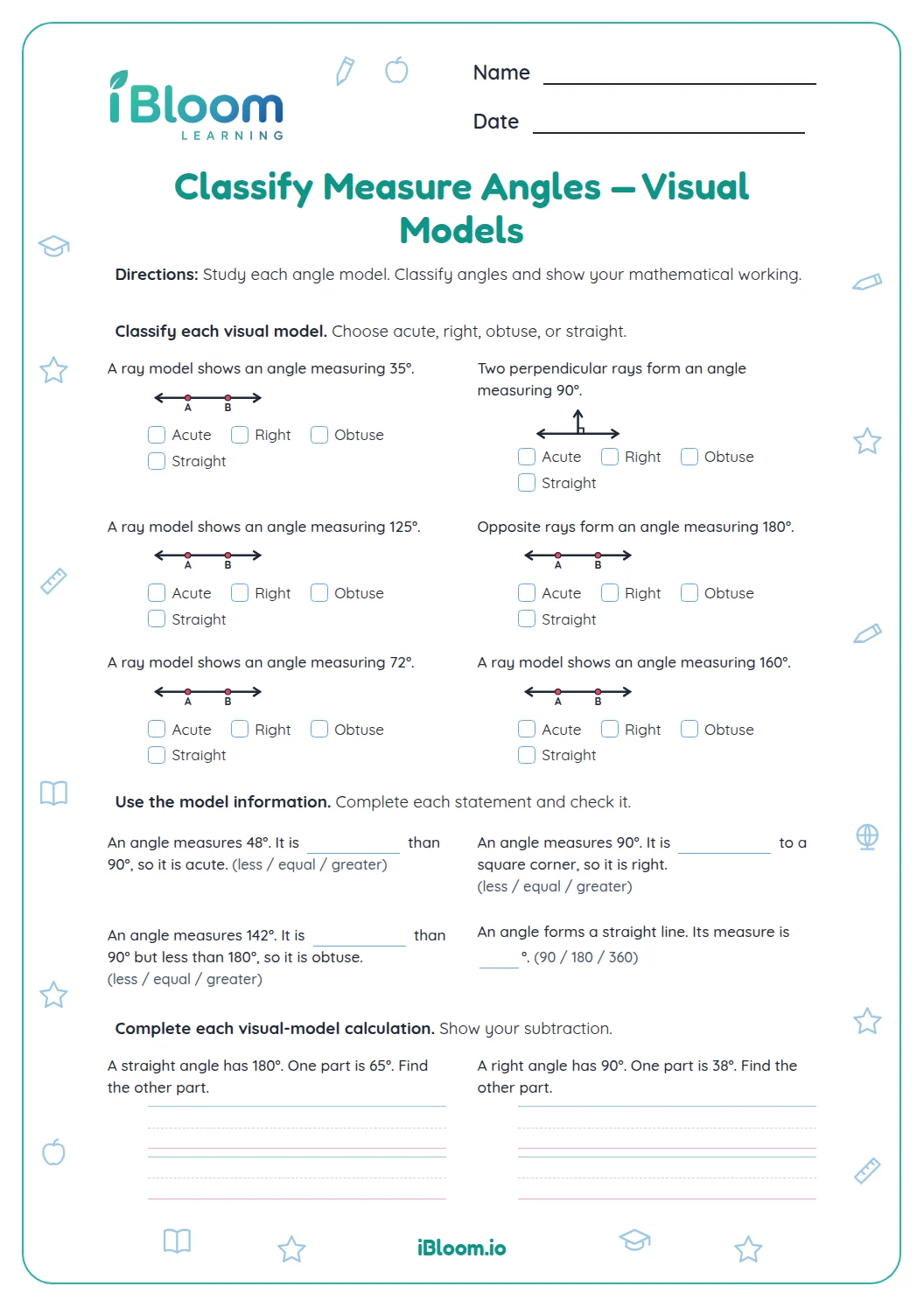
Compare the opening with a right angle: less than 90° is acute, exactly 90° is right, and greater than 90° but less than 180° is obtuse. The first eight questions ask learners to classify drawn or described angles.
- 1The drawing measures 128°.
- 2128° is greater than 90° and less than 180°.
- 3So the angle is obtuse.
How do you find an unknown angle measure?
Questions 9–14 describe turns and openings. Add adjacent turns or subtract a known part from a total, then choose the measure that fits.
- 1The sign turns from 25° to 70°.
- 270° − 25° = 45°
- 3The turn measures 45°.
How can a learner check an angle answer?
Check whether the calculation matches the described whole turn or opening. For a classification, compare the angle with 90° and 180°.
How to use this worksheet
- 1Read the situation and identify the angle or signed change.
- 2Use the picture, degree measure, or number line when provided.
- 3Choose or write the answer that matches the information.
- 4Check the answer key and revisit any missed item.
Common mistakes and quick fixes
The mistake
Calling every large angle obtuse without checking its measure
The fix
Compare with 90° and remember a straight angle is 180°.
The mistake
Calling a 90° angle acute
The fix
A right angle measures exactly 90°.
The mistake
Using the setting instead of the angle
The fix
Classify the drawn opening or stated degree measure.
What to practice next
Make more practice
Questions parents and teachers ask
What is an acute angle?
An acute angle is smaller than a right angle. For example, the 35° angle beside the ramp is acute because 35° is less than 90°. Use the angle drawing and its measure together to check the classification. Use the 90° benchmark to explain why each classification fits.
Which angles are drawn on the sheet?
Six items show an angle drawing to classify, including an acute ramp angle, a right book corner, and an obtuse gate angle. The remaining items give a degree measure in an everyday setting and ask for its classification. Read the measure first, then compare it with 90° and 180°.
How do I tell a right angle from an obtuse angle?
A right angle measures 90°. An obtuse angle is larger than 90° and smaller than 180°. The worksheet includes a 90° tile corner and wider openings, so compare each measure with 90° before choosing. The key lists each classification so learners can review the comparison.
Why does the worksheet use everyday examples?
Ramps, book corners, gates, clock hands, signs, fans, screens, lids, and doors make the angle measures easier to picture. Learners still answer with a geometry term: acute, right, or obtuse. For example, 30° is acute because it is less than 90°.
Is an answer key included?
Yes. The separate key names the drawn angles and marks the correct classification for each measured example. It can be used after the learner finishes to check that the degree measure matches the angle name. These comparisons make the angle names concrete in everyday contexts.