



About this worksheet
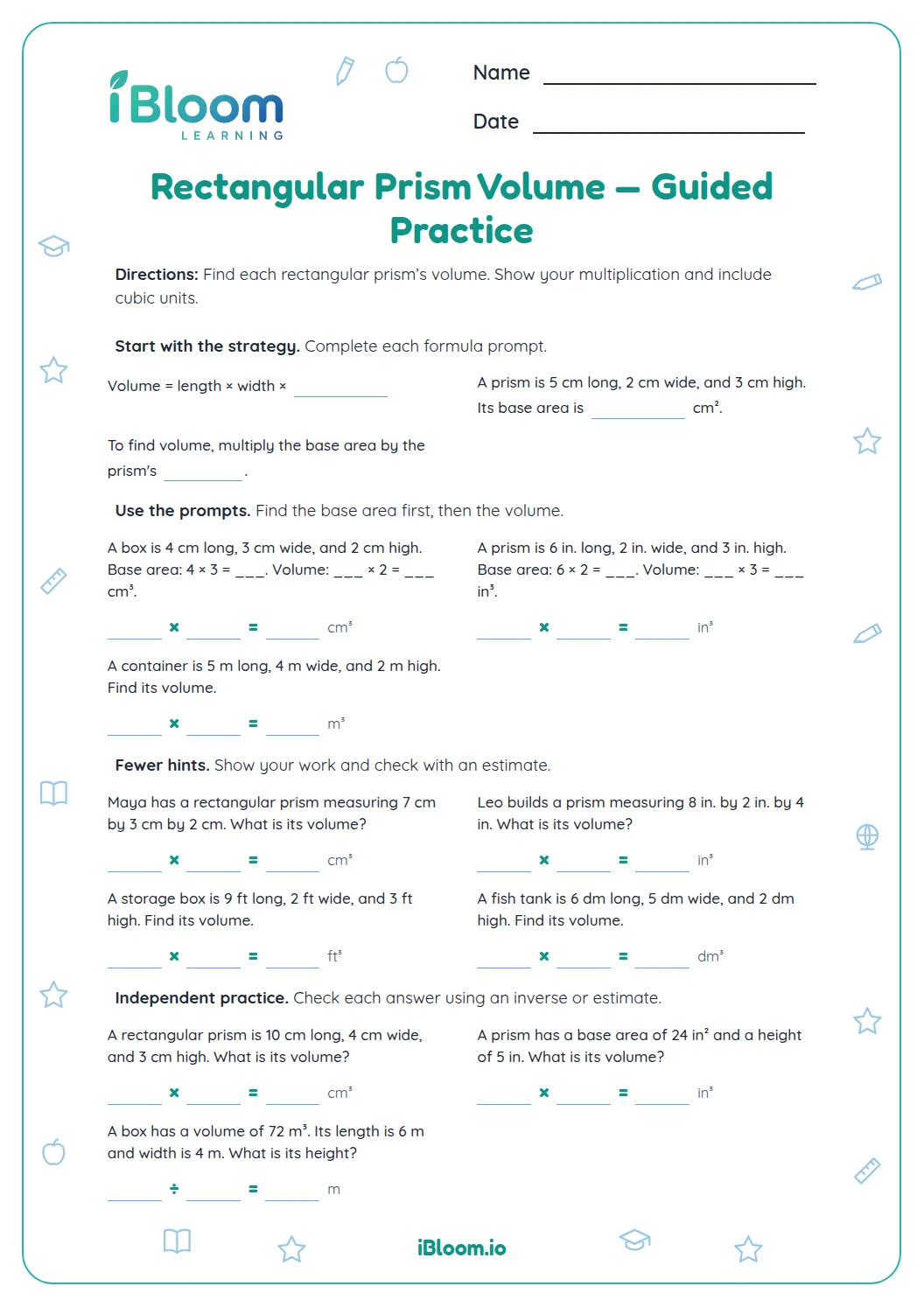
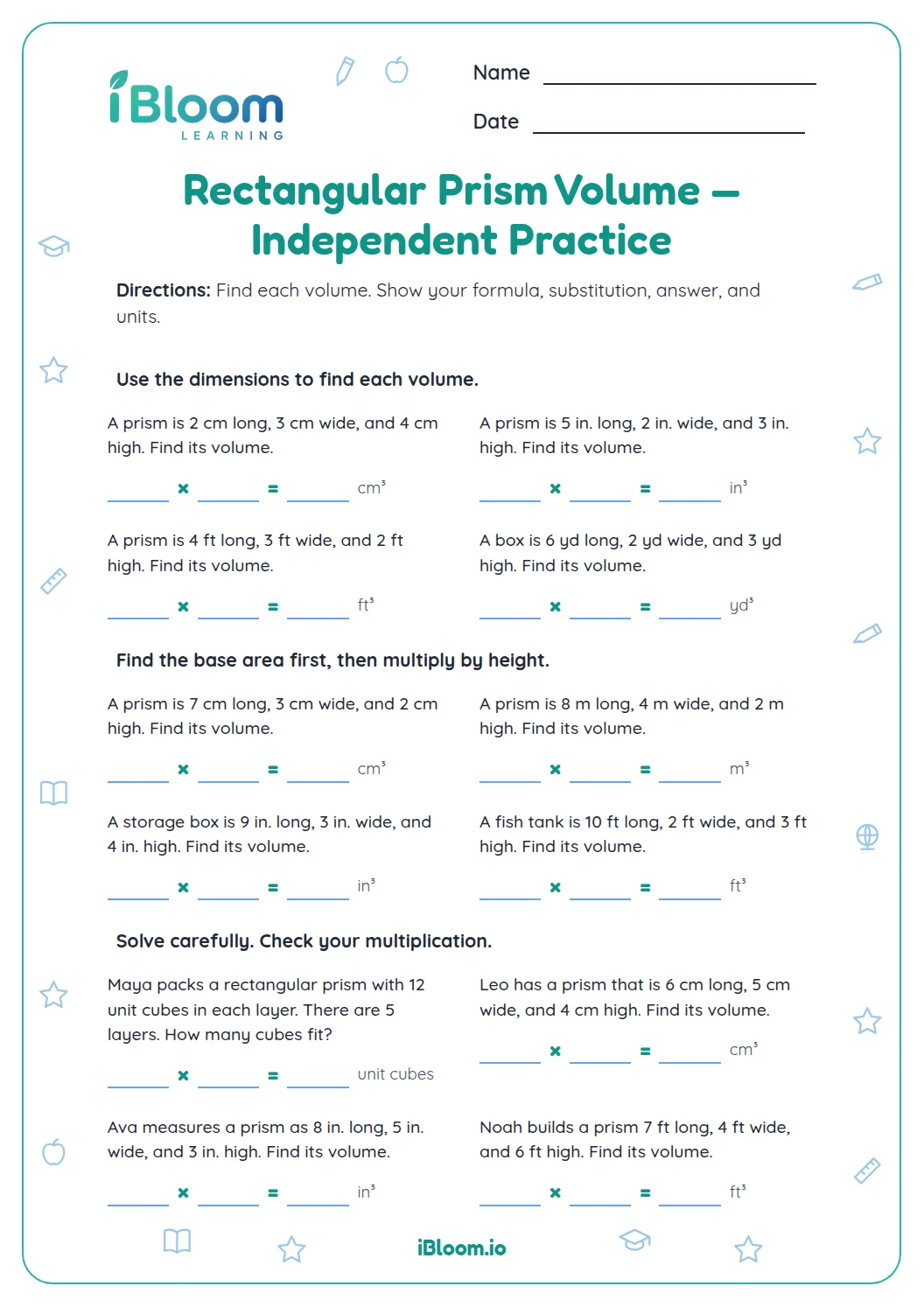
This printable asks students to distinguish volume from surface area and calculate with rectangular-prism dimensions. It includes unit choices, direct calculations, and real-world problems about storage, packaging, and capacity. Students label volume in cubic units and surface area in square units.
Volume and surface area answer different questions
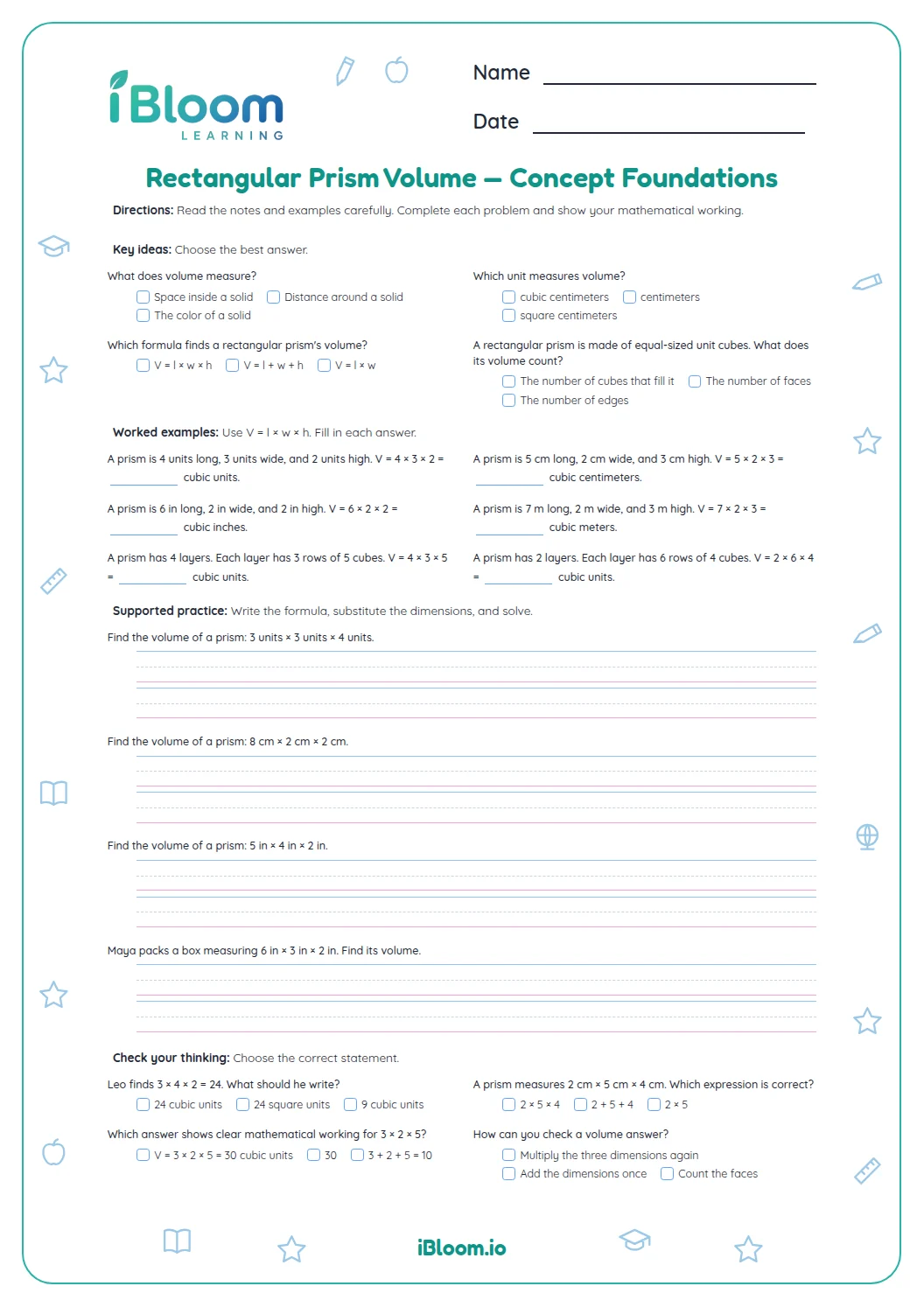
Volume measures space inside a rectangular prism. Multiply length by width and height, then use cubic units. A tank’s capacity is a volume question.
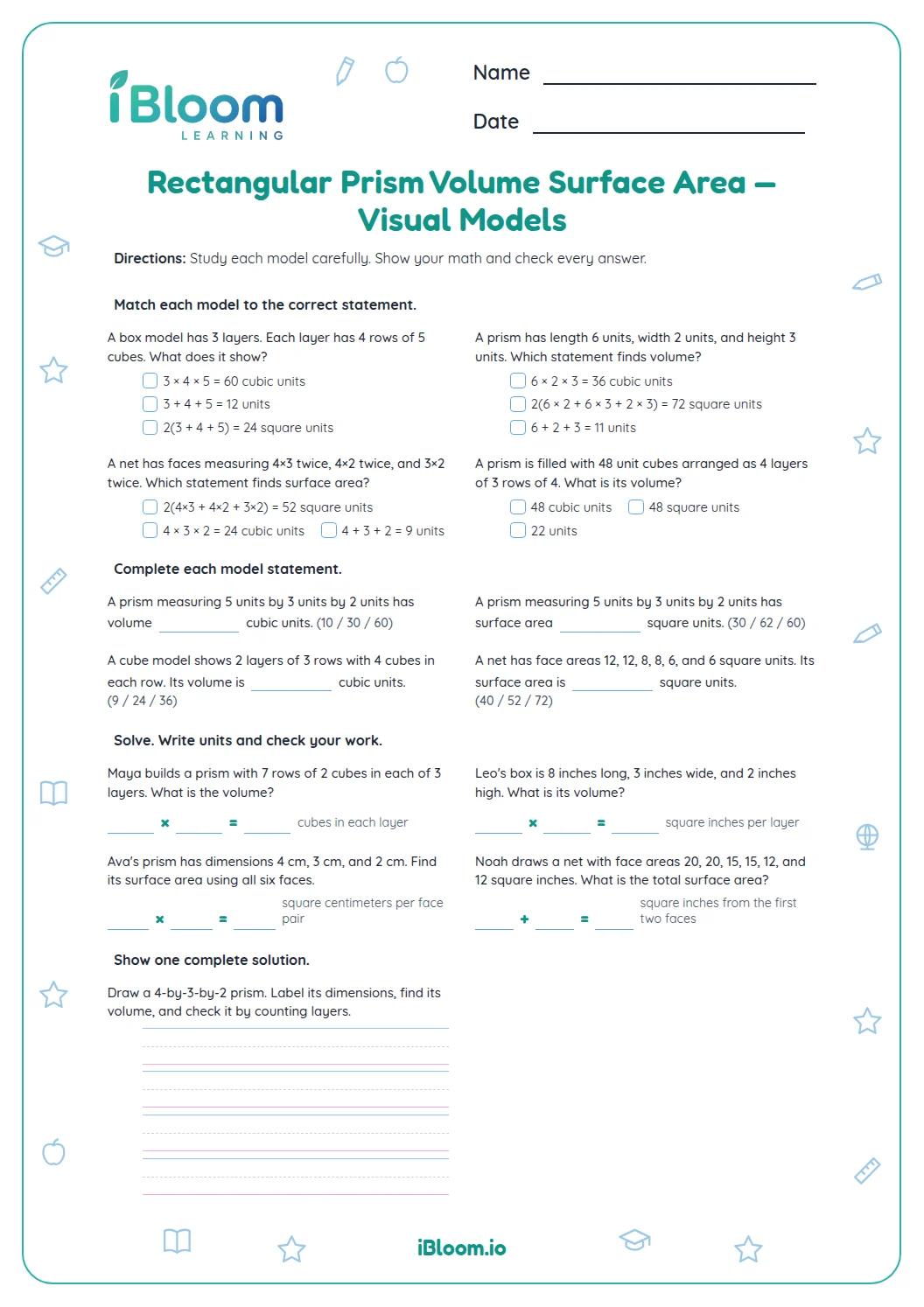
Surface area is the total area of the six outside faces. Find lw, lh, and wh, add them, then double the sum: 2(lw + lh + wh). A covering-material question asks for square units. Question 2, a 5 cm by 3 cm by 2 cm gift box, has 62 cm² of surface area.
A practical mix of prism problems
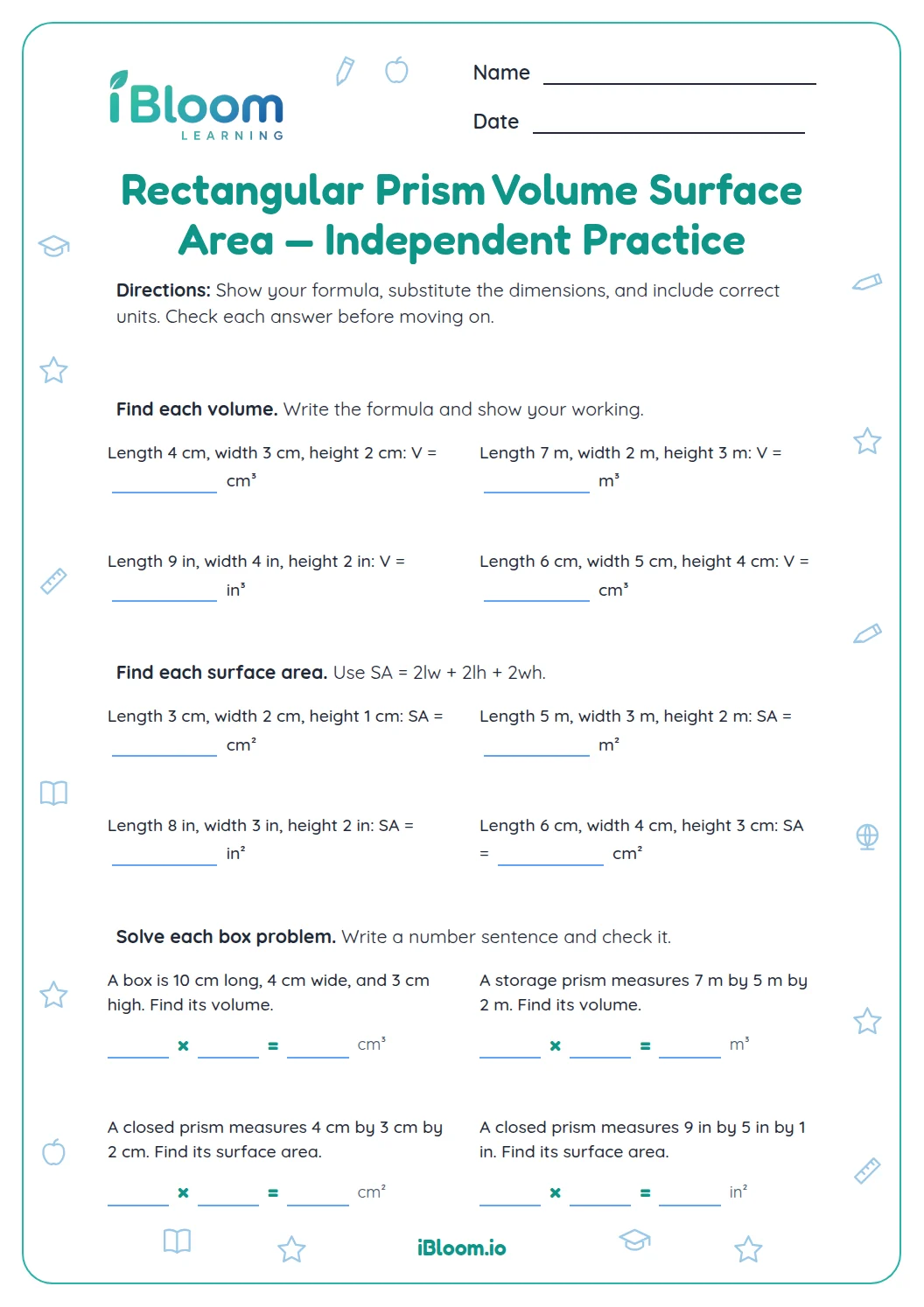
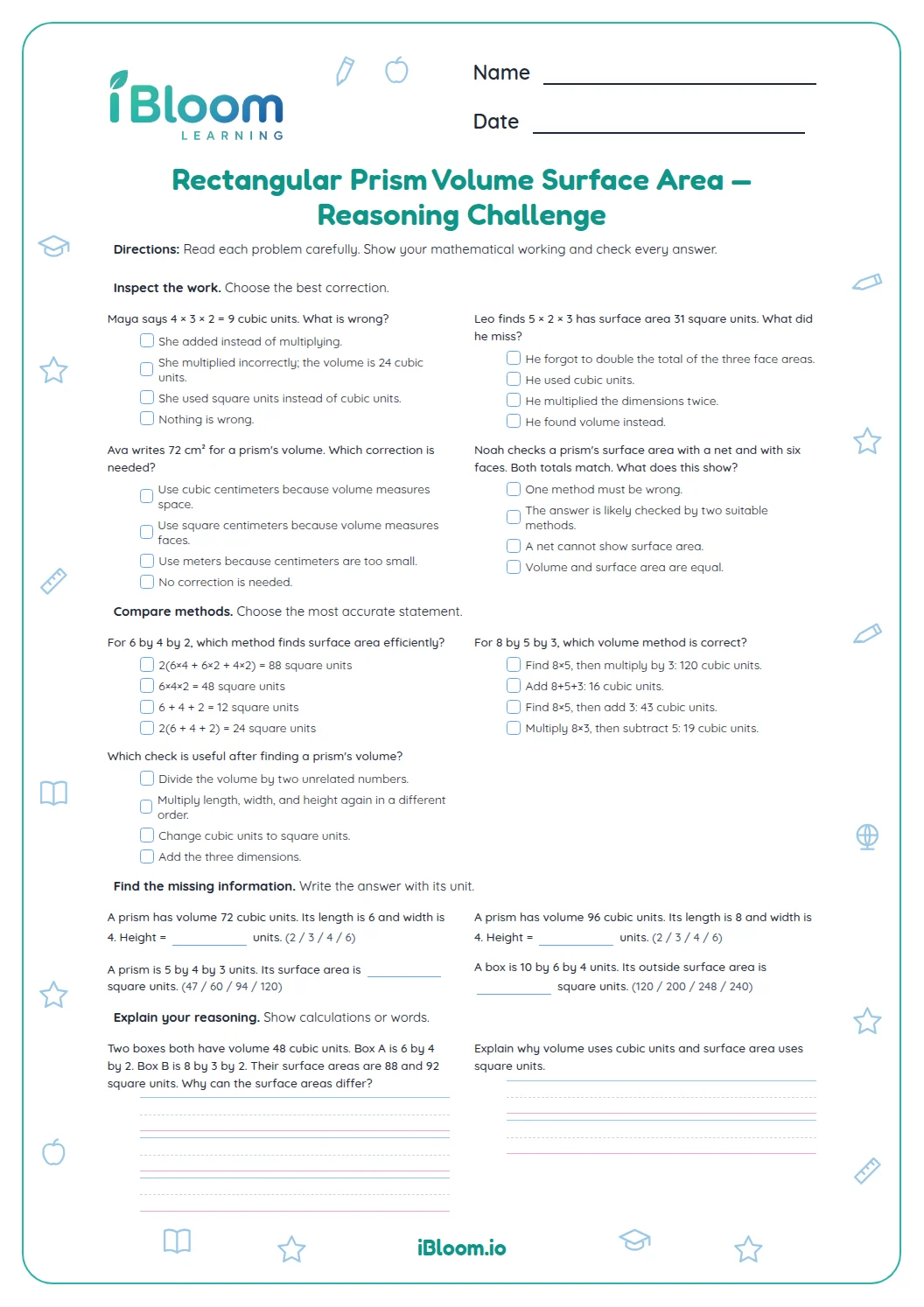
Part A distinguishes measures and units. Part B practices volume with short dimension sets. Part C calculates surface area and applies both measures to real-world situations.
- Choose the measure that matches the question
- Calculate volume in cubic units
- Add all six face areas for surface area
- Show work on application problems
Check the unit before finishing
Ask whether the story measures space inside or material on the outside. Square inches cannot describe aquarium capacity, and cubic inches do not describe wrapping paper.
How to use this worksheet
- 1Look for “hold” or “soil space” for volume and “cover” or “outside” for surface area.
- 2Write dimensions and select the matching formula.
- 3For surface area, add all three face pairs.
- 4Check the unit: square for area, cubic for volume.
Common mistakes and quick fixes
The mistake
Multiplying three dimensions when asked for covering material.
The fix
Use 2(lw + lh + wh) for the six faces.
The mistake
Counting only one pair of faces.
The fix
Find lw, lh, and wh, then double their sum.
The mistake
Writing square units for capacity.
The fix
Capacity is volume, so use cubic units.
What to practice next
Make more practice
Further reading
Questions parents and teachers ask
What is the difference between volume and surface area?
Volume is the amount of space inside a three-dimensional figure. Surface area is the total area covering its outside faces. A tank’s capacity asks for volume, while the paper needed to wrap a box asks for surface area. The units help: volume uses cubic units and surface area uses square units.
What formula finds volume?
Multiply the prism’s length, width, and height. For example, a box measuring 4 inches by 3 inches by 2 inches has volume 24 cubic inches. The three dimensions count rows, columns, and layers of unit cubes, which is why the result uses cubic units.
How do you find surface area?
A rectangular prism has three pairs of matching rectangular faces. Find the areas lw, lh, and wh, add those three values, and multiply by 2. The formula is 2(lw + lh + wh). Label the result in square units because it measures the area of flat faces.
Why are volume units cubic?
Volume uses cubic units because it measures space in three dimensions: length, width, and height. Surface area uses square units because each face is measured in two dimensions. Check the question before calculating so the formula and unit match what the situation asks.
What units should students use?
Volume describes space inside a prism, so students use cubic units such as cubic inches or cubic centimeters. Surface area describes the combined area of the outside faces, so it uses square units. The unit label should match the quantity the question asks them to find.
Is there an answer key?
Yes. The separate key gives the calculations and units. For surface area, students should show the three face-pair areas before doubling their sum. For volume, they should multiply all three dimensions. Checking the unit is a useful way to catch a formula mix-up.