




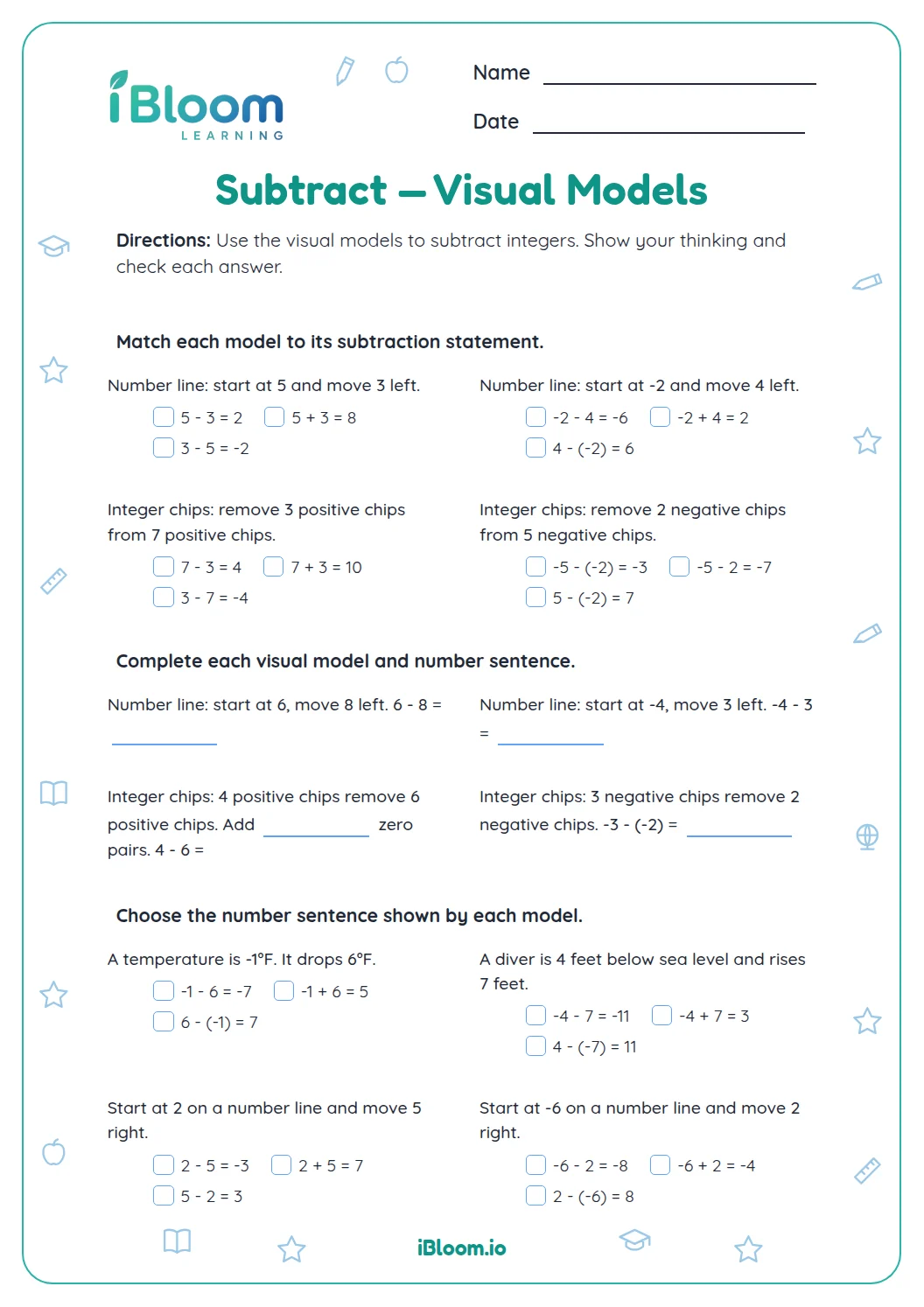
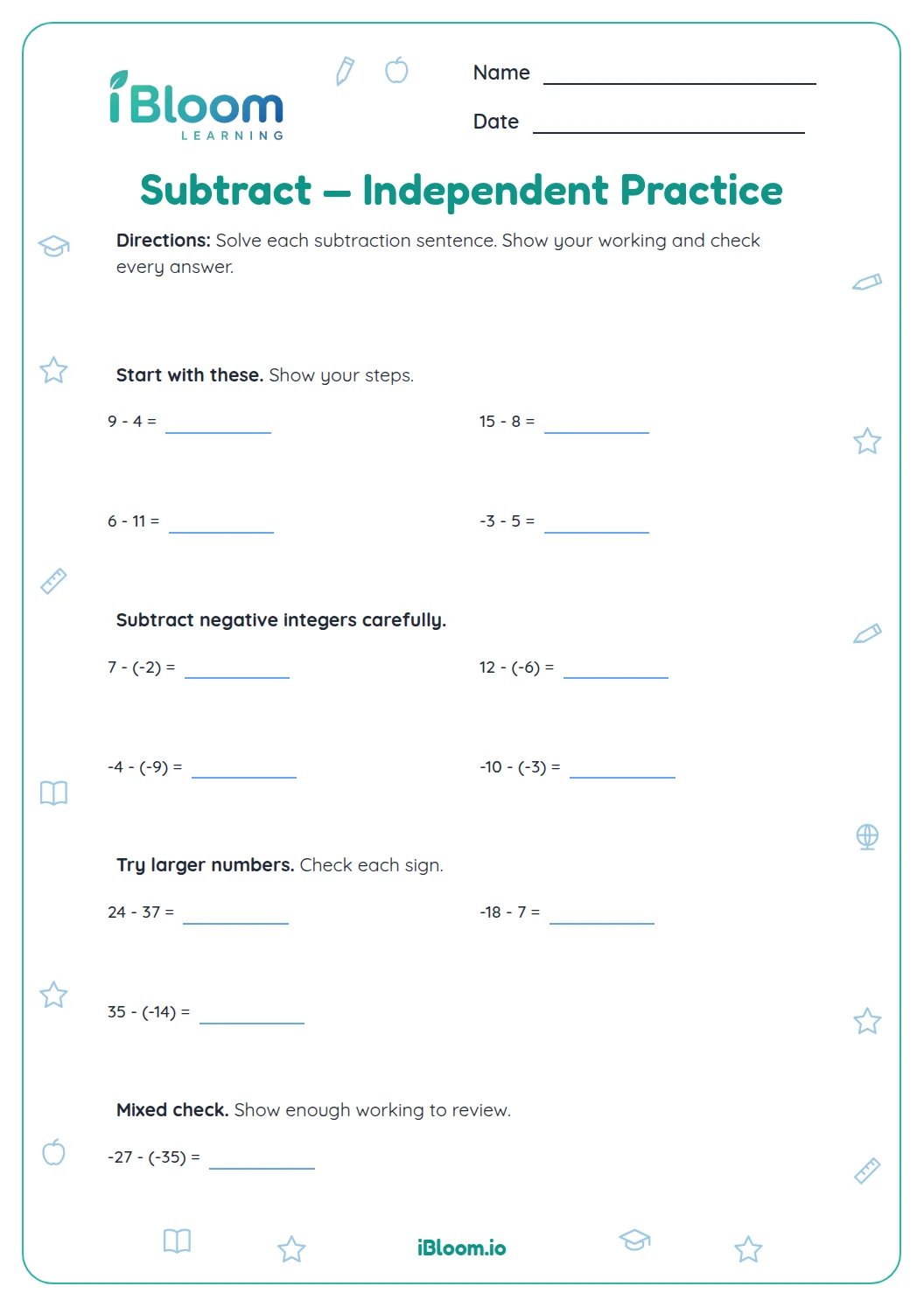
About this worksheet
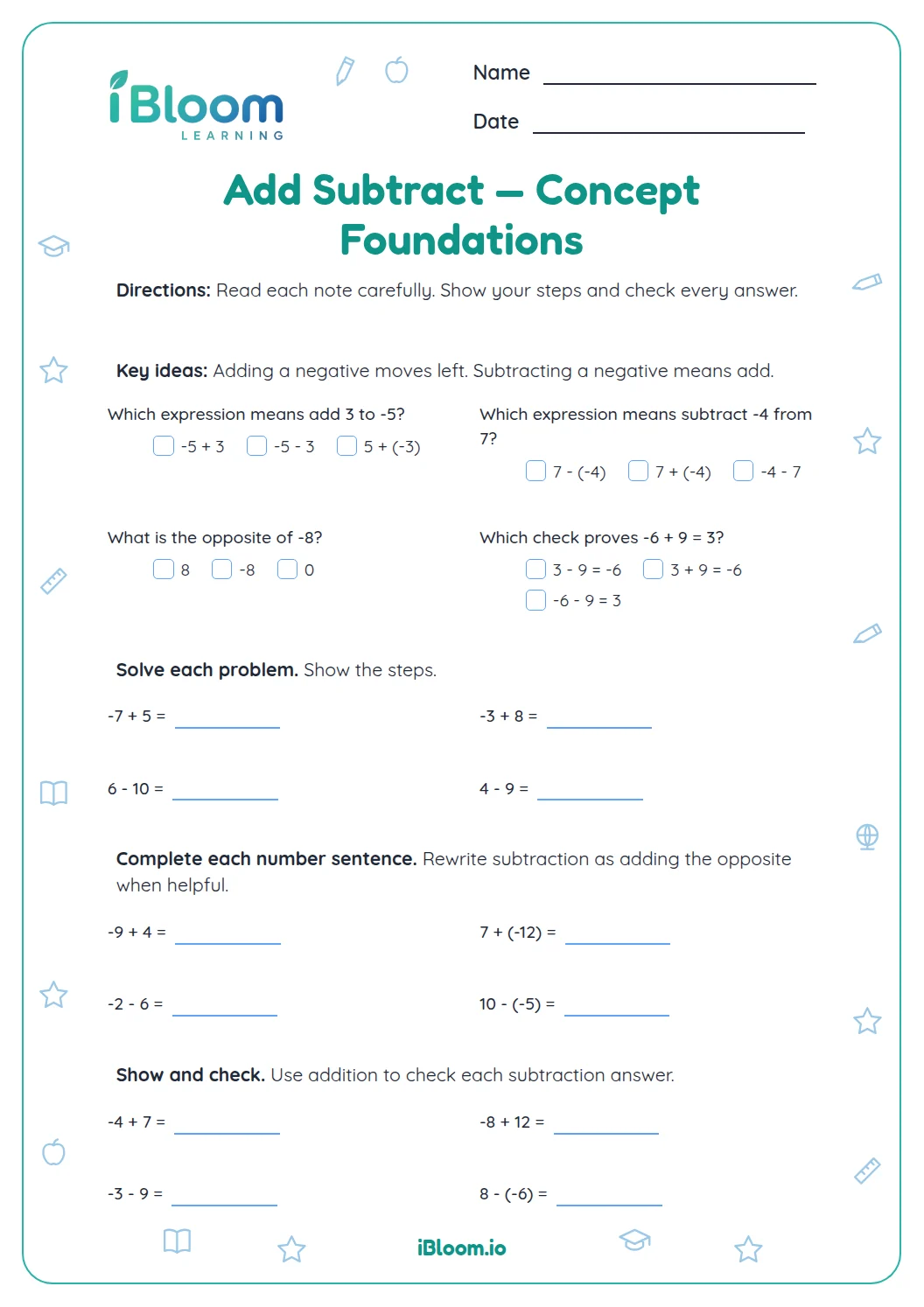
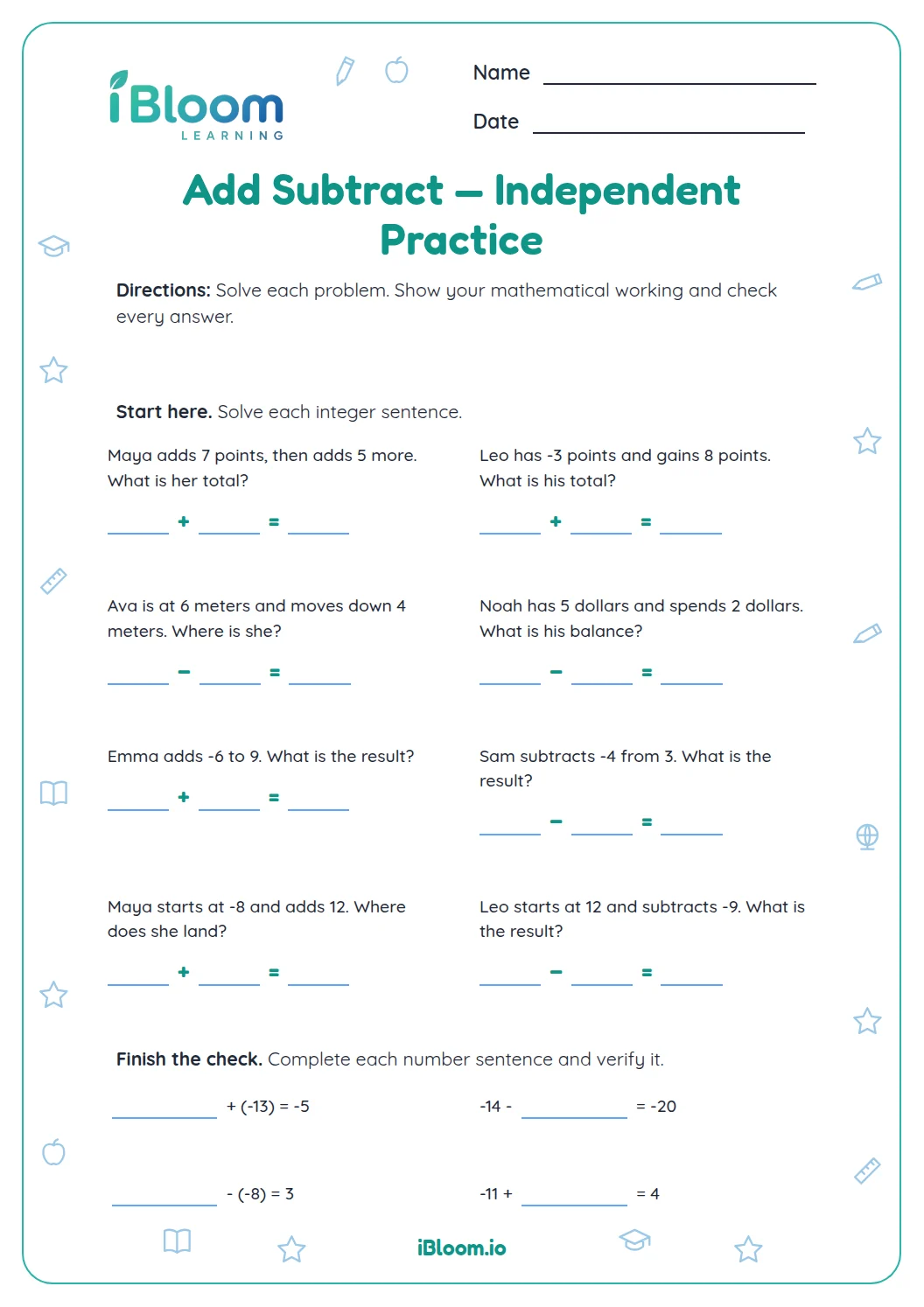
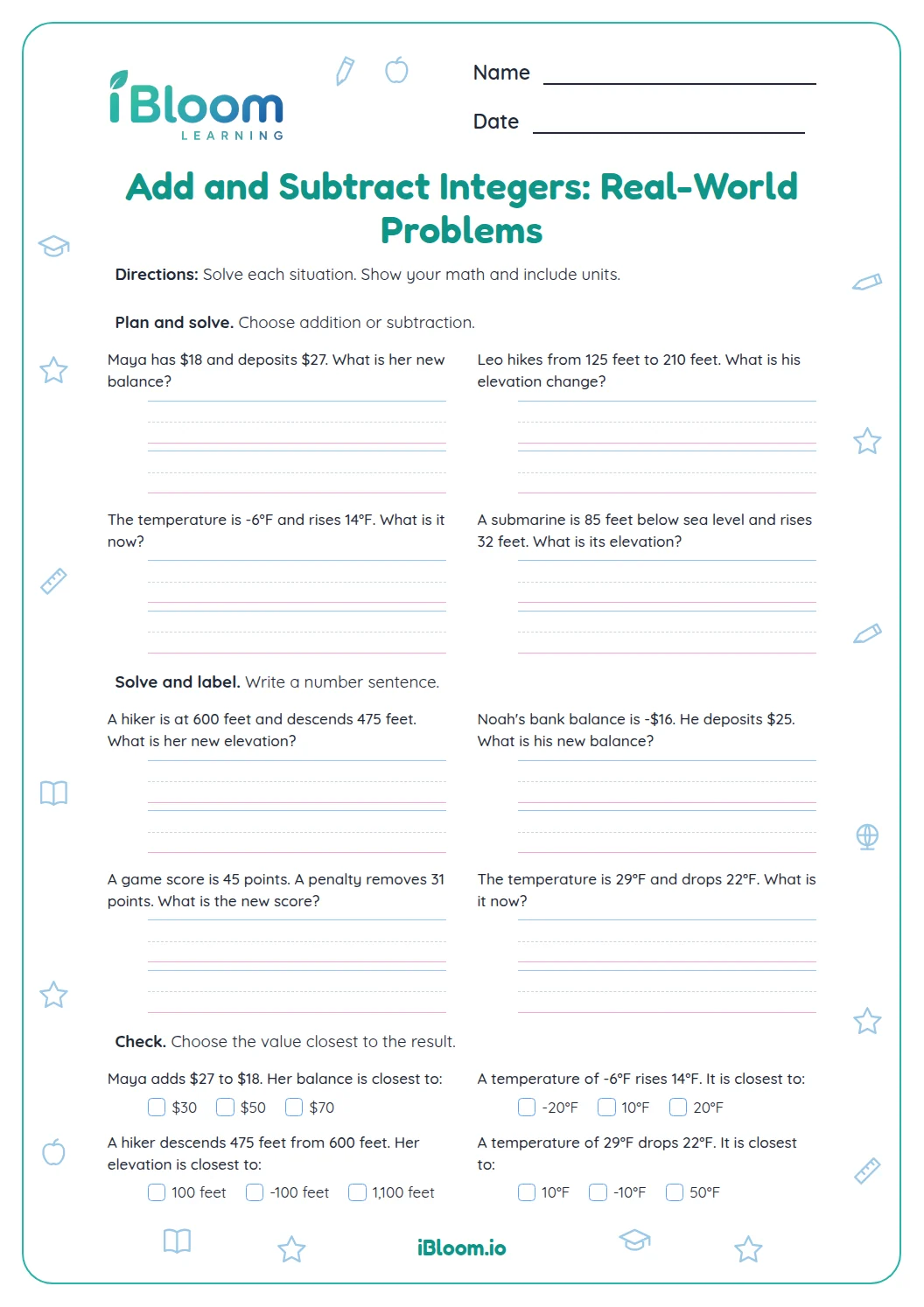
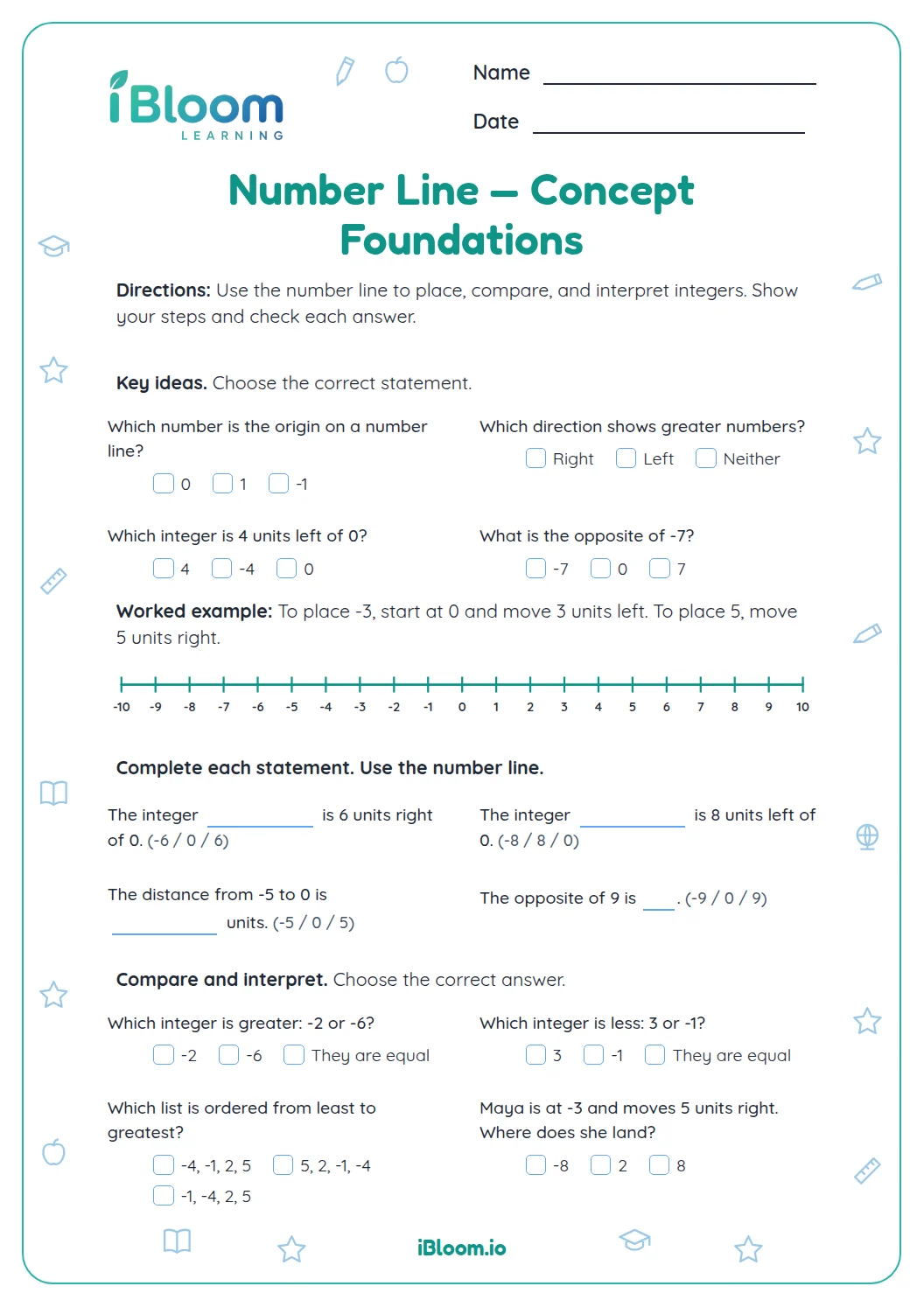
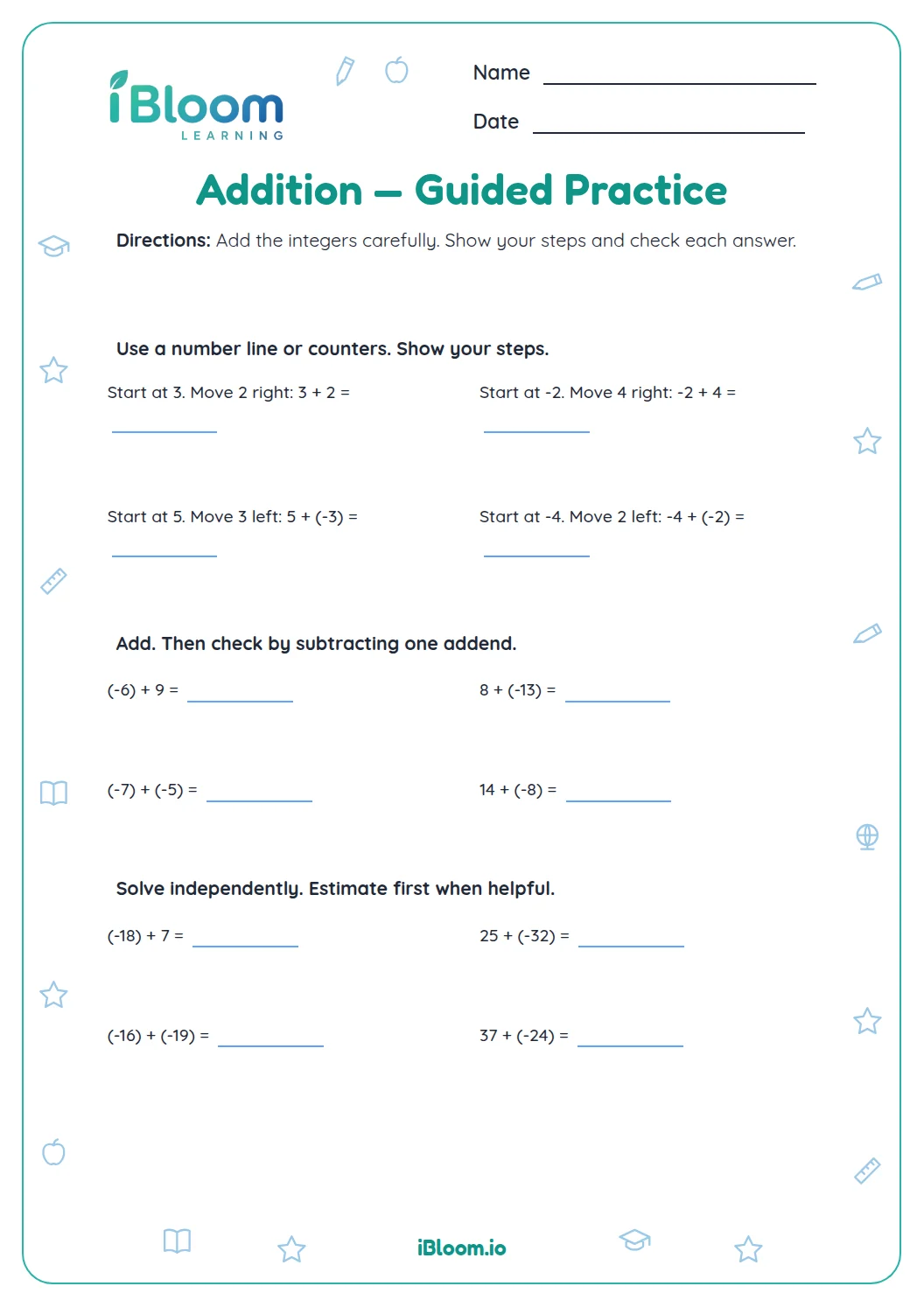
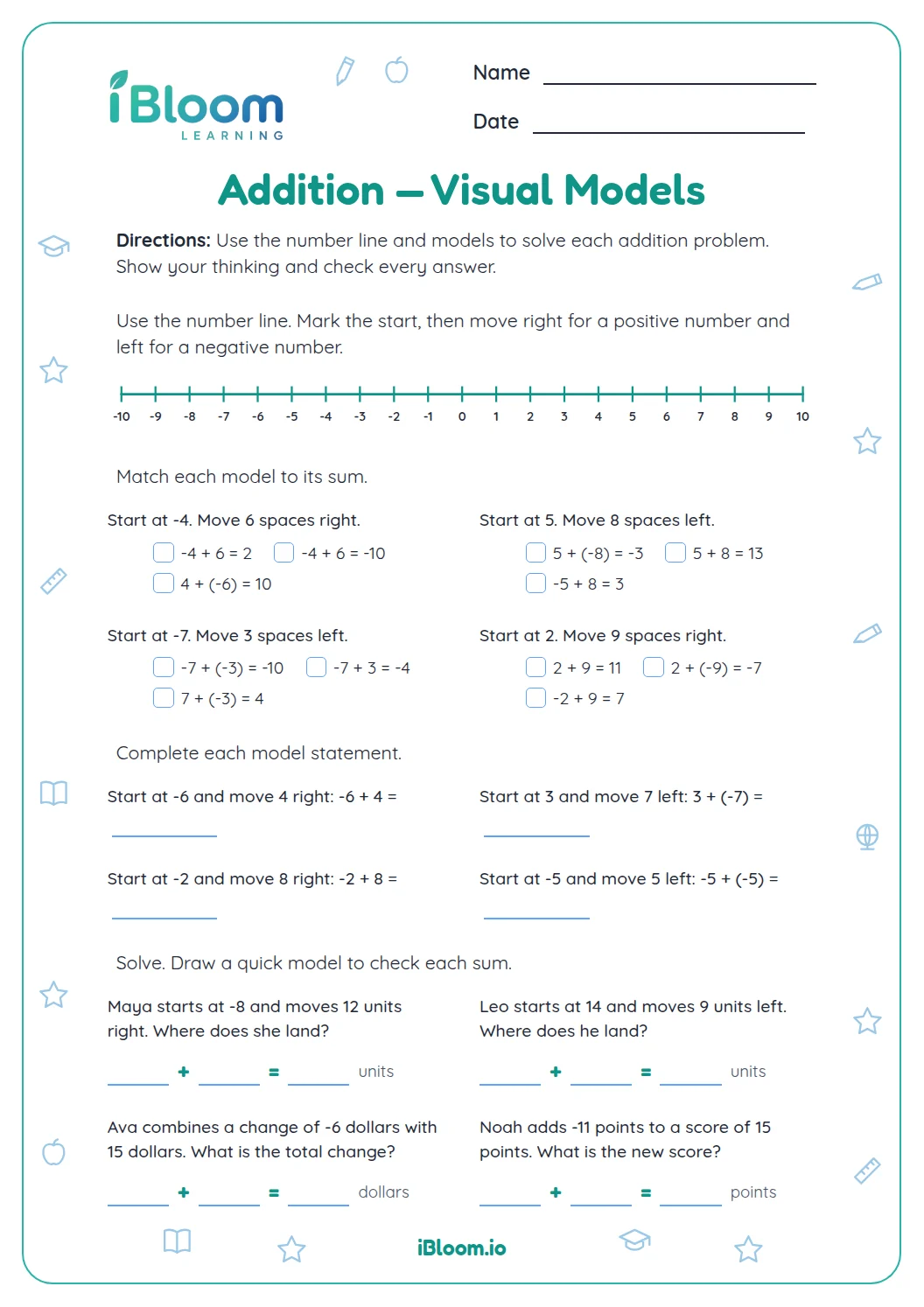
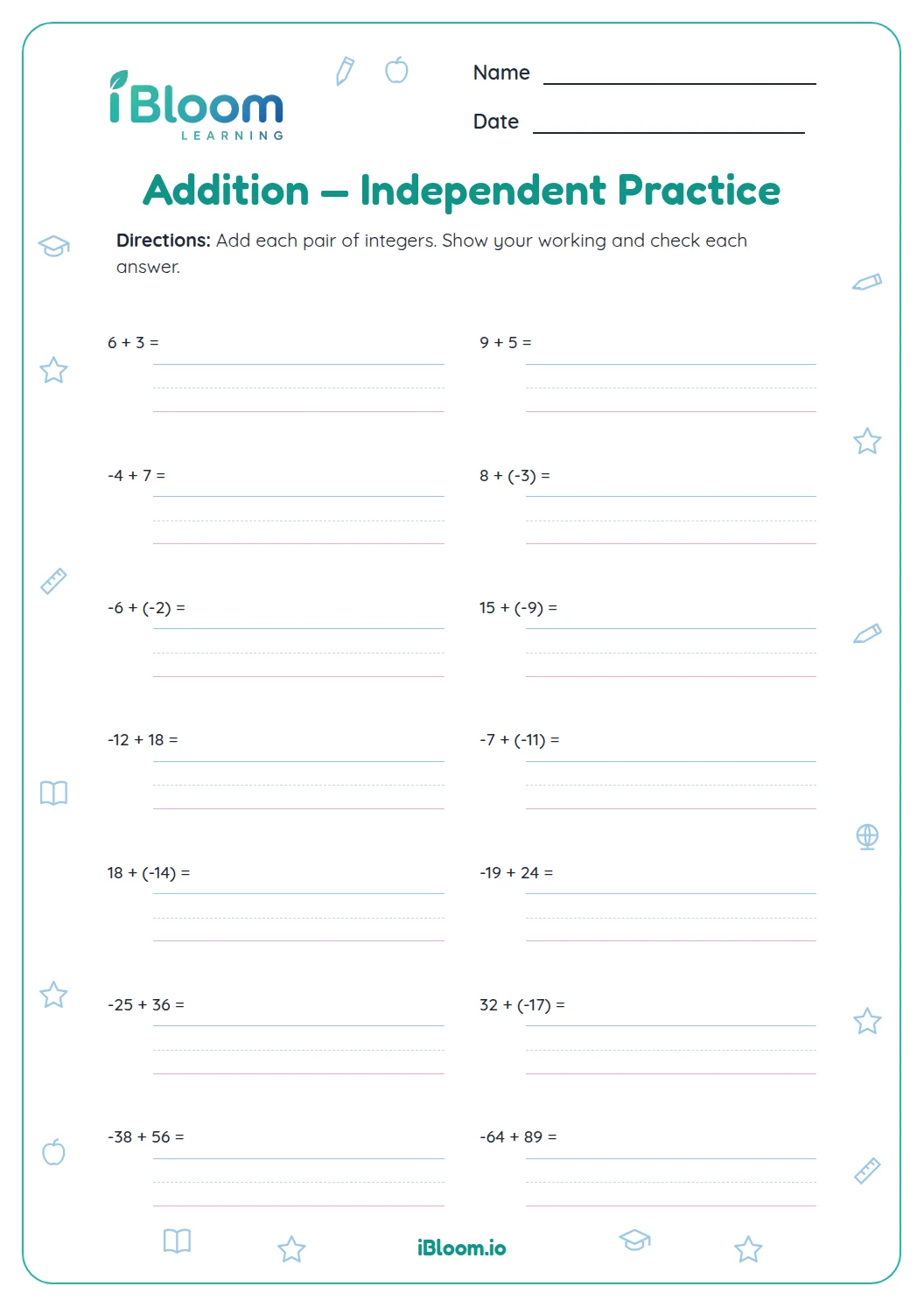
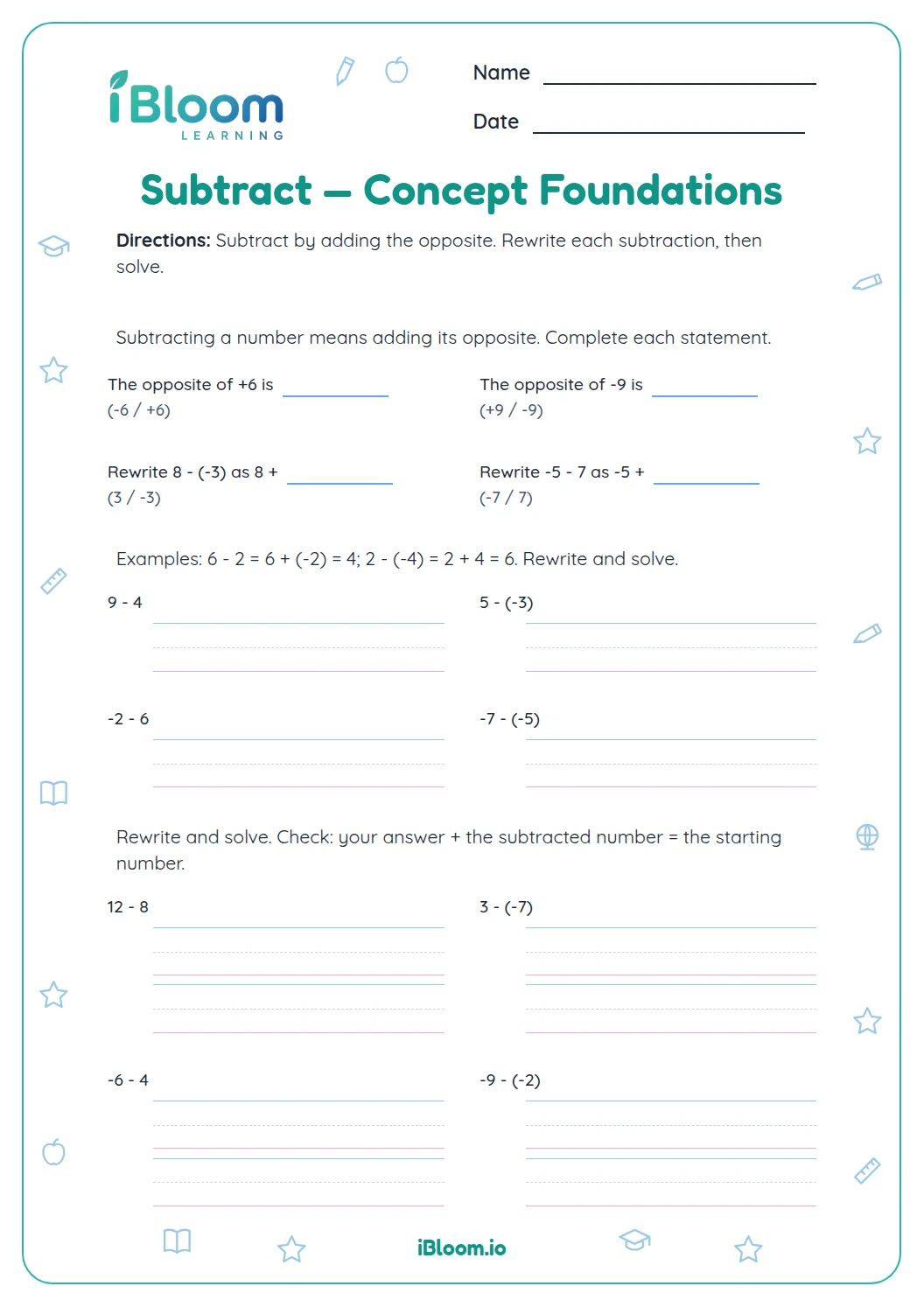
This free printable worksheet gives Grade 5 students fourteen integer addition and subtraction challenges. Part A starts with missing values, including an opposite that makes zero and a difference across zero. Part B asks students to choose valid moves, repair sign errors and represent a money balance. Part C uses a temperature change, a comparison and a subtraction claim to develop written explanations. The sheet practices Common Core 7.NS.A.1.b and 7.NS.A.1.c through integer sums, additive inverses and distance across zero. Students should already recognize negative numbers and read a number line. A separate answer key supplies every missing value and sample explanations.
Aligned to 7.NS.A.1.b and 7.NS.A.1.c
How do signs tell students which way to move?
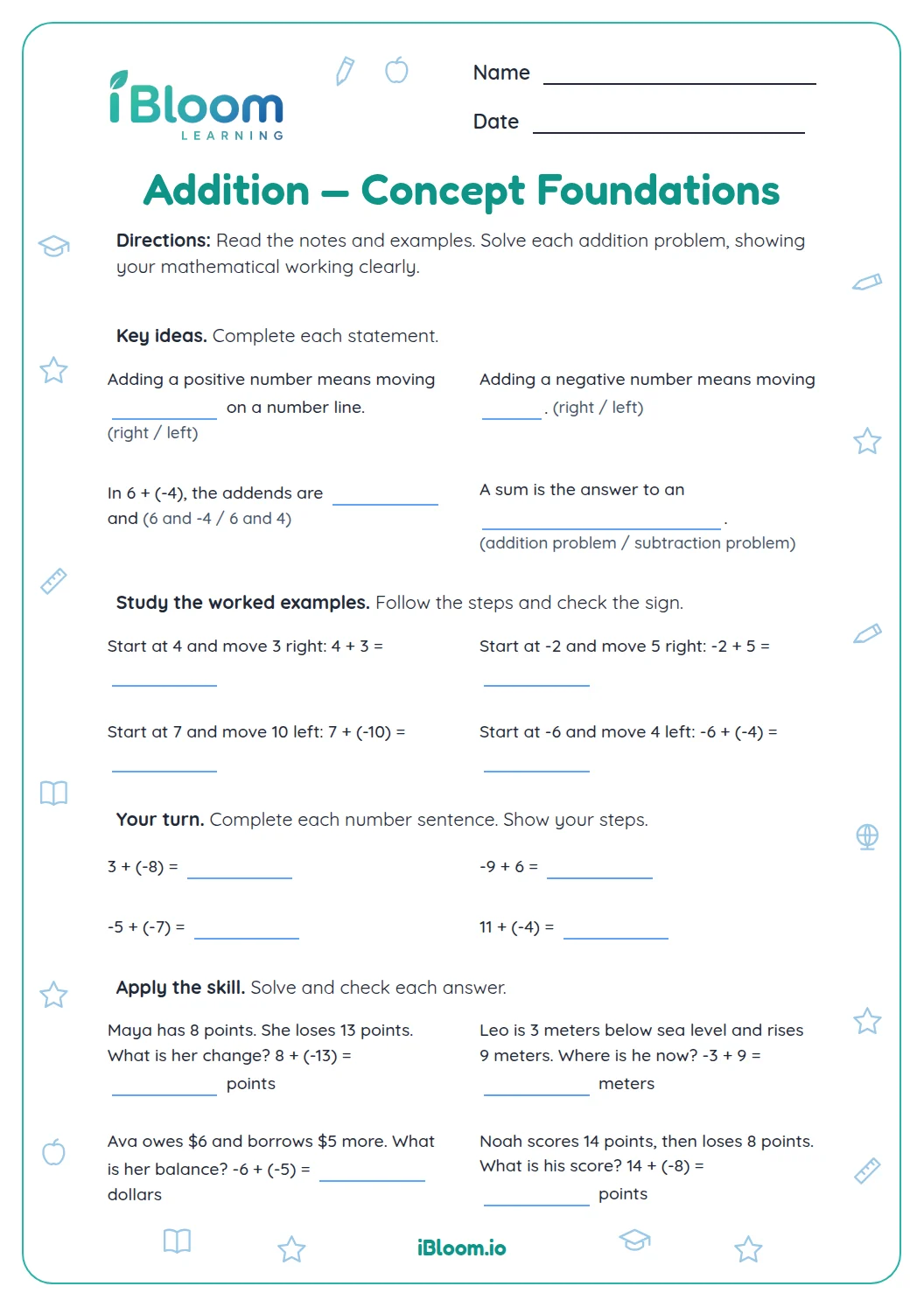
Adding a positive integer moves right on a number line. Adding a negative integer moves left. Start at zero, move 9 units right, then 9 units left. Returning to zero shows why 9 + (−9) = 0.
Question 7 asks for the move from −7 when adding 12. The correct move is 12 units right. Count seven units to zero, then five more to reach 5.
Why does subtracting a negative increase the value?
Subtraction can be rewritten as adding the opposite of the number being subtracted. The opposite of −5 is 5, so 8 − (−5) is 8 + 5. The number 8 stays the same; the operation and the second number change together.
- 1Leo wrote 8 − (−5) = 3.
- 2Rewrite as 8 + 5.
- 38 + 5 = 13, so choose “Add 5 to 8.”
- 4Check: 13 + (−5) = 8.
What makes these questions a reasoning challenge?
Six number sentences ask for missing values and a difference across zero. Five choice questions ask for a move, an error repair, equivalent expressions and a money-balance equation.
The three written questions require evidence. Students explain the rise from −4°F to 9°F, compare two negative results and correct a claim about subtracting −10. The key gives sample reasoning; other correct methods are welcome.
How to use this worksheet
- 1Review the position of −5, 0 and 5 on a number line.
- 2Complete Part A, substituting each answer back into its number sentence.
- 3For question 7, mark −7 on the number line and count 12 units right.
- 4Read every Part B choice and explain why the selected move or rewrite works.
- 5Write an equation and a brief reason for each Part C answer.
- 6Check signs and values against the key, then redo any error using the opposite operation.
Mistakes to notice and fix
The mistake
Adding the sizes in −7 + 12 and writing −19.
The fix
The moves oppose each other. Seven units reach zero; the remaining five reach 5.
The mistake
Treating 8 − (−5) as 8 − 5.
The fix
Keep 8, change subtraction to addition, and replace −5 with its opposite, 5.
The mistake
Calling −13 greater than −7 because 13 is greater than 7.
The fix
Place both values on a number line. −7 is farther right, so it is greater.
Common Core alignment
Use direction, opposites and real situations to reason about integer sums.
On this sheet: Missing addends, number-line reasoning and temperature changes connect integer sums to direction.
Show the official wordingHide the official wording
Understand p + q as the number located a distance |q| from p, in the positive or negative direction depending on whether q is positive or negative. Show that a number and its opposite have a sum of 0 (are additive inverses). Interpret sums of rational numbers by describing real-world contexts.
Rewrite subtraction as adding the opposite, and find distances across zero.
On this sheet: Students correct subtraction errors and find the temperature rise from a negative to a positive value.
Show the official wordingHide the official wording
Understand subtraction of rational numbers as adding the additive inverse, p - q = p + (-q). Show that the distance between two rational numbers on the number line is the absolute value of their difference, and apply this principle in real-world contexts.
What to practice next
Make more practice
Further reading
Questions parents and teachers ask
What should students know before starting?
Students should recognize positive and negative integers, locate them on a number line and understand that zero separates them. They should also know the opposite of a number. These ideas let them explain sign changes and check missing values instead of relying only on memorized rules.
How do students find the missing number in question 2?
The missing number is −5. The sentence is 8 − ___ = 13, so subtracting the missing number must increase 8 by 5. Replacing the blank with −5 gives 8 − (−5) = 13. Have students rewrite that as 8 + 5 to check it.
Why is the temperature rise 13°F?
The rise is 13°F because the temperature moves four degrees from −4°F to zero and nine more degrees to 9°F. Students can add 4 + 9 or subtract the starting temperature from the final temperature: 9 − (−4) = 13. Both methods measure the same change.
Are the written answers required to match the key exactly?
No; the key gives sample explanations, and any correct equation with a sound reason is acceptable. For the comparison, a number line or a statement that −7 is farther right than −13 works. Check both the computed values and the reason for choosing the greater result.
What is a quick check for subtracting a negative?
Add the subtracted number back to the result. For −6 − (−10) = 4, check 4 + (−10) = −6. Returning to the starting value confirms the subtraction. Students can also use a number line to confirm that adding 10 to −6 ends at 4.