





About this worksheet
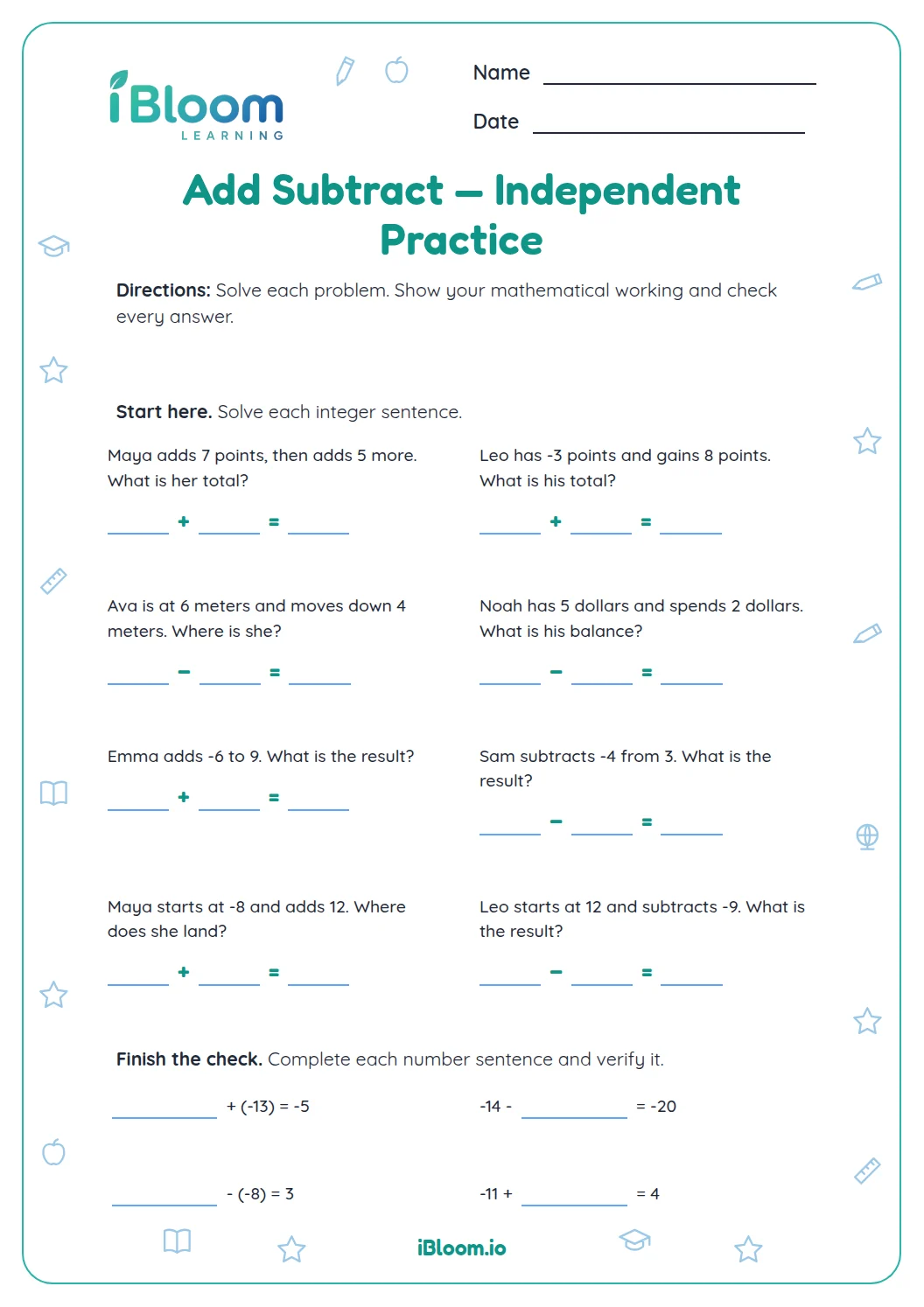
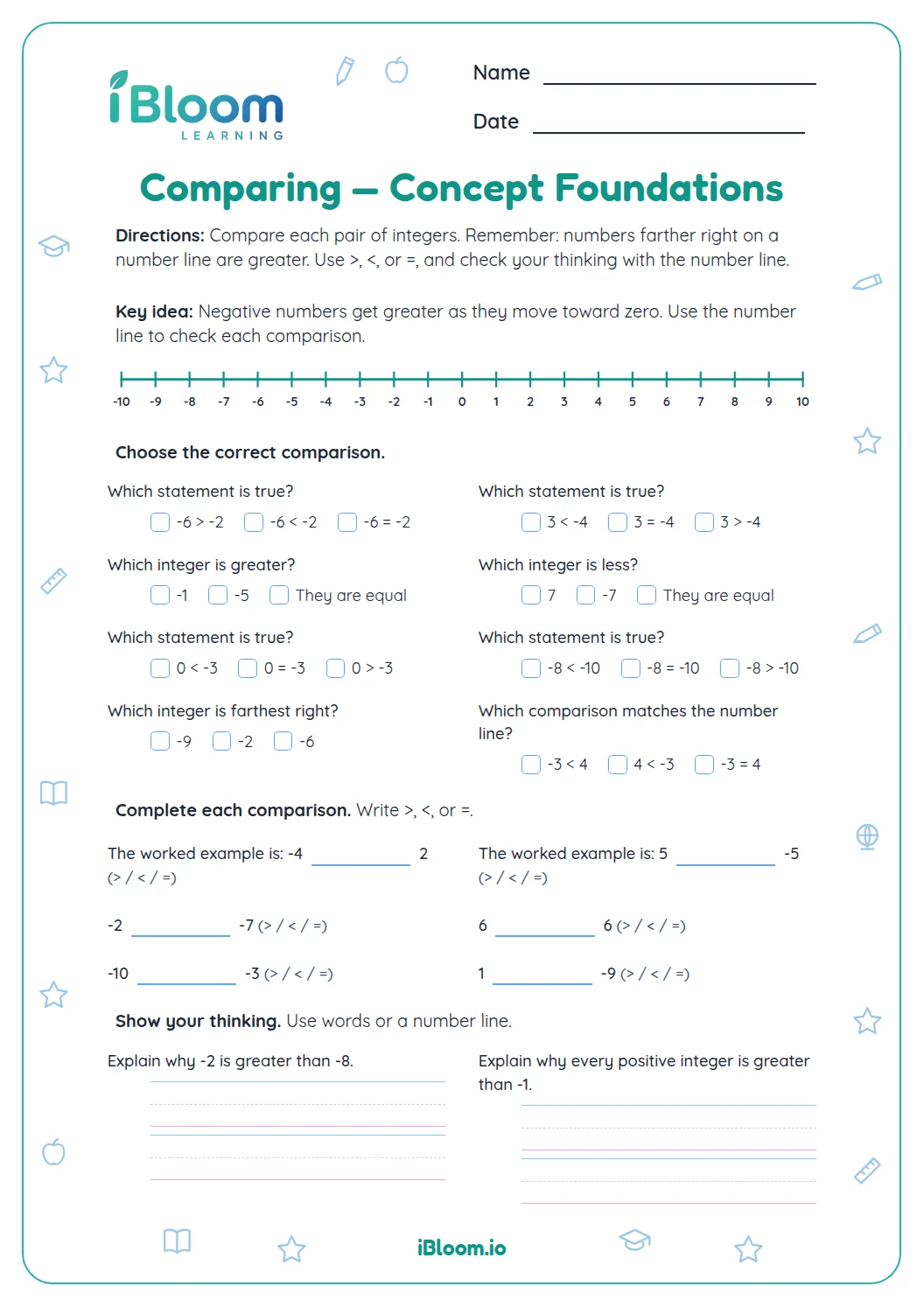
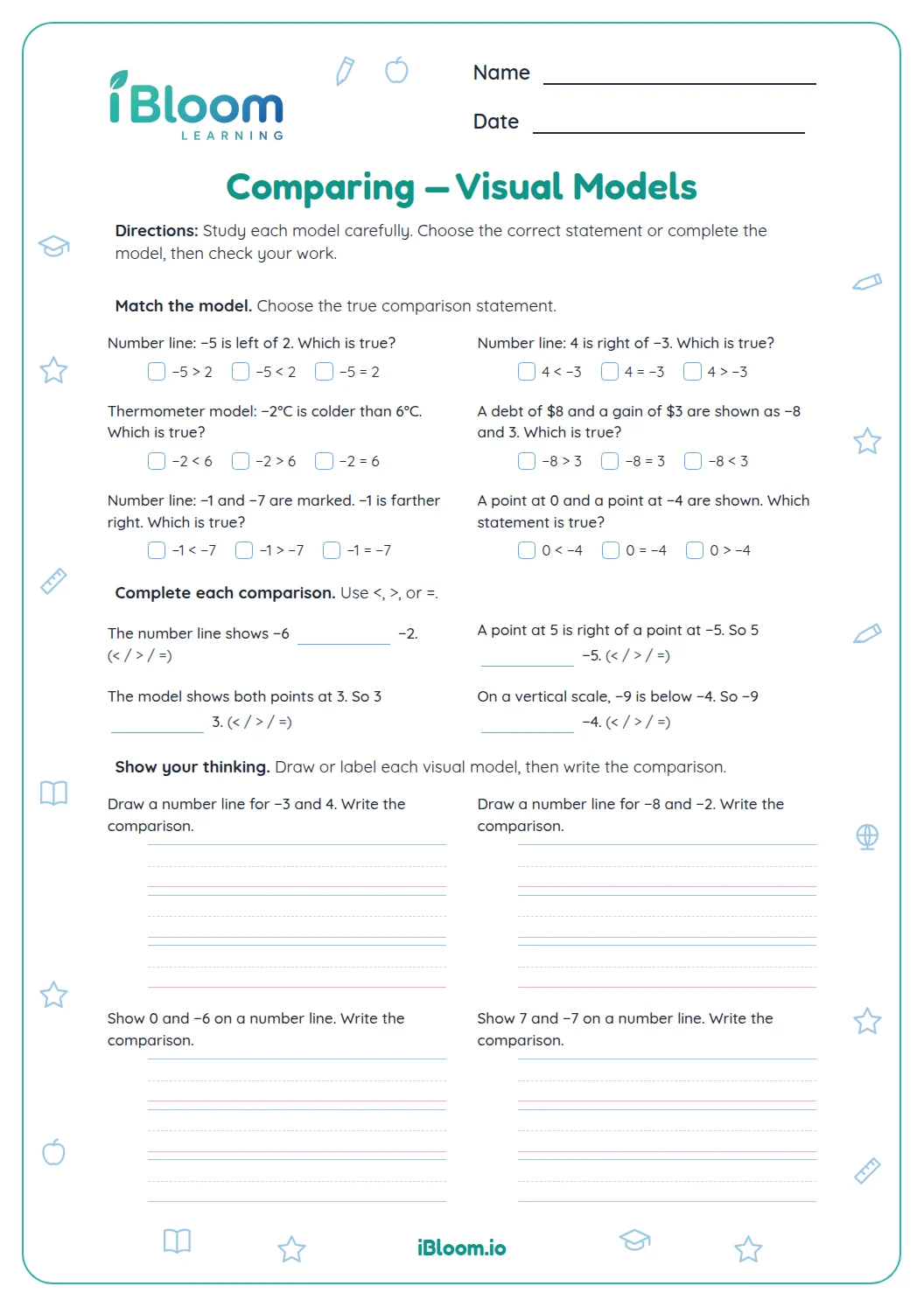
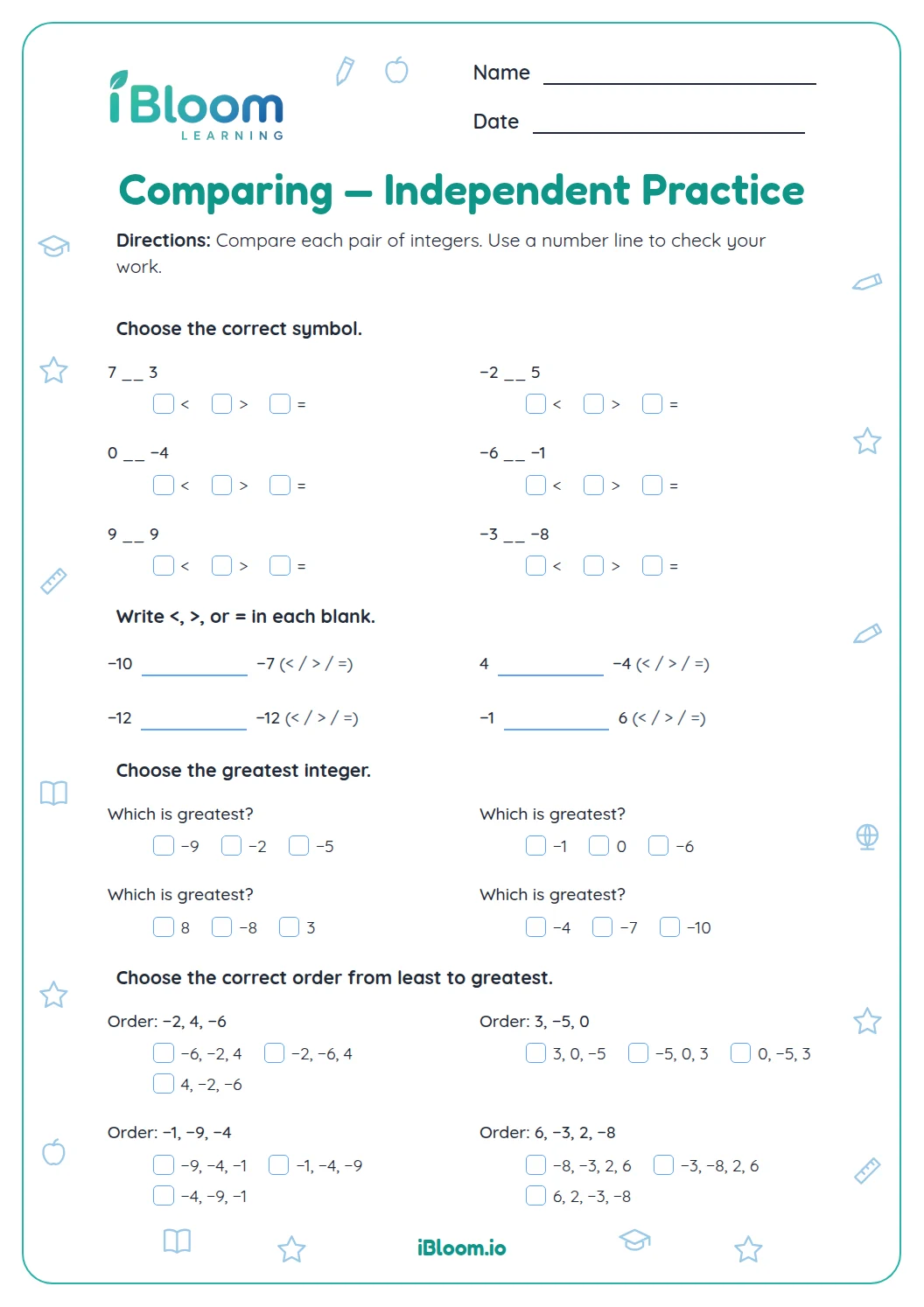
This Grade 5 integer division worksheet provides 16 guided practice problems with positive and negative dividends and divisors. Learners decide whether each quotient is positive, negative, or zero, then check the result with multiplication. The separate answer key lists all quotients.
How do signs affect a quotient?
Divide the absolute values to find the quotient’s size. Matching signs make a positive quotient; different signs make a negative quotient. Dividing zero by a nonzero integer gives zero.
How can multiplication check division?
Multiply the divisor by the quotient. The product should equal the dividend, including its sign. For −24 ÷ 6 = −4, check 6 × (−4) = −24.
- 1−24 ÷ 6 = ___
- 2Different signs mean a negative quotient; 24 ÷ 6 = 4.
- 3Answer: −4; check 6 × (−4) = −24.
What is on the worksheet?
The 16 equations include positive, negative, and zero dividends, with quotients checked by multiplication. The answer key lists each result.
How to use this worksheet
- 1Look at the dividend and divisor signs.
- 2Divide their absolute values.
- 3Choose the quotient sign from the sign pair.
- 4Write zero when the dividend is zero and divisor is nonzero.
- 5Multiply divisor by quotient to check.
Common mistakes and quick fixes
The mistake
Giving a negative quotient when both signs match.
The fix
Matching signs make a positive quotient.
The mistake
Dividing correctly but forgetting the sign.
The fix
Decide the sign before writing the quotient.
The mistake
Treating zero divided by a nonzero number as undefined.
The fix
Zero split into equal groups still gives zero in each group.
What to practice next
Make more practice
Questions parents and teachers ask
How do learners decide the sign of a quotient?
If the dividend and divisor have matching signs, the quotient is positive. If one is positive and the other is negative, it is negative. Then divide the absolute values. Multiplication checks both the size and sign of the result.
How does multiplication check a quotient?
Multiply the divisor by the quotient. For example, 6 × (−4) equals −24, so −24 ÷ 6 = −4 is correct. The product should match the original dividend, including whether it is positive or negative. This is a quick way to verify an equation without relying on the sign rule alone.
What happens when zero is divided by a nonzero integer?
The quotient is zero because zero divided into any positive number of equal groups leaves zero in each group. The worksheet includes 0 ÷ (−7). The answer is zero, and multiplying −7 by 0 returns the dividend, zero.
What problems are included?
There are 16 integer division equations. They include positive and negative dividends and divisors, matching and different sign pairs, and one zero dividend. The separate answer key lists each quotient so learners can check their sign reasoning. The equations are short enough to check one by one.
How long should this practice take?
About 15 minutes is a reasonable starting point for 16 short equations. Encourage learners to show a multiplication check for each answer, as directed on the worksheet. Some may work faster once they recognize the sign pattern. Leave time to check the answers rather than rushing through the sign decisions.