



About this worksheet
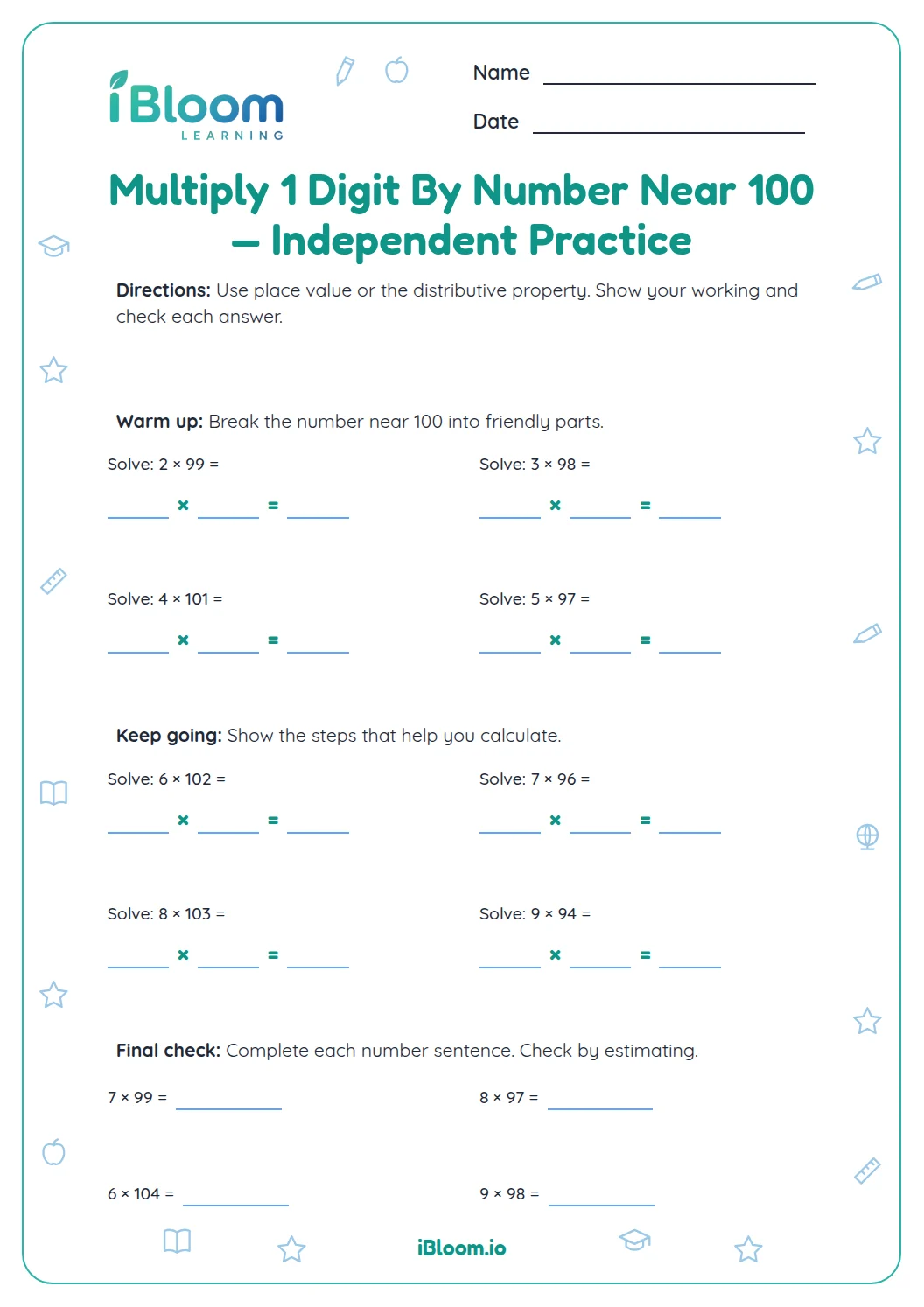
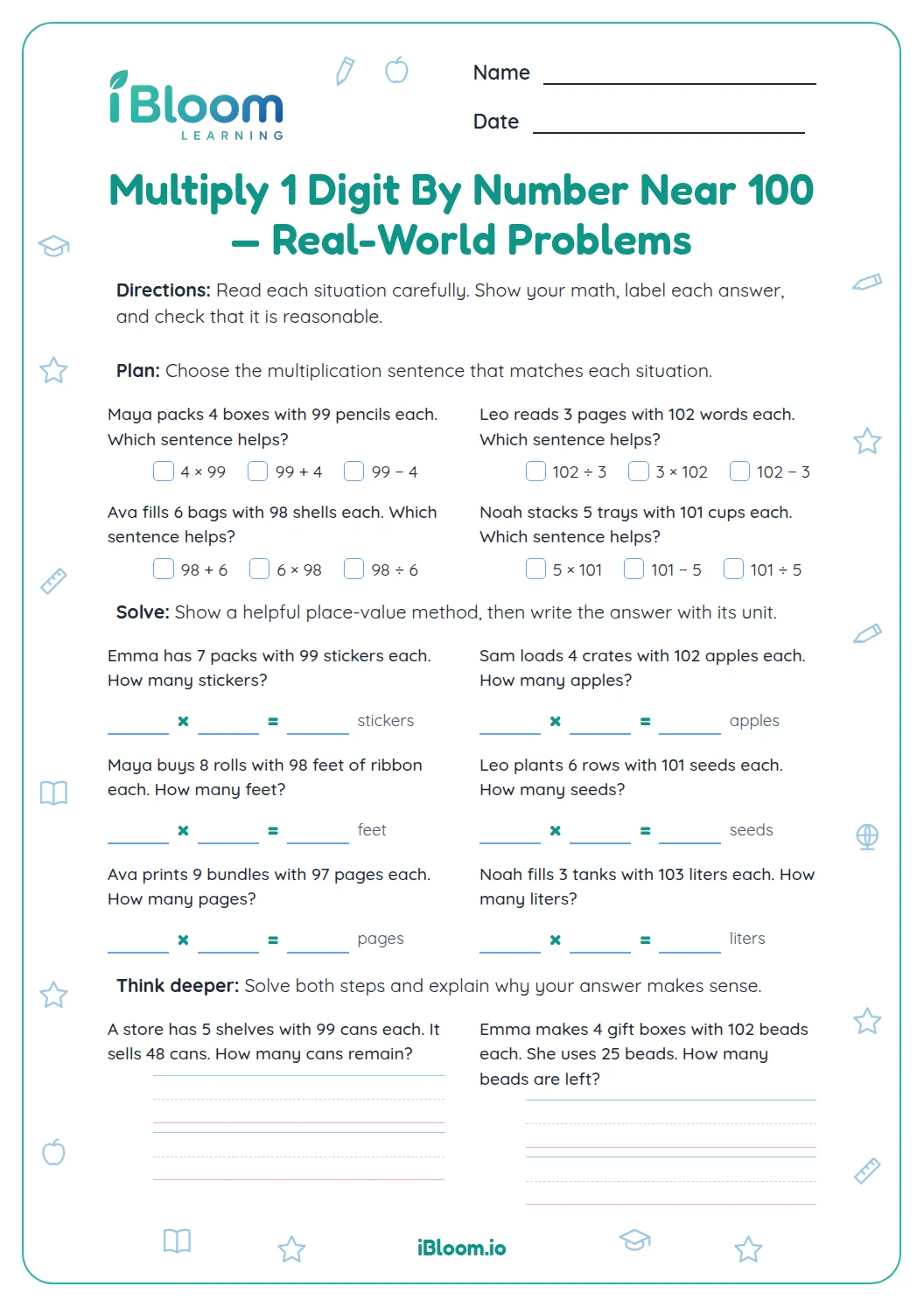
This free Grade 5 worksheet helps students multiply a one-digit number by a factor close to 100. Students rewrite factors such as 98 as 100 minus a small amount or 102 as 100 plus a small amount, then adjust the product. After guided products, they apply the strategy to two short situations. The practice uses place-value reasoning and equivalent expressions for one-digit by two-digit multiplication. A separate key gives each product.
Aligned to 4.NBT.B.5
Why is 100 a useful number to multiply by?
A number such as 98 is two less than 100. So 7 groups of 98 equal 7 groups of 100 minus 7 groups of 2. Part A makes the subtraction from 100 visible before students use the shortcut.
- 17 × 98 = 7 × (100 − 2)
- 2= 700 − 14 = 686
How do you finish a near-100 product?
Multiply the nearby hundred by the one-digit factor. Then multiply the small difference by that same factor. Subtract when the factor is below 100 and add when it is above 100. For 5 × 99, subtract 5 from 500.
- 98 = 100 − 2
- 99 = 100 − 1
- 97 = 100 − 3
How can a student check the strategy?
Part C applies the method to a box and a theater seating problem. For 4 × 98, think 4 × 100 − 4 × 2 = 400 − 8 = 392 markers.
How to use this worksheet
- 1Subtract the near-100 factor from 100 to find the difference.
- 2Write the factor as 100 minus that difference.
- 3Multiply the one-digit factor by 100.
- 4Multiply the same one-digit factor by the difference.
- 5Subtract the second product from the first and check with estimation.
Common mistakes and quick fixes
The mistake
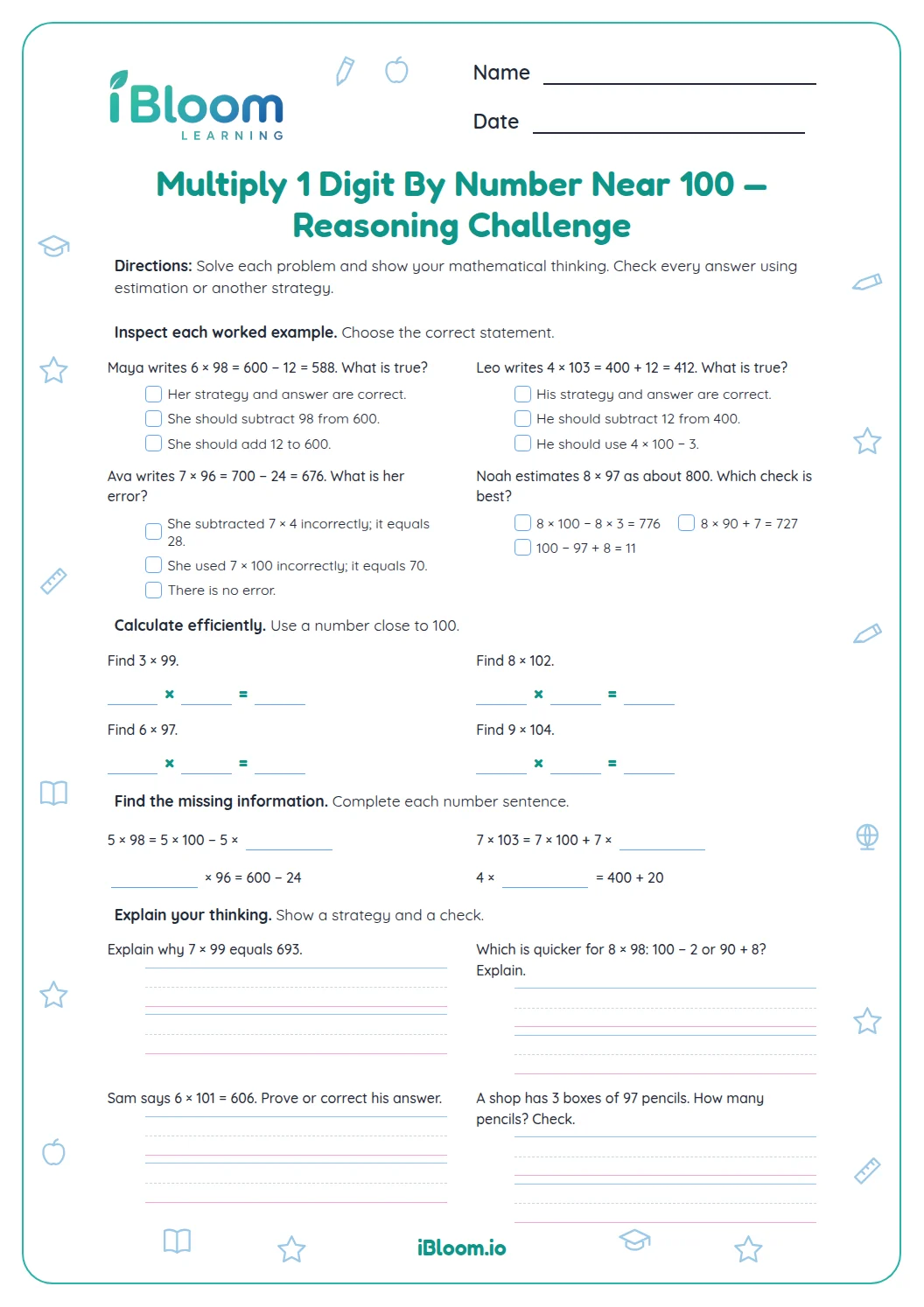
Subtracting the difference only once, as in 7 × 98 = 700 − 2.
The fix
The difference occurs in every group. Multiply 2 by 7, then subtract 14.
The mistake
Adding the correction instead of subtracting it.
The fix
A factor below 100 makes the product smaller than the 100-based product, so subtract.
The mistake
Using the wrong nearby-hundred product.
The fix
Keep the one-digit factor fixed: 4 × 97 starts with 4 × 100, then removes 4 × 3.
Common Core alignment
The page uses place-value reasoning to multiply one-digit numbers by two-digit numbers close to 100.
Multiply a one-digit number by a two-digit number using place-value strategies.
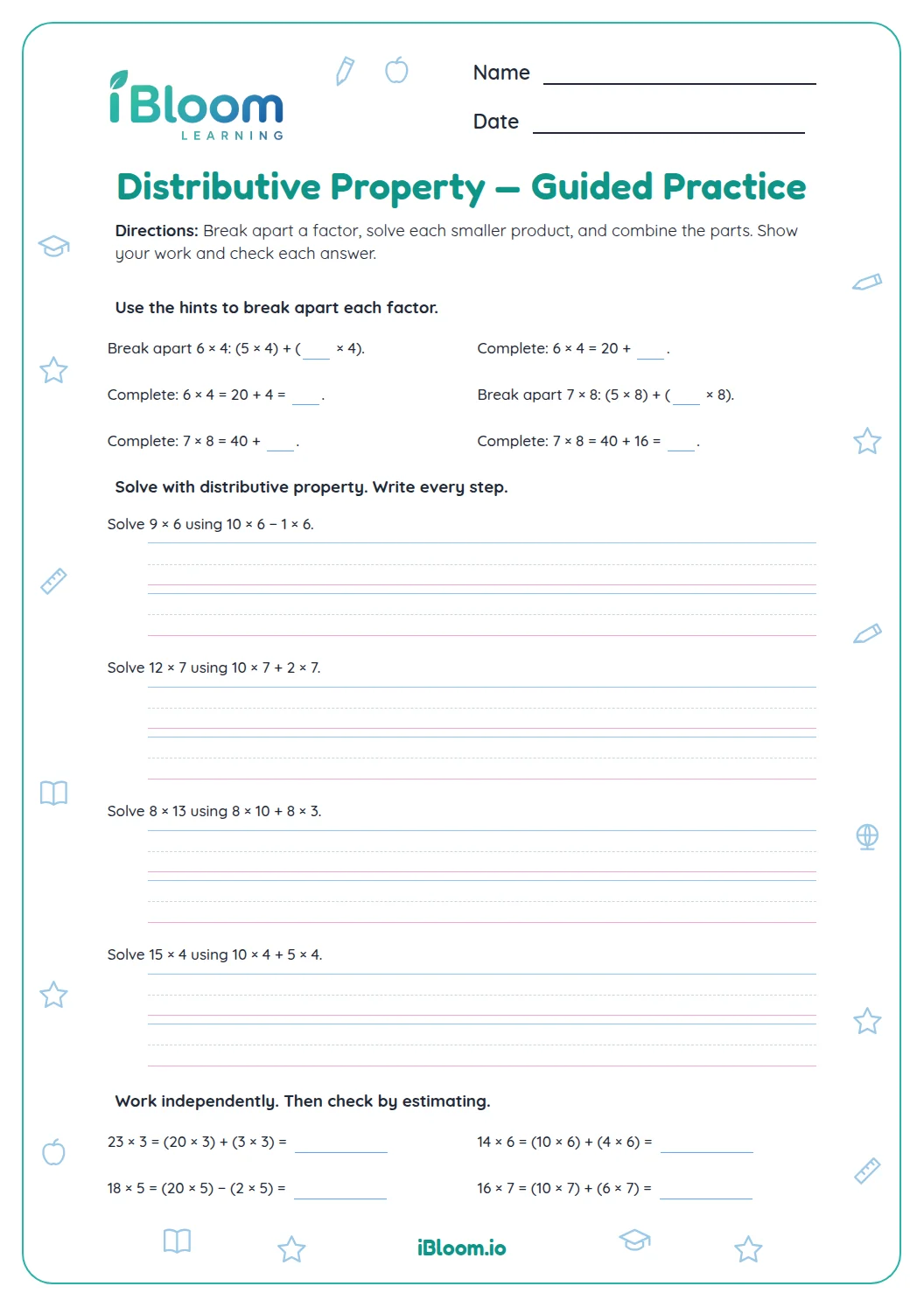
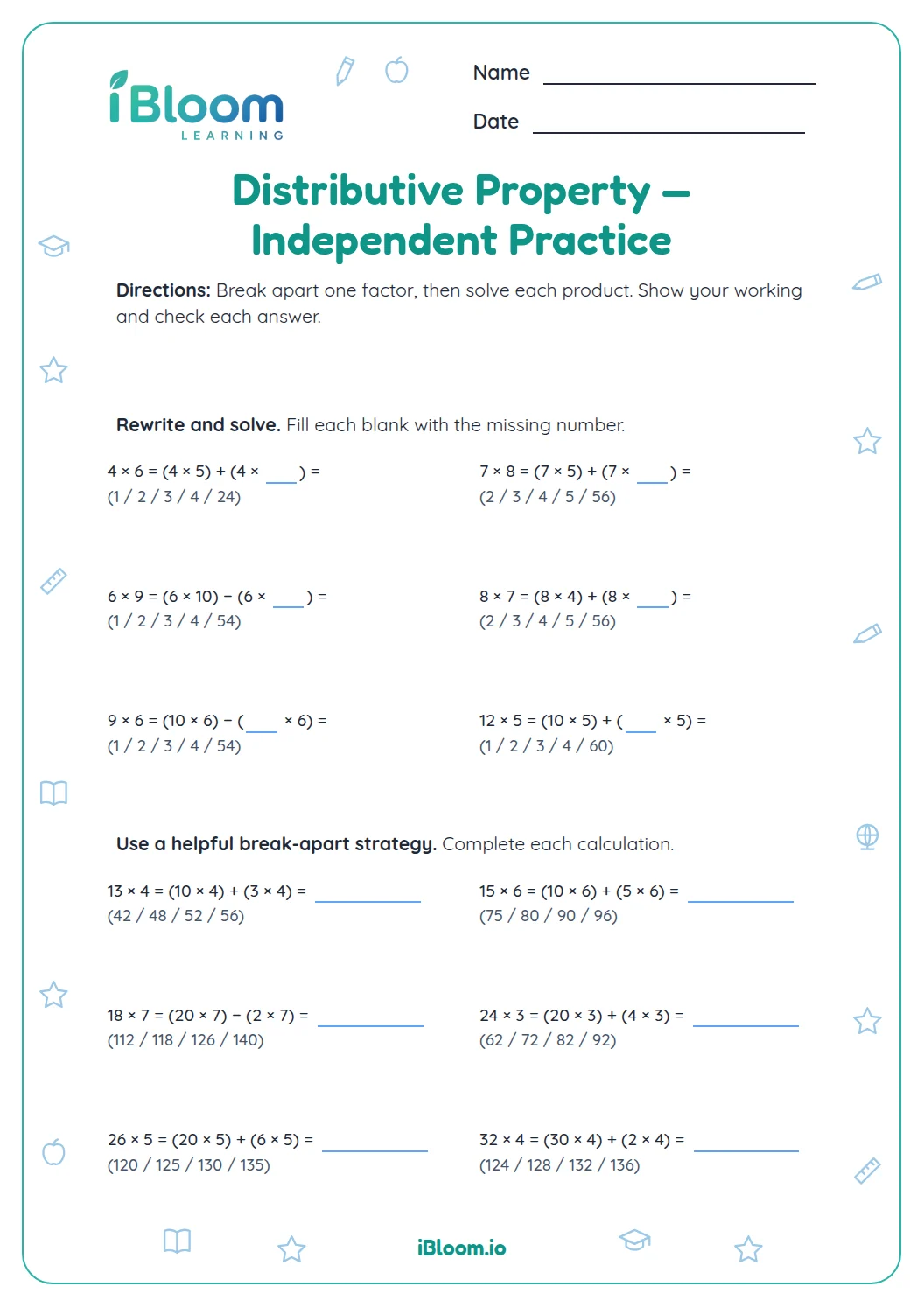
On this sheet: Students use the distributive property to multiply a one-digit factor by two-digit numbers just below or above 100.
Show the official wordingHide the official wording
Multiply a whole number of up to four digits by a one-digit whole number, and multiply two two-digit numbers, using strategies based on place value and the properties of operations. Illustrate and explain the calculation by using equations, rectangular arrays, and/or area models.
What to practice next
Make more practice
Further reading
Questions parents and teachers ask
Why multiply by 100 first?
Numbers such as 97, 98, and 99 are close to 100, which is easy to multiply. Rewriting 98 as 100 − 2 turns 6 × 98 into 600 − 12. The method keeps the correction tied to the number of groups.
How do I multiply 7 by 98?
Think of 98 as 100 − 2. Seven groups of 100 make 700, and the seven missing groups of 2 make 14. Subtract 14 from 700 to get 686, which is the answer to question 4. Every subtraction step can be checked by multiplying the final product back.
How many questions are on this worksheet?
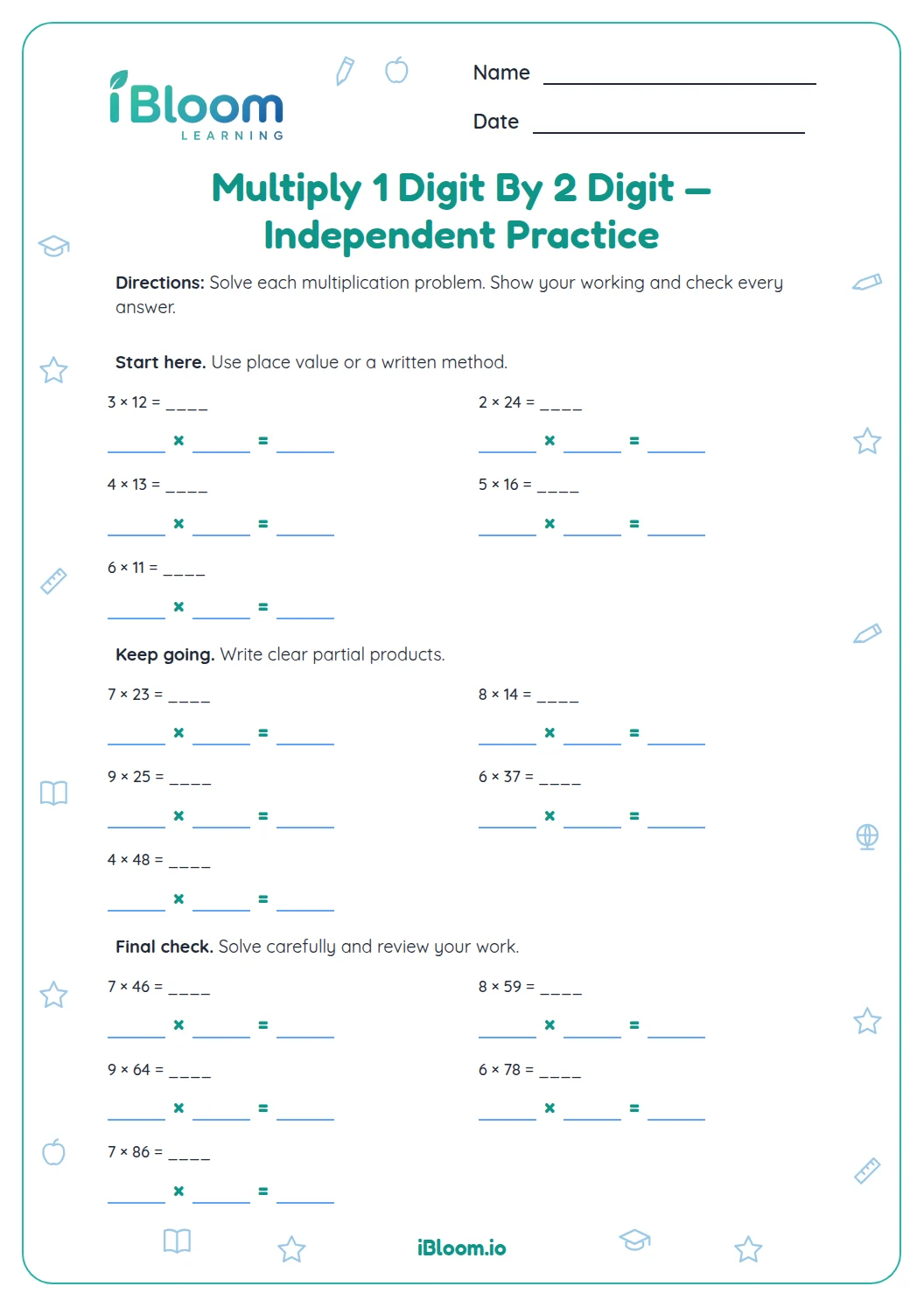
There are 14 questions across two worksheet pages, followed by a separate answer key. Students rewrite factors near 100, calculate products below and above 100, and solve two short situations. The questions move from a useful expression to independent applications.
What is a common mistake with 98?
A common slip is subtracting 2 only once after multiplying by 100. But each group of 98 is missing 2, so 7 groups are missing 14. Multiplying the small difference by the number of groups prevents that error. Students can show mental steps or write the calculation vertically.
Does this worksheet use the standard algorithm?
The questions focus on rewriting a factor near 100 and adjusting the product. Students may record the calculation in any clear way, but the featured method is an equivalent expression such as 6 × (100 − 2). This supports multiplication with place-value reasoning.
What should students practice next?
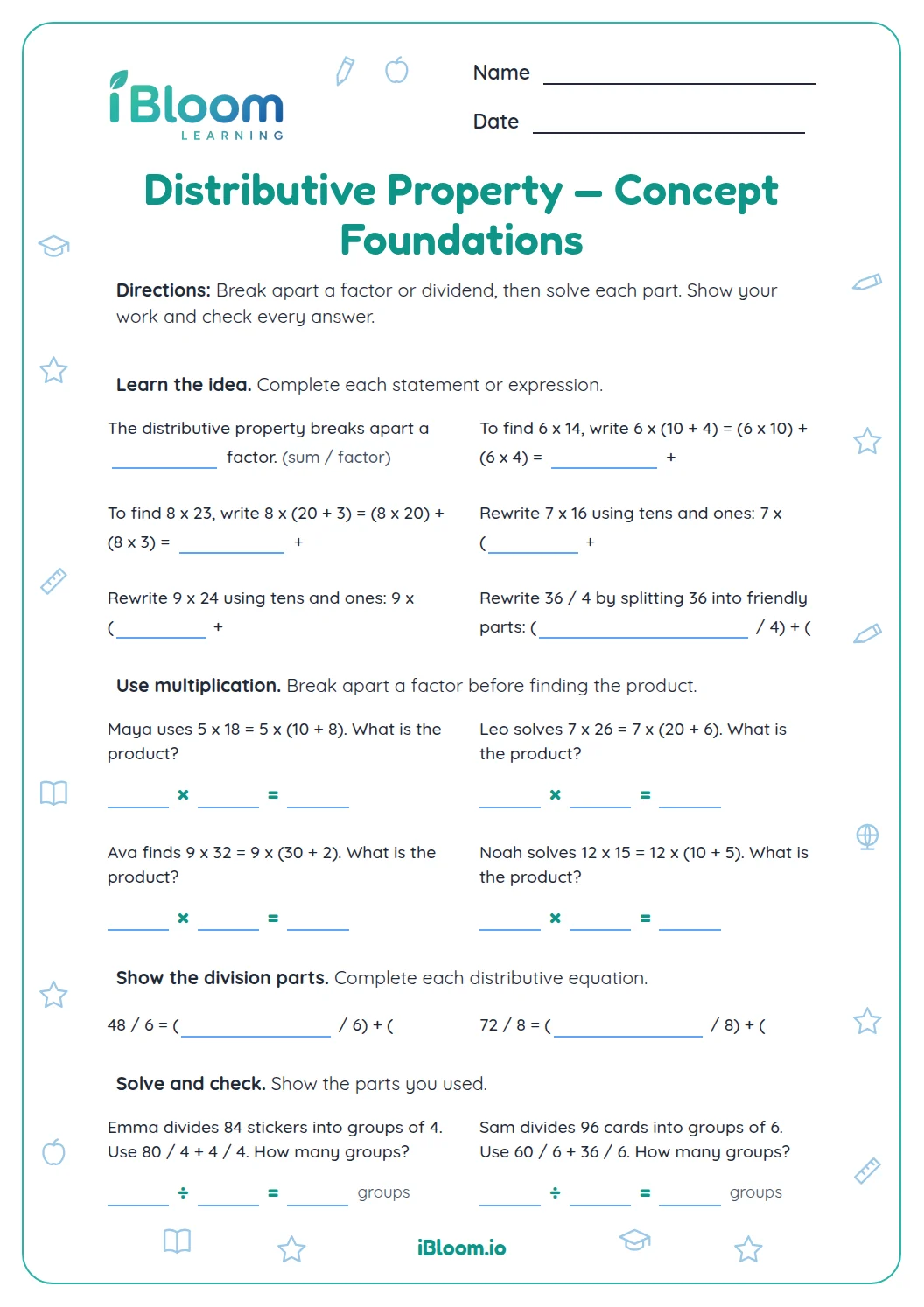
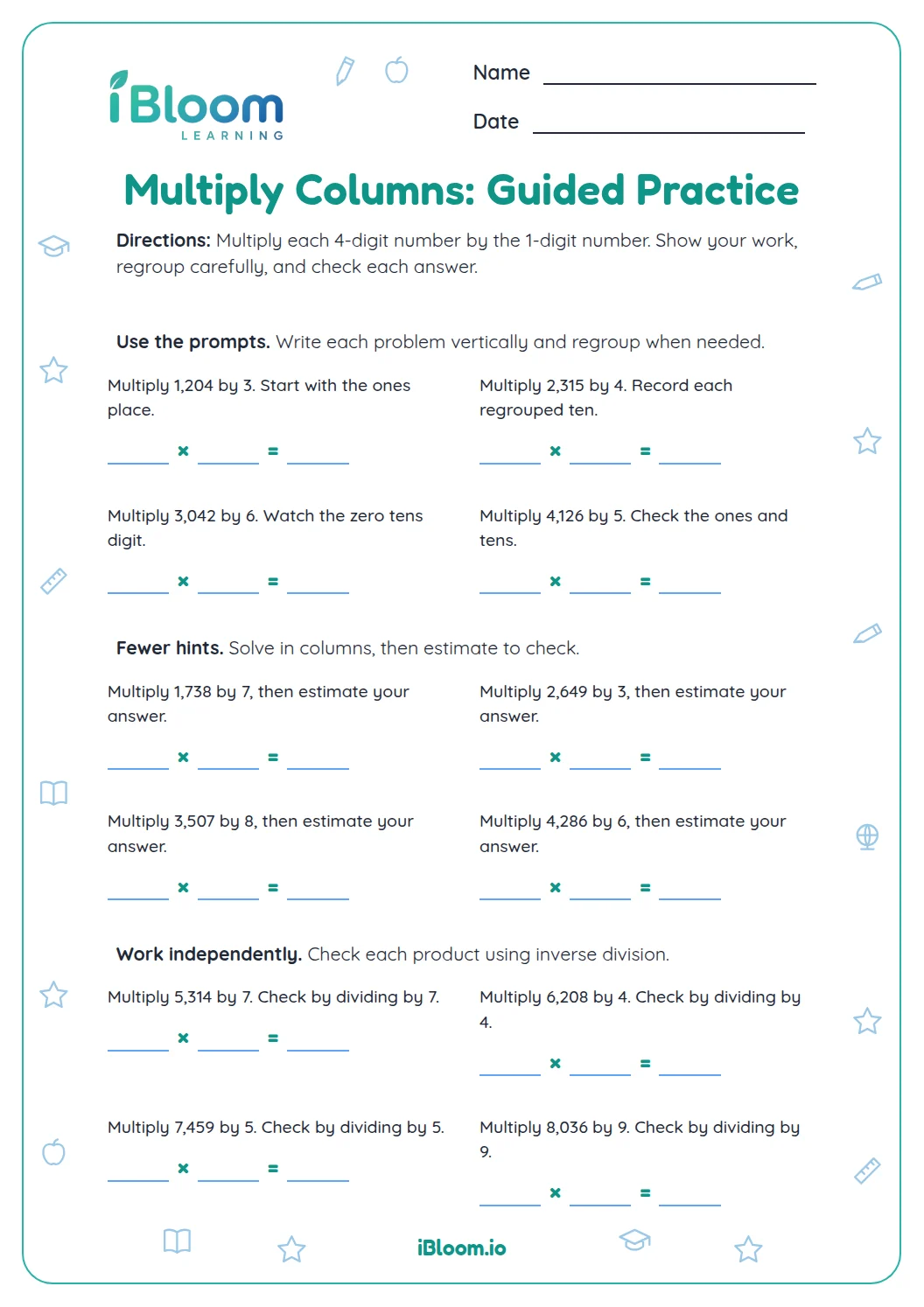
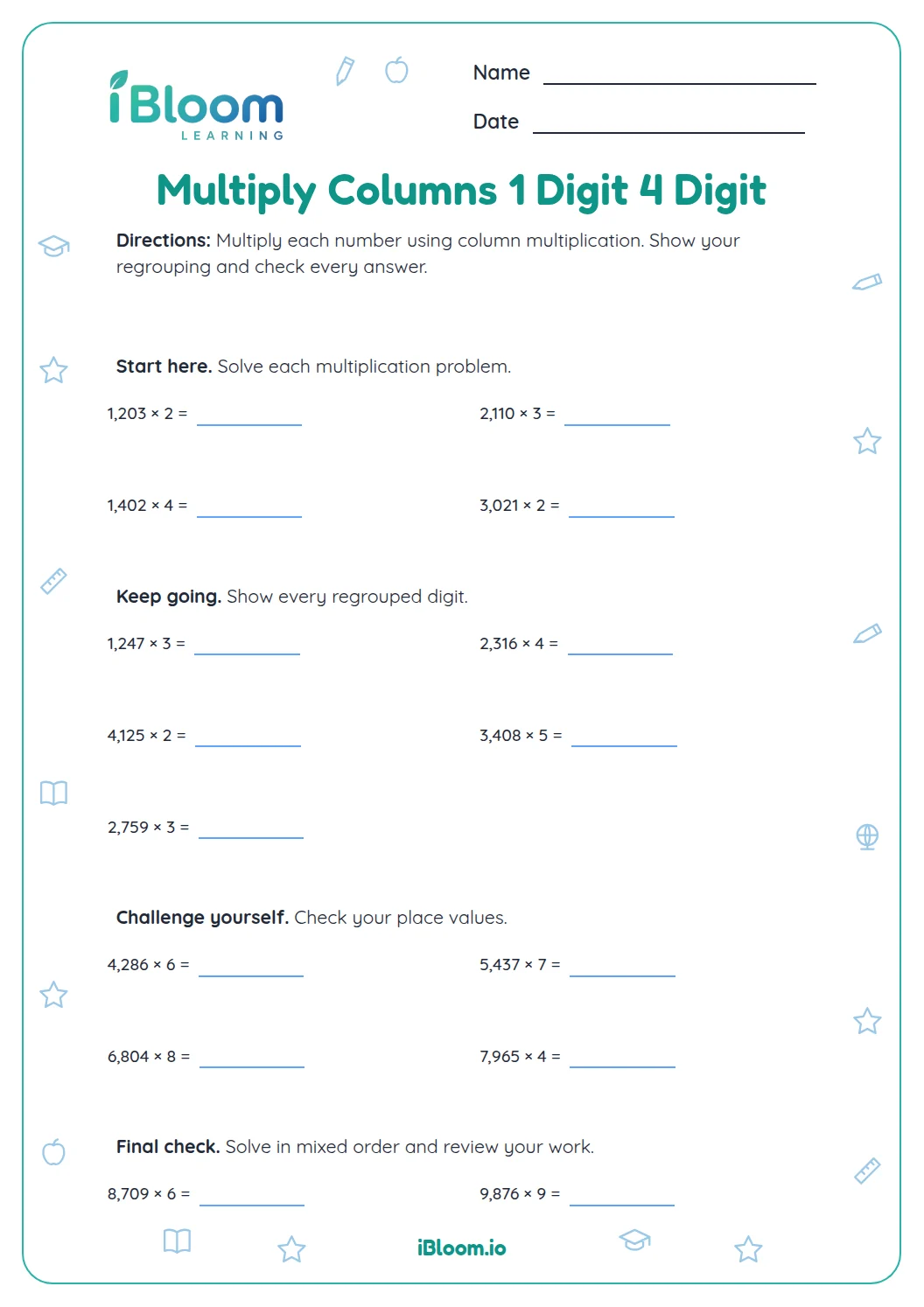
Students can move to the distributive property page to split products in different ways, then practice one-digit by two-digit multiplication more broadly. Column multiplication offers another way to record larger products. These linked skills reinforce multiplication facts and place-value reasoning.