


About this worksheet
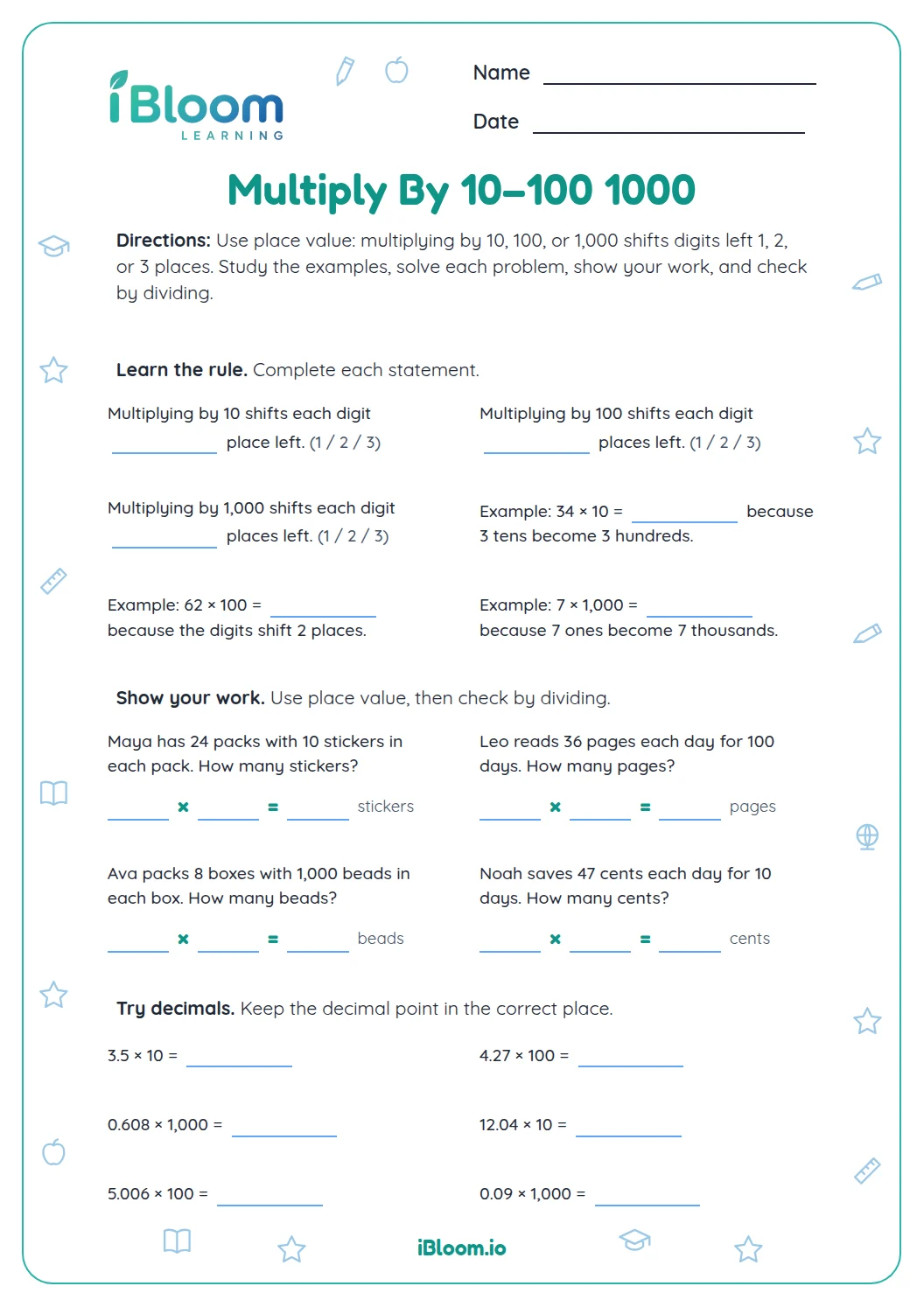
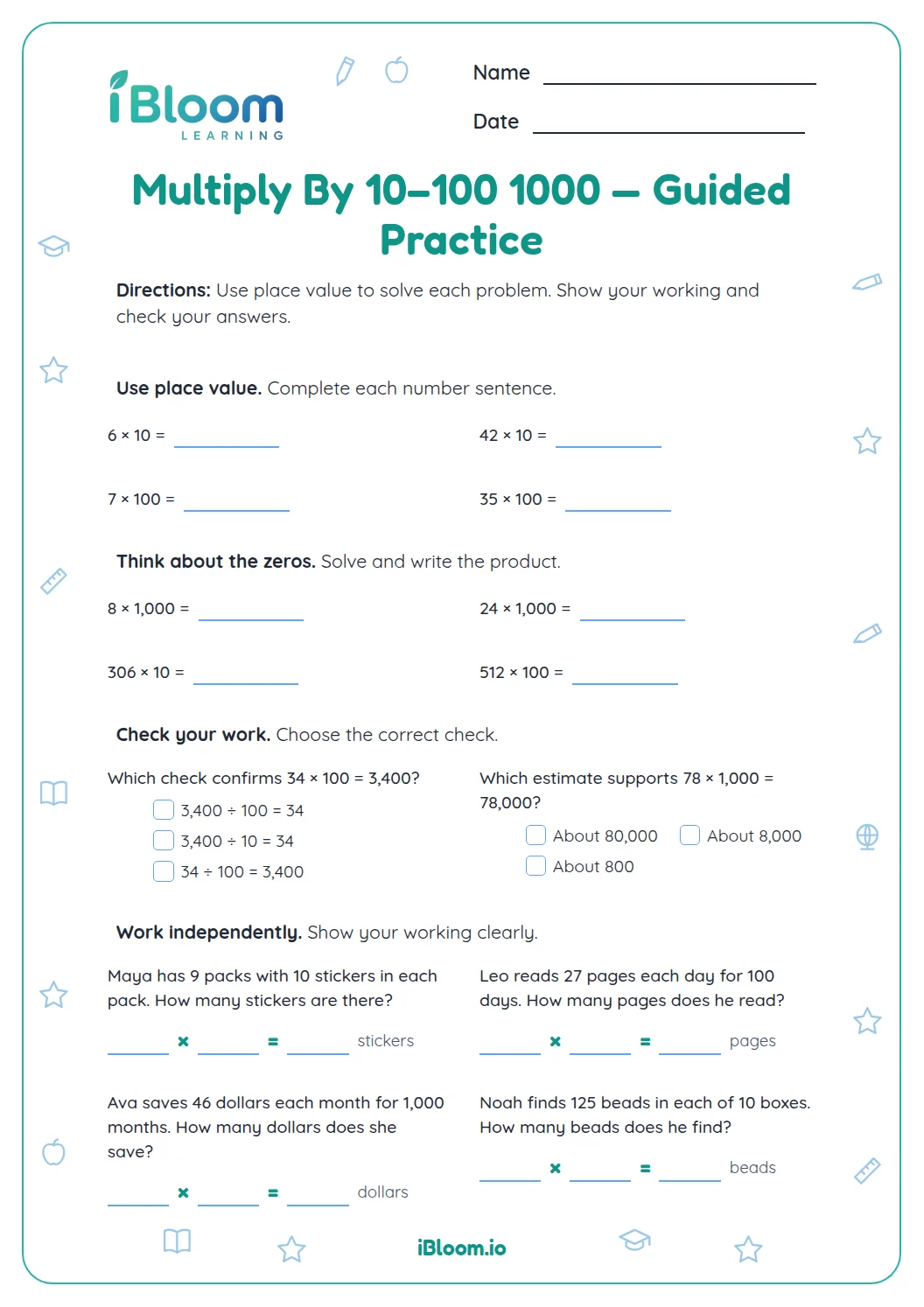
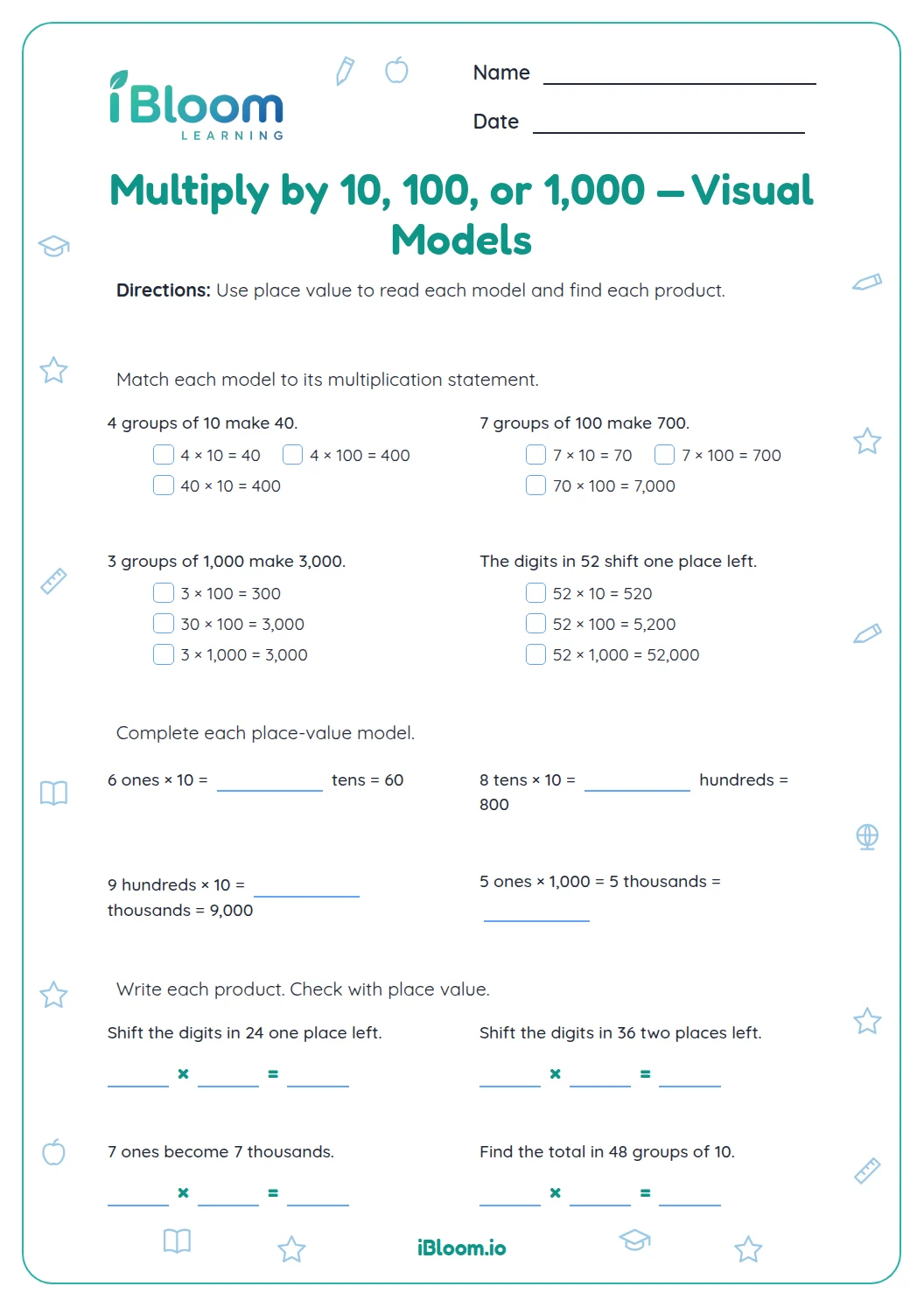
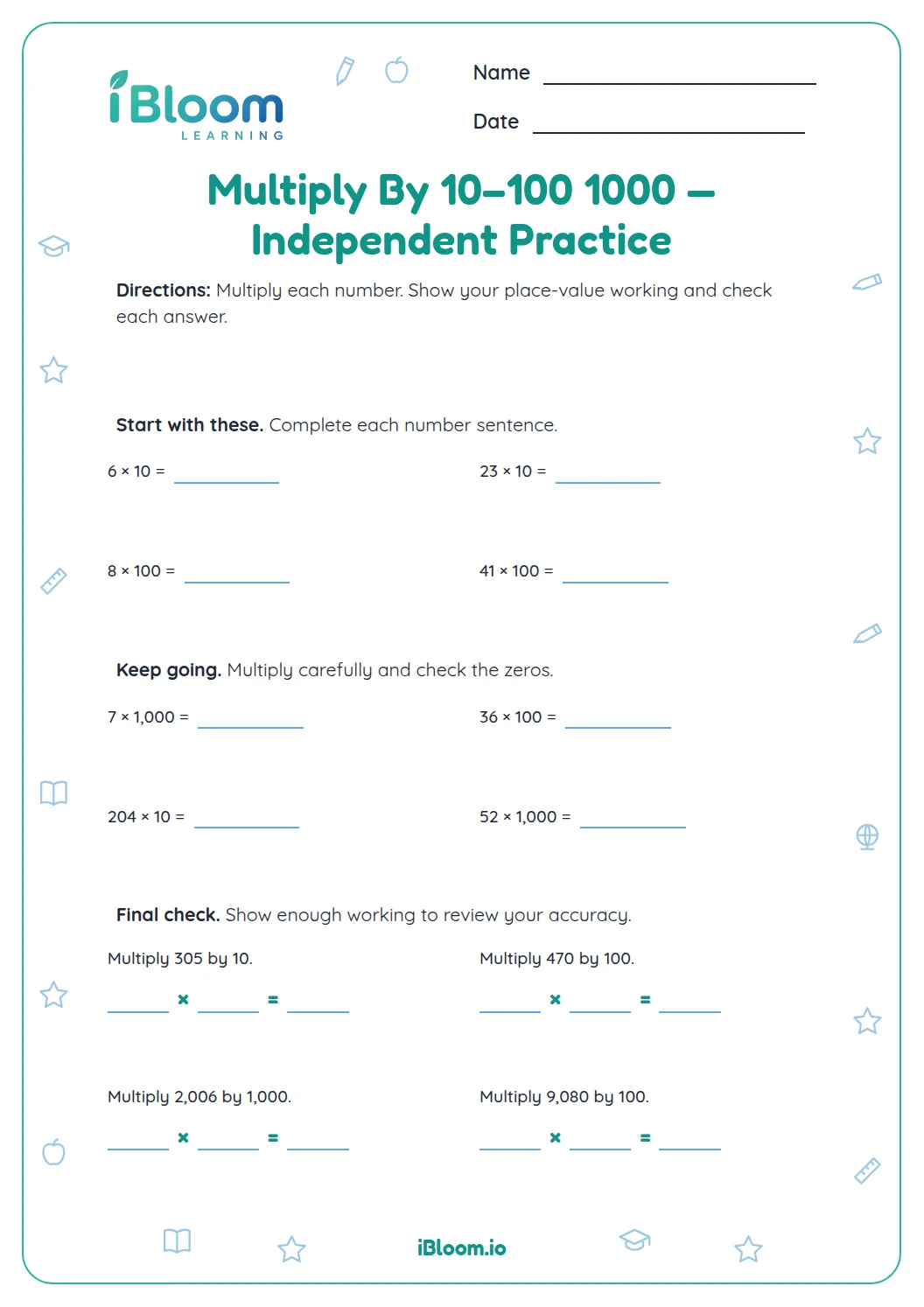
This Grade 5 worksheet applies multiplication and division by 10, 100, and 1,000 to everyday quantities. Across 14 problems, students find totals, equal shares, and rates with whole numbers and decimals, then label each result with a unit. The answer key shows the computation and units. The place-value work practices CCSS 5.NBT.A.2, including decimal shifts when multiplying or dividing by powers of 10.
Aligned to 5.NBT.A.2
What kinds of problems are on this worksheet?
The first eight problems ask for totals, such as seeds in 24 packs or flyers sent to 10 neighborhoods. The next six ask students to divide into equal groups, find a per-unit amount, or interpret a total. The quantities include money, distance, capacity, and counts.
Each response needs both a calculation and a unit. The key shows why the multiplier or divisor fits the situation.
- 124 packs × 10 seeds per pack = 240 seeds.
How can students choose multiplication or division?
Use multiplication when equal groups are combined to find a total, as with 24 packs holding 10 seeds each. Use division when a total is shared into equal groups, as with 3,600 cups placed in 100 boxes. The wording “each,” “equally,” and “per” helps identify the relationship.
How can students check a power-of-10 answer?
Estimate first, then check the place-value change. Multiplying by 10 makes a quantity ten times as large; dividing by 10 makes it one-tenth as large. For decimals, track the digits rather than adding or dropping zeros mechanically, then include the unit in the final answer.
How to use this worksheet at home or in class
- 1Identify the number of equal groups and the amount in each group.
- 2Choose multiplication for a total and division for an equal share.
- 3Estimate to check the size of the answer.
- 4Write the equation, calculate, and label the unit.
Common mistakes and quick fixes
The mistake
Adding zeros without checking place value
The fix
Track each digit’s place and the factor.
The mistake
Moving the decimal the wrong direction
The fix
Multiplying by 10 makes the value larger; dividing makes it smaller.
The mistake
Forgetting what is being counted
The fix
Carry the unit through the equation and answer.
Common Core alignment
This worksheet practices 5.NBT.A.2 through its printed questions.
Use place-value patterns to multiply or divide by powers of 10.
On this sheet: The worksheet questions ask students to practice this skill directly.
Show the official wordingHide the official wording
Explain patterns in the number of zeros of the product when multiplying a number by powers of 10, and explain patterns in the placement of the decimal point when a decimal is multiplied or divided by a power of 10. Use whole-number exponents to denote powers of 10.
What to practice next
Make more practice
Further reading
Questions parents and teachers ask
How do powers of 10 affect place value?
Multiplying by 10, 100, or 1,000 makes a quantity 10, 100, or 1,000 times as large; dividing makes it that many times smaller. With decimals, track each digit’s place value instead of relying on a rule to add zeros. The worksheet includes both whole numbers and decimals.
When should a student multiply?
Multiply when the problem gives equal groups and asks for the combined total. In the seed-pack problem, 24 packs with 10 seeds each means 24 × 10. If a total is being split into equal groups or a per-unit amount is requested, division is the better operation.
Why do some answers use decimals?
Some situations begin with decimal amounts, such as 4.8 miles per day or 62.5 meters across ten ribbons. Multiplying or dividing those values by a power of ten changes the place value. Students should preserve the decimal digits and label the result with the same unit.
Should students show an equation?
Yes. The worksheet provides space for students to show a number sentence before writing the answer with its unit. An equation makes the chosen operation visible and gives families a way to check whether the factor of 10, 100, or 1,000 matches the story.
What if an estimate and exact answer seem far apart?
Check the operation and the place-value change. A total found by multiplication should be larger than one group, while an equal share found by division should be smaller than the starting total. Then recalculate and confirm the unit, such as seeds, kilometers per day, or cents.