



About this worksheet
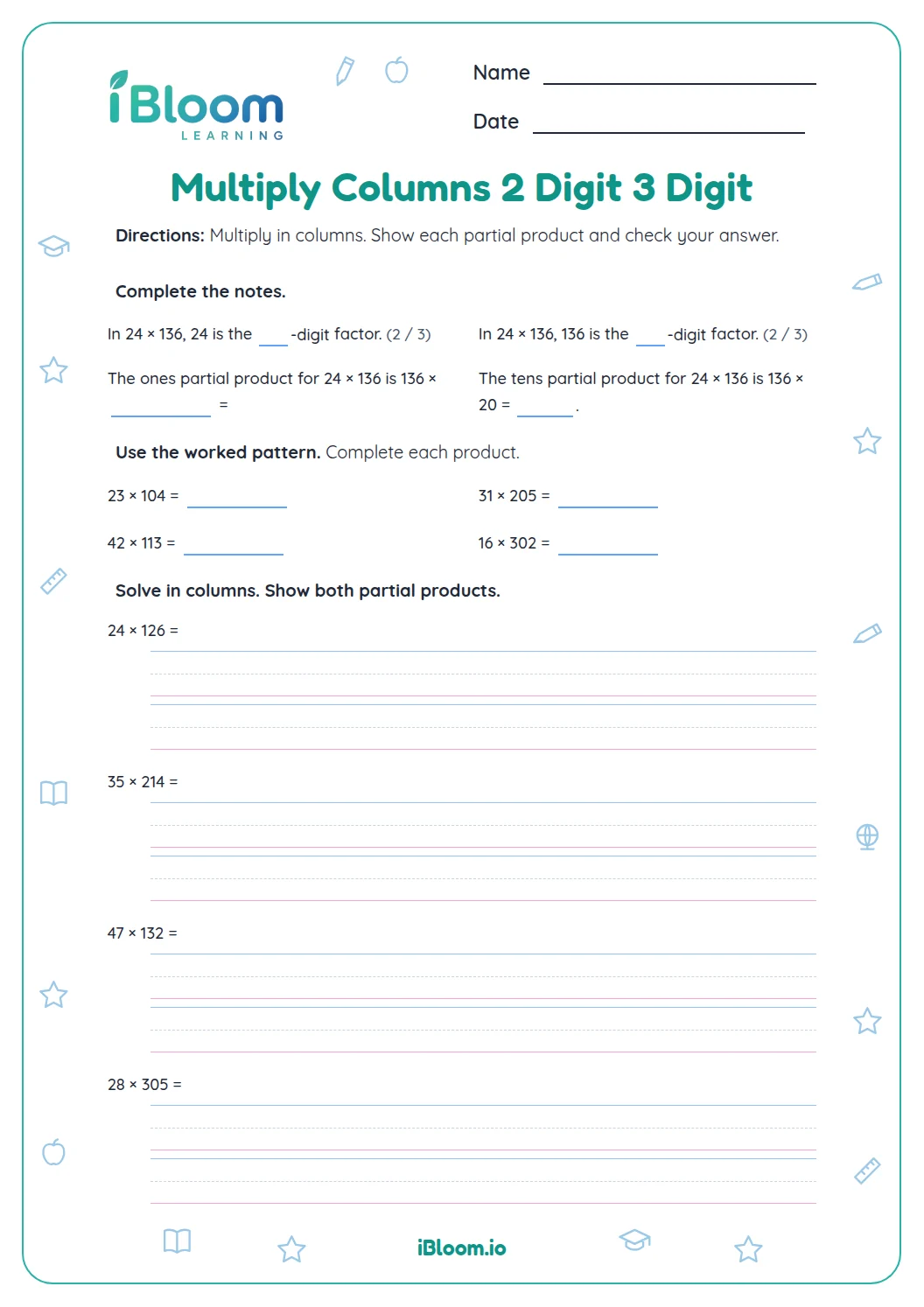
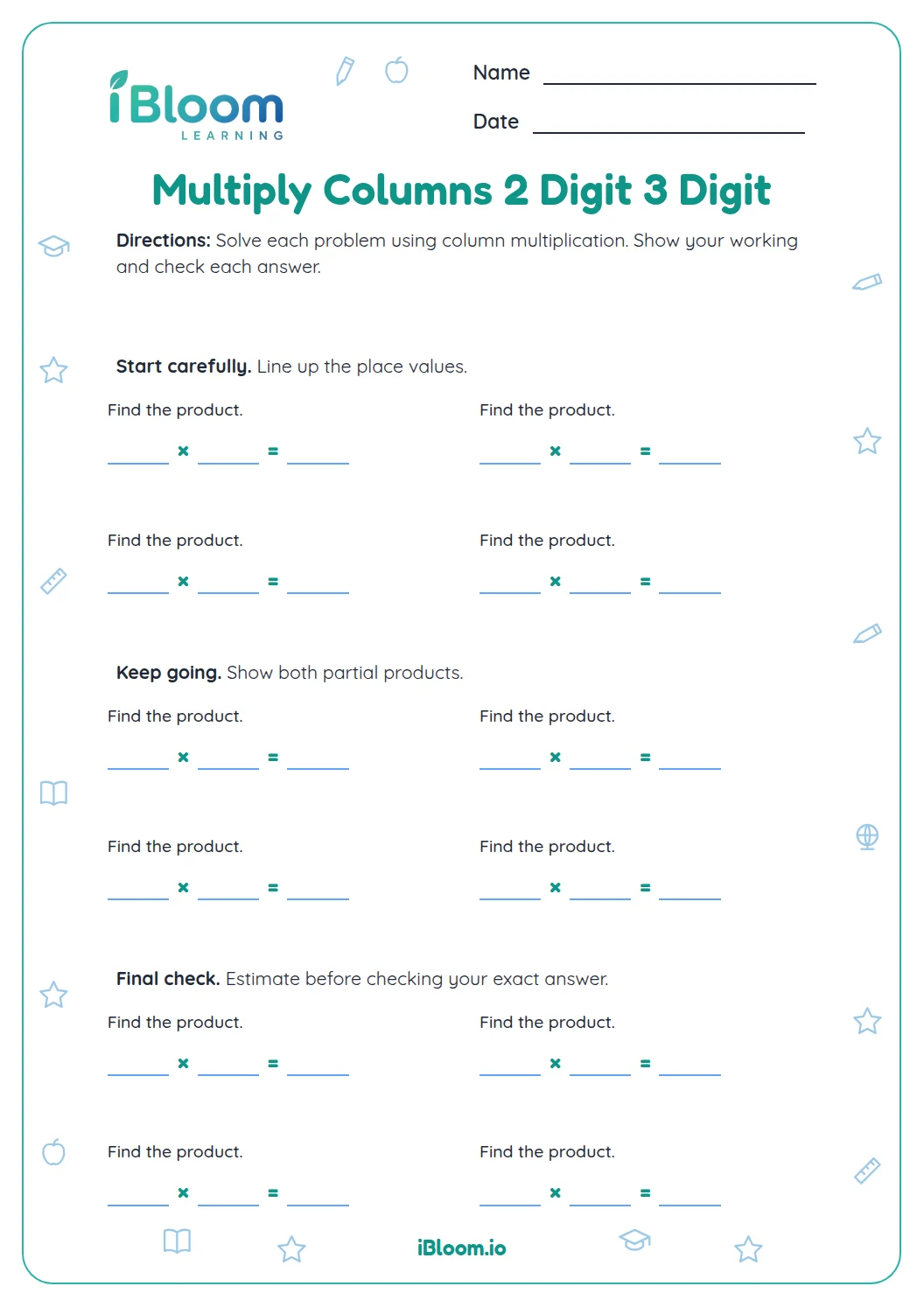
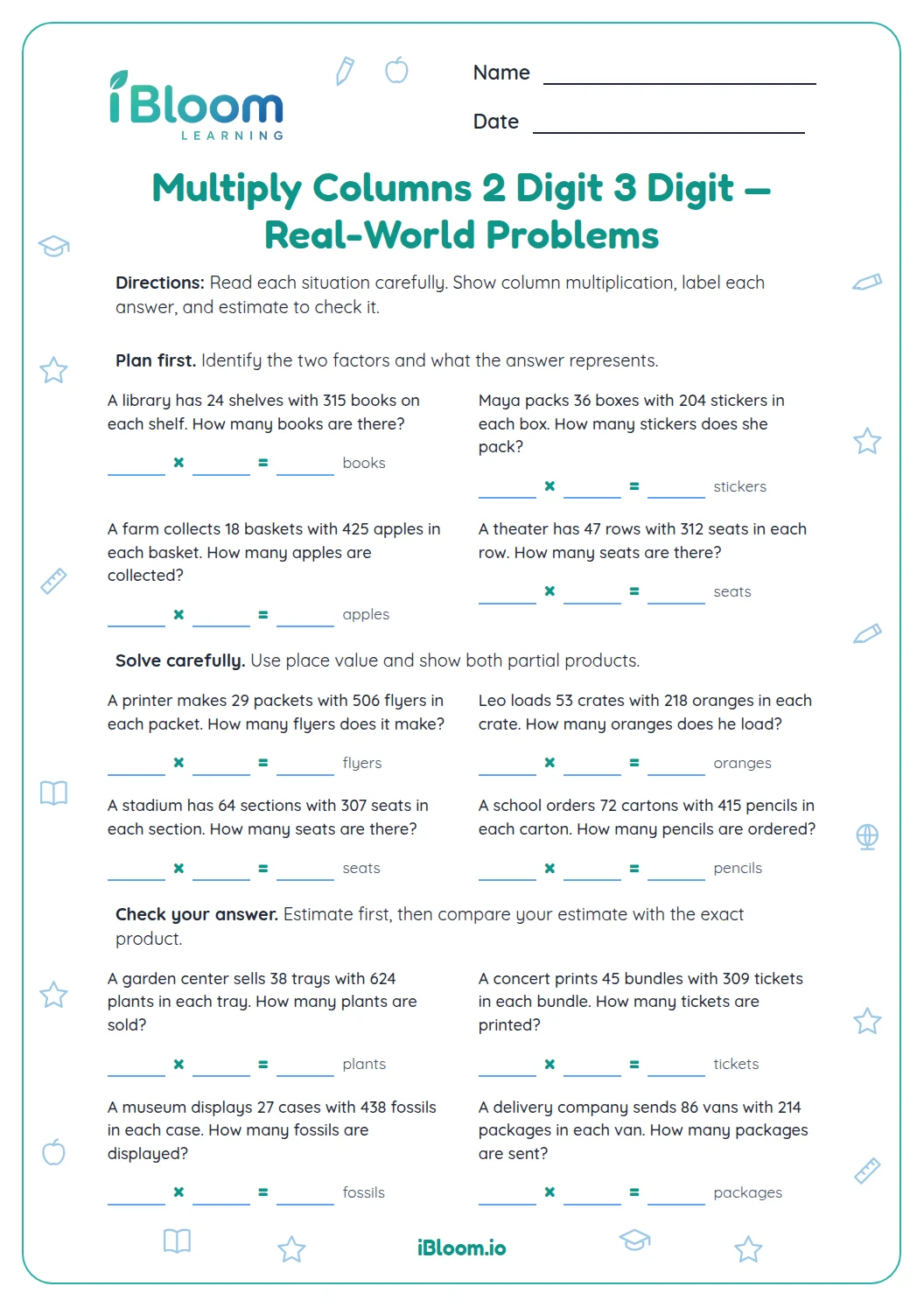
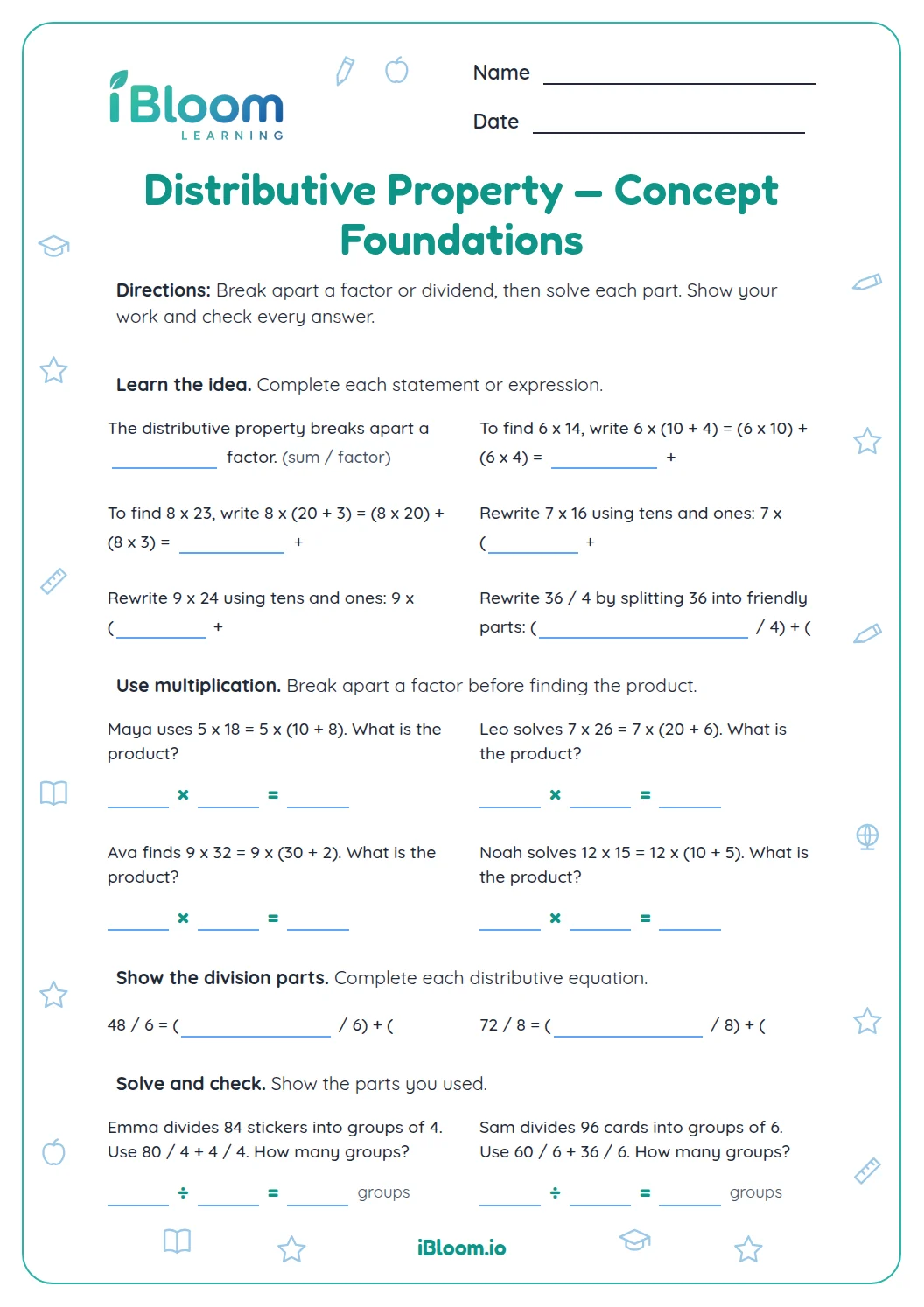
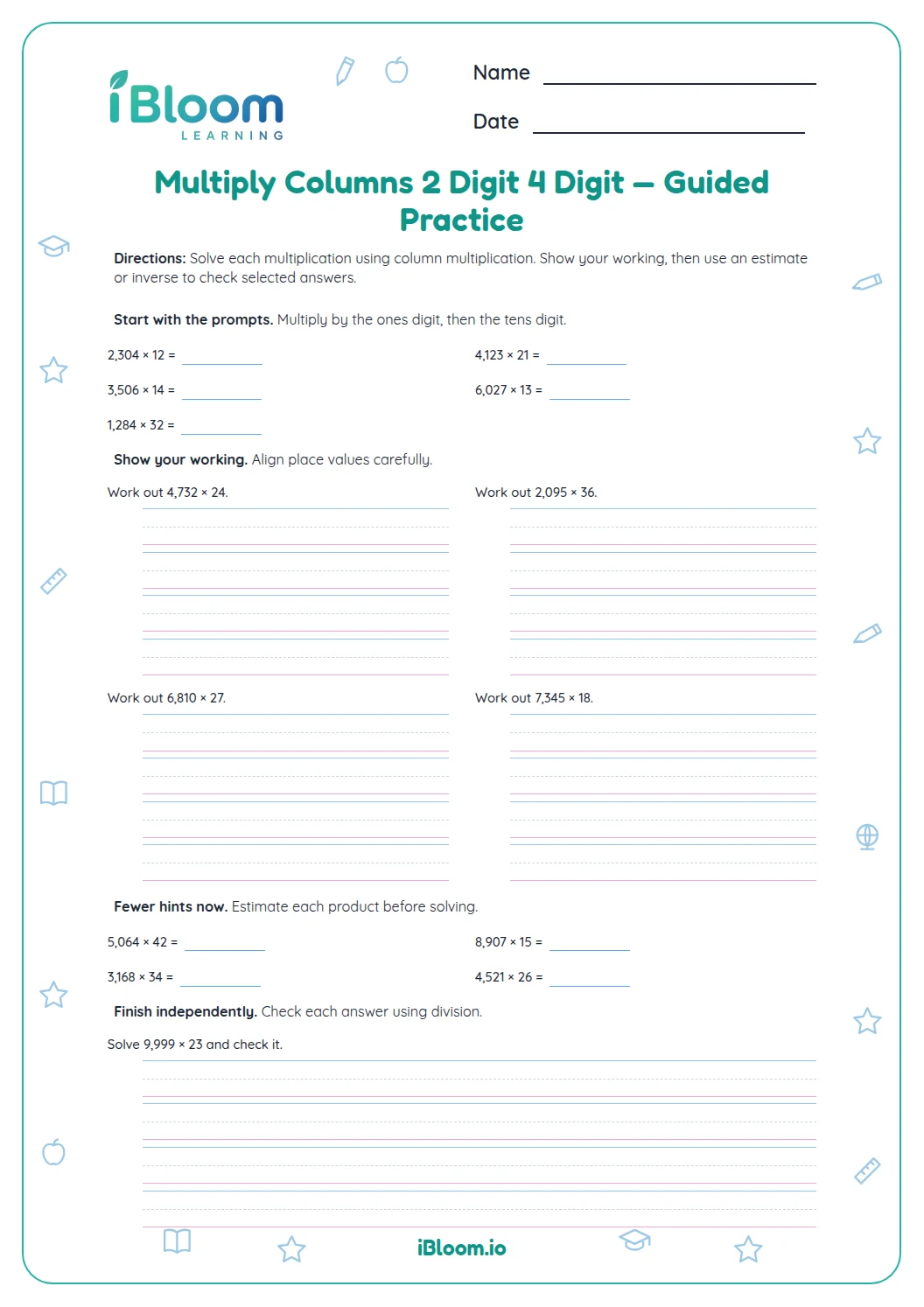
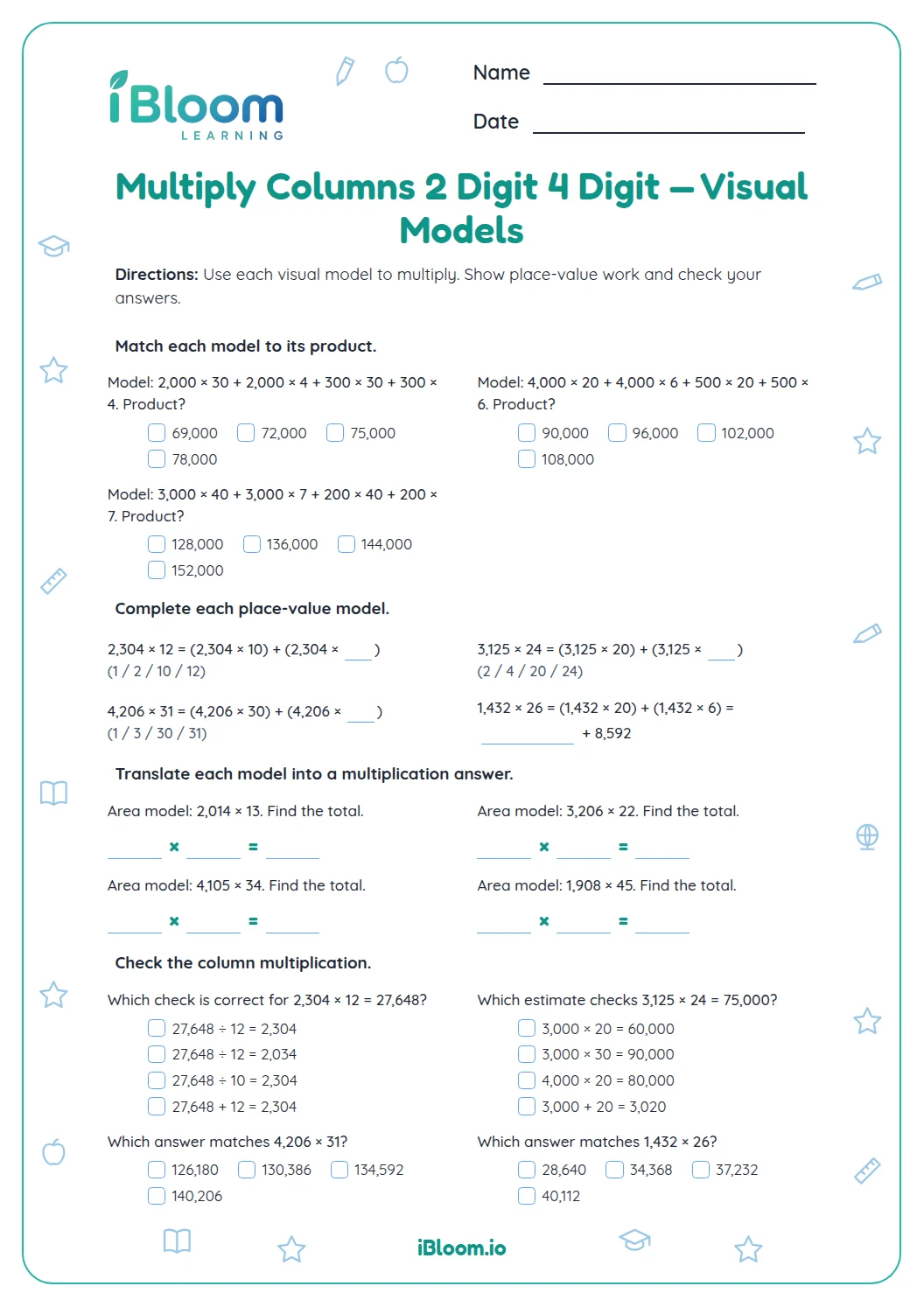
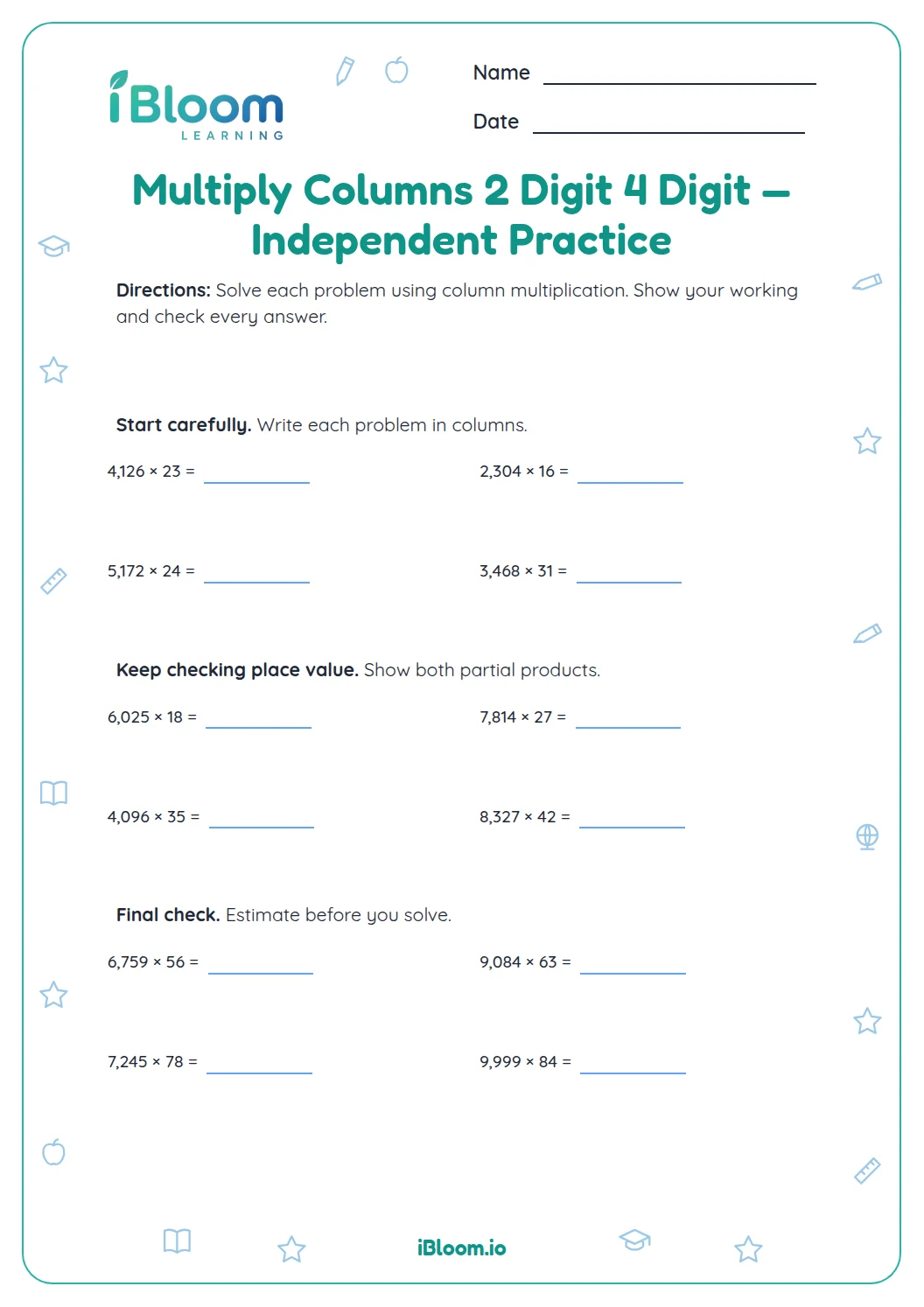
This free Grade 5 worksheet connects multiplication models with multiplying a three-digit number by a two-digit number. Part A matches repeated-group models to products. Part B splits each two-digit multiplier into tens and ones and asks for four missing partial products. Part C asks students to set up six products in columns, including factors with a zero. The column work practices CCSS 5.NBT.B.5. A separate key gives every answer, and the worked example below connects partial products with the column method.
Aligned to 5.NBT.B.5
How do the group models show multiplication?
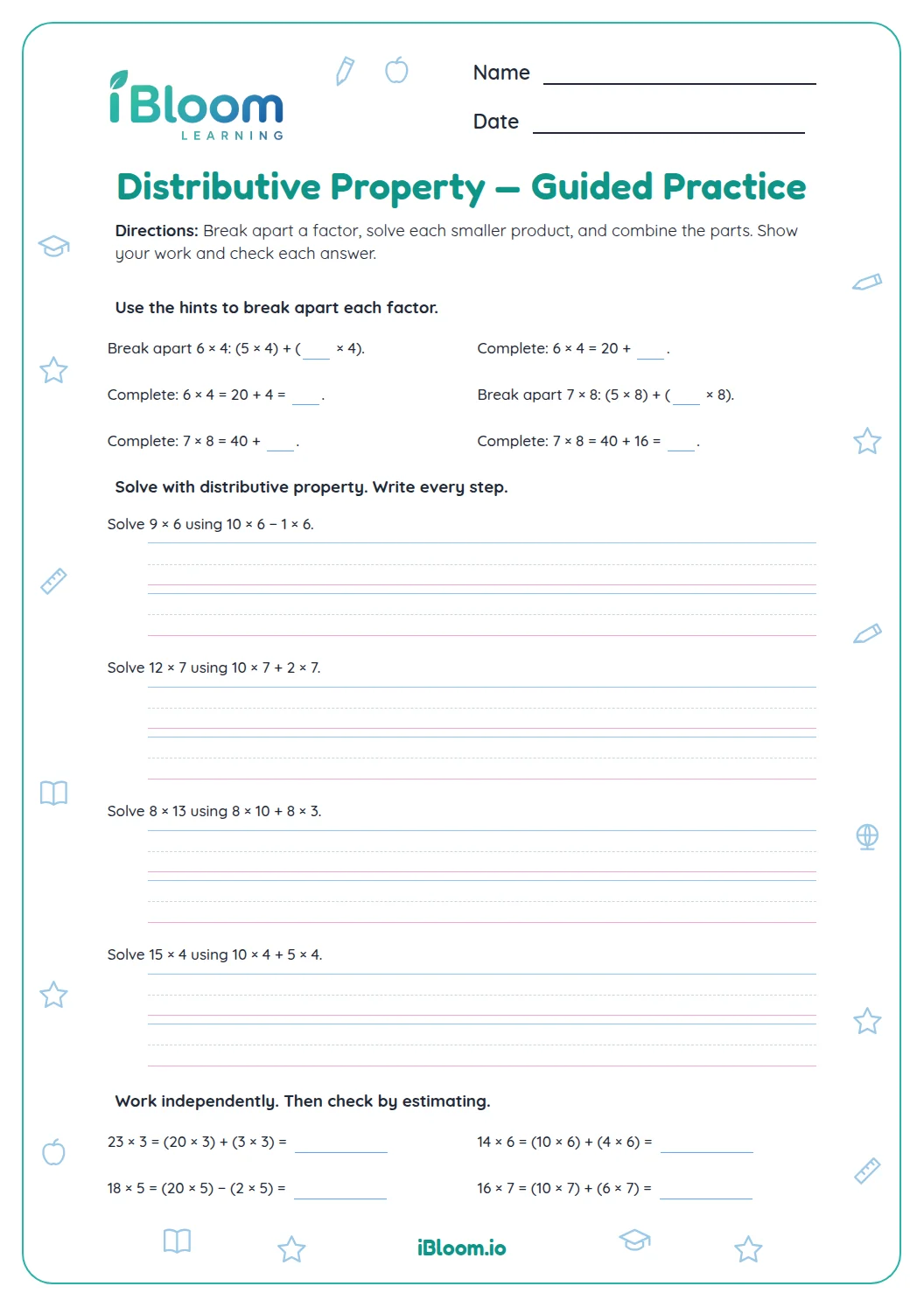
A model such as 3 groups of 246 means 246 is added three times, so the matching multiplication statement is 246 × 3. For 20 groups of 315, multiply 315 by 20.
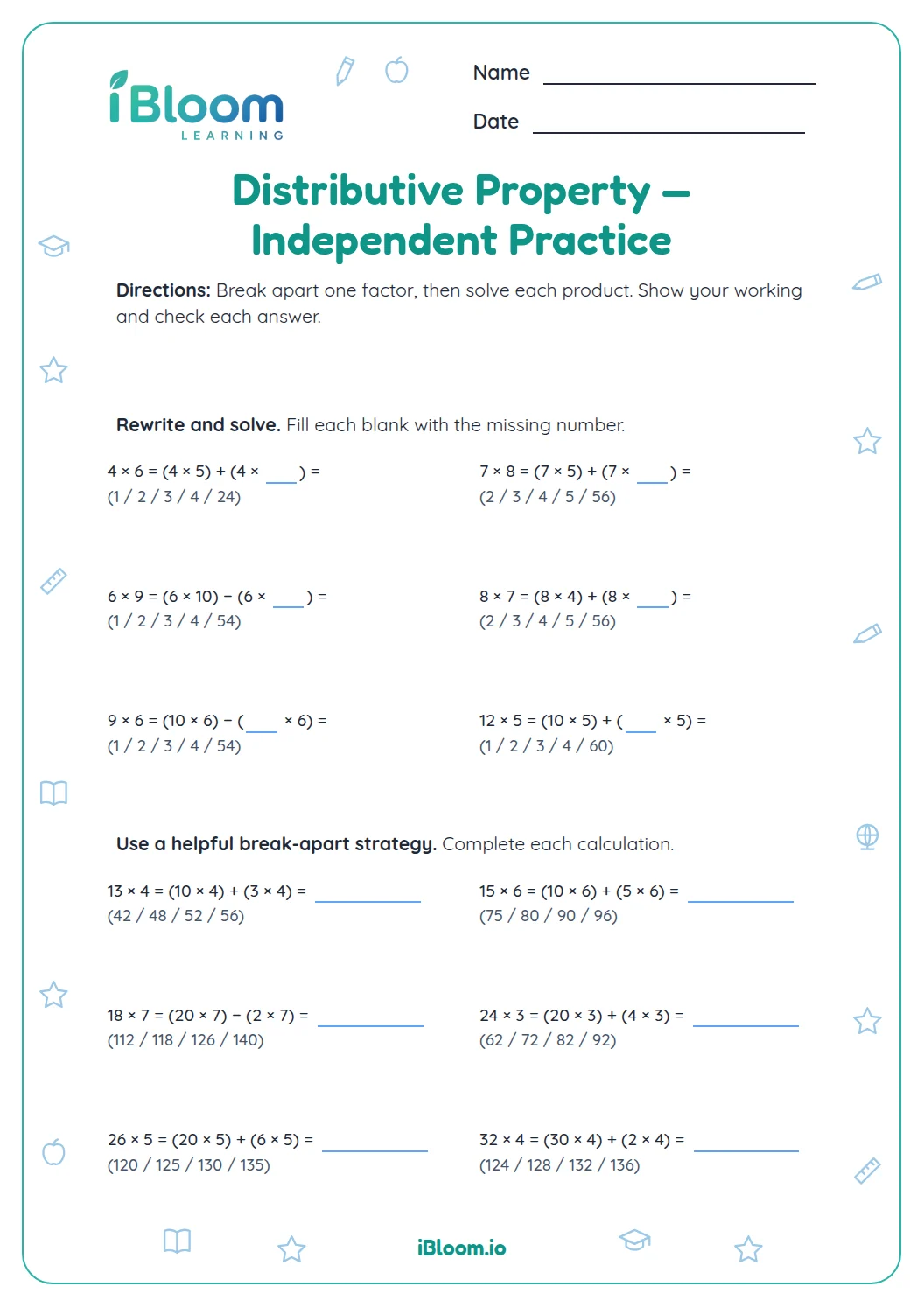
Part A asks students to connect the number of equal groups with the correct product. Part B then breaks two-digit multipliers into tens and ones.
How do the model and the two rows agree?
The ones digit of 23 gives 146 × 3. The tens digit gives 146 × 20. Keep these as separate rows and align the ones, tens, hundreds, and thousands before adding.
- 1146 × 23
- 2146 × 3 = 438
- 3146 × 20 = 2,920
- 4438 + 2,920 = 3,358
How does the practice get harder?
Part A matches repeated-group models with multiplication statements. Part B includes products such as 234 × 10 and 318 × 4.
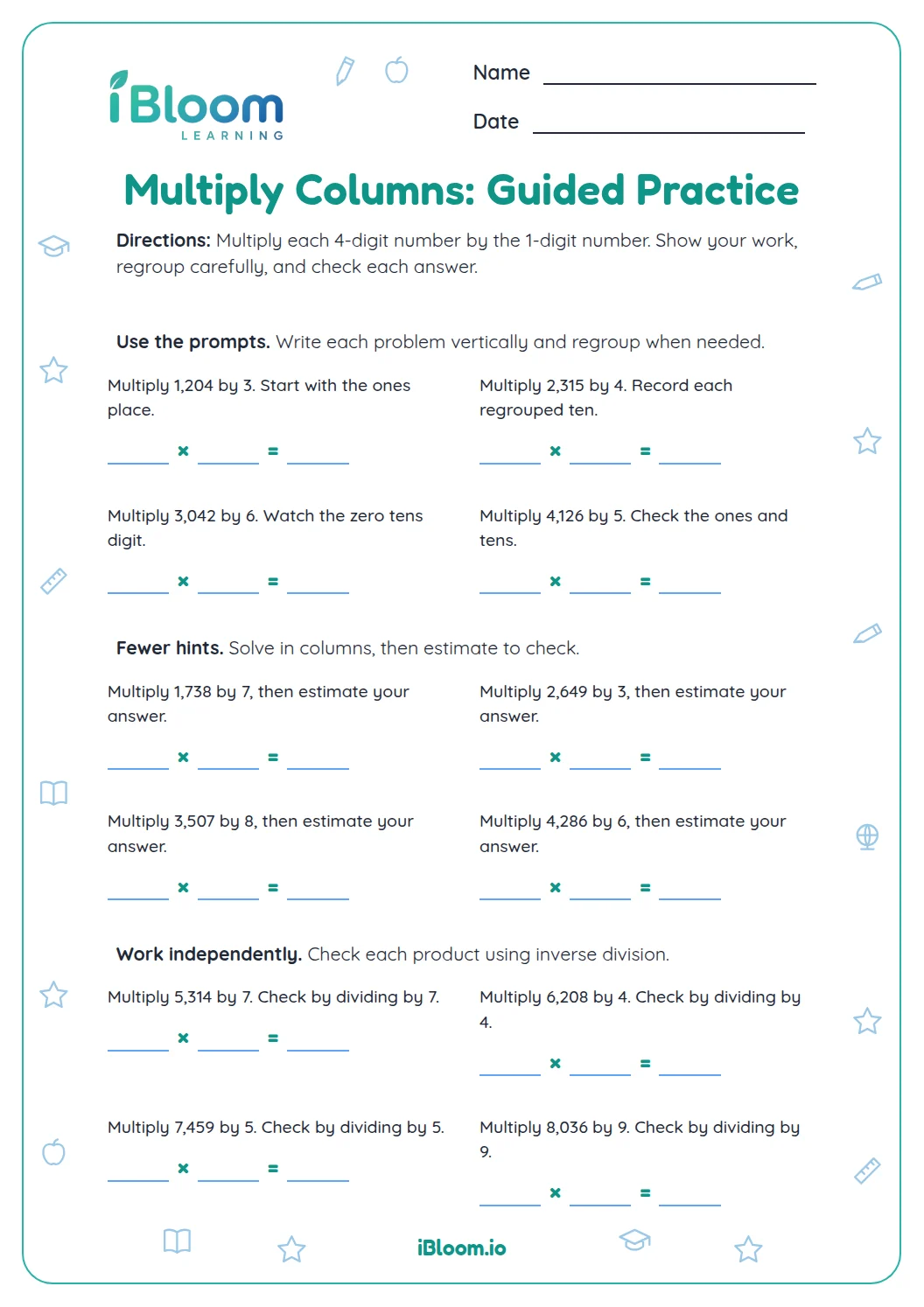
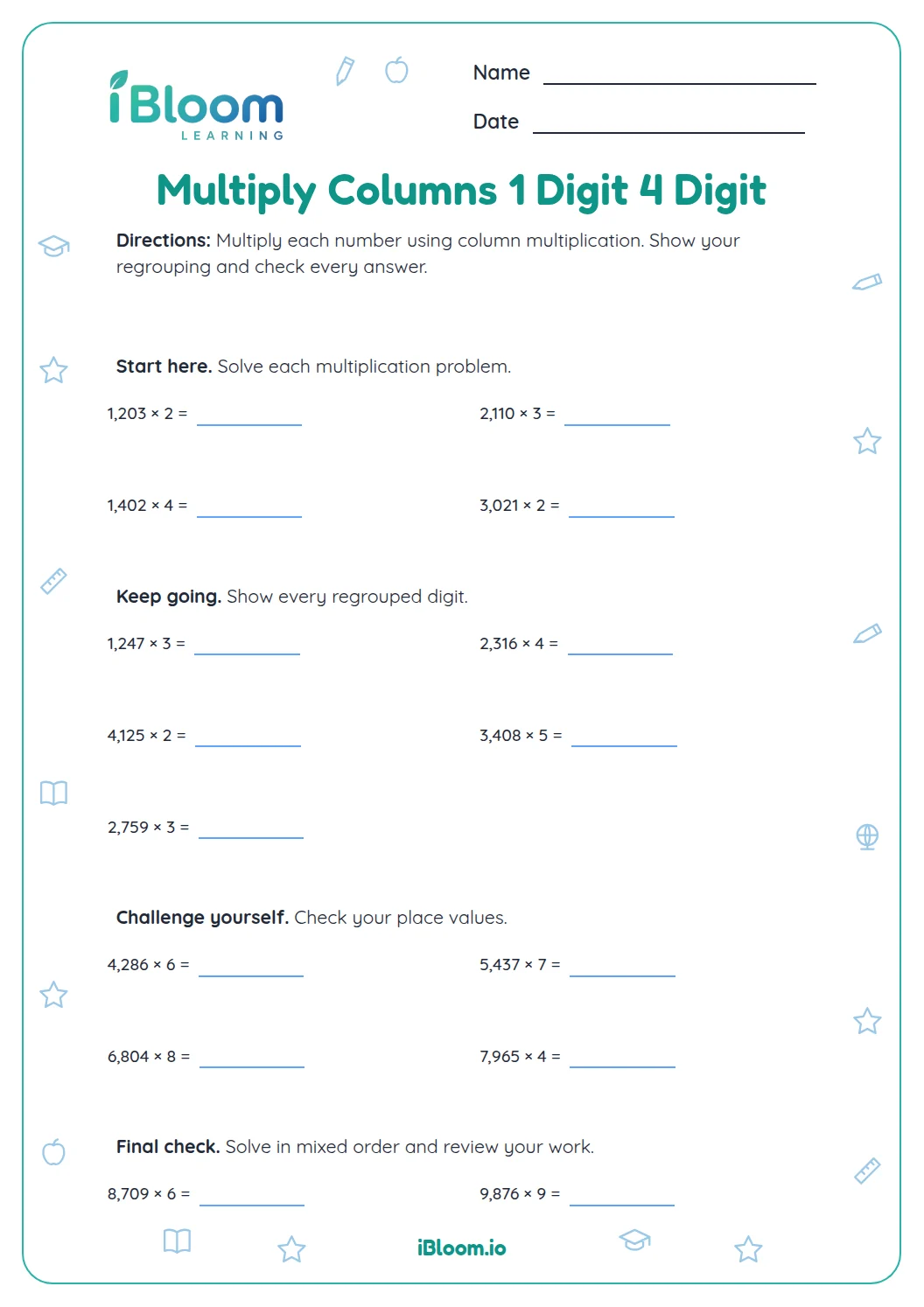
Part C includes 146 × 23 and 275 × 34, which require regrouping, followed by products including 306 × 24 and 420 × 16. Students leave both partial-product rows visible so an adult can check place-value alignment.
How to use this worksheet
- 1Read each Part A model as equal groups and choose its matching multiplication statement.
- 2In Part B, split the two-digit multiplier into tens and ones.
- 3Find the missing partial product in each equation.
- 4In Part C, align the factors in columns and write both multiplication rows.
- 5Add the rows and compare each product with the key.
Mistakes to check together
The mistake
Treating 20 groups as 2 groups.
The fix
The 2 in 20 means two tens, so 20 × 315 is 6,300.
The mistake
Multiplying 234 by 1 instead of 10 in 234 × 10.
The fix
The 1 is in the tens place, so the partial product is 2,340.
The mistake
Starting the tens row in the ones column.
The fix
The tens row represents a multiple of ten; align its last digit one place left.
Common Core alignment
Multiply three-digit numbers by two-digit numbers using the standard algorithm.
On this sheet: Part C asks students to set up and solve six products in columns.
Show the official wordingHide the official wording
Fluently multiply multi-digit whole numbers using the standard algorithm.
What to practice next
Make more practice
Further reading
Questions parents and teachers ask
What does “3 groups of 246” mean?
It means 246 is counted three times: 246 + 246 + 246. The matching multiplication statement is 246 × 3 = 738. Part A asks students to connect the group description to its product, then later parts show how place-value partial products support longer multiplication.
Does this worksheet include column multiplication?
Yes. Part C has six calculations that students set up and solve in columns. They write one row for multiplying by the ones digit and another for the tens digit, then add. Part B first practices finding those partial products in four equations.
How can I explain the zero in the tens row?
In a two-digit multiplier, the tens digit represents a multiple of ten. For 146 × 23, the tens row is 146 × 20 = 2,920. Start that row one place left of the ones row, then add 438 and 2,920.
What should I check besides the final answer?
Check that the student keeps the two partial-product rows aligned and includes any regrouped amounts. A correct total alone does not show how the work was organized. Use the open work space to review the calculation, and use the separate answer key to confirm the final product.
Can students solve the model questions another way?
Yes. Part A uses equal-group models, Part B shows tens and ones partial products, and Part C asks for column multiplication. For example, 146 × 23 can be split into 146 × 20 and 146 × 3, then the two products are added.