



About this worksheet
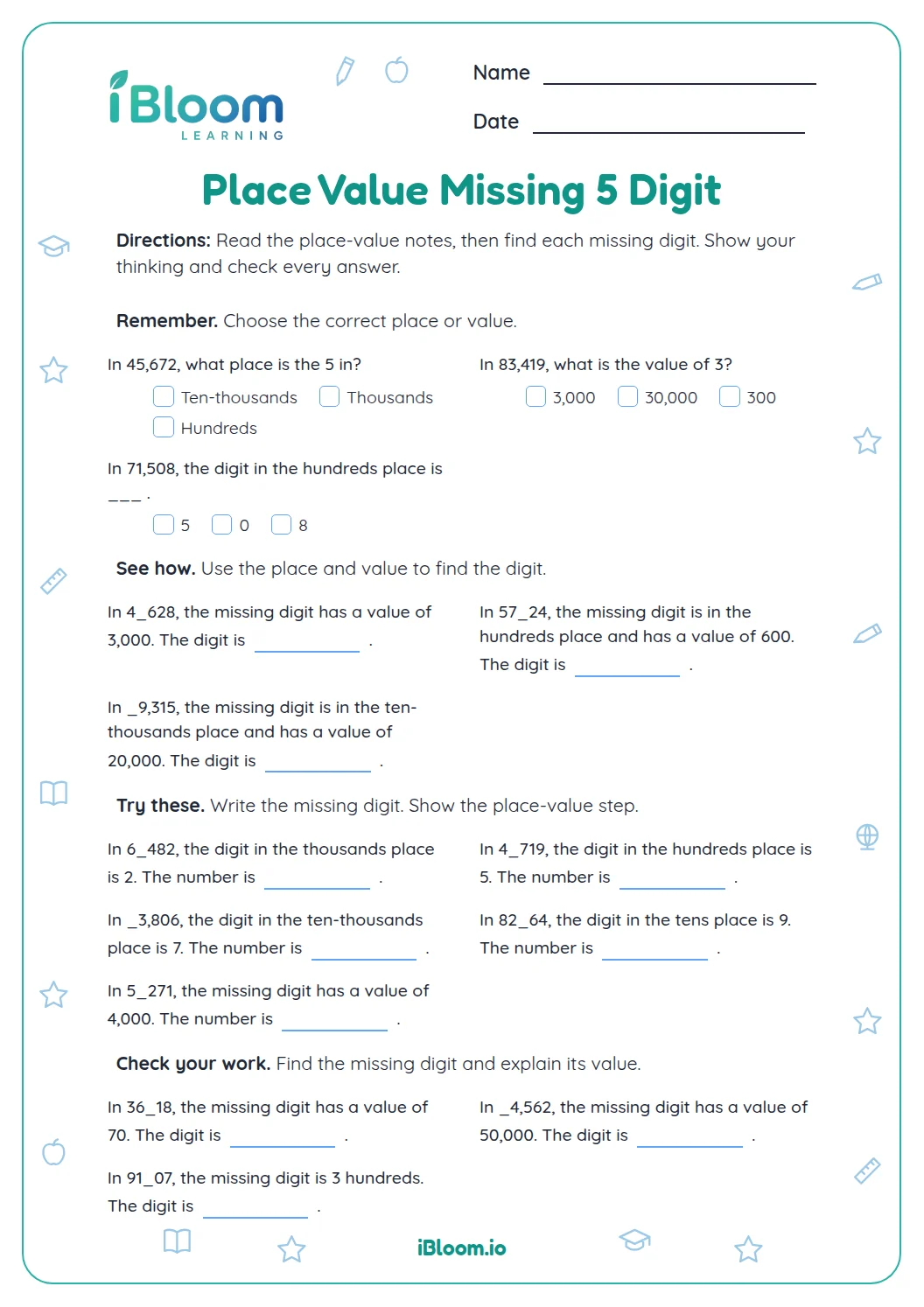
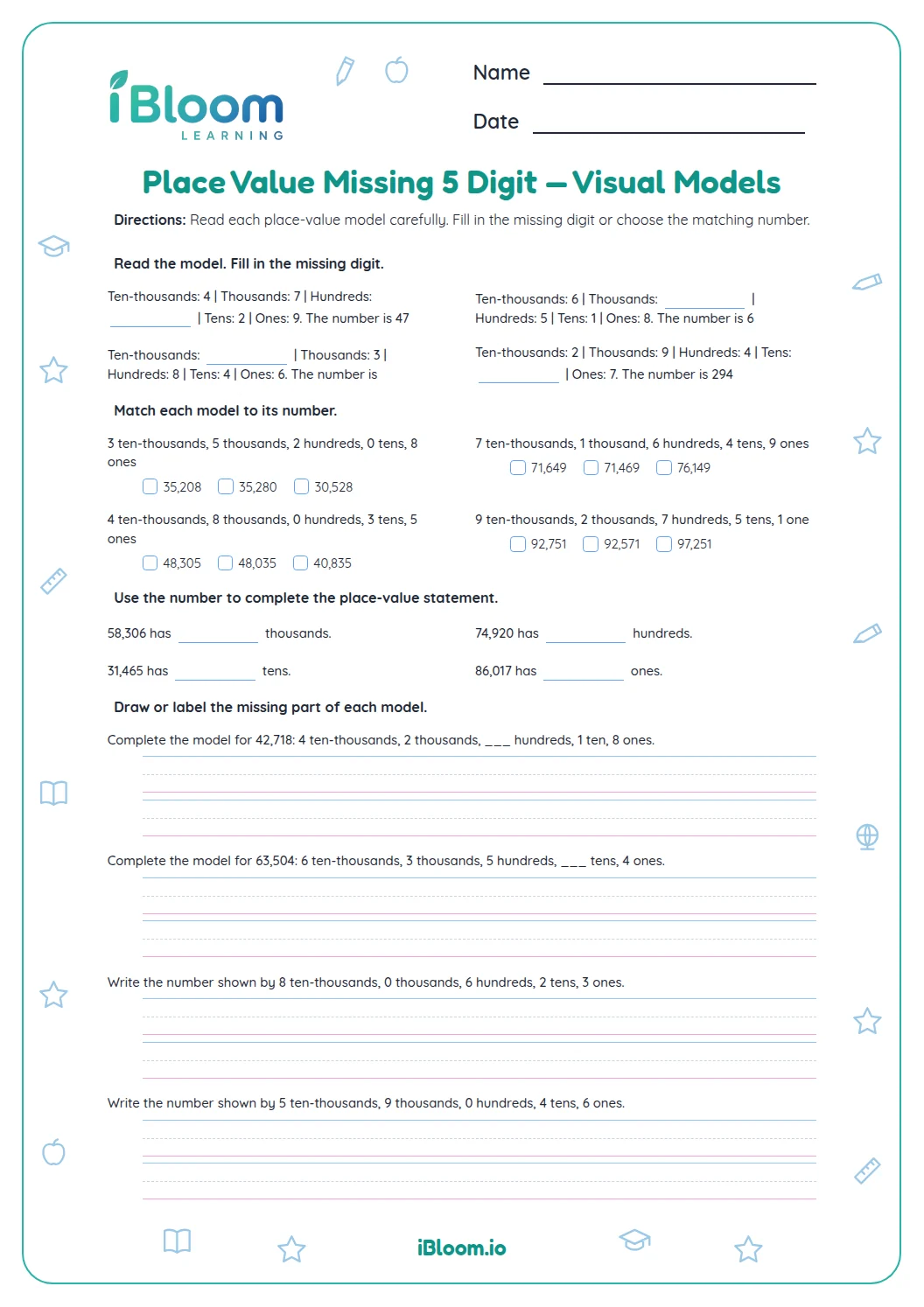
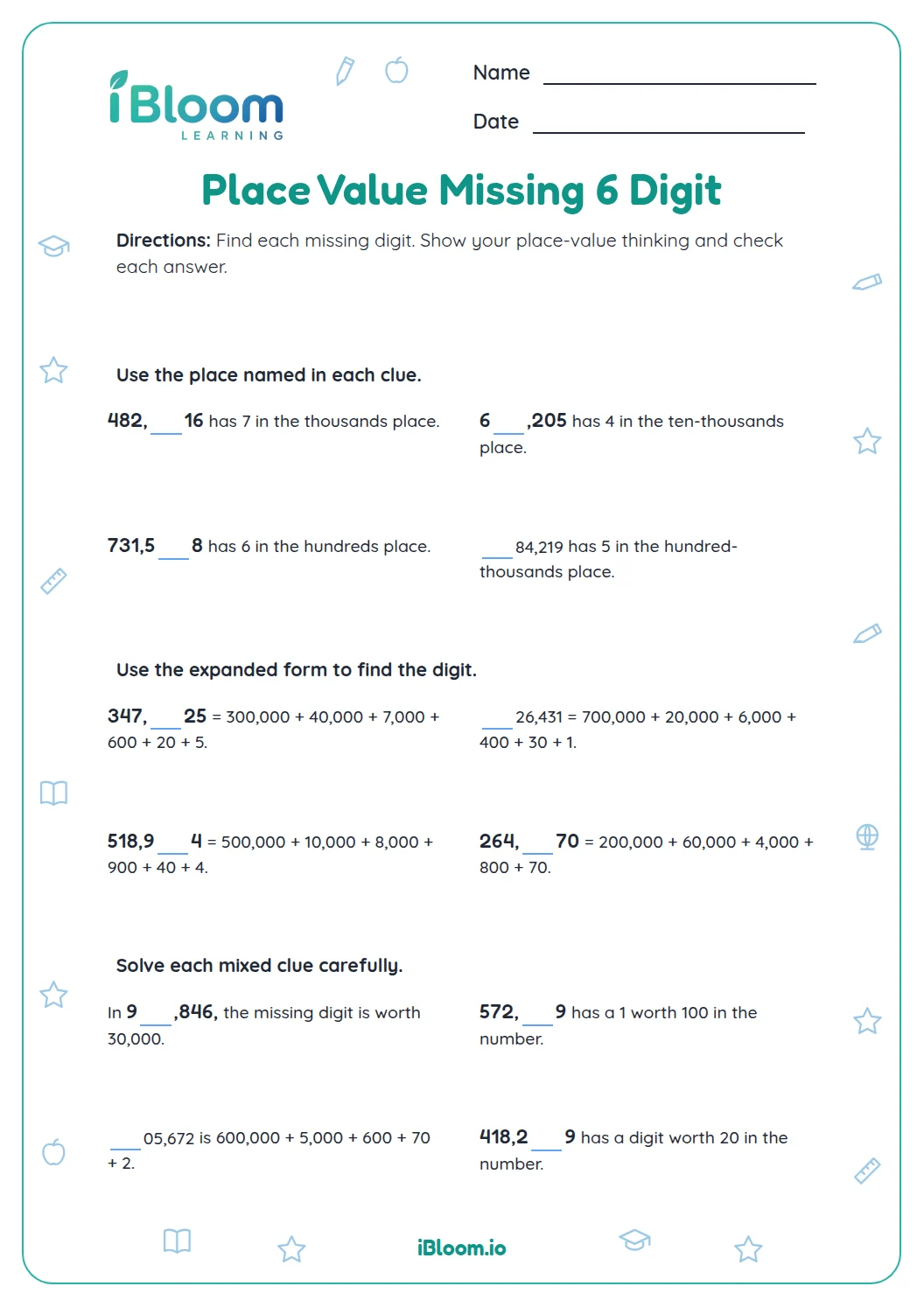
This free Grade 5 printable focuses on finding missing digits in five-digit numbers. Sixteen clues move from identifying a place to using expanded form and comparing digit values, following the old sheet’s missing-digit format. The questions practice how a digit’s value changes by a factor of ten from one place to the next, and a separate answer key is included.
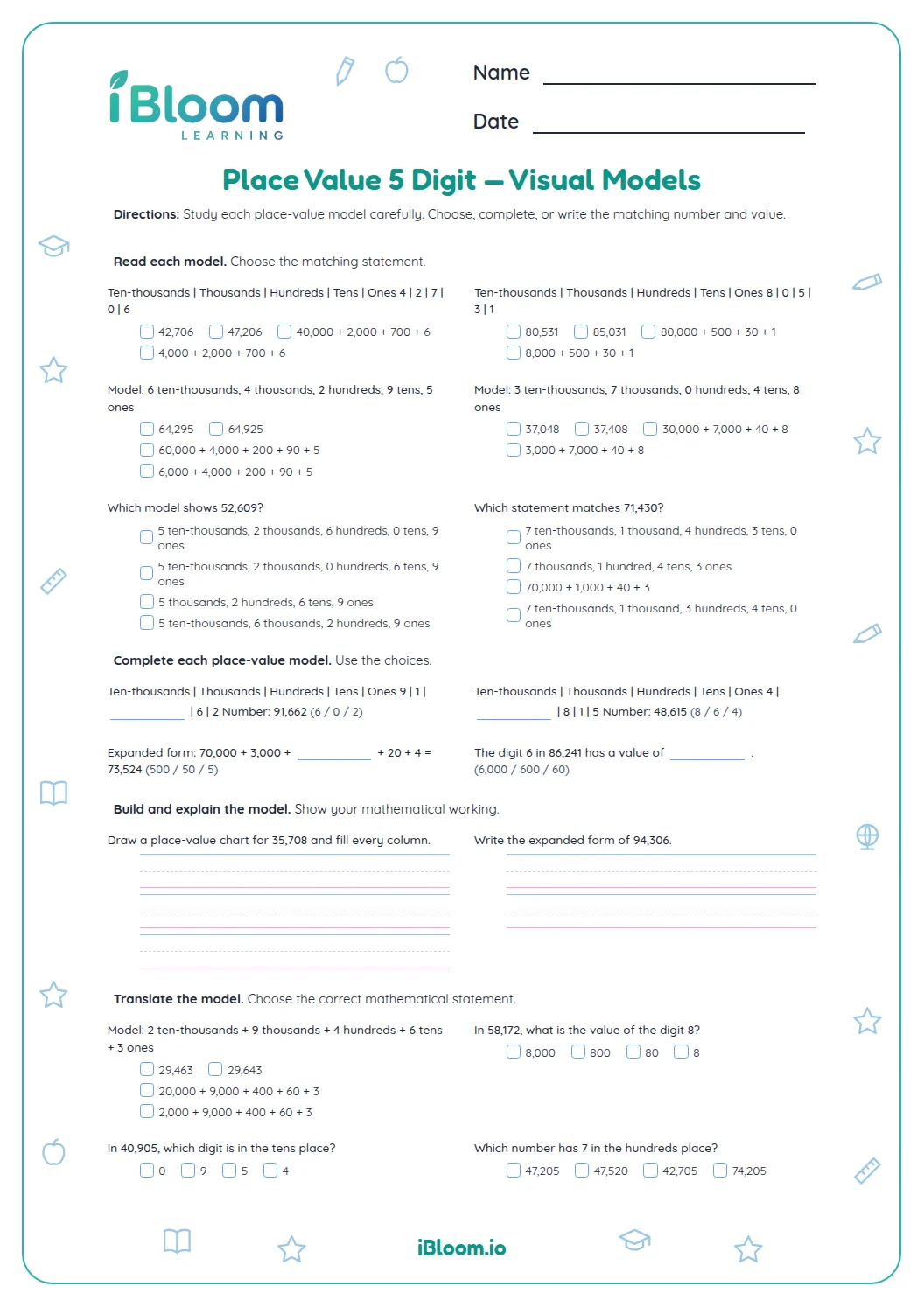
Aligned to 5.NBT.A.1
How do place-value clues reveal a missing digit?
Start by naming the place of the blank. In q1, 4___,582 has a 0 in the thousands place, so the missing digit is 0. The blank is in the thousands place, not the hundreds place.
- 14___,582 has 0 thousands.
- 2The blank is in the thousands place.
- 3Write 0: 40,582.
How can expanded form help?
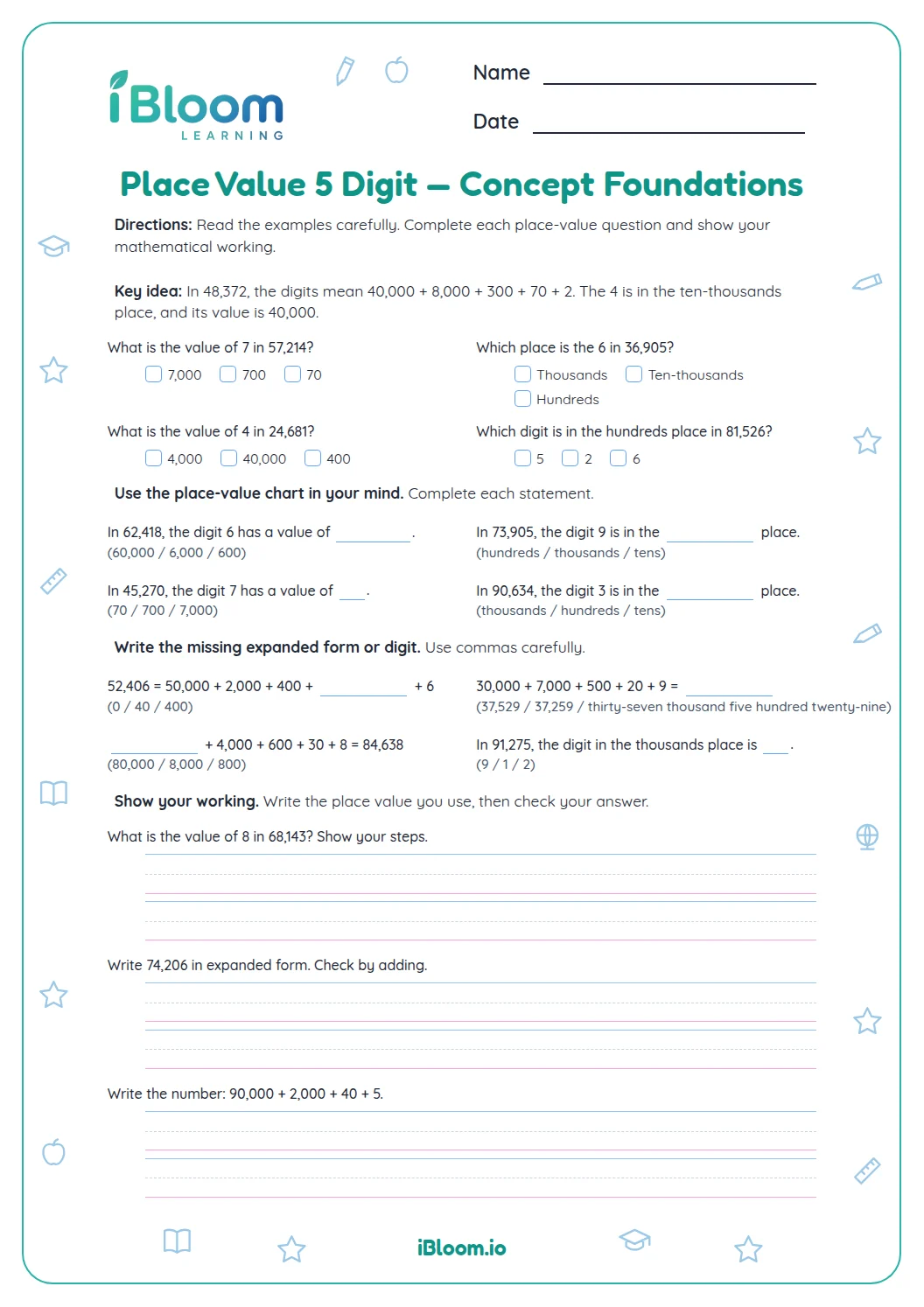
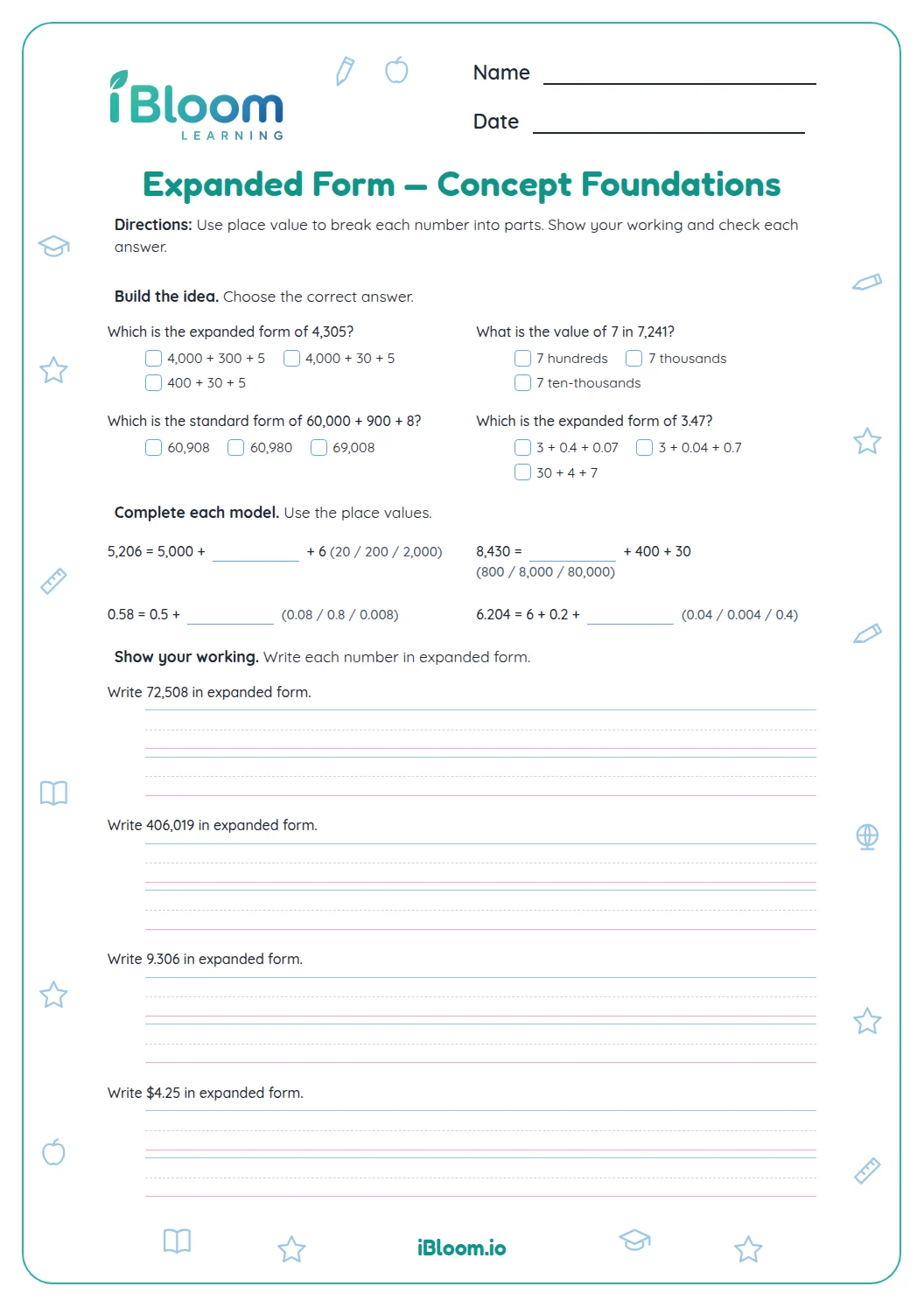
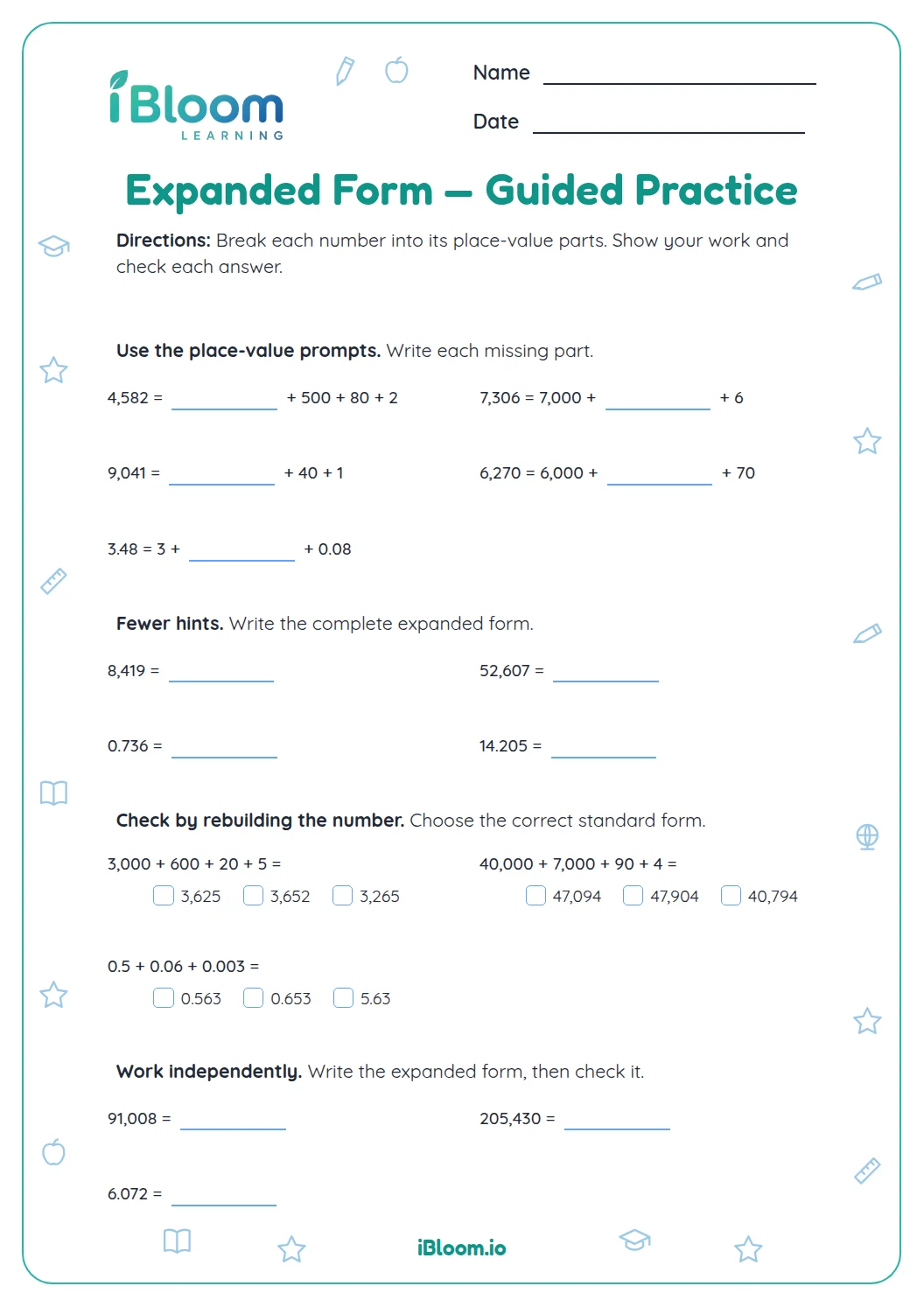
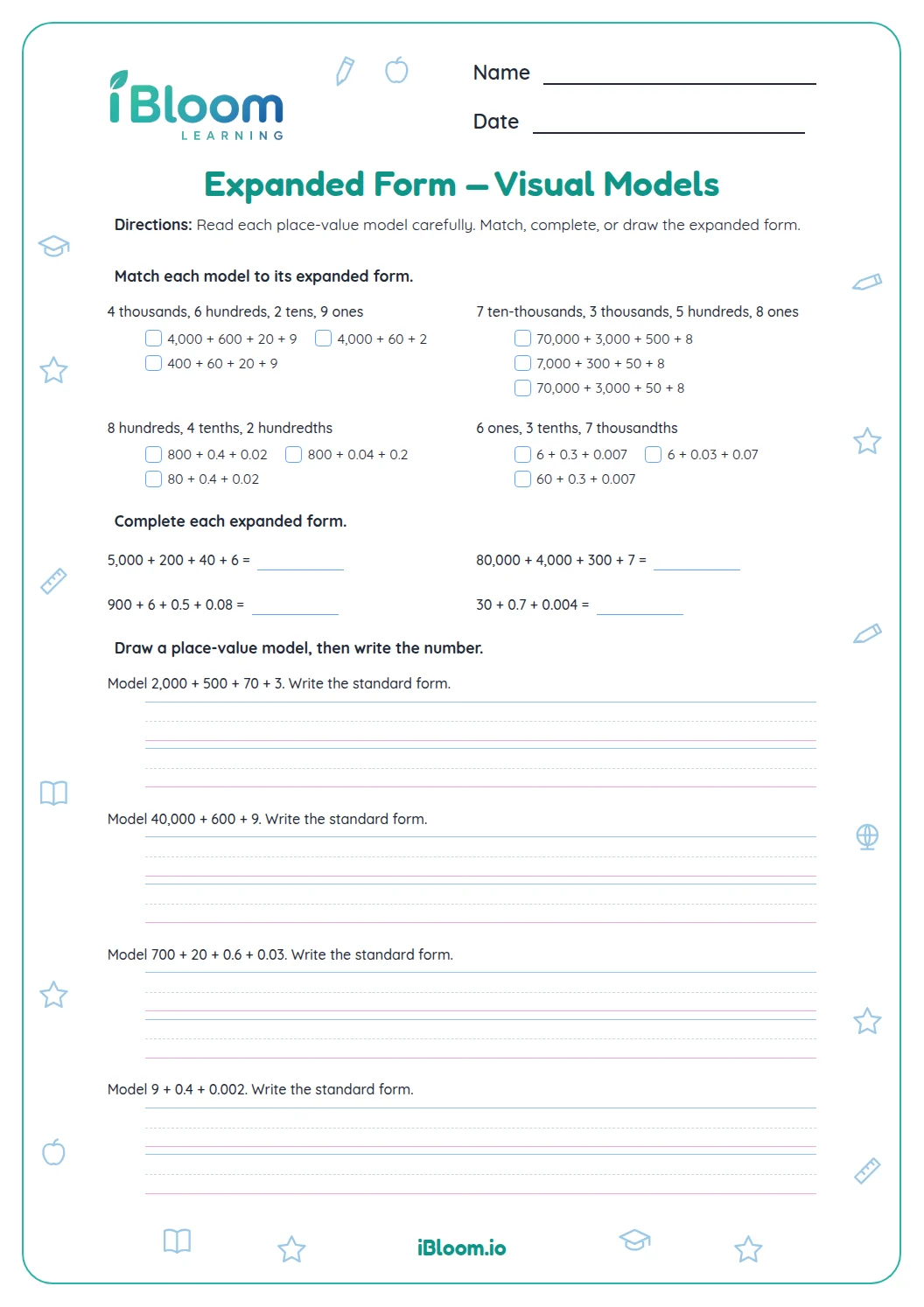
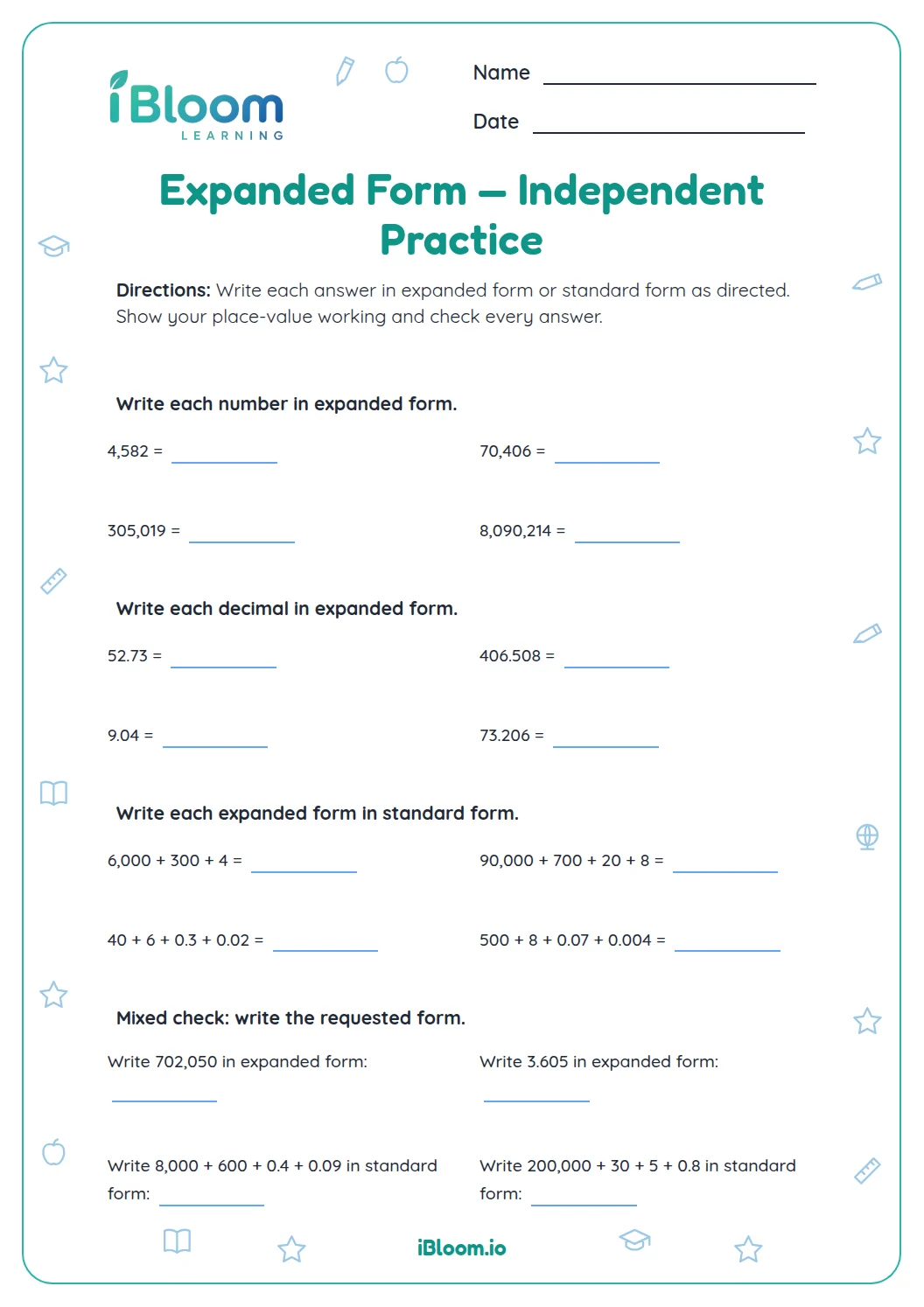
Match each addend to a place in the number. A 5,000 addend means the digit 5 belongs in the thousands place; a 600 addend means 6 belongs in the hundreds place.
How do neighboring places compare?
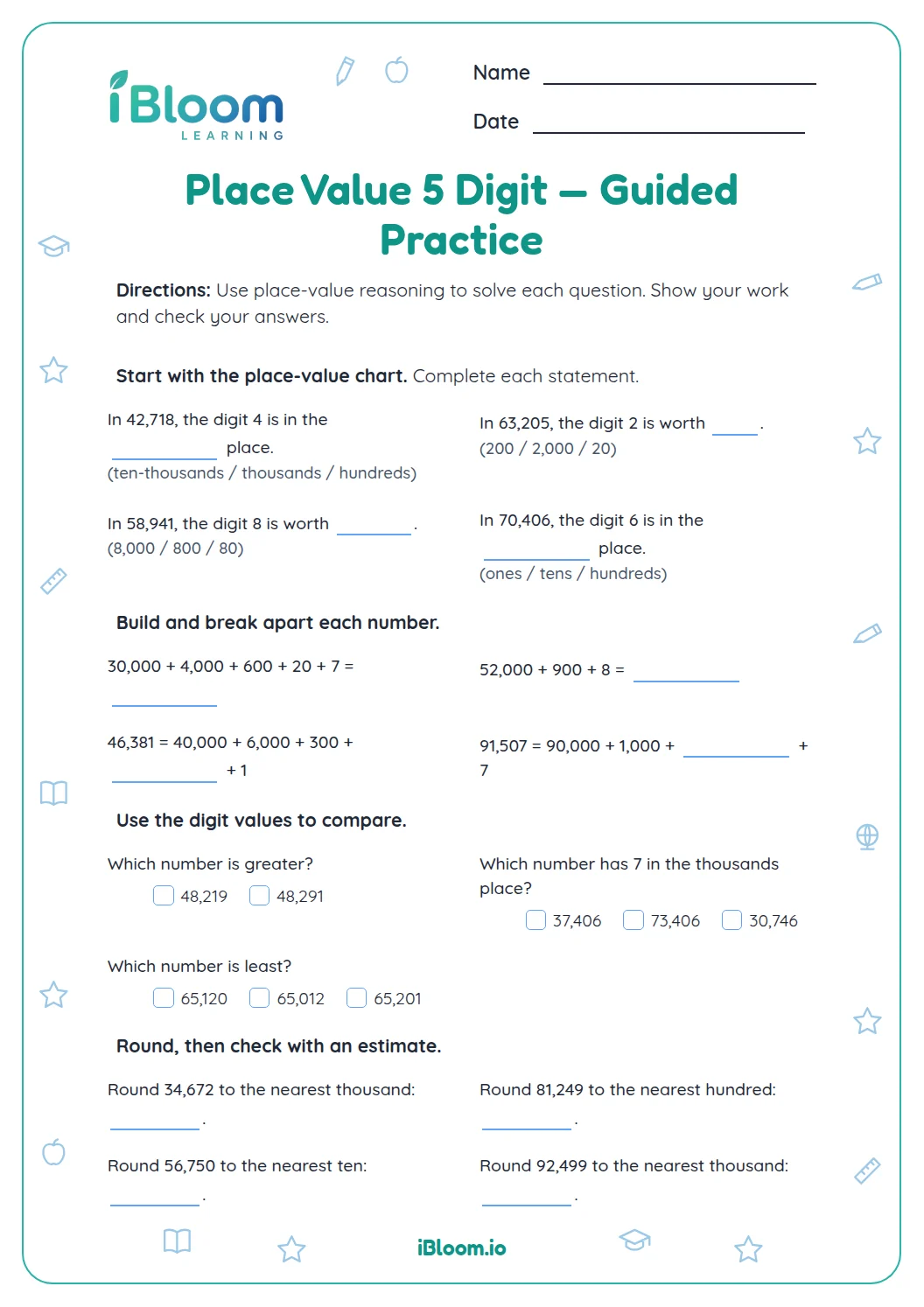
Each place to the left is worth ten times the place immediately to its right. In q11, the 3 in the thousands place is worth 3,000 and the 3 in the hundreds place is worth 300.
- 1In 33,000, compare the 3s.
- 23,000 ÷ 300 = 10.
- 3The thousands-place 3 is worth 10 times as much.
How to work through the clues
- 1Read the number and mark the place of the blank.
- 2Translate each clue into a digit or place value.
- 3For expanded form, match every addend to its place.
- 4For a ten-times clue, compare the two digits’ values, not just the digits.
- 5Check that the completed number satisfies the whole clue.
Place-value slips to watch for
The mistake
Putting a digit in the neighboring place.
The fix
Count the places from the right: ones, tens, hundreds, thousands, ten-thousands.
The mistake
Answering with a digit’s value when the question asks for the digit.
The fix
For the hundreds place, write the digit alone; for its value, include the place value.
The mistake
Comparing the face digits in a ten-times question.
The fix
Write each digit’s value first, then compare those values.
Common Core alignment
Use the tenfold relationship between adjacent places to solve digit-value clues.
On this sheet: The final part compares digit values in neighboring places.
Show the official wordingHide the official wording
Recognize that in a multi-digit number, a digit in one place represents 10 times as much as it represents in the place to its right and 1/10 of what it represents in the place to its left.
What to practice next
Make more practice
Further reading
Questions parents and teachers ask
What does the missing digit tell us?
Each clue identifies a place or value in a five-digit number. A clue about 5 thousands means the missing digit is 5 in the thousands place. Other items connect a digit to expanded form or compare the values of two places.
How many questions are on this worksheet?
There are 14 short-answer questions in three parts. They cover place clues, expanded form, and relationships between neighboring places. Each item asks for one digit or one numerical relationship, and a separate key lists the answers. Invite the student to reread the example and explain how its clue supports the answer.
Is an answer key included?
Yes. The answer key is separate and lists the missing digit for every question, including clues that combine more than one fact. Check the completed number against each clue before using the key to review the answer. Invite the student to reread the example and explain how its clue supports the answer.
How does expanded form help find a digit?
Each addend names one place value. In 30,000 + 5,000 + 600 + 4, the 5,000 addend shows that 5 belongs in the thousands place. Match the value to the place before filling the blank. Invite the student to reread the example and explain how its clue supports the answer.
What does “10 times as much” mean here?
A place is ten times the value of the place directly to its right. A 3 in the thousands place is worth 3,000, while a 3 in the hundreds place is worth 300. The worksheet compares these values. Invite the student to reread the example and explain how its clue supports the answer.