


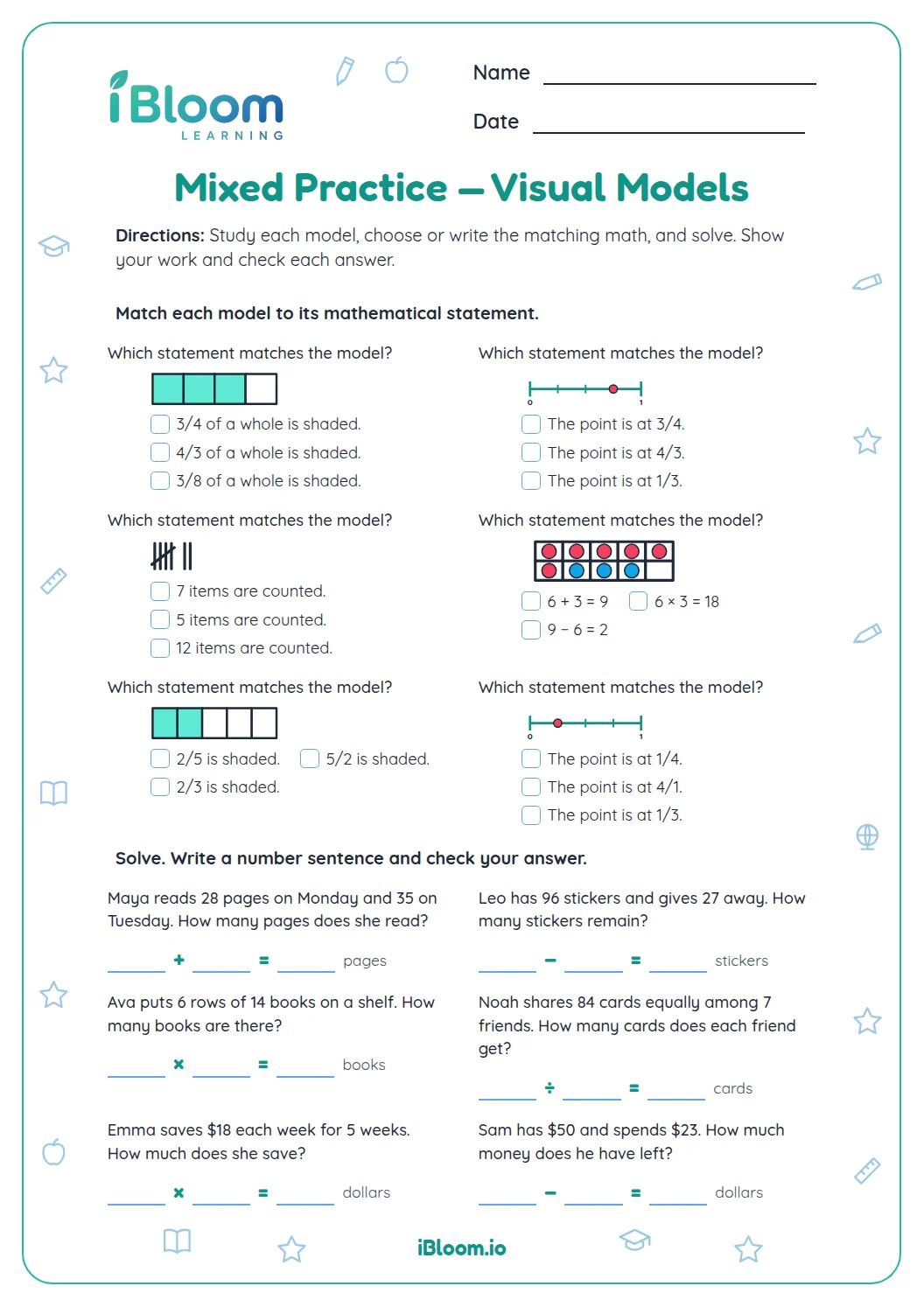

About this worksheet
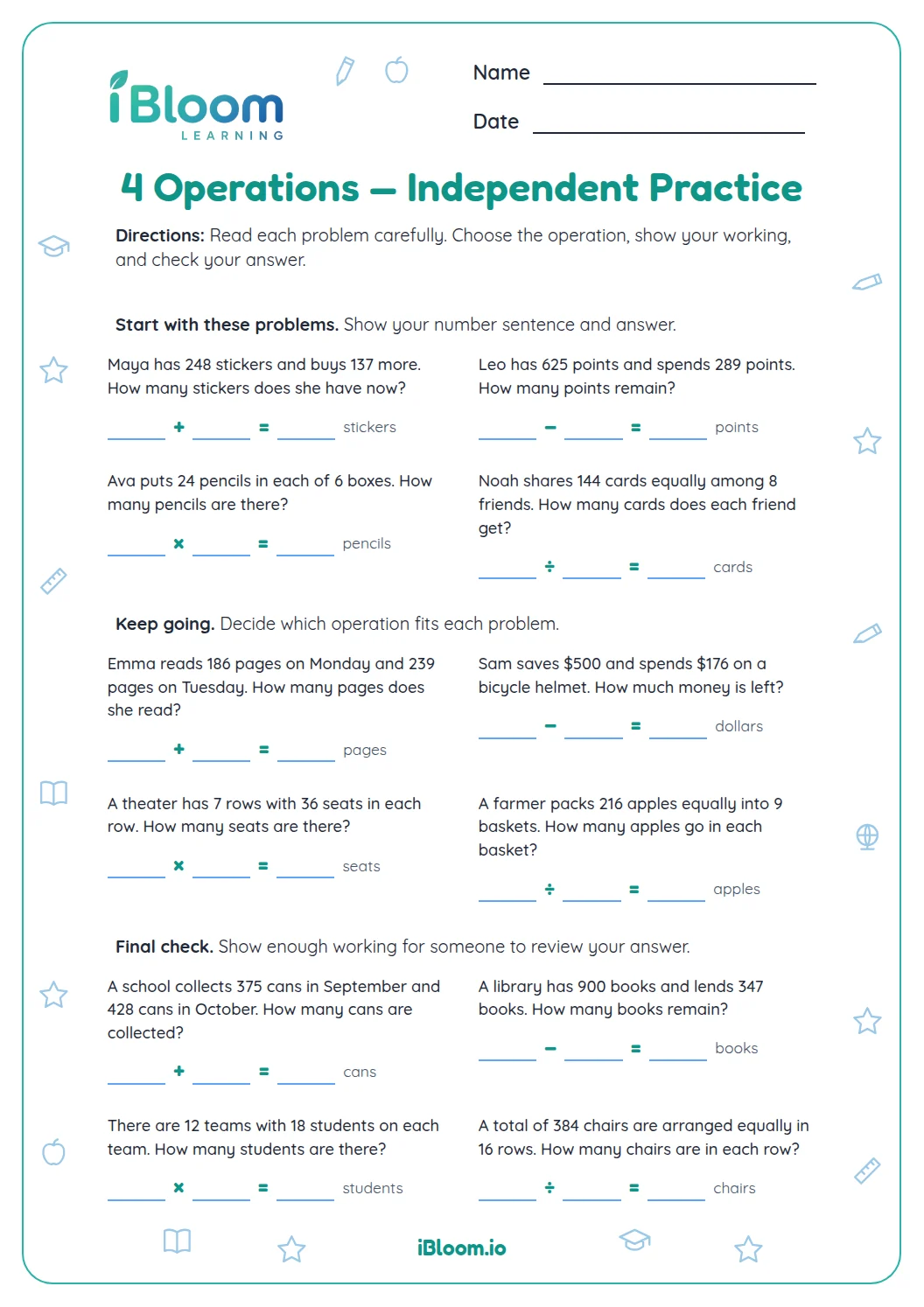
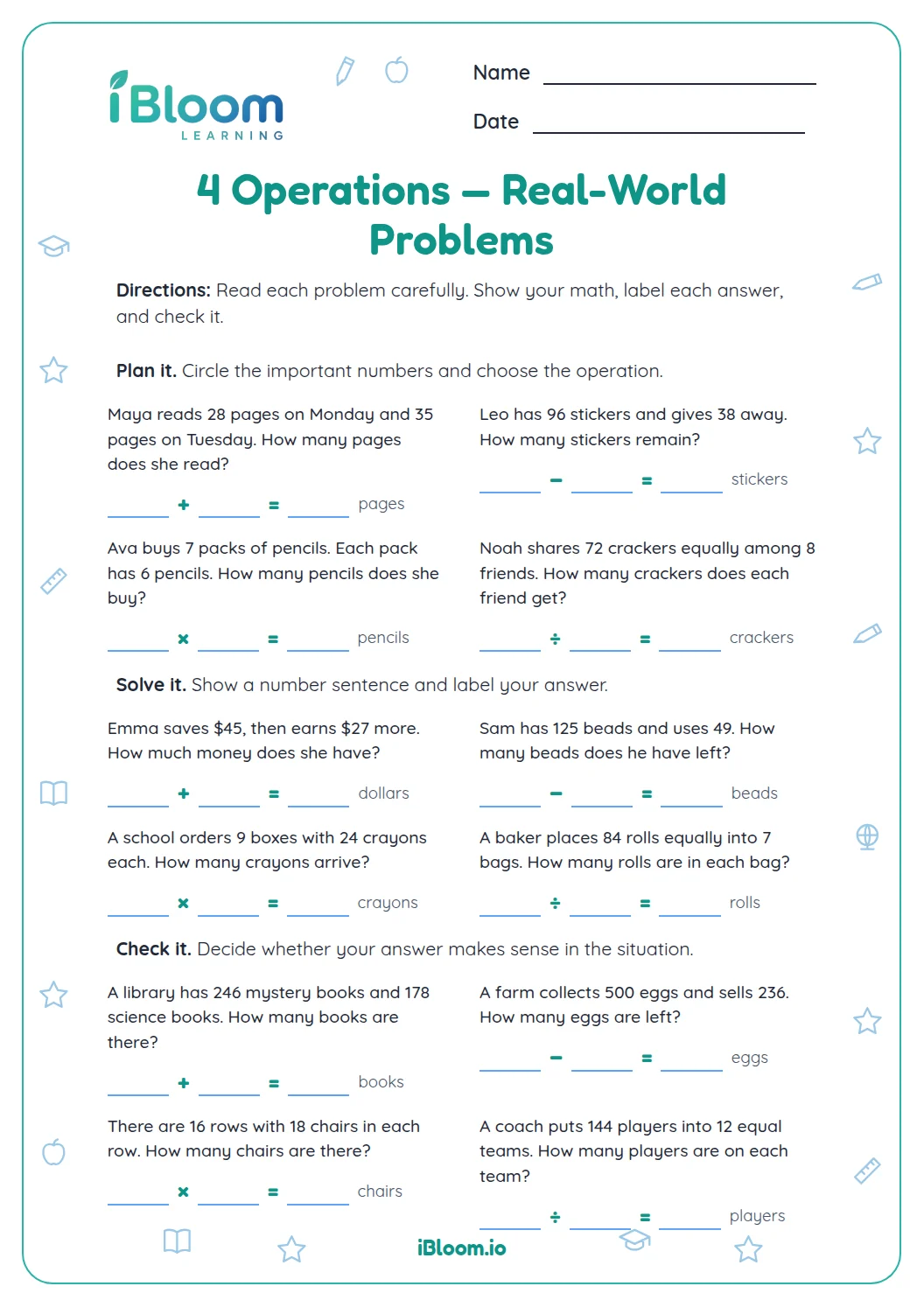
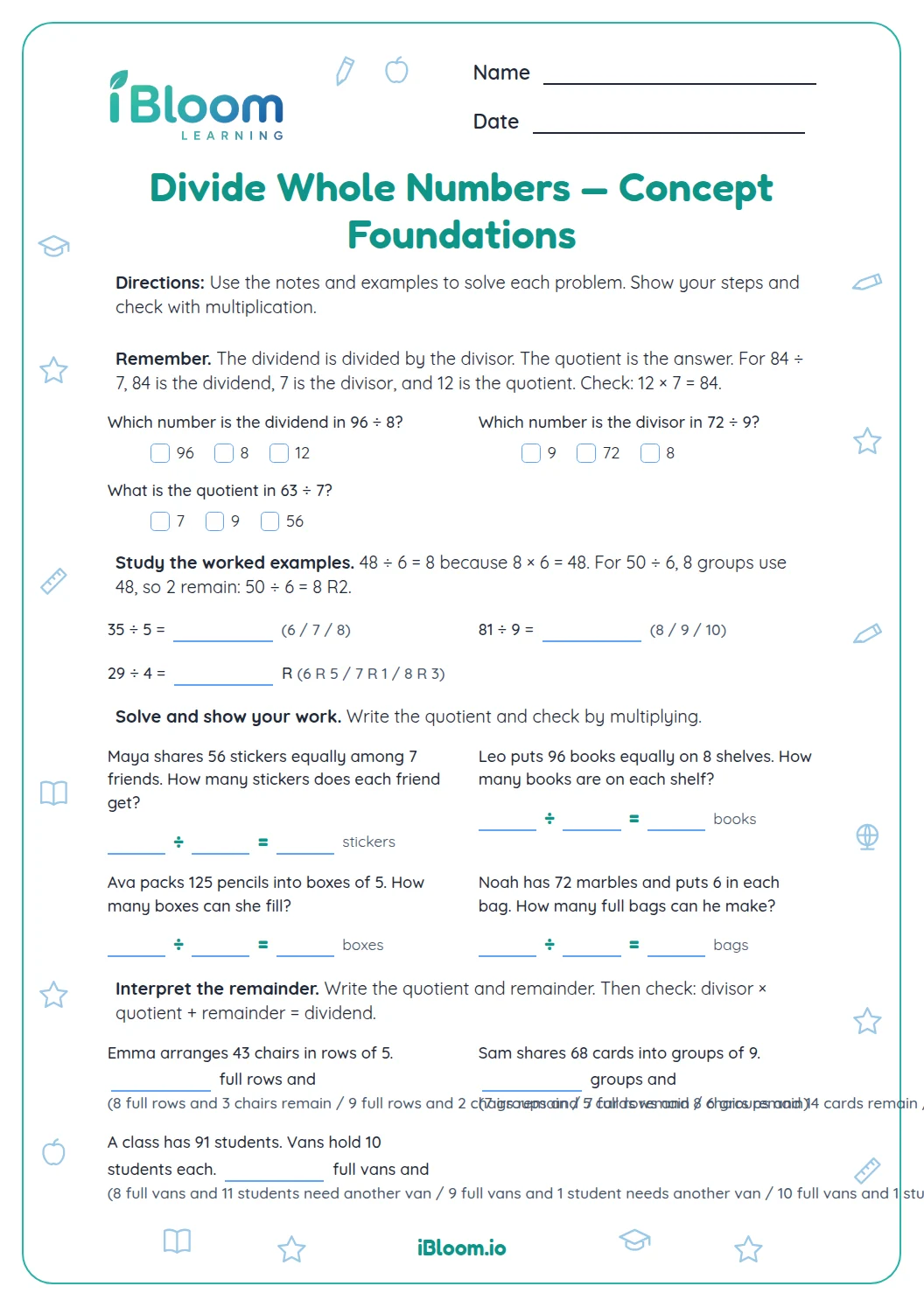
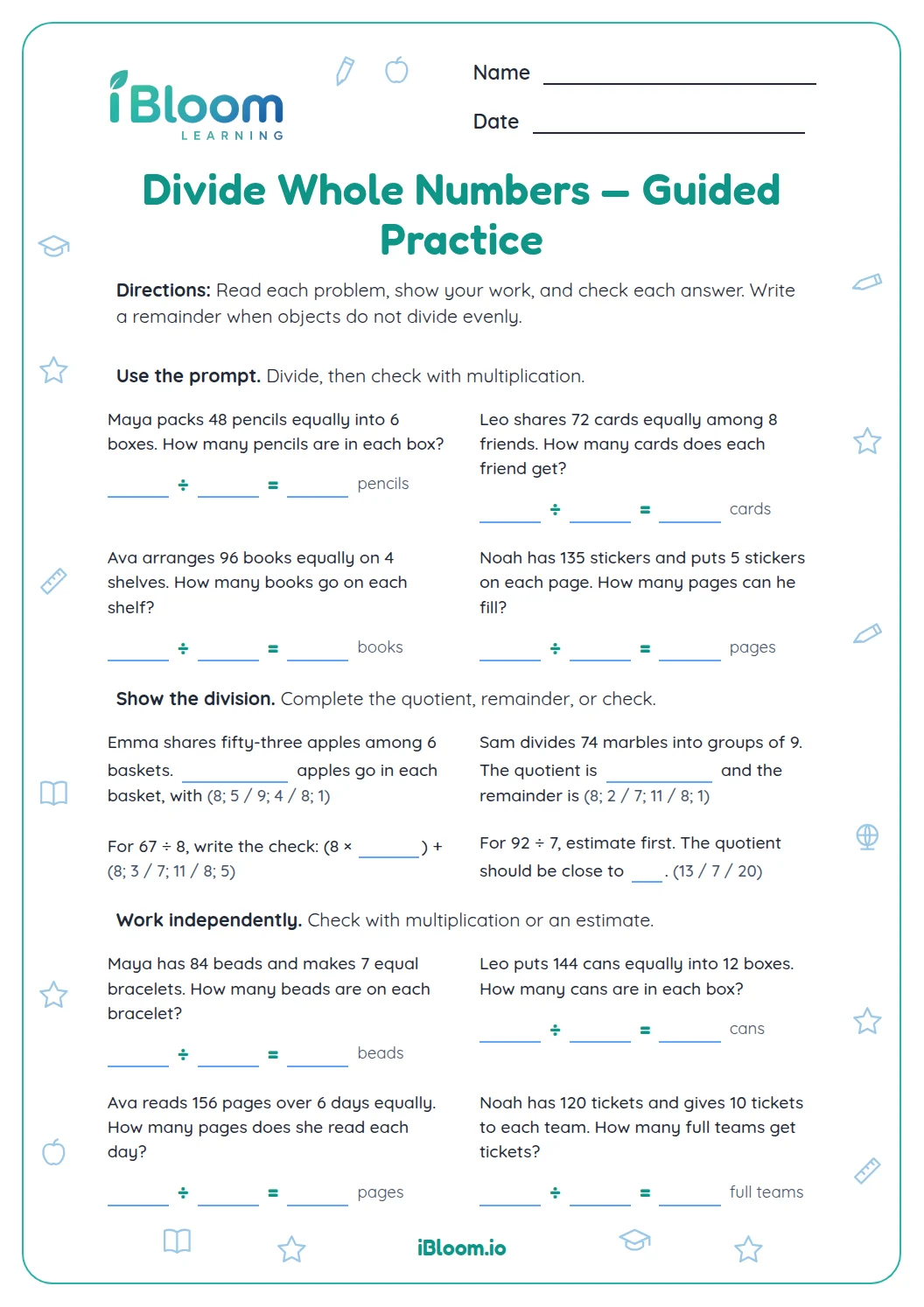
This Grade 5 worksheet starts by naming the operation a situation calls for, then moves to one-step and two-step word problems. Children write equations, solve with whole numbers, and check what the answer means. The 15 questions include addition, subtraction, multiplication, division, and familiar units. A separate answer key is included. Children also interpret calculations as numerical expressions under Common Core 5.OA.A.2.
Aligned to 5.OA.A.2
How do you choose the operation?
Read the relationship in the story instead of relying on a single keyword. Joining amounts suggests addition, finding what remains suggests subtraction, equal groups suggest multiplication, and equal sharing suggests division.
Question 5 asks about 248 red beads and 176 blue beads together: 248 + 176 = 424 beads.
- 1248 red beads + 176 blue beads
- 2248 + 176 = 424
- 3There are 424 beads.
How do you keep a two-step story in order?
Solve the first action in the story, then use that result for the next action. For question 9, find the pencils bought first: 6 × 24 = 144. Then subtract the 35 given away: 144 − 35 = 109 pencils.
What practice is included?
The first four questions ask which operation fits a situation; the next four apply one operation to a story; the final seven combine two steps. Each answer key entry follows the quantity asked for.
- Part A: four operation choices
- Part B: four one-step word problems
- Part C: seven two-step word problems
- Answer key on its own page
How to use this worksheet
- 1Read the final question first so you know what you need to find.
- 2Mark the quantities and describe how they change.
- 3Choose an operation and write an equation.
- 4For a two-step story, solve each event in order.
- 5Check the answer against the story and include a unit.
Common slips and quick fixes
The mistake
Choosing a sign from a single keyword without reading the whole situation.
The fix
Describe what happens to the quantities, then choose the operation that models it.
The mistake
Multiplying the numbers in a sharing problem.
The fix
Ask whether the groups are known or the total is known; equal sharing uses division.
The mistake
Stopping after the first calculation in a two-step story.
The fix
Reread the sentence after the first result and use that amount in the next step.
Curriculum alignment
This sheet gives children practice with the standard below.
Children match story calculations to numerical expressions.
On this sheet: Children match story calculations to numerical expressions.
Show the official wordingHide the official wording
Write simple expressions that record calculations with numbers, and interpret numerical expressions without evaluating them.
What to practice next
Make more practice
Further reading
Questions parents and teachers ask
Which operations are practiced?
The worksheet practices addition, subtraction, multiplication, and division with whole numbers. Part A asks children to solve one-step stories, Part B matches situations to expressions, and Part C combines operations in two-step problems. The answer key lists each result and unit where it helps clarify the answer.
How should a child start a word problem?
Read the story once for context, then identify what changes and what the question asks. Underline the quantities, choose an operation, and write an equation before calculating. For a two-step question, follow the events in order and use the first result in the second equation.
What is the answer to the pencils problem?
Question 9 has 6 boxes with 24 pencils each, so 6 × 24 = 144 pencils. After 35 are given away, 144 − 35 = 109 pencils remain. Writing both equations helps show why multiplication comes before subtraction in this story.
Does the sheet include two-step problems?
Yes. Part C contains seven two-step stories, including equal groups followed by taking some away, equal sharing followed by another change, and combining amounts before packing. Children should solve the first event and then apply the second action to that result.
What does the answer key include?
A separate answer key gives the numerical result for all 15 questions, including the correct expression choices. For stories involving quantities such as boxes or miles, the key includes the unit so adults can check both the calculation and what the number means.
How long might the worksheet take?
Plan for about 25 minutes, with extra time if a child writes full equations for every story. Let the child explain why an operation fits before calculating; this is especially useful for the two-step questions in Part C. If time is short, complete one part at a time and check each equation.