





About this worksheet
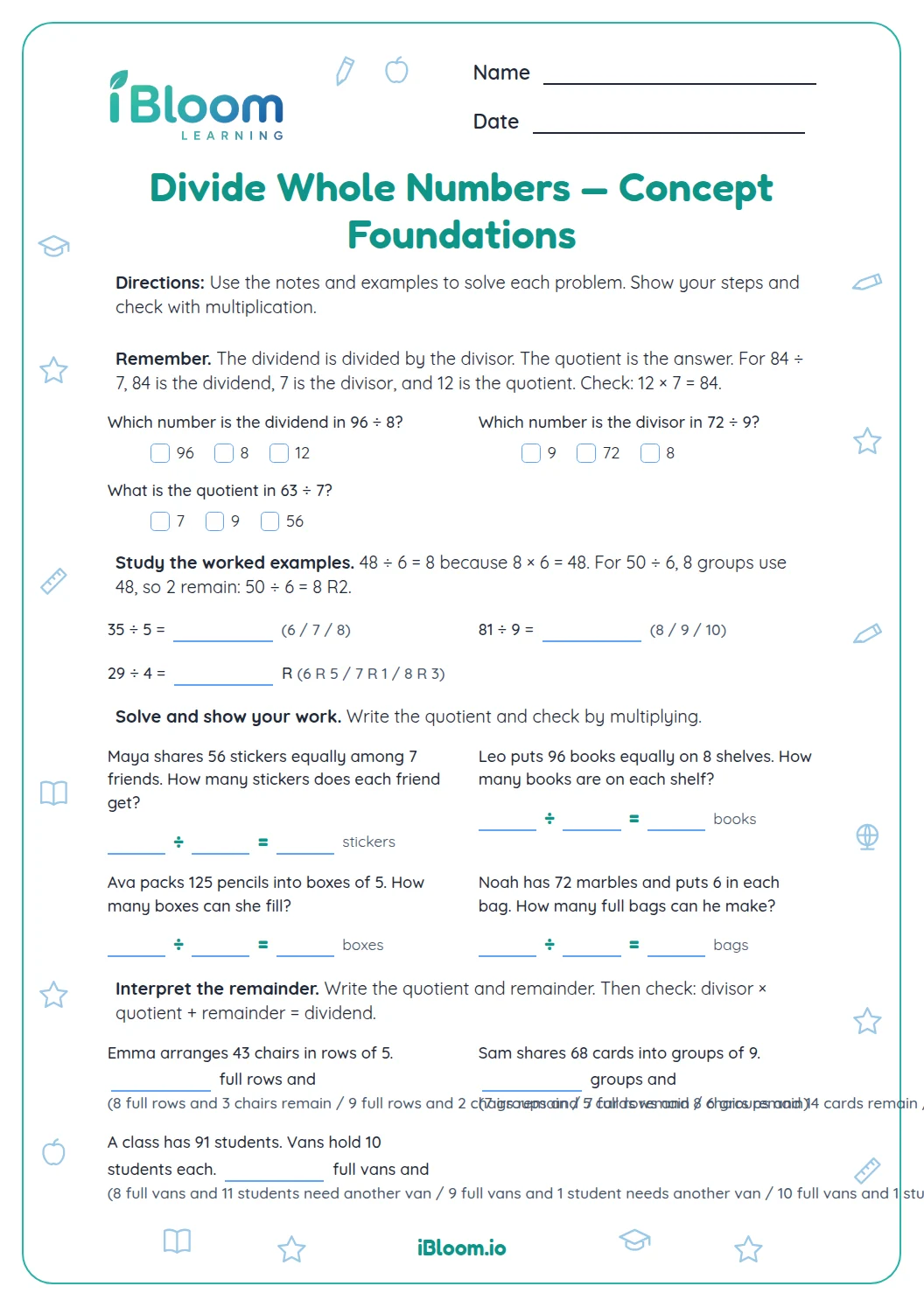
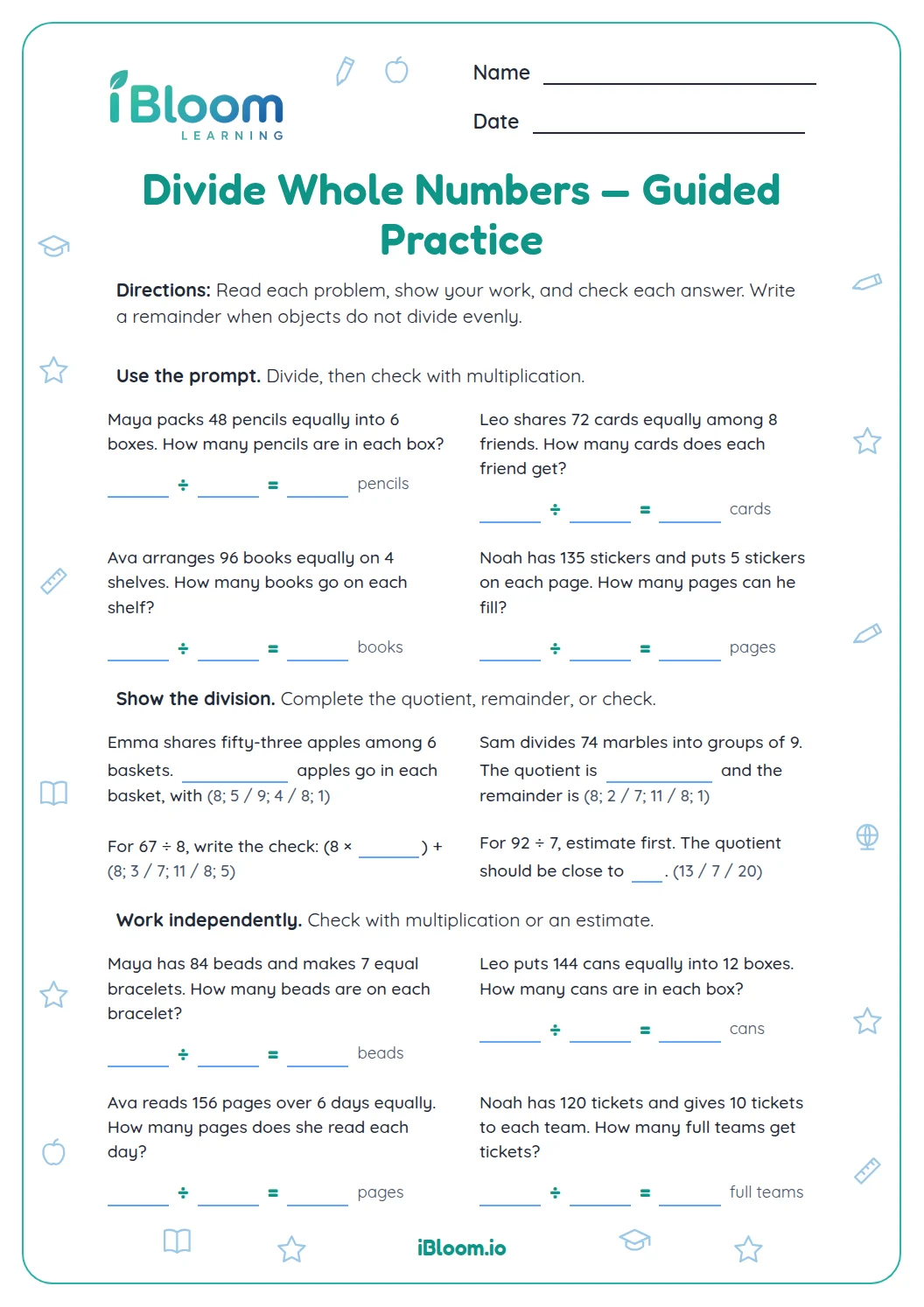
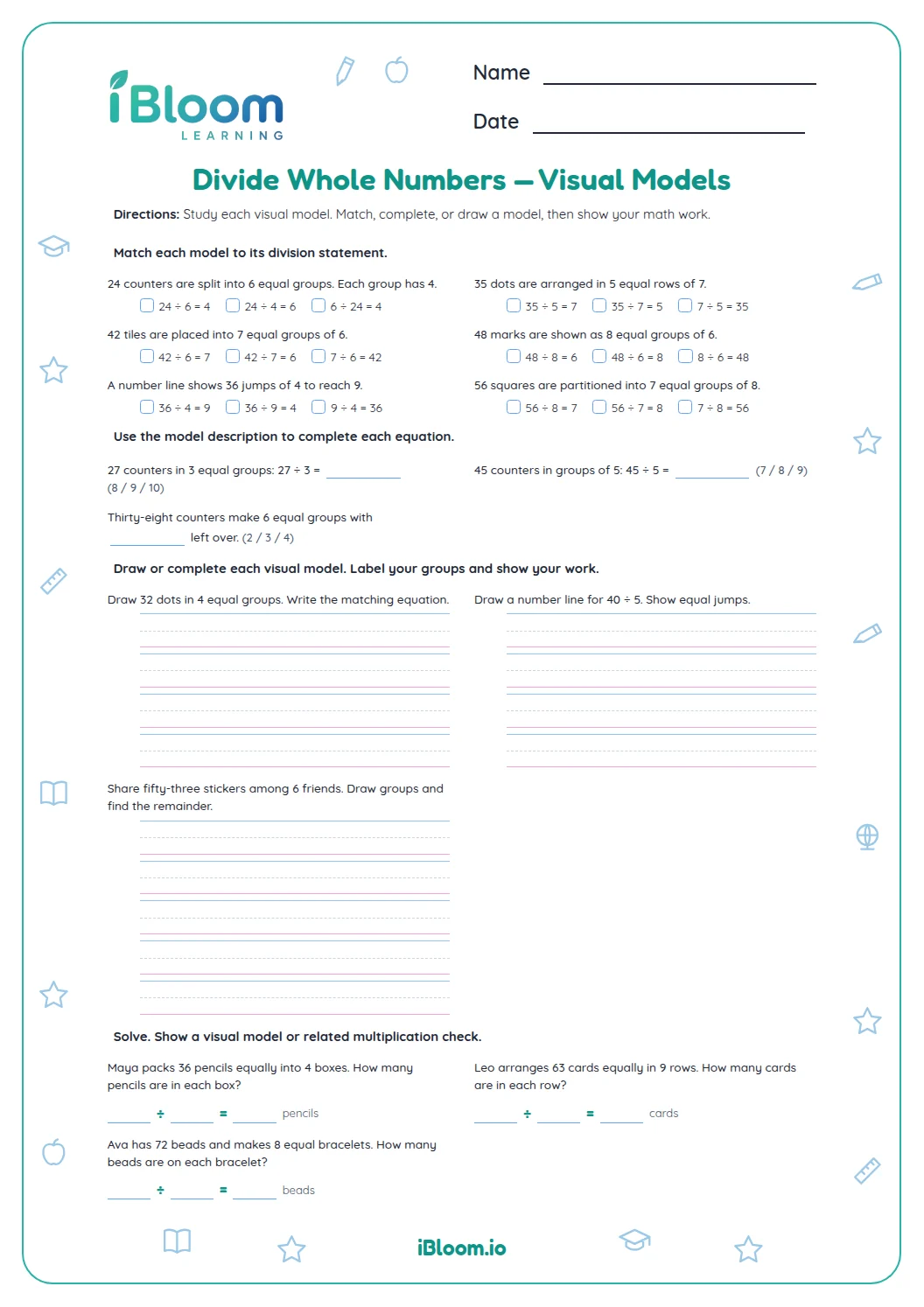
This free printable gives Grade 5 students ten whole-number division word problems to solve independently. Students write equations, divide three- and four-digit totals by two-digit numbers, and label their answers. Part A asks how much belongs in each equal share. Part B asks how many groups can be made. Part C asks students to decide what a remainder means when packing boxes or booking buses. The work practices Common Core 5.NBT.B.6, including the relationship between division and multiplication. A separate answer key gives each result, including the two remainder decisions.
Aligned to 5.NBT.B.6
What changes from one part to the next?
Part A gives the total and the number of equal shares, so the missing quantity is the size of each share. Part B gives the size of a group, so the missing quantity is the number of groups. Both situations use division.
Part C uses the same numbers in two settings. The apple problem asks for full boxes and leftovers. The bus problem asks for enough seats for everyone, so a bus is needed for the last five riders.
How can students divide 1,248 by 24?
Break the total into useful multiples of 24. Fifty groups use 1,200 beads, leaving 48 beads for two more groups. Students can write these equations in the working space and then check by multiplication.
- 11,248 ÷ 24 = ?
- 224 × 50 = 1,200; 1,248 − 1,200 = 48
- 324 × 2 = 48; 50 + 2 = 52
- 4Check: 24 × 52 = 1,248. Each student gets 52 beads.
What should I check besides the calculation?
Check the unit and the meaning of the answer. In the theater problem, 72 means rows; in the marker problem, 72 means packs. A correct number needs the right label.
For a remainder, multiply the divisor by the quotient and add the remainder. The remainder must be smaller than the divisor. Then reread the question to decide what to report.
How to use this worksheet
- 1Read the directions, then let the student identify the total and group information in each story.
- 2Write a division equation in each work box before calculating.
- 3Use partial quotients or another place-value strategy to divide.
- 4Check each quotient with multiplication and label the result.
- 5Compare the last two answers and explain why the bus problem needs an extra group.
Mistakes to catch and how to fix them
The mistake
Multiplying 864 by 12 because both numbers appear in the story.
The fix
Ask whether each classroom receives the whole supply or just one equal share; write 864 ÷ 12.
The mistake
Writing 7 for 3,360 ÷ 48 and losing a place-value zero.
The fix
Check 48 × 7 = 336, then compare it with 3,360; the quotient is 70.
The mistake
Booking only 40 buses for 965 riders.
The fix
Forty buses hold 960 riders. Five people still need seats, so book 41 buses.
Common Core alignment
Divide whole-number totals by two-digit group sizes and explain the work with equations.
On this sheet: All ten problems use two-digit divisors; students record equations and check quotients with multiplication.
Show the official wordingHide the official wording
Find whole-number quotients of whole numbers with up to four-digit dividends and two-digit divisors, using strategies based on place value, the properties of operations, and/or the relationship between multiplication and division. Illustrate and explain the calculation by using equations, rectangular arrays, and/or area models.
What to practice next
Make more practice
Further reading
Questions parents and teachers ask
Which division facts should my child know first?
Knowing multiplication facts and two-digit multiples helps with this sheet. For 864 ÷ 12, a student can start with 12 × 70 = 840 and then account for 24 more pencils. Each question has working space for the equations used to find the quotient.
Does this worksheet include remainders?
Yes, the last two questions use 965 ÷ 24, which is 40 with a remainder of 5. One asks for full boxes and leftover apples. The other asks for enough buses for every rider, so students must connect the calculation to each situation.
Must students use long division?
Students may use long division or a place-value strategy such as partial quotients. They should record equations that make their reasoning clear. For 1,248 ÷ 24, finding 50 groups and then 2 more groups gives the same quotient as a correctly completed long-division calculation.
How can I check a division answer quickly?
Multiply the quotient by the divisor and add any remainder. For 965 ÷ 24, calculate 40 × 24 + 5 = 965. That confirms the arithmetic, but the student must still decide whether the requested answer is full boxes, leftover apples, or enough buses.
What does the answer key show?
The separate key gives all ten results, including full boxes and leftover apples in question 9. For questions 1–8, it shows the quotient; check the student’s unit against the question too. Ask students to explain one multiplication check and why the two remainder stories need different answers.