



About this worksheet
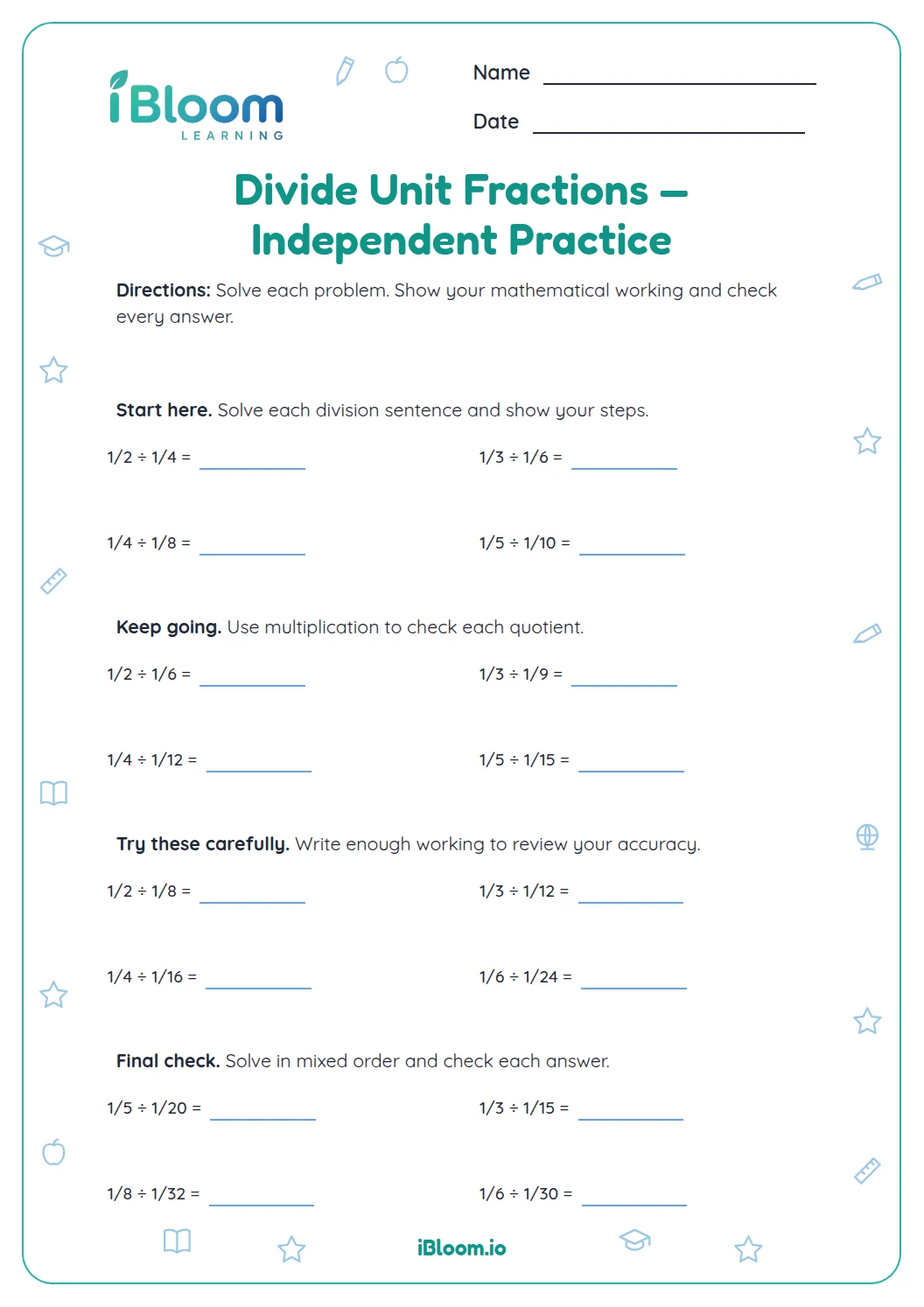
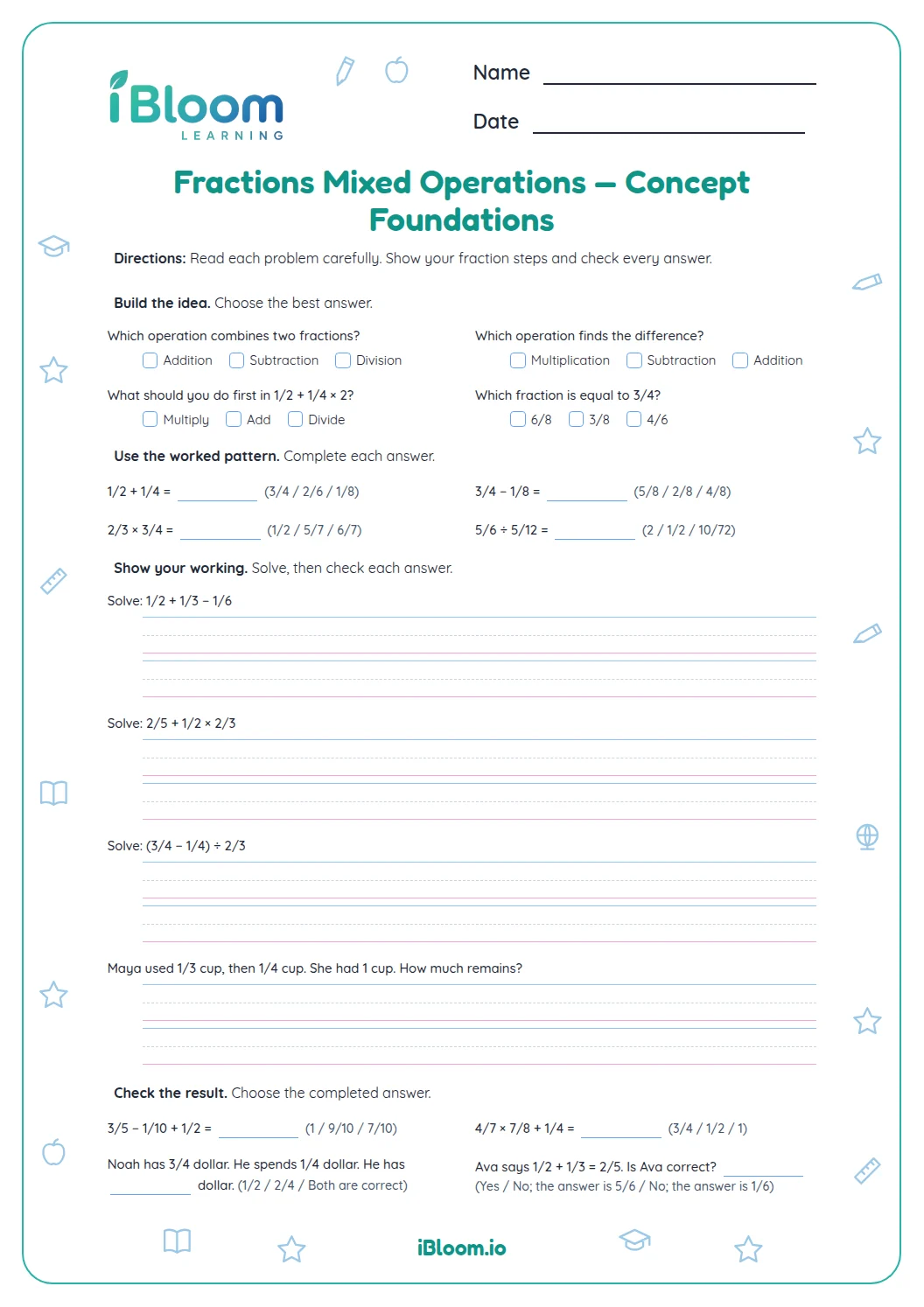
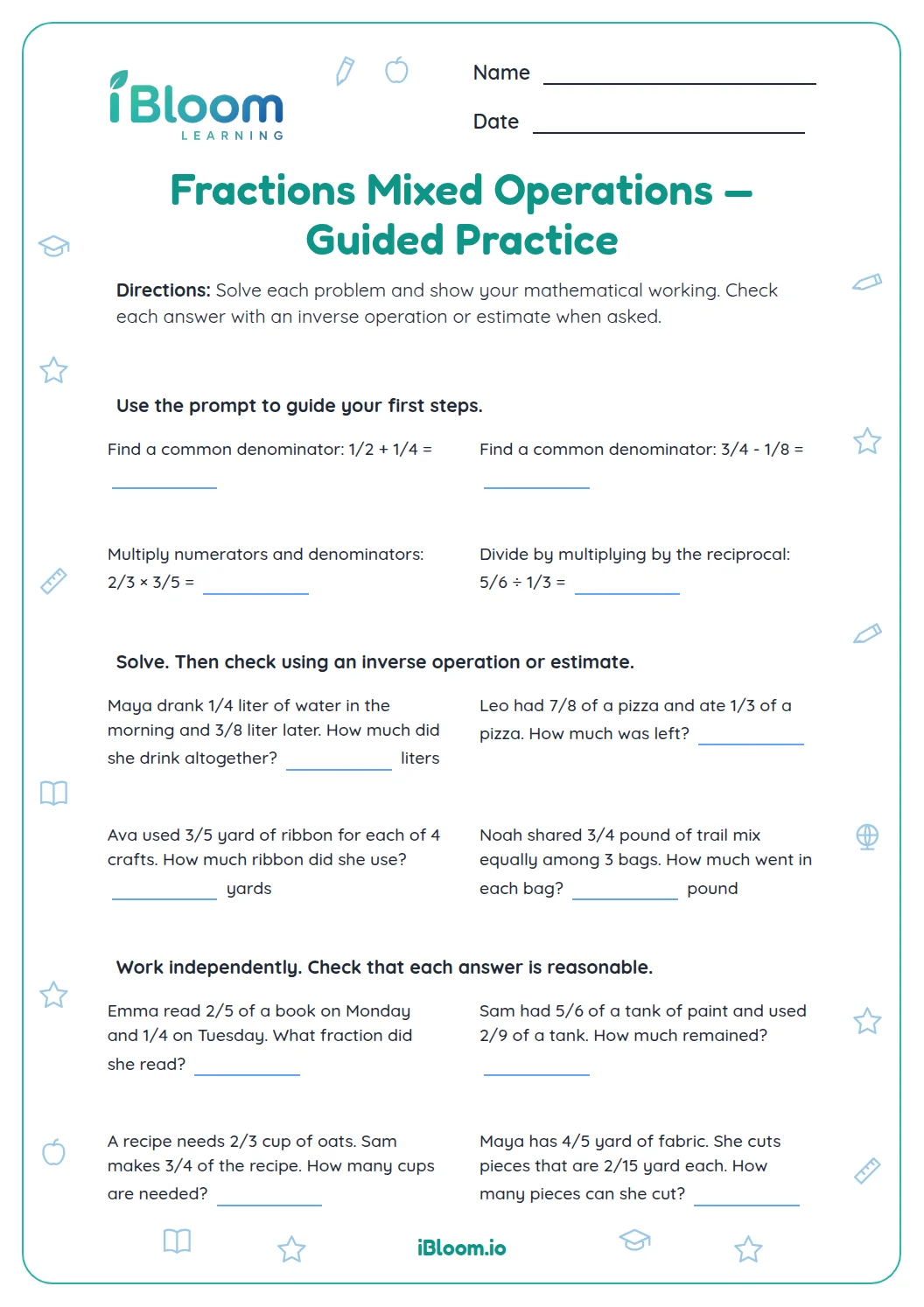
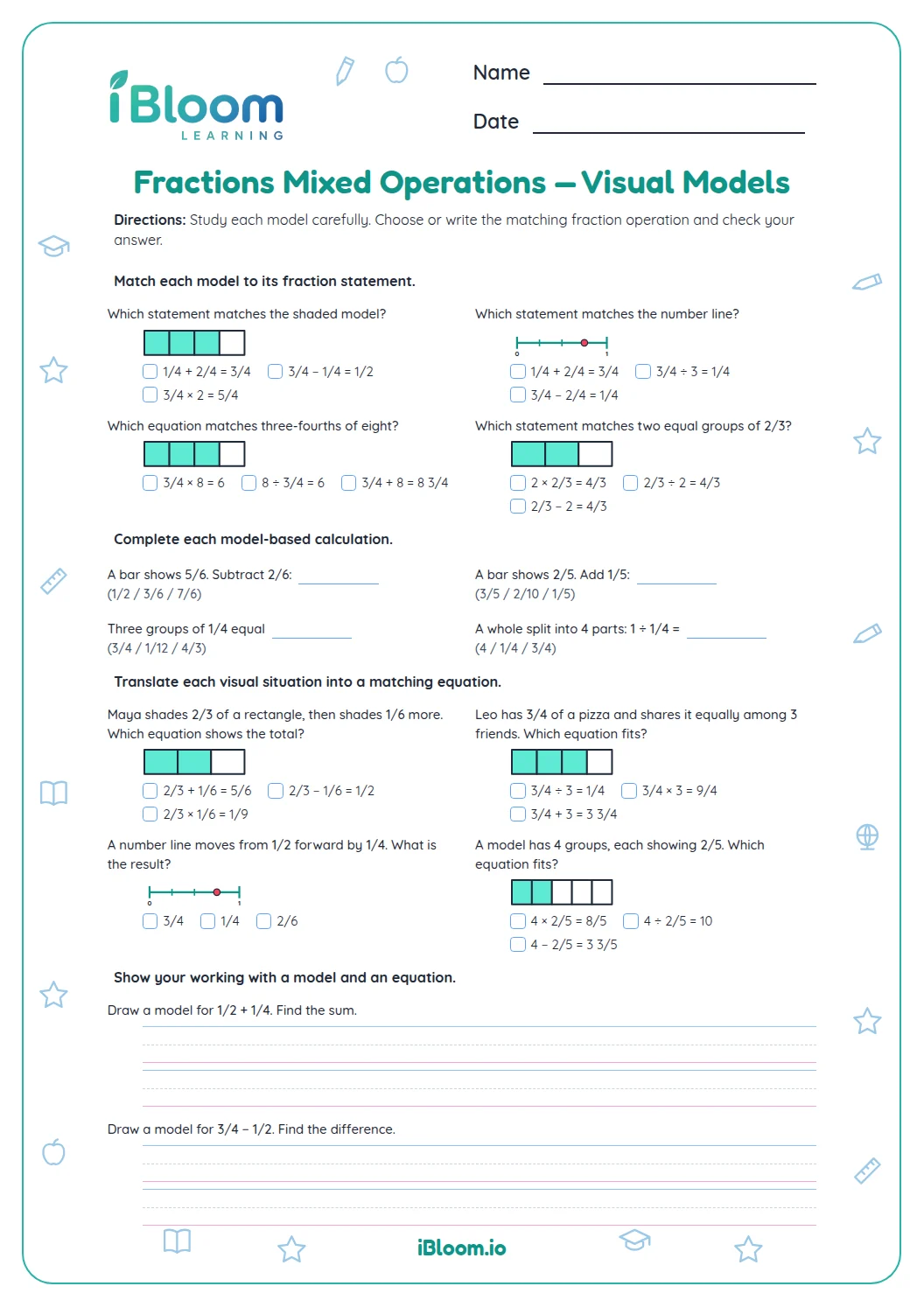
This free printable gives Grade 5 learners guided practice with division situations involving unit fractions. Part A shares a unit fraction equally; Part B counts unit-fraction groups, then mixes both situations. The 14 word problems ask students to solve and write each answer with its printed unit. A separate answer key supports checking. The sequence builds the meaning of division before students decide which situation each story describes.
Aligned to 5.NF.B.7
How do you share a unit fraction equally?
A unit fraction names one equal part of a whole. Dividing it among several people makes each share smaller. Multiply the denominator by the number of equal shares to find the size of one share.
For question 1, share 1/2 yard equally among 3 bows: (1/2) ÷ 3 = 1/6. Each bow gets 1/6 yard.
- 1(1/2) ÷ 3
- 21/2 = 3/6
- 33/6 ÷ 3 = 1/6
- 4Each bow gets 1/6 yard.
How do you count unit-fraction groups?
When a whole amount is divided by a unit fraction, the answer counts how many groups fit. For question 8, each cup holds two half-cup servings, so 3 cups hold 6 servings: 3 ÷ 1/2 = 6. The answer counts servings.
How can you choose the right division story?
Notice what the story asks for. “How much does each get?” signals equal sharing. “How many pieces or servings?” asks how many unit-fraction groups fit. The final questions mix these situations, so match the division to the requested quantity.
Check whether the result makes sense: equal shares of 1/3 among 4 are smaller than 1/3, while 2 wholes contain more than two 1/8-size scoops.
What is included in the practice sheet?
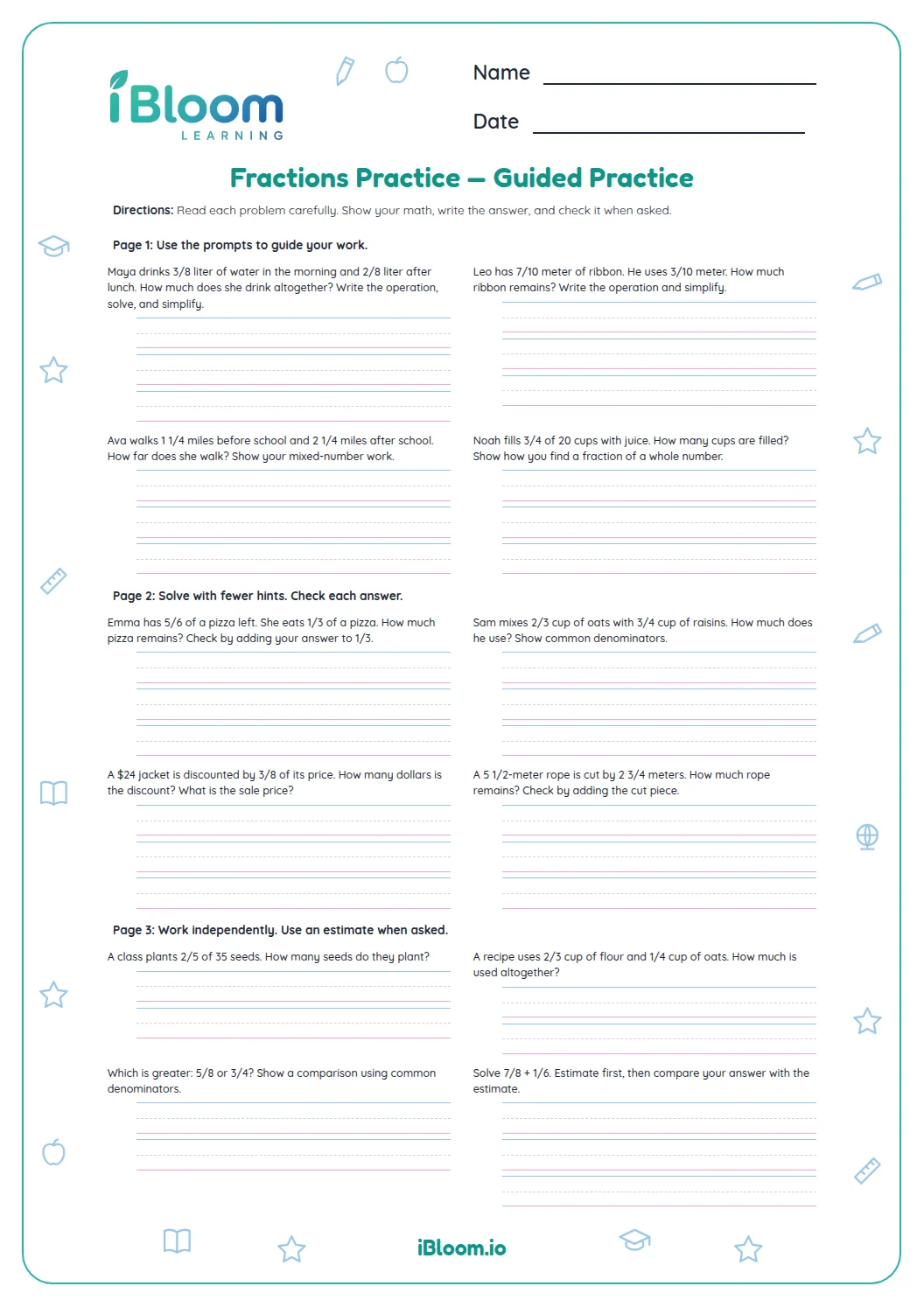
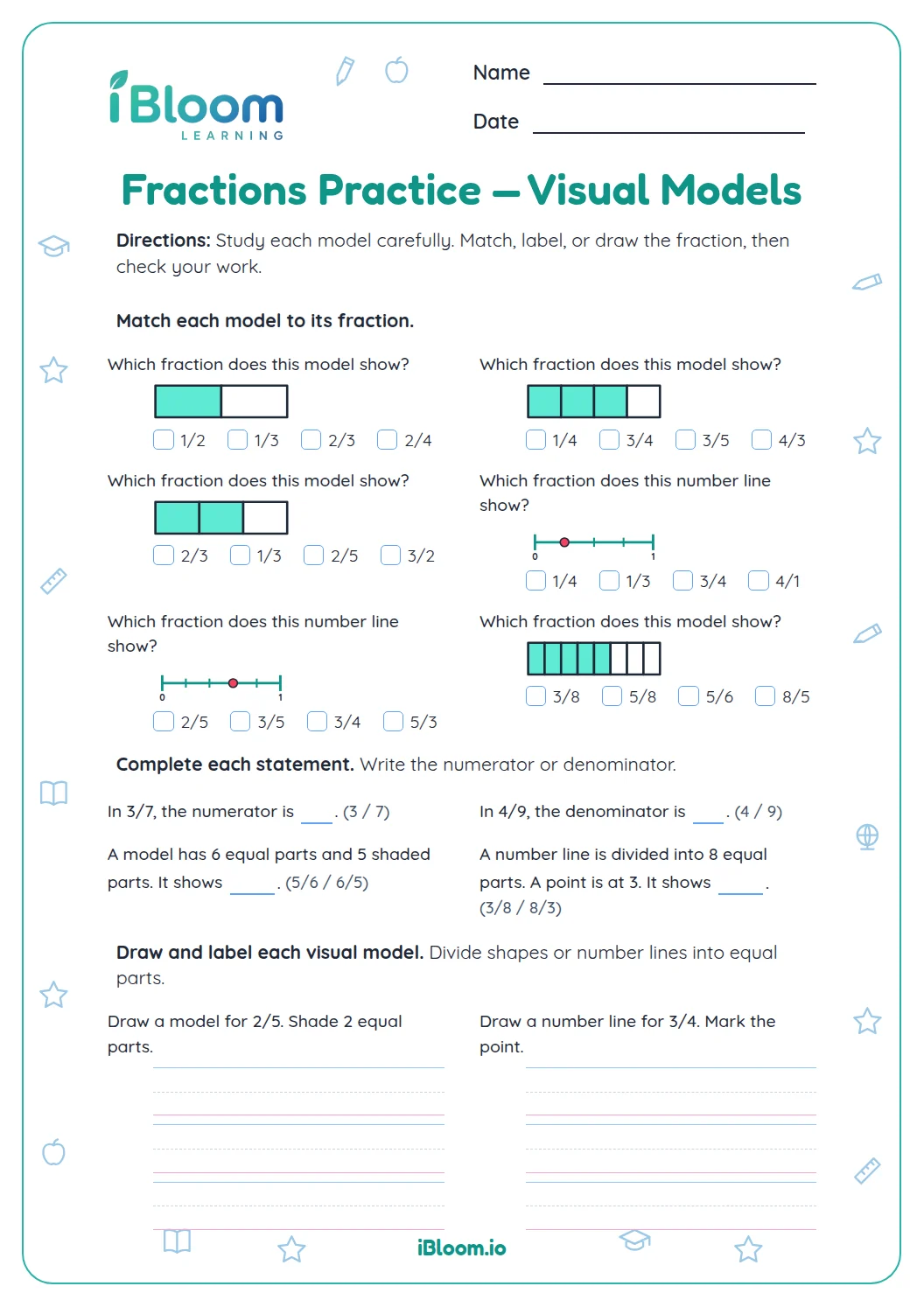
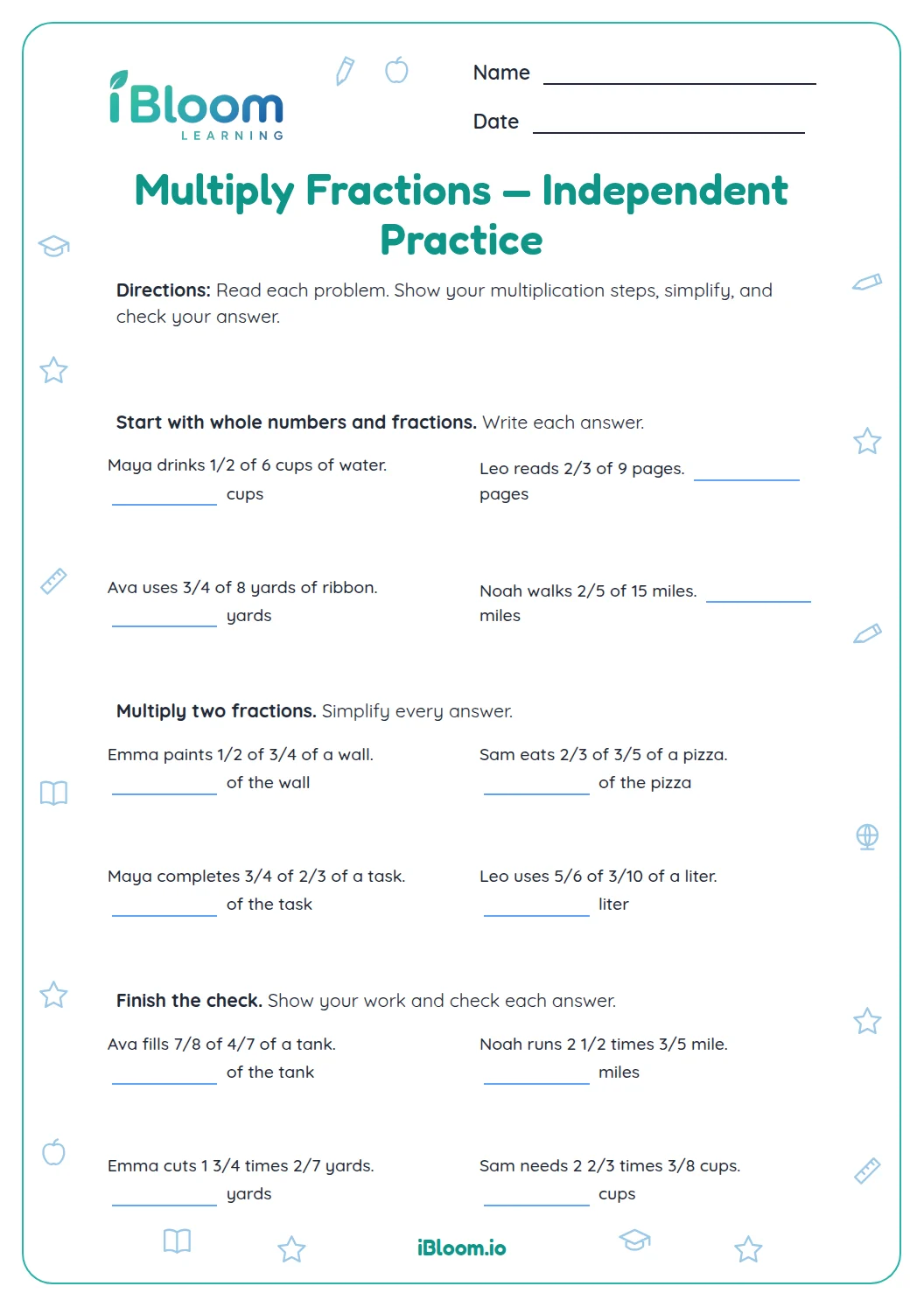
The worksheet has 14 word problems in two parts. Part A shares a unit fraction equally. Part B counts unit-fraction groups, then mixes both situations. Each question has one blank and a printed unit.
How should a learner work through the problems?
- 1Read what the story asks you to find: a share or a group count.
- 2Keep the amounts and units from the story together.
- 3Think of a division equation that matches the situation.
- 4For equal shares, divide the unit fraction among the stated number of recipients.
- 5For group counts, find how many unit fractions fit in the whole amount.
- 6Check that the number and printed unit answer the story.
Common mistakes and quick fixes
The mistake
Answering 3 for 3 ÷ 1/2 because 3 was the starting number.
The fix
Ask how many halves fit in each whole: two per cup, so 3 cups hold 6 halves.
The mistake
Multiplying 1/2 by 3 in a sharing problem and getting 3/2.
The fix
Sharing among more people makes each share smaller; use (1/2) ÷ 3 = 1/6.
The mistake
Writing a number without the quantity it measures, such as 6 instead of 6 servings.
The fix
Use the question to name the counted item and attach that unit to the answer.
Common Core alignment
This worksheet practices Grade 5 fraction division through equal-sharing and measurement situations.
Solve equal-sharing and measurement problems with unit fractions and whole numbers.
On this sheet: Problems divide a unit fraction by a whole number or a whole number by a unit fraction.
Show the official wordingHide the official wording
Apply and extend previous understandings of division to divide unit fractions by whole numbers and whole numbers by unit fractions.
What to practice next
Make more practice
Further reading
Questions parents and teachers ask
What does dividing a unit fraction by a whole number mean?
It means splitting one fractional piece into equal shares. For example, sharing 1/2 among 3 people gives each person 1/6, because 1/2 can be renamed as 3/6 and each person gets one of those sixths. Part A practices this equal-sharing meaning in familiar measurement stories.
What does 3 ÷ 1/2 ask?
It asks how many groups of one-half fit in 3 wholes. Each whole contains two halves, so three wholes contain six halves. The answer is 6 servings or groups, depending on the story, rather than 6/1 of the original unit.
Why can dividing by a fraction make the answer larger?
Dividing by a unit fraction asks how many groups of that size fit in the amount. For example, 3 ÷ 1/2 = 6 because each whole contains two halves, and three wholes contain six halves. A smaller group size means more groups fit.
How can a student decide whether to find a share or count groups?
Notice what the story asks for. If several people share one amount, find the size of each share. If it asks how many scoops, servings, or sections fit, count the unit-fraction groups. The last questions mix these cues so students choose a division situation before solving.
Should answers include units?
Yes. A number alone may not say what the result measures. Write “1/6 yard” when finding the length for each bow, and “6 servings” when counting how many half-cup servings fit in 3 cups. Units make the result clear and easy to check.
Is an answer key included?
Yes. The separate key gives the number for each blank. Since each question prints its unit after the blank, copy the number into the space and read it together with that unit. For example, 1/6 followed by “yard” means 1/6 yard.