




About this worksheet
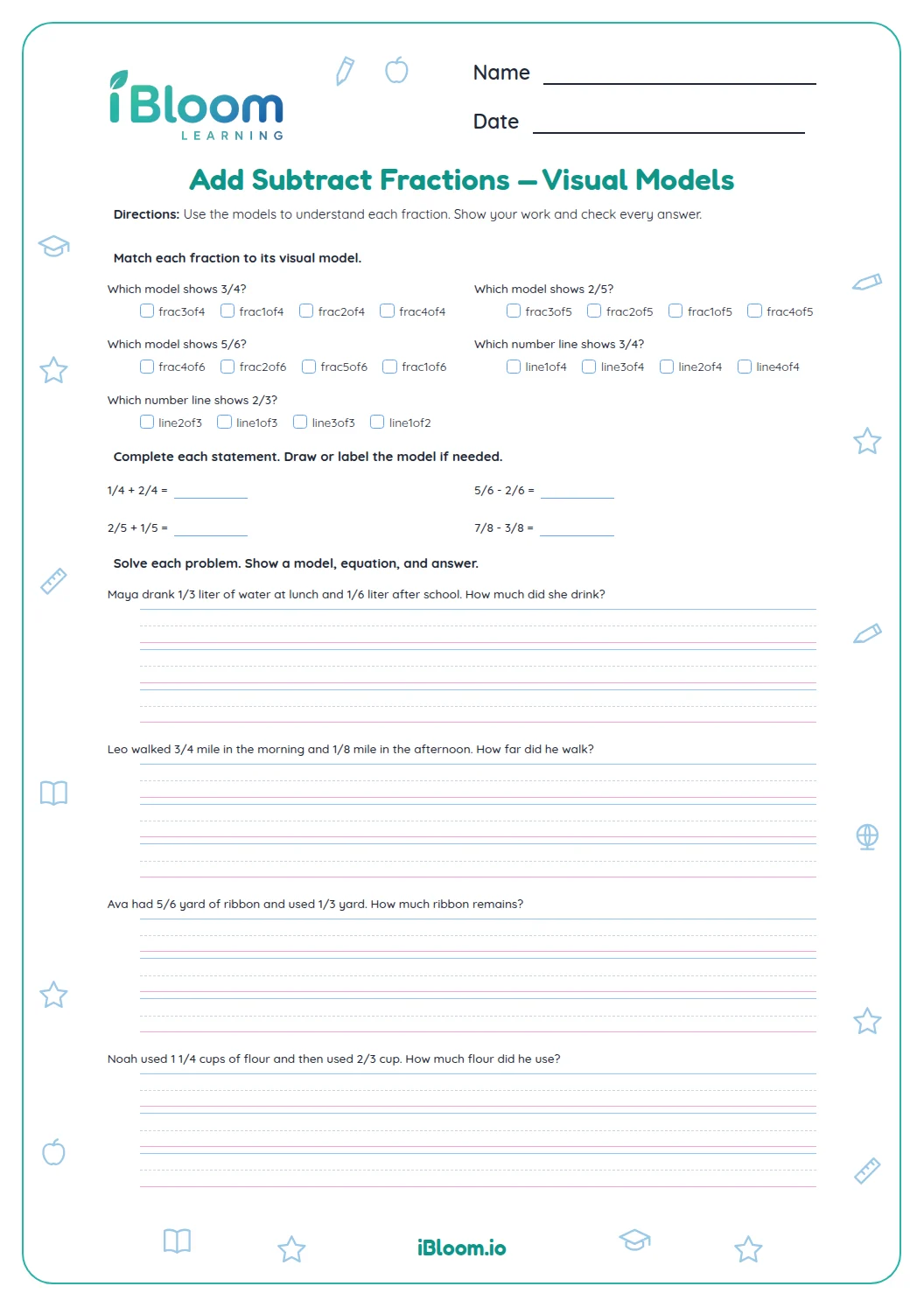
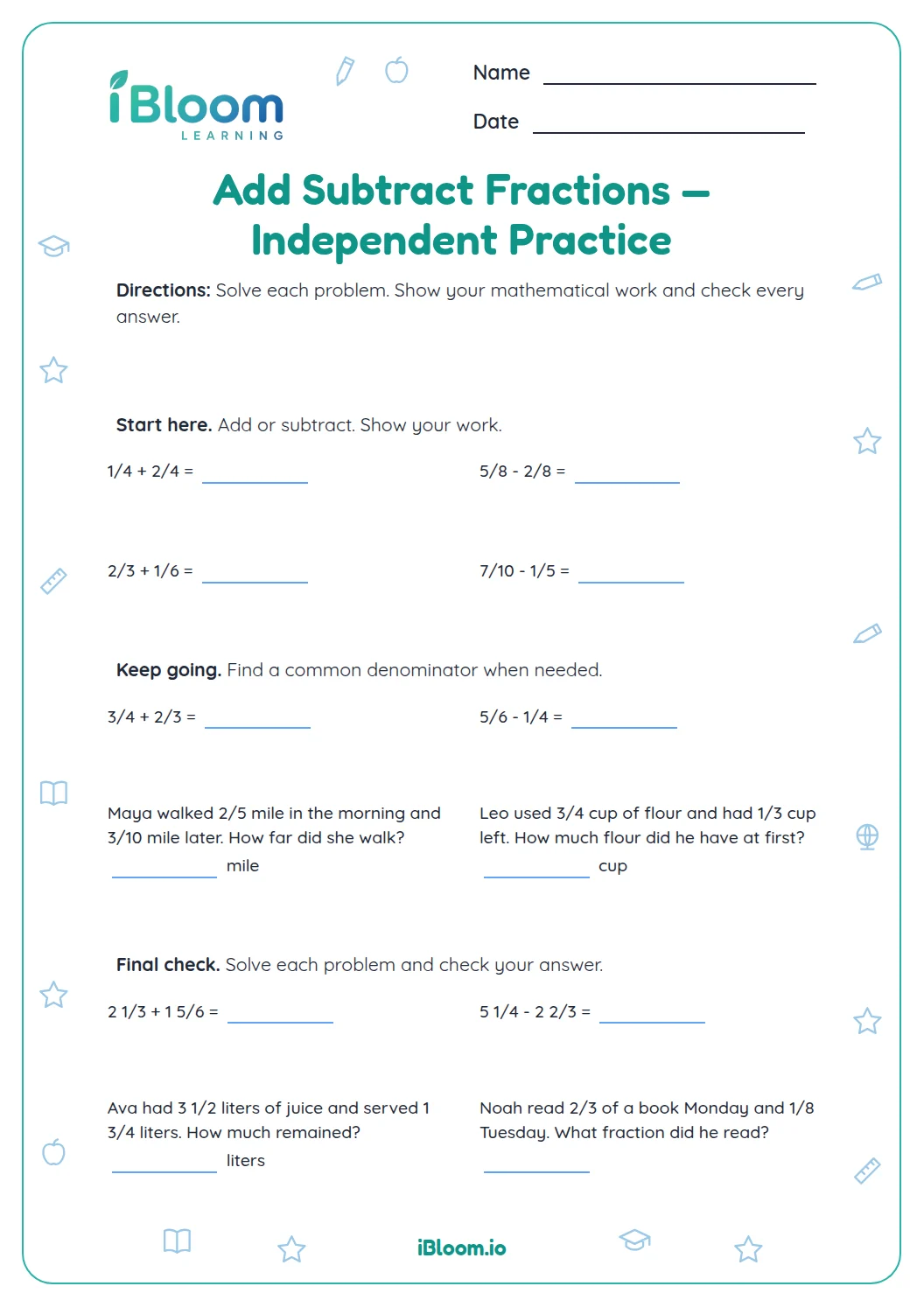
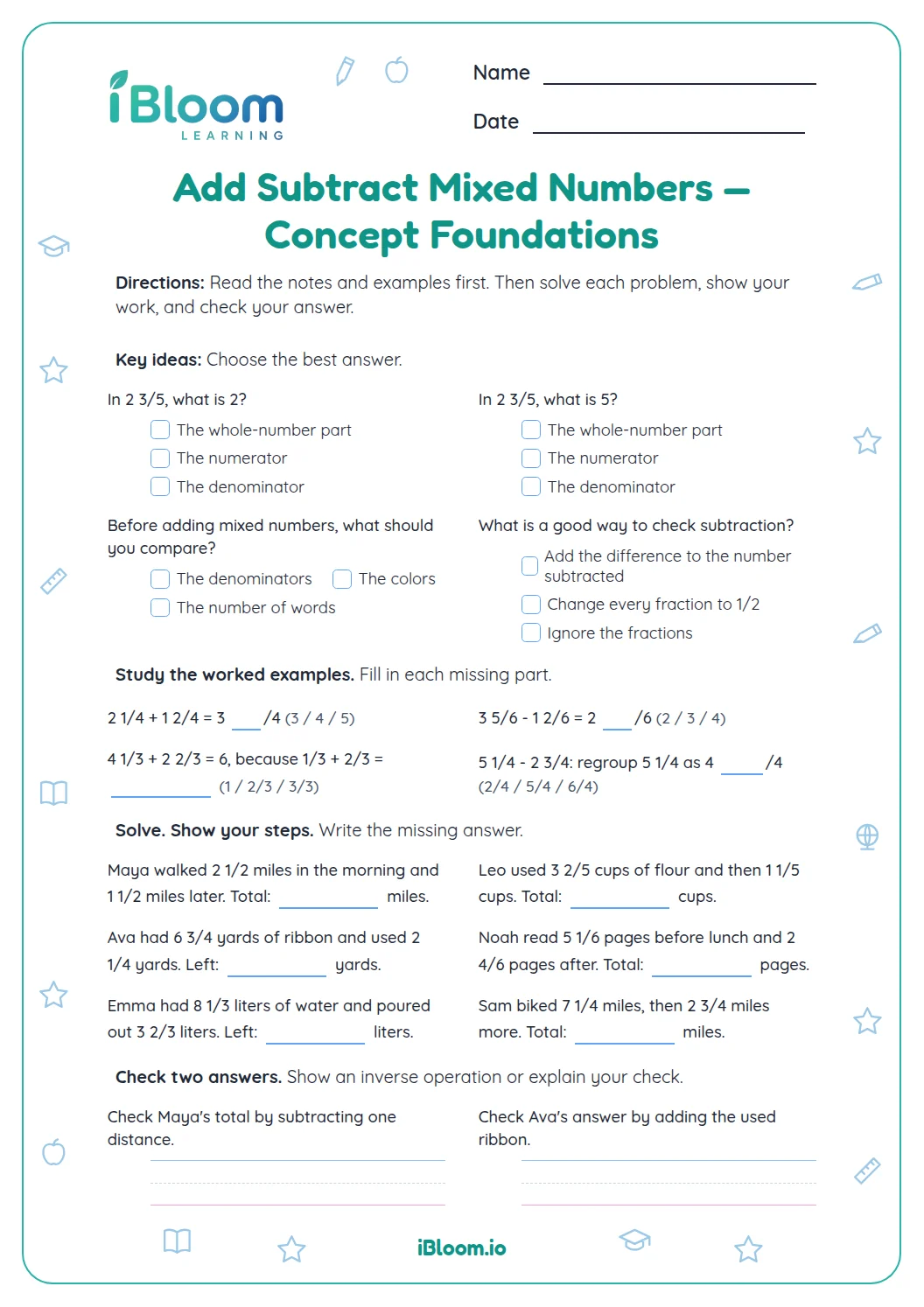
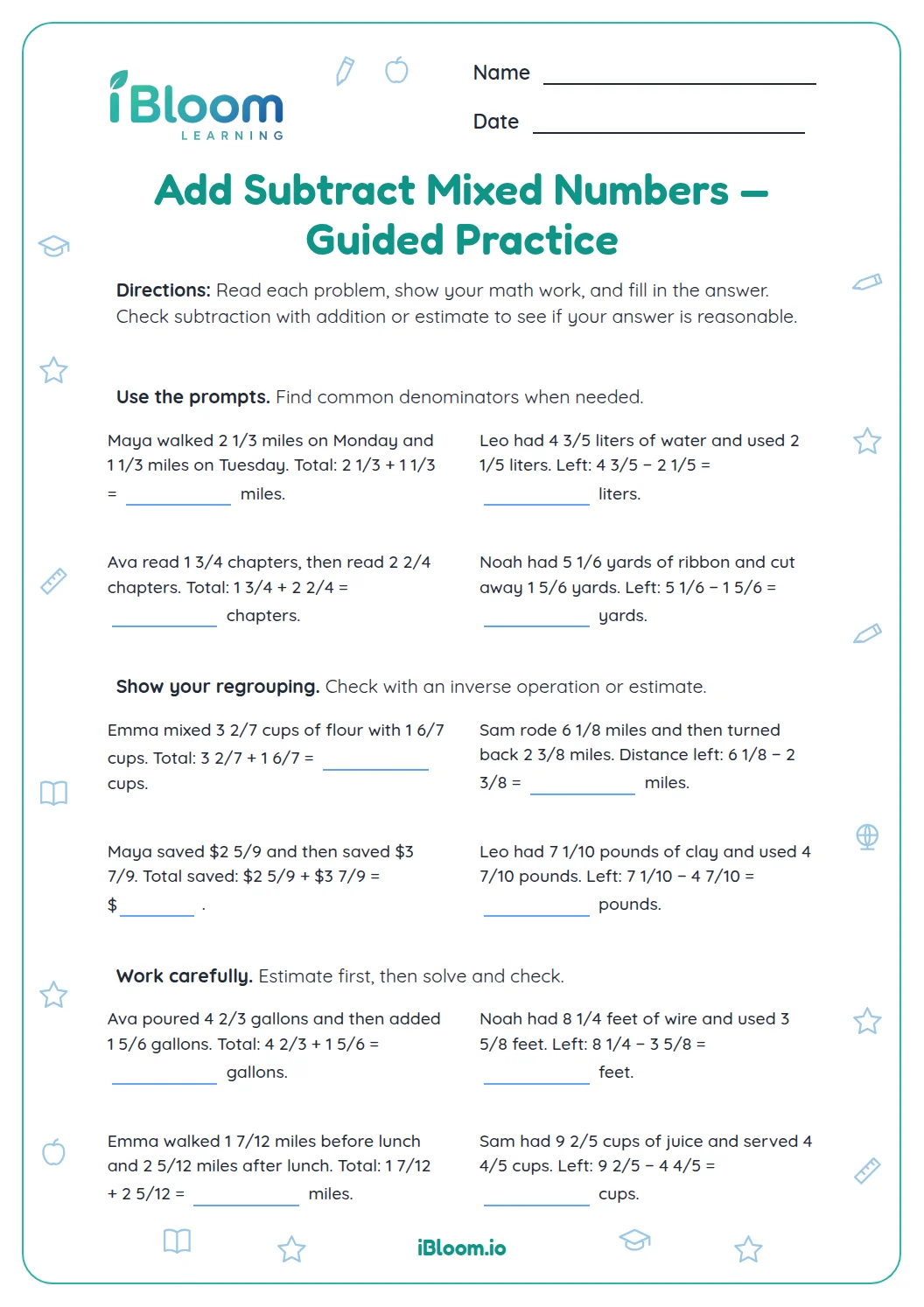
This Grade 5 worksheet gives 14 word problems about dividing fractions by unit fractions. Learners find how many small equal groups fit into a larger fractional amount, interpret a quotient in context, and evaluate a claim about a quotient. The answer key gives concise results and units. These situations practice CCSS 5.NF.B.7 by applying division to unit fractions and whole-number groups.
Aligned to 5.NF.B.7
How do you interpret the quotient?
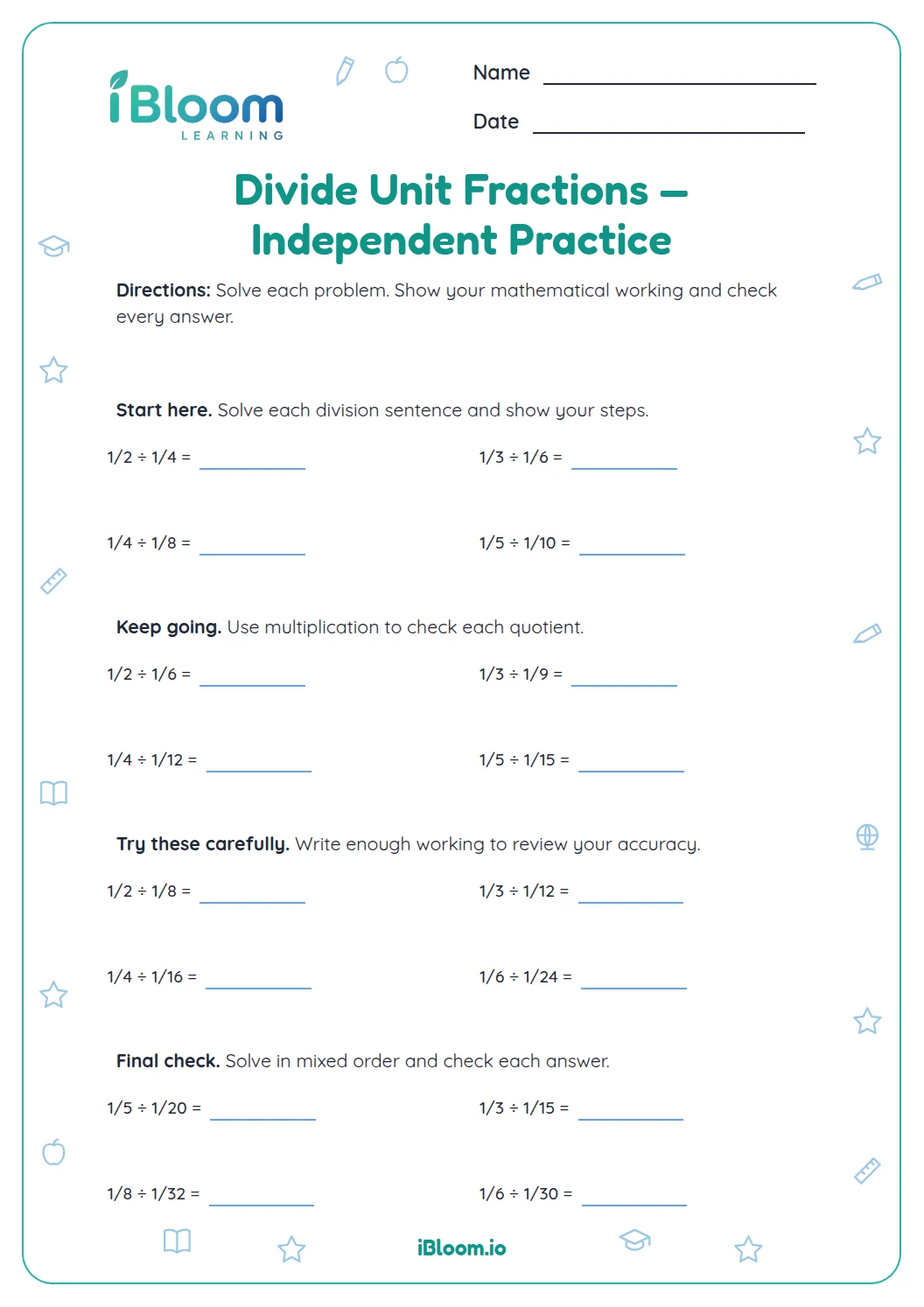
Think of the quotient as the number of groups that fit. Question 1 asks how many 1/9-yard pieces fit in 1/3 yard. Since 1/3 equals 3/9, three pieces fit.
- 11/3 ÷ 1/9 asks how many ninths are in one third.
- 21/3 = 3/9.
- 3So the strip makes 3 pieces.
How can you test a claim?
Use multiplication to check whether the proposed number of groups rebuilds the starting amount. If four groups each contain 1/12, their total is 4/12, which is 1/3.
What should go in the answer?
Include the number of groups and, when useful, the group name. For leftover questions, state both the full groups and any amount remaining.
How to use this worksheet
- 1Identify the total amount and the size of each group.
- 2Ask how many groups of the smaller fraction fit into the total.
- 3Write a division equation before calculating.
- 4Check by multiplying the quotient by the group size.
- 5Include the unit or group name in the answer.
Mistakes to watch for
The mistake
Dividing the denominators without checking the units.
The fix
Use the quotient to count groups of a stated size.
The mistake
Giving a fraction of a group when asked how many groups fit.
The fix
Check whether the quotient should count whole servings, pieces, or intervals.
The mistake
Accepting a quotient without checking it in the story.
The fix
Multiply the number of groups by the group size to recover the total.
Common Core alignment
Divide unit fractions by whole numbers and whole numbers by unit fractions in context.
On this sheet: The questions directly practice this skill.
Show the official wordingHide the official wording
Apply and extend previous understandings of division to divide unit fractions by whole numbers and whole numbers by unit fractions.
What to practice next
Make more practice
Further reading
Questions parents and teachers ask
What does a quotient mean in these stories?
The quotient tells how many groups of a given unit-fraction size fit in the total amount. For example, 1/2 ÷ 1/8 asks how many eighths make one half. The answer key names the groups in each story. Each story identifies the amount and the size of one group. Learners can check the numbers against the story details.
Does the worksheet include an answer key?
Yes. A separate answer key follows the three worksheet pages and lists answers for all 14 questions. Several answers include units or group names, such as servings, pieces, and intervals, to connect the quotient back to the story. Each story identifies the amount and the size of one group.
How can learners check a division answer?
Multiply the number of groups by the size of each group. If four servings are each 1/8 liter, then 4 × 1/8 liter equals 1/2 liter. This check confirms that the groups rebuild the original amount. Each story identifies the amount and the size of one group. Learners can check the numbers against the story details.
Do the questions ask learners to explain reasoning?
A few questions ask learners to interpret a quotient or judge a stated claim, while the others focus on solving a situation. Encourage the learner to connect the quotient to the number and size of groups described. Each story identifies the amount and the size of one group. Learners can check the numbers against the story details.
How long will the worksheet take?
Plan for about 20 minutes for the 14 questions. Learners may need more time to write equations or explain what a quotient counts. The problems can be split into two sets of seven if needed. Each story identifies the amount and the size of one group. Learners can check the numbers against the story details.