


About this worksheet
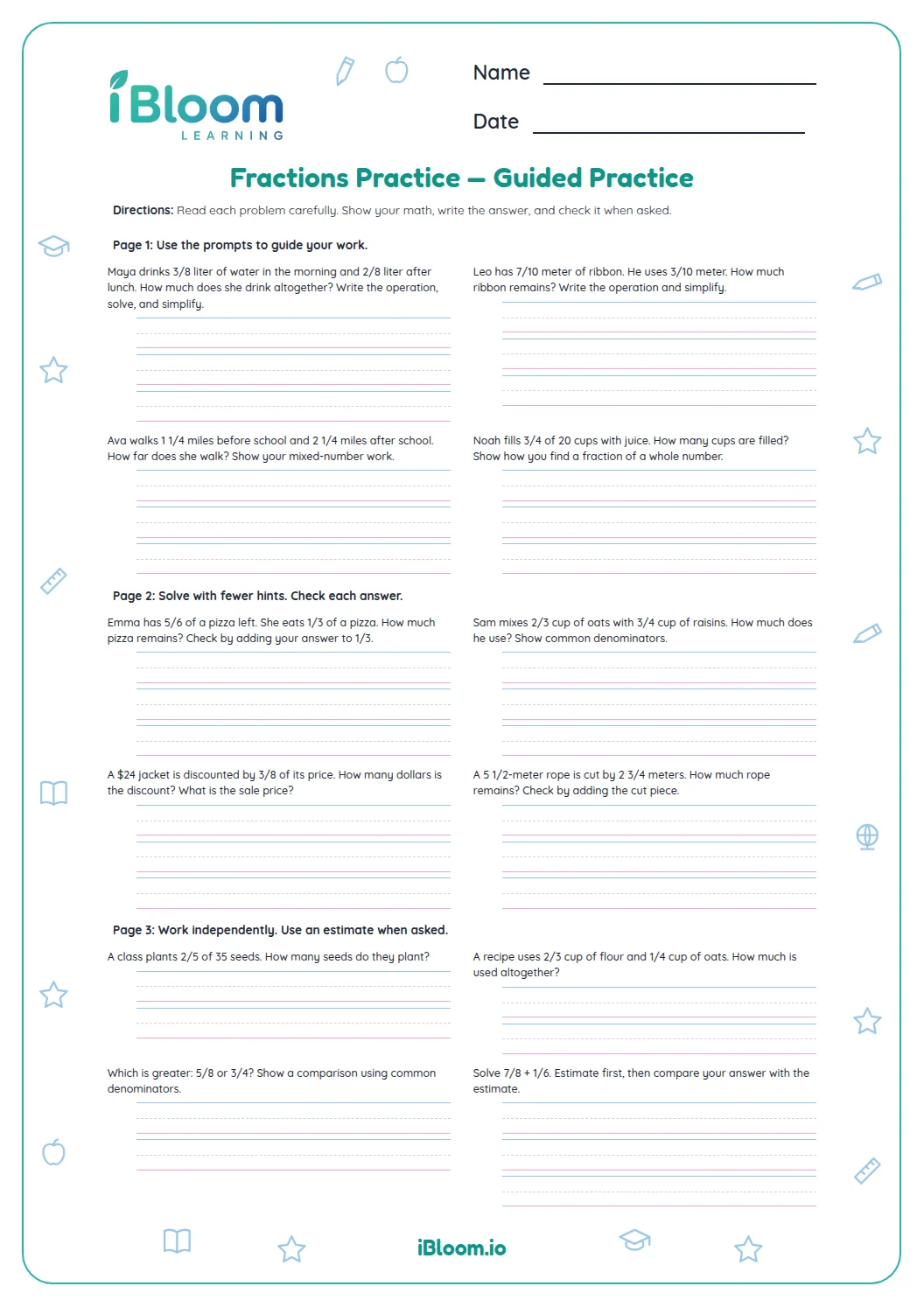
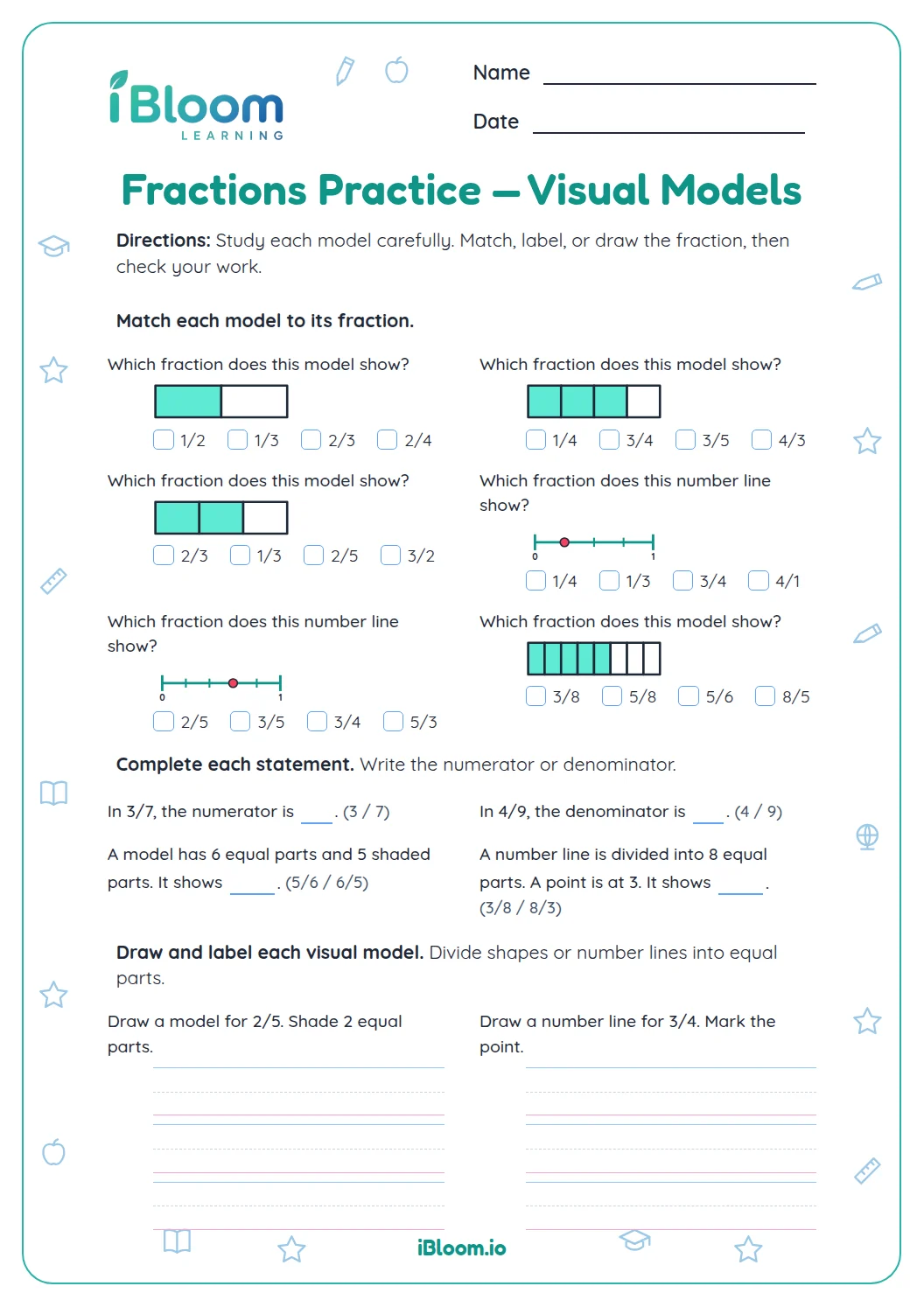
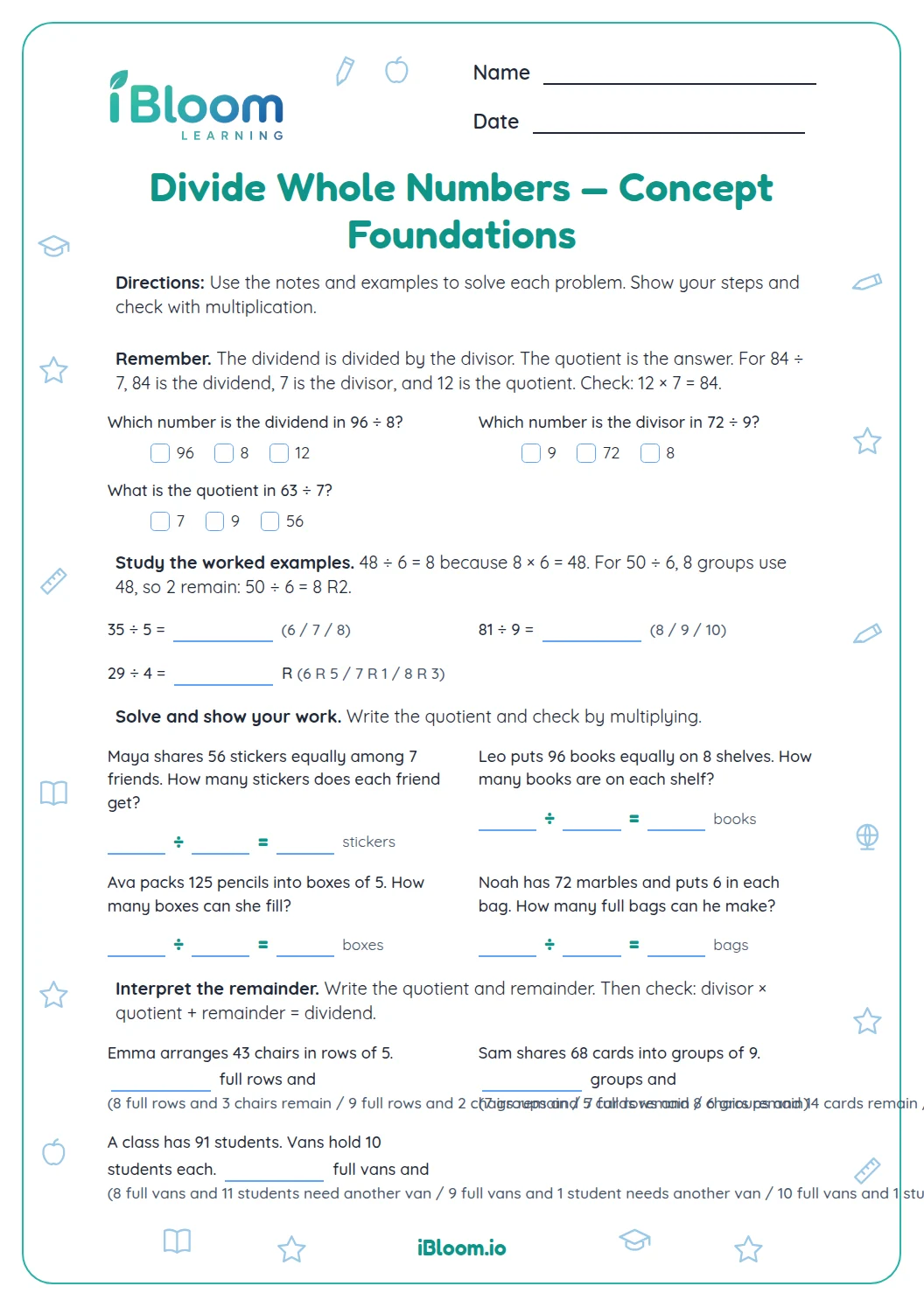
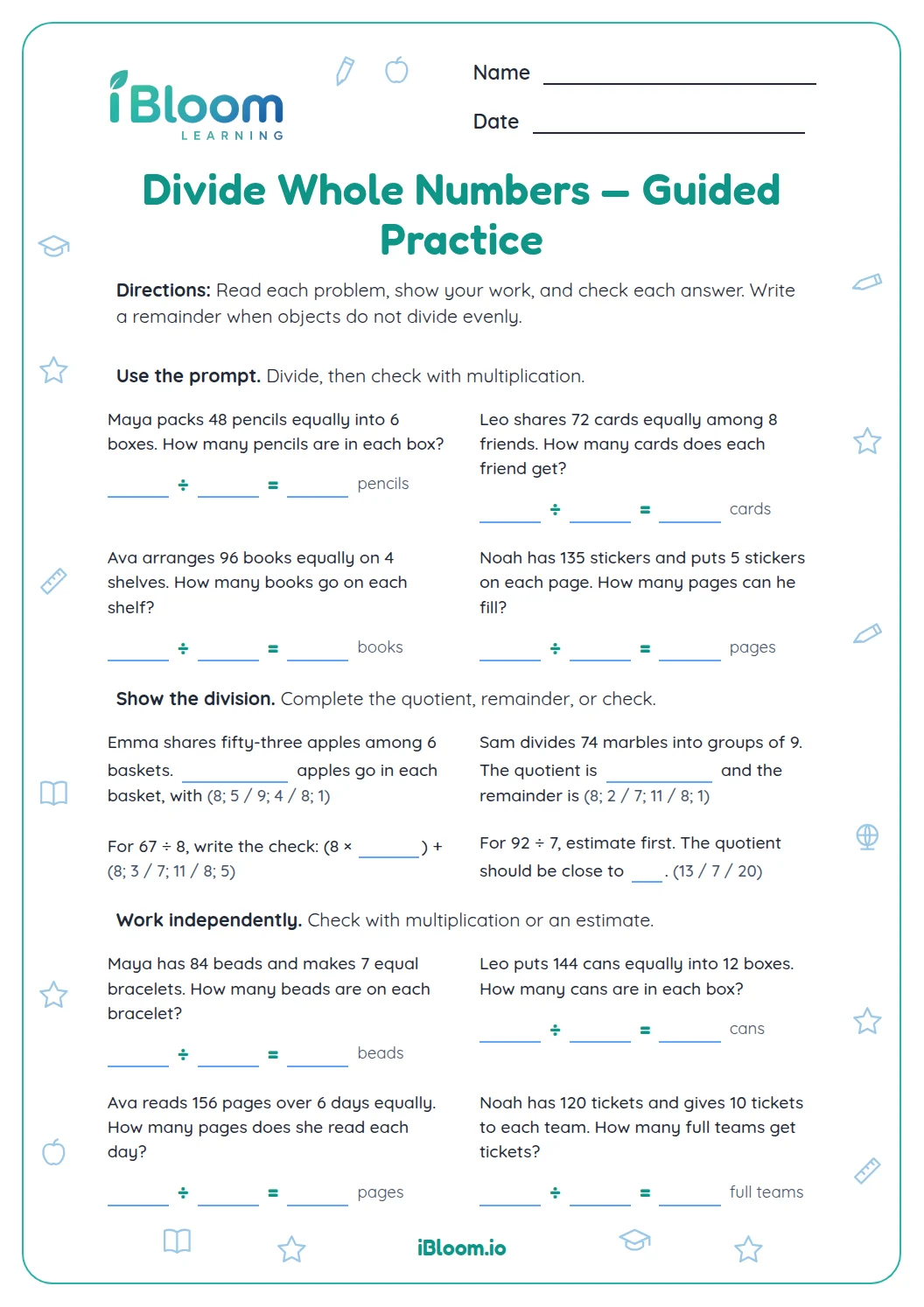
This Grade 5 worksheet uses fraction models and everyday situations to practice dividing unit fractions by whole numbers and dividing whole numbers by unit fractions. Students solve sharing and “how many groups?” problems, read shaded models, and explain how to check a quotient. The answer key shows results and sample reasoning. The questions address 5.NF.B.7 by interpreting and computing with unit-fraction division.
Aligned to 5.NF.B.7
What does a unit-fraction quotient count?
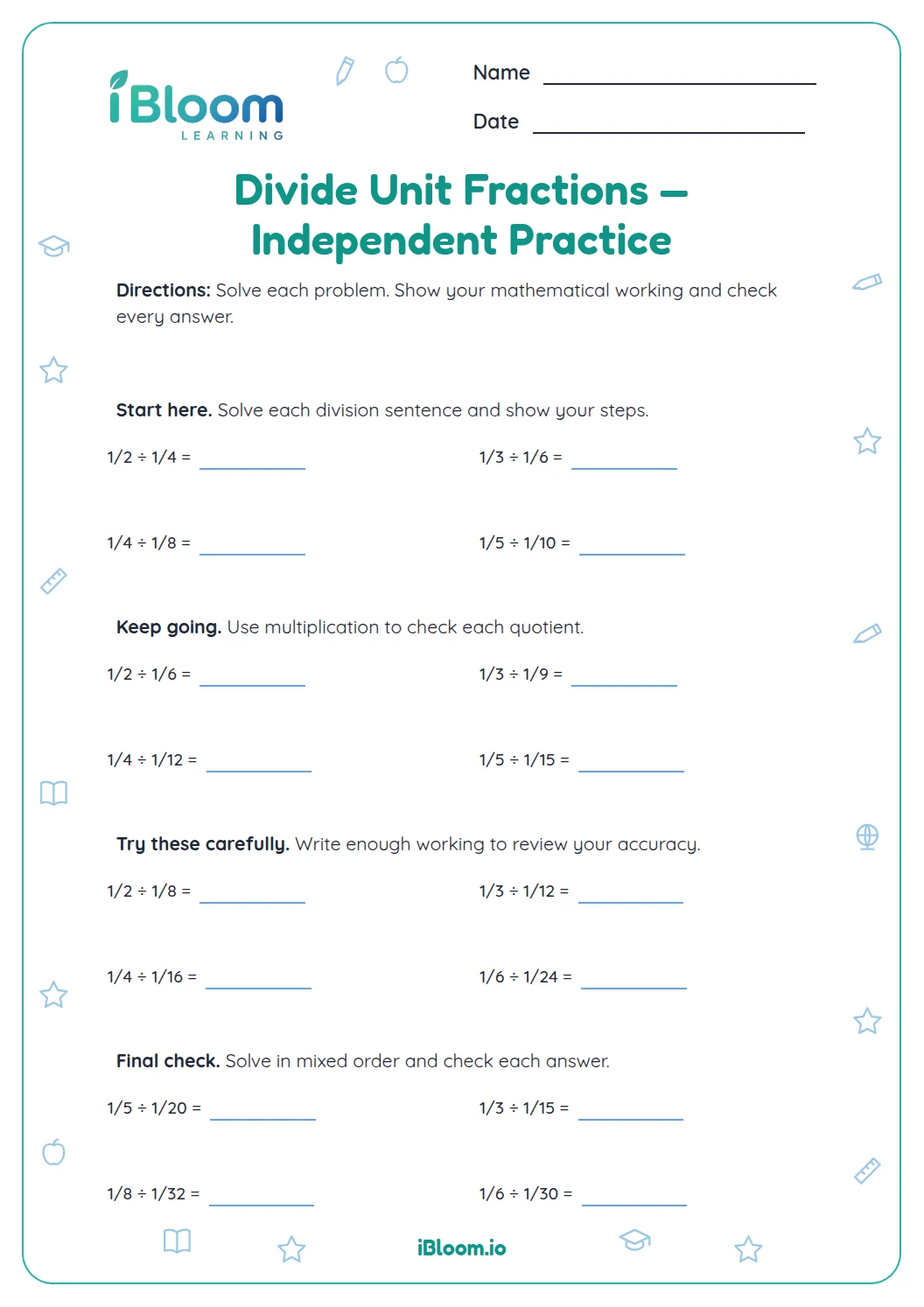
First decide what the quotient counts. In 1/2 ÷ 1/8, the question is how many eighths fit in one half. Four equal eighths fill one half, so the quotient is 4 pieces.
- 11/2 ÷ 1/8
- 2Count eighths in one half.
- 31/2 = 4/8, so the answer is 4 pieces.
How do the visual models help?
A sharing problem asks for the size of each equal share. If 1/2 pizza is shared by 3 friends, each share is 1/6 pizza because three sixths make one half. Multiplying the share by the number of friends checks the result.
How can students check a division answer?
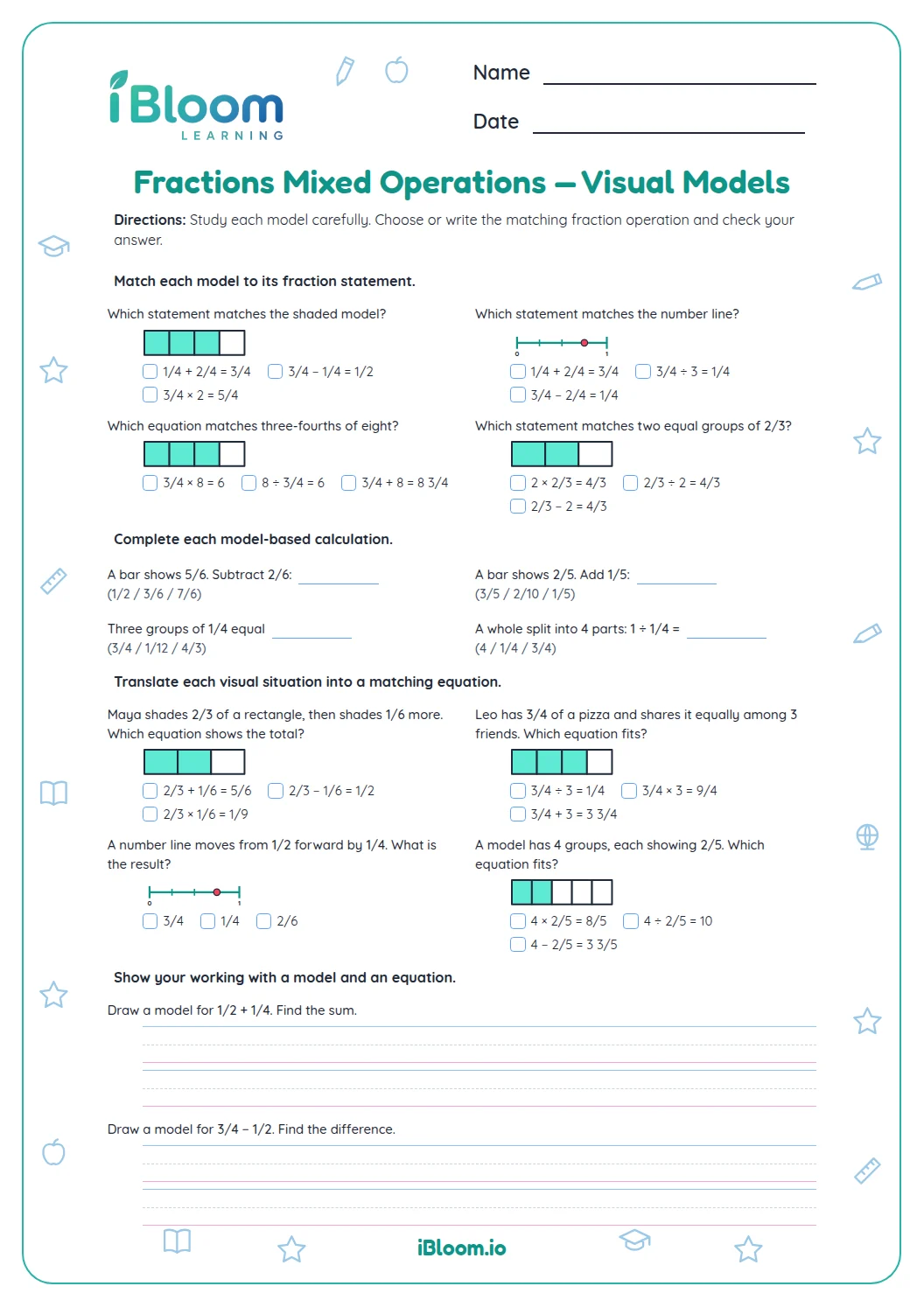
A shaded model shows the amount being divided. In question 9, four shaded eighths are shown, so four 1/8 pieces cover the shaded amount. Name the unit fraction and count equal pieces to read the model.
How to use this worksheet
- 1Read the part heading and direction before you begin.
- 2Solve each item in order, showing work when it helps.
- 3Reread your answer and check that it answers the prompt.
- 4Use the separate key to review each response.
Common mistakes and quick fixes
The mistake
Dividing the smaller number by the larger one automatically.
The fix
Read what the quotient counts before choosing the operation.
The mistake
Treating a sharing problem like a “how many groups” problem.
The fix
Name whether you need the group size or the number of groups.
The mistake
Forgetting to multiply the share to check it.
The fix
Multiply one share by the number of people and compare with the starting amount.
Common Core alignment
This worksheet provides focused practice with a grade-level Common Core skill.
Interpret unit-fraction division and solve real-world problems with visual models.
On this sheet: Students interpret unit-fraction quotients in contexts and connect each situation to an equal-sharing model.
Show the official wordingHide the official wording
Apply and extend previous understandings of division to divide unit fractions by whole numbers and whole numbers by unit fractions.
What to practice next
Make more practice
Further reading
Questions parents and teachers ask
How many 1/8-yard pieces come from 1/2 yard?
The half-yard makes four pieces that are each 1/8 yard long. Since 1/2 equals 4/8, count four eighths in the half. A fraction strip divided into eighths makes those four equal pieces easy to see and count. Each piece is one eighth yard long.
What is the difference between 1/2 ÷ 3 and 3 ÷ 1/2?
In 1/2 ÷ 3, half a whole is shared into three equal groups, so each group is 1/6. In 3 ÷ 1/2, the question asks how many halves fit into three wholes, which is six. The order changes the meaning.
Why can a quotient be bigger than the starting number?
When the divisor is a fraction smaller than one, several fractional groups can fit inside one whole. Four groups of 1/4 fit inside 1, so 2 ÷ 1/4 equals 8. A model makes the groups visible and helps explain why the quotient grows.
How many questions are on the sheet?
There are 15 questions in four parts: eight word problems, four model-reading items, and three more division and reasoning questions. The key gives concise answers and sample explanations so families can review both the quotient and what it represents.
How can I check a sharing problem?
Multiply the amount each person receives by the number of people. For 1/2 shared by 3, each gets 1/6; three groups of 1/6 combine to 1/2. This reverses the sharing and checks that the answer matches the original amount.