
About this worksheet
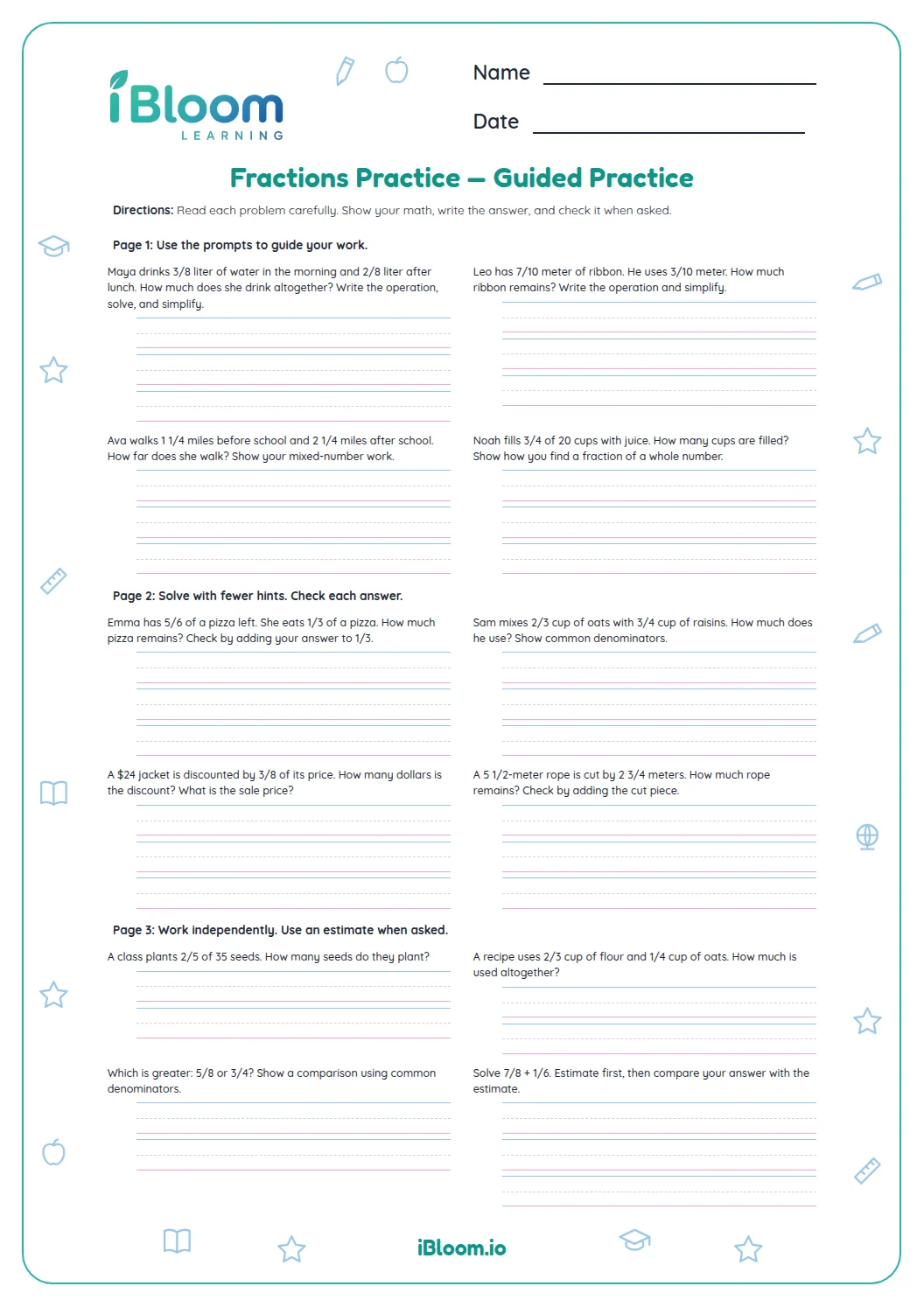
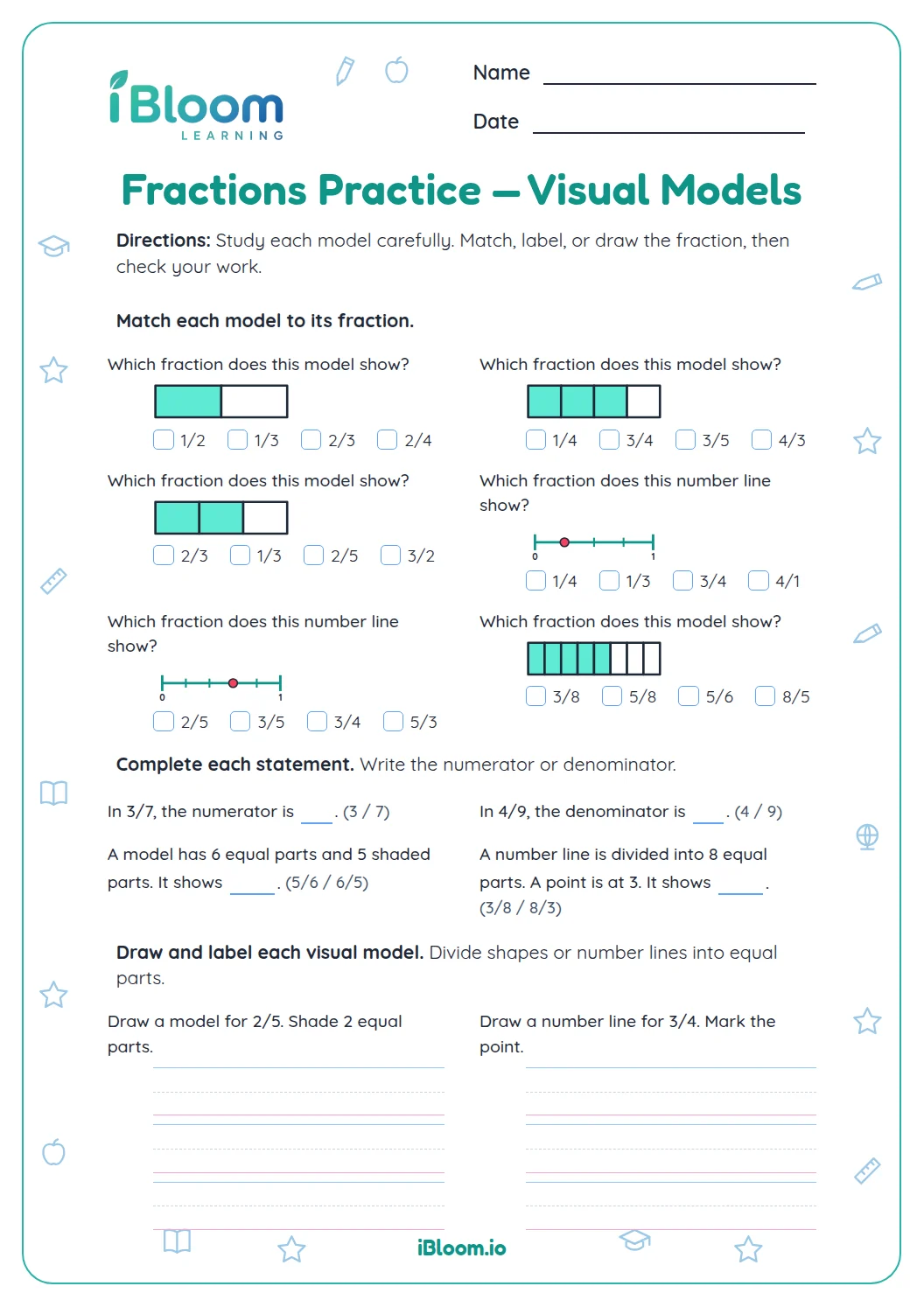
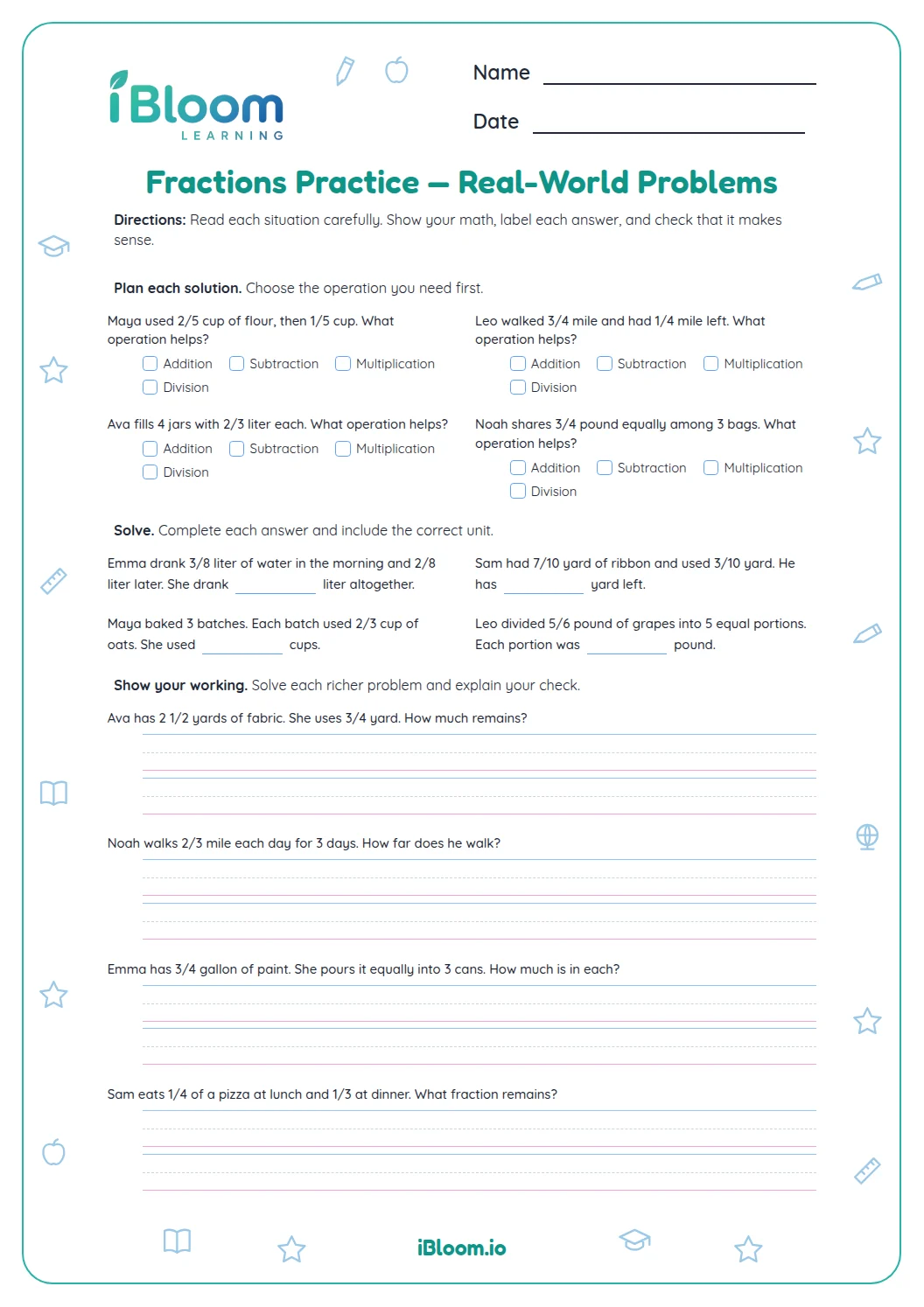
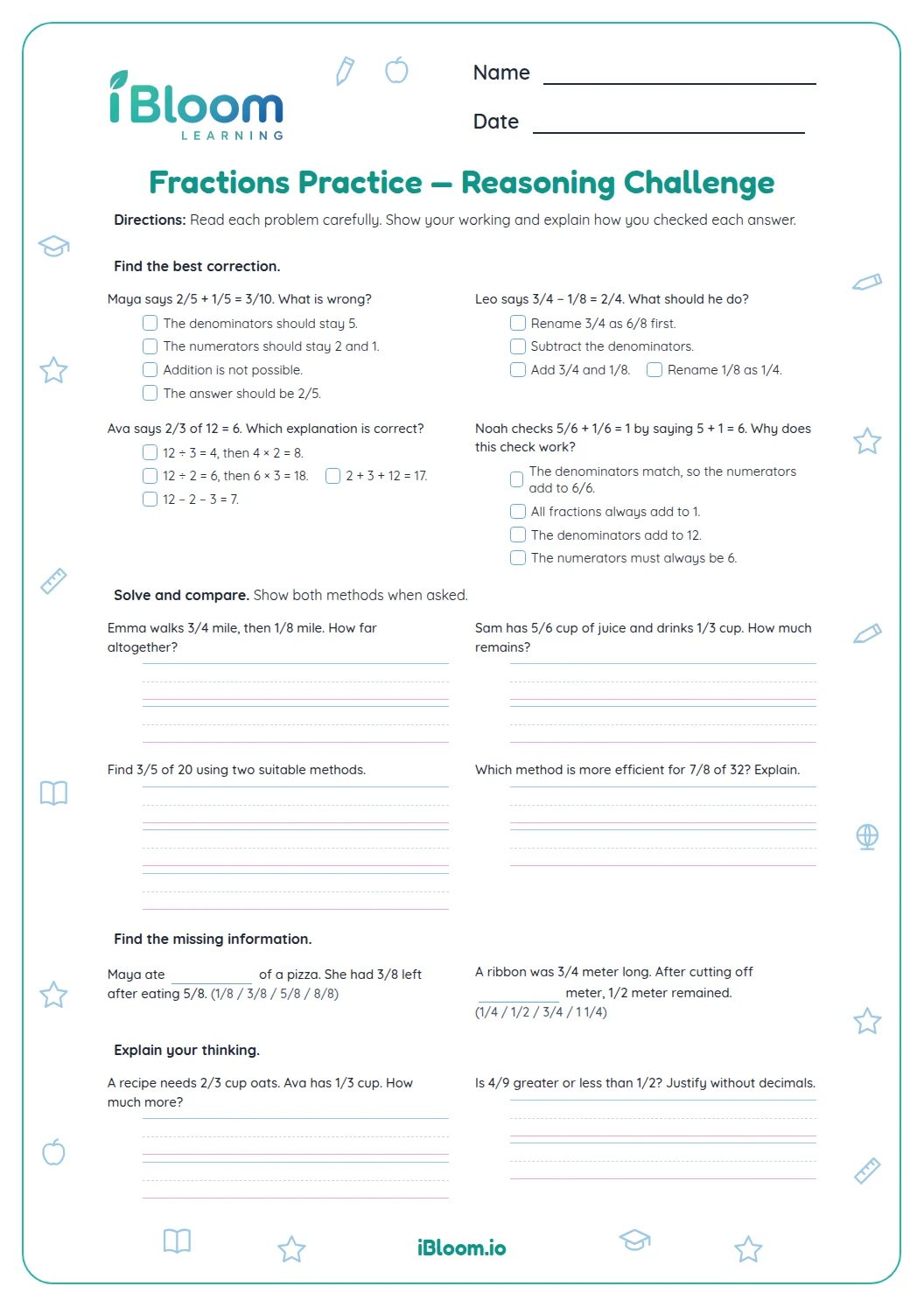
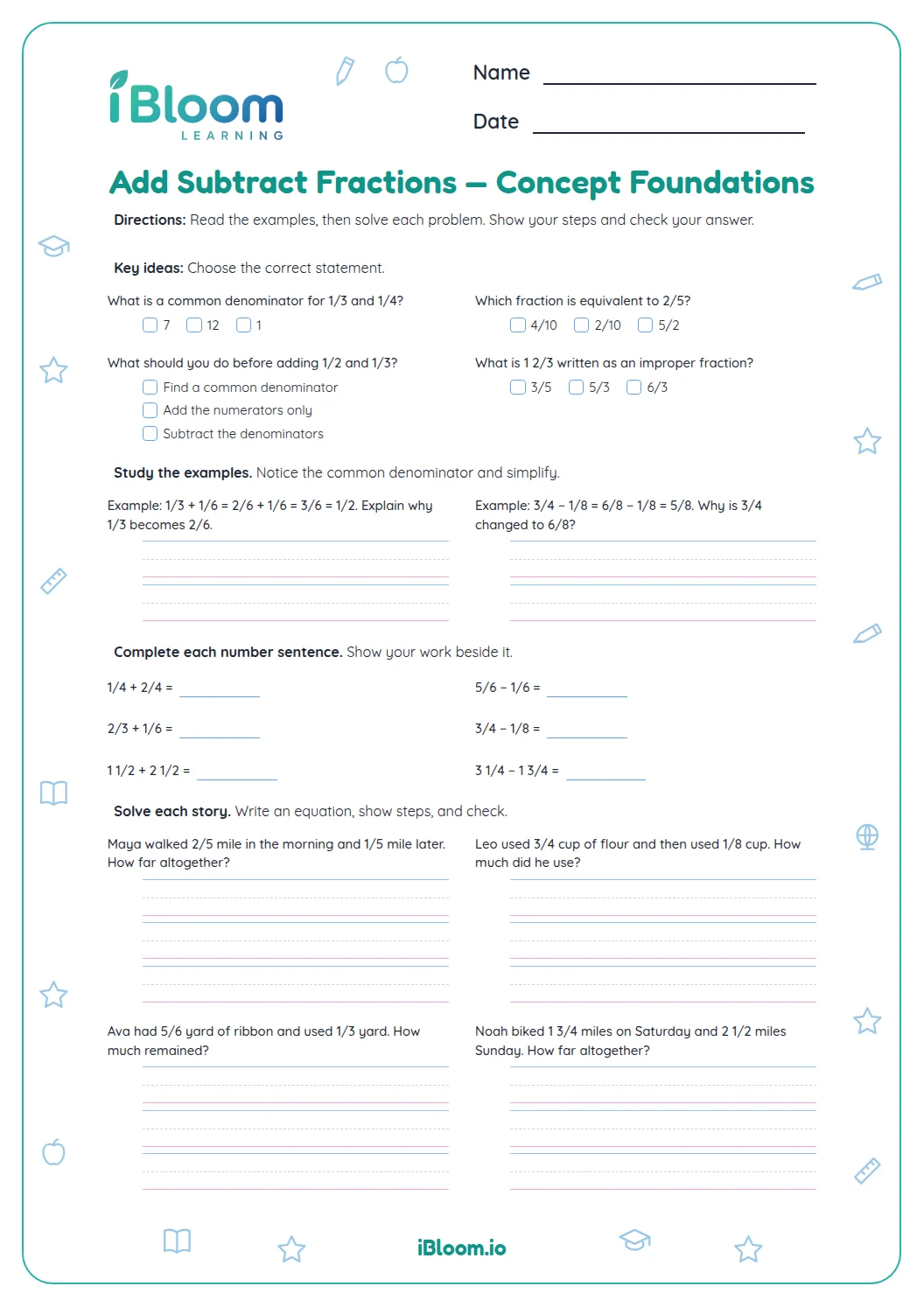
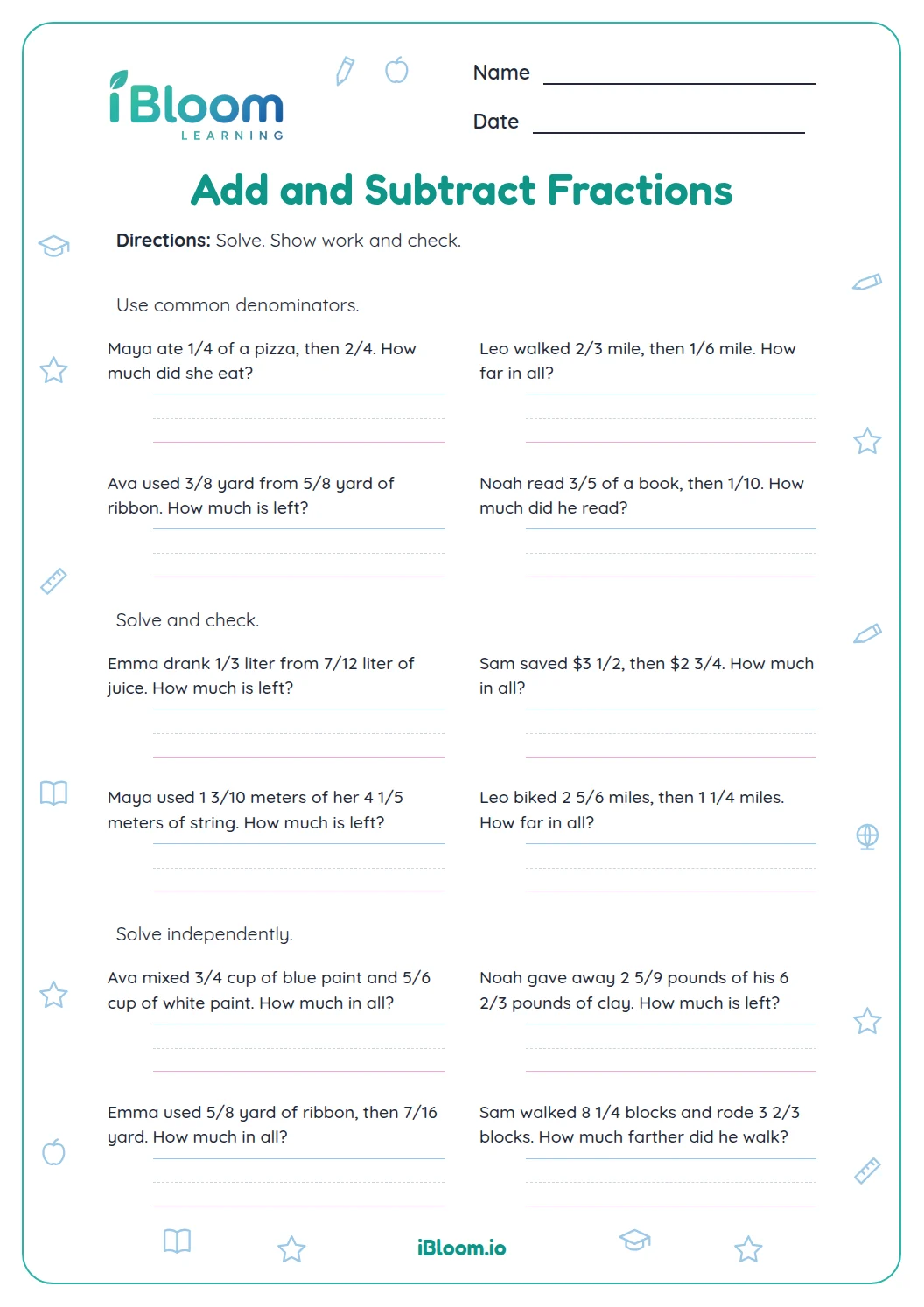
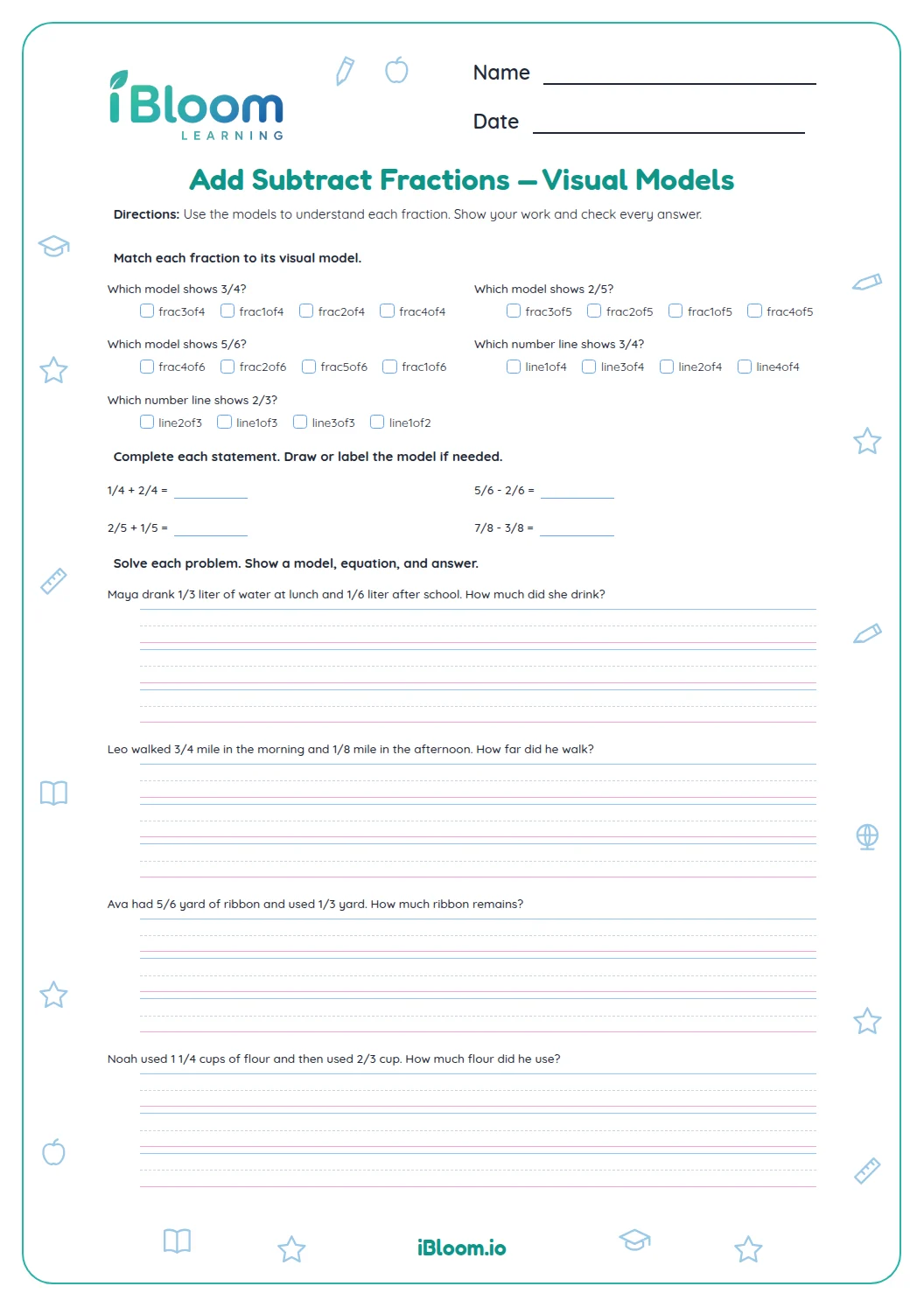
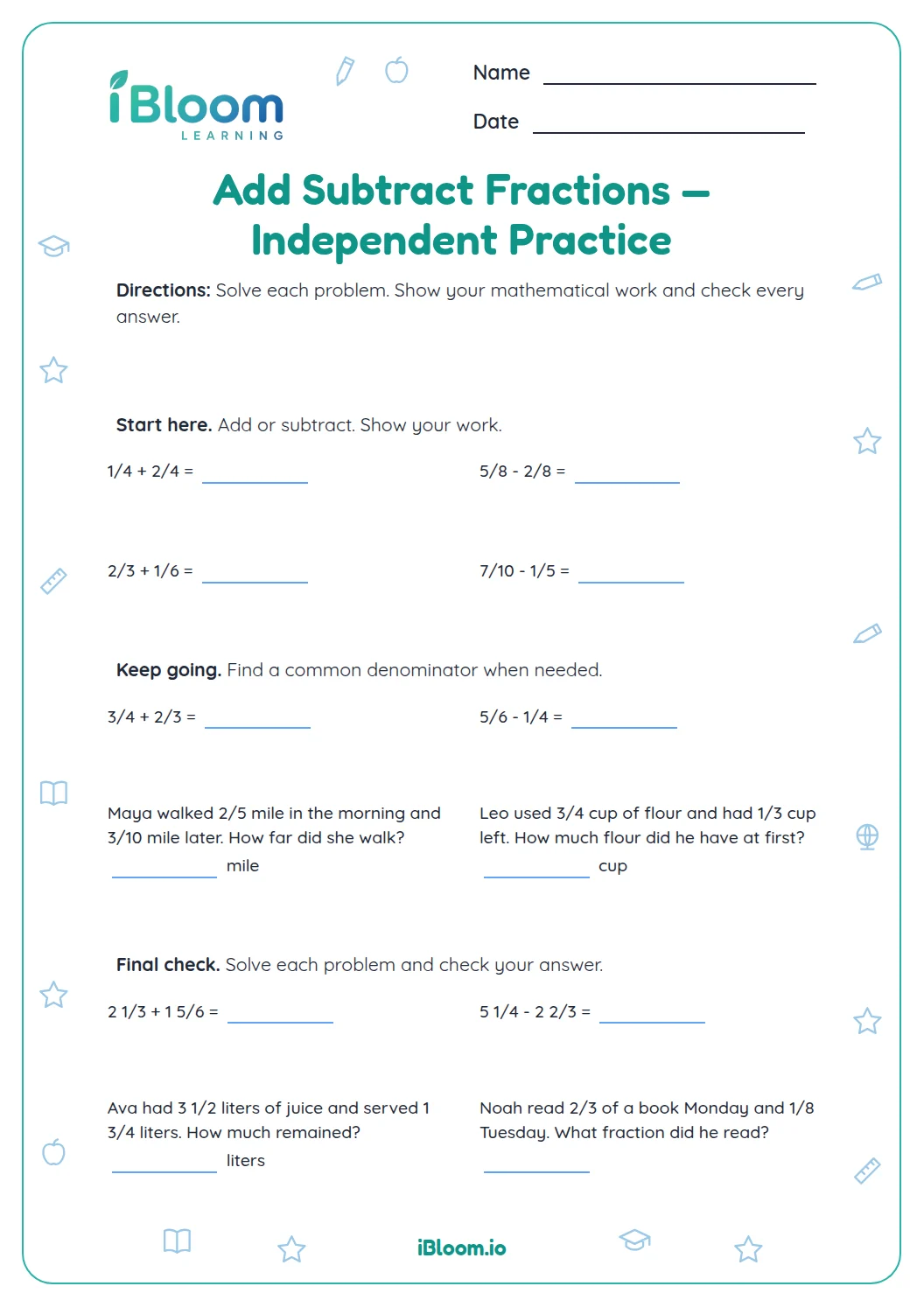
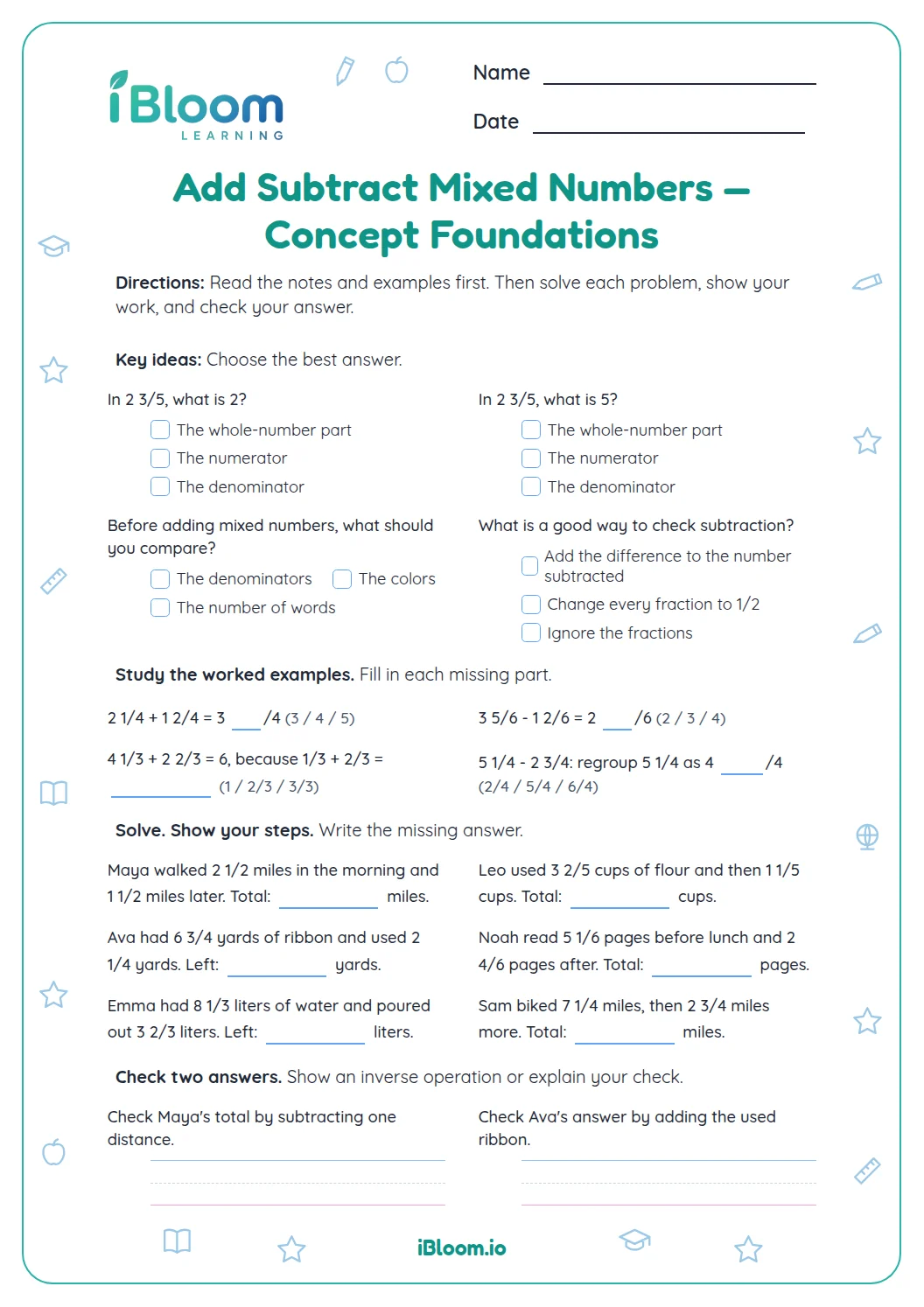
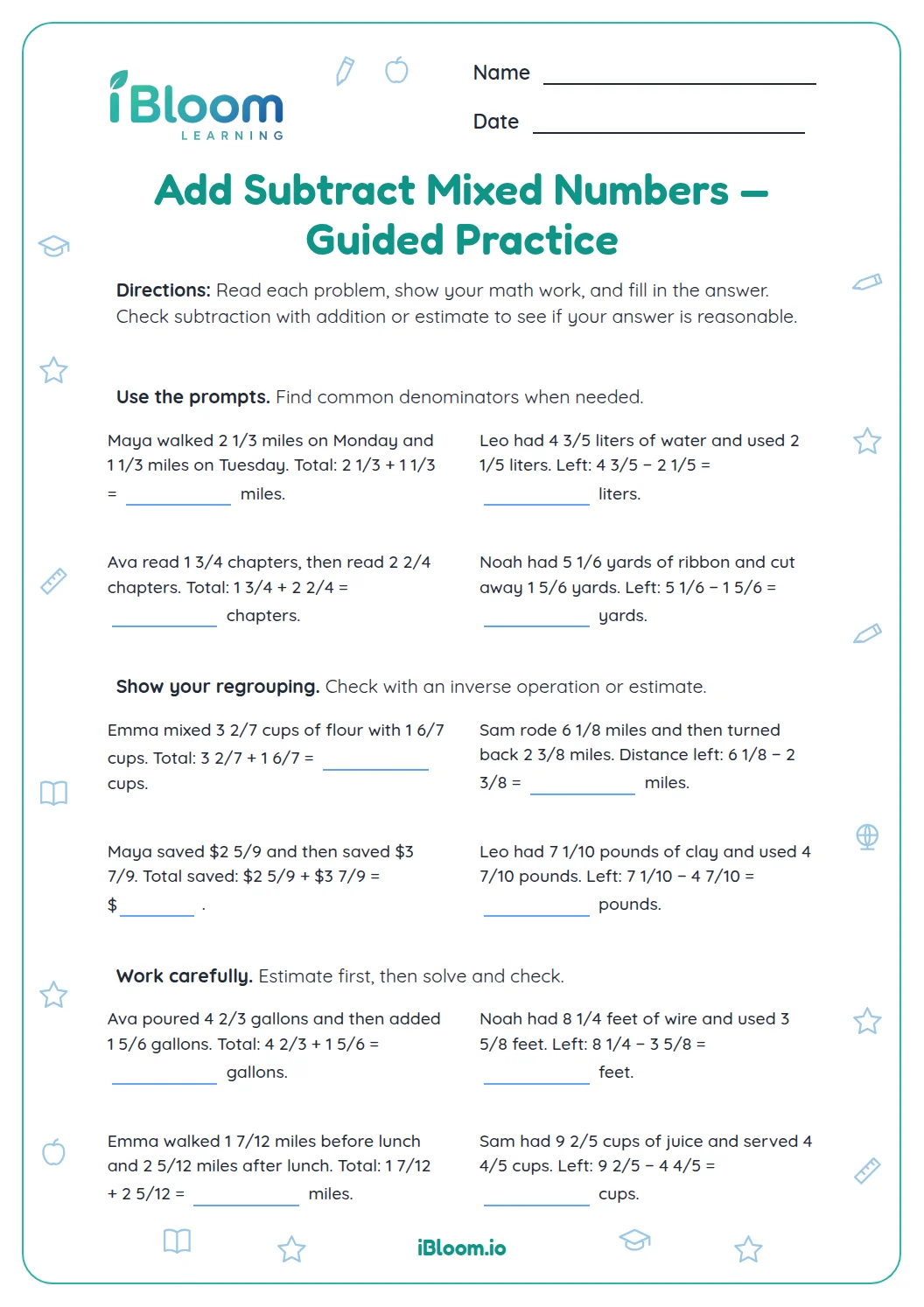
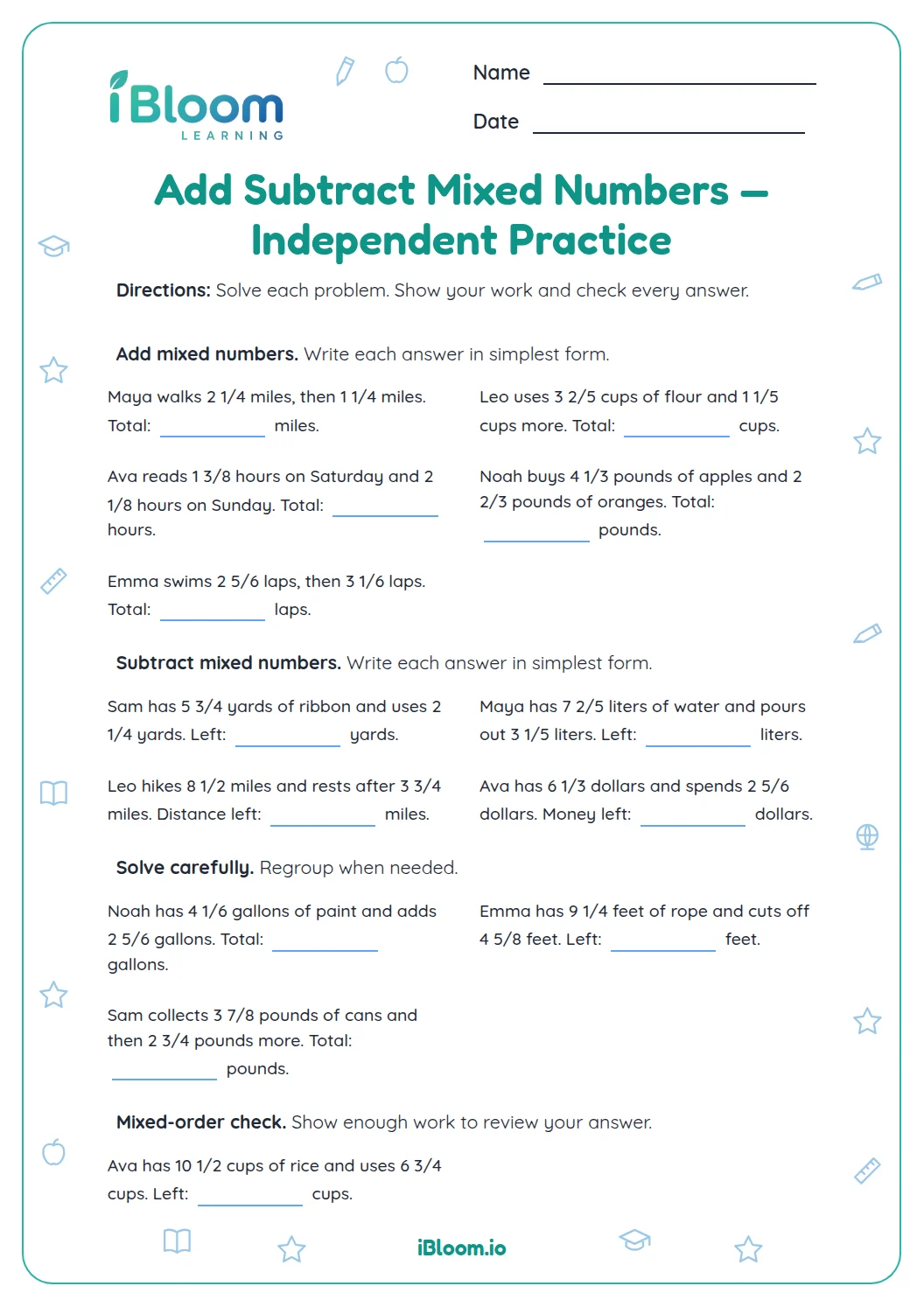
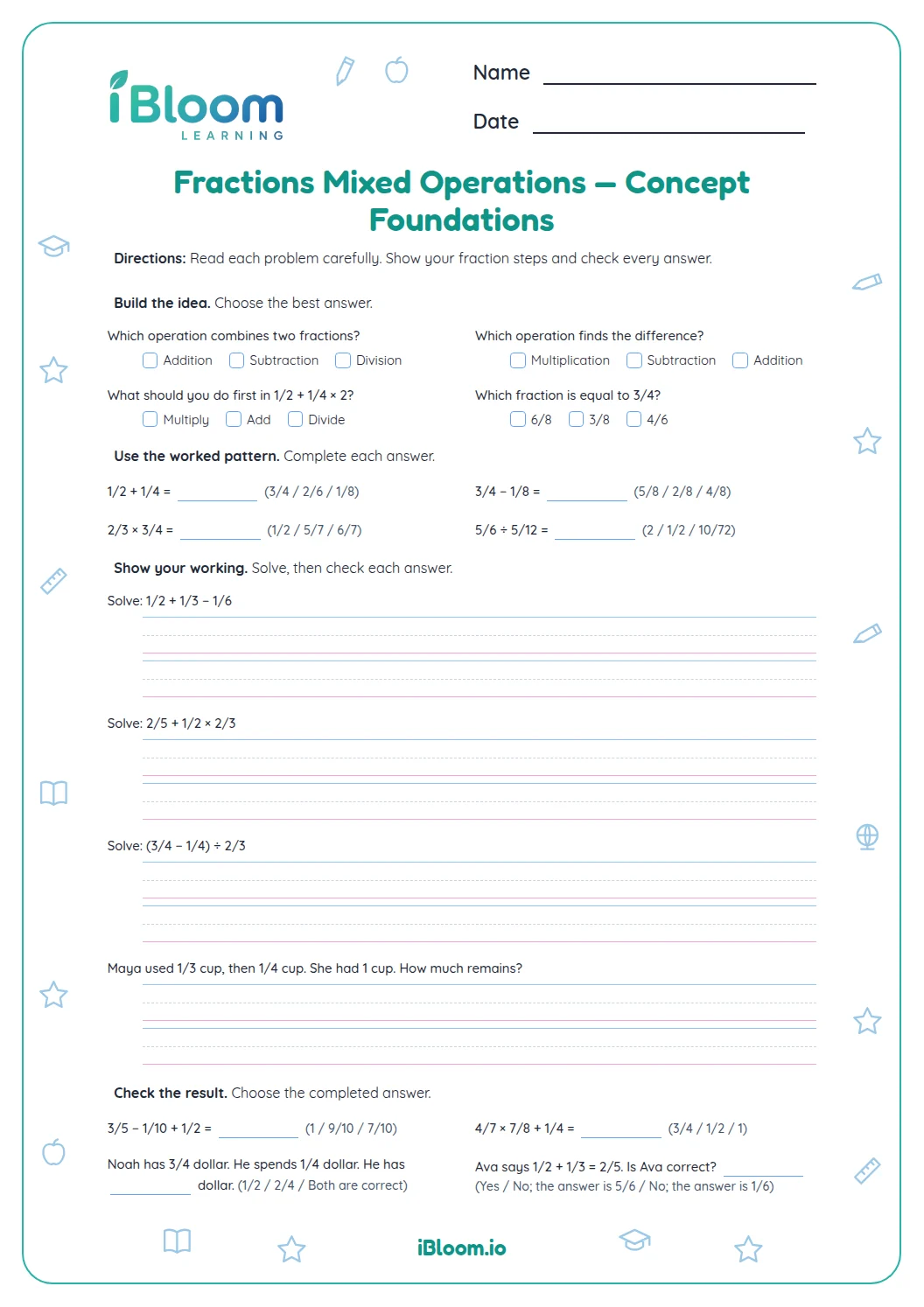
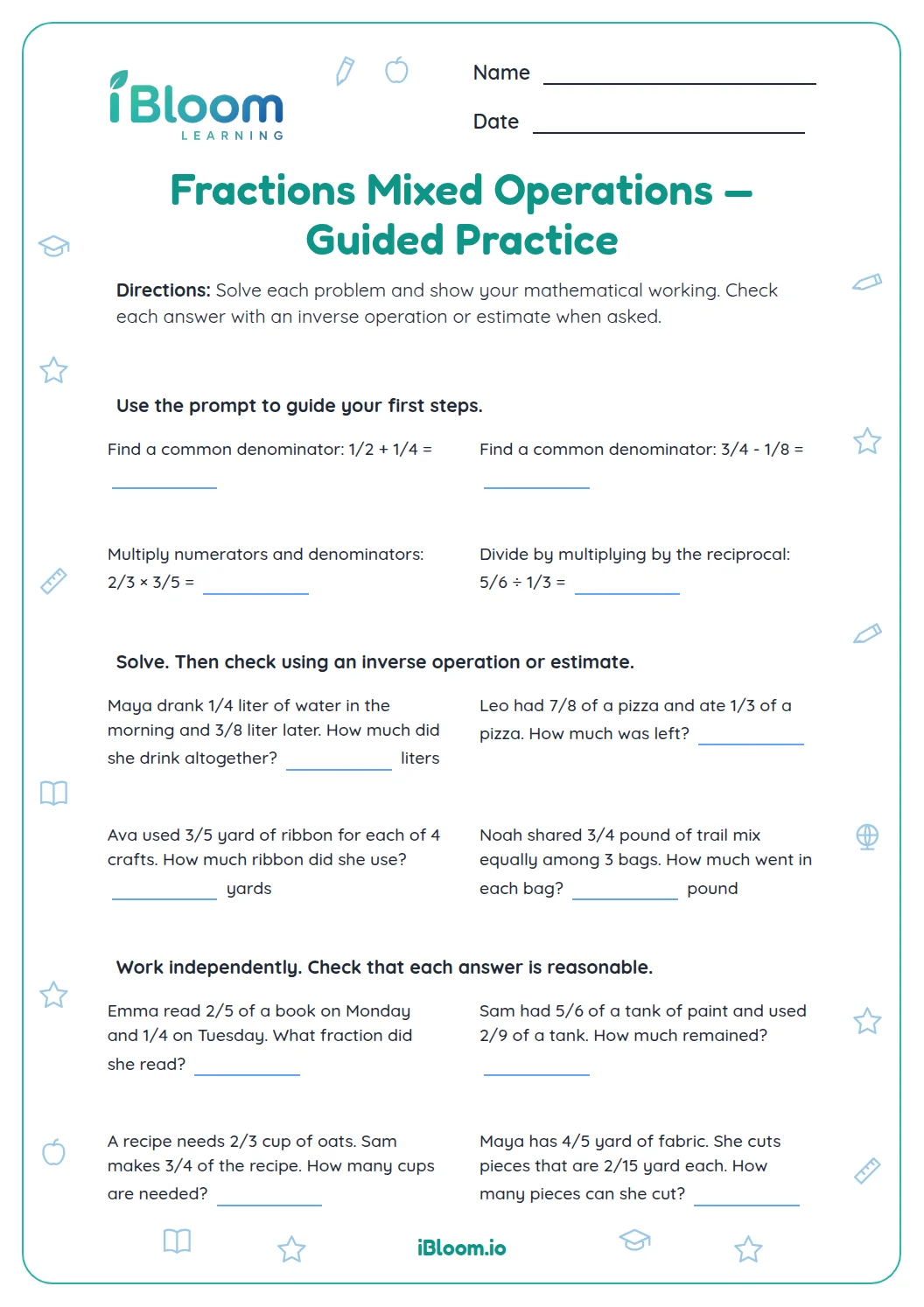
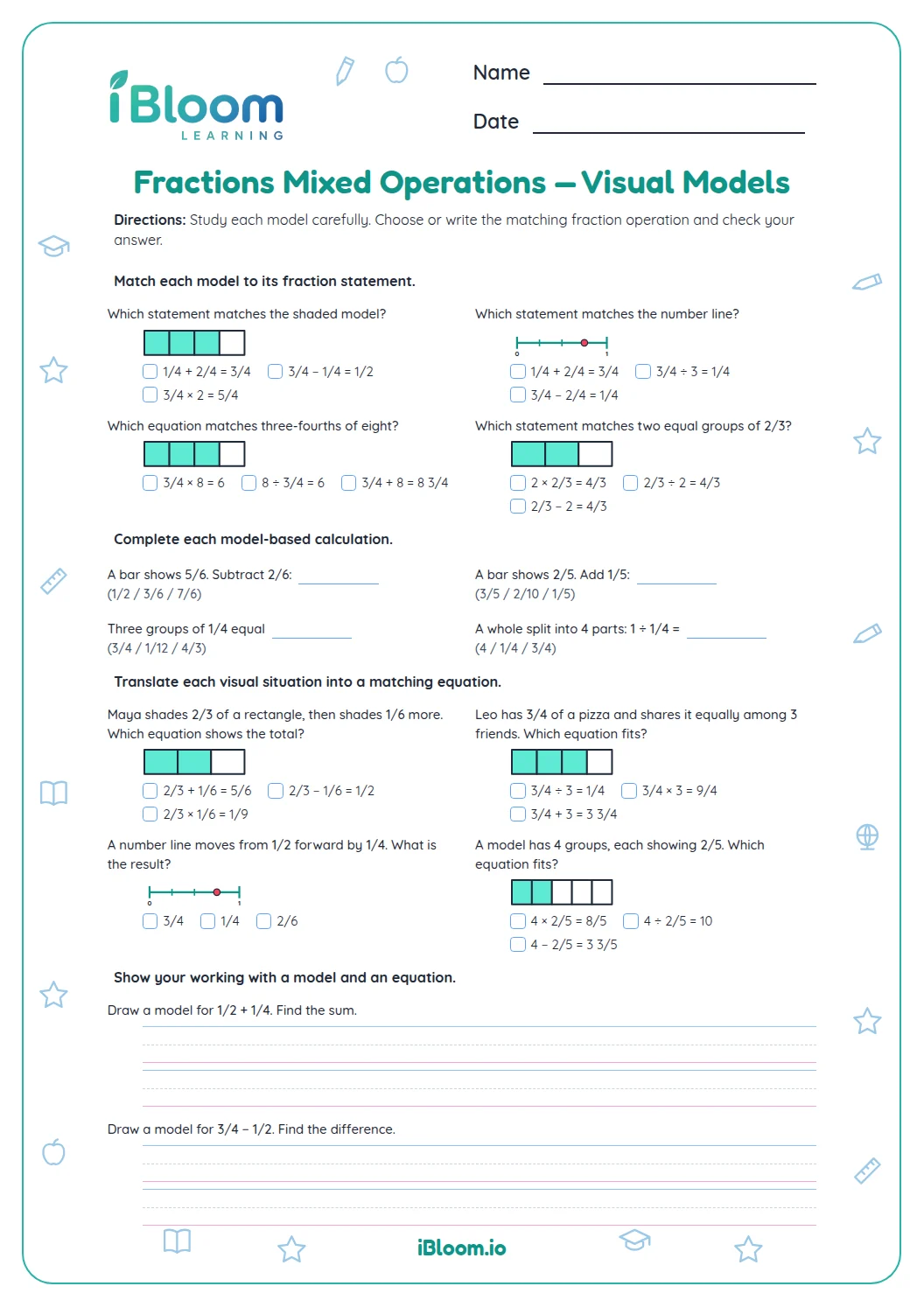
This two-page Grade 5 worksheet moves from fraction calculations to short situations. Part A practices adding and subtracting like denominators, simplifying, and multiplying a fraction by a whole number. Part B applies those ideas to five stories about amounts, lengths, and groups. It aligns with CCSS 5.NF.B.4 through the fraction-by-whole-number products and includes a separate two-page answer key.
Aligned to 5.NF.B.4
How do you add or subtract like fractions?
Keep the denominator and combine or subtract the numerators. Simplify the result if numerator and denominator share a factor. For 7/10 − 3/10, the difference is 4/10, which simplifies to 2/5.
- 17/10 − 3/10 = ___
- 2Subtract the numerators: 4/10.
- 3Simplify 4/10 to 2/5.
How do you multiply a fraction by a whole number?
Multiply the numerator by the whole number and keep the denominator, then simplify or write a mixed number if needed. For 3/5 × 2, the product is 6/5, or 1 1/5. Part A also asks for a fraction of a whole-number quantity.
How can a story tell you which operation to use?
Identify what changes or what group is being described. Combining two amounts calls for addition; a loss calls for subtraction; “one third of 12” calls for finding an equal third of 12. Write an equation before giving the answer with its unit or object.
A fraction-solving routine
- 1Read the full equation or story and identify the quantities.
- 2For like denominators, add or subtract only the numerators first.
- 3For a whole number times a fraction, multiply the numerator by the whole number.
- 4Simplify the fraction or rewrite an improper fraction as a mixed number.
- 5For stories, label the result with the unit or object asked for.
- 6Compare the result with the answer key after solving.
Fraction slips to watch
The mistake
Adding both numerators and denominators in 3/8 + 2/8.
The fix
Keep the common denominator and add the numerators: 5/8.
The mistake
Stopping at 4/10 when the answer can be simplified.
The fix
Divide numerator and denominator by 2 to get 2/5.
The mistake
Reporting 6/4 as the distance for two 3/4-mile walks.
The fix
Rewrite 6/4 as 1 1/2 and include miles.
Common Core alignment
This worksheet uses fraction operations in equations and real-world situations.
Multiply a fraction or whole number by a fraction in models and situations.
On this sheet: Several questions multiply fractions by whole numbers and interpret the products.
Show the official wordingHide the official wording
Apply and extend previous understandings of multiplication to multiply a fraction or whole number by a fraction.
What to practice next
Make more practice
Further reading
Questions parents and teachers ask
Which fraction operations are included?
Part A includes addition and subtraction with like denominators, plus fraction-by-whole-number multiplication. Part B uses these ideas in five contexts, including a ribbon, brownies, a trail, and apples. The key uses simplified forms when they name the same value. Ask the learner to explain why.
Why does 7/10 − 3/10 simplify to 2/5?
First subtract the numerators to get 4/10. Both 4 and 10 divide by 2, so the equivalent simplified fraction is 2/5. The value stays the same after simplifying. Writing the intermediate fraction makes the simplification easy to follow. Check each equivalent fraction.
How do you find one third of 12 brownies?
Divide 12 brownies into three equal groups. Each group contains 4, so one third of 12 brownies is 4 brownies. This story uses multiplication or equal grouping to find a fraction of a quantity. The unit or object in the question should appear in the response.
What does twice a 3/4-mile trail mean?
It means two groups of 3/4 mile: 2 × 3/4 = 6/4 = 1 1/2 miles. The answer should include miles because the question asks for a distance. Learners can check that the result is reasonable for the story. Include the requested unit.
How many questions and pages are included?
There are 15 questions across two parts. They fit on two worksheet pages, and the separate answer key also spans two pages with simplified fractions and story units. Show the equation as well as the final value when solving a story.