



About this worksheet
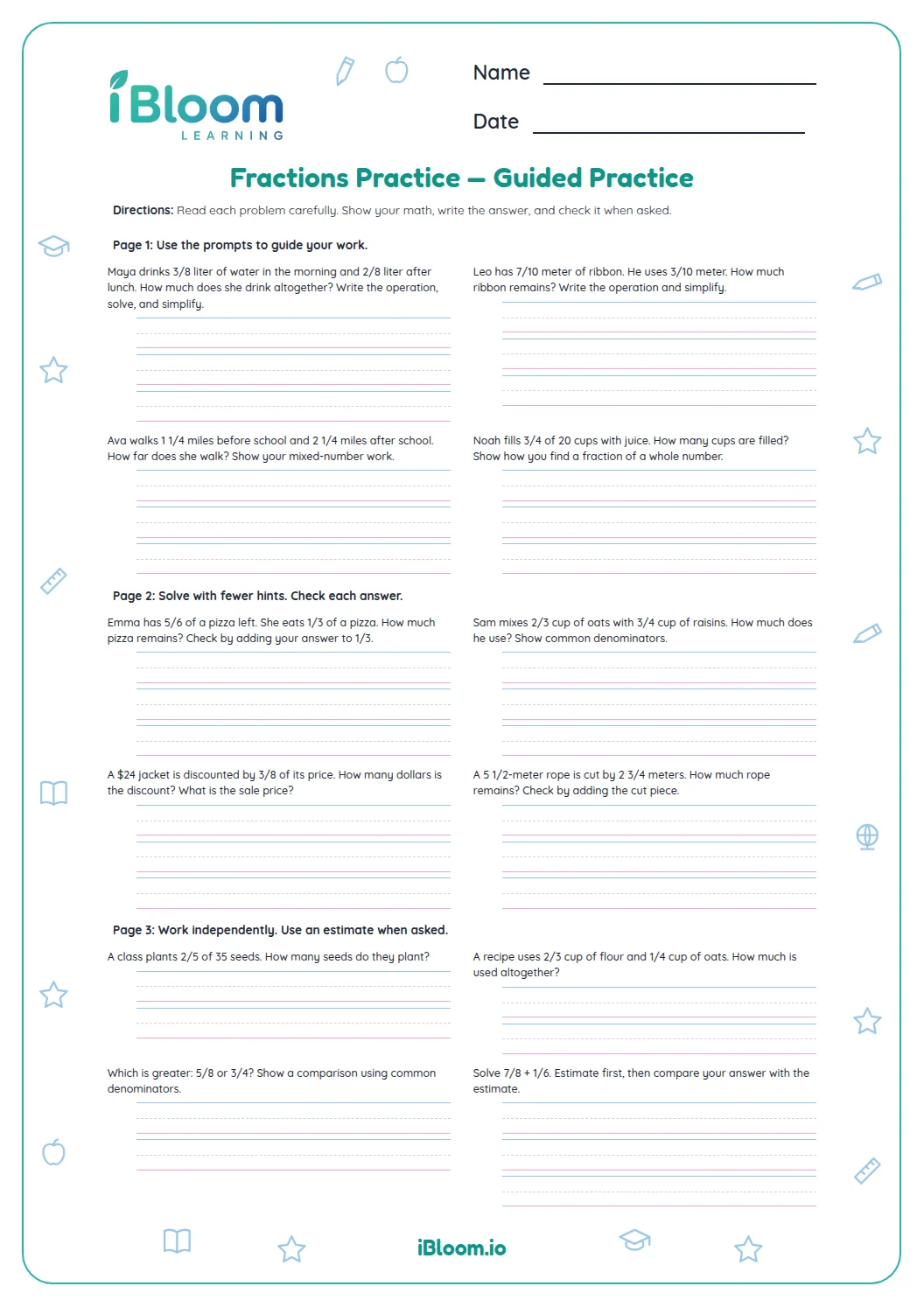
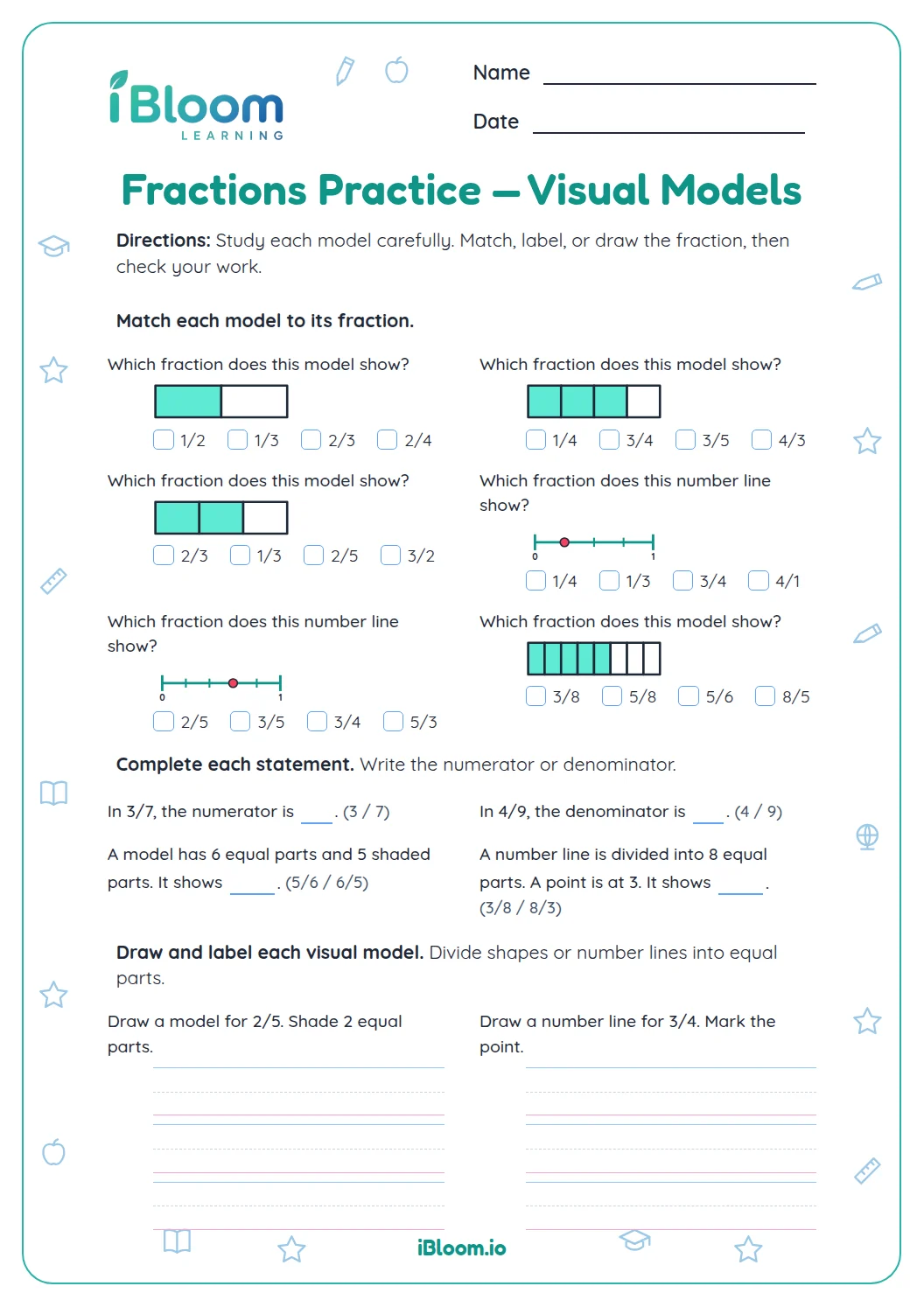
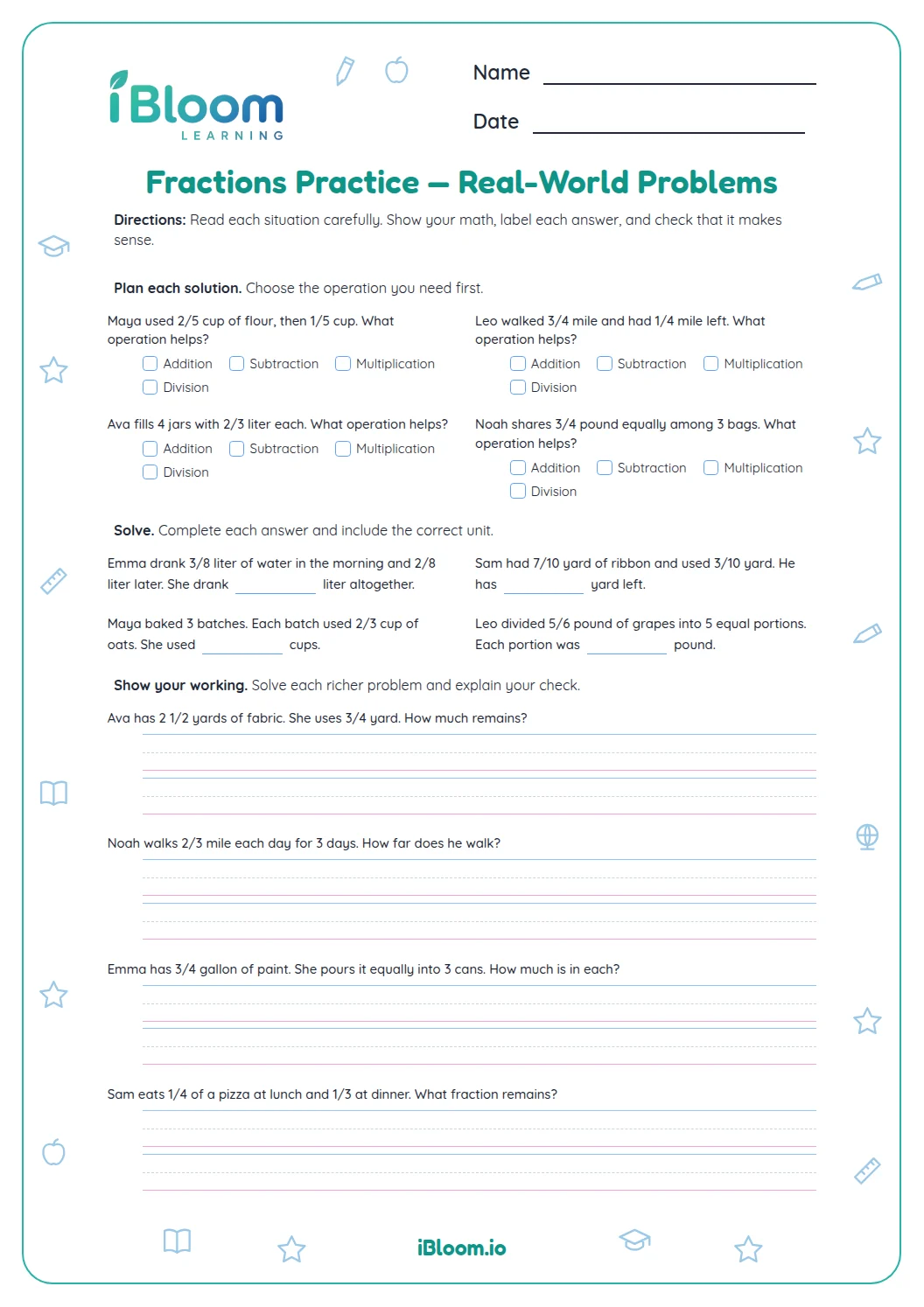
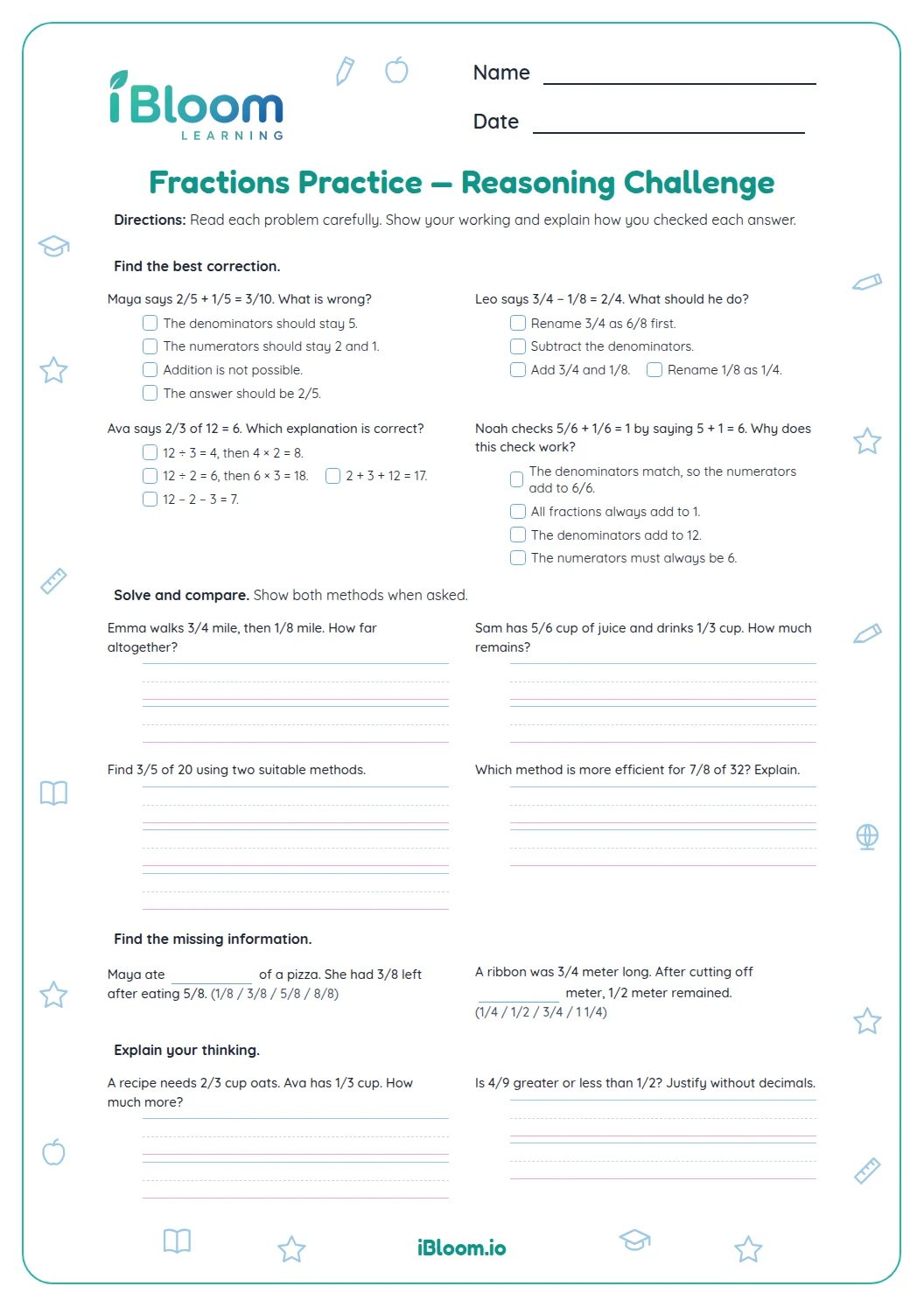
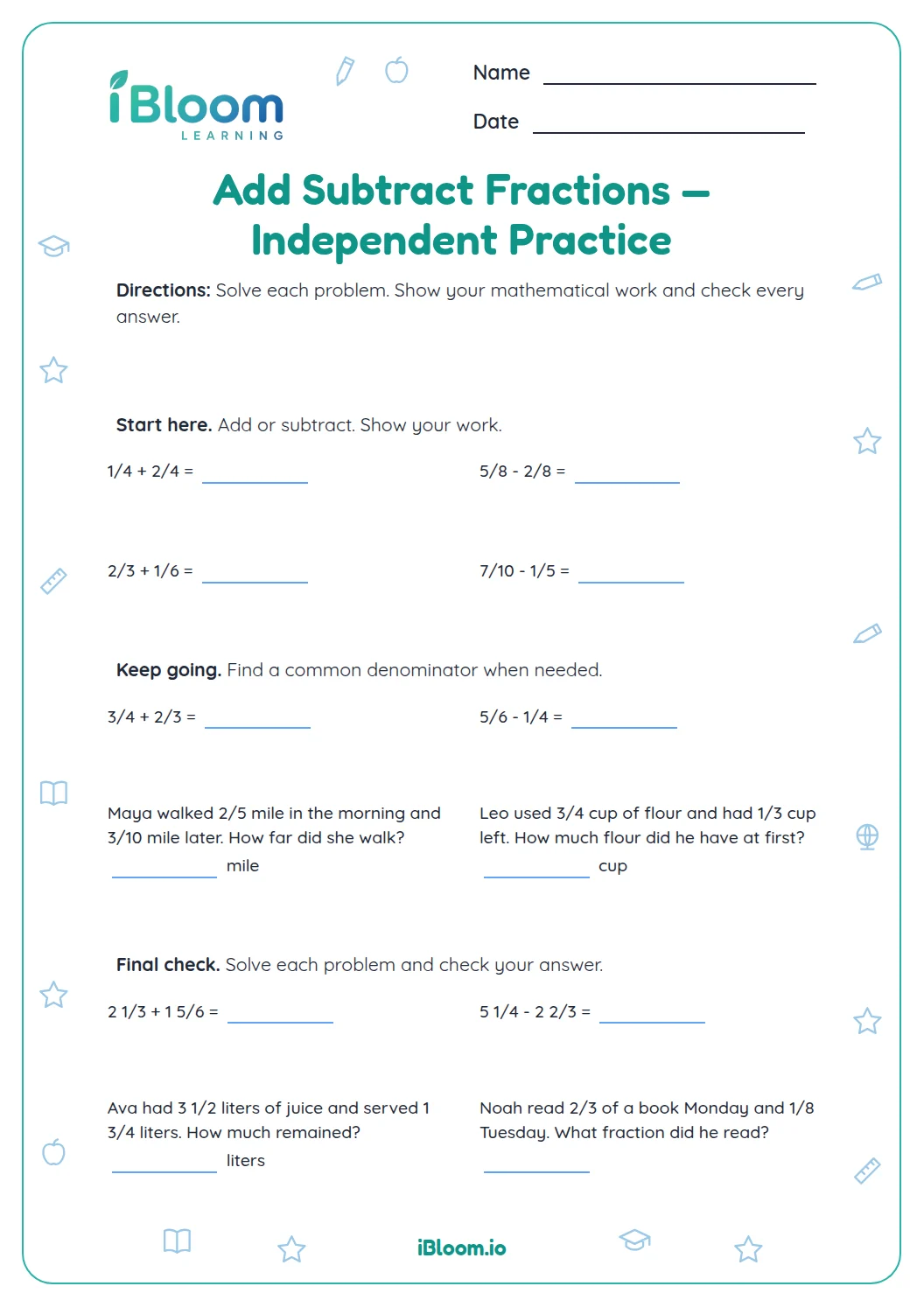
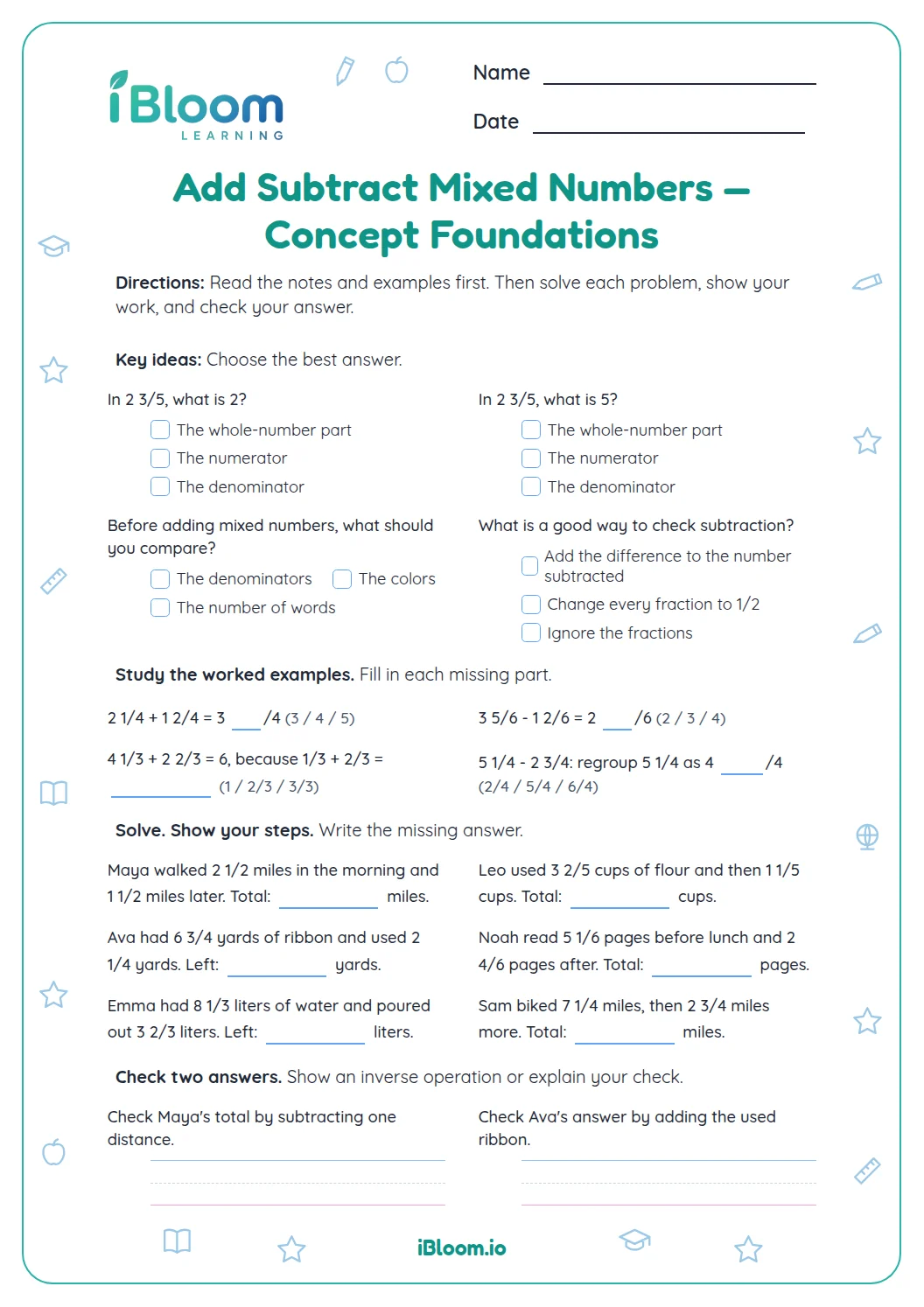
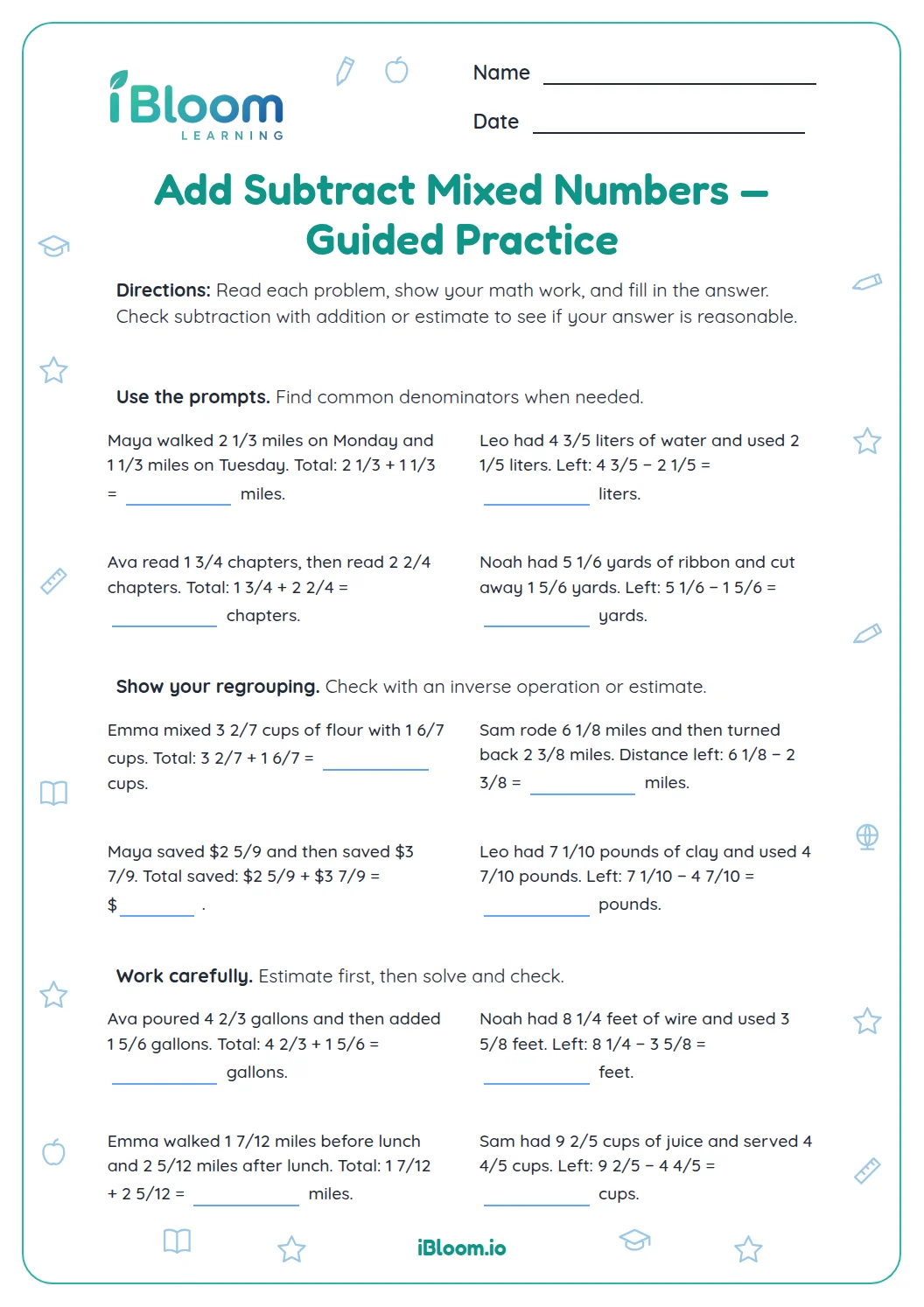
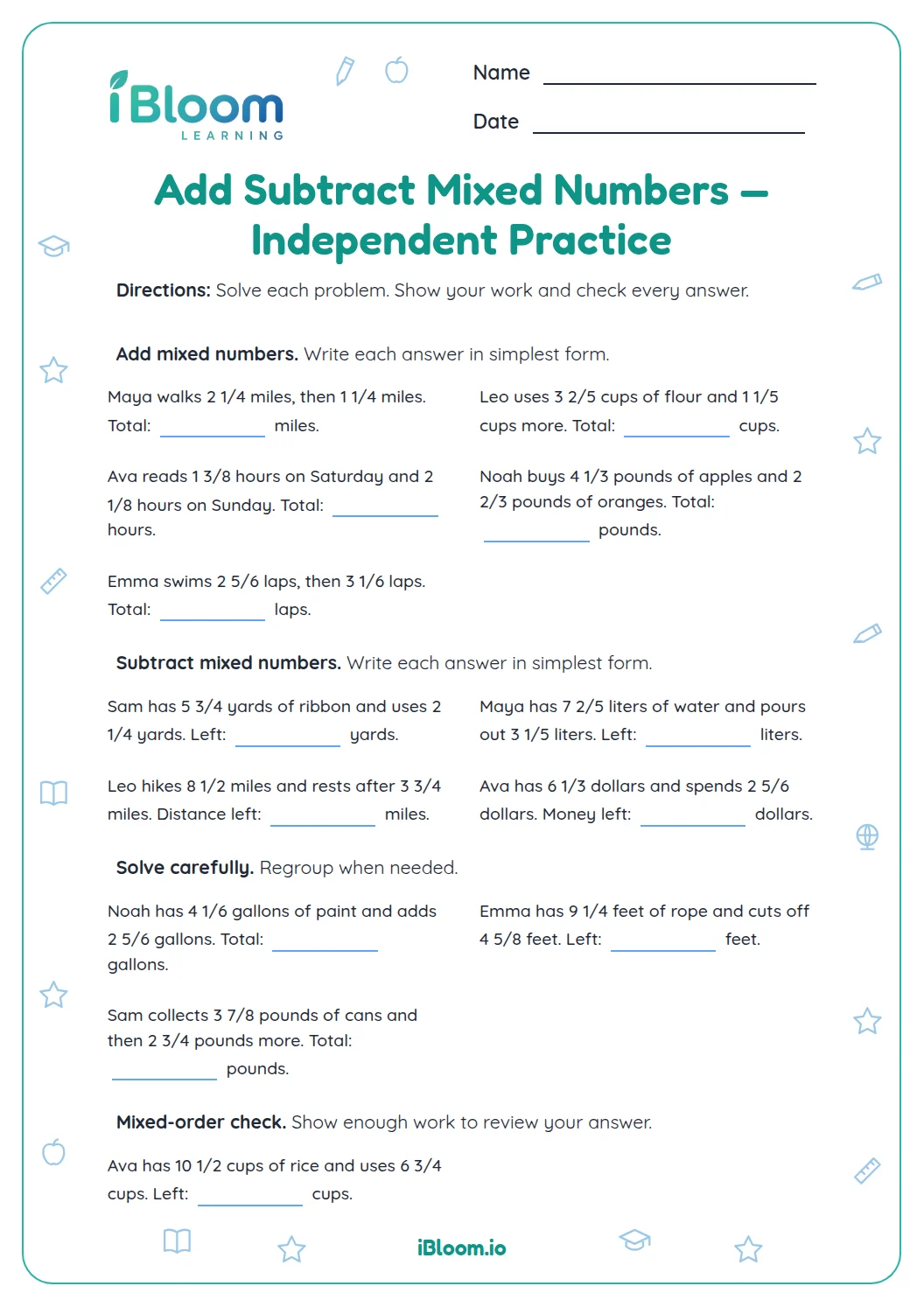
This Grade 5 printable has 14 fraction word problems set in recipes, walks, ribbons, reading, and other familiar situations. Learners add and subtract fractions and multiply fractions by whole numbers, including equal sharing. The answer key includes units where the story asks for them. The worksheet practices CCSS 5.NF.B.4 by applying fraction multiplication to real situations.
Aligned to 5.NF.B.4
How do you choose an operation?
Notice whether the story combines amounts, removes an amount, repeats a fraction, or splits an amount equally. Question 4 combines oats and seeds, so add the two fractions after expressing them with a common denominator.
- 1Oats: 2/3 cup; seeds: 1/6 cup.
- 2Rename 2/3 as 4/6.
- 34/6 + 1/6 = 5/6 cup.
What do the stories ask you to do?
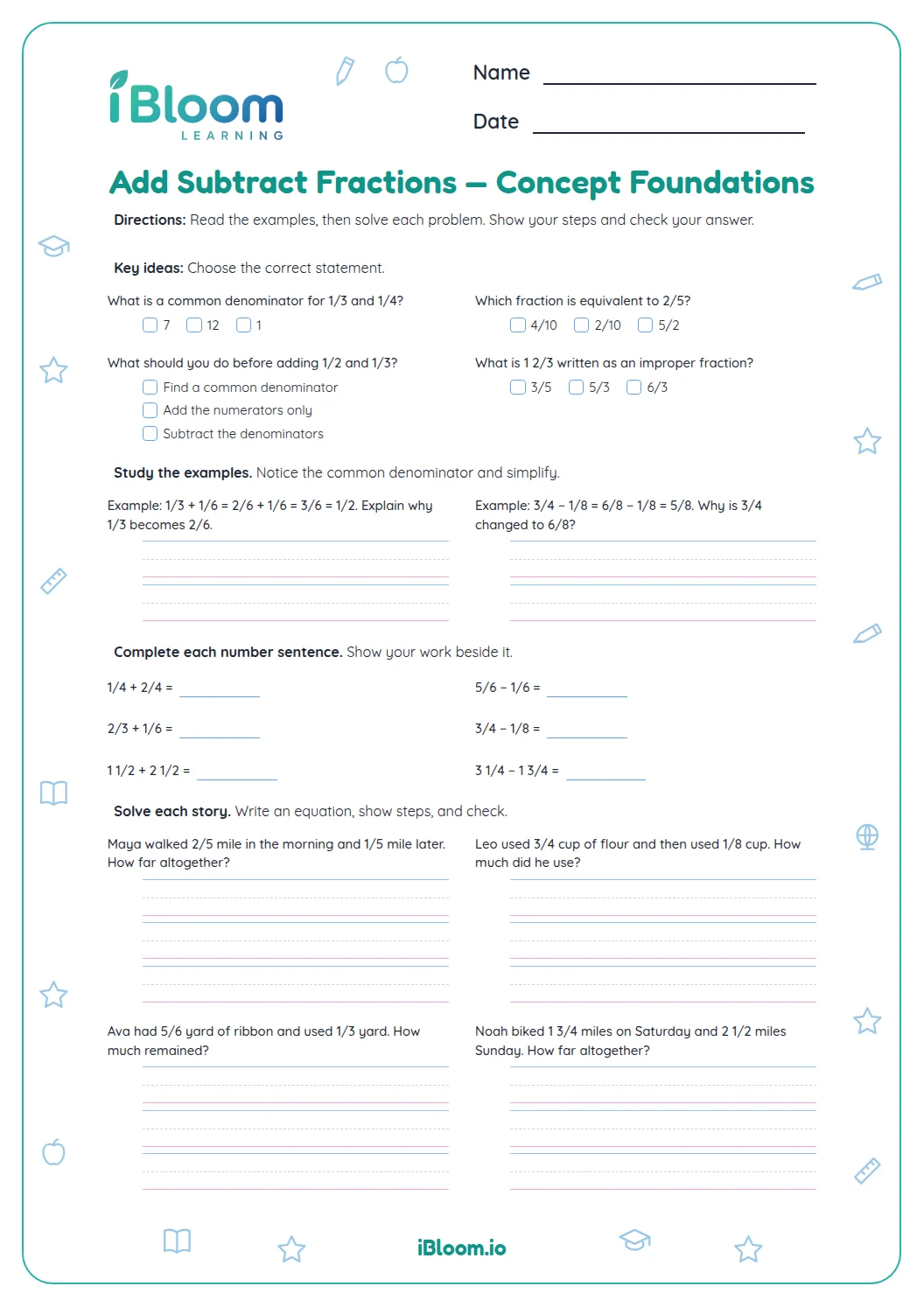
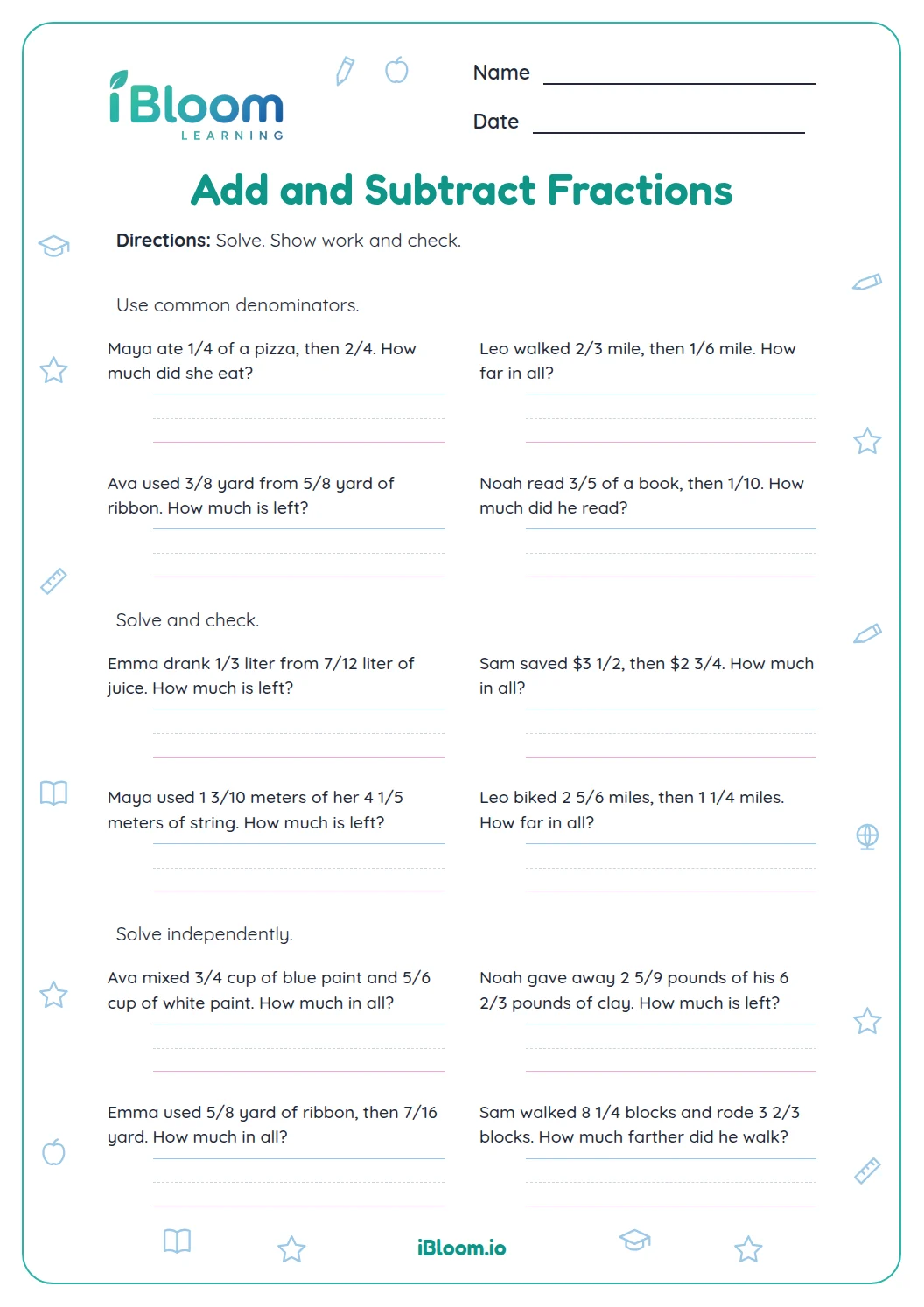
The first part focuses on adding and subtracting fractional amounts. The second part uses multiplication and equal sharing to find amounts for batches, pieces, walks, or groups.
What should learners check?
Check the operation against the story, then check that the denominator and unit make sense. A result for a single equal share should be smaller than the total being shared.
How to use this worksheet
- 1Read what amount the story starts with and what changes.
- 2Choose addition, subtraction, multiplication, or equal sharing from the situation.
- 3Rename fractions with common denominators before adding or subtracting.
- 4Multiply the numerator by the whole number, then simplify if useful.
- 5Write the unit named in the story.
Mistakes to watch for
The mistake
Adding fractions with unlike denominators by adding the numerators only.
The fix
Rename them with a common denominator first.
The mistake
Subtracting an amount from the wrong whole.
The fix
Check whether the story removes a part or a fraction of the whole.
The mistake
Leaving off the unit in a story answer.
The fix
Carry the unit from the question into the answer.
Common Core alignment
Multiply fractions and whole numbers to solve real-world problems.
On this sheet: The questions directly practice this skill.
Show the official wordingHide the official wording
Apply and extend previous understandings of multiplication to multiply a fraction or whole number by a fraction.
What to practice next
Make more practice
Further reading
Questions parents and teachers ask
What operations are practiced?
The 14 stories ask learners to add and subtract fractions and multiply fractions by whole numbers. Some questions involve equal sharing. The story context helps identify which operation fits, and the separate answer key includes the requested units. Problems ask for units when a measured amount is found.
Is an answer key included?
Yes. The answer key lists answers for all 14 problems. It includes units such as miles, cups, and yards where the question asks for a measured amount. Use it after the learner finishes a part so the work remains practice first.
Do the problems include unlike denominators?
Yes. Several addition and subtraction problems use different denominators, so learners need equivalent fractions before combining amounts. For example, sixths and thirds can be renamed as sixths. The key gives the resulting fraction for each story. Problems ask for units when a measured amount is found.
How should learners handle equal sharing?
Treat equal sharing as dividing the total fraction into the stated number of equal groups. For example, sharing 4/5 mile across two equal walks means finding half of 4/5. The answer should describe the amount in one group. Problems ask for units when a measured amount is found.
How long will this worksheet take?
About 20 minutes is a useful estimate for 14 word problems, depending on how much work the learner writes. It can also be split into two sittings: addition and subtraction stories first, then multiplication and sharing stories. Problems ask for units when a measured amount is found.