
About this worksheet
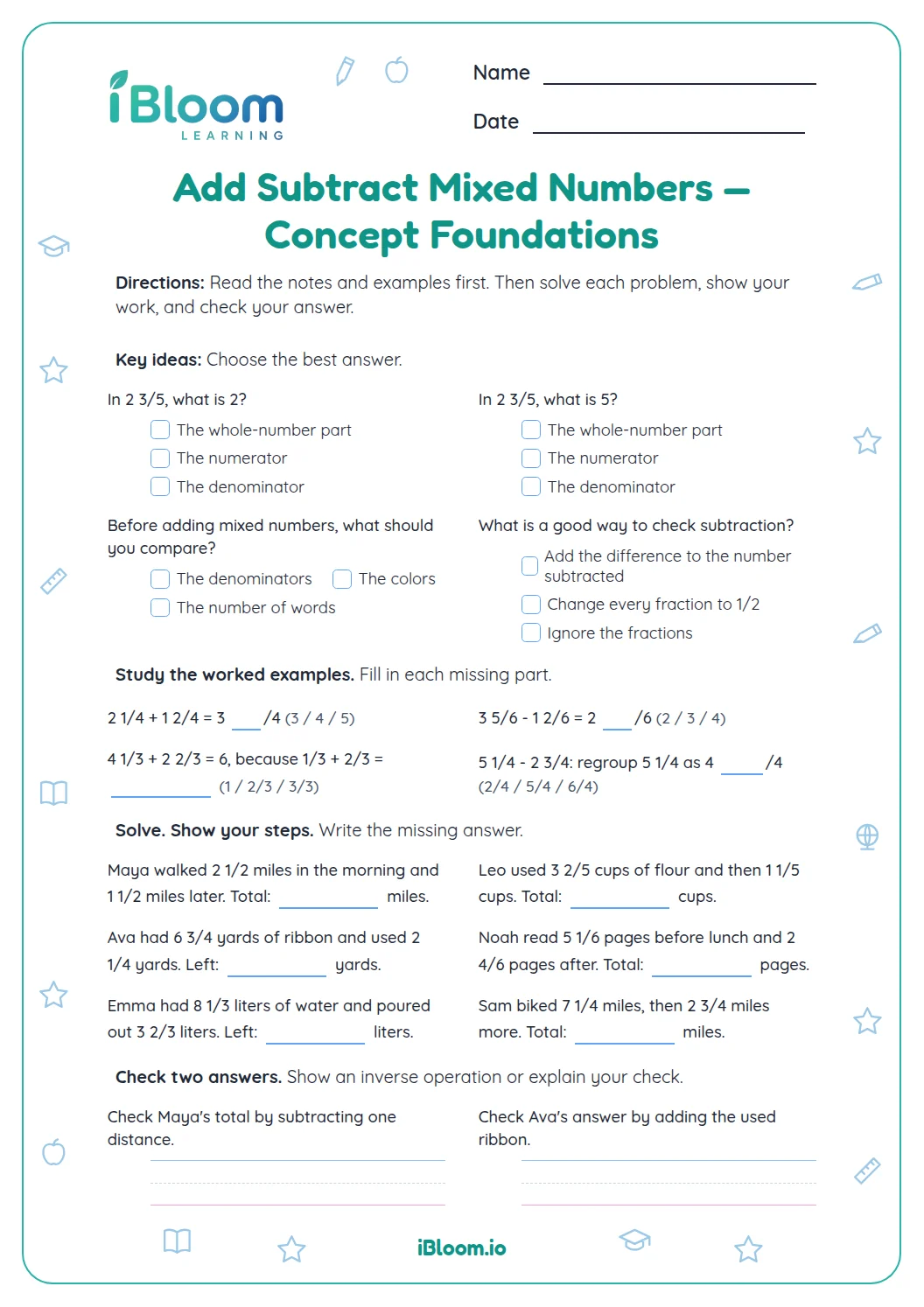
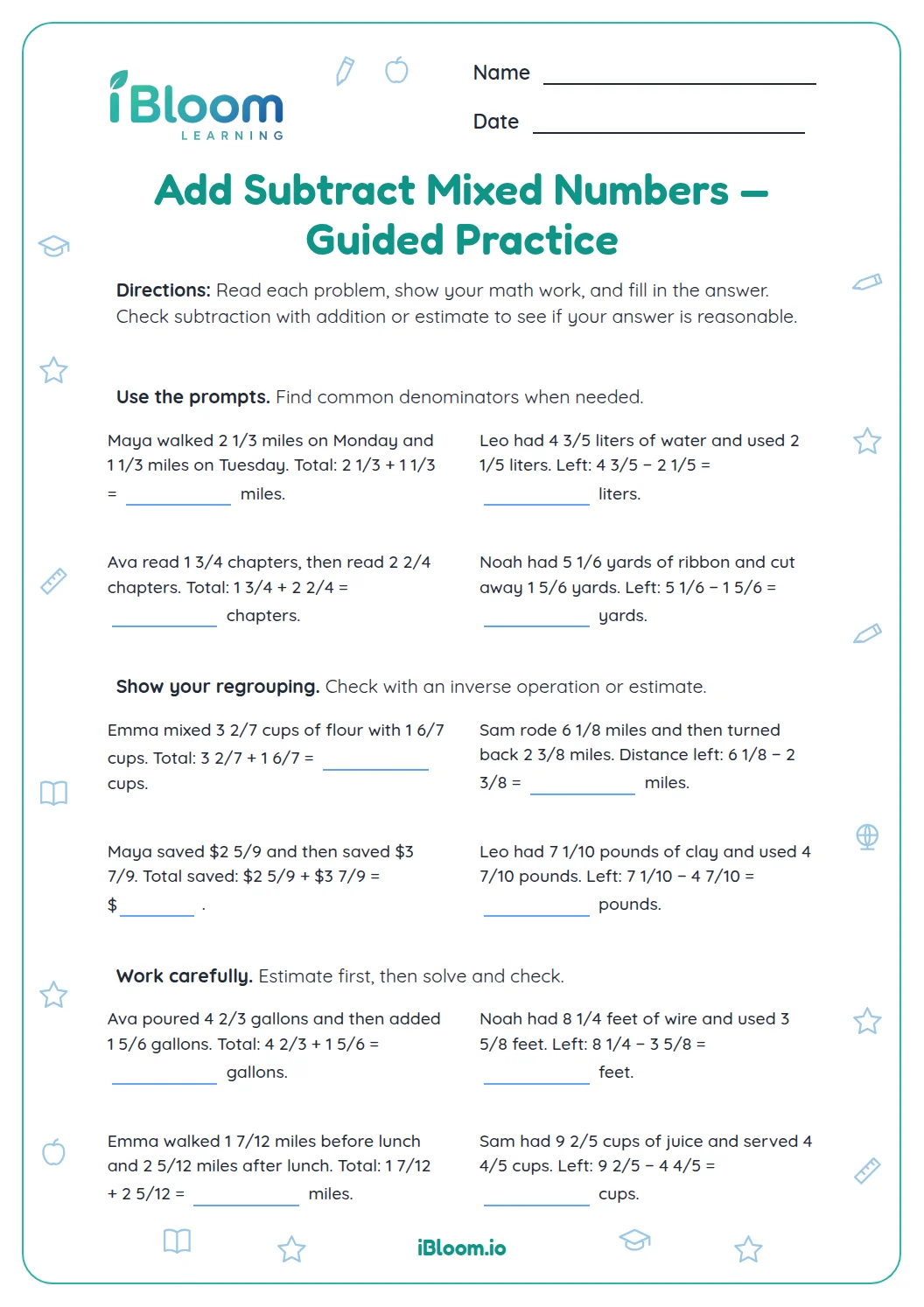
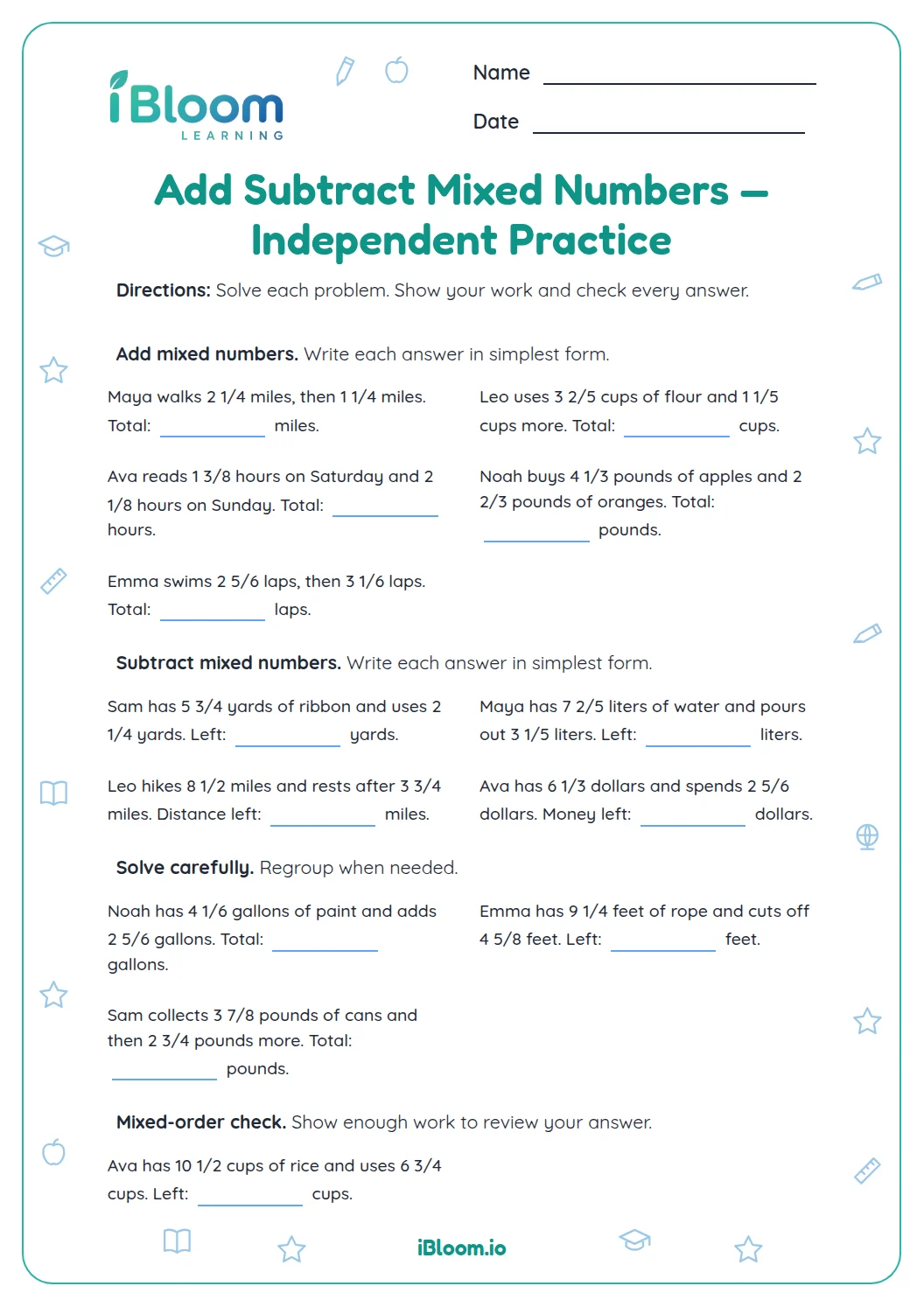
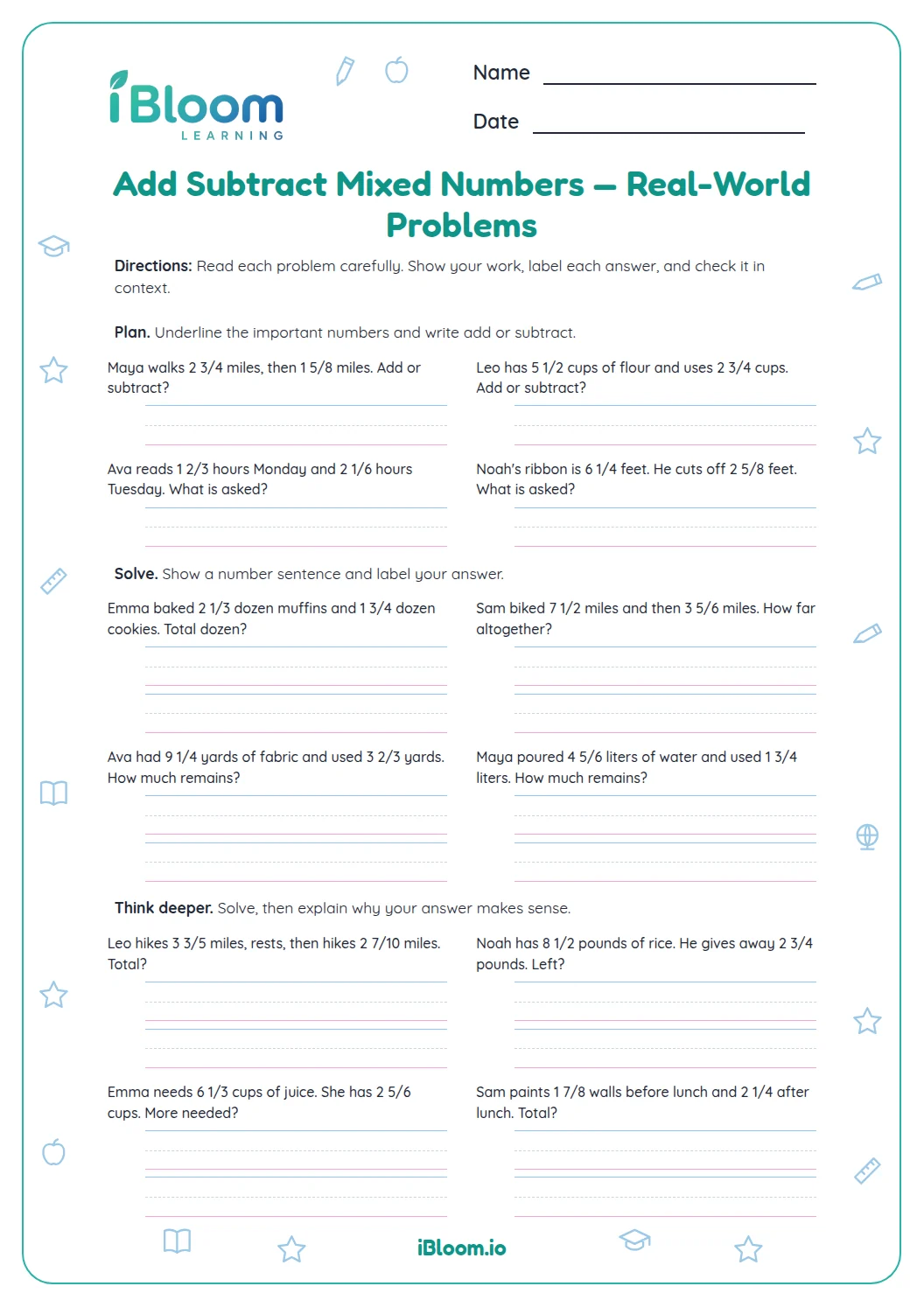
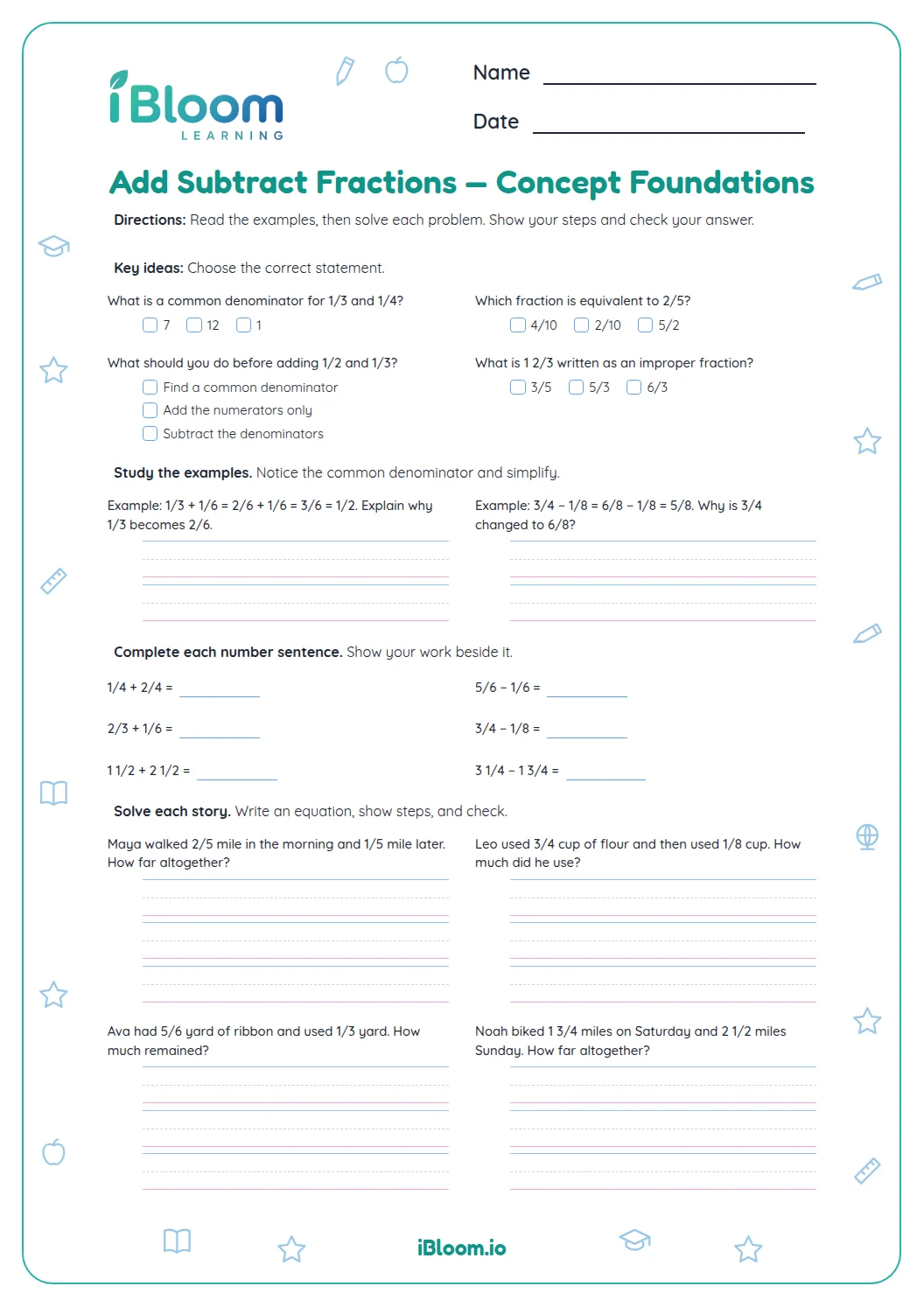
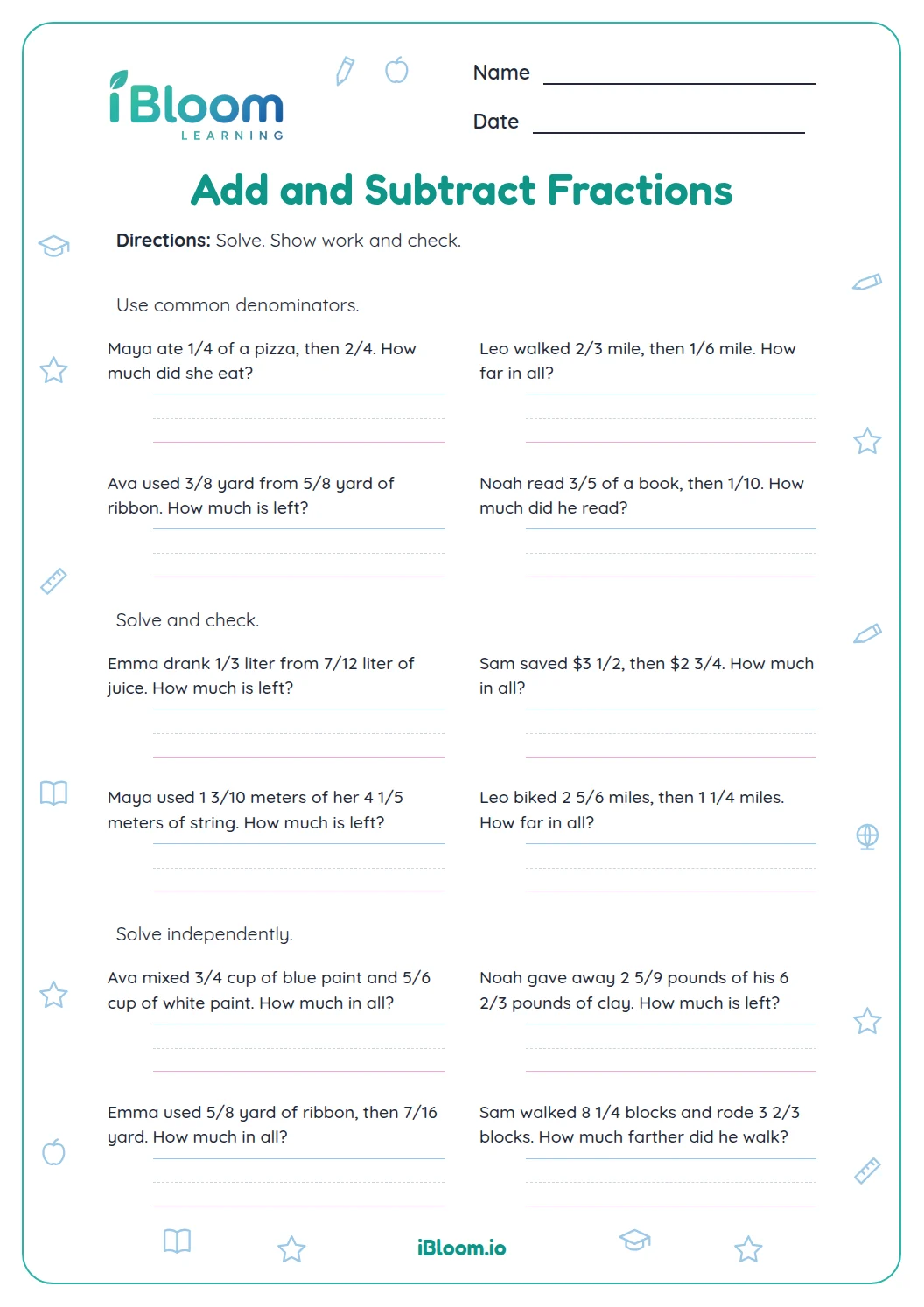
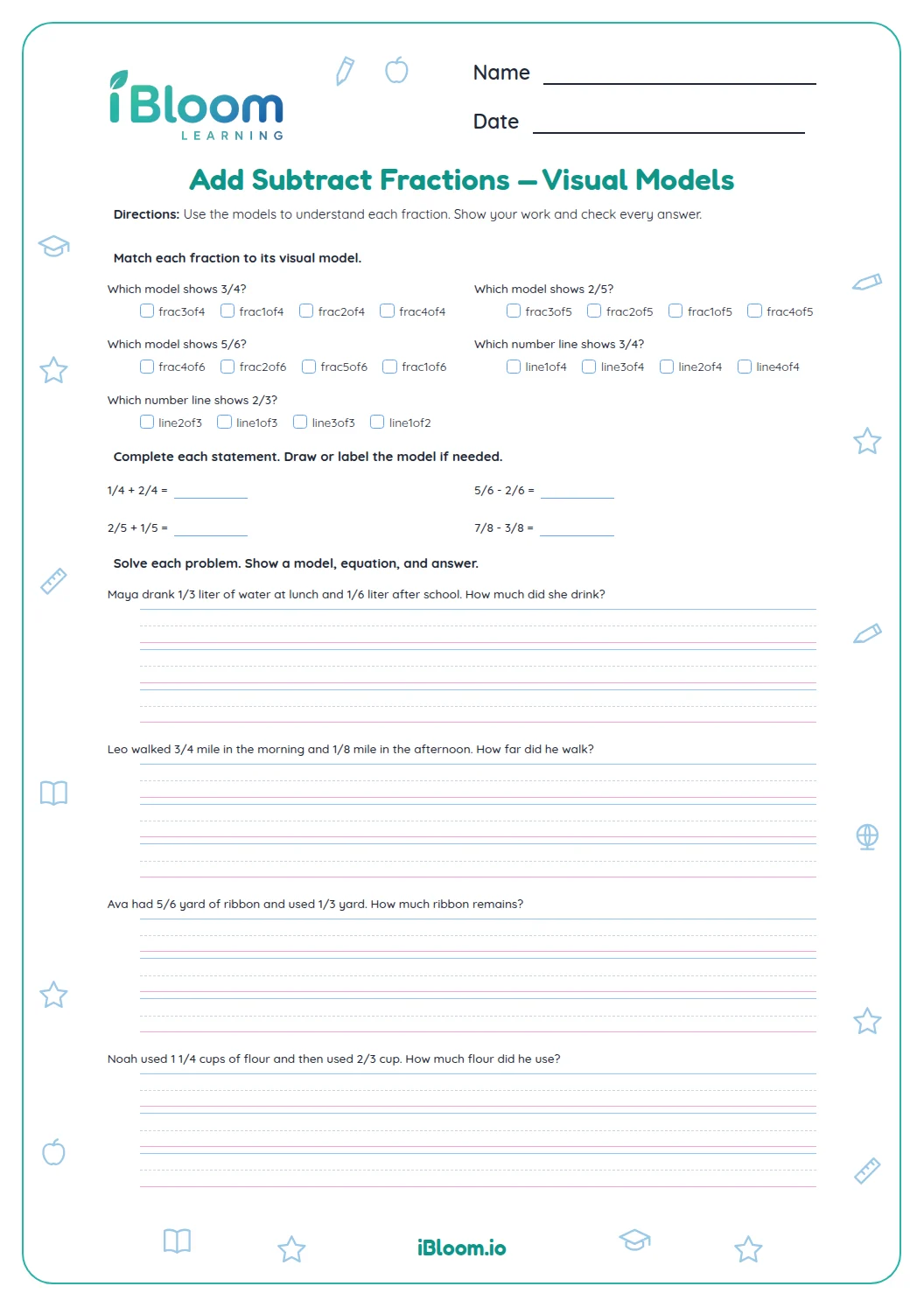
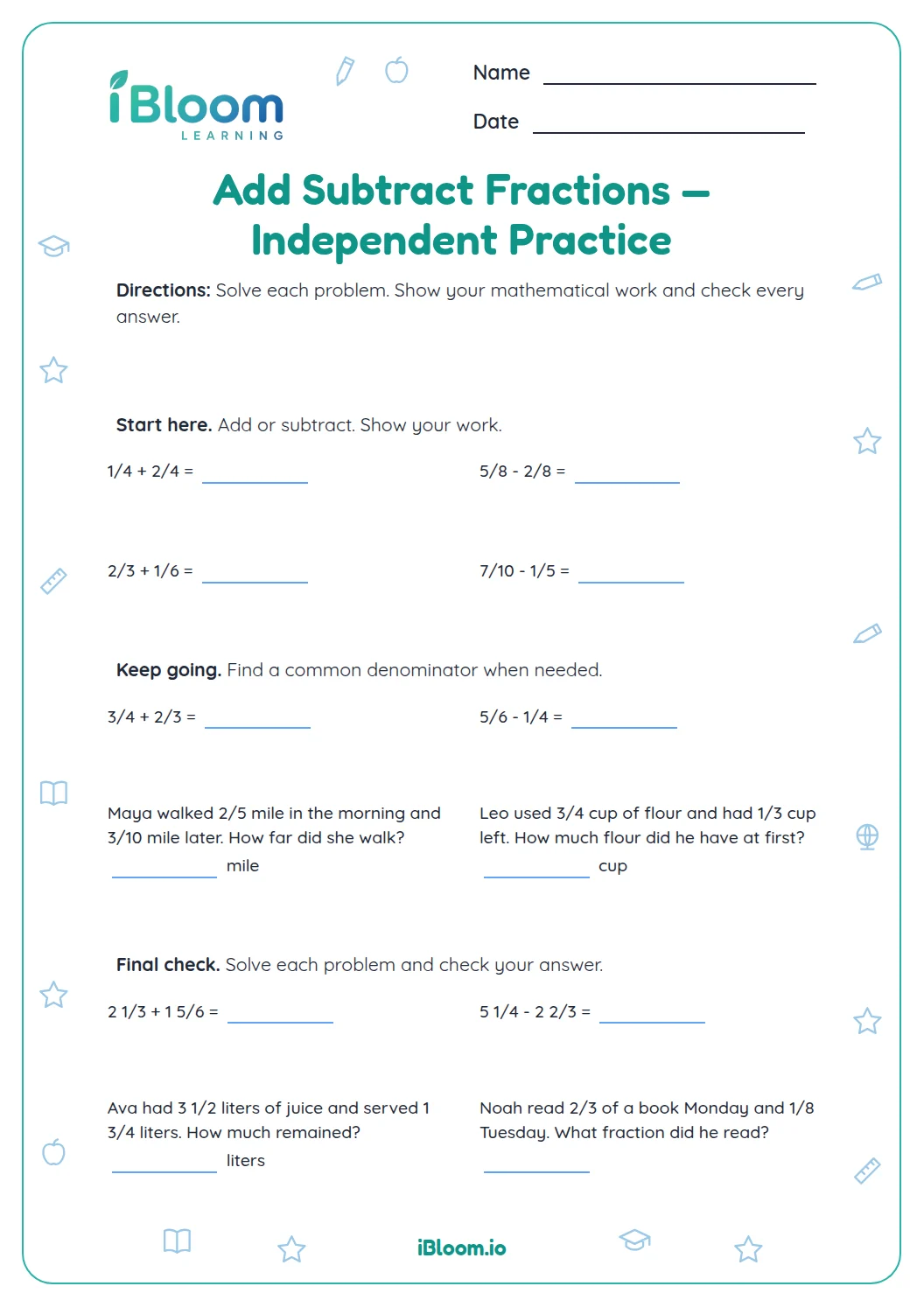
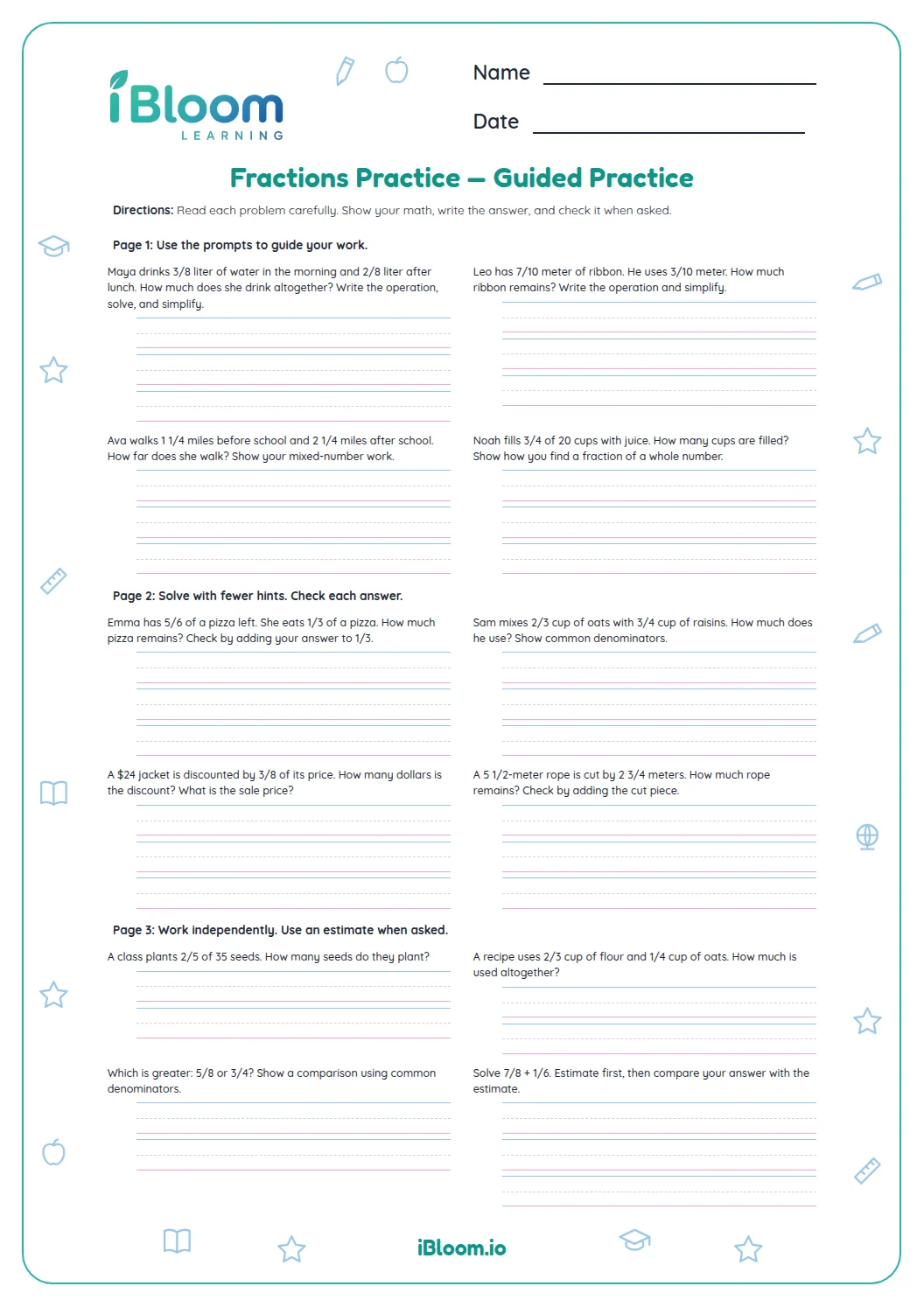
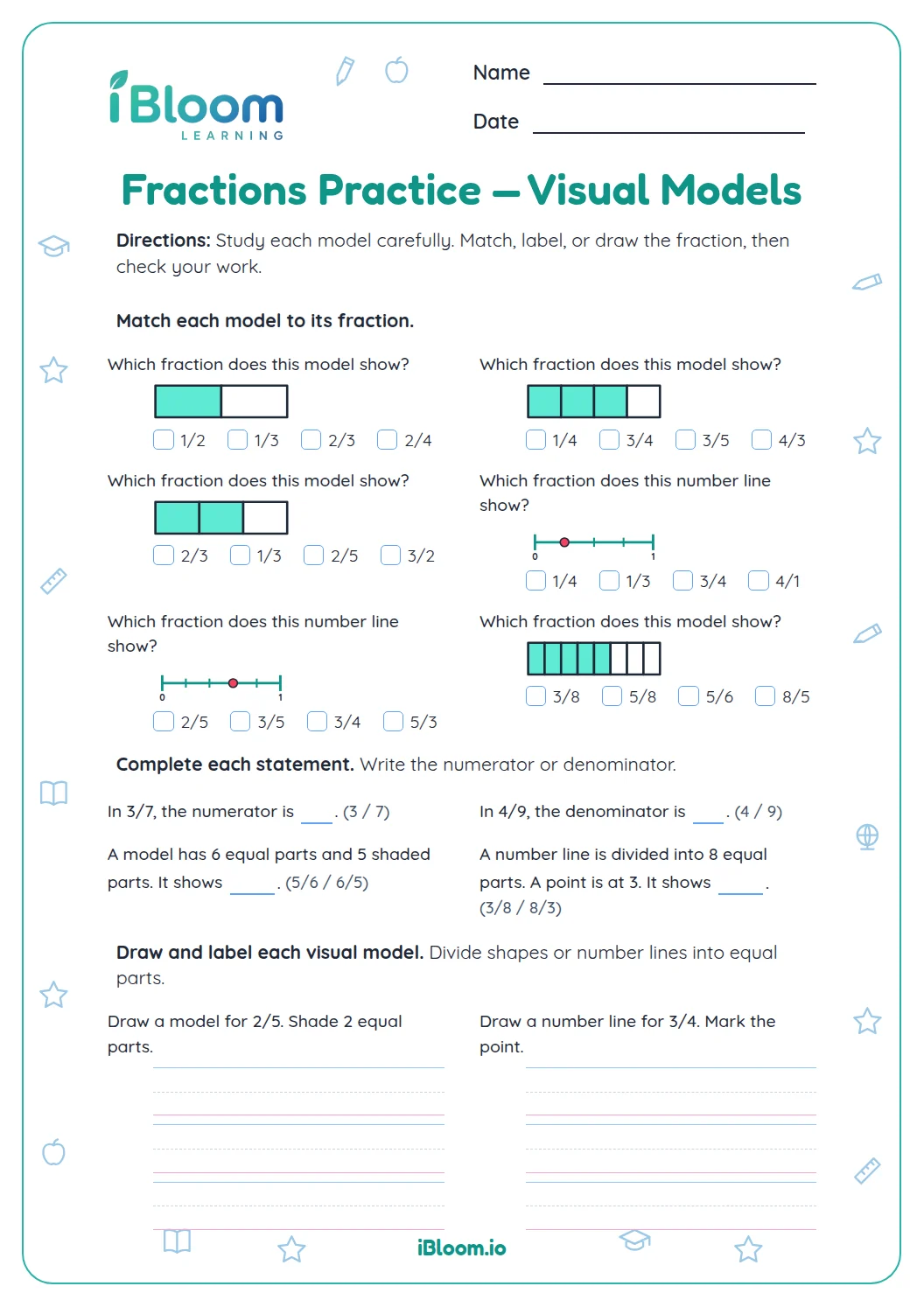
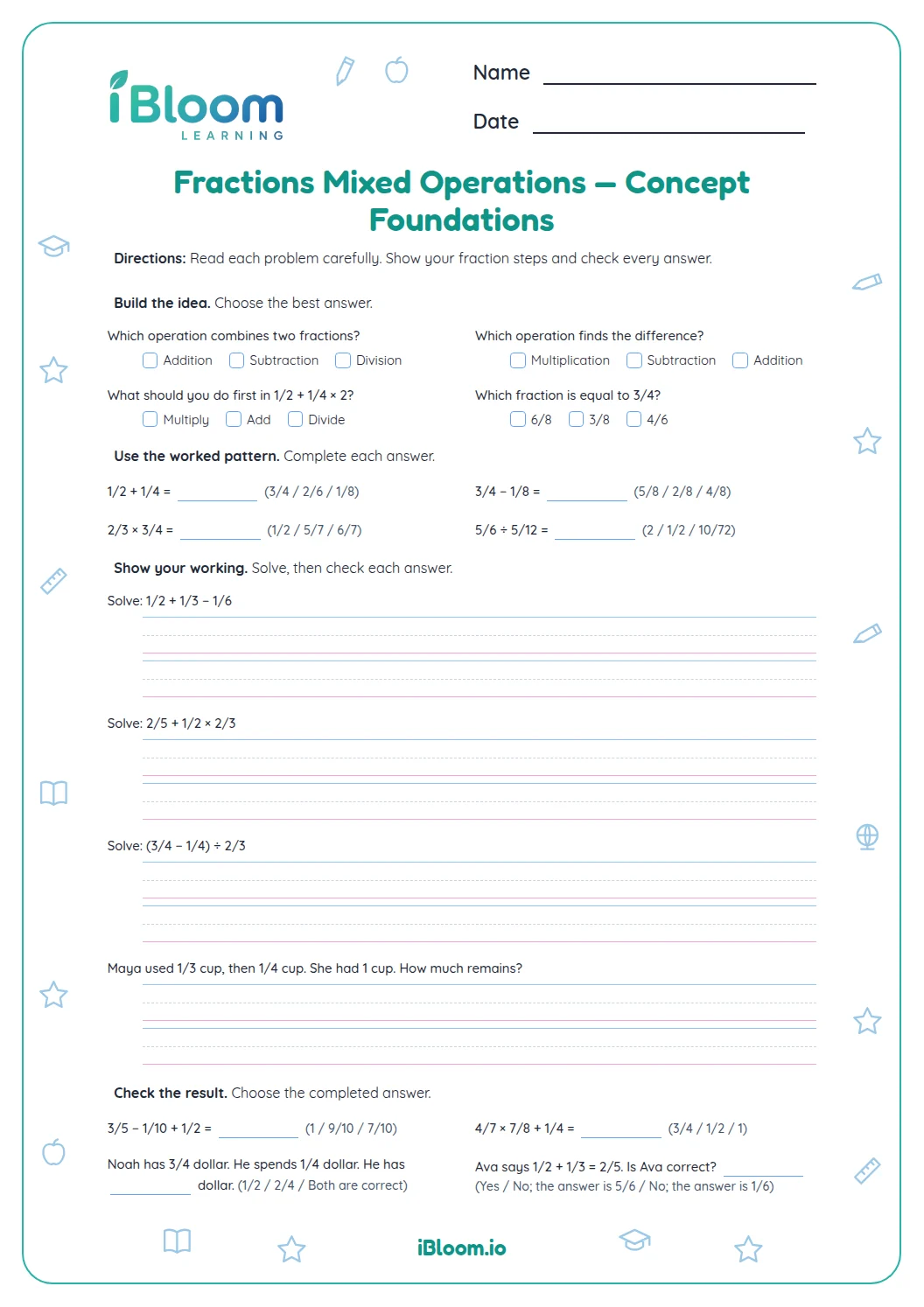
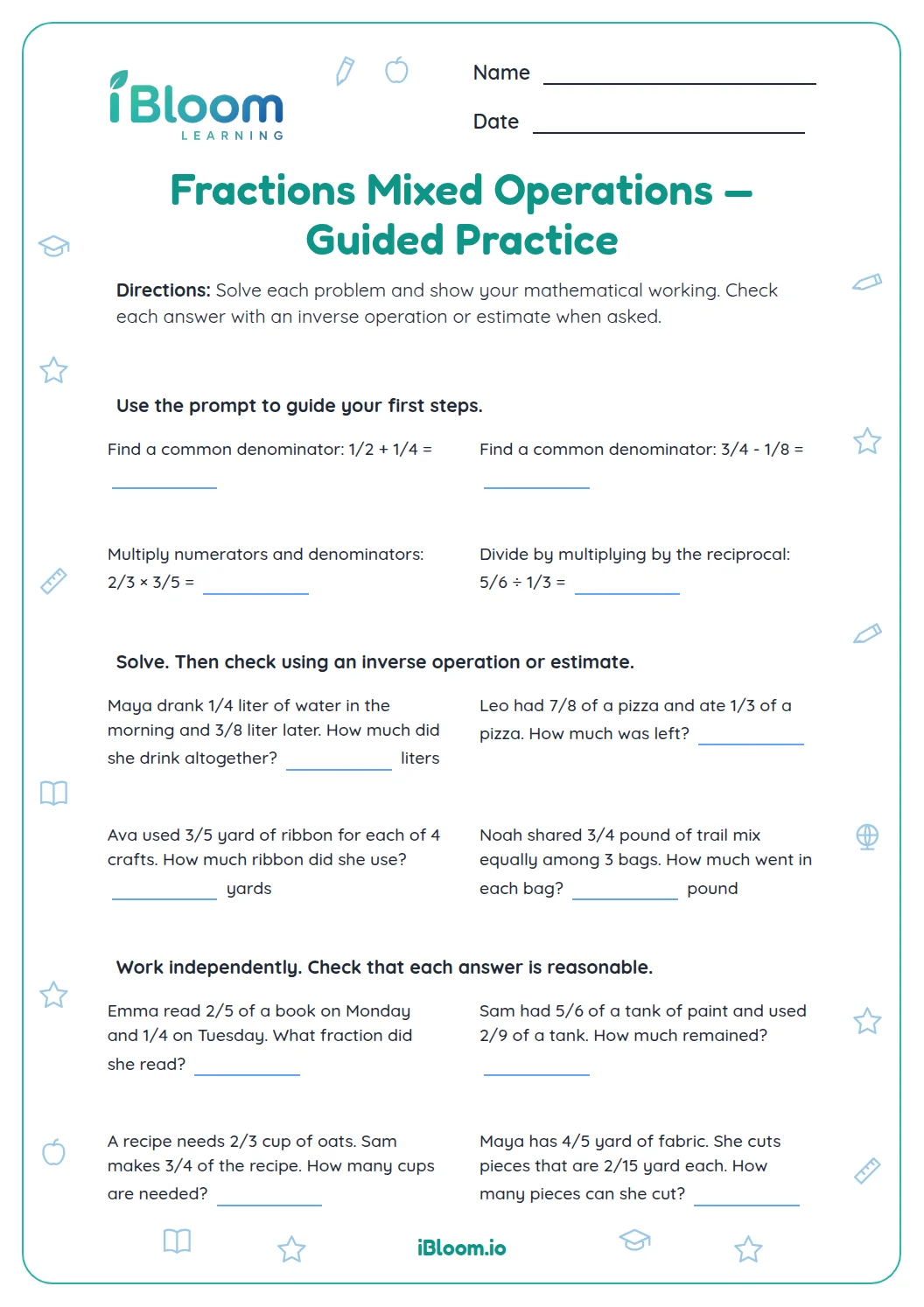
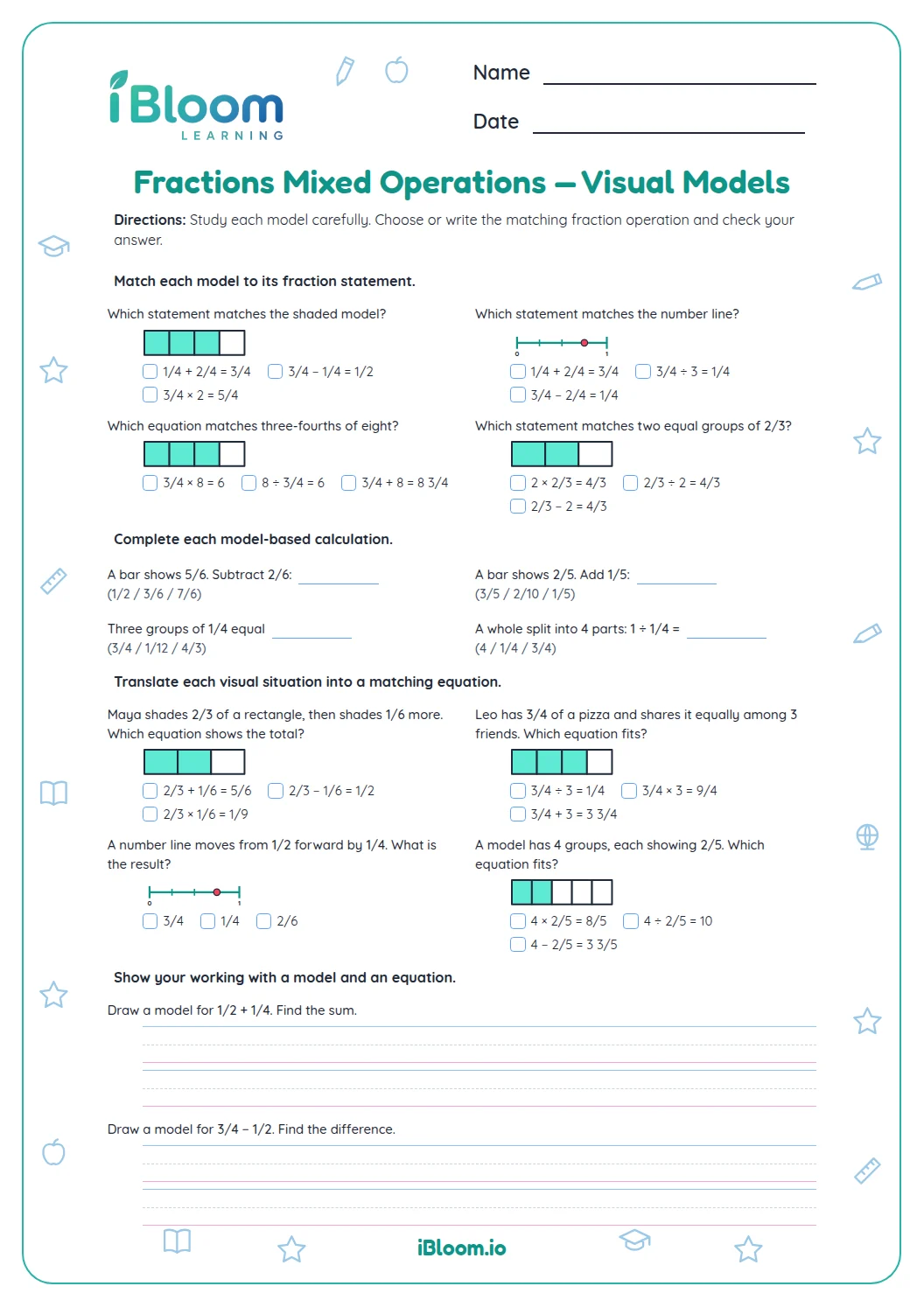
This Grade 5 printable pairs two shaded fraction bars with mixed-number addition and subtraction. Children read two visual models, solve eight calculations, and work through four measurement word problems. The questions use equivalent fractions and regrouping, and a separate answer key includes the results. It practices Common Core 5.NF.A.1 and 5.NF.A.2.
Aligned to 5.NF.A.1 and 5.NF.A.2
How do the visual models show mixed numbers?
A fraction bar shows complete wholes followed by an equal-part bar. Count each fully shaded bar as one, then count the shaded pieces of the last bar. The denominator tells how many equal pieces make that whole.
- 1Two full bars show 2 wholes.
- 2Three of four parts in the last bar are shaded.
- 3Answer: 2 3/4.
How can equivalent fractions help with mixed-number operations?
For unlike denominators, rename the fractional parts with a common denominator before combining them. If subtraction needs more fractional parts than are available, regroup one whole. Keep the whole number and fractional part connected as you calculate.
How do you choose an operation in a story problem?
Look for whether the quantities join, increase, or remain after a part is removed. Write an addition or subtraction equation, compute with equivalent fractions, then include the same unit as the story.
How can children check each answer?
Estimate whether the answer should be larger or smaller than the starting amount, then recompute the fractional parts. Check that the final mixed number is simplified and the unit matches the question.
How to use this worksheet
- 1Count complete shaded bars first.
- 2Name the shaded part using its equal pieces.
- 3Find a common denominator for unlike fractions.
- 4Regroup one whole when subtraction needs it.
- 5Write an equation and include the story unit.
Common mistakes and quick fixes
The mistake
Adding denominators instead of renaming fractions.
The fix
Find a common denominator and rewrite both fractions.
The mistake
Subtracting a smaller fraction without regrouping.
The fix
Rename one whole as fractional parts before subtracting.
The mistake
Leaving the measurement unit off a story answer.
The fix
Carry the unit from the question into the answer.
Common Core alignment
This practice connects each item to a clear grade-level language or math goal.
Add and subtract fractions, including mixed numbers, using equivalent fractions.
On this sheet: The computation and visual-model questions add and subtract mixed numbers with unlike fractional parts.
Show the official wordingHide the official wording
Add and subtract fractions with unlike denominators (including mixed numbers) by replacing given fractions with equivalent fractions in such a way as to produce an equivalent sum or difference of fractions with like denominators. For example, 2/3 + 5/4 = 8/12 + 15/12 = 23/12. (In general, a/b + c/d = (ad + bc)/bd.)
Solve mixed-number story problems with equations or visual models.
On this sheet: The story problems use measures of the same kind and ask for mixed-number sums or differences.
Show the official wordingHide the official wording
Solve word problems involving addition and subtraction of fractions referring to the same whole, including cases of unlike denominators, e.g., by using visual fraction models or equations to represent the problem. Use benchmark fractions and number sense of fractions to estimate mentally and assess the reasonableness of answers. For example, recognize an incorrect result 2/5 + 1/2 = 3/7, by observing that 3/7 < 1/2.
What to practice next
Make more practice
Further reading
Questions parents and teachers ask
How do visual models represent mixed numbers?
Each fully shaded bar represents one whole. The shaded equal parts in the last bar show the fraction, so question 1 has two full bars and three of four parts shaded: 2 3/4. This page has two model-reading questions, followed by calculations and measurement stories.
How do you add mixed numbers with unlike denominators?
Rename each fractional part with a common denominator, then add the fractions and whole numbers. For example, 2 1/3 + 1 1/6 becomes 2 2/6 + 1 1/6, or 3 3/6, which simplifies to 3 1/2. Question 3 uses these steps to combine thirds and sixths before writing the sum as a mixed number.
How do you subtract when the first fraction is smaller?
Regroup one whole as fractional parts, then subtract using like denominators. For 4 1/4 − 2 2/3, rename fourths and thirds in twelfths, regroup, and subtract to get 1 7/12. Question 4 uses regrouping because one fourth is less than two thirds; renaming the whole makes the subtraction possible.
What units appear in the story problems?
The four stories use miles, yards, liters, and feet. Each asks children to add two mixed amounts or find what remains after a subtraction. Include the same unit in the final answer so it answers the story, as in 3 11/12 miles for question 11.
What is one story problem example?
Question 11 combines Nina’s 2 1/4 miles before lunch with 1 2/3 miles after lunch. Rename the fractional parts in twelfths: 2 3/12 + 1 8/12 = 3 11/12. The total distance is 3 11/12 miles, as shown in the answer key.
How many questions and pages are included?
There are 14 questions: two shaded fraction-model readings, eight mixed-number calculations, and four measurement stories. The worksheet prints on two pages, and its separate answer key also uses two pages. Children can check the computation and the measurement unit in each story answer.