


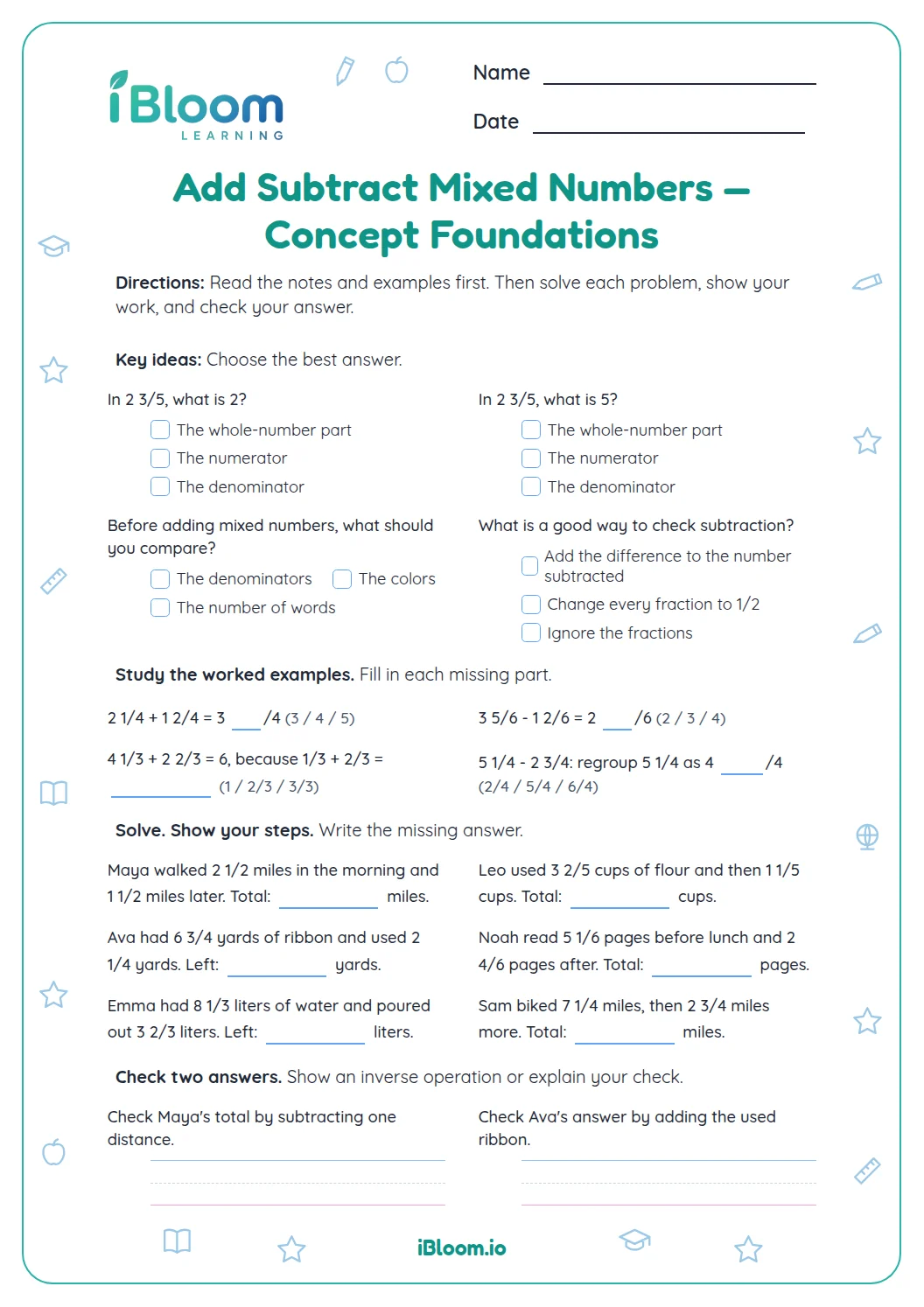
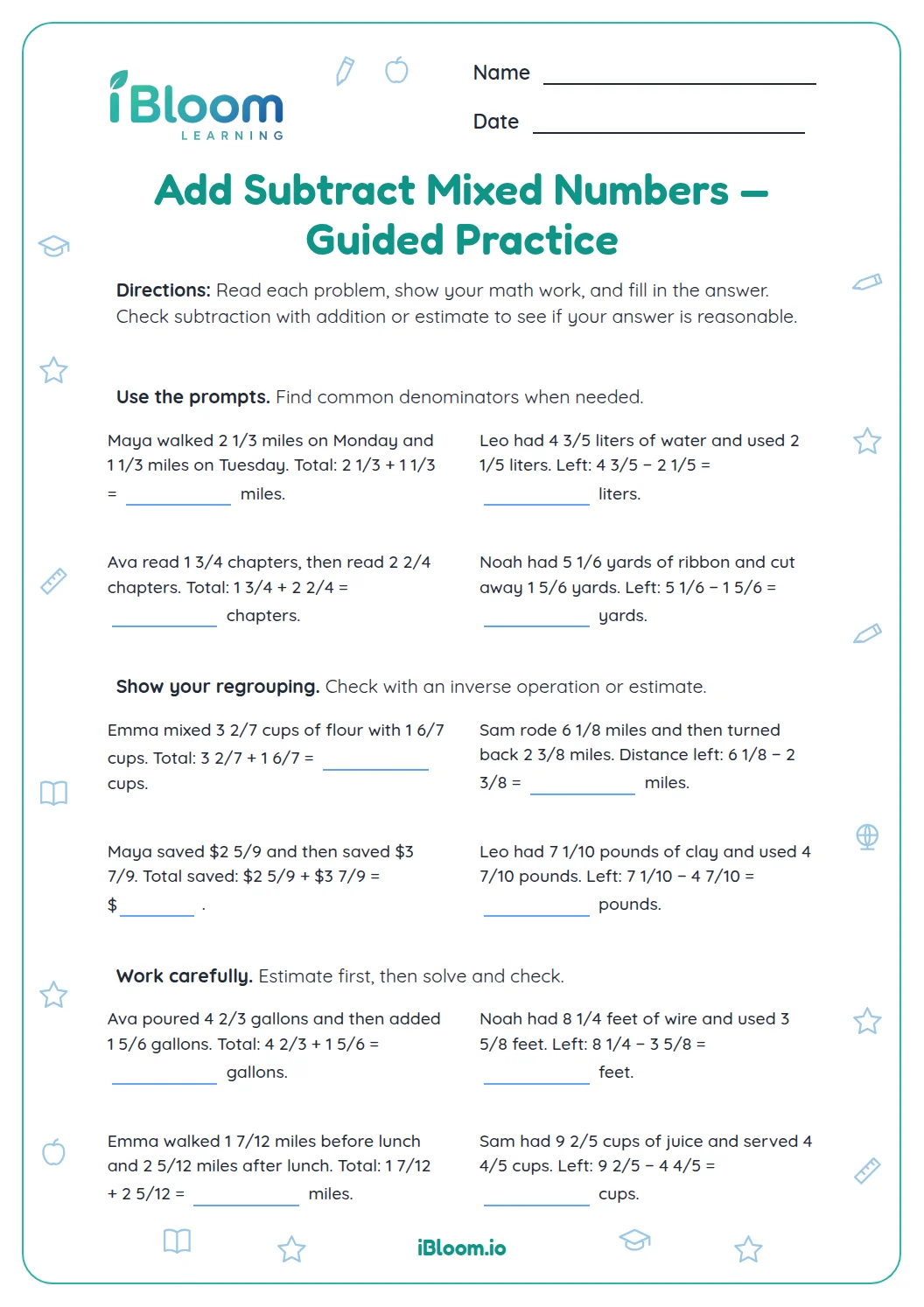
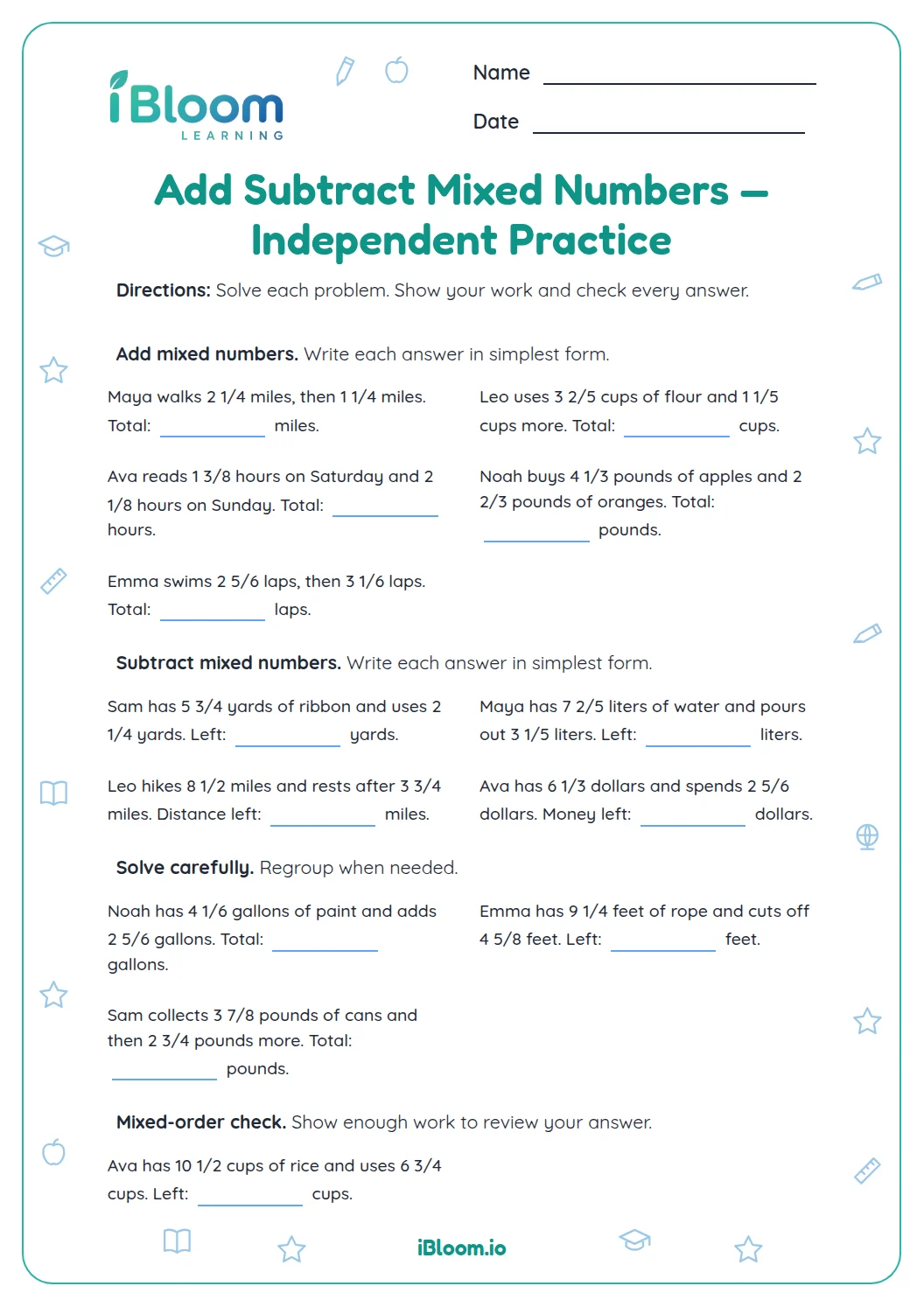
About this worksheet
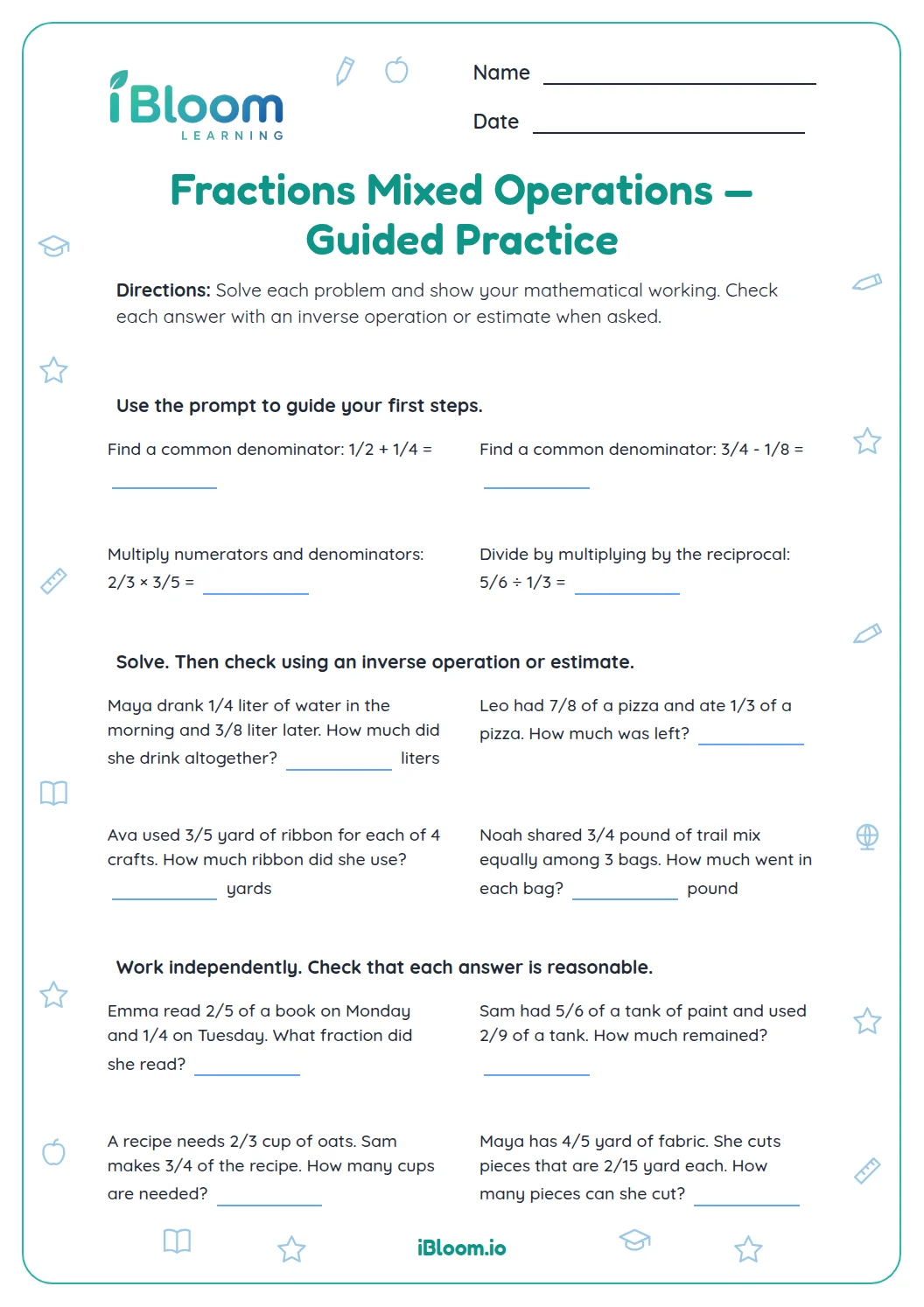
This printable Grade 5 worksheet practices fraction operations in everyday word problems. Its 15 fill-in questions move from multiplication to division and comparison, then to stories combining operations. The answer key lists the missing amount or count for each problem.
Aligned to 5.NF.B.4.a and 5.NF.B.7
How does fraction operations word problems work?
Read what is happening before choosing an operation. Multiplication can find a fractional amount or repeated groups; division can find an equal share or count how many groups fit.
The three parts move from multiplication to division and comparison, then to stories that combine operations.
- 1A recipe uses 1/2 cup of oats per batch. For 3 batches: ___ cups.
- 2Multiply 1/2 × 3 = 3/2, or 1 1/2 cups.
What will learners practice on this sheet?
The 15 stories use multiplication, division, addition, and subtraction. Each prompt leaves a blank for the amount or count that answers the story.
How can a learner check the answers?
Check that the number you wrote fits the story and uses the stated unit. The separate answer key lists each missing value.
How to use this worksheet
- 1Read the whole story and identify what it asks you to find.
- 2Decide whether the story describes groups, a fraction of an amount, or equal sharing.
- 3Solve and write the missing amount or count in the blank.
- 4Keep any unit printed after the blank with your answer.
- 5Check the answers and redo any story where the operation did not match.
Common mistakes and quick fixes
The mistake
Adding the fraction when the story describes equal groups.
The fix
For 3 batches at 1/2 cup each, multiply 1/2 by 3.
The mistake
Dividing by the number of groups when finding the total for repeated batches.
The fix
Check whether the question asks for the total or one equal share.
The mistake
Leaving a word-problem answer without its unit.
The fix
Use the unit named in the story, such as cups, miles, or pounds.
Common Core alignment
This worksheet practices the following Common Core skill.
Multiply a fraction or whole number by a fraction in a story context.
On this sheet: Learners multiply fractions and whole numbers to solve fraction word problems.
Show the official wordingHide the official wording
Interpret the product (a/b) × q as a parts of a partition of q into b equal parts; equivalently, as the result of a sequence of operations a × q ÷ b.
Solve real-world problems that divide unit fractions by whole numbers and whole numbers by unit fractions.
On this sheet: Learners divide quantities into equal fraction-sized groups in context.
Show the official wordingHide the official wording
Apply and extend previous understandings of division to divide unit fractions by whole numbers and whole numbers by unit fractions.
What to practice next
Make more practice
Further reading
Questions parents and teachers ask
What operations appear in these fraction stories?
The 15 stories use multiplication, division, addition, and subtraction, including equal sharing. Learners read the situation, choose an operation, and fill in the missing amount or count. A separate key lists the expected values. Have the learner name the story detail that supports the operation and answer.
How many problems are included?
There are 15 fill-in word problems in three parts. The first focuses on multiplication, the second on division and comparison, and the third combines operations in familiar situations. Each blank asks for an amount or count. Have the learner name the story detail that supports the operation and answer.
Is an answer key included?
Yes. The separate answer key lists the missing value for each of the 15 problems. Check that the number answers the story and that any unit in the prompt is included in the response. Have the learner name the story detail that supports the operation and answer.
How can I tell whether to multiply or divide?
Ask what the story wants. Finding the total for several equal batches calls for multiplication; splitting a quantity into equal shares calls for division. Counting how many fraction-sized pieces fit is also a division situation. Have the learner name the story detail that supports the operation and answer.
Should answers be simplified?
Write a fraction in simplest form when possible, and use a mixed number for an improper fraction when it makes the amount clearer. The unit is printed after the blank whenever the story gives one, such as cups, yards, or pounds.