



About this worksheet
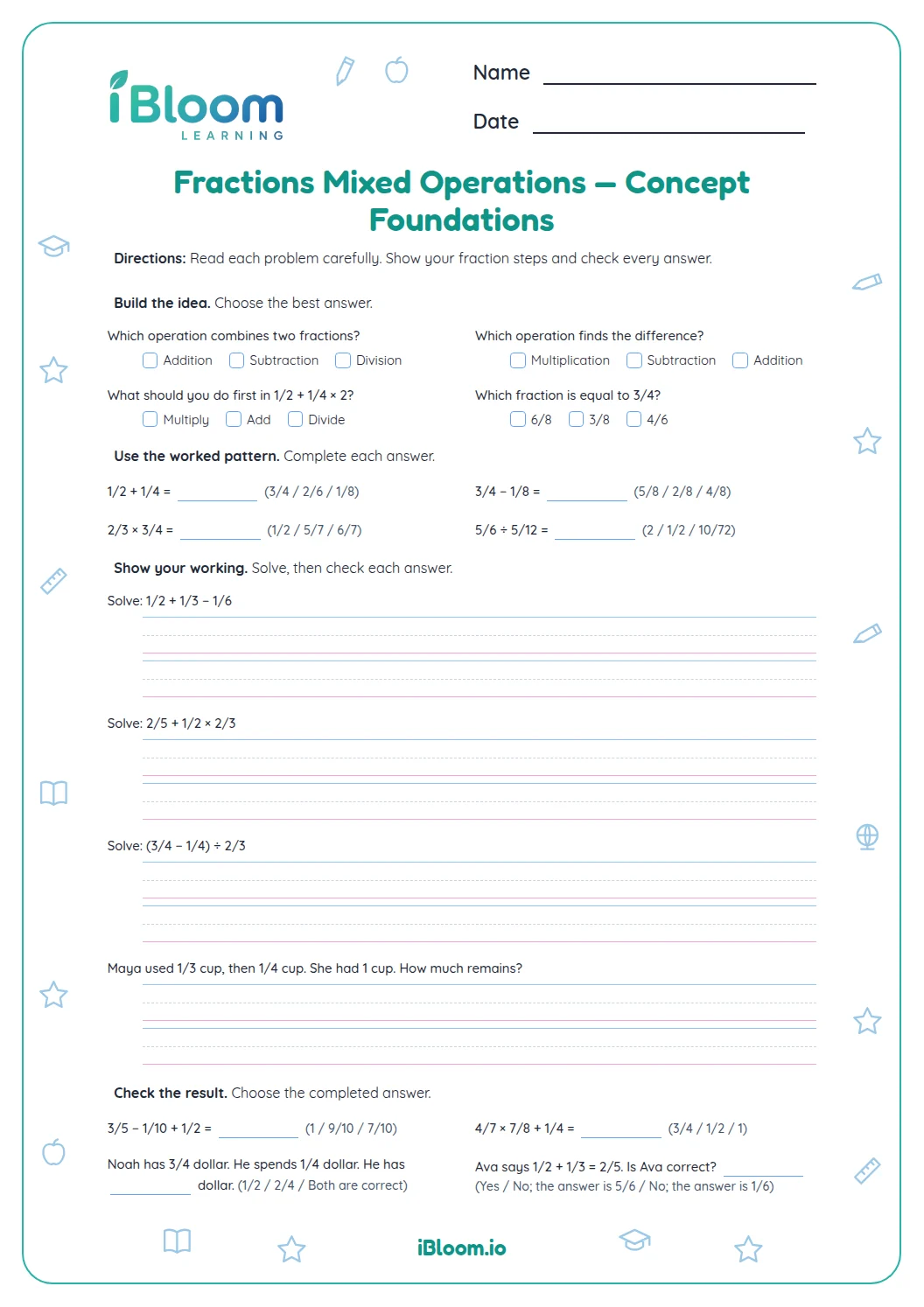
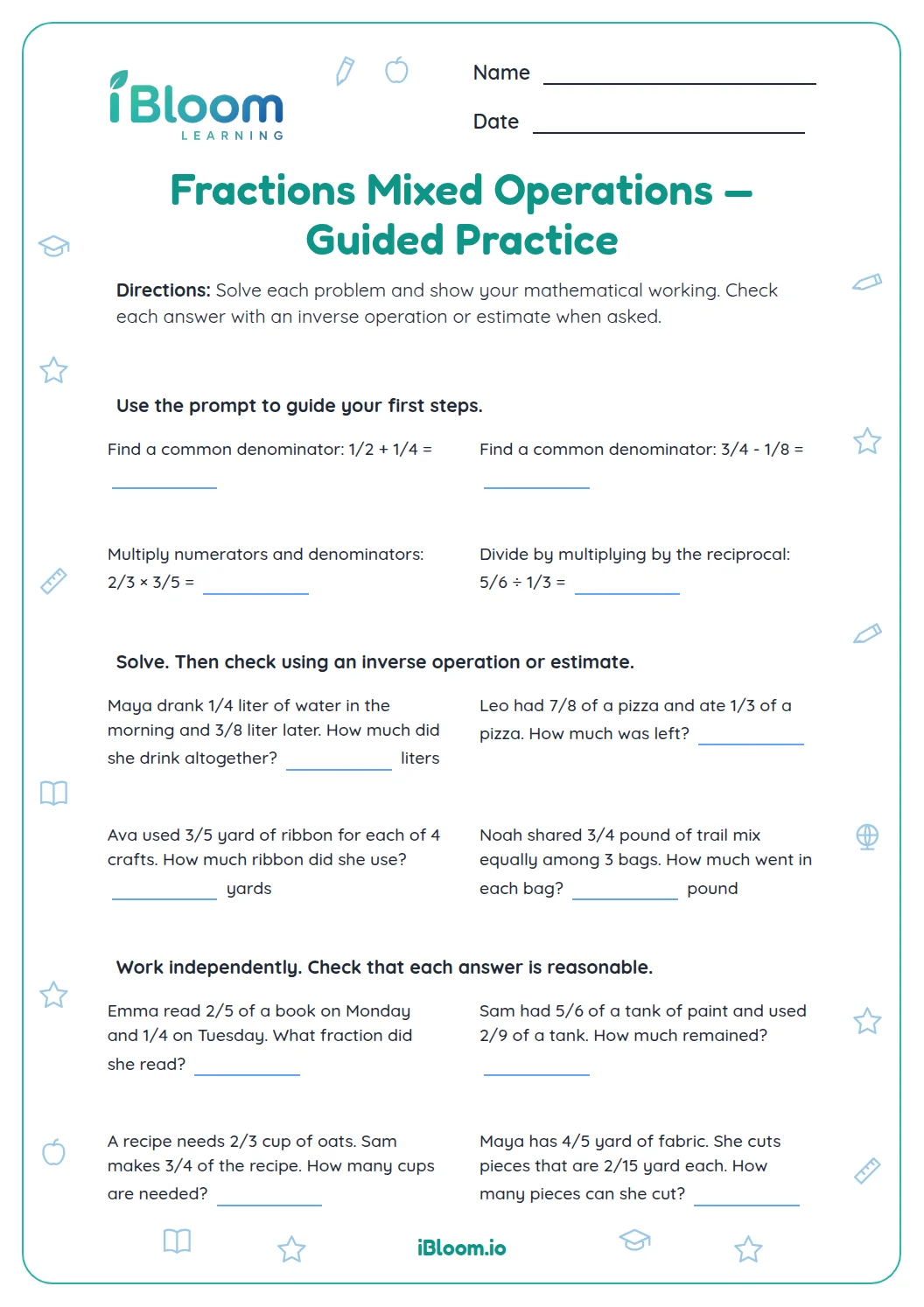
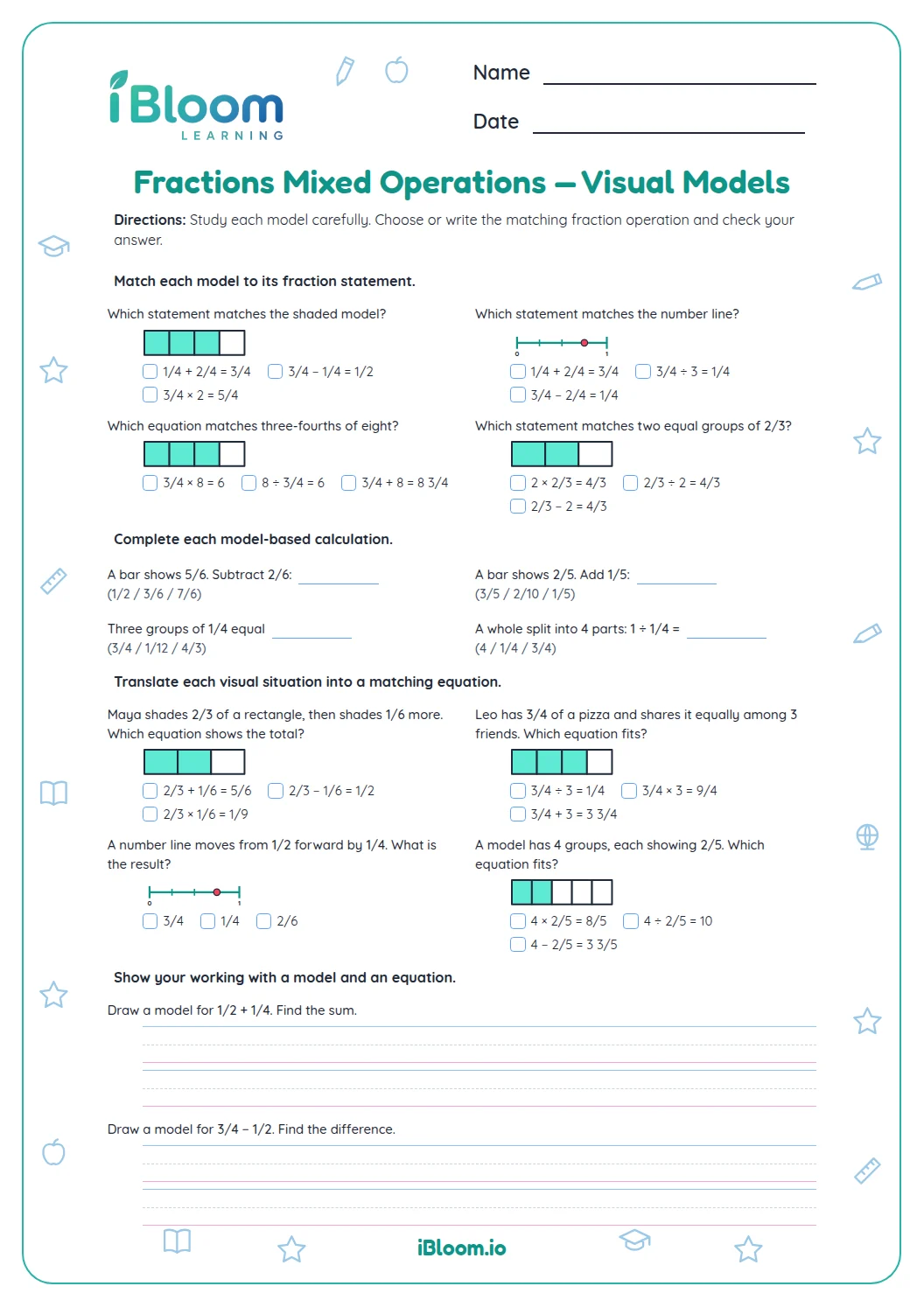
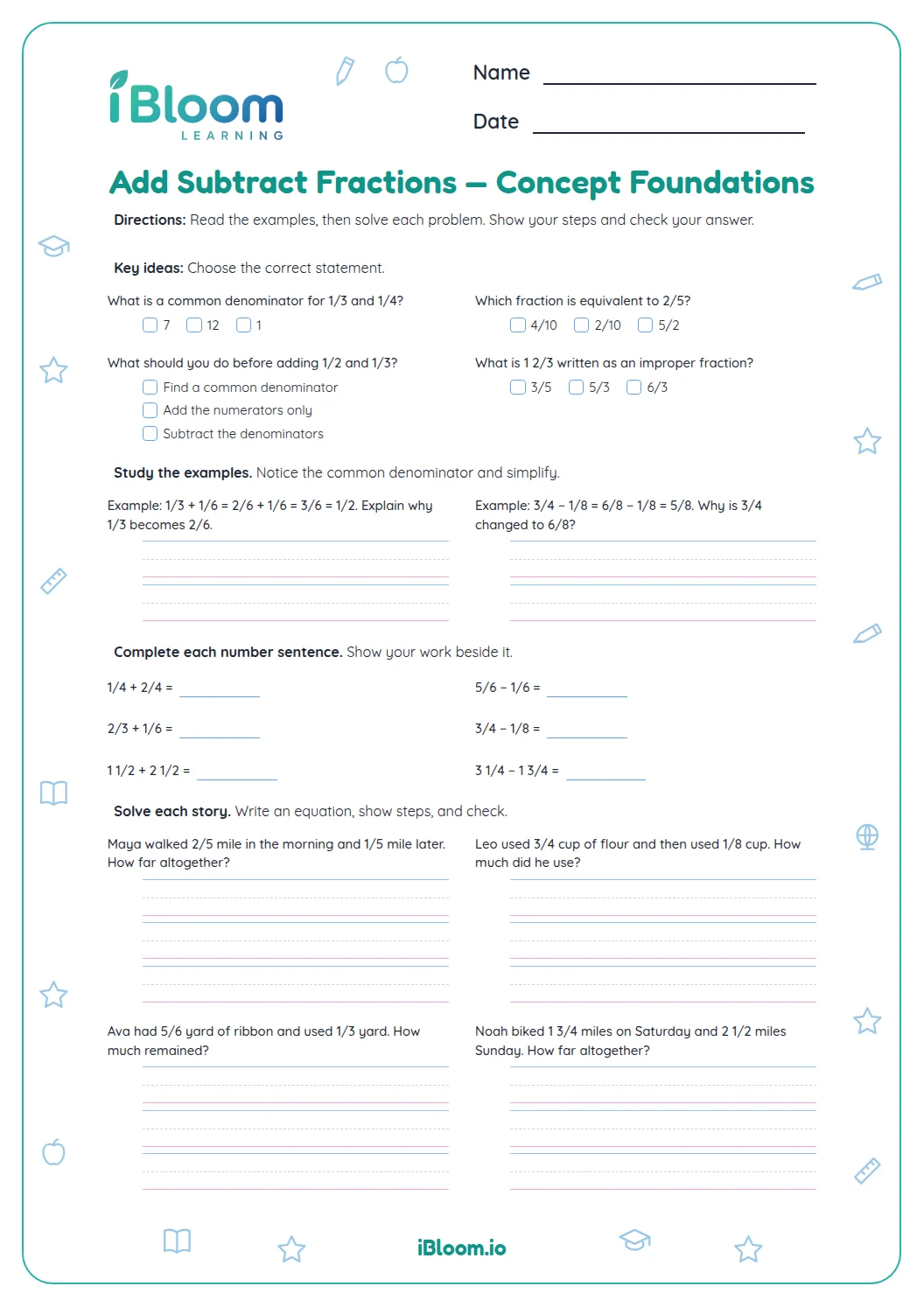
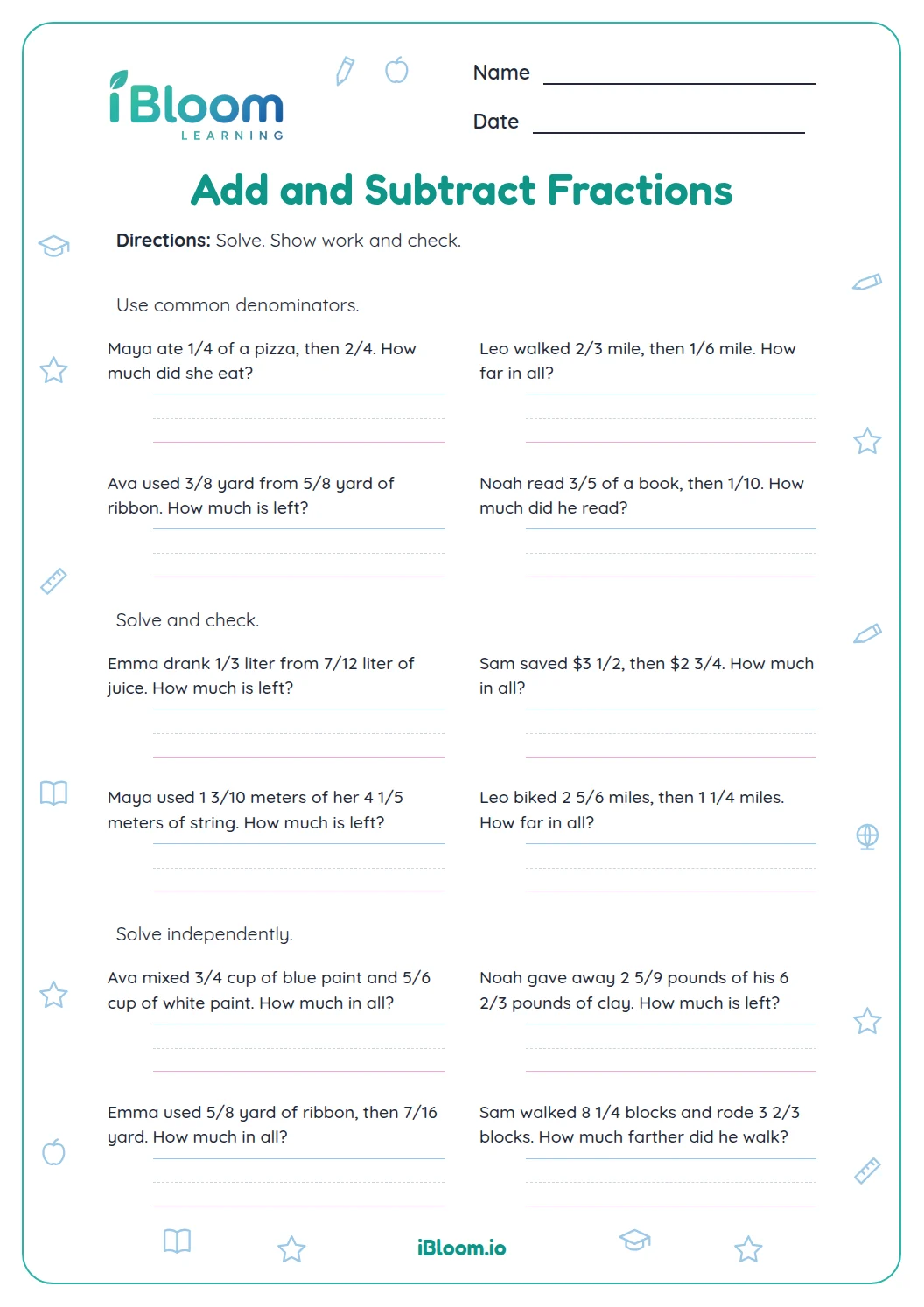
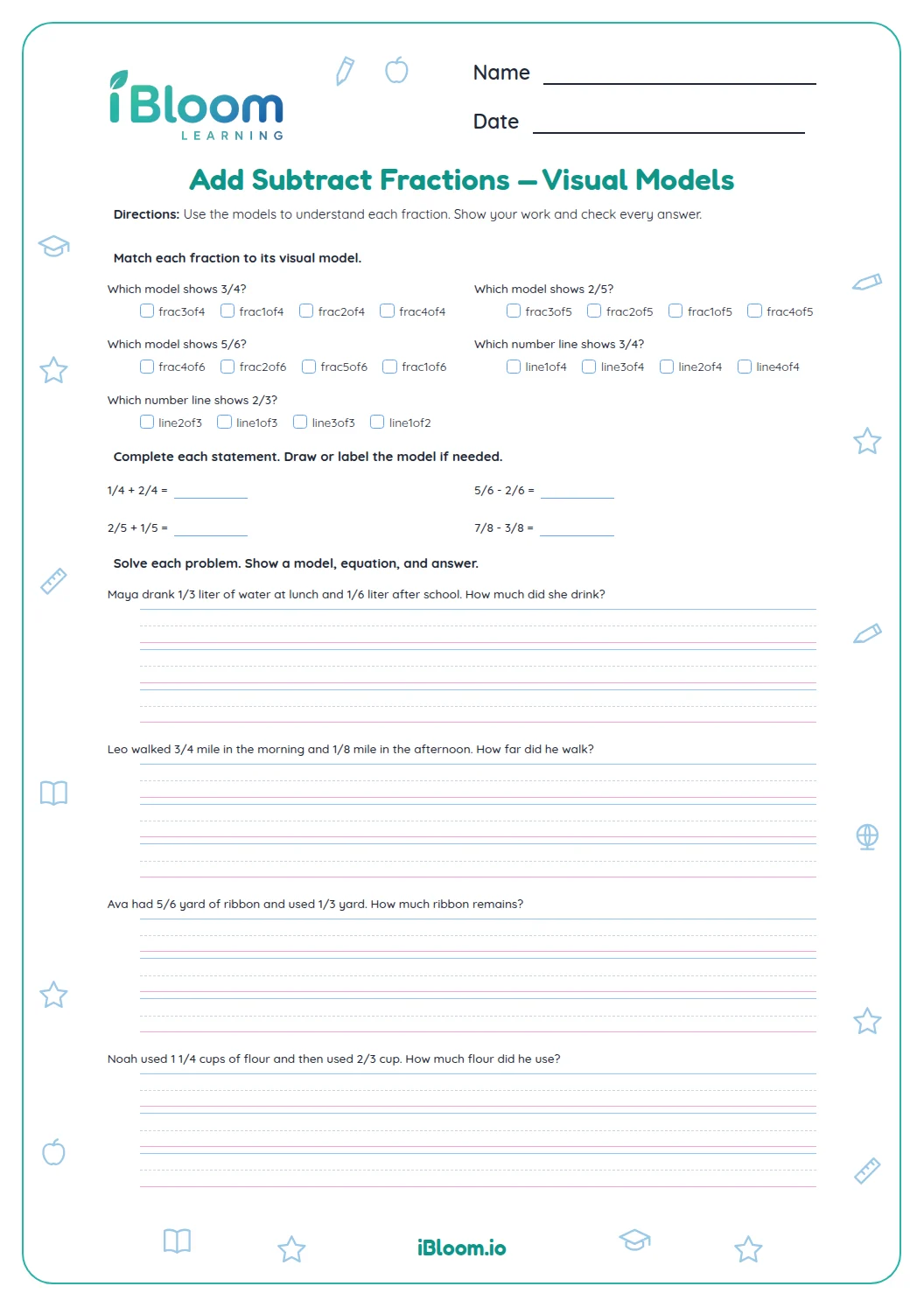
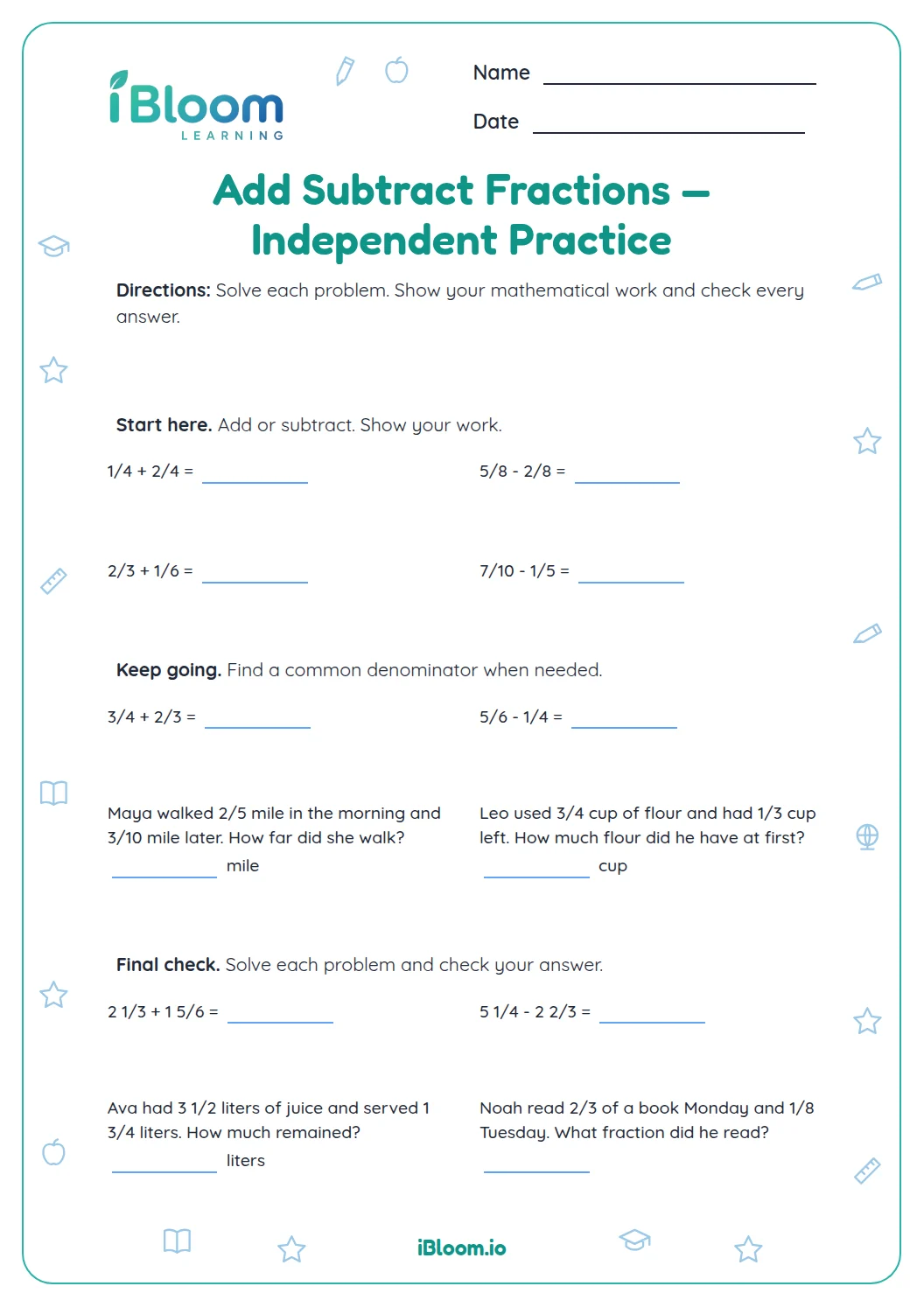
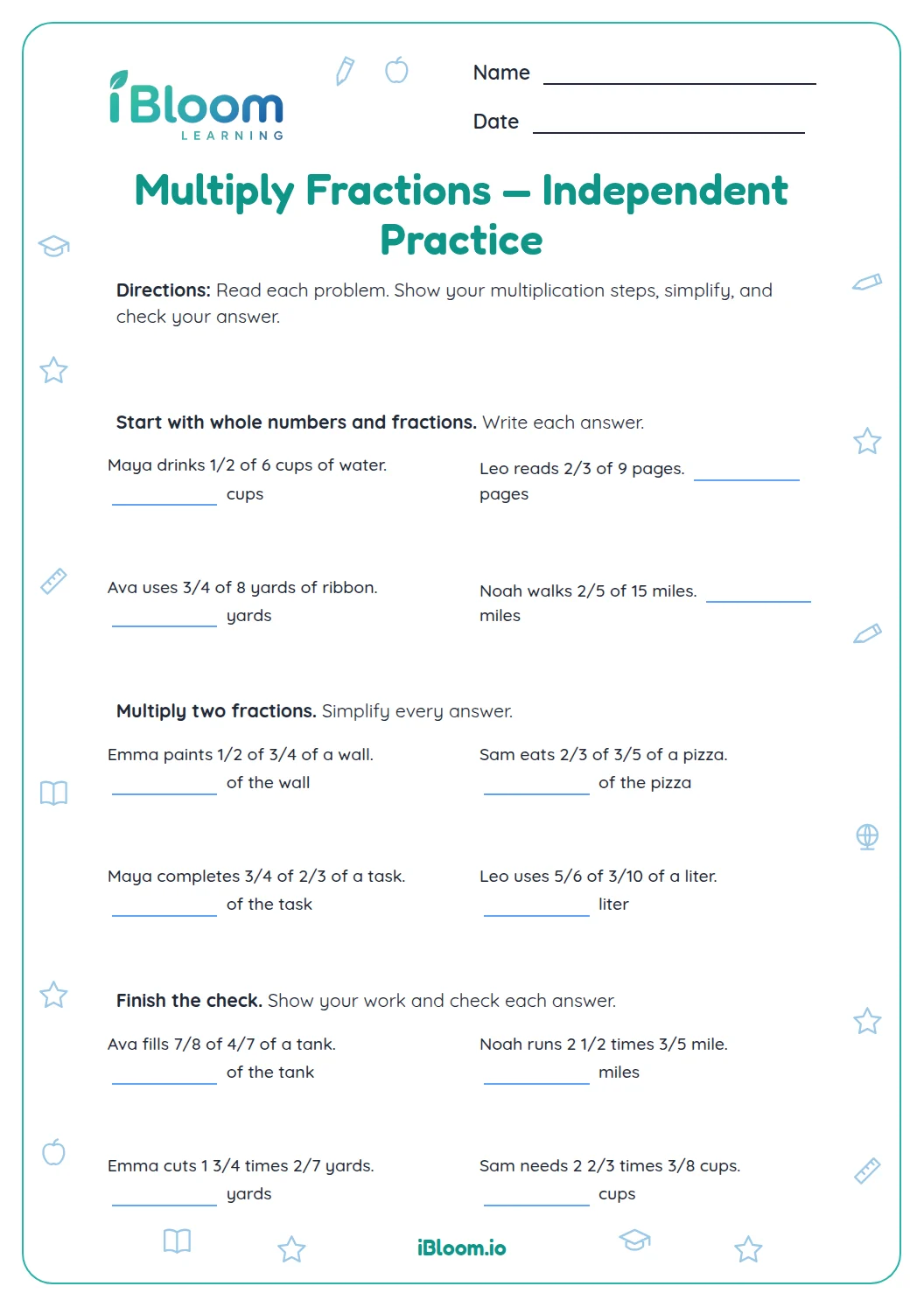
This Grade 5 worksheet gives students 16 real-world problems using fraction addition, subtraction, multiplication, and division. The stories involve recipes, sharing, distance, and materials, with a separate answer key. It practices CCSS 5.NF.A.1 and 5.NF.B.4.
Aligned to 5.NF.A.1 and 5.NF.B.4
How do I choose an operation for a fraction story?
Identify the quantity the question asks for. Joining amounts calls for addition; finding what remains calls for subtraction. Equal groups can call for multiplication, while splitting or finding how many pieces fit calls for division. Keep the unit with the result.
- 1Each batch uses 2/5 cup; there are 3 batches.
- 22/5 × 3 = 6/5 = 1 1/5 cups.
How can I check a fraction answer?
Estimate the size before calculating, then compare the result with the story. Three amounts of a little less than one-half cup should total a little less than 1 1/2 cups. For a sharing problem, multiply one share by the number of people to check the starting amount.
How to use this worksheet
- 1Read the question and name the quantity it asks for.
- 2Mark the fractions, whole numbers, and units.
- 3Choose the operation that matches the relationship.
- 4Calculate and simplify the fraction or mixed number.
- 5Check the size and label the answer with its unit.
Common mistakes and quick fixes
The mistake
Multiplying because a story has the word “each.”
The fix
Check whether the question asks for a total, one share, or a count of pieces.
The mistake
Subtracting the smaller-looking fraction from the larger one without reading the story.
The fix
Use the story to decide which amount is being taken away.
The mistake
Dropping the unit from the result.
The fix
Carry cups, yards, miles, or pieces through the equation and answer.
Common Core alignment
The worksheet practices adding and subtracting unlike fractions and multiplying fractions in story problems.
Add and subtract unlike fractions in stories, including mixed numbers.
On this sheet: Problems 1 and 6 use unlike denominators in addition and subtraction stories.
Show the official wordingHide the official wording
Add and subtract fractions with unlike denominators (including mixed numbers) by replacing given fractions with equivalent fractions in such a way as to produce an equivalent sum or difference of fractions with like denominators.
Multiply fractions to solve real-world problems.
On this sheet: Problems 7 and 14 multiply two fractions; other stories multiply by whole numbers.
Show the official wordingHide the official wording
Apply and extend previous understandings of multiplication to multiply a fraction or whole number by a fraction.
What to practice next
Make more practice
Further reading
Questions parents and teachers ask
How many problems are on the worksheet?
There are 16 real-world fraction problems across the worksheet. They include adding, subtracting, multiplying, and dividing fractions or mixed numbers. The separate answer key gives a labeled answer for each story, including the unit when the story gives one. This gives students another chance to explain their reasoning clearly.
Should students write an equation?
Yes. Each problem provides working space so students can name the operation, write an equation, and solve. Encourage them to include the unit shown in the story when they write the final answer, then estimate to decide whether the result is reasonable.
What fraction skills are practiced?
The stories ask students to combine fractional amounts, find a fraction of a group, and share or group fractional quantities. Denominators stay within familiar Grade 5 fraction work, and each situation gives a reason to choose an operation. This gives students another chance to explain their reasoning clearly.
How can I help without solving it?
Ask what the story asks them to find: a total, a remainder, an equal share, or a number of groups. Then ask whether their answer should be larger or smaller than the starting amount. This keeps the student responsible for choosing and doing the calculation.
Is an answer key included?
Yes. The answer key is printed separately and includes a labeled answer for each story. Students can compare their result after showing their own equation and work. Accept equivalent fraction forms when they name the same amount and include the correct unit.
How long should this practice take?
Plan for about 20 minutes, with more time if students write out each equation and explain their estimate. Completing a few problems together first can help children settle on a clear strategy before finishing the remaining questions independently. This gives students another chance to explain their reasoning clearly.