

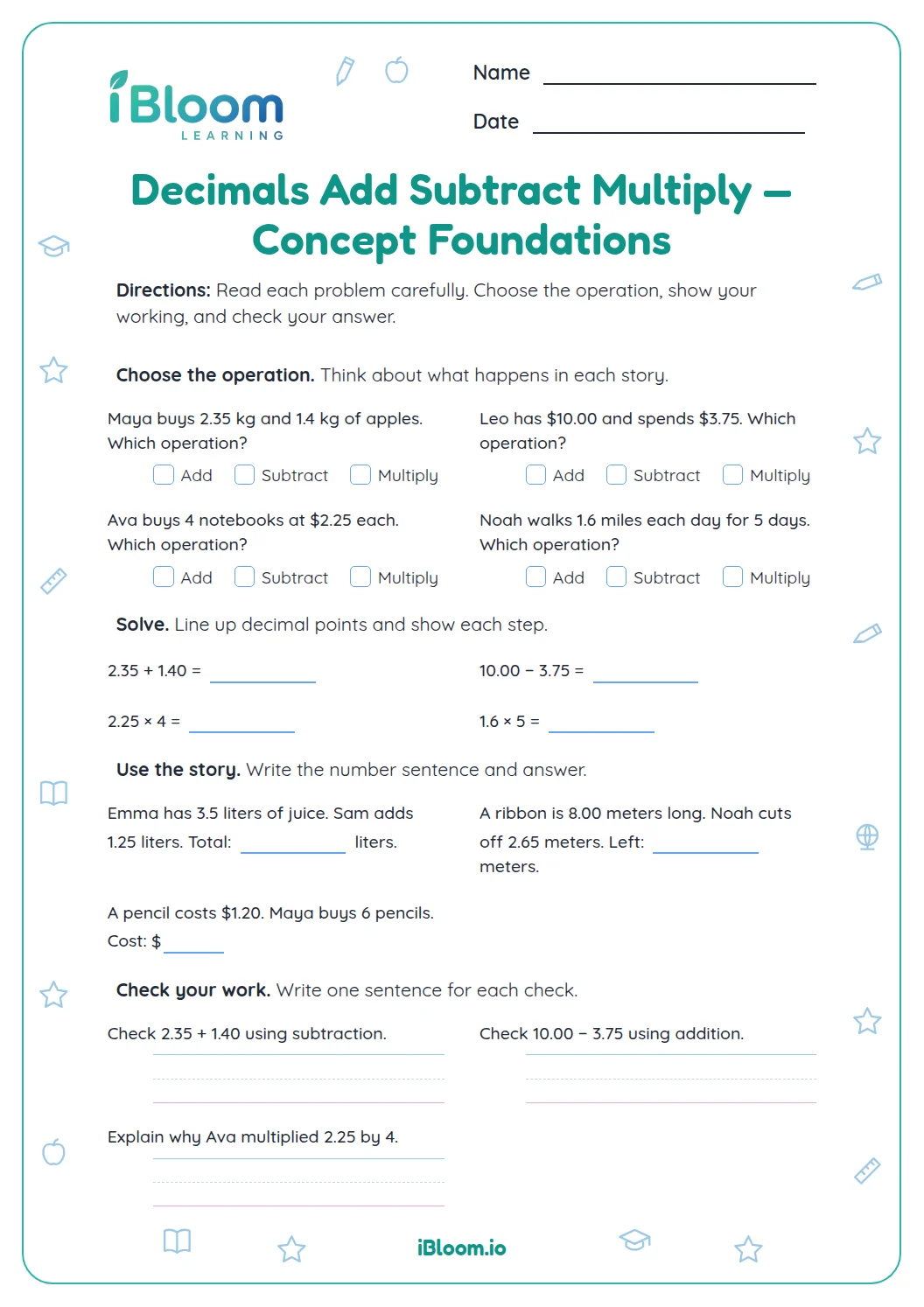

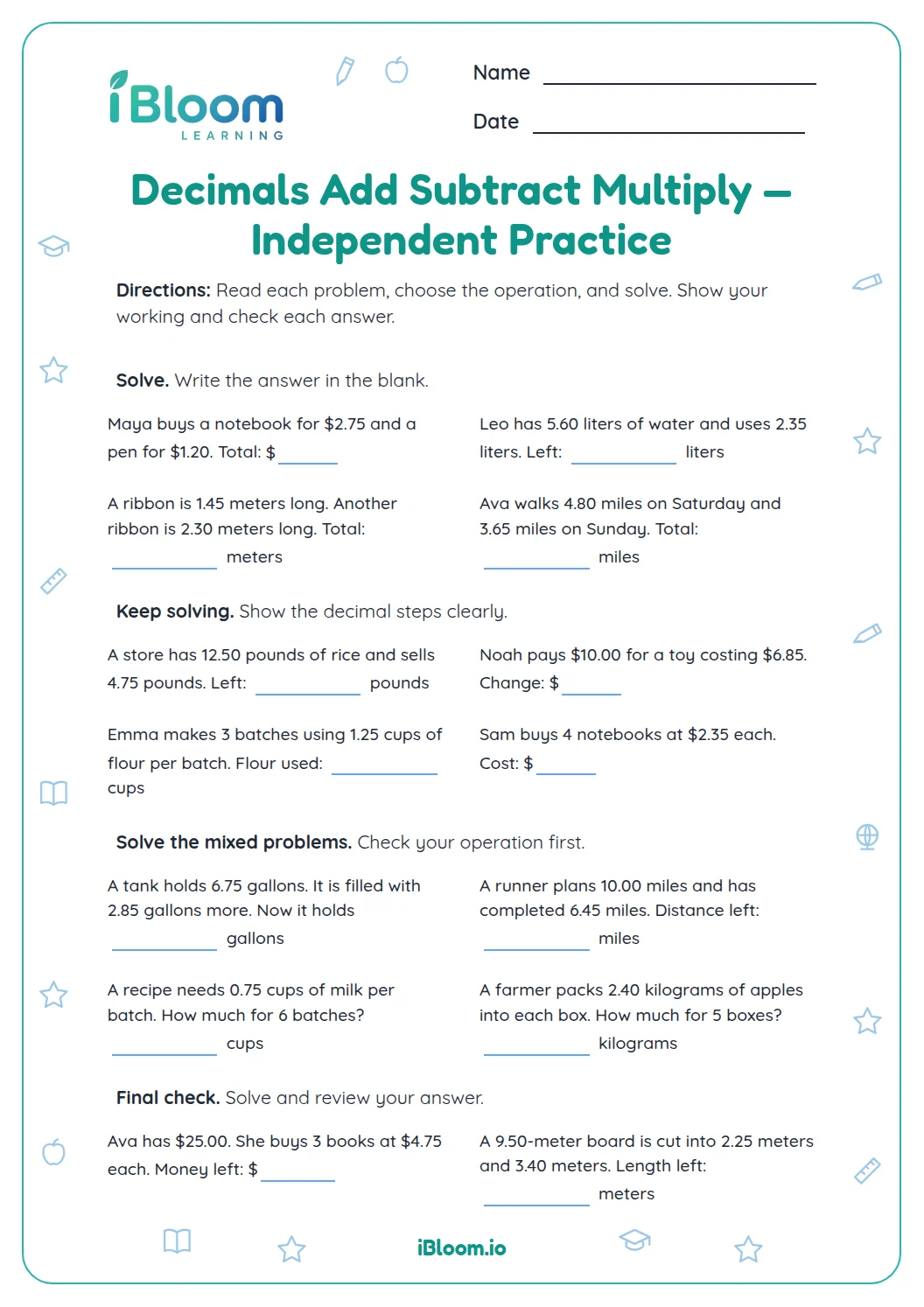
About this worksheet
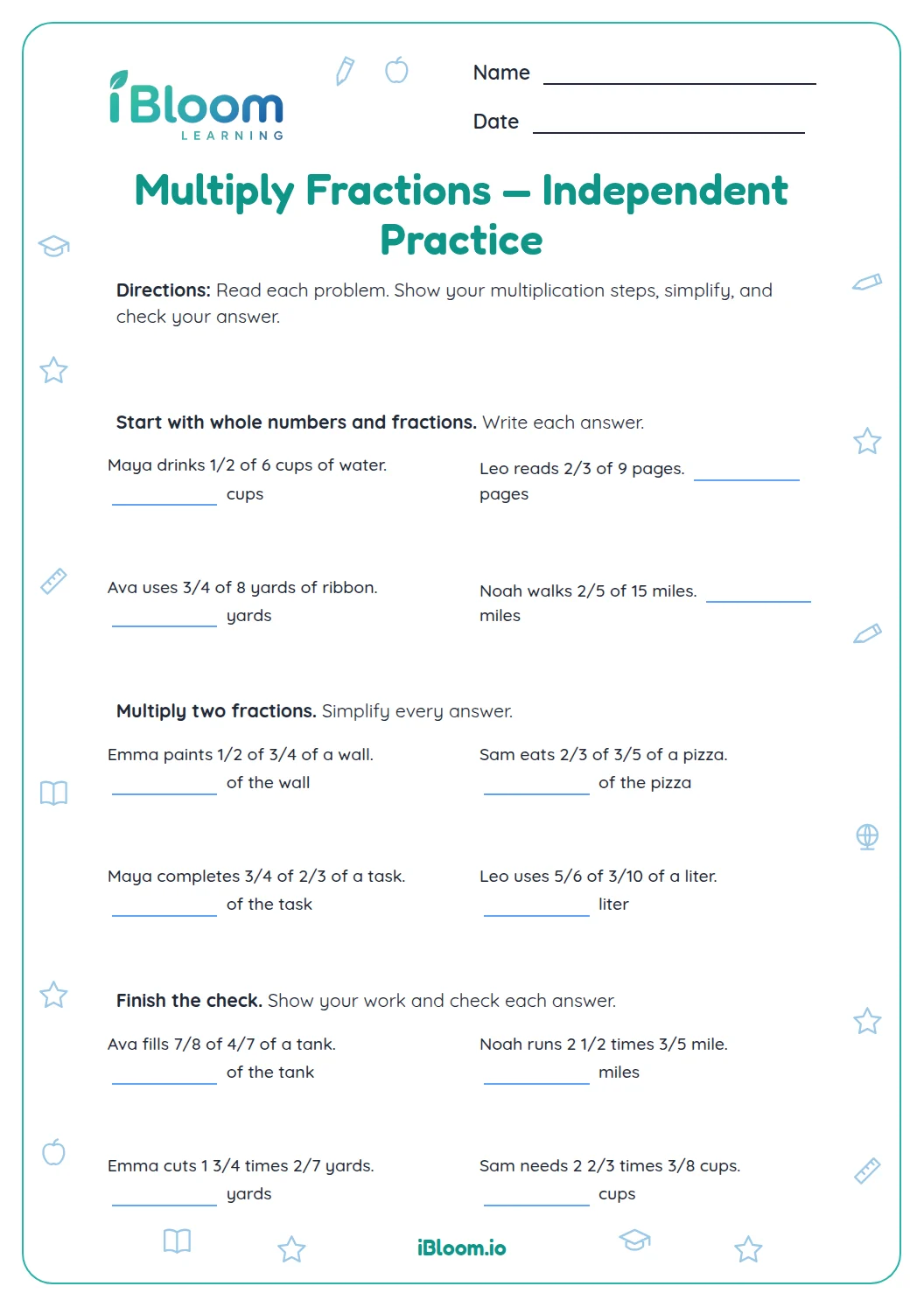
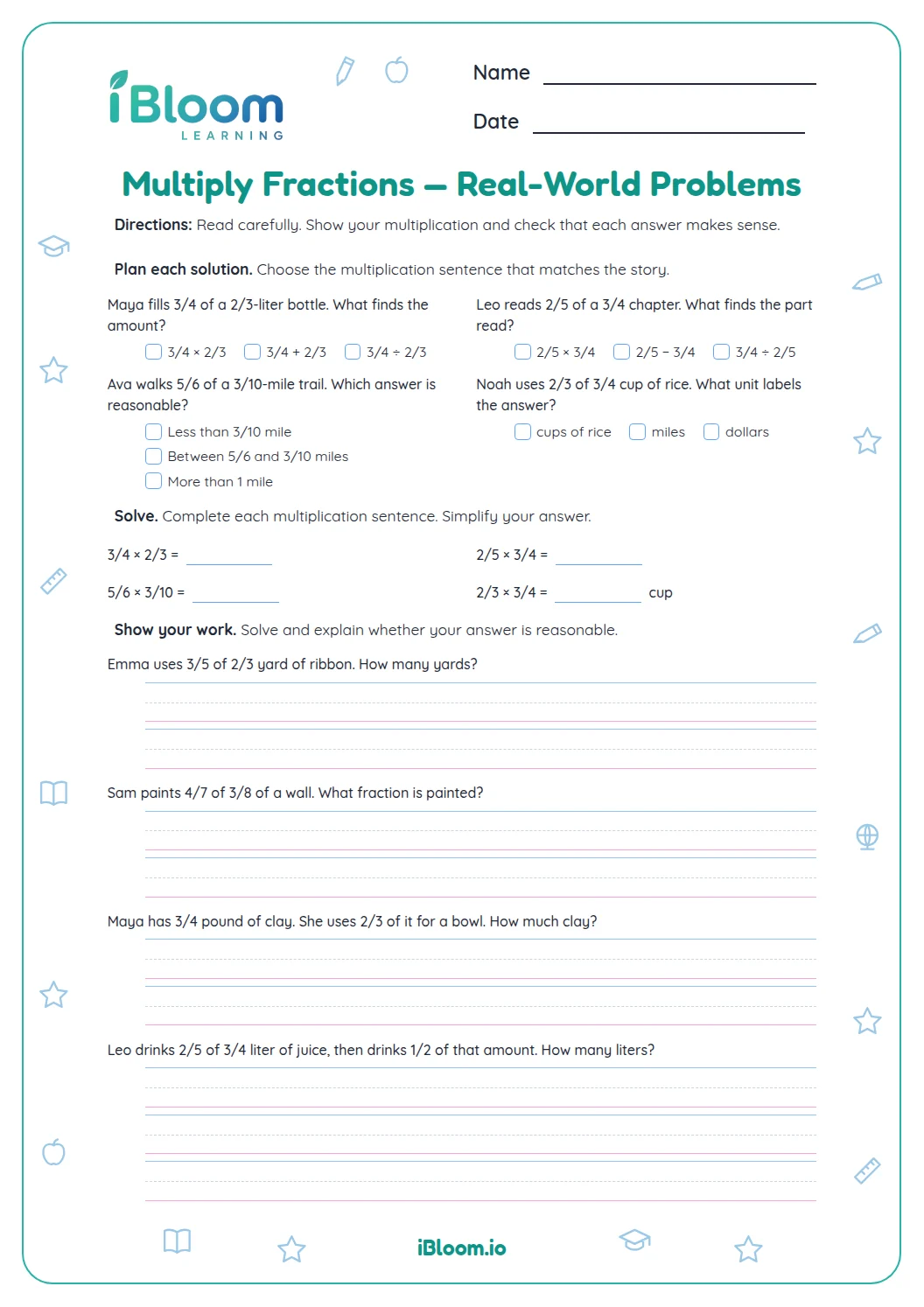
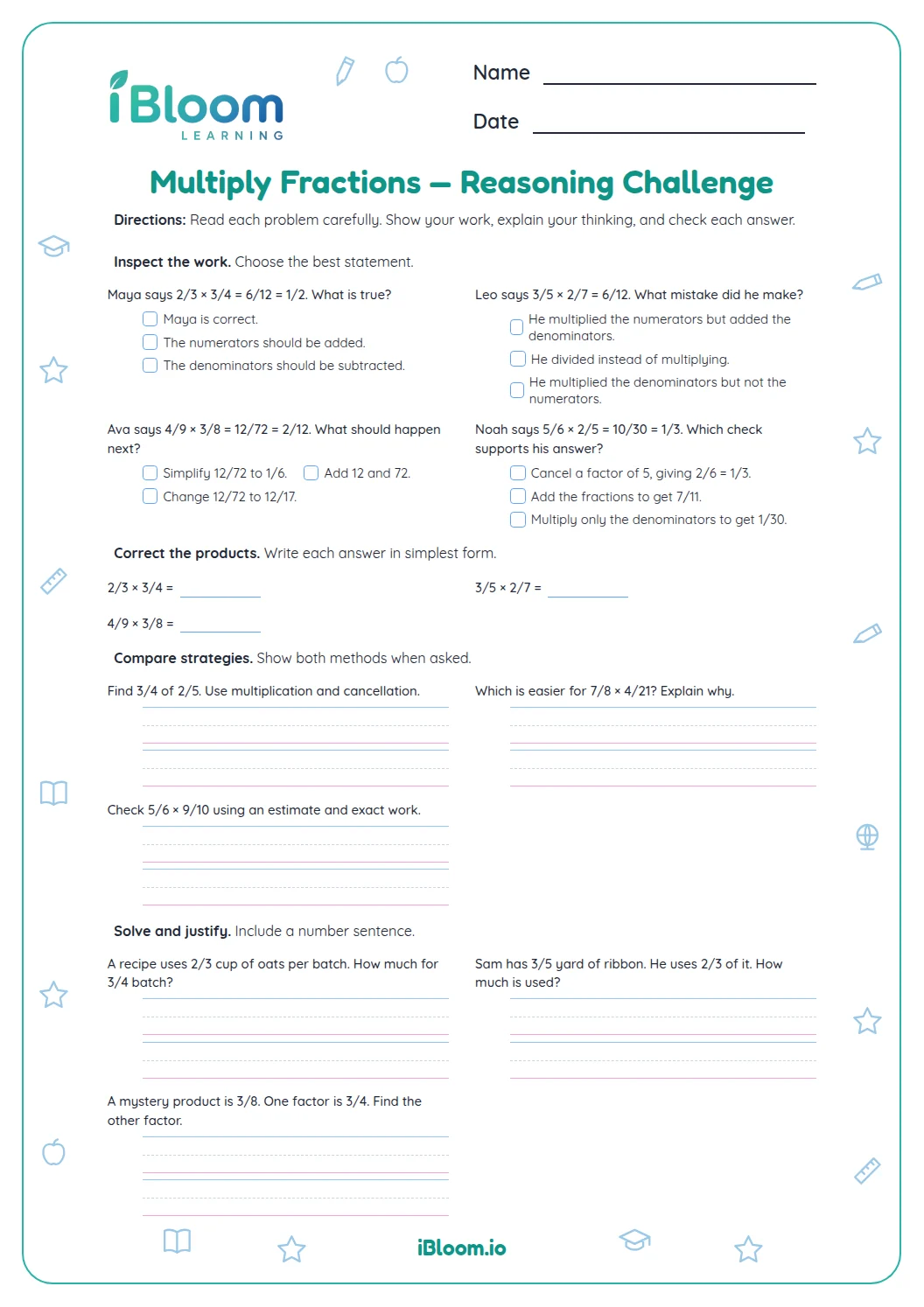
This free printable worksheet helps Grade 5 students connect fraction multiplication to quantities they can picture, such as a fraction of a trail, recipe, ribbon, or route. Its 14 questions move from choosing multiplication for “of” situations to solving word problems and checking products. Students practice finding a fraction of a whole number and multiplying two fractions, in line with CCSS 5.NF.B.4. A separate answer key makes it easy to review answers and multiplication sentences.
Aligned to 5.NF.B.4
How does multiplication find a fraction of a quantity?
A fraction can describe how much of a group or measurement to take. “Three fourths of 20” means 3/4 × 20. One useful route is to divide 20 into four equal groups, then take three groups.
Question 10 asks for 3/5 of 20: 20 ÷ 5 = 4, and 4 × 3 = 12. The multiplication sentence 3/5 × 20 = 12 records the same thinking.
- 13/5 of 20
- 220 ÷ 5 = 4
- 34 × 3 = 12
- 4So 3/5 × 20 = 12
What if both factors are fractions?
Multiply the numerators and multiply the denominators. Then simplify if the numerator and denominator share a factor. For question 11, 5/6 × 3/10 = 15/60 = 1/4.
In a story problem, first decide what “of” connects. Question 4 asks for 2/3 × 7/8; multiply the numerators and denominators, then simplify.
What kinds of questions are on the sheet?
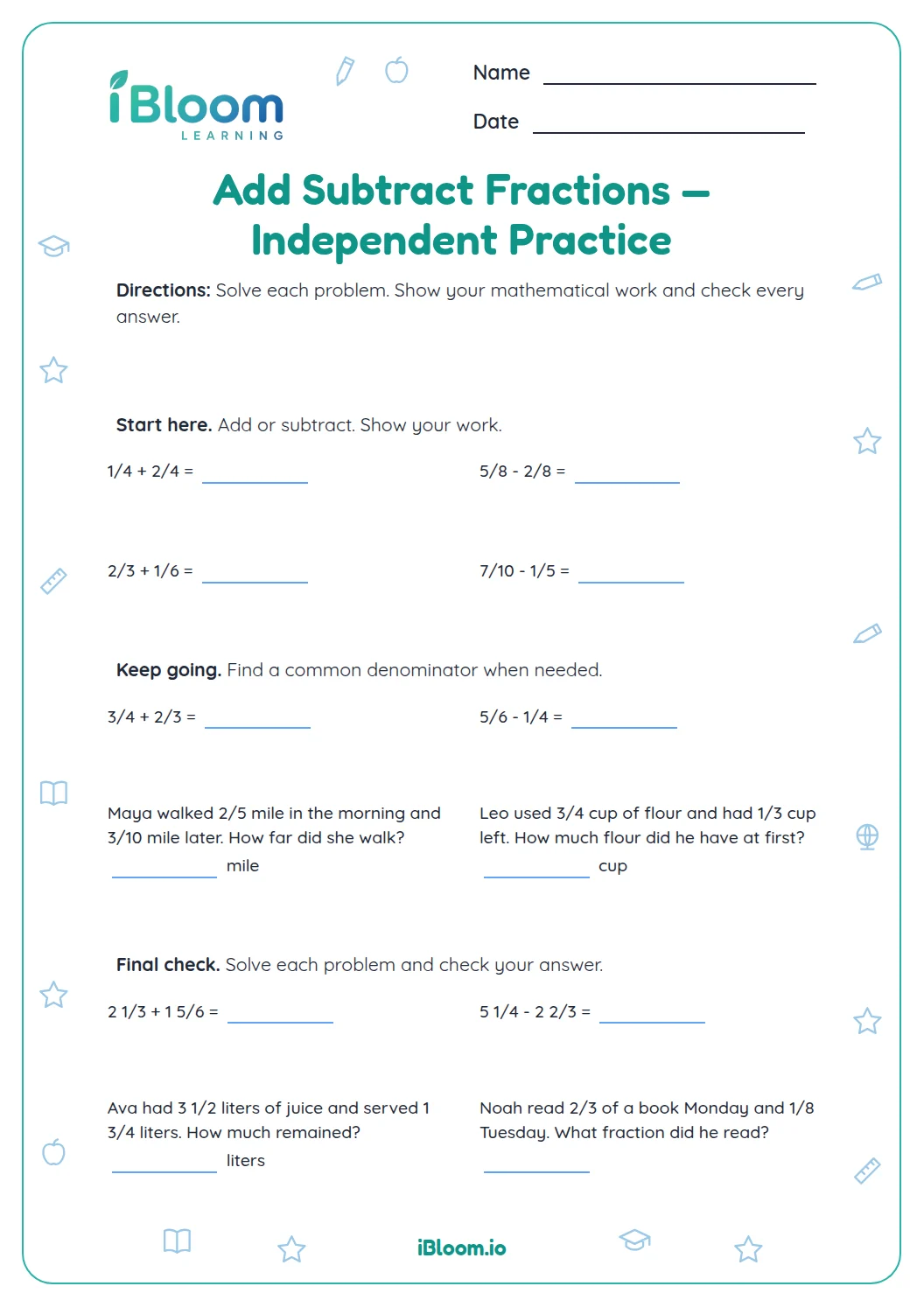
Part A moves from quantity stories to multiplication choices and a product check. Part B compares two fraction-of-quantity results. Part C practices six multiplication products in number sentences.
- Part A: three story contexts and four multiplication choices or checks
- Part B: compare two fraction-of-quantity results
- Part C: six multiplication products
- Answer key on separate pages
How can I use this worksheet?
- 1Read each story and underline the amount being taken as a fraction of something.
- 2Write “fraction × quantity” before doing the arithmetic.
- 3For a fraction of a whole number, divide by the denominator and multiply by the numerator when that is convenient.
- 4For two fractions, multiply across and simplify the result.
- 5Attach the unit from the story to the answer.
- 6Check that the result makes sense: a proper fraction of a quantity should be smaller than the original quantity.
Common mistakes and quick fixes
The mistake
Adding the fraction to the quantity when a story says “of.”
The fix
Translate “of” as multiplication, then check whether the answer should be part of the original.
The mistake
Multiplying the numerator but forgetting to multiply the denominator when both factors are fractions.
The fix
Write a fraction bar for each factor and multiply top by top and bottom by bottom.
The mistake
Leaving an answer such as 15/60 unsimplified when the prompt asks for simplest form.
The fix
Divide numerator and denominator by the same common factor; 15/60 reduces to 1/4.
Common Core alignment
This worksheet practices Grade 5 fraction multiplication in quantity and measurement situations.
Multiply fractions and whole numbers to find a fraction of a quantity.
On this sheet: Students model “of” situations with multiplication of fractions and whole numbers.
Show the official wordingHide the official wording
Apply and extend previous understandings of multiplication to multiply a fraction or whole number by a fraction.
What to practice next
Make more practice
Further reading
Questions parents and teachers ask
What does “of” mean in a fraction word problem?
In these problems, “of” signals multiplication. For example, 3/5 of 20 means 3/5 × 20. Divide 20 into five equal groups of four, then take three groups: 12. Questions 1–3 use this idea with a trail, a pitcher, and a ribbon.
How do I multiply a fraction by a whole number?
Write the whole number as a fraction over 1, or divide by the denominator first when that is easy. For 3/5 × 20, divide 20 by 5 to get 4, then multiply by 3 to get 12. The worksheet includes both story and direct practice.
How do I multiply two fractions?
Multiply the numerators together and the denominators together, then simplify. Question 11 gives 5/6 × 3/10, or 15/60. Divide the numerator and denominator by 15 to get 1/4. Questions 4, 6, 11–13 practice fraction products in different forms.
Why can a product be smaller than both factors?
When two positive proper fractions are multiplied, each is less than one, so the product is smaller than either factor. For example, 5/6 × 3/10 = 1/4. This size check helps students notice when a calculation may need another look.
Does the worksheet include an answer key?
Yes. The answer key follows the three worksheet pages and lists the correct choice or product for all 14 questions. It can be printed separately for checking. For story problems, use the key to check both the amount and its measurement unit.
What should students do after finding a product?
Simplify when the directions ask for simplest form, and include the measurement unit from a story. Then check the size against the context. Taking a proper fraction of a trail, recipe, or ribbon should give less than the original amount.