




About this worksheet
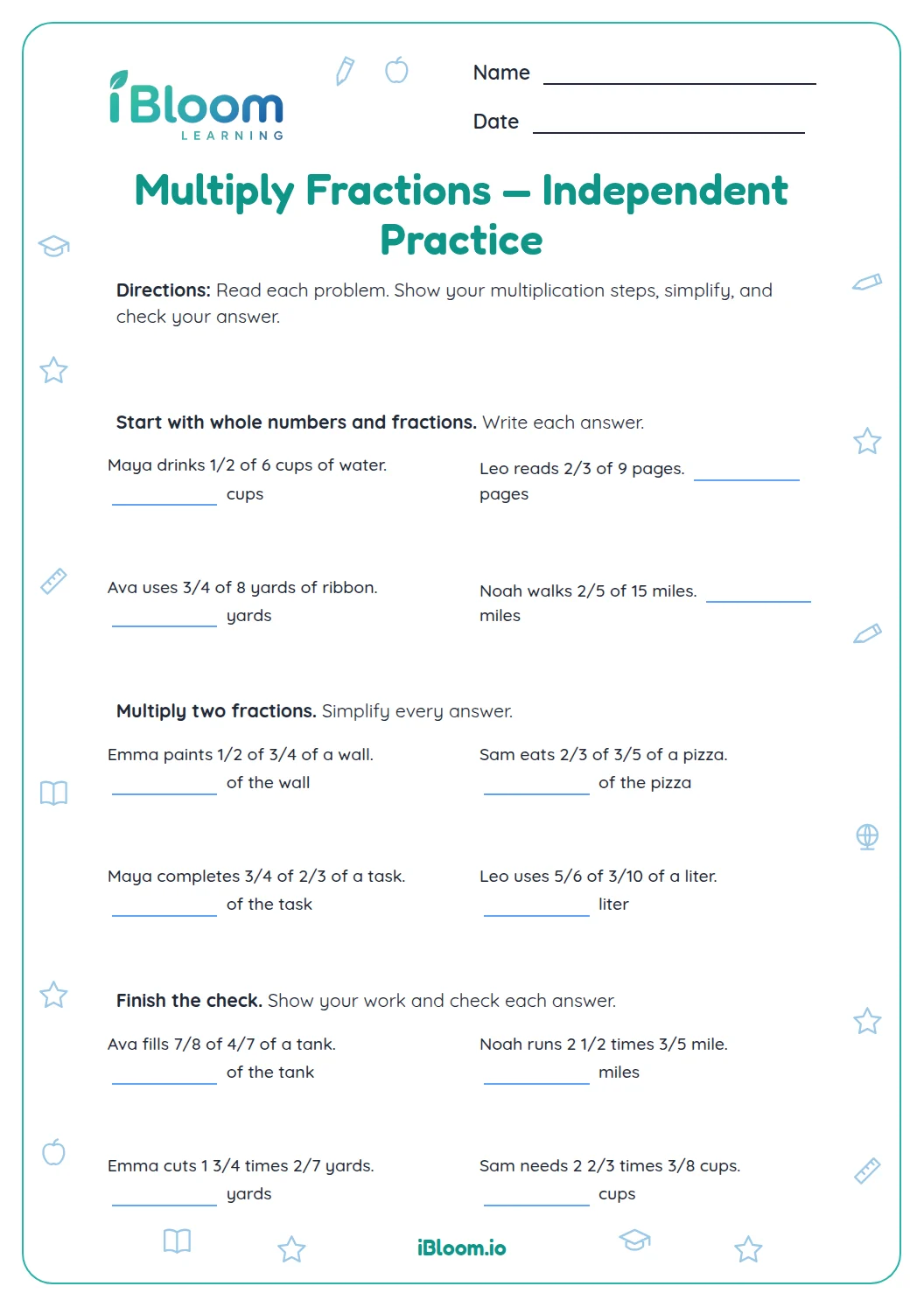
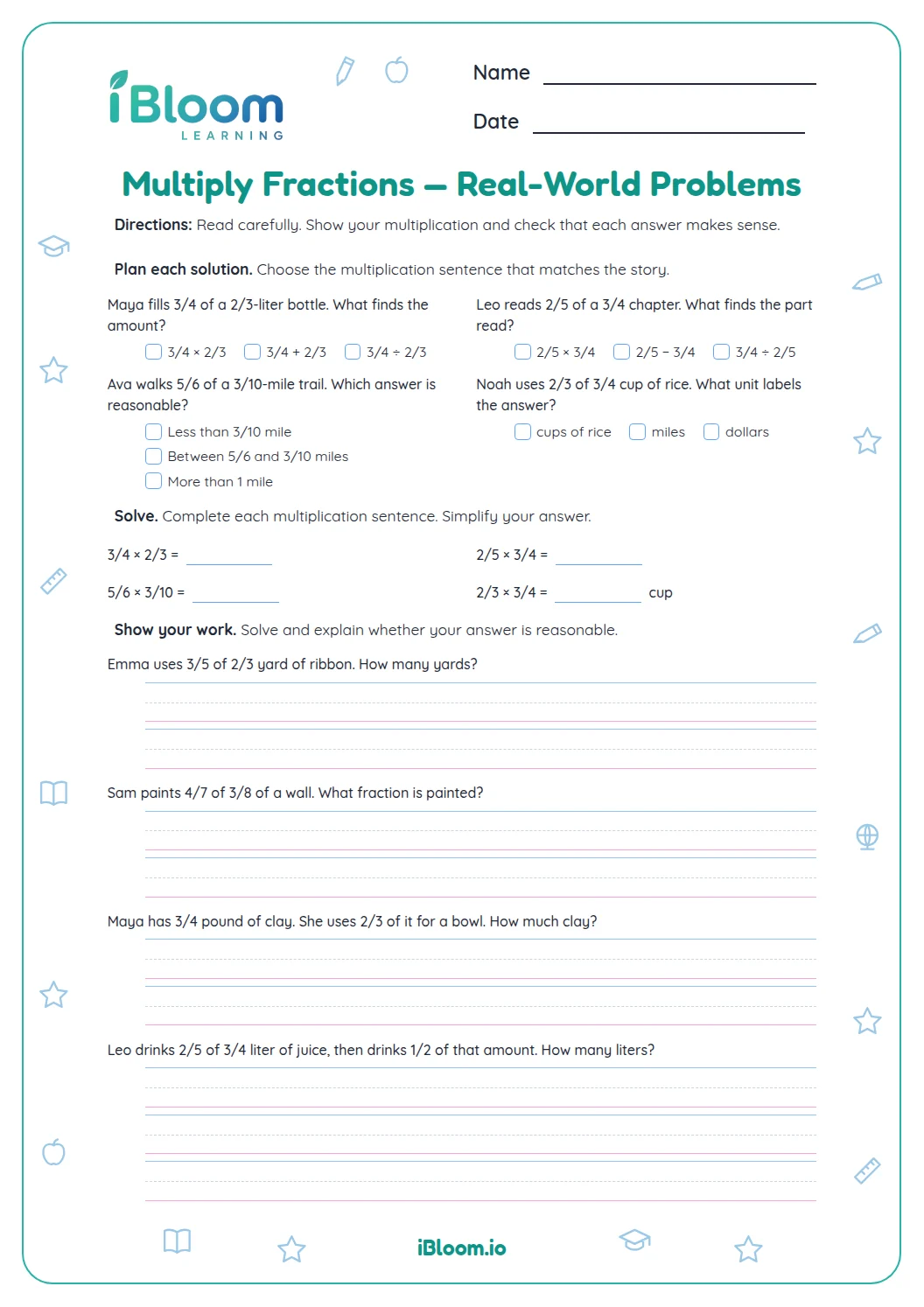
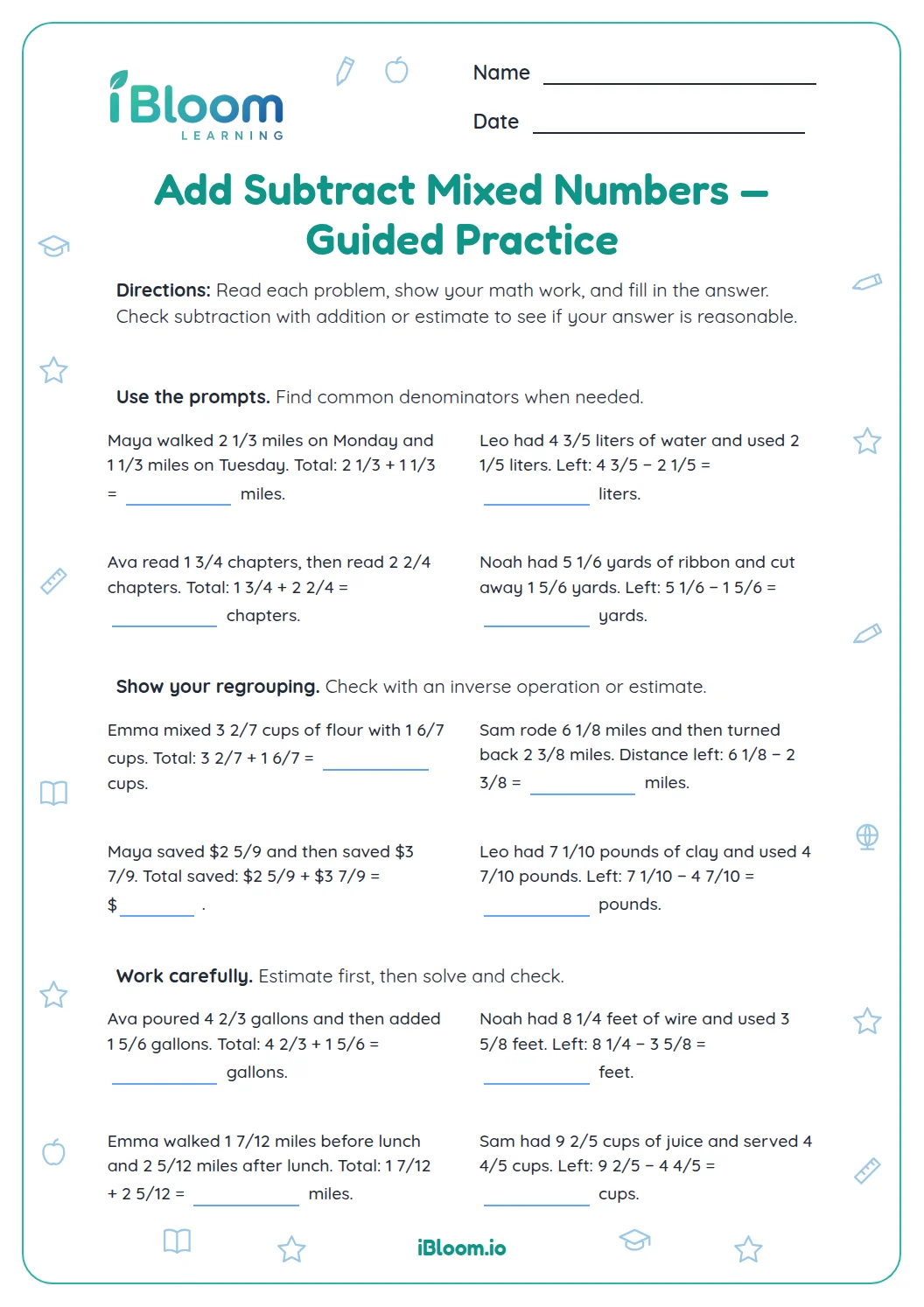
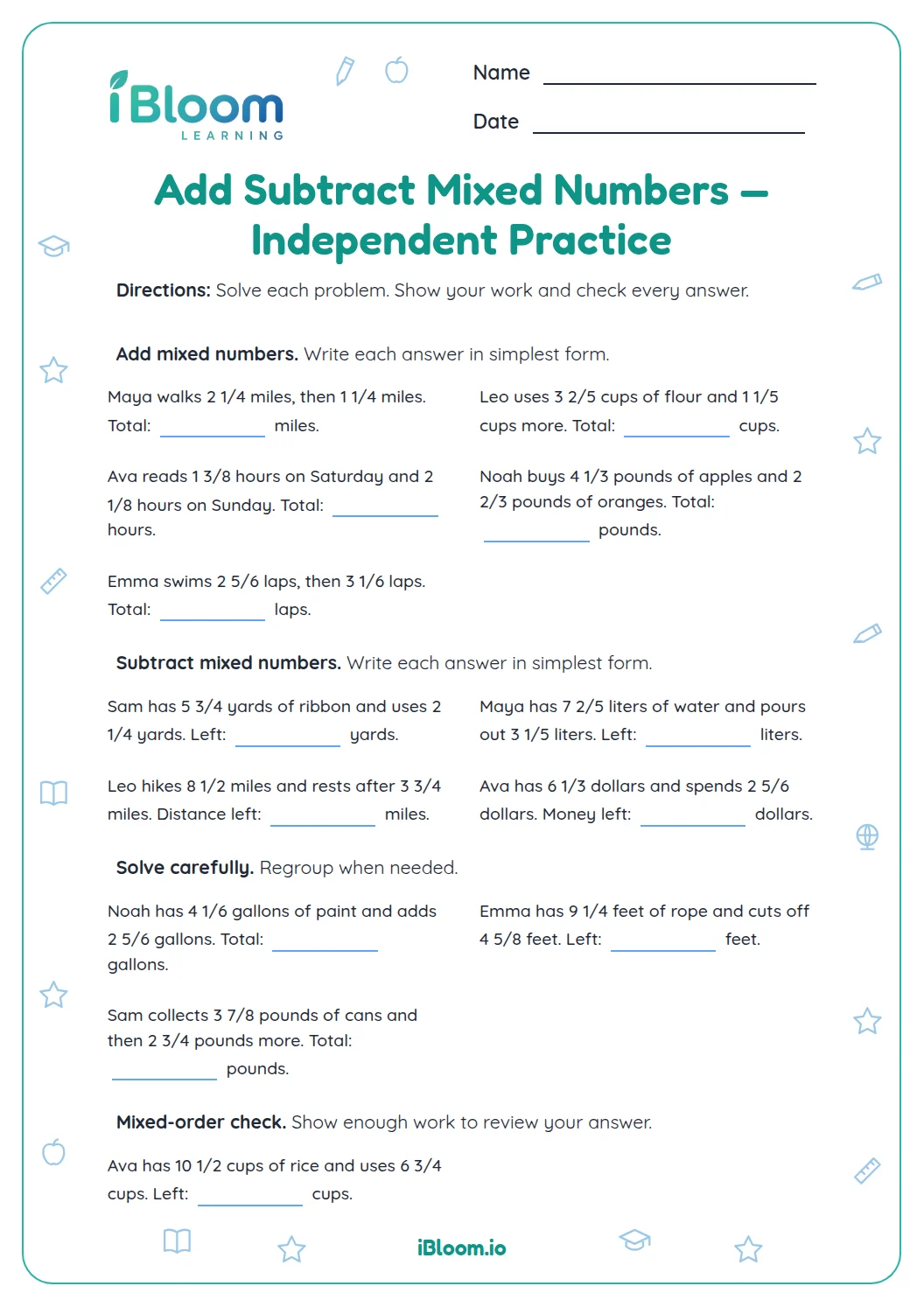
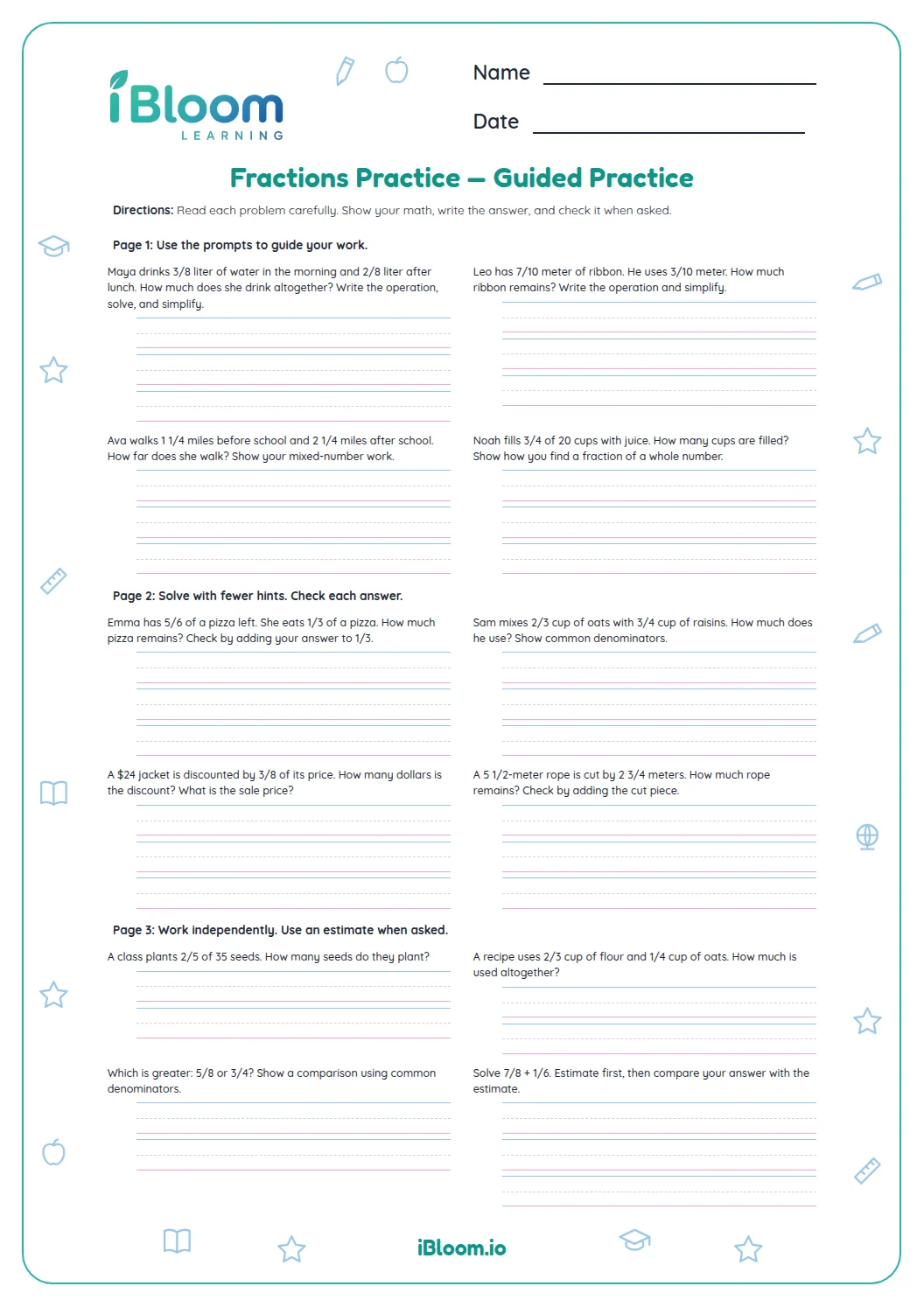
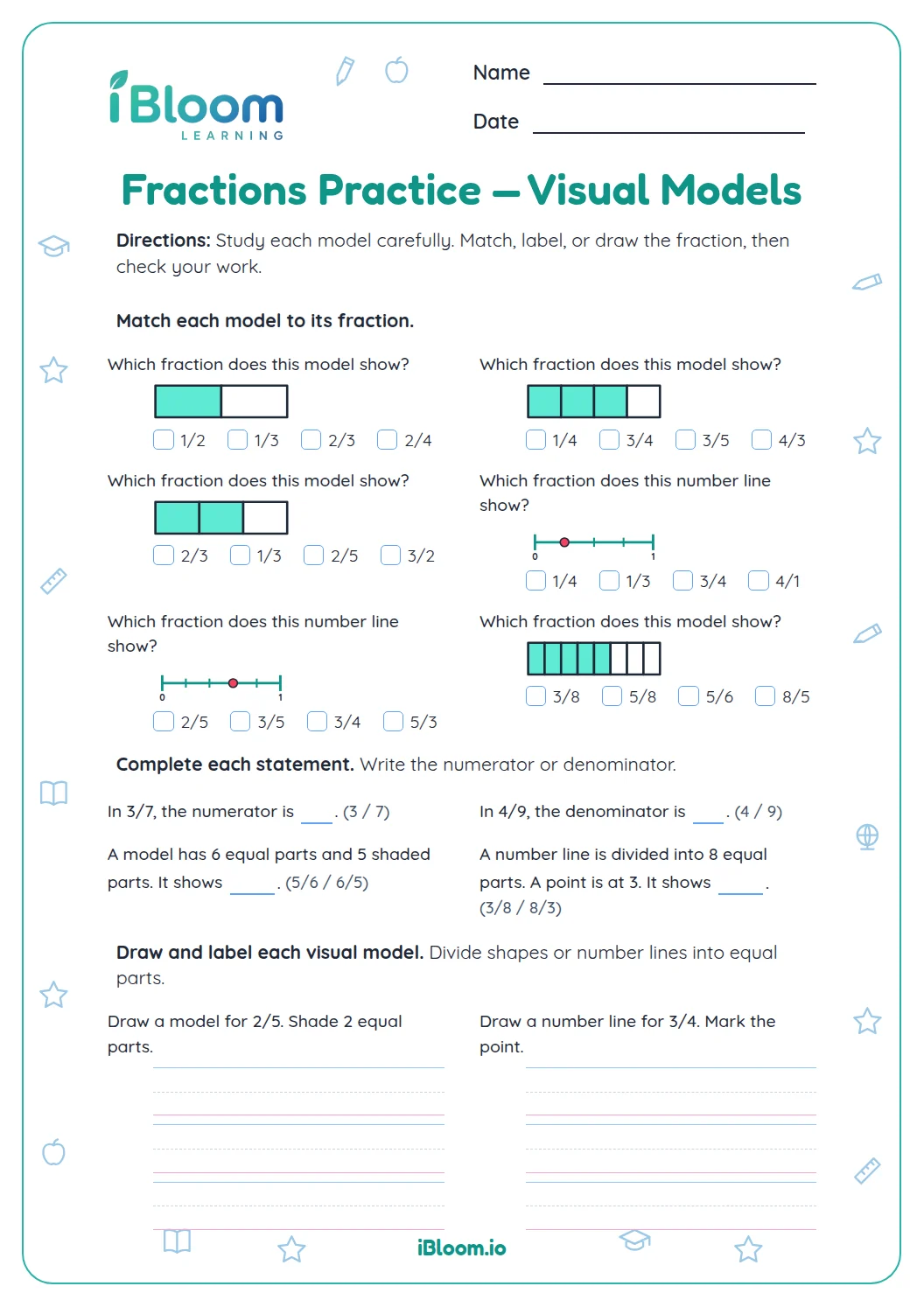
This Grade 5 printable gives students 14 real-world problems for multiplying a fraction by a fraction. Contexts include recipes, measurements, area, and a fraction of a group. Students calculate each product and record an answer with the requested unit. It practices CCSS 5.NF.B.6 and includes a separate answer key.
Aligned to 5.NF.B.6
How do you turn a story into a multiplication equation?
Look for the amount that represents the whole and the fraction of that whole. “3/4 of 2/3 liter” means multiply 3/4 × 2/3. Multiply numerators and denominators, then simplify if possible.
- 13/4 × 2/3 = 6/12
- 26/12 = 1/2
- 3The jug contains 1/2 liter.
How can you check whether the answer makes sense?
When both factors are less than 1, the product is smaller than either factor. In q1, 3/4 × 2/3 should be less than both dimensions; 1/2 square yard is reasonable.
What practice is on the pages?
Part A has eight measurement, recipe, and area problems. Part B has six problems about groups and quantities. Each answer includes the unit named in its story.
How to use this worksheet
- 1Underline the amount that is the whole in each story.
- 2Circle the phrase that tells what fraction is used.
- 3Multiply the numerators and denominators to find the product.
- 4Simplify the product when possible, then write its unit.
- 5Check whether the product is a sensible part of the starting amount.
Common mistakes and quick fixes
The mistake
Multiplying only the numerators and leaving the denominator unchanged.
The fix
Multiply the denominators too, then reduce the fraction.
The mistake
Adding the fractions because the story has two quantities.
The fix
Ask whether the story says “of”; that phrase signals multiplication.
The mistake
Dropping the unit from a measurement answer.
The fix
Copy the unit from the quantity the question asks for.
Common Core alignment
This page practices multiplication of fractions in real situations.
Represent and solve real-world fraction multiplication problems.
On this sheet: Represent and solve real-world fraction multiplication problems.
Show the official wordingHide the official wording
Solve real world problems involving multiplication of fractions and mixed numbers, e.g., by using visual fraction models or equations to represent the problem.
What to practice next
Make more practice
Further reading
Questions parents and teachers ask
What does “of” mean in a fraction story?
In these problems, “of” means multiply. For example, 3/4 of 2/3 liter is 3/4 × 2/3 = 6/12 = 1/2 liter. First identify the amount being acted on, then multiply and simplify. For example, multiply 3/4 by 2/3 and simplify 6/12 to 1/2.
Should students simplify every answer?
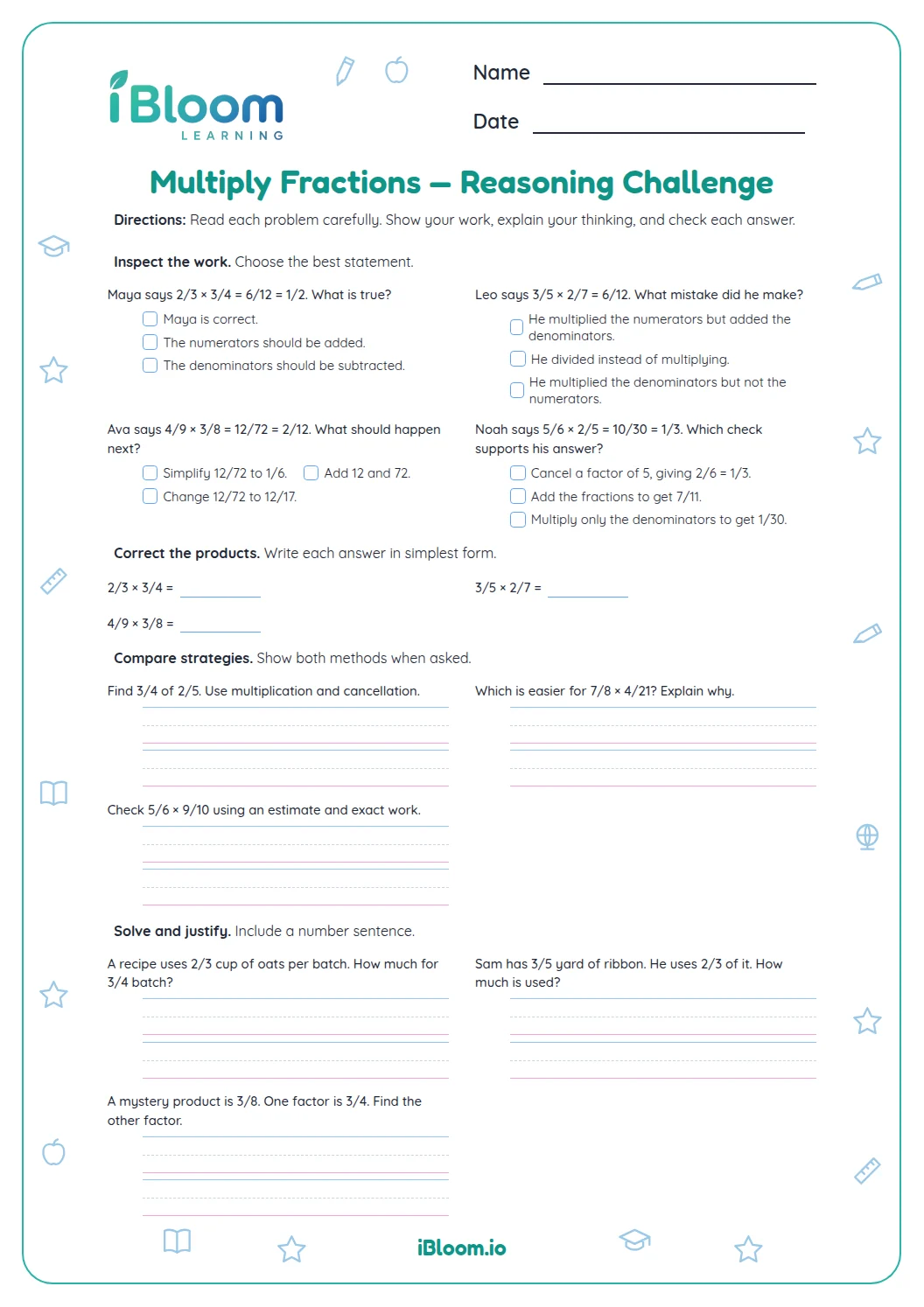
Yes, simplest form makes each key answer easy to read. For example, 6/12 becomes 1/2. Encourage students to check that the simplified fraction still describes the same amount. Check that simplifying changes the form without changing the amount.
How do I handle units?
Carry the unit named in the question into the answer. An area answer uses square yards or acres, while a length answer uses miles or meters. A fraction of a group is given in students. For q7, the result is one third of a tank, so name the tank as the unit.
Is there an answer key?
Yes. The separate key lists all 14 products and their units. Students can compare both the fraction and the unit, then revisit any story where the result seems too large or too small. It helps to check both the calculation and whether the answer fits the story.
How can I check a product less than one?
If both factors are proper fractions, their product should be smaller than either factor. Compare the product with the values in the story before accepting it; that quick estimate can catch multiplication errors. Estimate the size before calculating, then compare the product with both factors.