


About this worksheet
This free Grade 5 worksheet gives students 14 questions on rounding and estimation. Part A uses number lines to round 347 to the nearest ten and 6.42 to the nearest whole number, then rounds a four-digit number to the nearest hundred. Parts B and C ask students to round before adding or subtracting, including decimal sums. The separate answer key shows the estimates. The sheet practices CCSS 5.NBT.A.4: using place-value understanding to round decimals to any place.
Aligned to 5.NBT.A.4
How does this worksheet practice the skill?
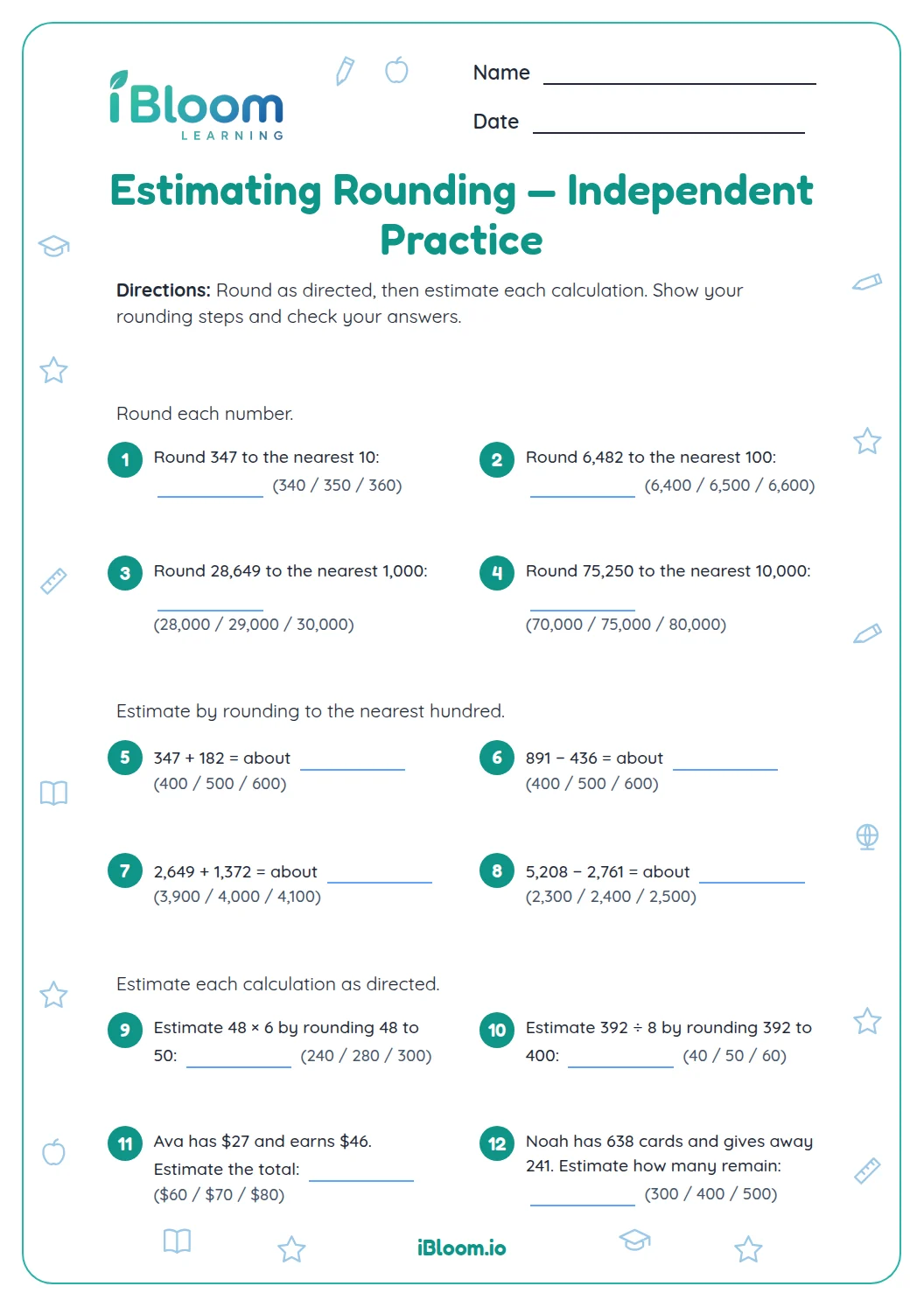
A number line places 347 between 340 and 350. Since it is 7 away from 340 and 3 away from 350, it rounds to 350. Students use a second number line to round 6.42 to a whole number, then apply place value to 1,286.
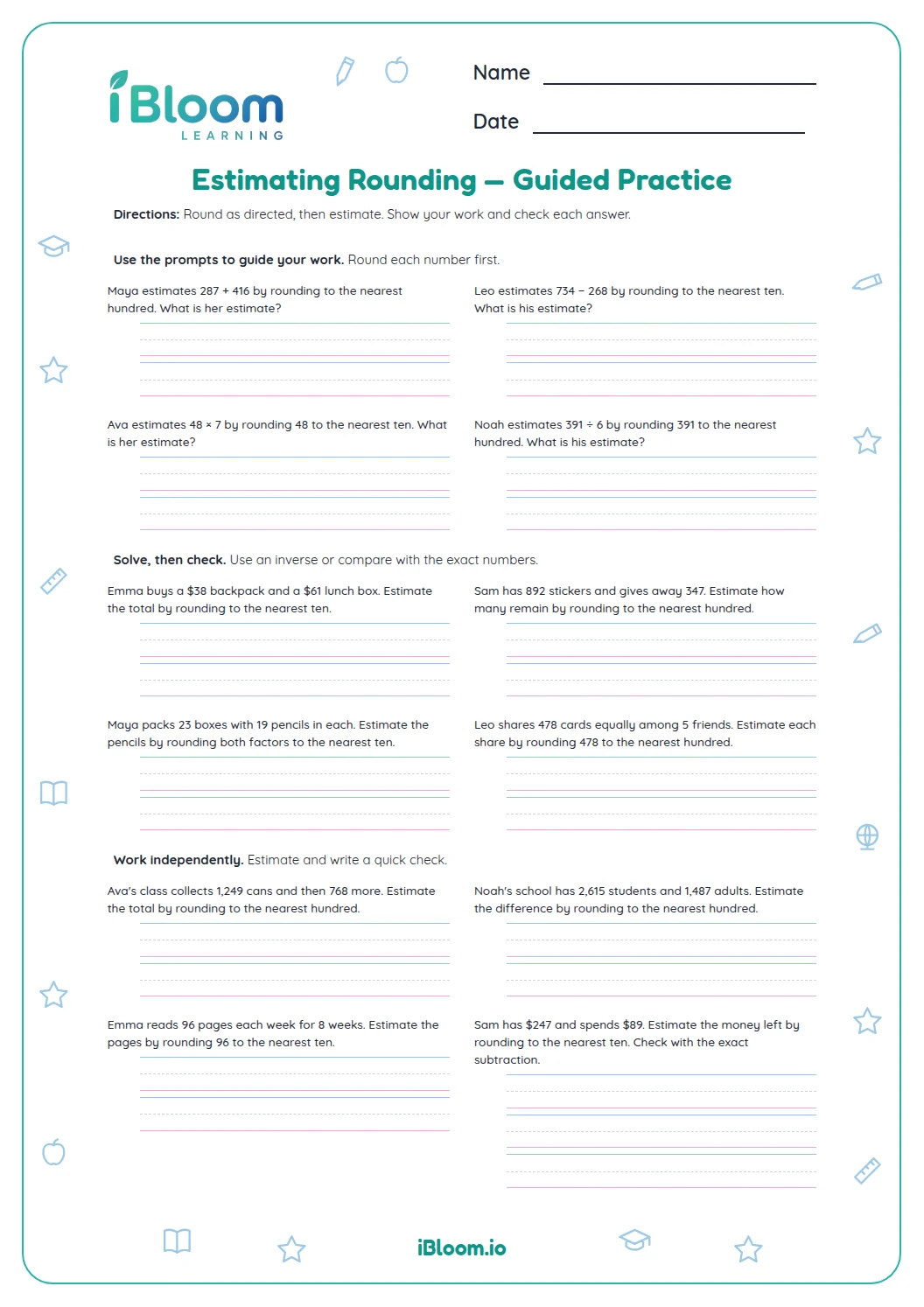
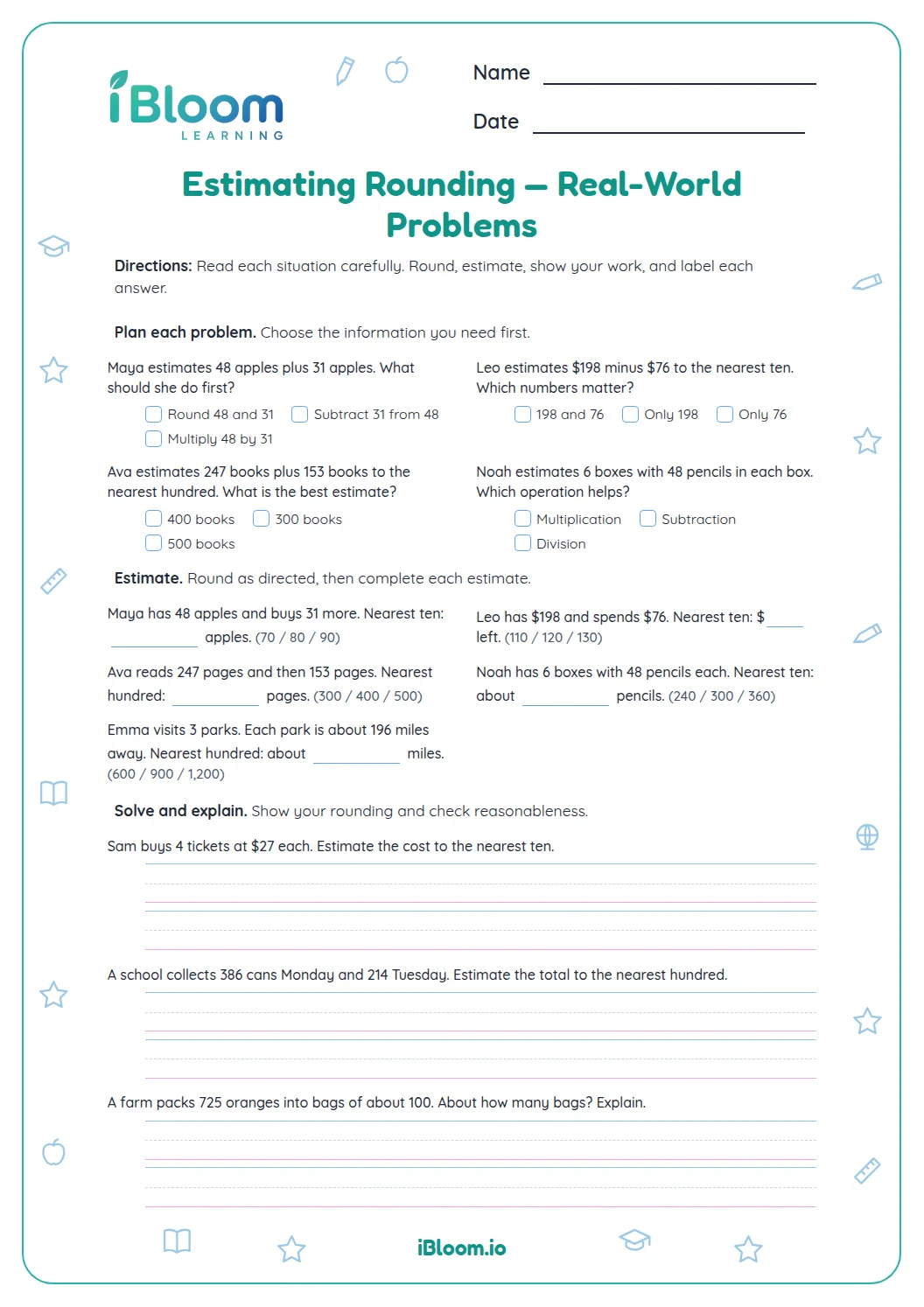
In Parts B and C, round each number before adding or subtracting. For example, 238 rounds to 240 and 61 rounds to 60, so the estimated sum is 300.
What will students find on the page?
Part A starts with round to the named place before combining estimated values. Part B adds another format or a new application, and Part C gives students a chance to use the same skill independently.
The worksheet has 14 questions across 3 parts, followed by a separate answer key.
How can students check their work?
The answer key follows the worksheet and gives a response for every item. Have students finish a part before checking, then review a missed answer by returning to the relevant number line, clue, equation, or passage detail.
How to work through the worksheet
- 1Read the directions at the start of each part.
- 2Complete one question at a time and use the named model or clue when it is provided.
- 3Check that the response answers the exact question.
- 4Use the separate key to check work and revisit any step that needs another try.
Common mistakes and quick fixes
The mistake
Rounding the final sum instead of each addend first.
The fix
Round each number as the prompt directs, then add the rounded values.
The mistake
Choosing a benchmark without checking distance.
The fix
Compare the ones, tenths, or hundreds digits to find which benchmark is nearer.
The mistake
Treating a halfway value as closer to the lower benchmark.
The fix
At a 5 in the next place, round up to the next benchmark.
Curriculum alignment
This worksheet gives students practice with the listed Common Core skills.
Use place value to round decimals to any place.
On this sheet: Students use place-value reasoning to round whole numbers and decimals, then estimate with rounded values.
Show the official wordingHide the official wording
Use place value understanding to round decimals to any place.
What to practice next
Make more practice
Further reading
Questions parents and teachers ask
What is included in each part?
The 14 questions practice rounding whole numbers and decimals and using rounded values to estimate sums and a difference. The two number-line items make benchmark distance visible; later items ask students to round each number first, then calculate with those estimates. The part headings show how the work is grouped.
How should a student use the answer key?
The answer key follows the worksheet pages and lists the expected response for each numbered item. Finish a part before checking it, then return to any question that needs another try. For open responses, use the sample as a guide and check that the answer matches the passage or the math.
Can this worksheet be completed independently?
Yes. The directions are printed on the sheet, and each part begins with a short instruction. A student can work through the questions and use the separate key afterward. An adult can also read the directions aloud or discuss one example before independent practice.
What should I do if an answer is incorrect?
Ask the student to reread the prompt and look back at the relevant model, equation, clue, or passage detail. Have them explain the step that led to the answer, then check it against the key. Correcting the reasoning helps show which part of the skill needs more practice.
How can I support a child without giving the answer?
Invite the student to explain what the question asks and point to useful evidence on the page. If they are stuck, model a different example with new numbers or details, then let them return to this question. The answer key can help confirm their reasoning after they finish.