






About this worksheet
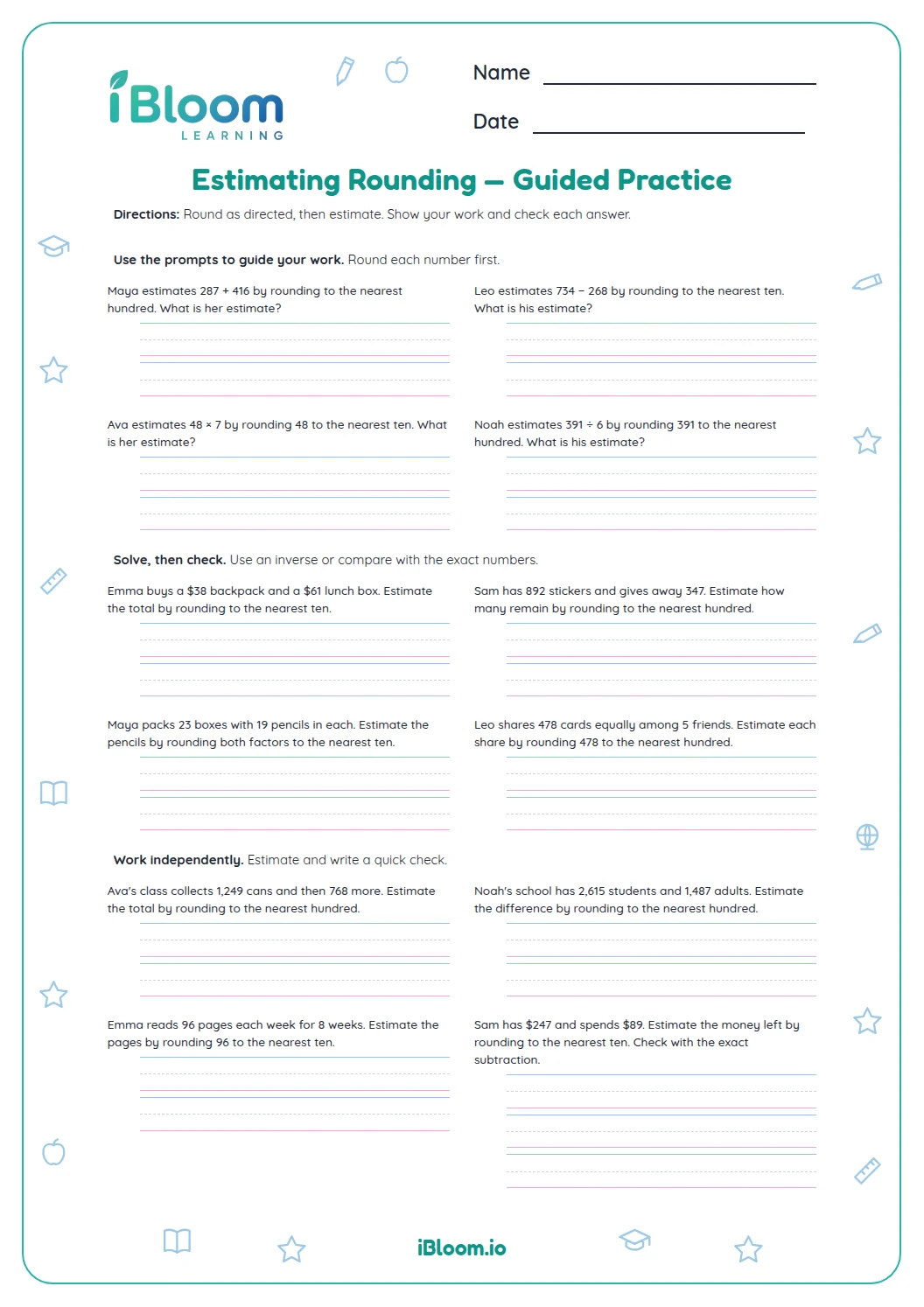
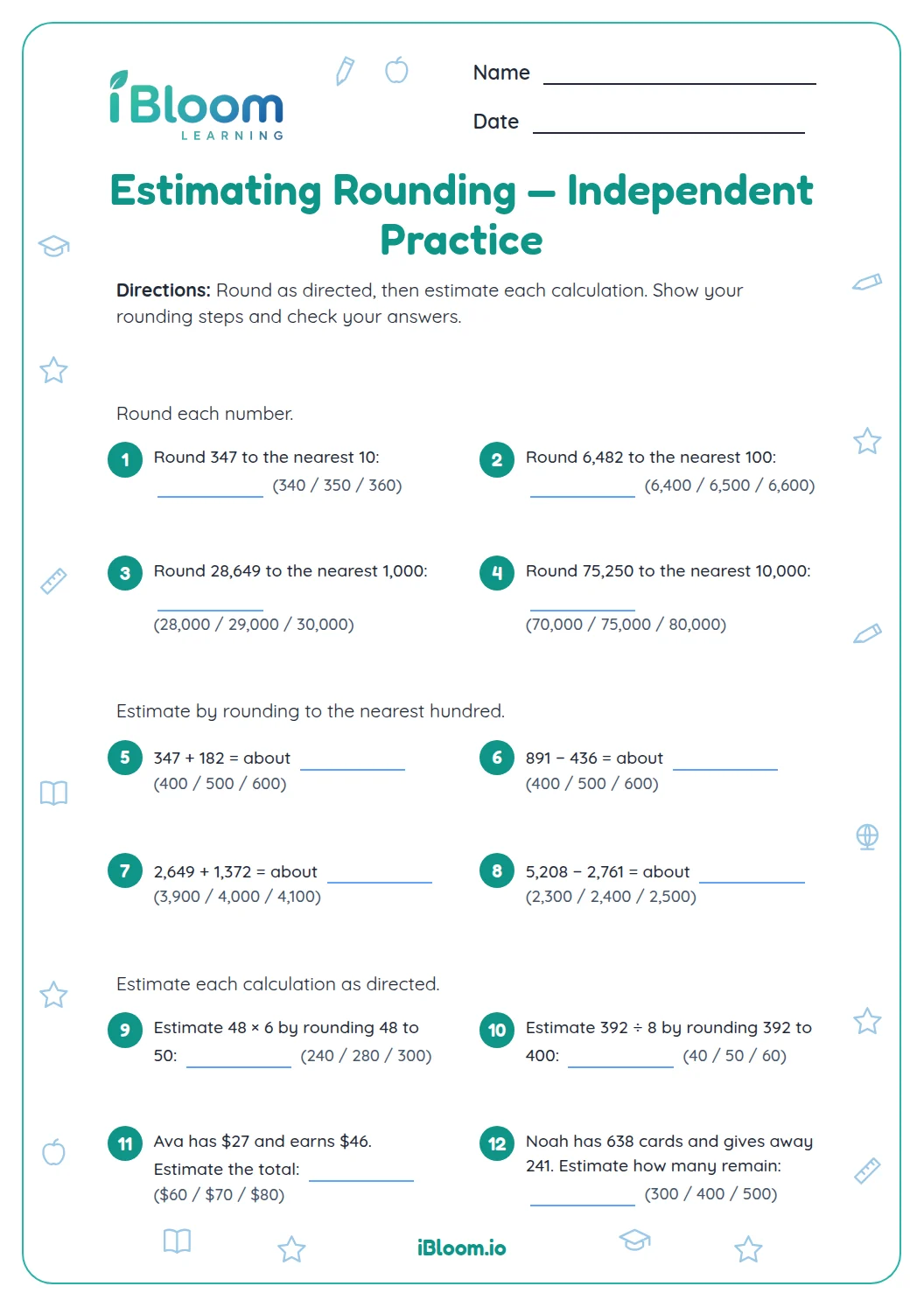
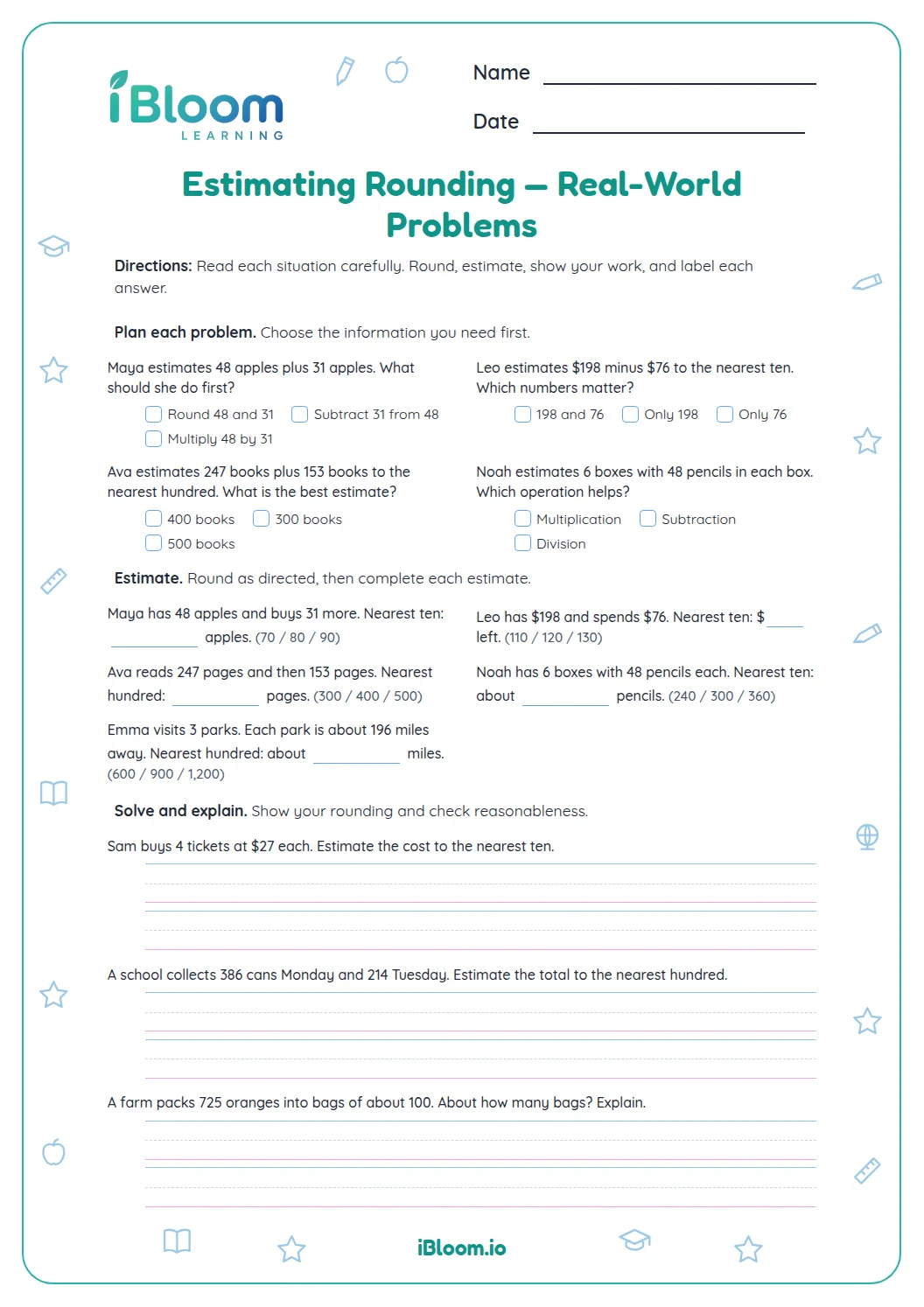
This free printable worksheet gives Grade 5 students a reasoning challenge on rounding and estimating in word problems. In Part A, students round a whole number and two decimals to a stated place, such as 2.847 km to the nearest hundredth. In Part B, they check a classmate's rounding, an addition that looks too big, and a decimal product. In Part C, they round each number first to estimate a number of pencils, a cost and a length. It practices Common Core 5.NBT.A.4, rounding decimals with place value, and the answer key is printed separately.
Aligned to 5.NBT.A.4
What is the difference between rounding and estimating?
Rounding replaces a number with a nearby number that is easier to work with, such as 4,682 to 4,700 or $6.78 to $7. Estimating uses rounded numbers to find an answer that is close, not exact, such as 4,700 + 3,500 = 8,200. Rounding is the tool, and estimating is what you do with it.
In Grade 5, students round decimals as well as whole numbers, so the same rule applies to money, lengths and distances: look at the digit to the right of the place you are rounding to.
How do students use an estimate to check an answer?
Ask three things: what did I round each number to, what is the easy answer, and is my exact answer near it? If the two are far apart, something went wrong. A common cause is a place-value slip, such as writing 12,199 instead of 8,199.
Estimates are not exact, so students also learn how close is close enough. A total of 1,019 and an estimate of 1,000 agree. A total of 12,199 and an estimate of 8,200 do not.
- 1Nora added 4,682 + 3,517 and got 12,199.
- 2Round: 4,682 is about 4,700 and 3,517 is about 3,500.
- 3Estimate: 4,700 + 3,500 = 8,200.
- 412,199 is far larger than 8,200, so Nora should recheck.
- 5Answer: Recheck: sum too big
What is on this worksheet?
Part A has three rounding problems: 48,617 fans to the nearest thousand, 3.46 m to the nearest tenth and 2.847 km to the nearest hundredth. Part B checks Noor's rounding of 5.36, asks what Nora should do when her sum of 12,199 is far from her estimate of 8,200, and asks for the best estimate of 6.8 × 4.1. Part C has three word problems about pencils, notebooks and a rope, each solved by rounding first.
- Part A: 3 questions, round to a stated place
- Part B: 3 questions, check a rounding, a sum and an estimate
- Part C: 3 word problems, round each number then solve
- Money, length and distance contexts, with whole numbers and decimals
How to use this worksheet at home or in class
- 1Warm up by asking for a quick guess: about how much would 3 notebooks at $2.89 cost? Talk about how rounding to $3 helps.
- 2Do question 1 together. Underline the thousands digit, then circle the digit to its right and decide whether to round up or stay.
- 3Let your student finish Part A alone, then check that decimal answers keep the right number of places.
- 4In Part B, have your student say which digit the classmate looked at, or should have looked at, before choosing an answer.
- 5In Part C, ask for the rounded numbers first, then the easy calculation. Compare the estimate with a calculator answer afterward.
- 6Finish by checking with the answer key, and ask your student to say how close each estimate came to the exact answer.
Common mistakes and quick fixes
The mistake
Looking at the wrong digit, such as checking the ones digit 2 in 4,682 when rounding to the nearest hundred and writing 4,600.
The fix
Underline the place you round to, then look only at the digit just to its right. Here it is the tens digit 8, and a 5 or more means round up to 4,700.
The mistake
Dropping digits instead of rounding a decimal, such as writing 3.4 for 3.46 to the nearest tenth.
The fix
Check the hundredths digit. Here it is 6, so the tenths digit goes up and 3.46 becomes 3.5.
The mistake
Treating an estimate as the exact answer, or trusting an exact answer that is far from the estimate.
The fix
Compare the two. If they differ by a lot, recheck the place values in the exact work.
Common Core alignment
Most US states use the Common Core Mathematics standards or a close state version. This sheet practices the standard below.
Round decimals to any place using place value.
On this sheet: Parts A and B round decimals such as 3.46 m, 2.847 km and 5.36 to the nearest tenth or hundredth, and Part C rounds 49.8 m and $2.89.
Show the official wordingHide the official wording
Use place value understanding to round decimals to any place.
What to practice next
Make more practice
Further reading
Questions parents and teachers ask
How do you round a decimal to the nearest tenth?
Look at the hundredths digit, the one just right of the tenths. If it is 5 or more, the tenths digit goes up by one; if it is 4 or less, it stays. So 3.46 rounds to 3.5 because the hundredths digit is 6. Question 2 practices exactly this.
Why does the sheet ask students to estimate instead of calculating exactly?
A quick estimate lets a student judge an exact answer before trusting it. In real life, people estimate to check a bill or to decide whether a plan is possible. In question 8, 3 notebooks at $2.89 each gives about 3 × $3 = $9, which is close to the exact cost of $8.67.
Are the answers in Part C exact?
No. Part C asks for an estimate after rounding, so the answers are 400 pencils, $9 and 10 m. The exact answers are 456 pencils, $8.67 and 9.96 m. Students should see that each estimate is close but not equal, and that is expected.
What should my child do if the estimate and the exact answer are far apart?
Recheck the exact work, starting with place value and regrouping. In question 5, the exact sum is 8,199, so Nora's 12,199 is 4,000 too big, which the estimate of 8,200 shows at once. If the exact work is right, check the rounding next, since a rounded number can also be off.
Why is the estimate for 6.8 × 4.1 about 28?
Rounding 6.8 to 7 and 4.1 to 4 gives 7 × 4 = 28, and the exact product is 27.88, so about 28 is the best choice. The other choices, about 24 and about 35, come from rounding one factor the wrong way. Question 6 shows students that rounding works for multiplying decimals, too.
Is there an answer key, and how long does it take?
Yes, the answer key is printed separately with the answer to every question. Plan on about 20 minutes. Part C takes the most thought because students round before they solve, so you can split the sheet into two sittings: Parts A and B first, then the three word problems.