








About this worksheet
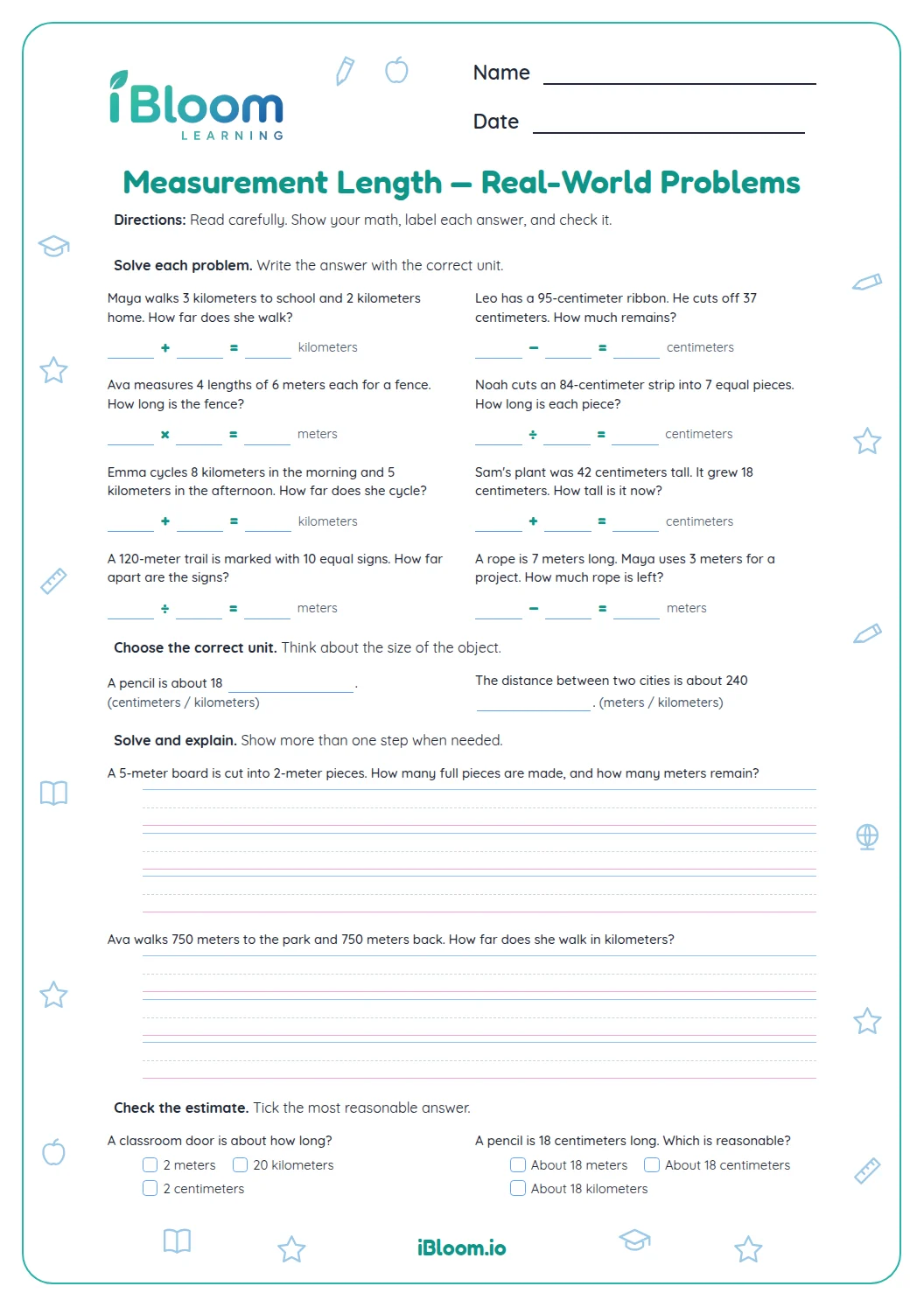
This free Grade 5 worksheet gives students 14 metric length-conversion and word problems. They convert among millimeters, centimeters, meters and kilometers, then use those relationships to solve practical situations. Questions include direct conversions, missing values, combining or comparing measurements, and sharing a length equally. The sheet practices CCSS 5.MD.A.1 and includes a separate answer key.
Aligned to 5.MD.A.1
How do you convert metric length units?
Use 1 m = 100 cm, 1 cm = 10 mm, and 1 km = 1,000 m. Multiply when changing a larger unit to a smaller one; divide when changing to a larger unit.
Question 1 asks for centimeters in 3 meters: 3 × 100 = 300 cm. Keep the unit with the number so the answer describes a length.
- 12 m = 200 cm
- 2200 + 35 = 235
- 3The ribbon is 235 cm long.
How can a conversion help solve a story problem?
Rewrite both lengths in the same metric unit before joining or comparing them. Question 9 changes 2 m to 200 cm, then adds 35 cm for a total of 235 cm. In question 12, both boards are already in centimeters, so subtract their lengths directly.
What does the worksheet practice?
The 14 questions include metric conversions, missing values, and situations involving equal groups or a change in length. Students use millimeters, centimeters, meters, and kilometers.
How can you use this worksheet?
- 1Write the conversion fact needed before calculating.
- 2Convert lengths to one unit when combining or comparing them.
- 3Choose multiplication for larger units into smaller units.
- 4Choose division for smaller units into larger units.
- 5Write the unit in the answer and estimate to check.
What errors should children check?
The mistake
Multiplying when changing centimeters to meters.
The fix
Since 100 cm make 1 m, divide centimeters by 100 to find meters.
The mistake
Adding unlike units directly, such as 2 m + 35 cm.
The fix
Convert 2 m to 200 cm first, then add.
The mistake
Leaving off the unit.
The fix
Write mm, cm, m, or km so the answer names the measurement.
Common Core alignment
This page practices the listed Common Core skills through the worksheet questions.
Convert metric length units and use those conversions in the worksheet problems.
On this sheet: Questions convert metric units directly and use conversions in multi-step length situations.
Show the official wordingHide the official wording
Convert among different-sized standard measurement units within a given measurement system (e.g., convert 5 cm to 0.05 m), and use these conversions in solving multi-step, real world problems.
What to practice next
Make more practice
Further reading
Questions parents and teachers ask
Which length units appear?
The worksheet uses millimeters, centimeters, meters, and kilometers. Questions ask children to move between these units using facts such as 10 millimeters in a centimeter and 1,000 meters in a kilometer. The last six questions apply those facts to combining, comparing, and sharing lengths.
How many centimeters are in a meter?
There are 100 centimeters in 1 meter. To change meters to centimeters, multiply by 100; to change centimeters to meters, divide by 100. Question 1 uses this fact to change 3 meters into 300 centimeters, and question 13 combines meters and centimeters.
How should my child solve a problem with two units?
Convert both lengths into one unit before adding or subtracting. For example, change 2 meters to 200 centimeters before adding 35 centimeters. Then add 200 + 35 and label the total in centimeters. Question 9 practices this step, and the answer key shows 235 cm.
Does the worksheet include an answer key?
Yes. A separate two-page answer key gives answers for all 14 questions, including metric conversions and word problems. Students can attempt the worksheet first, then use the key to check each calculation and unit. It can also help them revisit a conversion fact that caused confusion.
What if a child chooses the wrong operation?
Ask whether the units are getting smaller or larger. A larger unit changes to a smaller unit by multiplying, while a smaller unit changes to a larger one by dividing. Then use the conversion fact to check. For example, 4 meters equals 400 centimeters, not 40 centimeters.