








About this worksheet
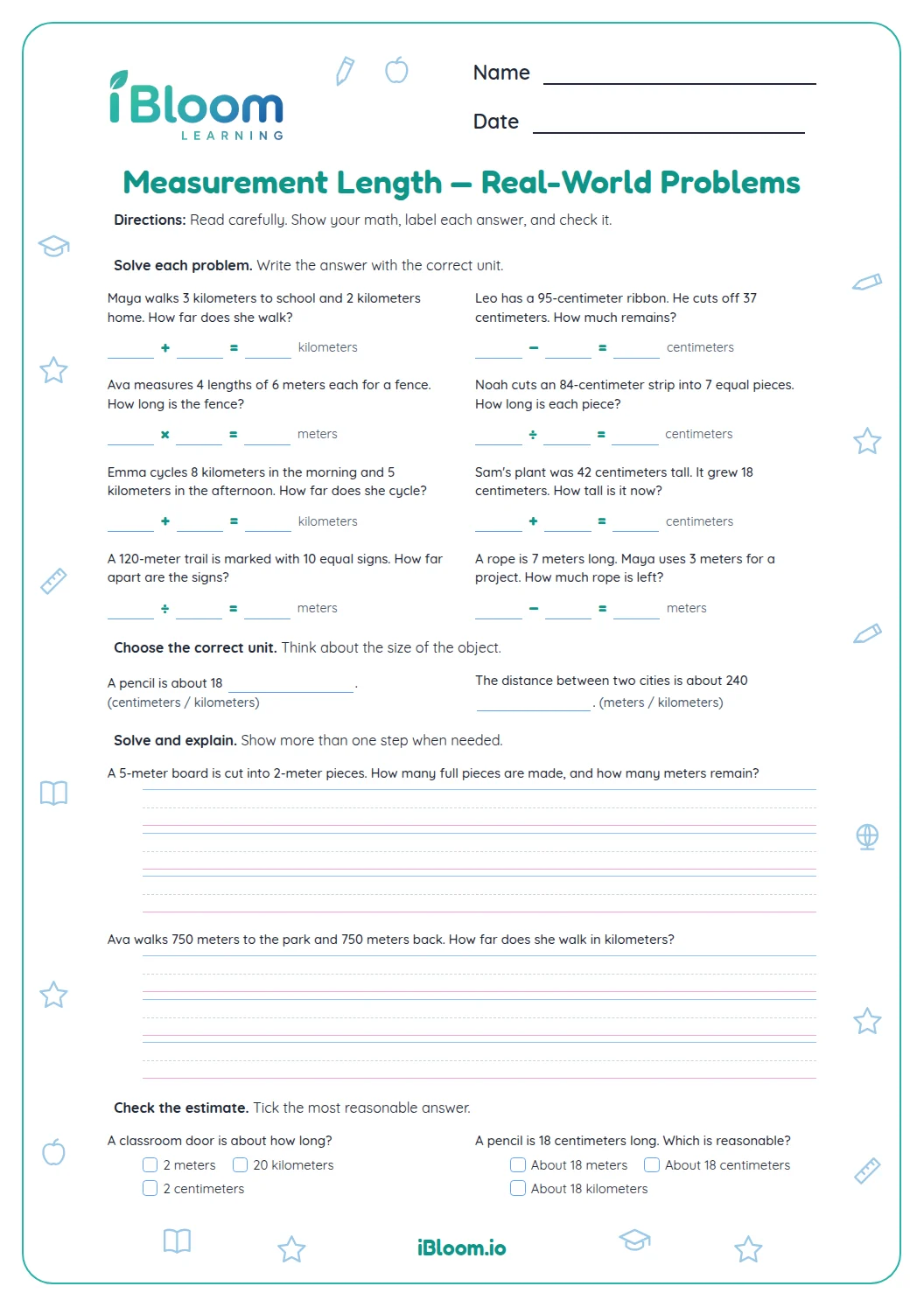
This Grade 5 printable combines ruler and conversion-table models with length word problems. Children read lengths, convert between feet and inches, yards and inches, or meters and centimeters, and use those conversions in multi-step situations. The 14 questions move from models to stories, with a separate answer key. It practices CCSS 5.MD.A.1 through measurement conversions and real-world length problems.
Aligned to 5.MD.A.1
How do you read a ruler model?
Start at zero and read the ruler mark at the object’s end. The pencil in question 1 reaches the 4-inch mark, so it is 4 inches long. Use the same endpoint rule for each ruler model.
- 1The pencil starts at 0.
- 2Its end lines up with 4.
- 3The pencil is 4 inches long.
How do you convert a length?
Use a known relationship between units, then multiply or divide. There are 12 inches in 1 foot, 36 inches in 1 yard, and 100 centimeters in 1 meter. For a calculation, convert both lengths to the same unit first.
How do you solve a length story?
When pieces are joined end to end, add their lengths. When some length is trimmed away, subtract. If a story gives different units, convert before calculating. For question 9, 3 feet equals 36 inches, so 36 − 8 = 28 inches remain.
How to use this worksheet at home or in class
- 1For a ruler model, start at zero and read the object’s endpoint.
- 2Use the table to connect units, such as 1 foot = 12 inches.
- 3Before a story calculation, convert both lengths to the same unit.
- 4Add joined lengths, subtract trimmed lengths, or divide for equal pieces.
- 5Write the unit with the answer and check that the result is reasonable.
Common mistakes and quick fixes
The mistake
Starting to measure at the first mark instead of zero.
The fix
Line up the object’s start with zero and read its endpoint.
The mistake
Adding or subtracting lengths with different units.
The fix
Convert both measurements to the same unit before calculating.
The mistake
Using the wrong conversion factor.
The fix
Recall the table relationship: 12 inches per foot, 36 per yard, or 100 centimeters per meter.
Common Core alignment
Students convert within customary and metric length systems and use conversions in story problems.
Convert measurement units within one system and use conversions to solve problems.
On this sheet: Students convert feet, yards, inches, meters, and centimeters, then use conversions in length stories.
Show the official wordingHide the official wording
Convert among different-sized standard measurement units within a given measurement system (e.g., convert 5 cm to 0.05 m), and use these conversions in solving multi-step, real world problems.
What to practice next
Make more practice
Further reading
Questions parents and teachers ask
How do you read the ruler drawings?
Start at the zero mark and read the ruler mark at the object’s endpoint. The pencil in the first drawing reaches 4, so it is 4 inches long. The ruler models use whole-inch lengths, and each object begins at zero.
How do conversion tables help with length?
A conversion table shows the relationship between units, such as 1 foot equaling 12 inches. Use that relationship to find an equivalent length, then convert both measurements to the same unit before solving a story. For example, 2 feet matches 24 inches because 2 × 12 = 24.
What grade is this worksheet for?
It is written for Grade 5 students practicing ruler reading, customary and metric length conversions, and word problems. The page uses feet, inches, yards, meters, and centimeters, and asks students to use unit relationships to solve each story. Students can check the unit in the separate key.
How many questions are on the worksheet?
There are 14 questions in three parts: five ruler models, three conversion-table questions, and six length stories. A separate answer key gives each measurement with its unit or number of pieces, so an adult can check the calculation. Each story answer names the requested unit.
When should I convert before adding or subtracting?
Convert whenever the lengths use different units. For example, change 3 feet to 36 inches before subtracting 8 inches. Once both amounts are in inches, subtract to find the 28 inches that remain. The story also tells you which unit to use for the final result.
Why do answers need units?
The unit tells what the number measures. Writing 28 inches is clearer than writing 28 by itself. This worksheet uses customary and metric lengths, so include the unit after each measurement and identify the unit requested. Convert 3 feet to 36 inches before finding a difference.