








About this worksheet
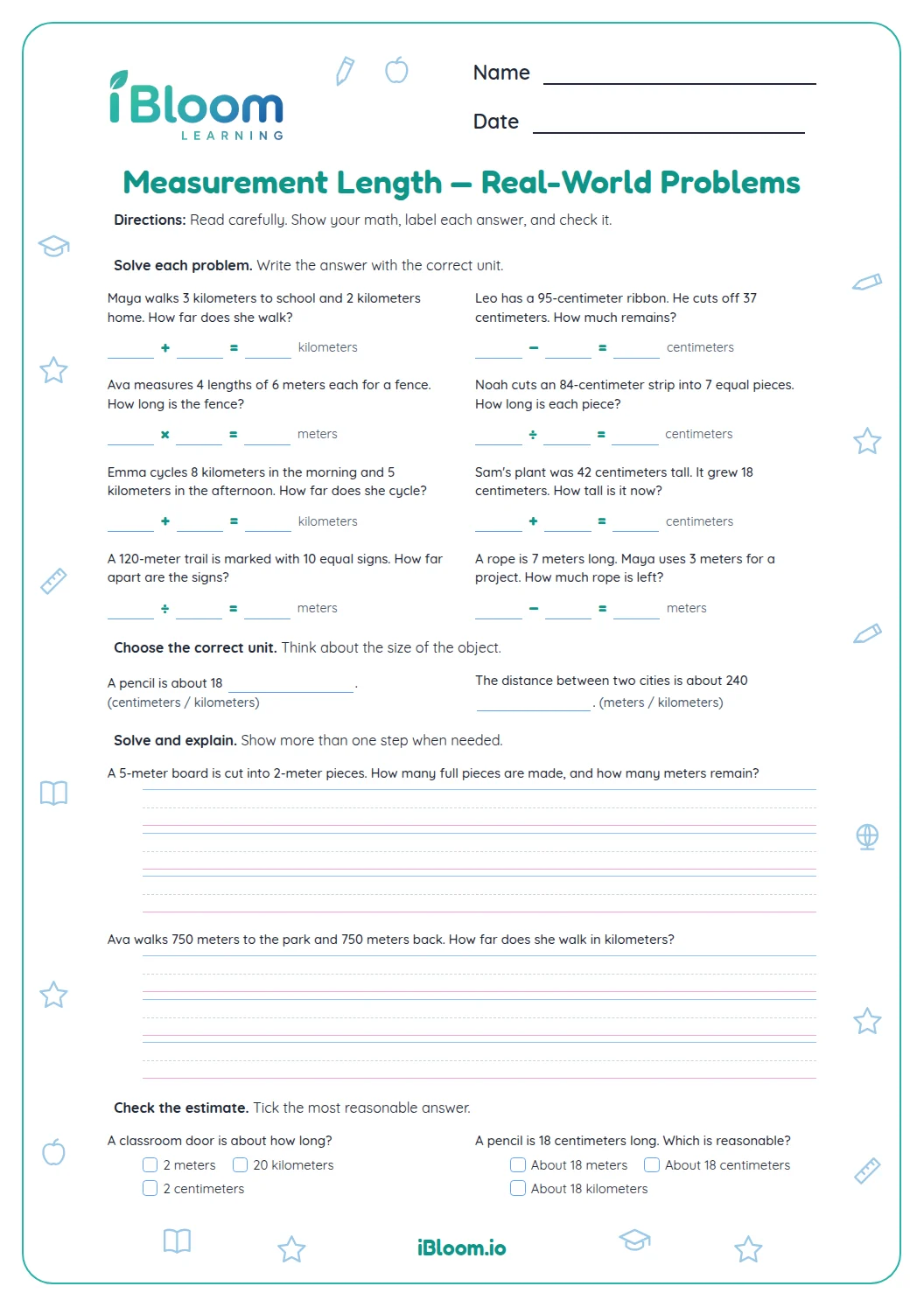
This free printable Grade 5 worksheet gives students metric length word problems that mix units, such as 2 km and 1,500 m in one question. Students choose a sensible unit, compare lengths given in different units, convert meters, kilometers and millimeters, and solve five multi-step problems that need a conversion before the arithmetic. It practices Common Core 5.MD.A.1 and suits students who are comfortable multiplying and dividing by 10, 100 and 1,000. There are 12 questions in three parts, with a separate answer key.
Aligned to 5.MD.A.1
How do you solve a length problem that uses two units?
Two lengths can only be added or subtracted when they are in the same unit. A problem that gives 2 km and 1,500 m is really asking for two steps: convert, then add. Writing the converted number on the page before calculating prevents the most common error, adding the numbers as they stand.
The metric system makes conversion a matter of place value. A meter is 100 centimeters and 1,000 millimeters, and a kilometer is 1,000 meters, so moving between units multiplies or divides by 10, 100 or 1,000.
- 12 km + 1,500 m
- 22 km = 2,000 m
- 32,000 m + 1,500 m = 3,500 m
- 4The question asks for kilometers
- 53,500 m = 3.5 km
Do you multiply or divide when you change units?
Ask whether the unit you are going to is bigger or smaller. Going to a smaller unit (meters to centimeters) gives a bigger number, so multiply. Going to a bigger unit (millimeters to meters) gives a smaller number, so divide.
Question 6 shows the check: 4,500 mm should be a few meters, since a meter is 1,000 mm. The answer 4.5 m passes that check, while 450 m does not.
What is on this worksheet?
Twelve questions in three parts, from choosing units to multi-step problems.
- Part A, Choose the best answer: a sensible unit, an equal length and the greatest of three lengths in mixed units
- Part B, Change the unit: four conversions, including decimals such as 0.75 km and 4,500 mm
- Part C, Solve and write the unit: five word problems with working space and an answer box
- Answer key on separate pages
How to use this worksheet at home or in class
- 1Review the metric facts together: 1 m = 100 cm, 1 m = 1,000 mm and 1 km = 1,000 m. Writing them at the top of the page helps.
- 2Do Part A first. For question 3, ask your student to rewrite all three lengths in centimeters before choosing.
- 3In Part B, say whether the answer should be bigger or smaller than the starting number before converting.
- 4For each word problem, underline the unit the question asks for and write the converted numbers before doing any arithmetic.
- 5Have your student check each answer for sense: does 40 cm sound right for a piece of a 3.6 m board cut into 9?
- 6Mark with the answer key and redo any missed problem, converting first.
Common mistakes and quick fixes
The mistake
Adding without converting: 2 km + 1,500 m = 1,502.
The fix
Rewrite 2 km as 2,000 m first. Then 2,000 m + 1,500 m = 3,500 m.
The mistake
Moving the decimal the wrong number of places: 4,500 mm = 450 m.
The fix
There are 1,000 mm in 1 m, so divide by 1,000 and get 4.5 m. Sense check: 4,500 mm is four and a half meter sticks laid end to end, not the length of several sports fields.
The mistake
Answering in the wrong unit: writing 500 for the meters in question 9 because the strips are measured in centimeters.
The fix
Underline the unit the question asks for. 500 cm is correct for the row, but the question asks for meters, so write 5 m.
Common Core alignment
Most US states use the Common Core standards or a close state version. This sheet practices the standard below.
Convert between metric units and use the conversions in multi-step word problems.
On this sheet: Part B converts meters, kilometers and millimeters, and the five word problems in Part C need a conversion before the arithmetic.
Show the official wordingHide the official wording
Convert among different-sized standard measurement units within a given measurement system (e.g., convert 5 cm to 0.05 m), and use these conversions in solving multi-step, real world problems.
What to practice next
Make more practice
Further reading
Questions parents and teachers ask
What metric facts should my student know first?
Students should know that 1 meter is 100 centimeters and 1,000 millimeters, and 1 kilometer is 1,000 meters. With these, every conversion on the sheet works by multiplying or dividing by 100 or 1,000. Writing the facts at the top of the page is a good habit.
What is the answer to Emma’s bike ride problem?
Emma bikes 3.5 kilometers. Rewrite 2 km as 2,000 m, add the afternoon ride of 1,500 m to get 3,500 m, and then change back to kilometers by dividing by 1,000. The question asks for kilometers, so 3.5 km is the answer, not 3,500.
Why does question 3 have lengths in three different units?
Comparing lengths in different units cannot be done by looking at the numbers, because 2,050 is the biggest number but the smallest length. Students change all three to one unit, such as centimeters: 250, 240 and 205. That makes 2.5 meters the greatest.
Why do some answers have decimals?
Changing to a bigger unit often gives a decimal. Question 6 turns 4,500 mm into 4.5 m, and Emma’s bike ride comes to 3.5 km. Dividing by 1,000 moves each digit three places to the right, so students need to be comfortable with tenths and hundredths, as in 0.75 km = 750 m.
How can students check a converted answer?
Ask whether the answer should be bigger or smaller than the starting number. Changing to a smaller unit gives a bigger number; changing to a bigger unit gives a smaller one. Then picture a real length: 4.5 m is about the length of a car, while 450 m is several city blocks.
Is there an answer key for this worksheet?
Yes. A separate answer key shows the bubbles for Part A, the converted numbers in Part B and the five word problem answers with units in Part C. Print the worksheet by itself and keep the key for checking, or download the worksheet and key together as a free PDF from this page.