







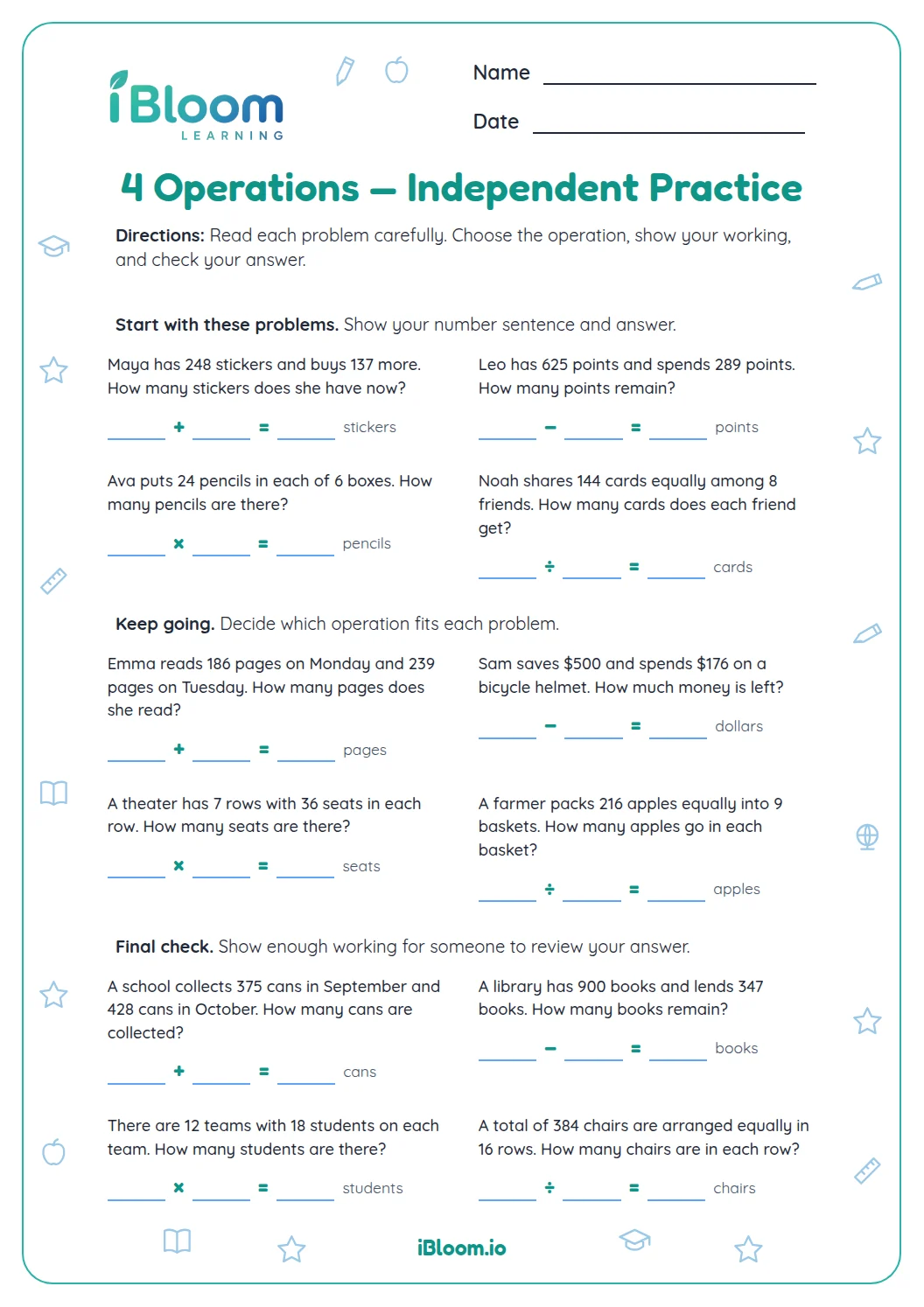
About this worksheet
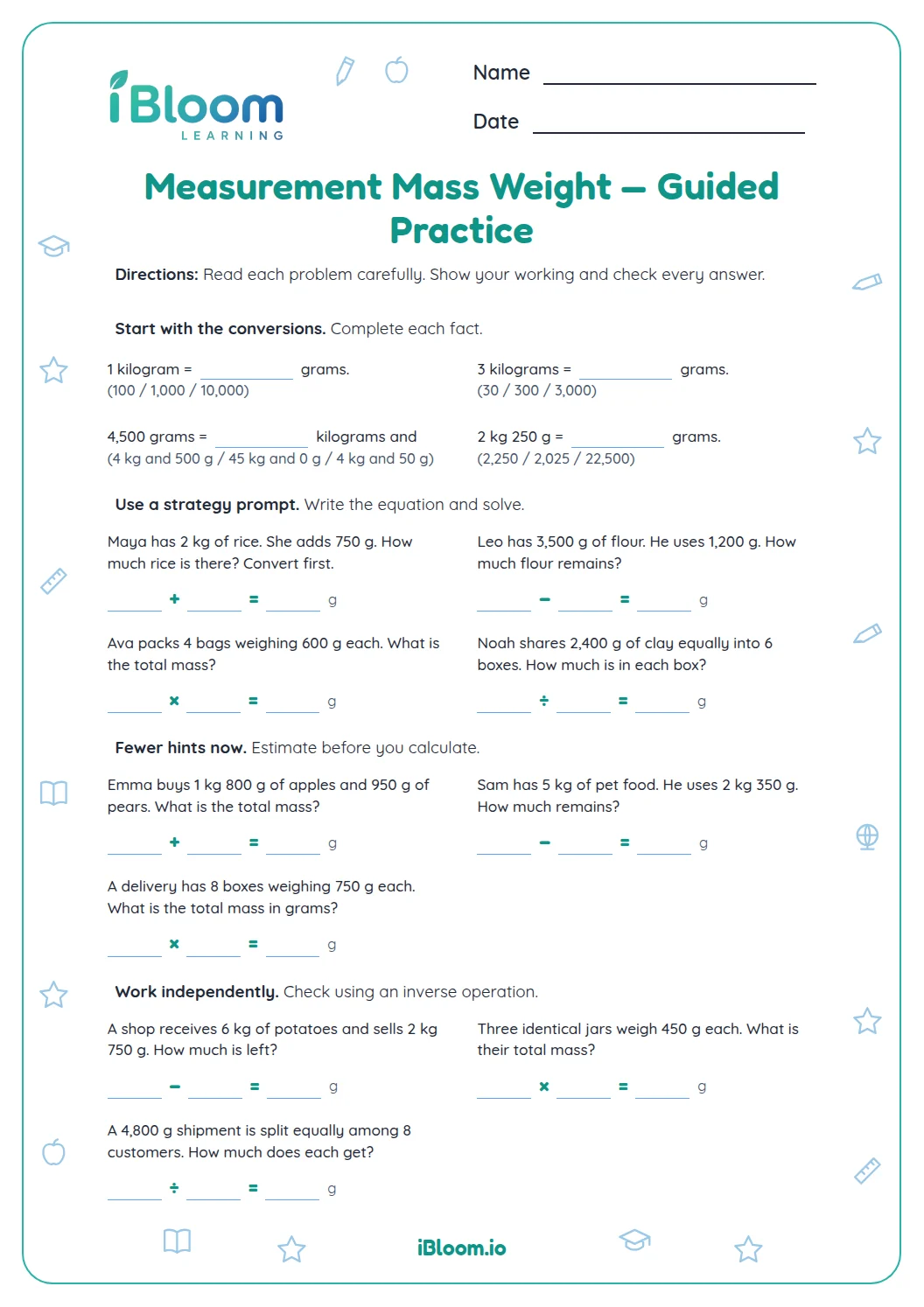
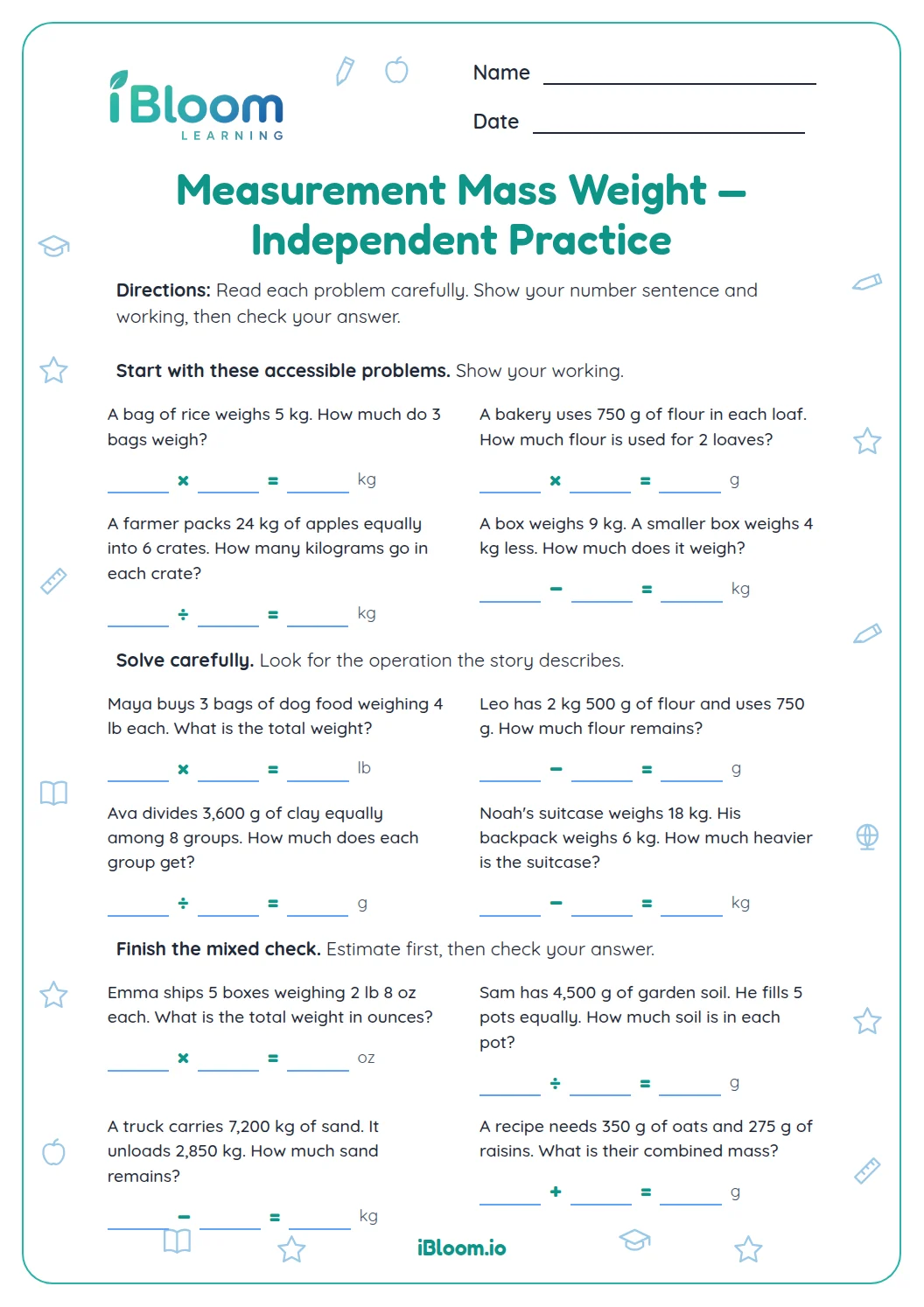
This Grade 5 worksheet builds mass measurement from unit sense to word problems. Learners choose milligrams, grams, or kilograms for familiar objects, convert between units, and solve addition, subtraction, multiplication, and division situations. A worked conversion reminds them that 1 kg = 1,000 g; the separate answer key includes units. The page practices CCSS 5.MD.A.1 through mass conversions and their use in problems.
Aligned to 5.MD.A.1
Which unit fits an object?
Use milligrams for tiny masses such as a tablet, grams for light objects, and kilograms for heavier objects. The opening questions ask learners to match a reasonable unit to each object.
- 1A paper clip has a mass of about 1 ___.
- 2Choose g: it is light, but not as tiny as a milligram.
How do you convert kilograms and grams?
The sheet has 15 questions in four parts. Learners begin with unit choices, convert mass units, model a calculation, and finish with short mass problems.
- 13 kg = 3 × 1,000 g
- 23 kg = 3,000 g
- Part A: Choose mg, g, or kg for familiar objects.
- Part B: Convert between mass units.
- Part C: Model a mass calculation with working space.
- Part D: Solve three more mass word problems.
How do the final parts use mass?
Part C gives room to write a number sentence for a mass problem. Part D offers three shorter problems using subtraction, multiplication, and division; each answer still needs its unit.
How to use this worksheet
- 1Read the object or situation and note its unit.
- 2Use 1 kg = 1,000 g to convert before comparing.
- 3Choose the operation that matches the story.
- 4Write the number sentence and include a unit in your answer.
- 5Check that the result is reasonable for the amount described.
Common mistakes and quick fixes
The mistake
Using kilograms for a very small mass.
The fix
Compare the object with the unit sizes: mg is tiny, g is light, kg is heavier.
The mistake
Moving from kilograms to grams by dividing.
The fix
Multiply kilograms by 1,000; divide grams by 1,000 to get kilograms.
The mistake
Adding masses in different units without converting.
The fix
Convert both amounts to the same unit before calculating.
Curriculum alignment
This worksheet gives learners practice with the standard below.
Convert and compare measurements in different-sized units.
On this sheet: Learners convert between kilograms and grams and use those conversions in mass problems.
Show the official wordingHide the official wording
Convert among different-sized standard measurement units within a given measurement system (e.g., convert 5 cm to 0.05 m), and use these conversions in solving multi-step, real world problems.
What to practice next
Make more practice
Further reading
Questions parents and teachers ask
How many grams are in a kilogram?
One kilogram is equal to 1,000 grams. The worksheet uses this relationship in its conversion questions and in mass situations. For example, 3 kg is 3 × 1,000, or 3,000 g. Learners can write the unit beside every value before deciding whether a conversion is needed.
When should a learner use mg, g, or kg?
Milligrams describe very small masses, grams describe lighter everyday objects, and kilograms describe heavier objects. The first part asks learners to choose among these units for a paper clip, tablet, backpack, and grain of salt. Learners can write the unit beside every value before deciding whether a conversion is needed.
Does this worksheet include word problems?
Yes. The final part includes five mass situations using addition, subtraction, multiplication, or division. Learners write a number sentence, solve it, and include the unit in their answer. Learners can write the unit beside every value before deciding whether a conversion is needed.
Why should units be included in answers?
A number alone does not say whether a mass is measured in grams or kilograms. Writing the unit shows what the result means and helps catch a conversion error, especially when the problem gives values in different units. Learners can write the unit beside every value before deciding whether a conversion is needed.
What comes in the answer key?
The separate key lists the selected units, conversion results, and word-problem answers. For calculations, encourage the learner to show a number sentence on the worksheet before checking the final value and unit. Learners can write the unit beside every value before deciding whether a conversion is needed.