





About this worksheet
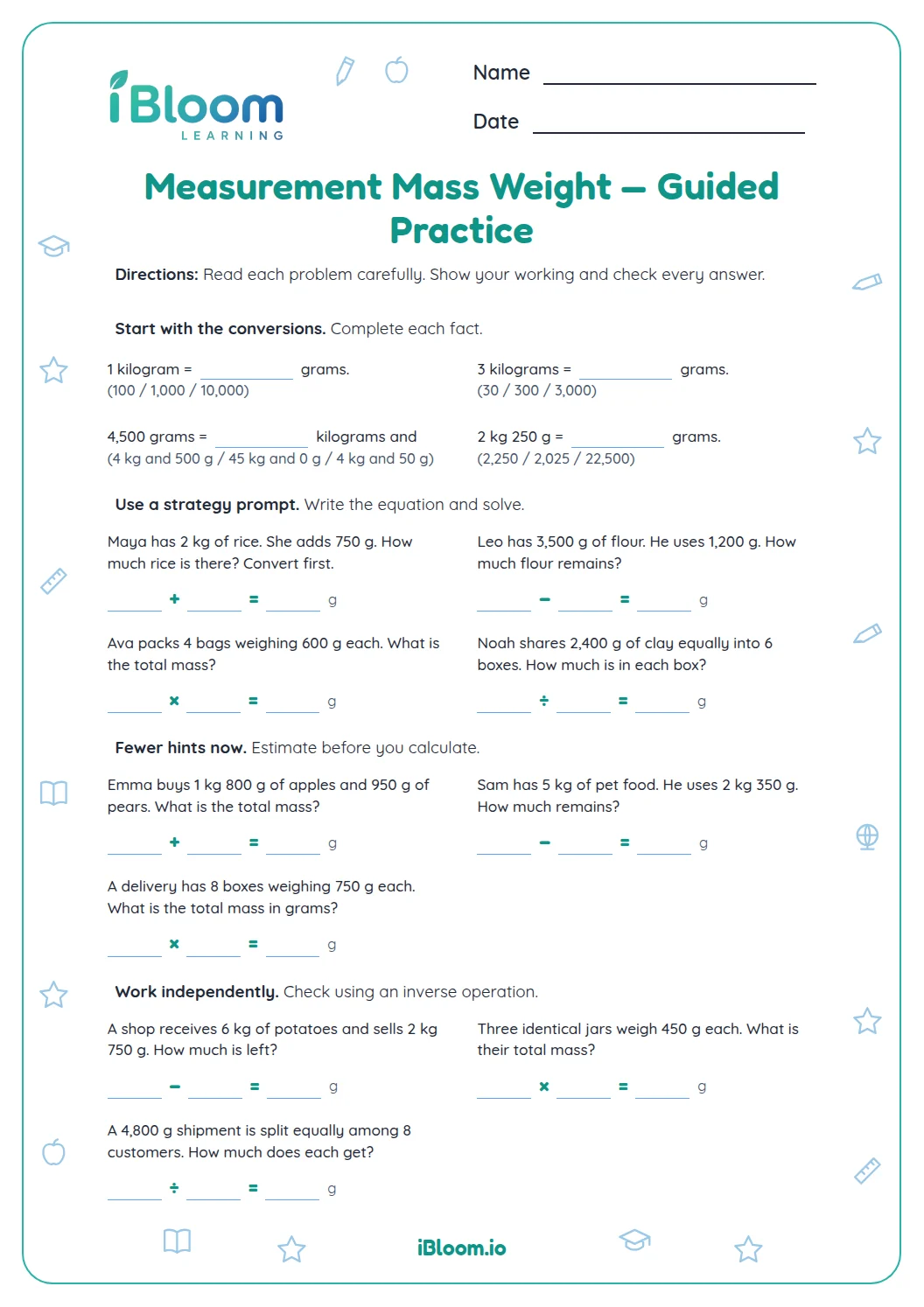
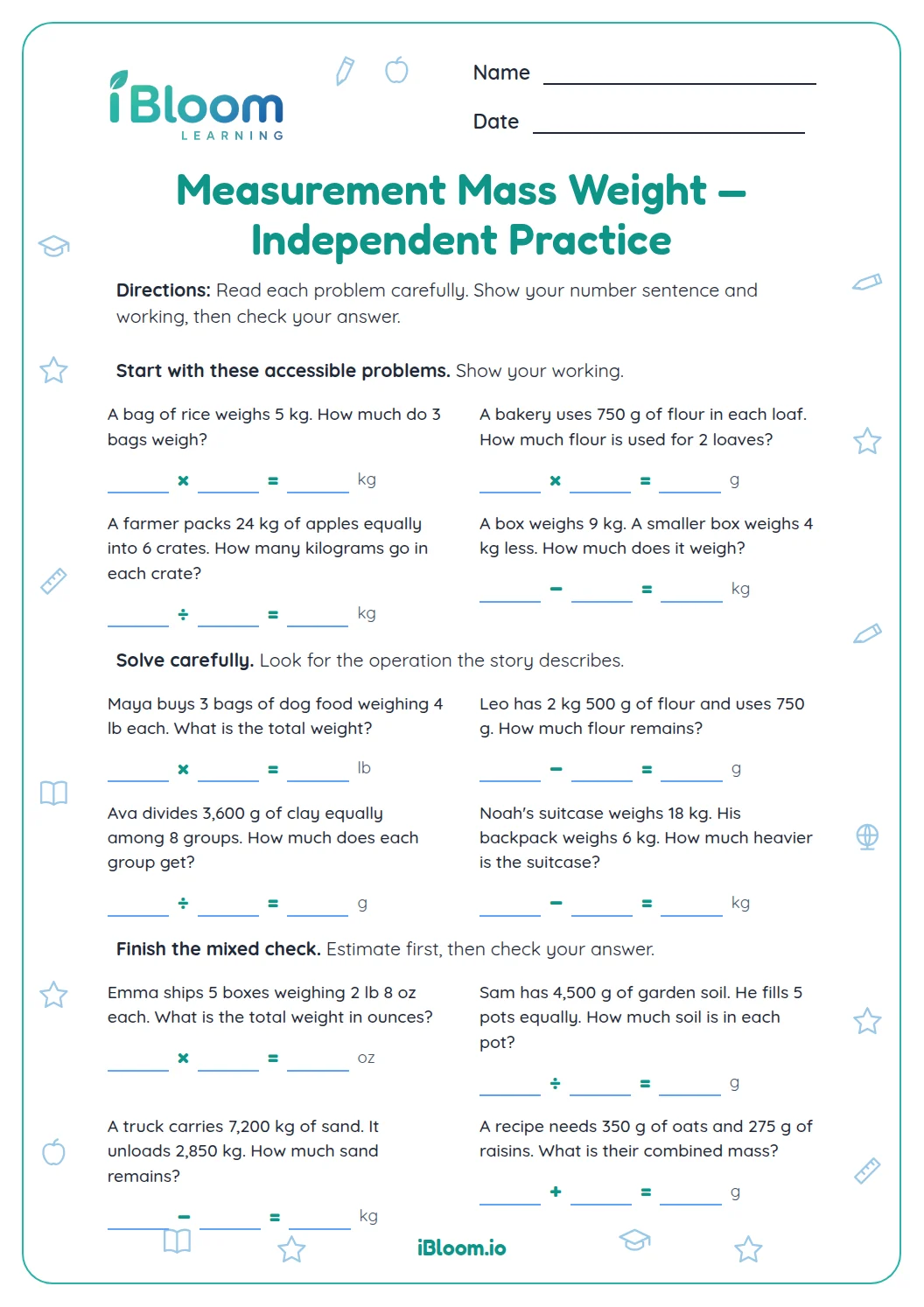
This Grade 5 worksheet gives learners 16 problems about customary weight and metric mass. It practices CCSS 5.MD.A.1 by converting pounds to ounces and kilograms to grams in real-world problems. Learners work with mixed-unit amounts and solve comparison and equal-group situations. A separate answer key lists each result with its unit.
Aligned to 5.MD.A.1
Which unit relationships help solve these problems?
Use 1 pound = 16 ounces and 1 kilogram = 1,000 grams. Write the relationship first so the unit tells you whether to multiply or divide.
For example, 3 pounds is 3 × 16 = 48 ounces.
How do you work with mixed-unit amounts?
Convert the larger unit to the smaller unit, then combine or compare. For 5 pounds 8 ounces, convert 5 pounds to 80 ounces and add 8 ounces to get 88 ounces.
How can you check whether a conversion makes sense?
A smaller unit takes more units to describe the same amount. Three pounds should therefore be 48 ounces, a larger number with an equivalent weight.
How to solve each problem
- 1Underline the given measurement and the unit requested.
- 2Write the conversion fact you need.
- 3Convert the larger unit into smaller units when useful.
- 4Complete any addition or subtraction in the story.
- 5Write the answer with the requested unit.
Conversion errors to catch
The mistake
Multiplying ounces by 16 when converting to pounds.
The fix
Divide by 16 because pounds are larger units.
The mistake
Using 100 grams in a kilogram.
The fix
Recall that 1 kilogram equals 1,000 grams.
The mistake
Leaving off the unit in the answer.
The fix
Copy the unit named in the question after the number.
Common Core alignment
This worksheet practices the standards below through focused reading and problem solving.
Convert within customary and metric mass units in real-world problems.
On this sheet: The problems convert pounds and ounces or kilograms and grams to solve measurement situations.
Show the official wordingHide the official wording
Convert among different-sized standard measurement units within a given measurement system (e.g., convert 5 cm to 0.05 m), and use these conversions in solving multi-step, real world problems.
What to practice next
Make more practice
Further reading
Questions parents and teachers ask
Which conversion facts are used?
The questions use 1 pound = 16 ounces and 1 kilogram = 1,000 grams. Keep the customary and metric relationships separate, and write the requested unit after each answer. Check that the final unit matches what the question asks.
What types of problems are on the sheet?
The 16 items include direct conversions, mixed pounds-and-ounces or kilograms-and-grams amounts, comparisons, equal groups, and finding how much remains or is needed. The separate answer key includes units. Check that the final unit matches what the question asks.
Why is the number larger when converting pounds to ounces?
An ounce is a smaller unit than a pound, so more ounces describe the same weight. For example, 3 pounds equals 48 ounces because each pound contains 16 ounces. Check that the final unit matches what the question asks.
Should learners show their work?
Yes. The worksheet gives working space, so write the conversion fact and any multiplication, addition, or subtraction used. Include the requested unit with the final answer to make its meaning clear. Check that the final unit matches what the question asks.
What does the key include?
The separate answer key lists all 16 results with their requested units. Check both the calculation and the unit, especially when a question asks for kilograms after starting with grams or ounces after starting with pounds. Check that the final unit matches what the question asks.