







About this worksheet
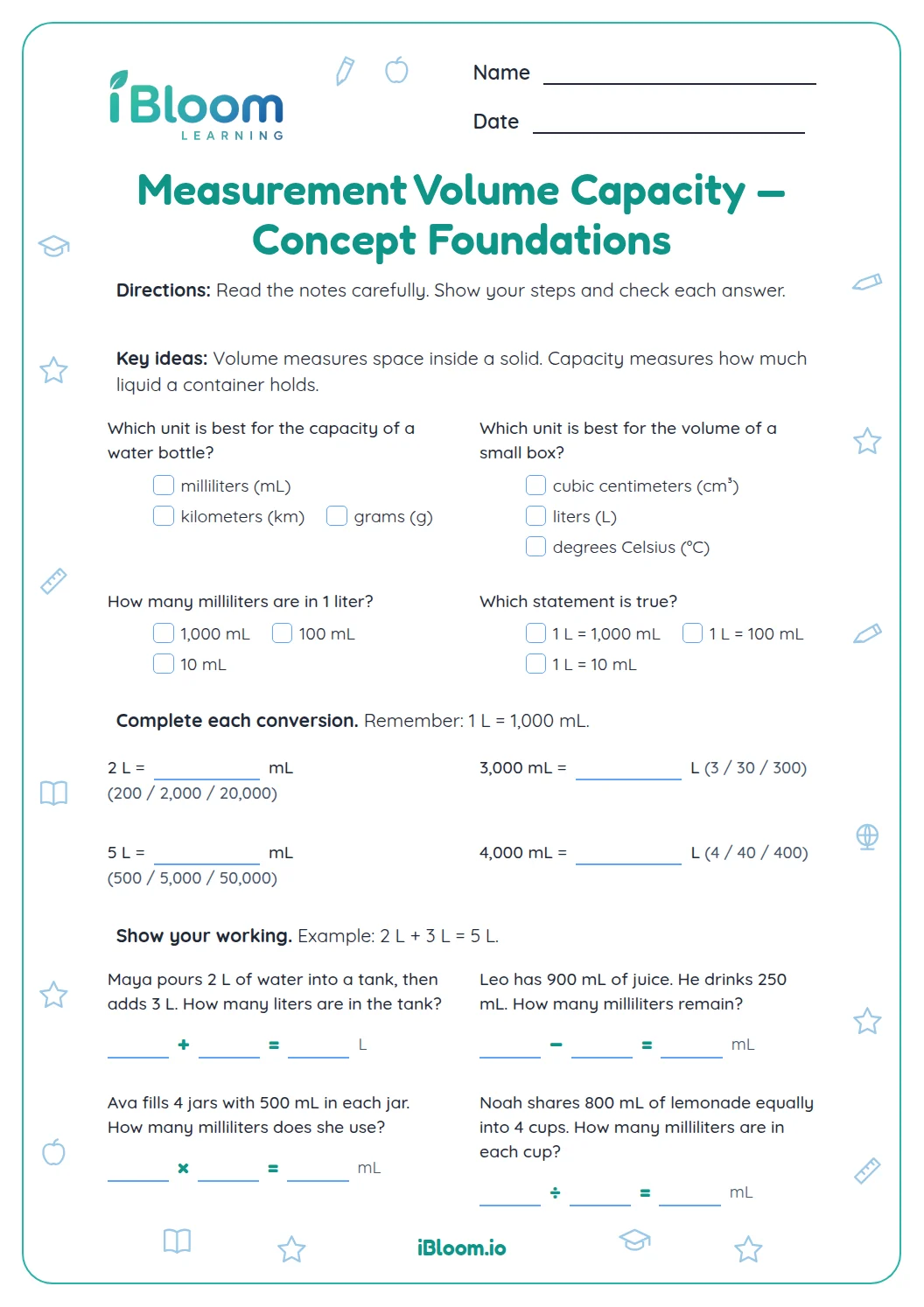
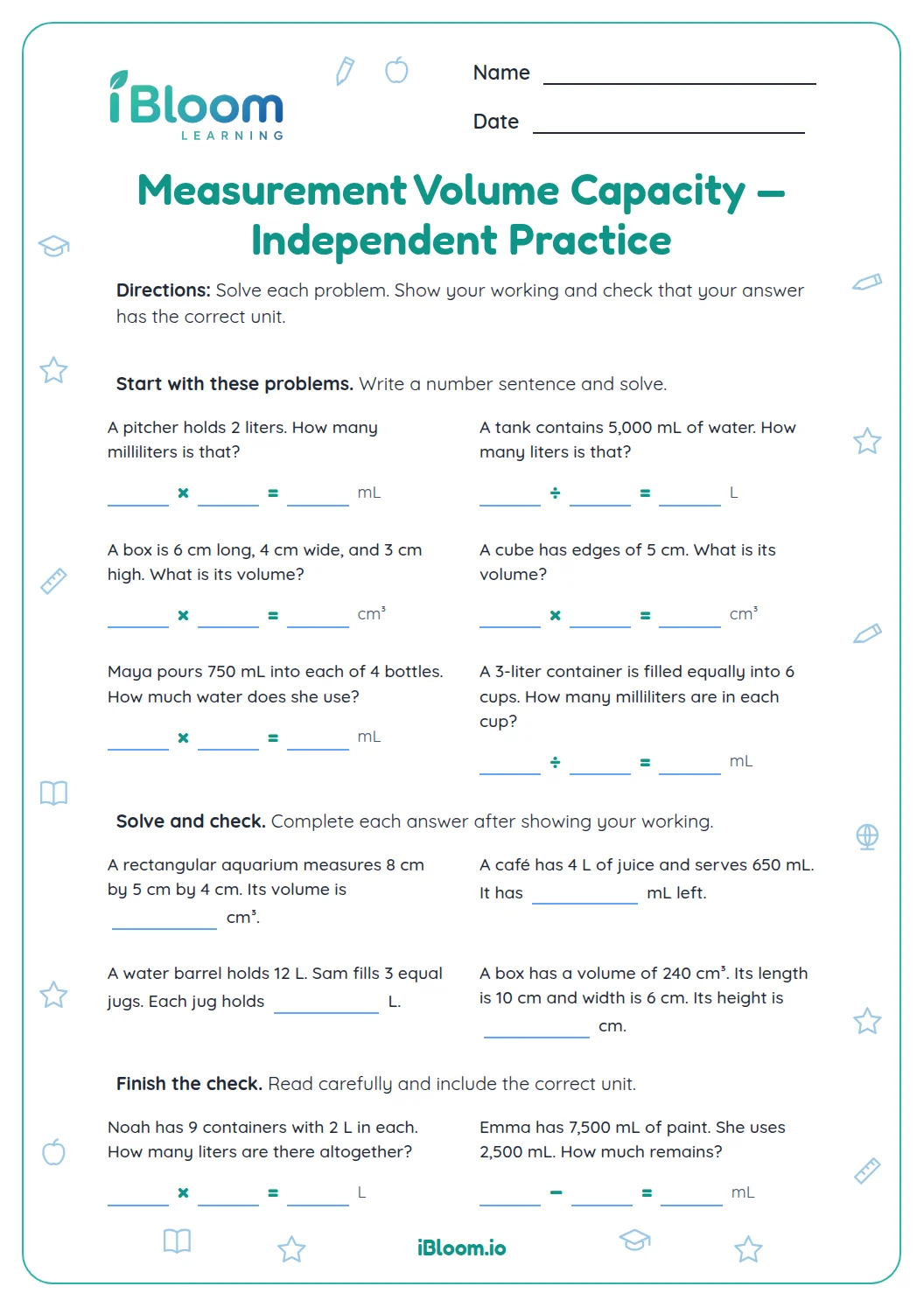
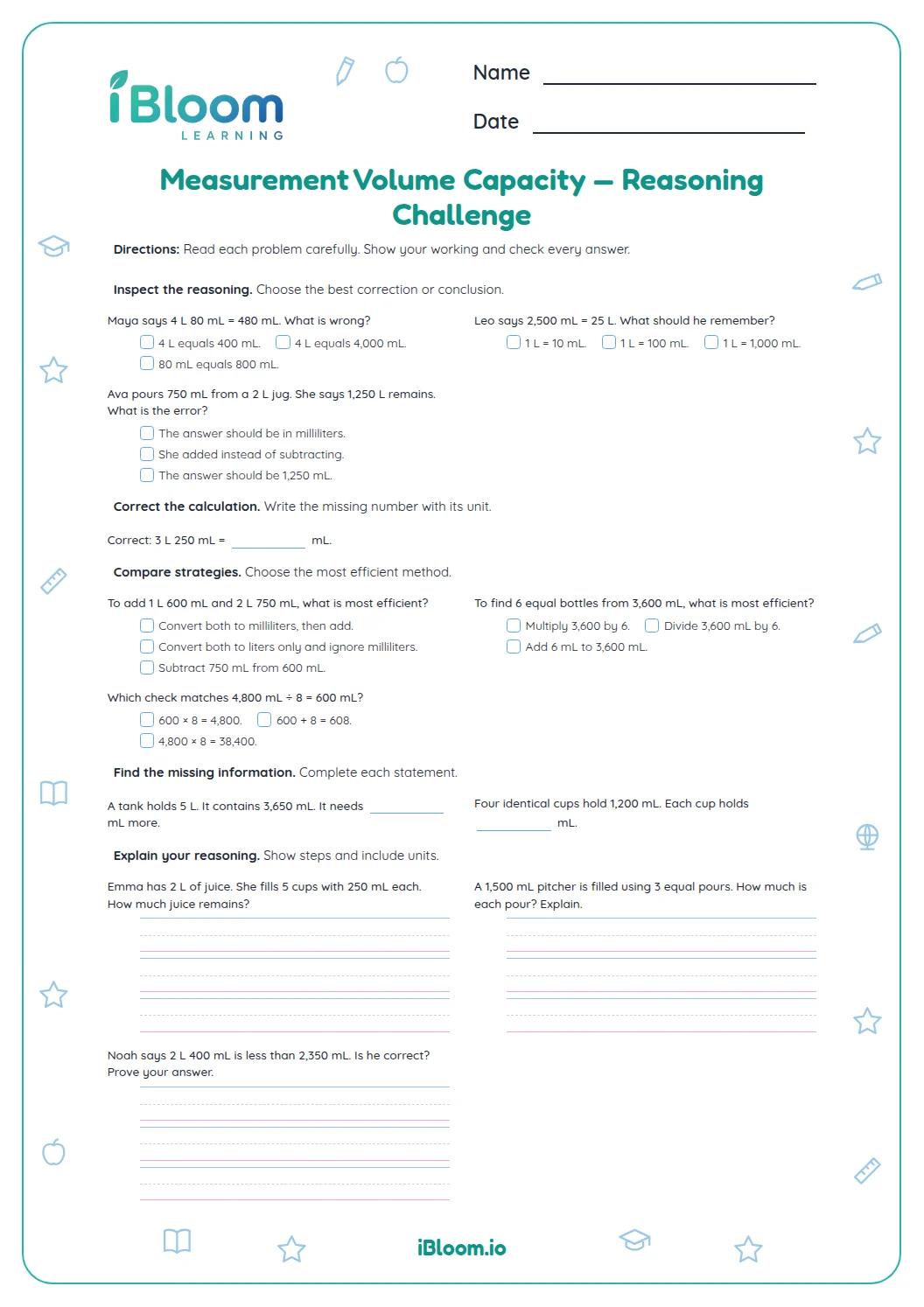
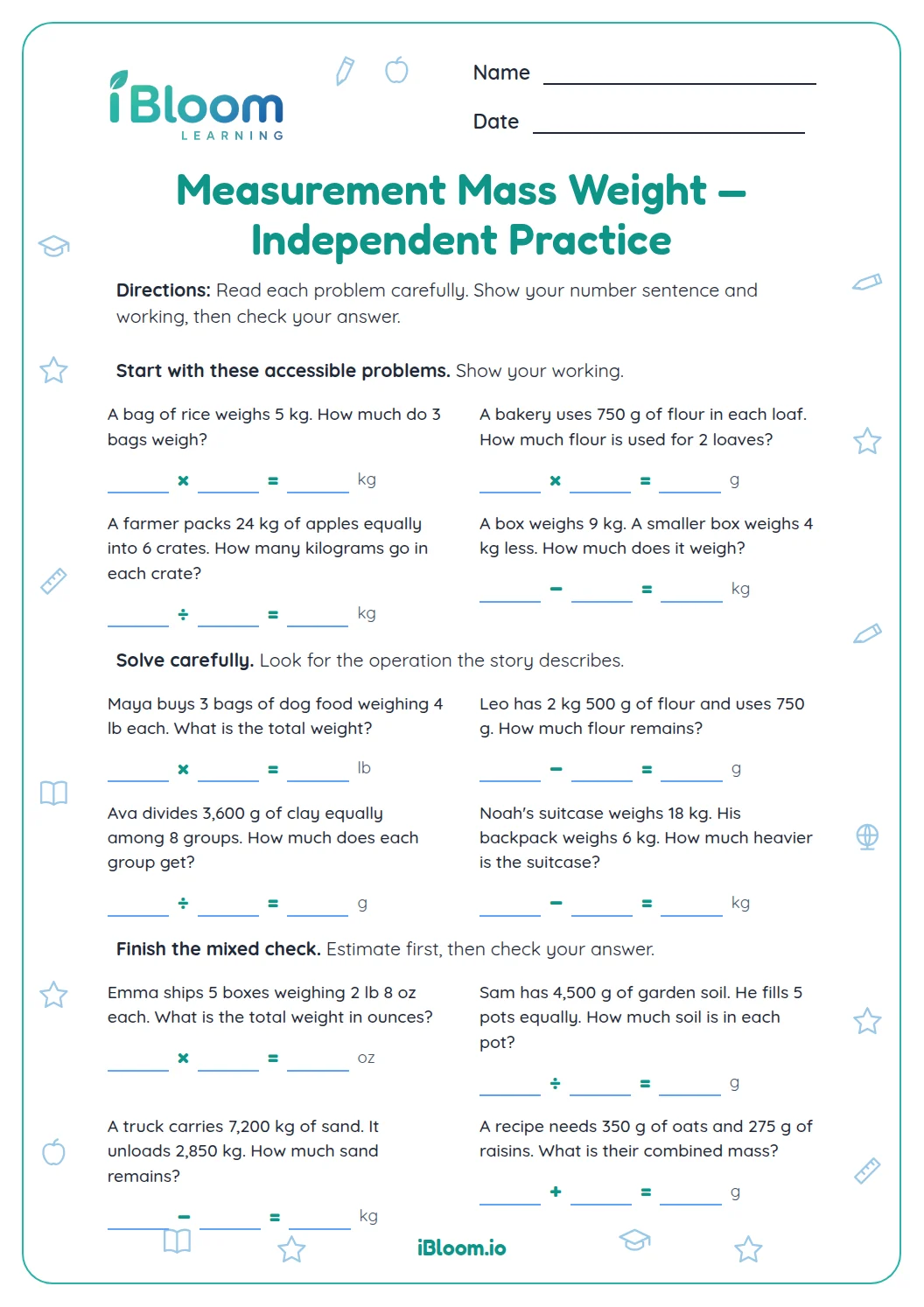
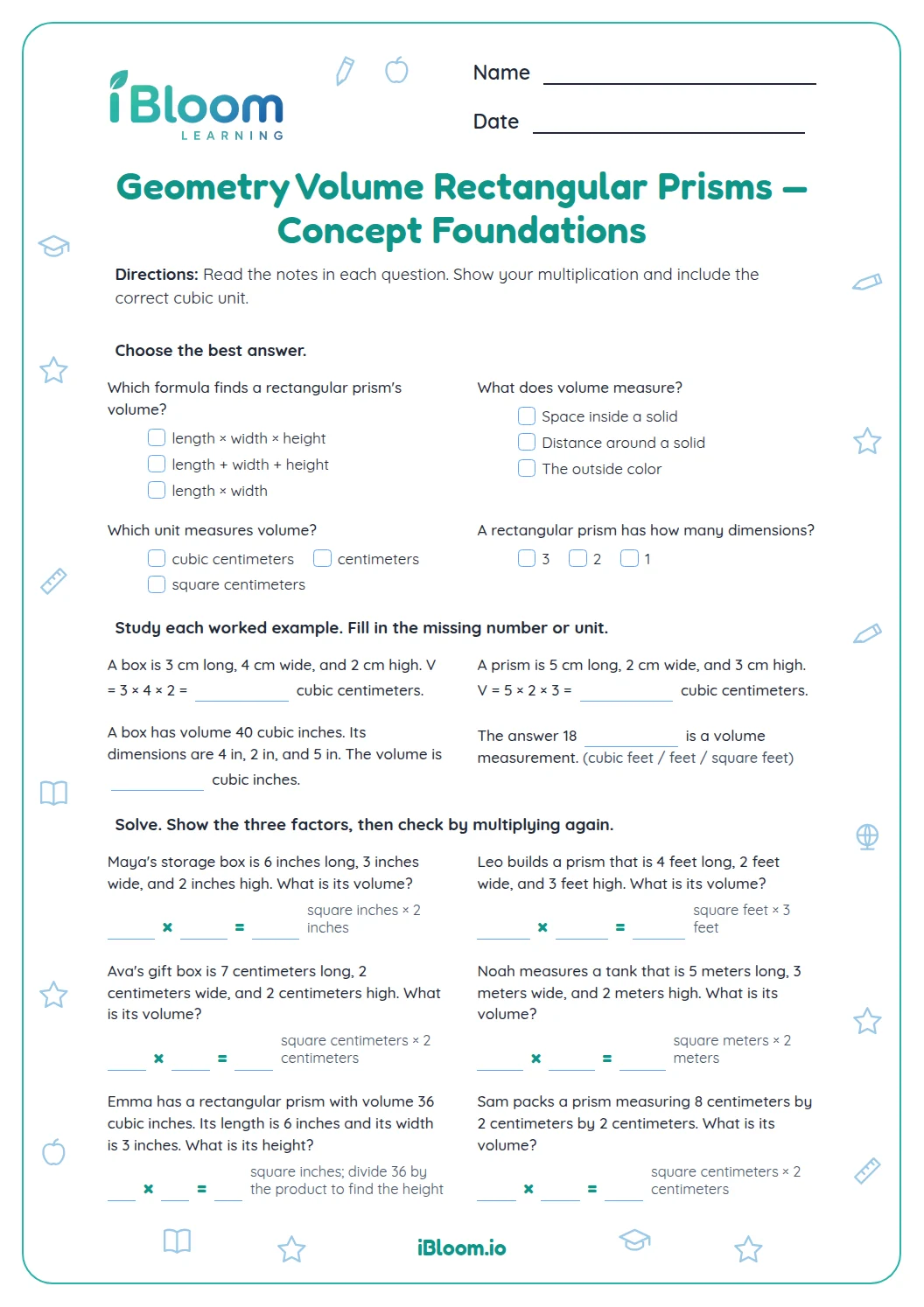
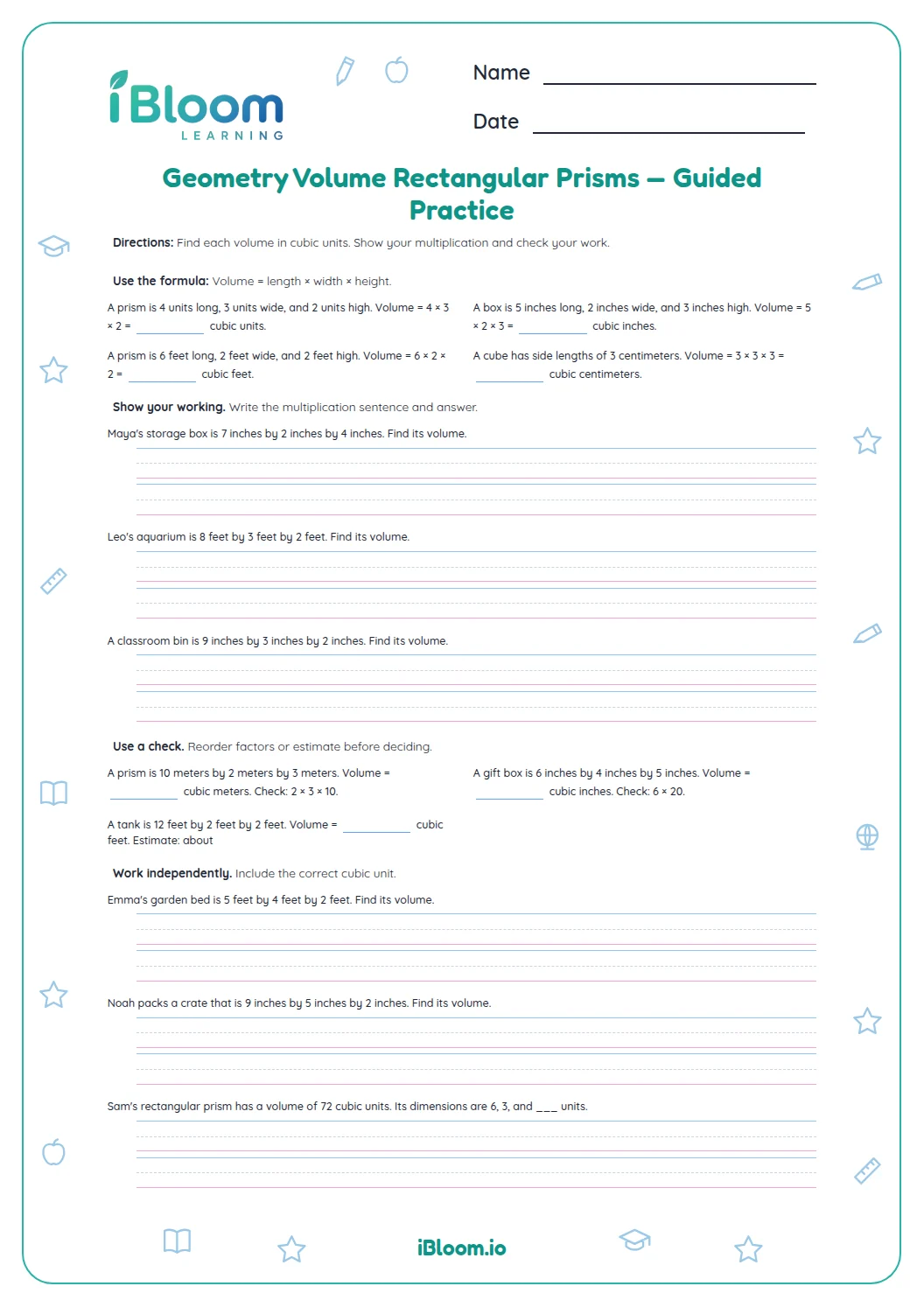
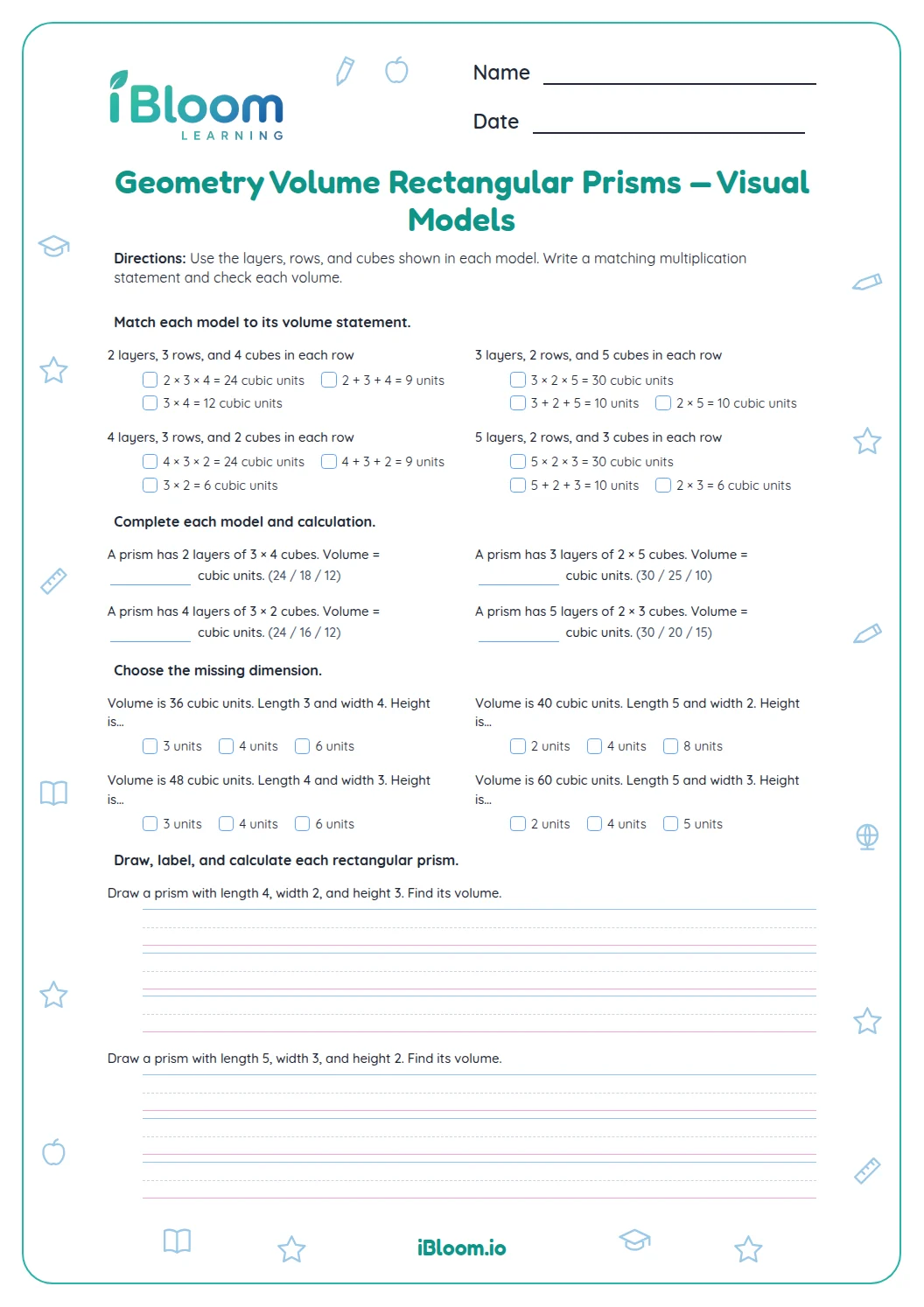
This free Grade 5 worksheet connects container capacities with liters and milliliters. Children choose sensible capacities for a baby bottle and large bowl, read two shaded-bar models, and complete eight measurement number sentences. Two final word problems ask children to calculate how much liquid fills a jug and how much each bottle receives when sharing equally. The fourteen tasks practice Common Core 5.MD.A.1 through conversions used in measurement problems. A separate answer key gives the fixed answers and describes the two labeled models.
Aligned to 5.MD.A.1
How do children choose a sensible capacity?
Part A asks about a baby bottle and a large bowl. Compare the choices with familiar containers: 250 mL is sensible for the bottle, and 2 L is sensible for the large bowl. These are estimates, not measurements taken from the pictures.
How do children read the volume models?
Part B begins with two shaded-bar models. Each full bar represents 1 L. A fourth is 250 mL and a half is 500 mL. Count any whole liters as well as the shaded fraction, then express the total in milliliters.
Part C moves from reading models to converting and calculating. The first two blanks rename 0.6 L and 2.5 L in milliliters. The next four number sentences convert liters to milliliters. The final four combine conversion with addition, subtraction, multiplication, or division. For question 8, 1.5 L + 250 mL becomes 1,500 mL + 250 mL = 1,750 mL.
- 1Three shaded fourths of 1 L
- 21,000 ÷ 4 = 250 mL per part
- 33 × 250 = 750 mL
- 4The bottle contains 750 mL.
How are filling and sharing problems solved?
Part D applies the liter-to-milliliter conversion in four short capacity problems. For question 11, convert 2 L to 2,000 mL and 1 1/4 L to 1,250 mL, then subtract: 2,000 − 1,250 = 750 mL still fits.
For question 12, divide 2,000 mL equally among four bottles. Each bottle receives 500 mL. Questions 13 and 14 ask for similar unit-conversion and sharing calculations. The bar models in Part B show how a whole liter can be split into equal parts before children solve these related calculations.
How to use this worksheet
- 1Compare the Part A capacity choices with a familiar baby bottle and large bowl.
- 2Read the 1 L = 1,000 mL reminder and find the shaded amount in question 3.
- 3Read both Part B bar models and write each amount in milliliters.
- 4In Part C, convert liters to milliliters before adding, subtracting, or multiplying.
- 5Choose answers for the four capacity applications in Part D, then check each unit and calculation.
Mistakes to check and ways to help
The mistake
Treating three fourths of a liter as 3 mL.
The fix
One full bar is 1,000 mL; each of its four parts is 250 mL.
The mistake
Adding 250 to 1.5 without converting units.
The fix
Rename 1.5 L as 1,500 mL before adding 250 mL.
The mistake
Labeling 1,250 mL as the amount needed to fill the jug in question 11.
The fix
That is the liquid already inside. Subtract it from the 2,000 mL capacity to find the 750 mL gap.
Common Core alignment
Convert liters to milliliters and use the conversions to solve liquid-volume problems.
On this sheet: Children read liquid amounts from models, convert units, and combine or subtract amounts.
Show the official wordingHide the official wording
Convert among different-sized standard measurement units within a given measurement system (e.g., convert 5 cm to 0.05 m), and use these conversions in solving multi-step, real world problems.
What to practice next
Make more practice
Further reading
Questions parents and teachers ask
Which questions use visual models?
Questions 3 and 4 give shaded bars to read, and questions 11 and 12 ask children to draw their own models. Part A also has two container pictures for capacity estimates. Part C uses eight measurement number sentences to practice converting units before calculating.
Which conversion does my child need?
Use 1 L = 1,000 mL, printed in the worksheet directions. Children convert halves, fourths, decimals, and whole liters before calculating. In question 9, for example, half a liter equals 500 mL, so multiplying that amount by two gives a total of 1,000 mL.
How is the jug problem solved?
The jug in question 11 needs 750 mL more. Its capacity is 2 L, or 2,000 mL, and it already contains 1 1/4 L, or 1,250 mL. A labeled bar can show both the filled amount and the gap: 2,000 − 1,250 = 750 mL.
Can children use different drawings in Part D?
Yes. The bar models in Part B show liquid amounts in equal parts, and Part D asks children to calculate a jug’s remaining capacity and equal bottle shares. For equal sharing, divide 2,000 mL among four bottles to get 500 mL in each.
What does the answer key include?
The key gives all fourteen answers, including the two shaded-bar readings and four capacity applications. For question 11, check that the remaining capacity is 750 mL; for question 12, each bottle receives 500 mL. The arithmetic answers can be checked by converting liters before calculating.