


About this worksheet
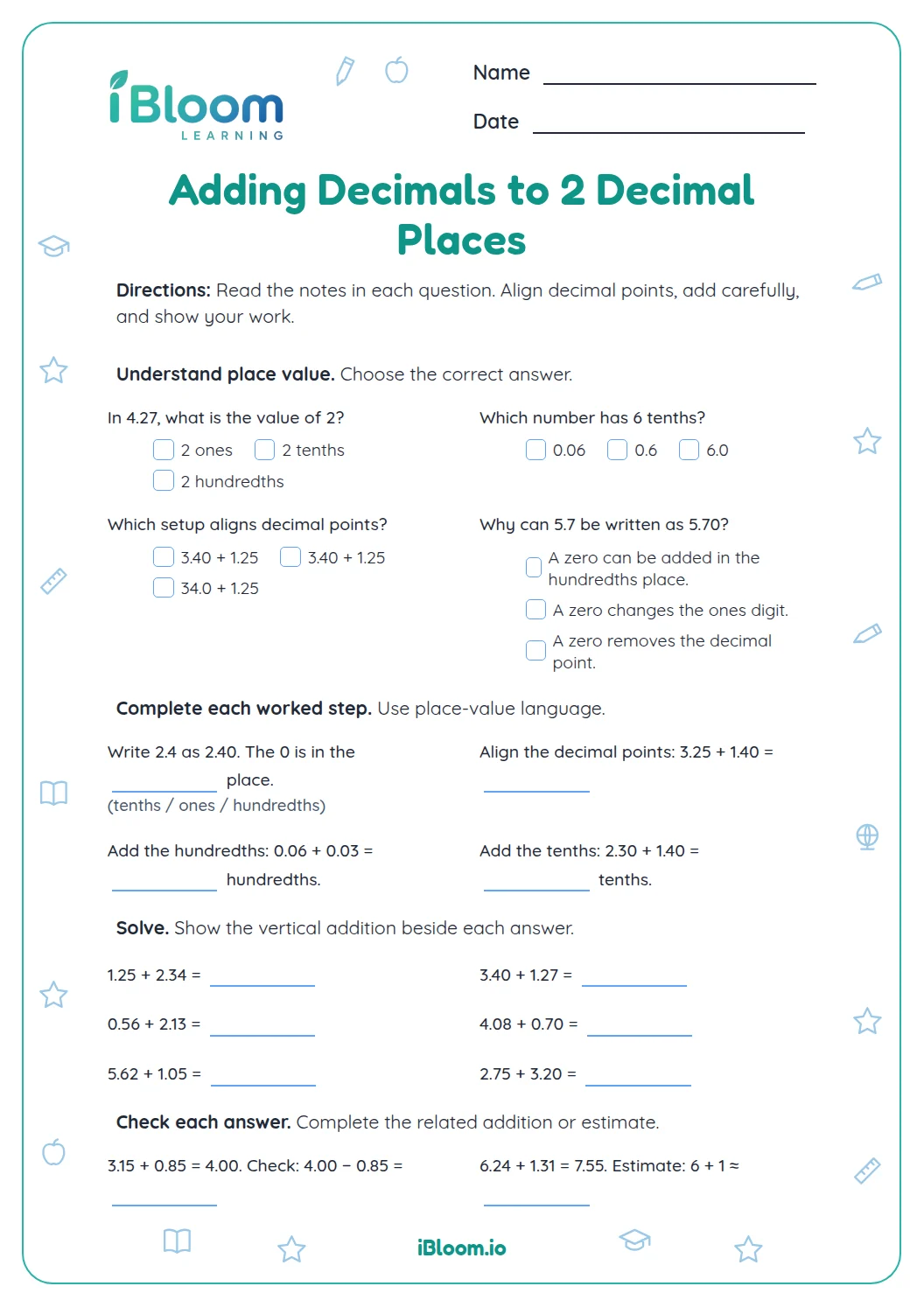
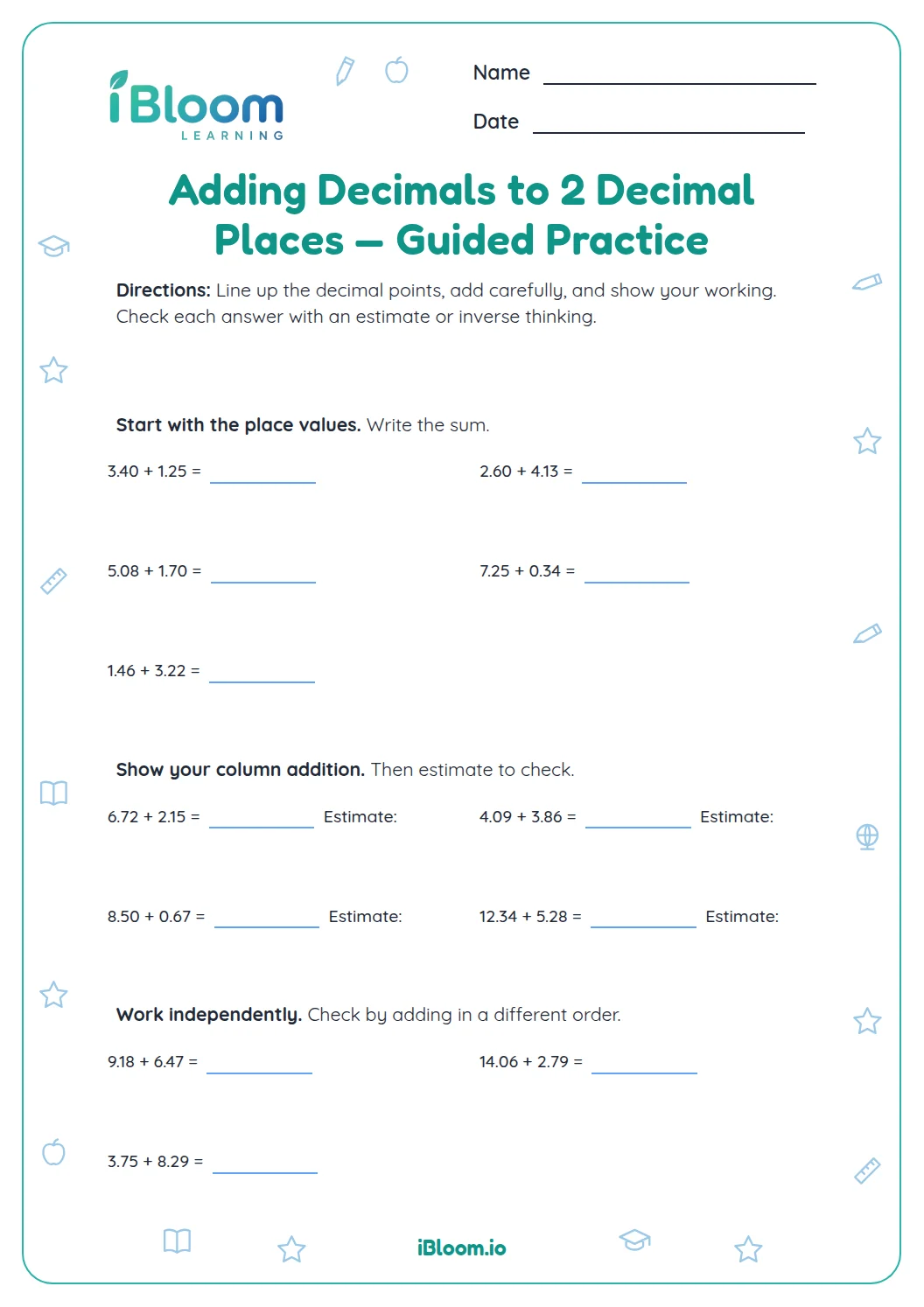
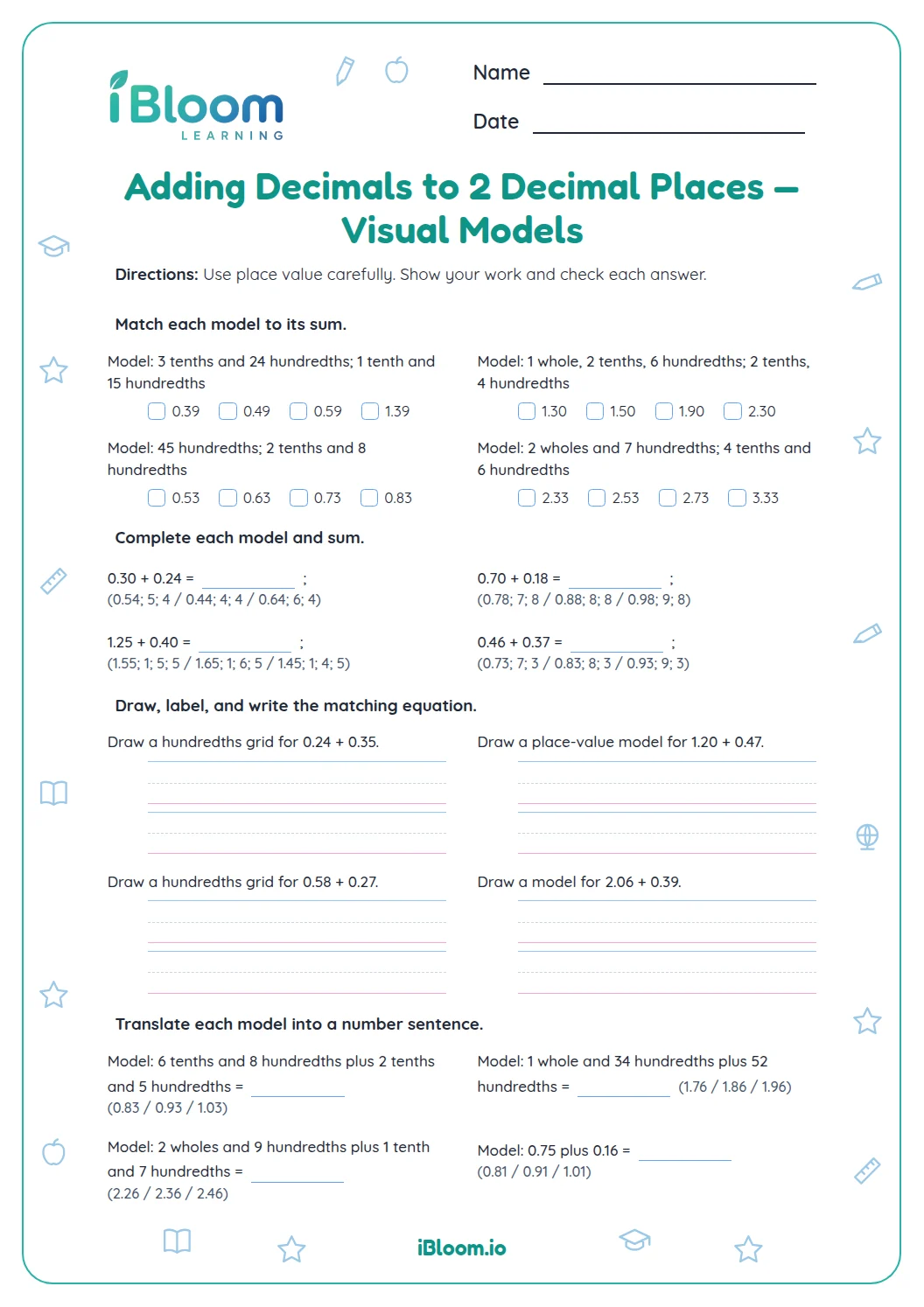
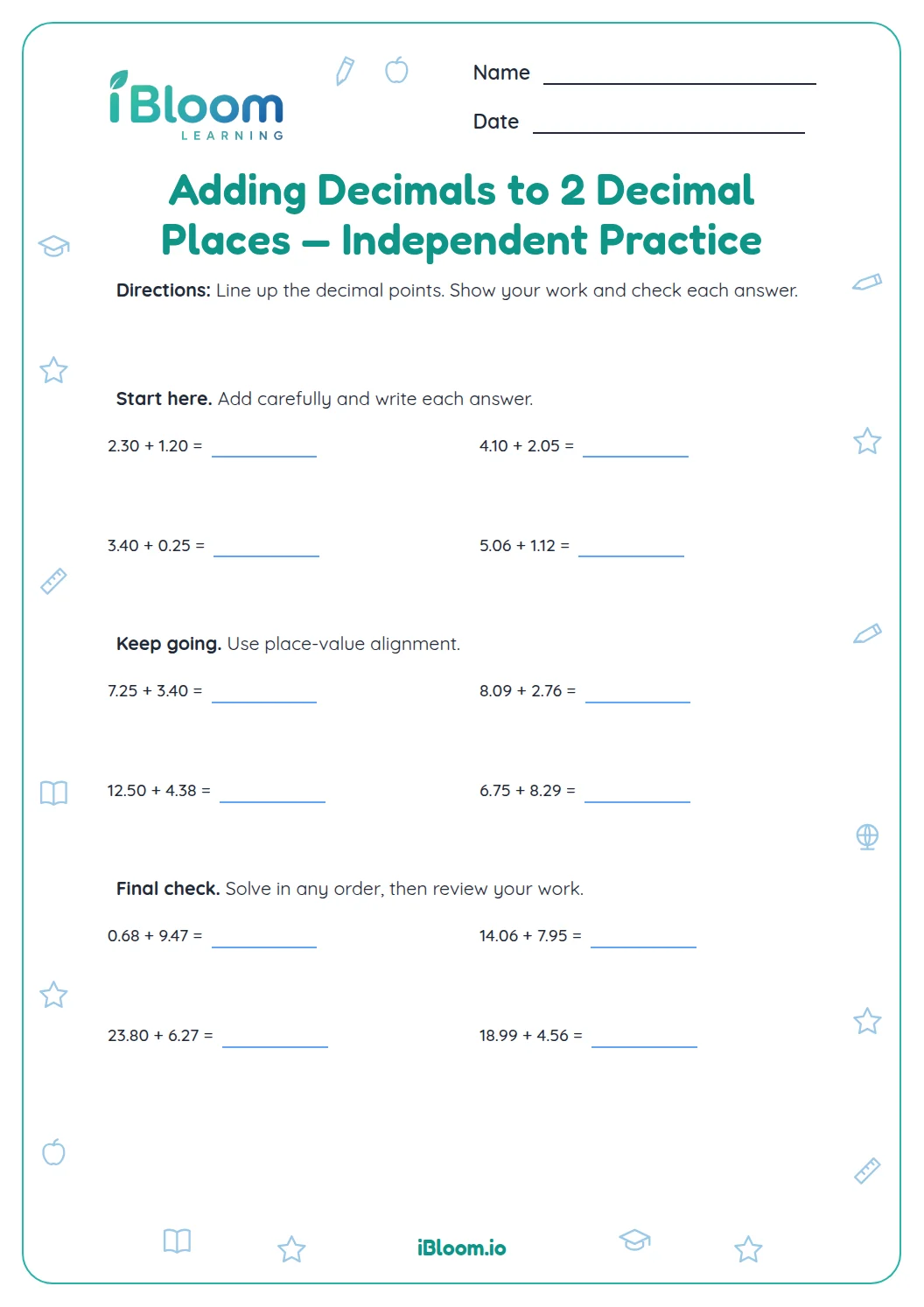
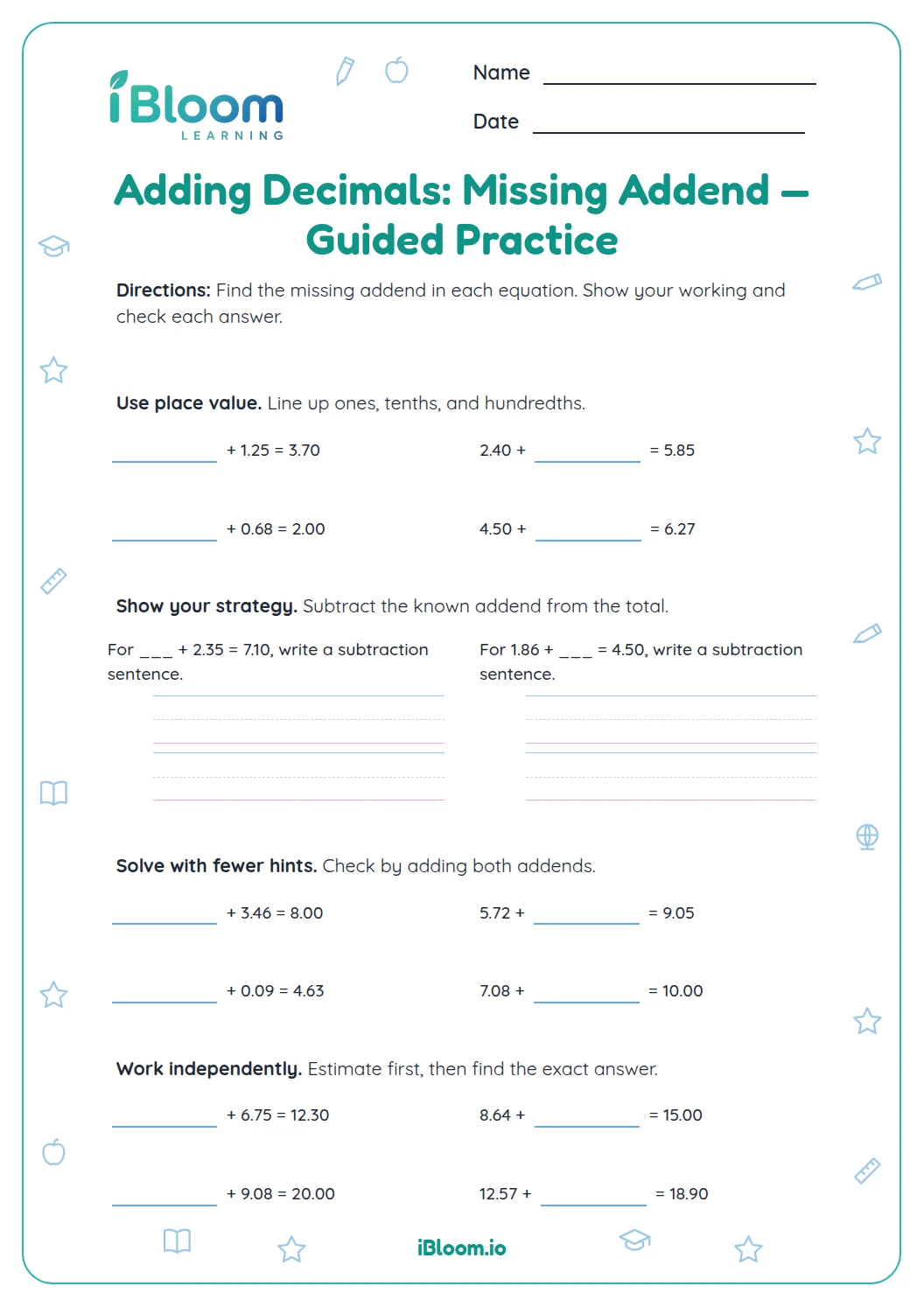
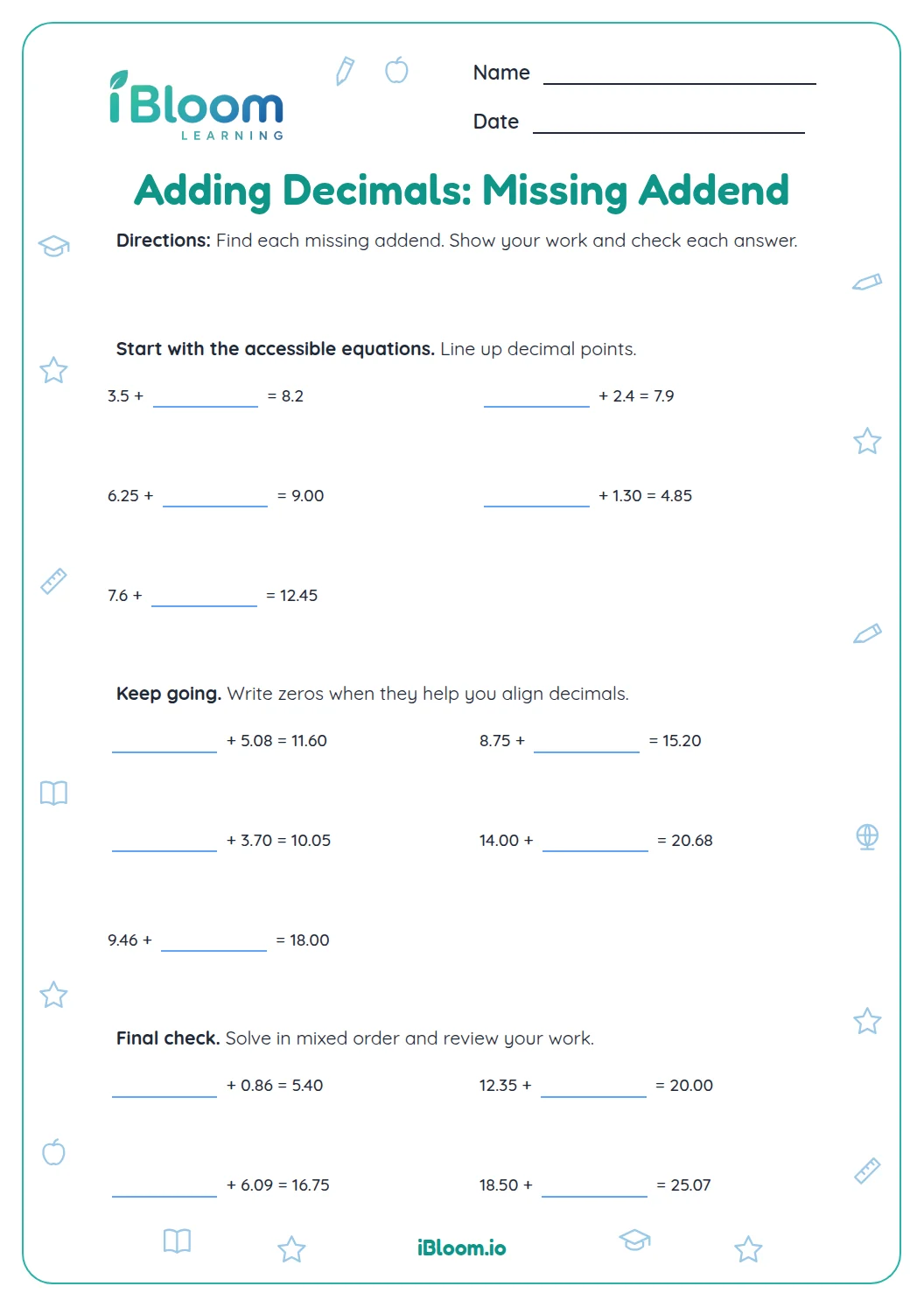
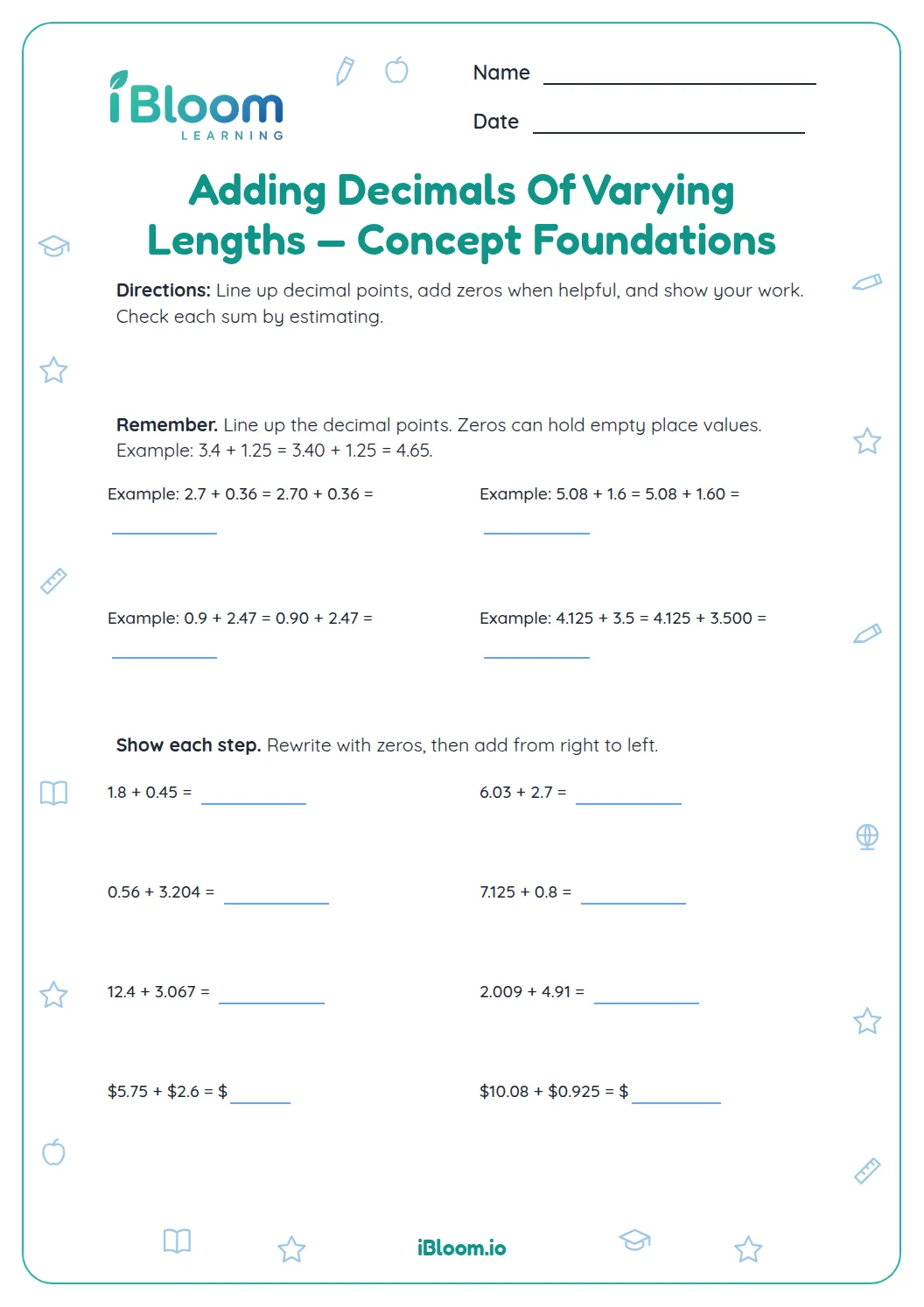
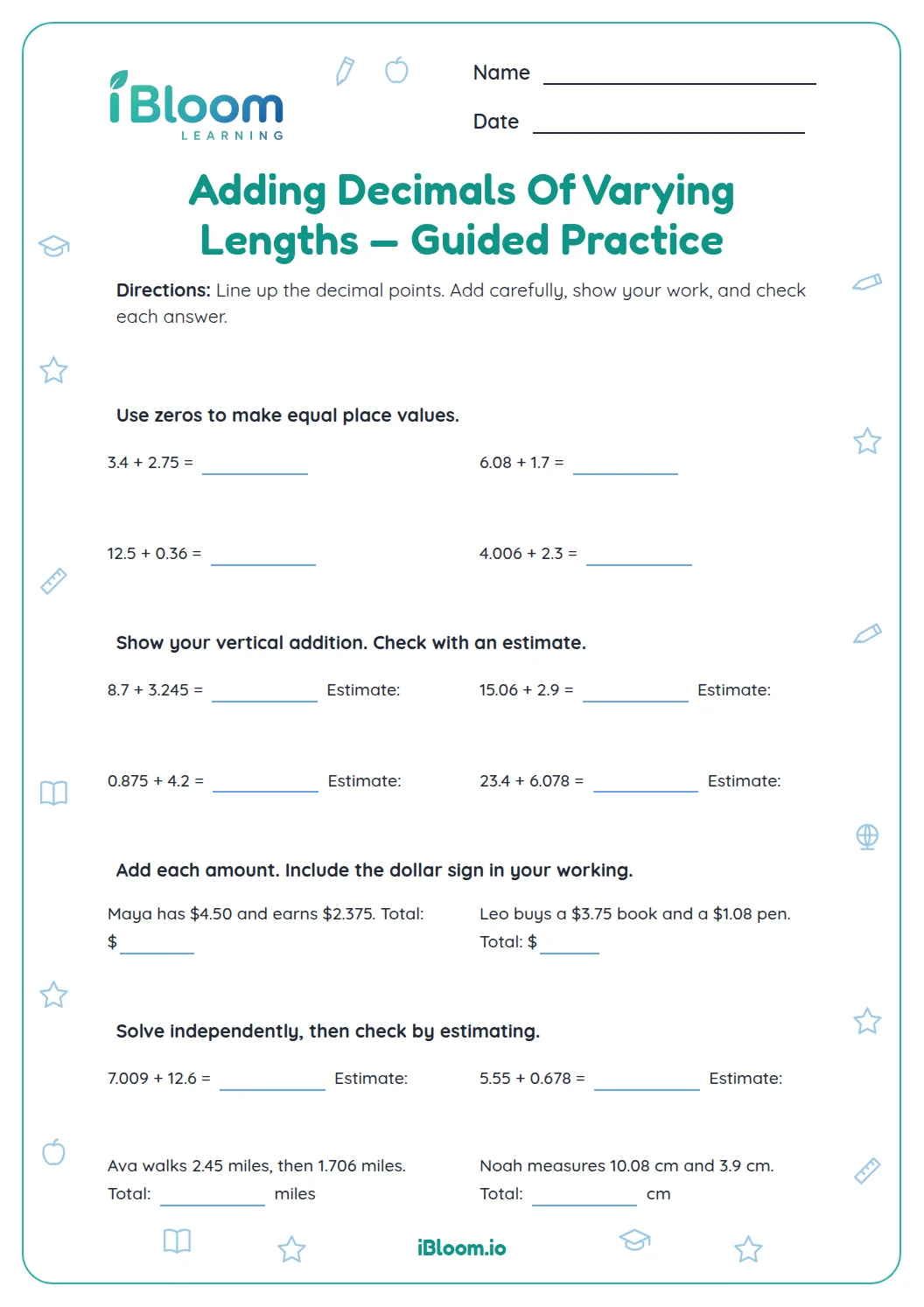
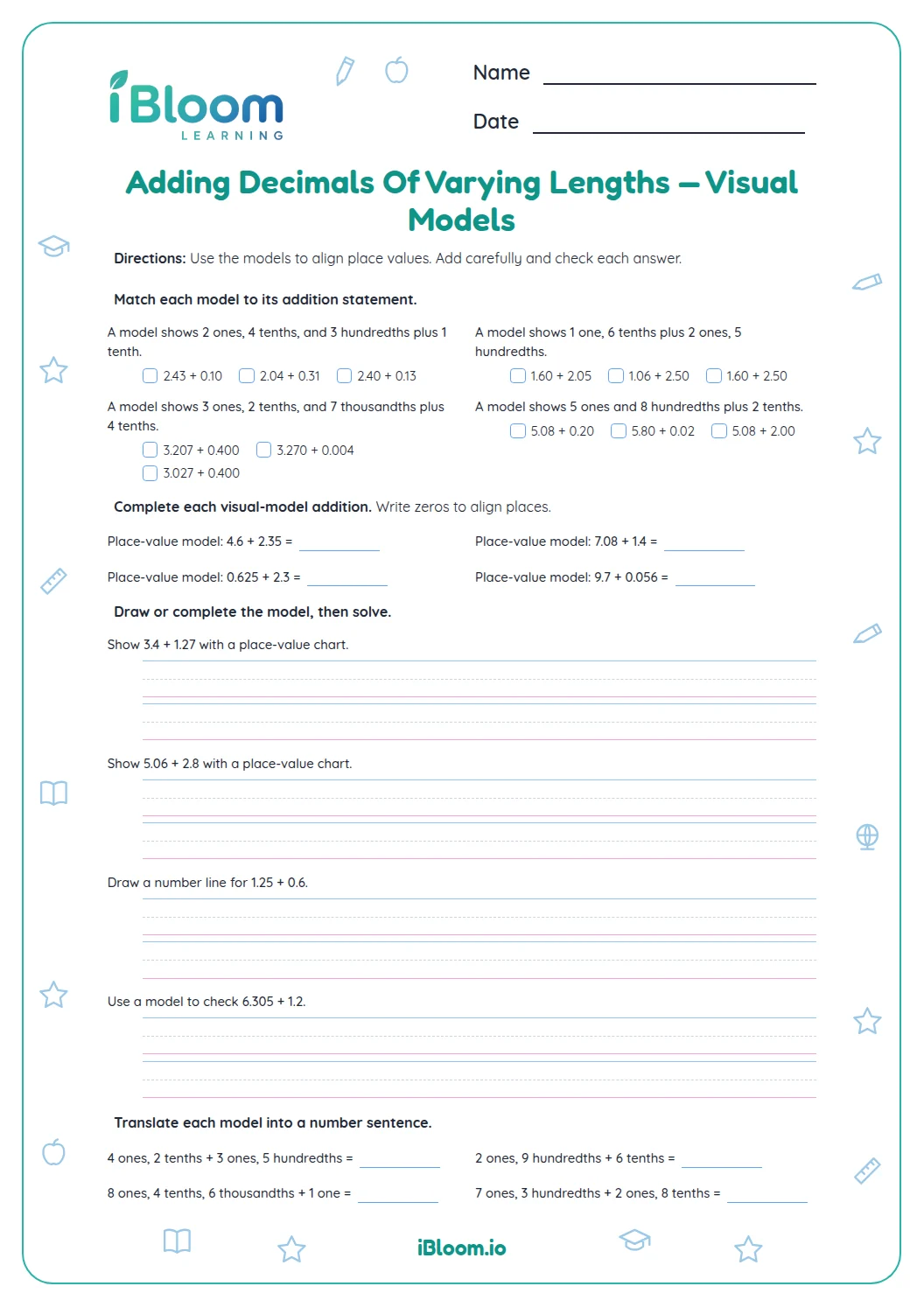
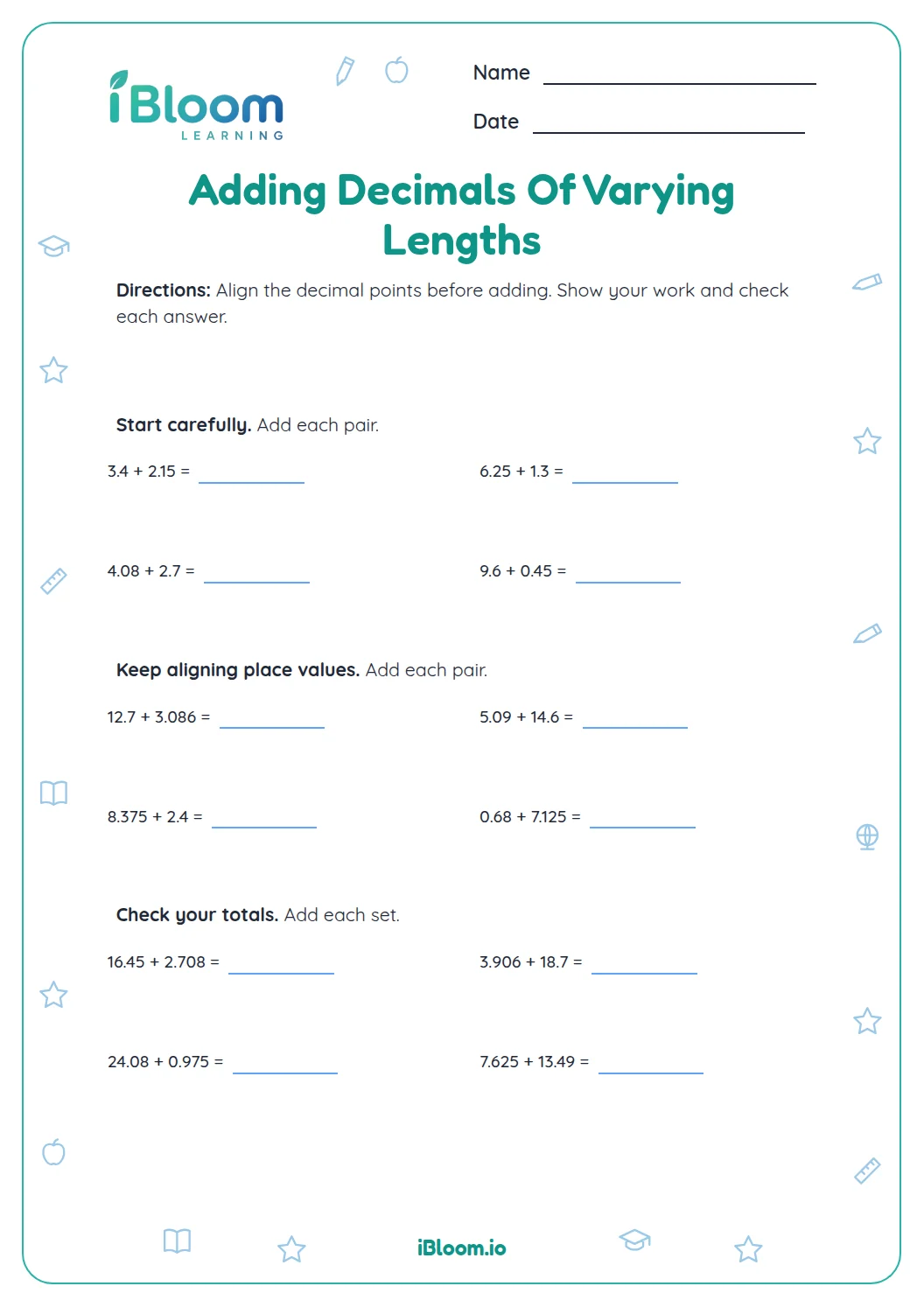
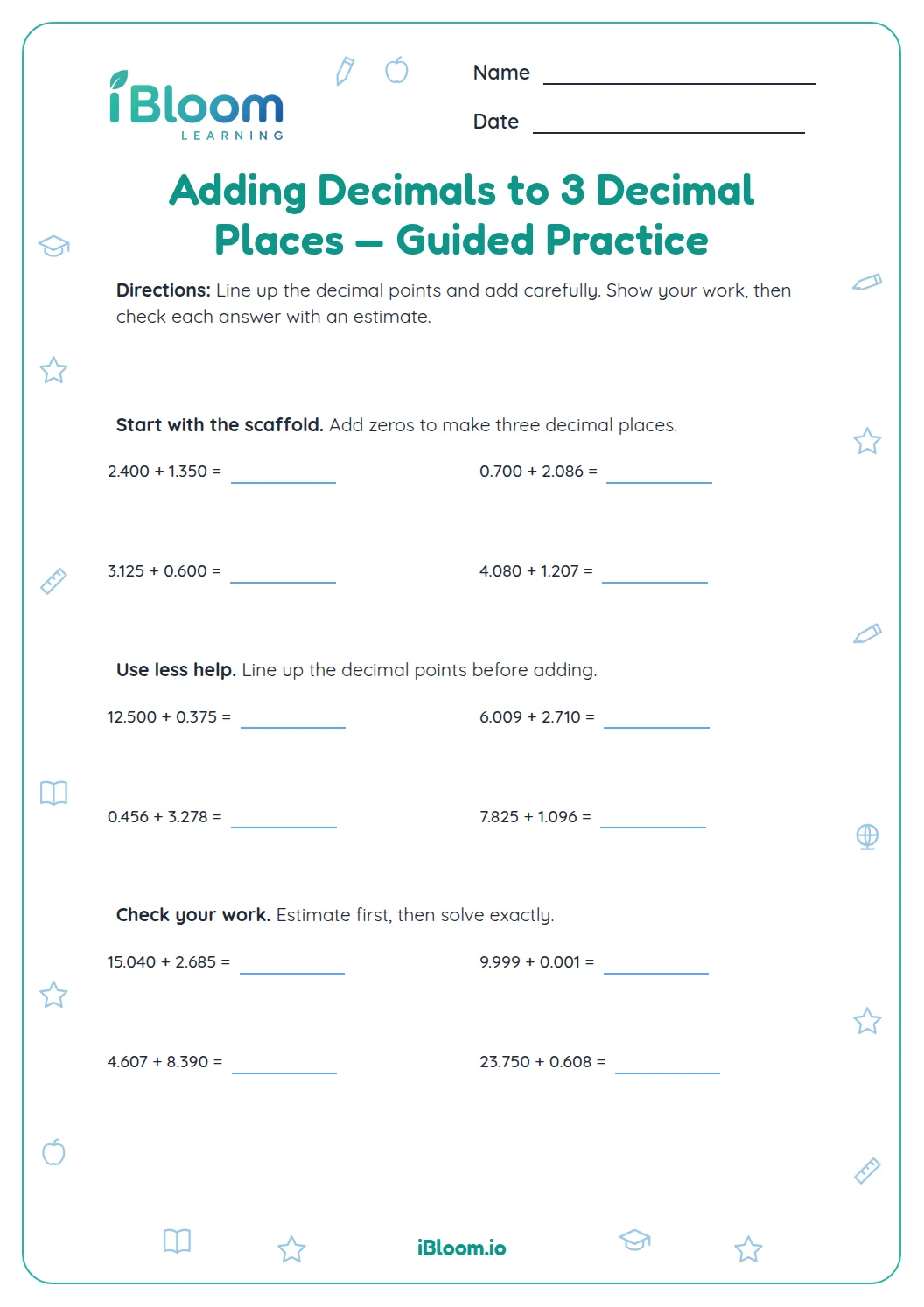
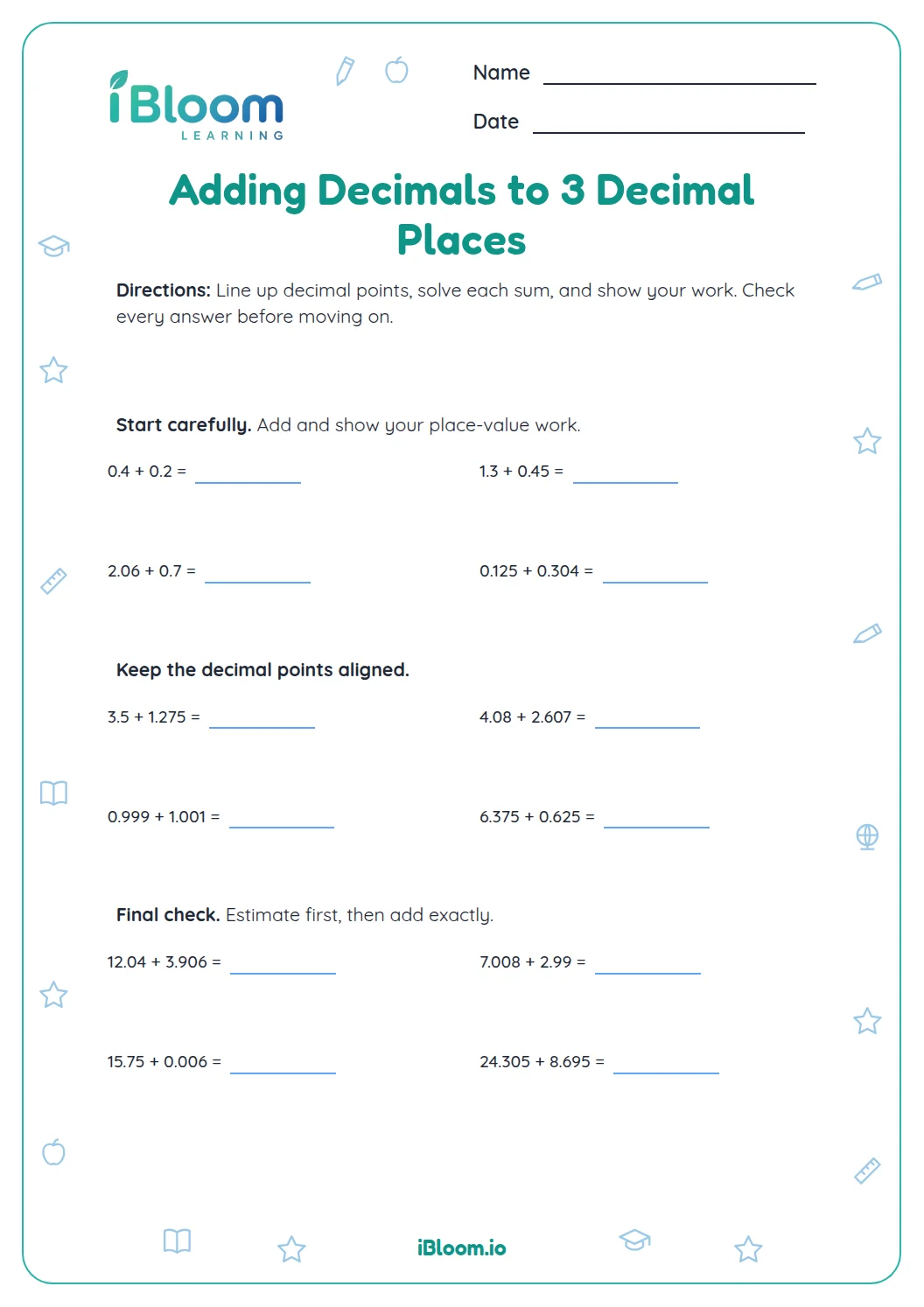
This printable worksheet gives Grade 6 learners practice adding decimals to hundredths in real-world situations. Its 18 problems use dollars, distances, lengths, weights, and recipe amounts, and each provides room to write an addition equation and total. Learners line up decimal points, preserve the units, and check whether each sum makes sense. The questions practice the decimal-addition strategies described in CCSS 5.NBT.B.7.
Aligned to 5.NBT.B.7
How do I add prices?
For prices, add dollars to dollars and cents to cents. Keep the dollar sign with the total.
- 1A notebook costs $2.45 and a pen costs $1.30.
- 22.45 + 1.30 = 3.75, so the total is $3.75.
How do I add measurements with different decimal lengths?
Write a zero in an empty hundredths place when it helps. Then add the aligned values and include the unit from the situation.
- 1Maya walked 1.25 miles and then 2.4 miles.
- 21.25 + 2.40 = 3.65 miles.
How can I check whether a sum is reasonable?
Estimate each amount before adding exactly. A result near the estimate is a useful check, and the total should use the same unit as the amounts.
- 1A total of $3.75 is closest to $4.
- 2Estimate first, then compare with the exact sum.
How to solve each problem
- 1Underline the two amounts being added.
- 2Write an addition equation using those amounts.
- 3Line up decimal points, adding a zero when needed.
- 4Add from right to left and check the decimal places.
- 5Include the dollar sign or measurement unit in the answer.
Decimal addition errors to check
The mistake
Adding tenths to hundredths
The fix
Line up the decimal points before adding.
The mistake
Dropping a zero in a value such as 2.4
The fix
Write 2.40 so its tenths and hundredths align with the other amount.
The mistake
Leaving off the unit or dollar sign
The fix
Read the question again and label the total with the same unit or currency.
Common Core alignment
Add and subtract decimals to hundredths using place value strategies.
On this sheet: Each word problem requires adding decimals to hundredths.
Show the official wordingHide the official wording
Add, subtract, multiply, and divide decimals to hundredths, using concrete models or drawings and strategies based on place value, properties of operations, and/or the relationship between addition and subtraction; relate the strategy to a written method and explain the reasoning used.
What to practice next
Make more practice
Further reading
Questions parents and teachers ask
What skills does the decimal worksheet practice?
The 18 problems practice adding decimals with one or two places after the decimal point. Situations include prices, distances, lengths, weights, and recipe amounts. Learners write an equation, align decimal points, calculate the sum, and include a dollar sign or measurement unit in the answer.
How should I add 2.4 and 1.25?
Write 2.4 as 2.40 so the tenths and hundredths line up: 2.40 + 1.25 = 3.65. The decimal points stay in one column, which keeps like place values aligned. This worksheet includes several sums with different decimal lengths for learners to practice that alignment.
Does the worksheet include an answer key?
Yes. A separate answer key lists all 18 totals. The money answers include dollar signs, and measurement answers include the units named in the problems. Learners can compare the total and their equation after finishing each page, then review any place-value steps that need another look.
Are these only money problems?
No. Some questions use dollars, while others use miles, meters, cups, liters, feet, pounds, kilometers, yards, or points. These varied settings keep addition in context and ask learners to carry the relevant unit into each total. The unit comes directly from the question.
How can a learner check an answer?
Estimate the amounts first, then compare the exact total with the estimate. For instance, $2.45 and $1.30 are close to $2.50 and $1.50, so a total near $4 is reasonable. Also check that decimal points and units are in the right places.