



About this worksheet
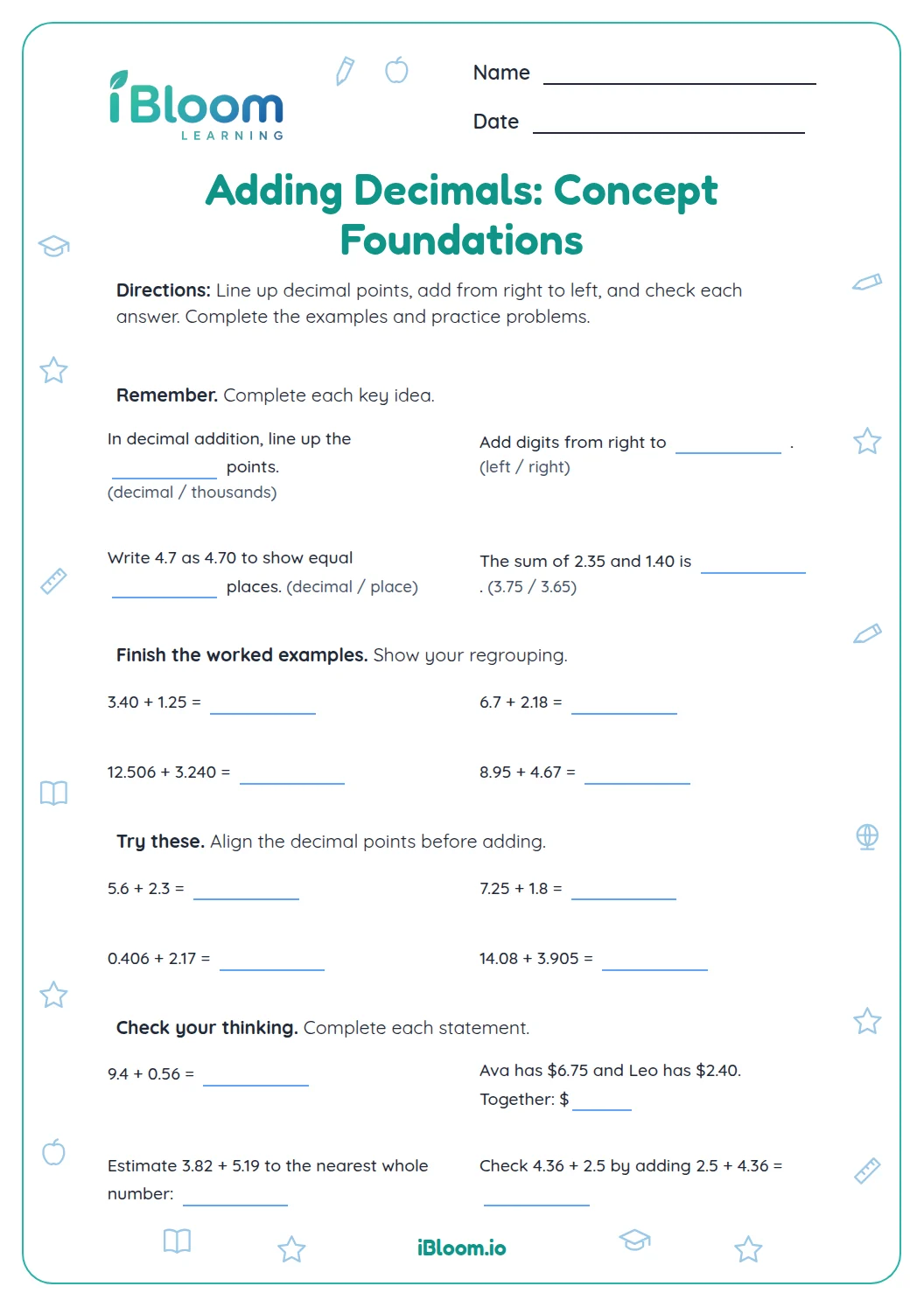
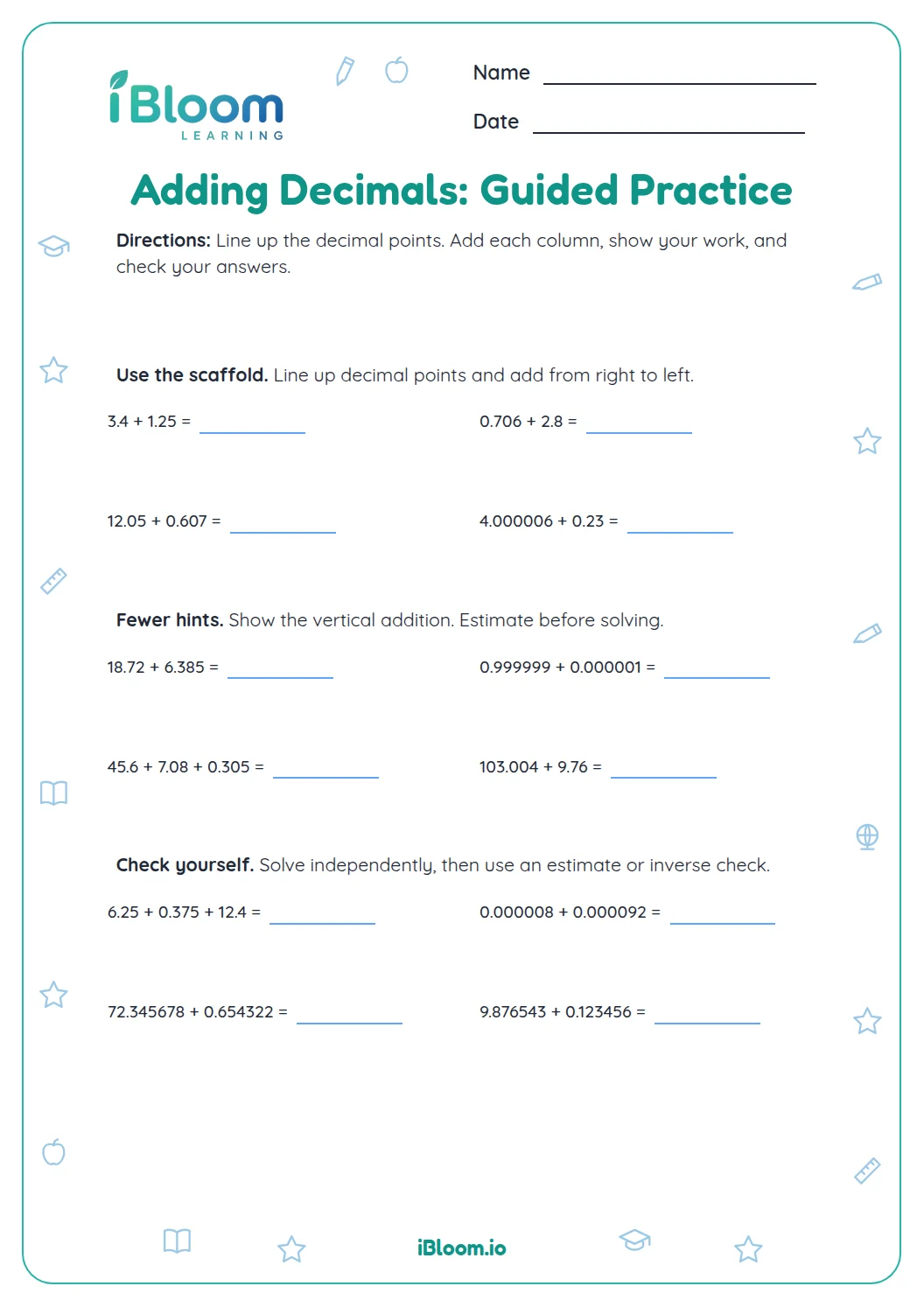
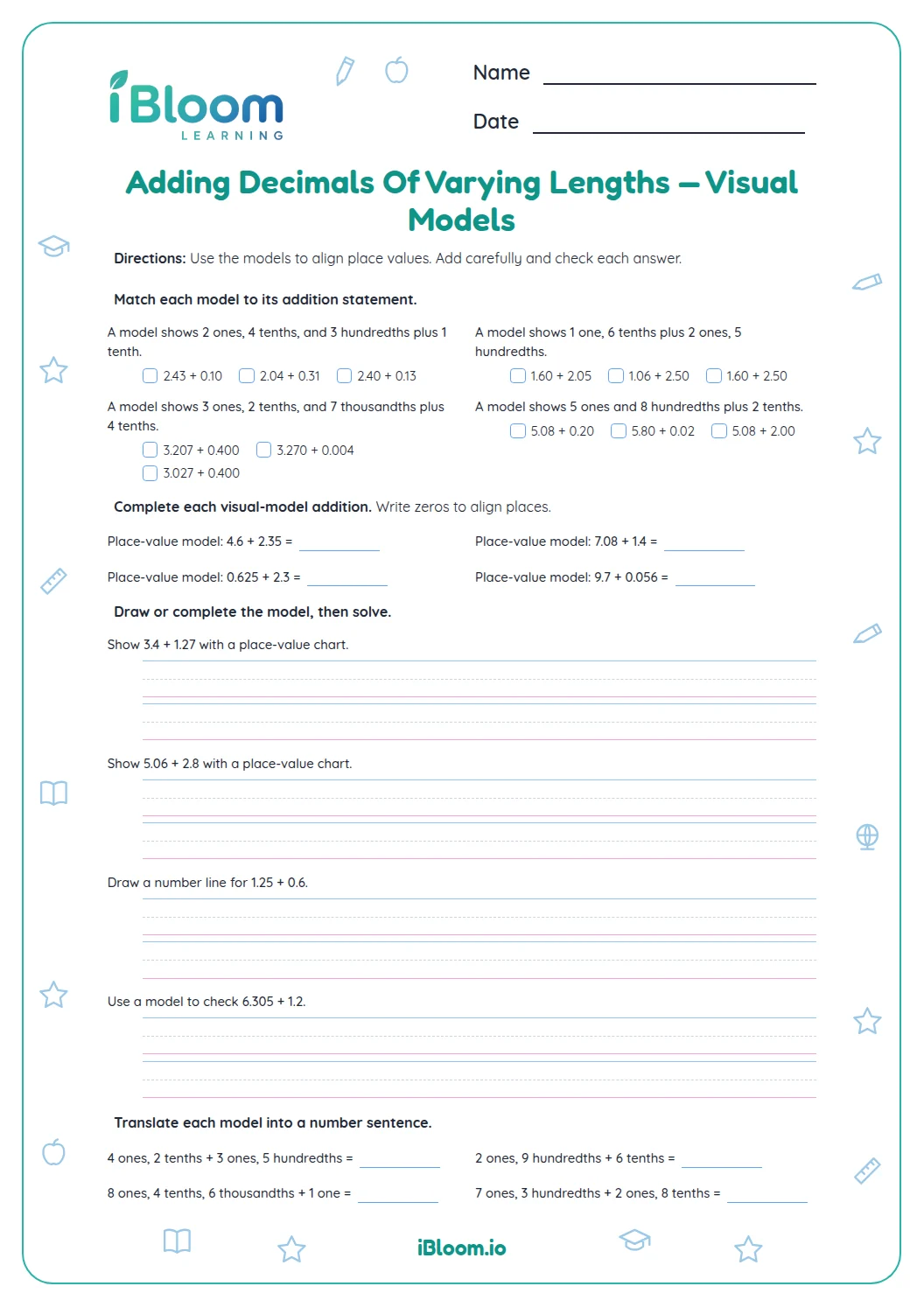
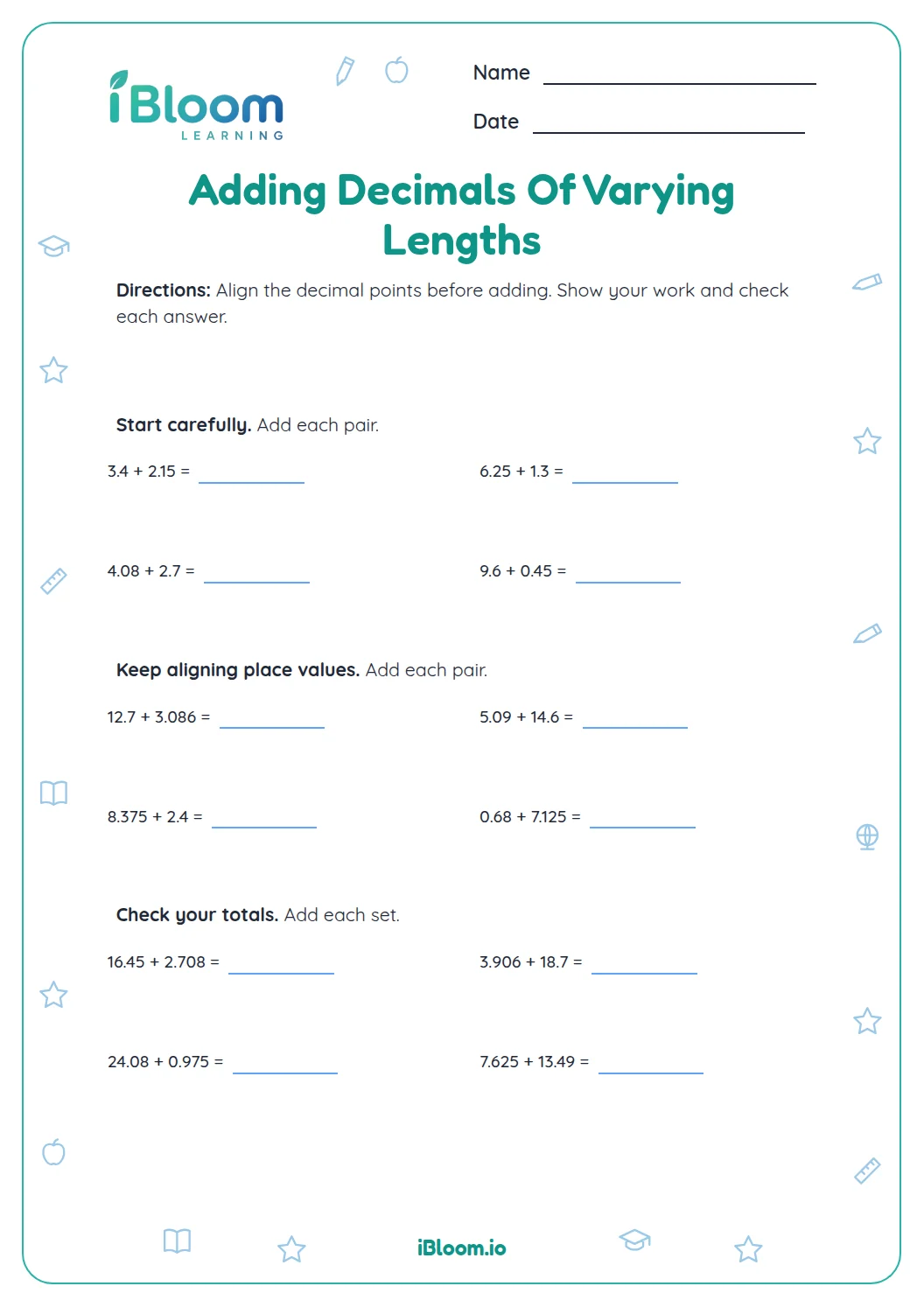
This Grade 6 worksheet provides 14 questions about adding decimals through hundredths. Students check common place-value errors, estimate sums, choose aligned setups, find missing addends, and solve short measurement and money problems. Three written items ask for reasoning or an example problem. A separate answer key shows the calculations and practices part of Common Core 6.NS.B.3.
Aligned to 6.NS.B.3
Why align decimal points before adding?
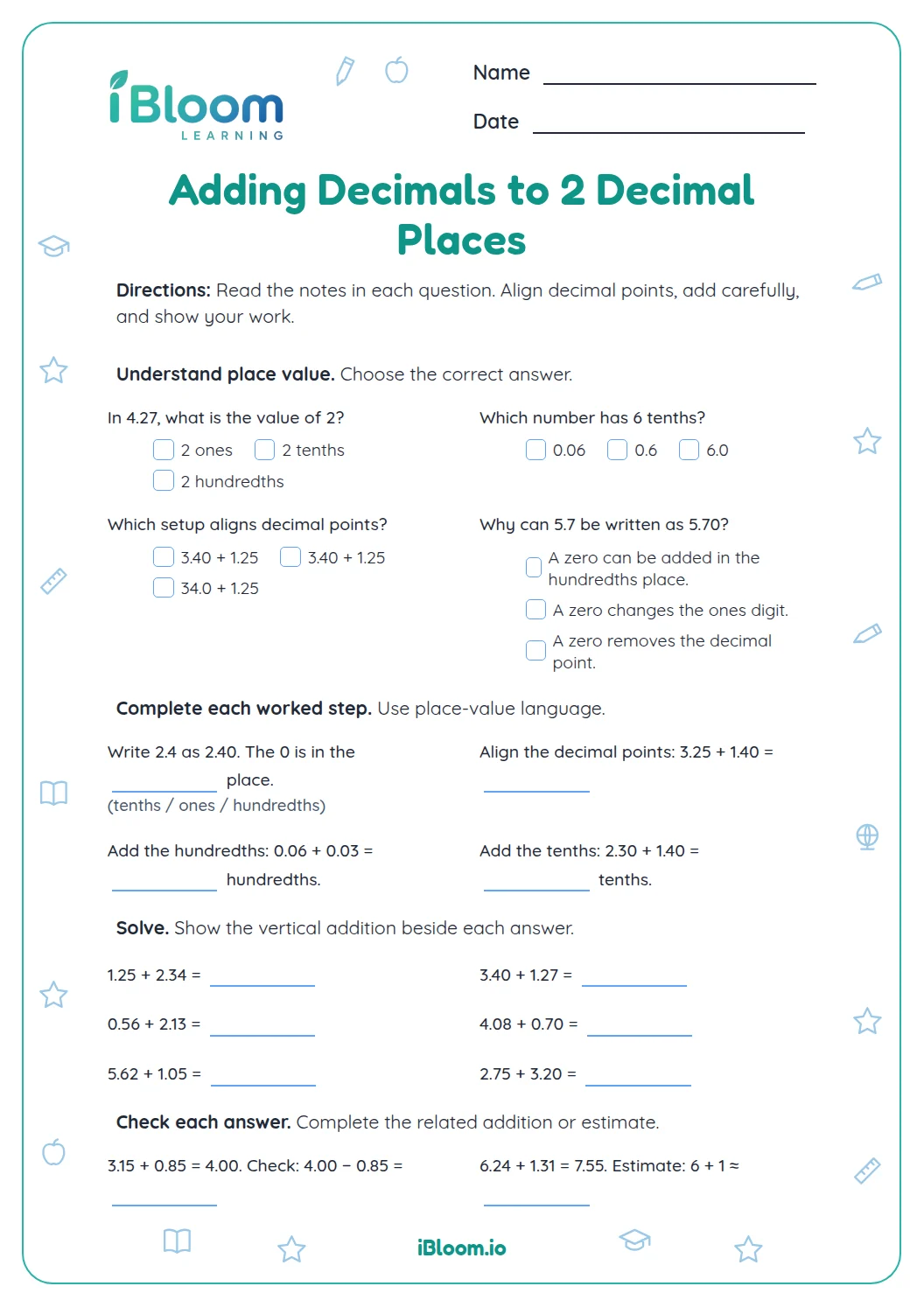
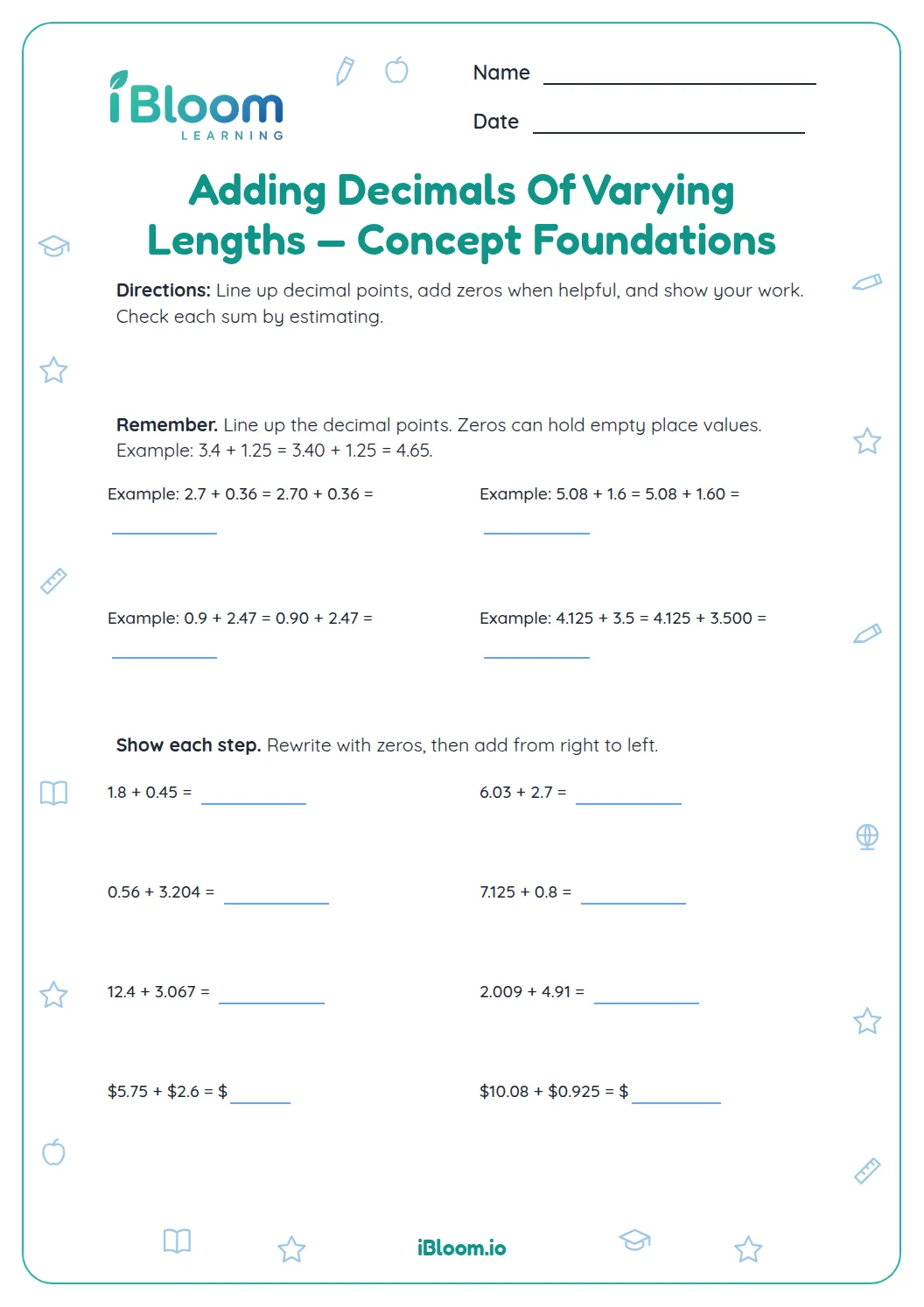
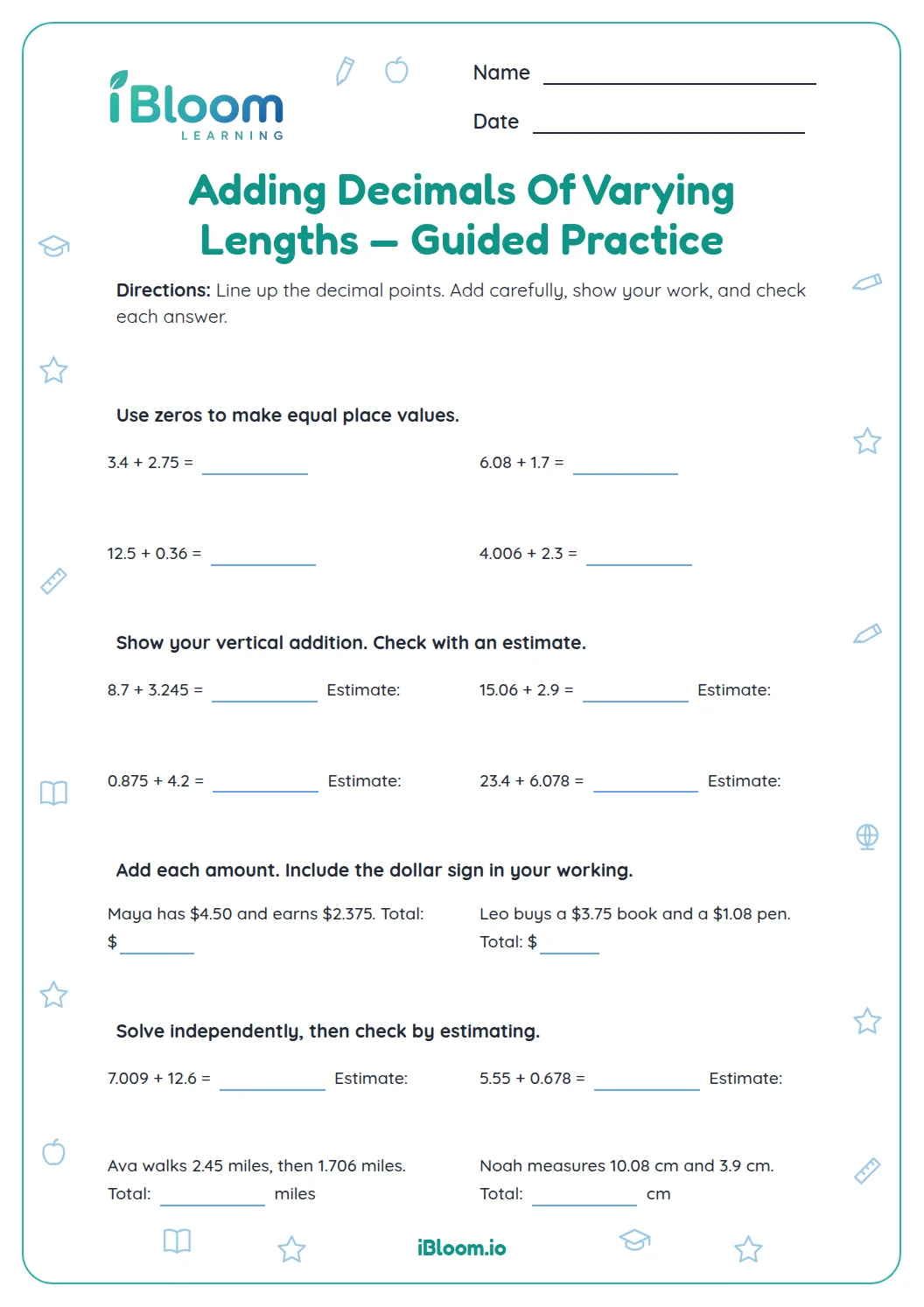
Aligning decimal points places tenths under tenths and hundredths under hundredths. A zero can hold an empty place, so 4.6 can be written as 4.60 before adding 0.38.
How can an estimate catch an addition error?
Round each addend to a nearby whole number or benchmark, then compare the estimate with the exact sum. For 3.40 + 0.85, a sum near 4 is reasonable; 3.125 is not.
- 13.40 + 0.85 = 4.25. The result is close to the estimate 4.
What should students show in a written explanation?
Name the place-value issue or explain how the addends combine. For an open-ended problem, check the calculation and the student’s reasoning rather than expecting the sample wording exactly.
How to use this worksheet
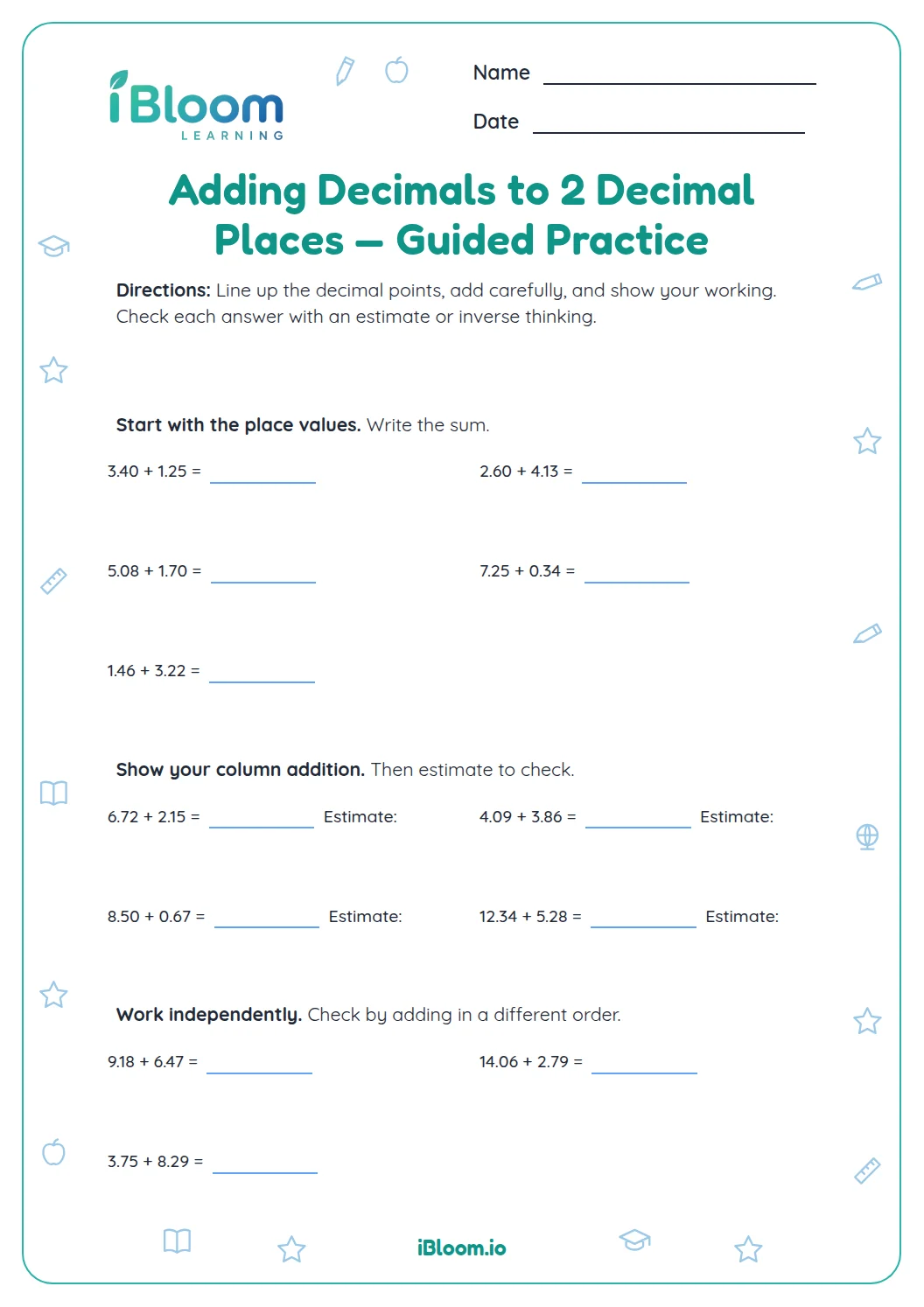
- 1Estimate the size of the sum before calculating.
- 2Write addends with decimal points aligned.
- 3Add from the hundredths place, regrouping when needed.
- 4Use a zero as a placeholder when one addend has fewer decimal places.
- 5Check that the result is close to the estimate.
Common mistakes and quick fixes
The mistake
Adding digits that are in different place-value columns.
The fix
Line up decimal points and add a zero placeholder if useful.
The mistake
Treating 0.9 as smaller than 0.37 because it has fewer digits.
The fix
Write 0.90 and compare tenths and hundredths.
The mistake
Accepting an answer that is far from a reasonable estimate.
The fix
Round the addends and check the size of the exact sum.
Common Core alignment
This worksheet practices the listed Common Core skill.
Fluently add, subtract, multiply and divide multi-digit decimals using place value.
On this sheet: Students add decimals to hundredths, estimate, find missing addends, and explain place-value alignment.
Show the official wordingHide the official wording
Fluently add, subtract, multiply, and divide multi-digit decimals using the standard algorithm for each operation.
What to practice next
Make more practice
Further reading
Questions parents and teachers ask
What decimal places are practiced?
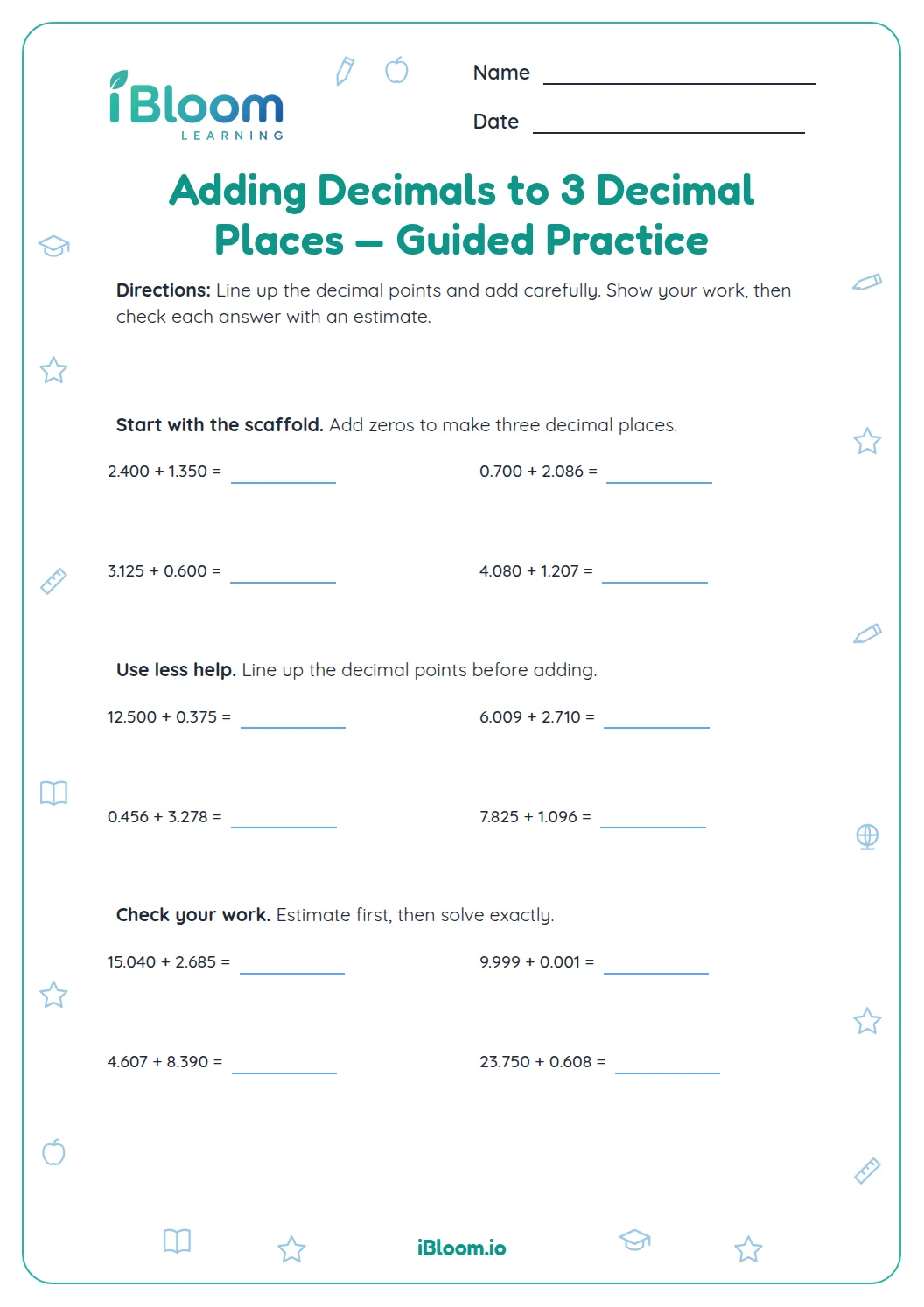
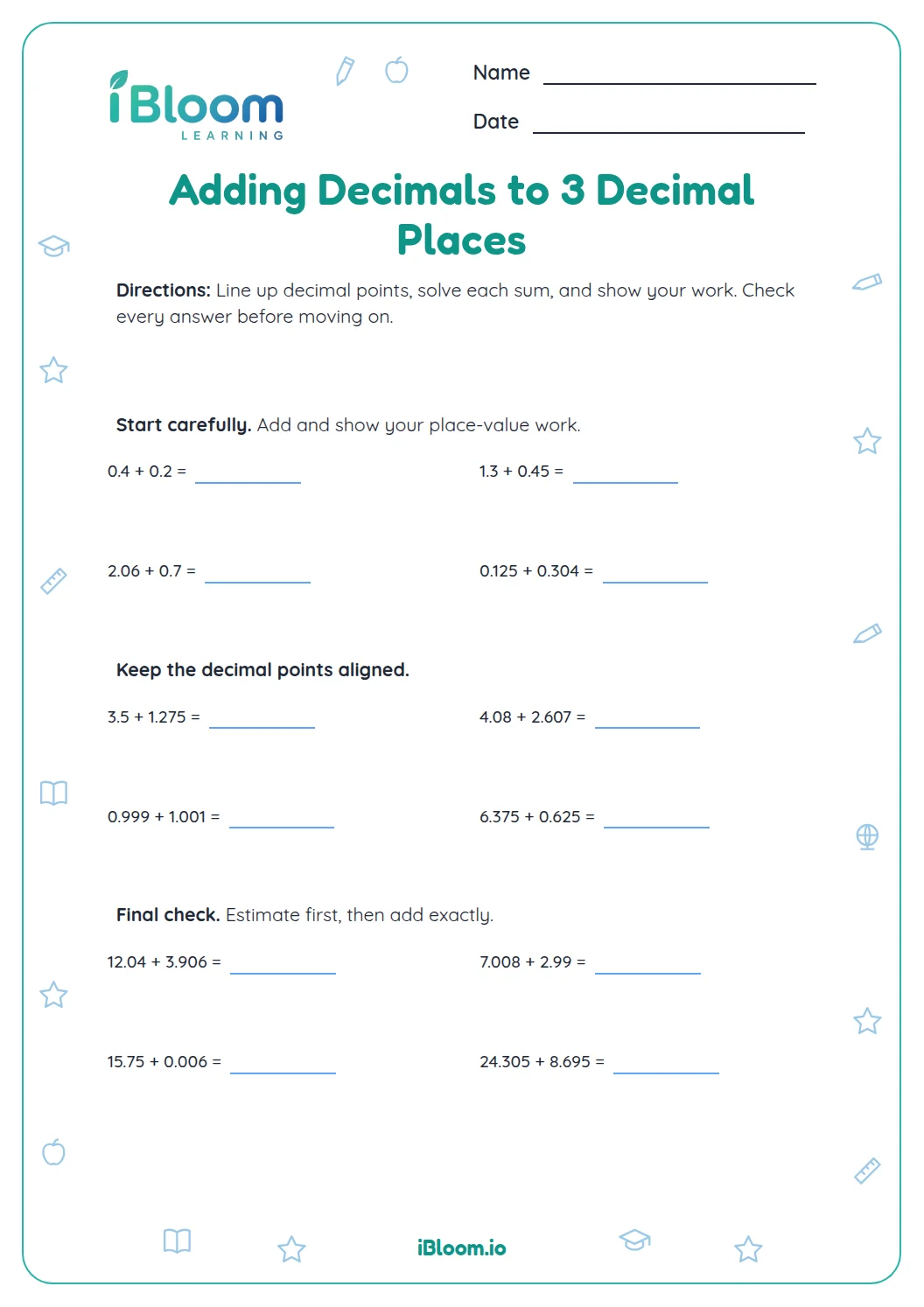
The problems use decimals with up to two digits after the decimal point. Students add whole numbers and tenths or hundredths, and several items ask them to align place values or use a zero placeholder before calculating. The answer key includes the worked results so students can check both their sum and their place-value setup.
How many problems are on the worksheet?
There are 14 questions across four parts. Students select answers about errors, estimates, methods, and missing addends, then complete three written reasoning items. Measurement and money contexts give practice applying addition to quantities. The answer key lets students verify each selected result and review the written work after finishing.
Does the worksheet include subtraction?
The new sheet focuses on addition, matching its title. Students estimate sums, align decimal points, find missing addends, and solve addition situations. The related worksheet links lead to more decimal practice, including other operations and decimal lengths. Students can use a related worksheet from the links when they are ready to practice subtraction or another decimal skill.
Why does the worksheet use missing addends?
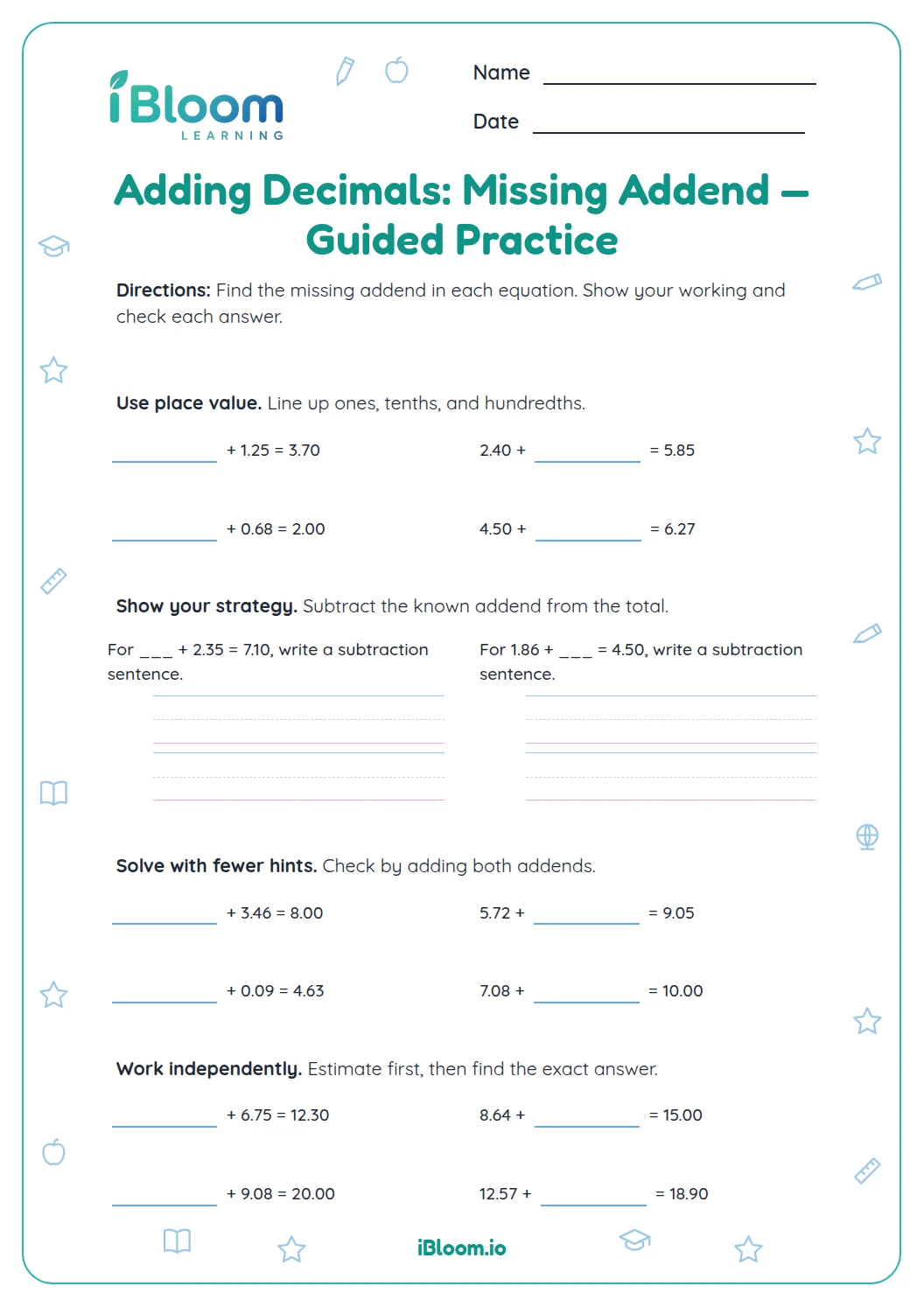
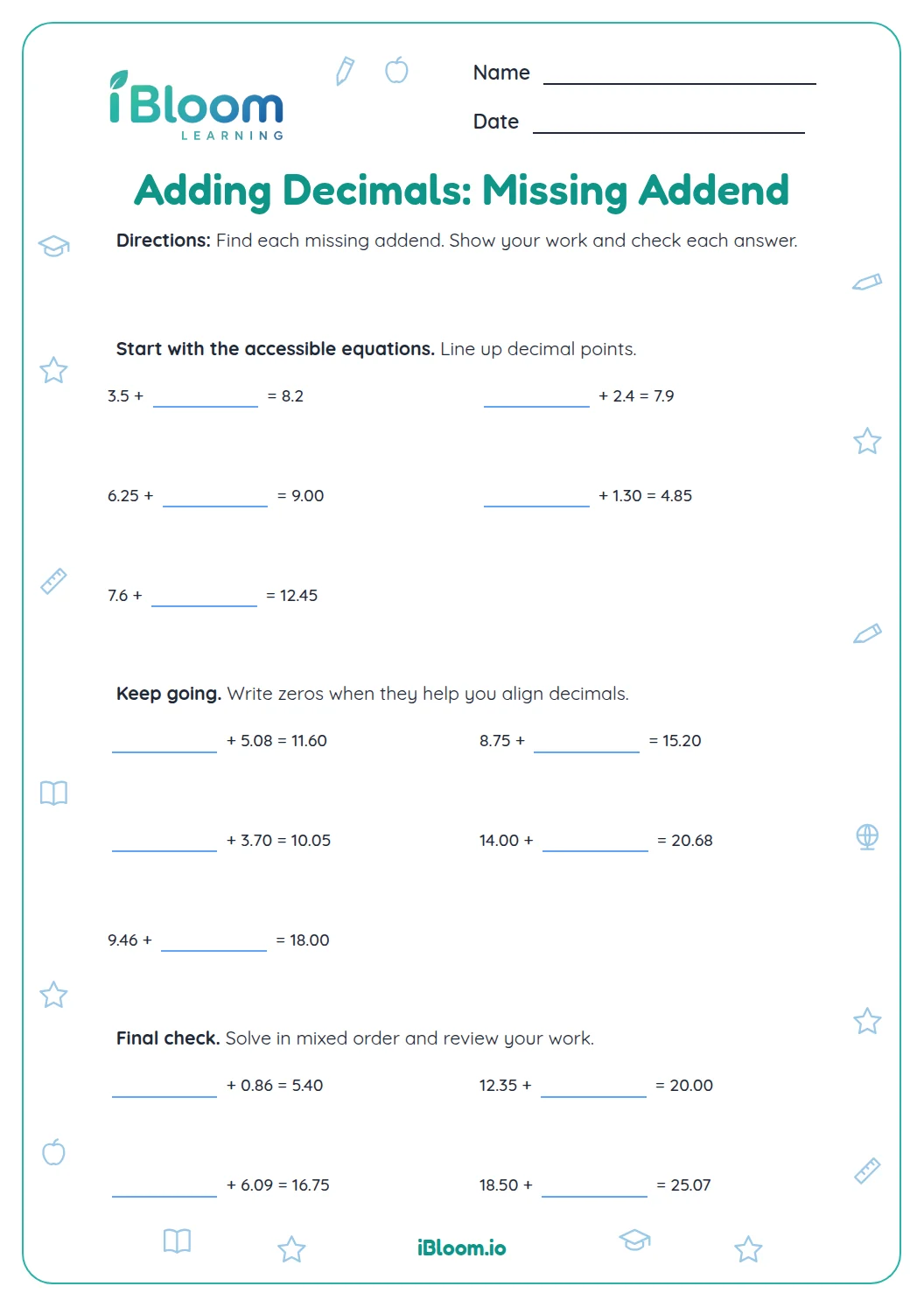
Finding a missing addend connects addition to the relationship between a total and its parts. Students can reason about the needed amount or use subtraction to check their answer, while the worksheet’s unknown remains part of an addition equation.
What is in the answer key?
The separate key marks the correct choices and gives sample work for written responses. For open questions, check that the arithmetic is accurate and that the explanation addresses the requested place-value idea or estimate. Equivalent calculations are acceptable when they support the same result.