
About this worksheet
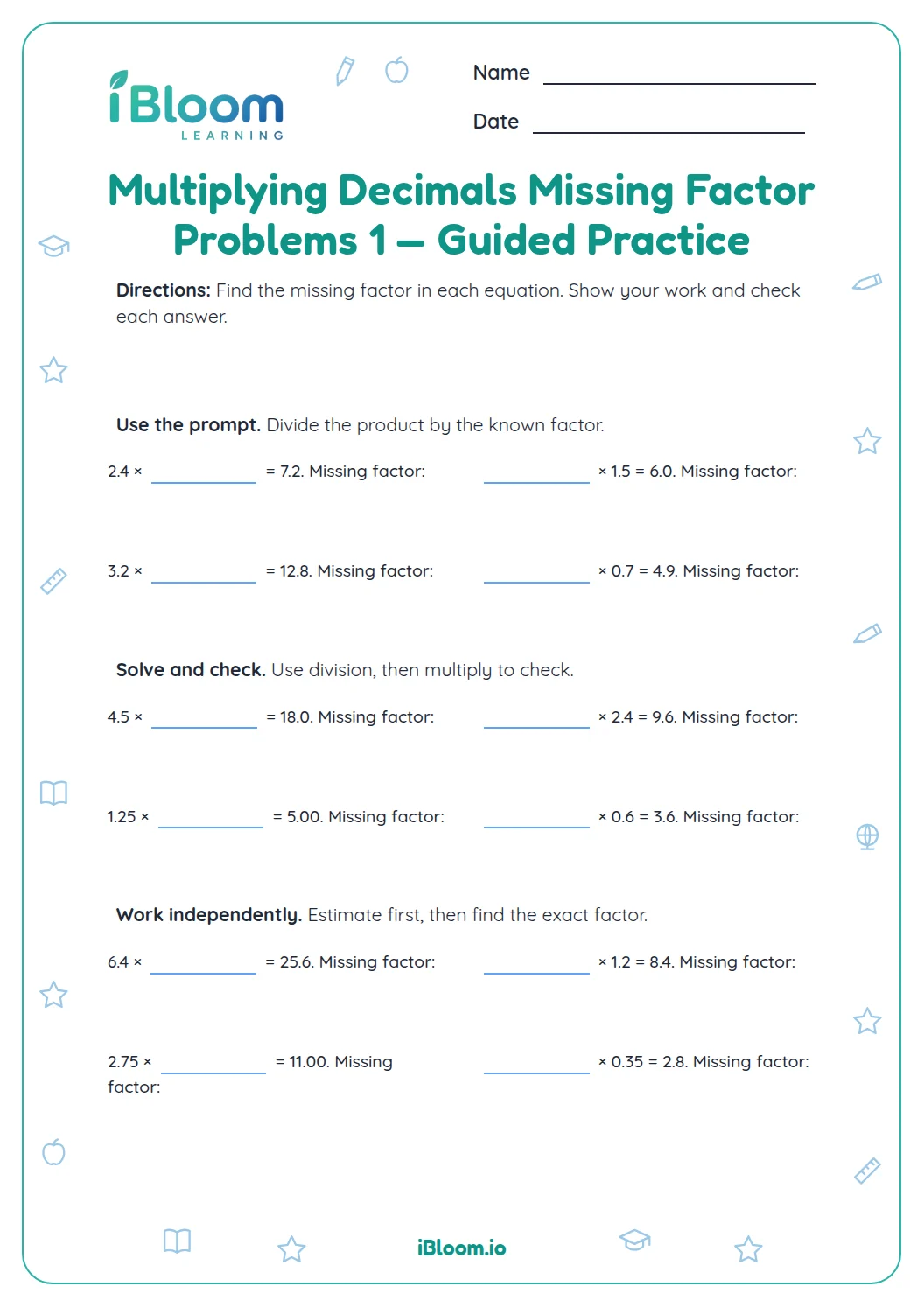
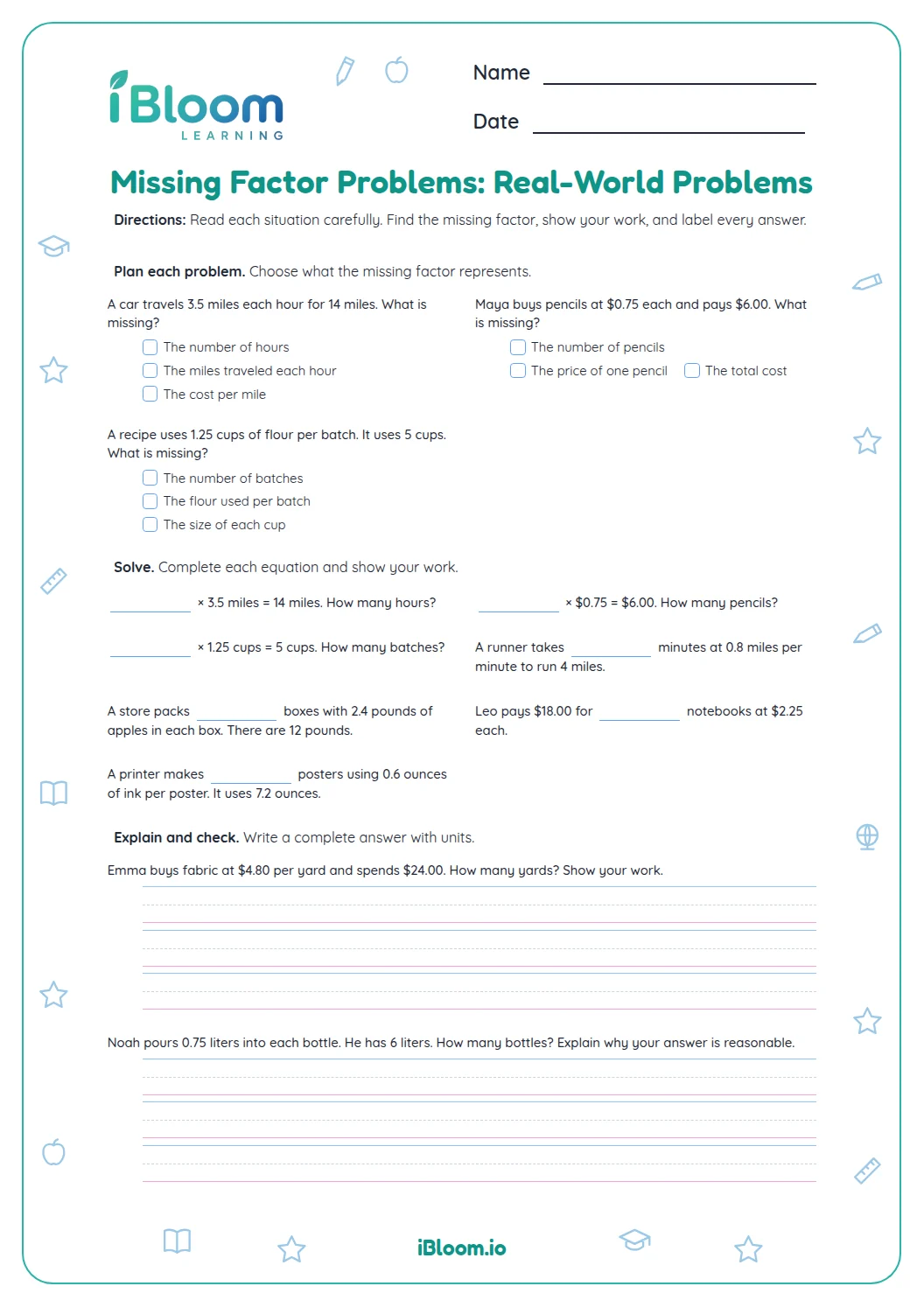
This Grade 6 worksheet provides 16 equations with one missing factor in a decimal multiplication equation. Learners use division to find the unknown and multiplication to check the result. The equations vary the decimal factors and the location of the blank.
Aligned to 5.NBT.B.7
How does division reveal a missing factor?
Multiplication and division are inverse operations. In 0.4 × ___ = 2.8, divide 2.8 by 0.4 to find the missing factor, 7.
Check by substituting 7: 0.4 × 7 = 2.8. Keep the decimal places aligned in the computation.
What equations are on the sheet?
All 16 items are missing-factor equations. The unknown appears before or after the known factor, and the factors and products include tenths, hundredths, and thousandths.
The answer key lists each missing factor. Learners can check each answer in its original equation by multiplying.
How can learners check decimal factors?
Use division to find a candidate factor, then substitute it into the multiplication equation. The product should match the number on the other side of the equal sign.
Solve and check
- 1Identify the known factor and product.
- 2Divide the product by the known factor.
- 3Record the missing factor.
- 4Multiply the factors to check the equation.
- 5Recheck decimal placement if the product does not match.
Decimal multiplication checks
The mistake
Moving a decimal the wrong number of places
The fix
Estimate the product before calculating.
The mistake
Dividing the known factor by the product
The fix
Divide the product by the known factor.
The mistake
Skipping substitution
The fix
Multiply the known and missing factors to verify the equation.
Curriculum alignment
Multiplication and division are inverse operations. In 0.4 × ___ = 2.8, divide 2.8 by 0.4 to find the missing factor.
Multiply decimals to hundredths using place-value strategies.
On this sheet: Learners use division as the inverse operation to find a missing factor in decimal products.
Show the official wordingHide the official wording
Add, subtract, multiply, and divide decimals to hundredths, using concrete models or drawings and strategies based on place value, properties of operations, and/or the relationship between addition and subtraction; relate the strategy to a written method and explain the reasoning used.
What to practice next
Questions parents and teachers ask
How do I find a missing factor in a decimal equation?
Divide the product by the factor that is already given. For example, in 0.4 times an unknown number equals 2.8, calculate 2.8 divided by 0.4. Then multiply 0.4 by your result to confirm the product and check the original equation.
Are all the missing factors whole numbers?
Yes. Each equation has a whole-number missing factor, even when the known factor or product is a decimal. This lets learners focus on inverse operations and decimal placement. Substitute each answer into its equation and multiply to verify it.
Why should learners multiply to check?
Division finds a possible factor, and multiplication checks it using the original equation. If the known factor times the proposed answer equals the product, the missing factor is correct. This check also helps catch an error in decimal placement.
What does this independent practice include?
It includes sixteen distinct decimal multiplication equations. The unknown appears in different positions, and the known factors use tenths, hundredths, and thousandths. Learners find each missing factor with division and check it by multiplying. The answer key makes it easy to review the results.