
About this worksheet
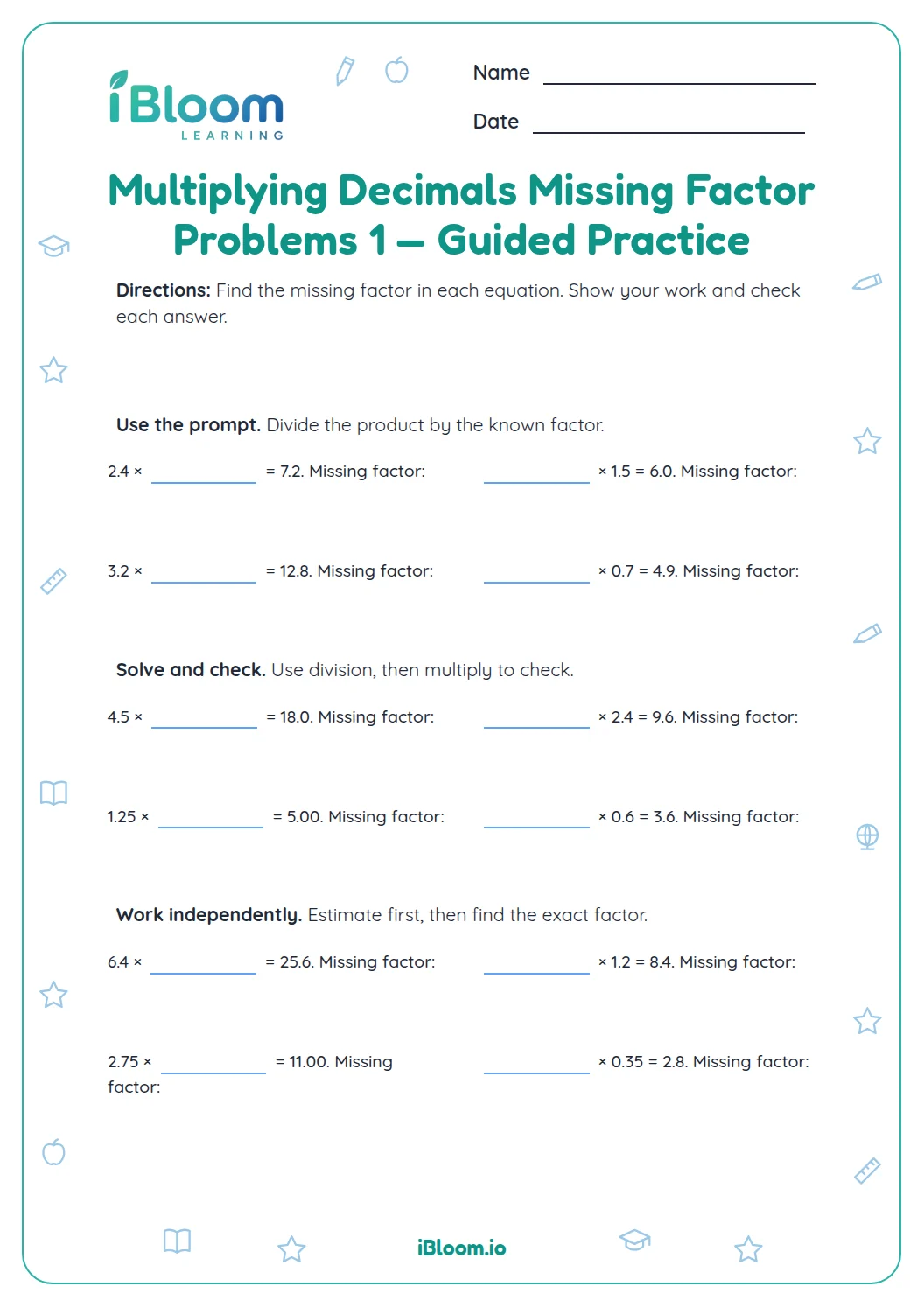
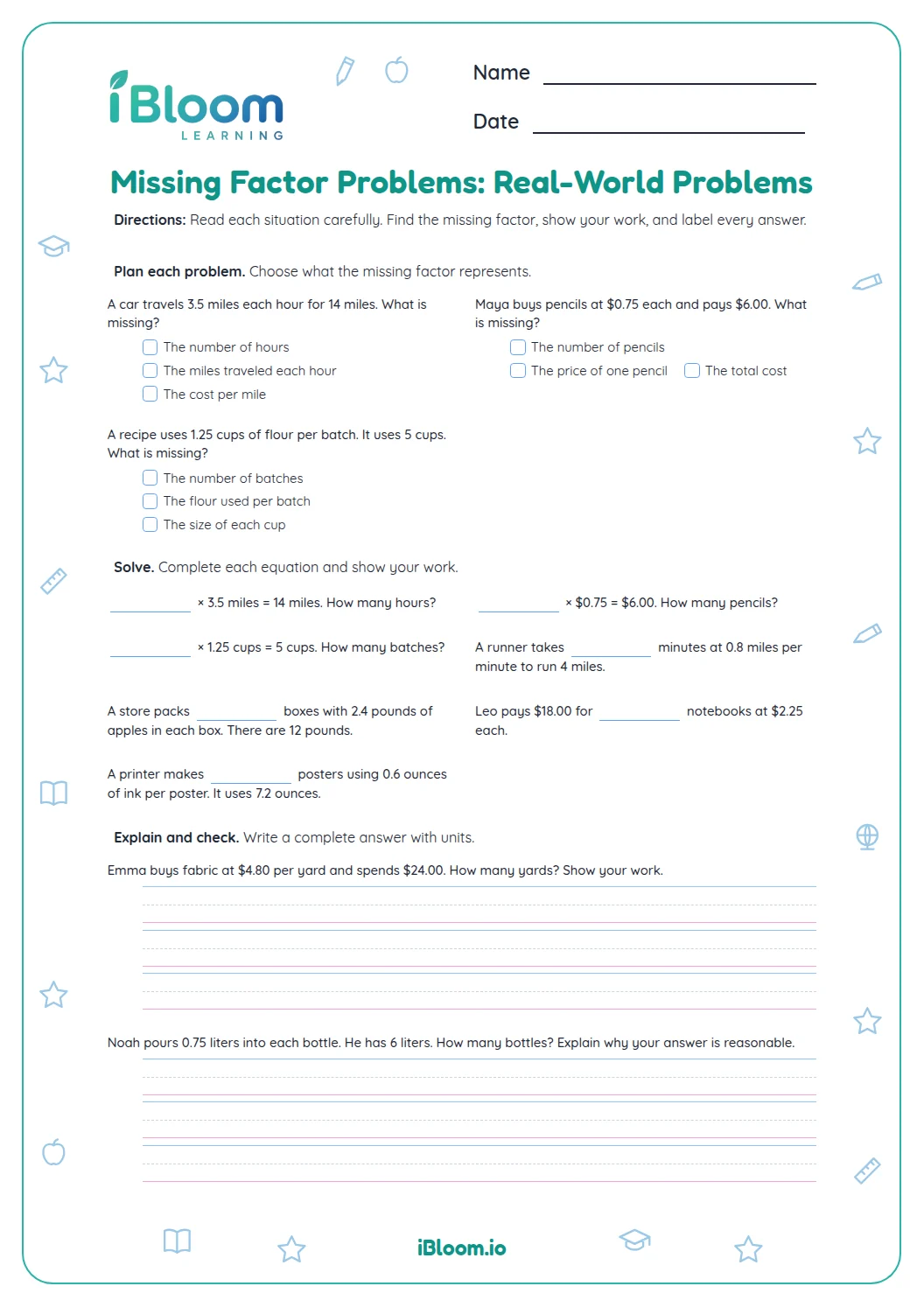
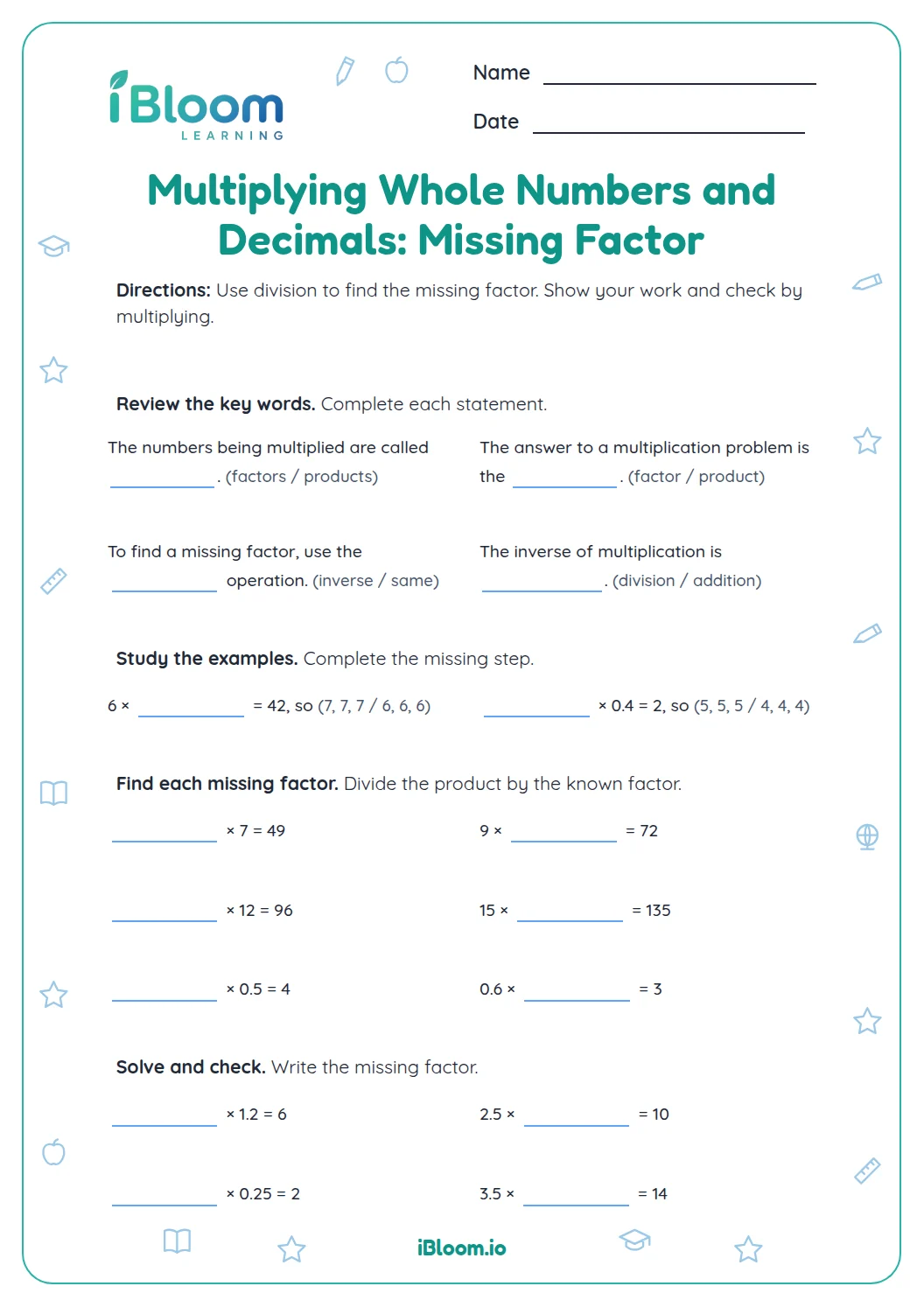
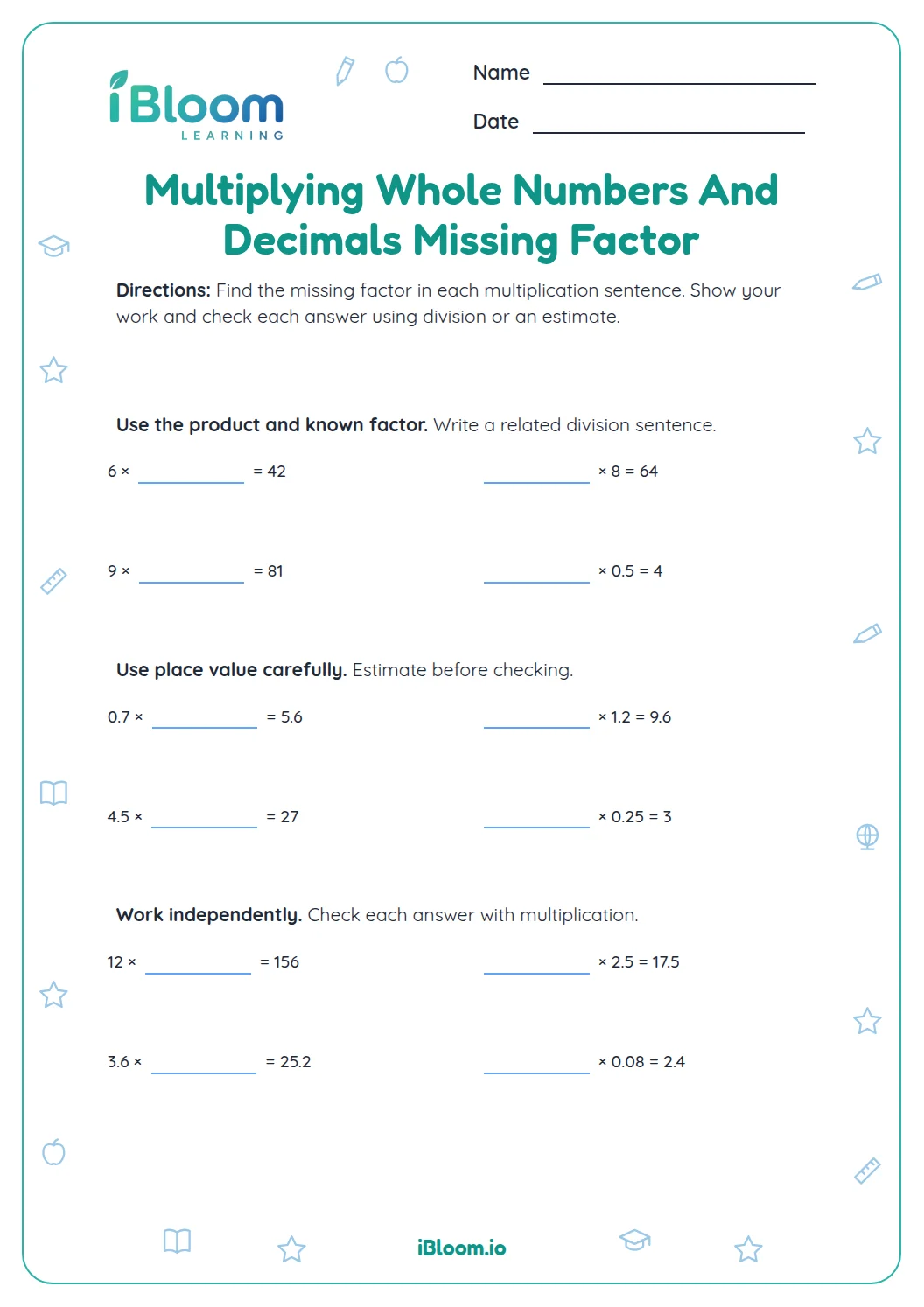
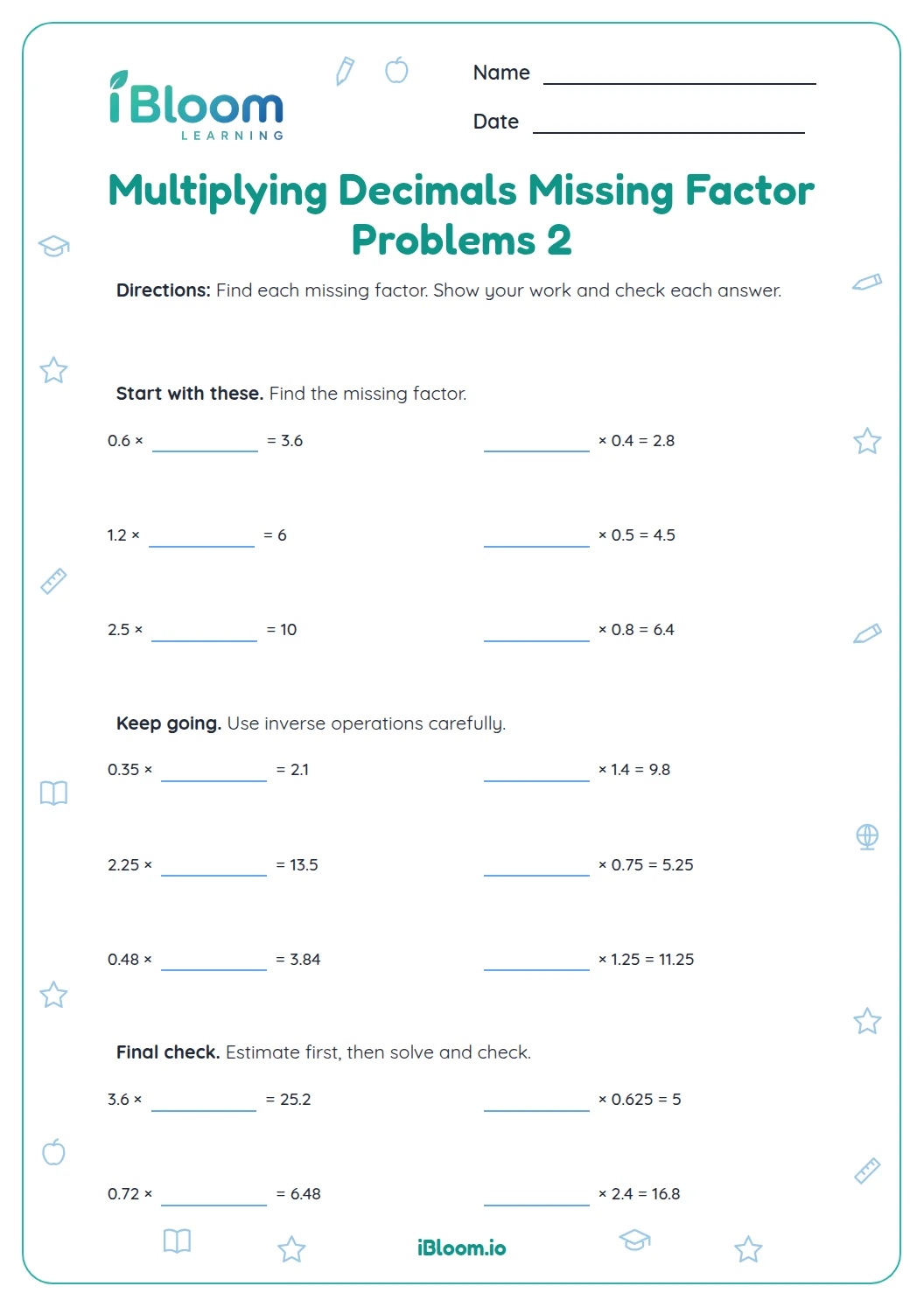
This free Grade 6 worksheet asks students to reason about missing factors in decimal multiplication. Part A has six equations with products above and below one. Part B gives four choice questions that require estimating, comparing or checking a proposed factor. Part C has four written responses about errors, changing factors, a related fact and a two-number challenge. Students divide to find unknown factors and multiply to verify them, practicing Common Core 6.NS.B.3. The separate answer key includes exact values and sample explanations for the four written questions.
Aligned to 6.NS.B.3
Why does division find the missing factor?
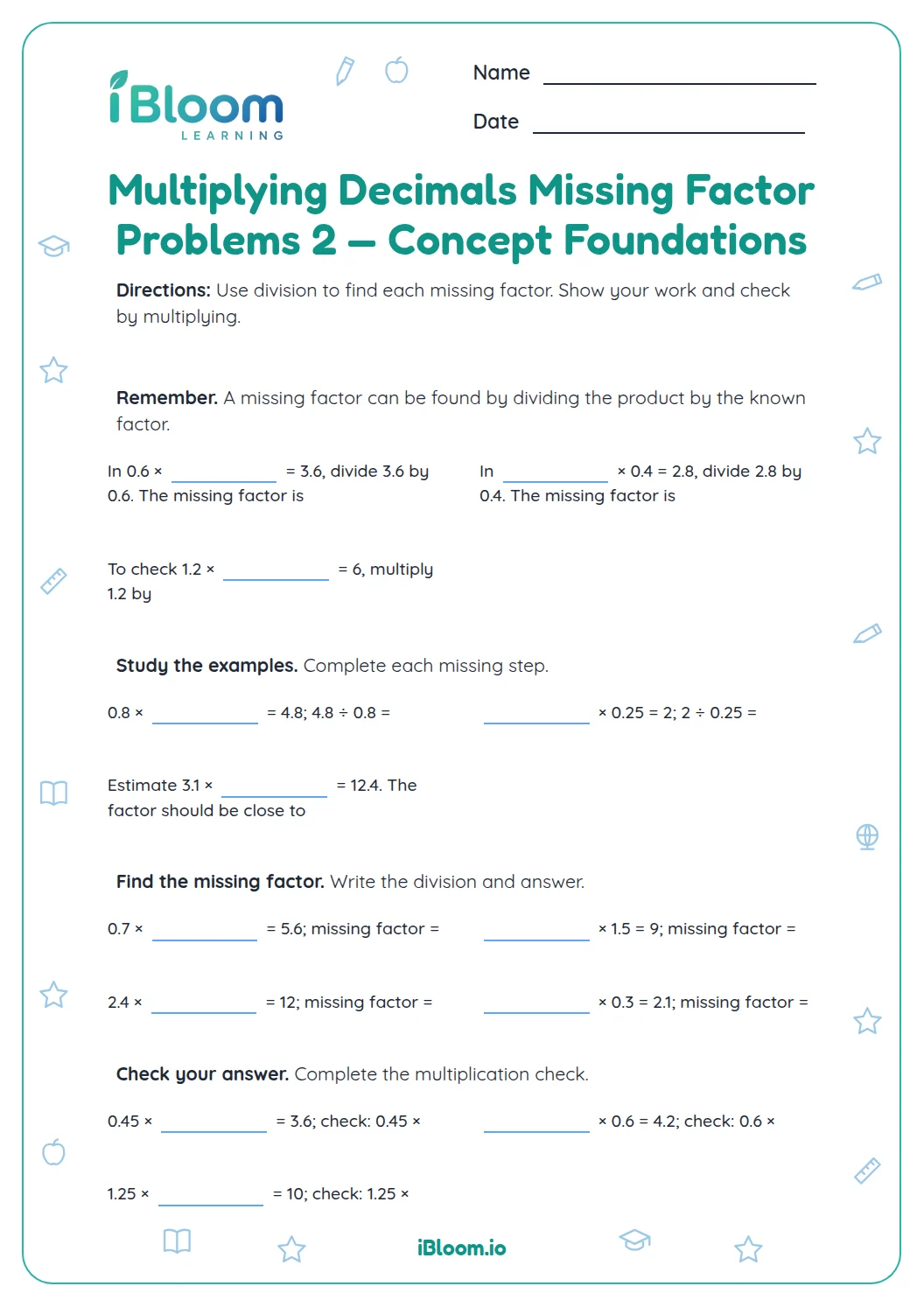
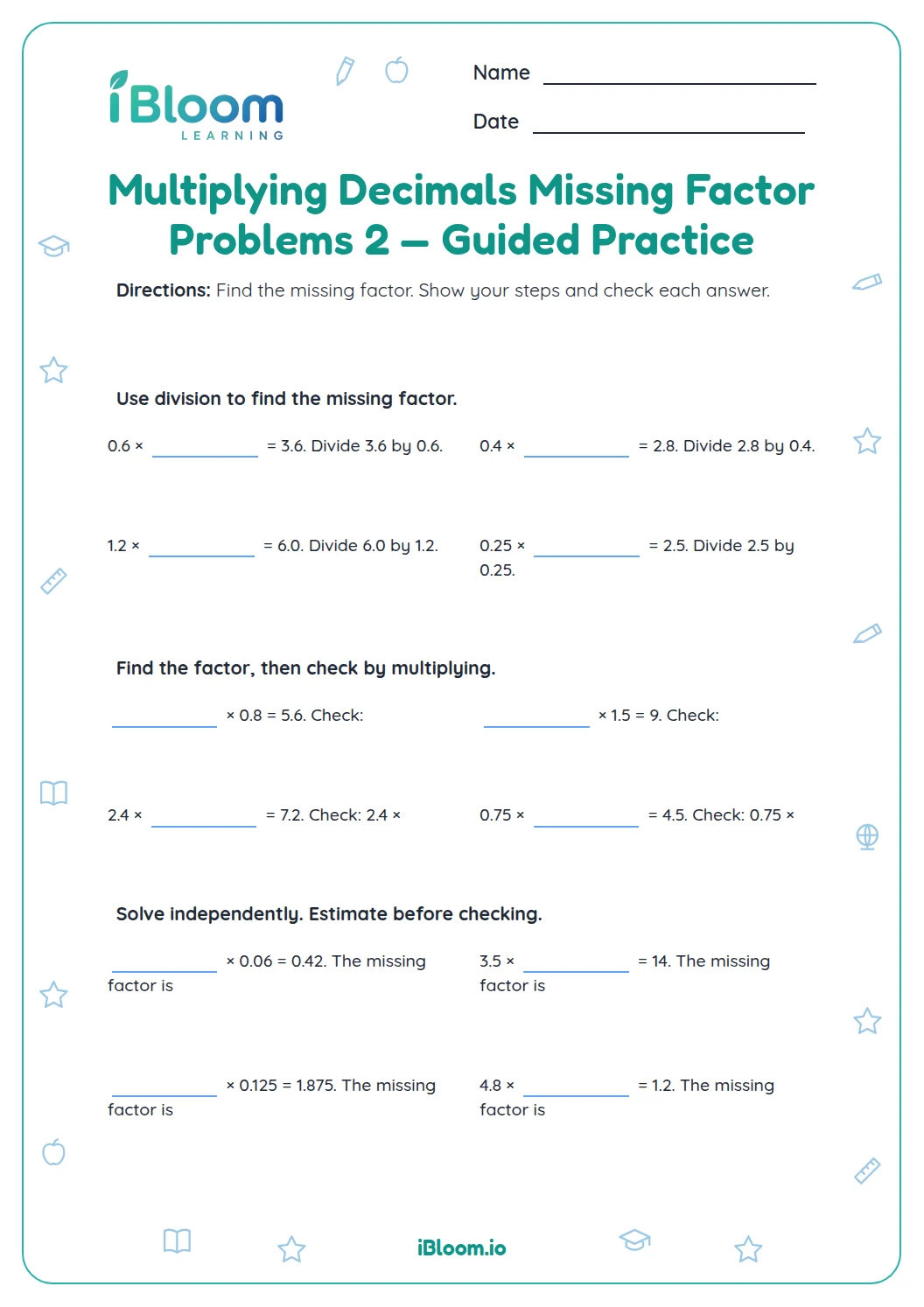
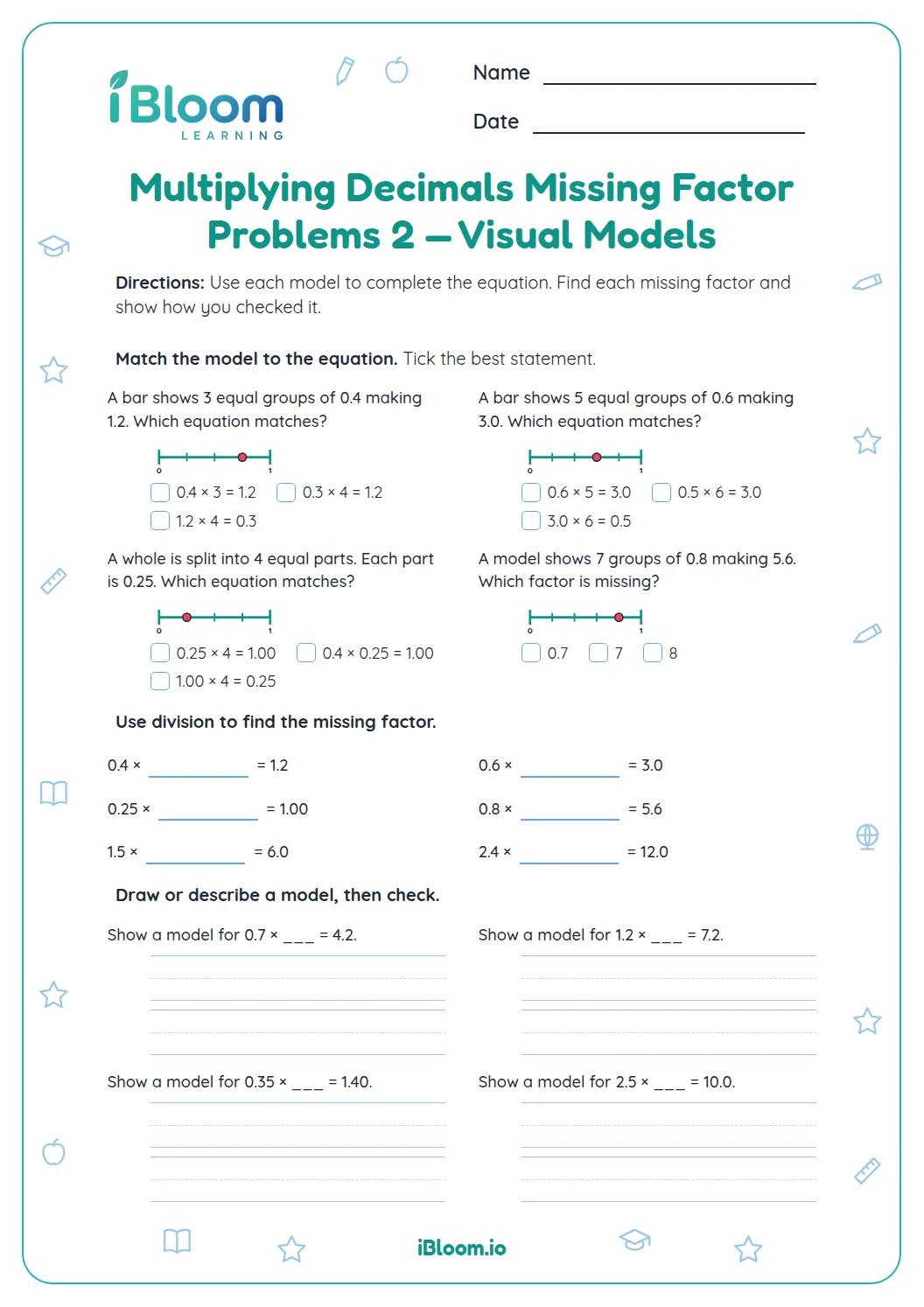
Multiplication connects two factors with their product. Dividing that product by the factor you know recovers the other factor. Use the original equation for the final multiplication check.
- 11.5 × ___ = 0.675
- 20.675 ÷ 1.5 = 6.75 ÷ 15 = 0.45
- 3Check: 1.5 × 0.45 = 0.675
- 4The missing factor is 0.45.
How can students predict whether the factor is above or below one?
Compare the product with the known positive factor. In question 7, 1.04 is greater than 0.8, so the missing factor must be greater than one. Multiplying 0.8 by one would leave it at 0.8.
This estimate catches a misplaced decimal before a full calculation. In question 8, multiplying 0.04 by 0.45 would produce a number smaller than 0.04, so it cannot give 0.18.
What makes the final questions reasoning problems?
Questions 11 and 12 ask students to explain a factor error and a compensating change. Question 13 invites a related fact or division strategy. Question 14 uses a decimal product and an addition relationship to find two numbers.
The key gives sample explanations. Accept another clear explanation if the equations and factor relationships are correct.
How to use this worksheet
- 1Estimate whether each missing factor is less than, equal to or greater than one.
- 2Divide the product by the known factor, moving both decimal points equally if needed.
- 3Substitute the result into the original multiplication equation.
- 4Use product size to test the choices in Part B.
- 5In Part C, explain the factor relationships and check both conditions in the two-number challenge.
Mistakes to notice and fix
The mistake
Using 7 instead of 0.7 in question 1.
The fix
Check: 0.6 × 7 = 4.2, so the factor must be ten times smaller.
The mistake
Moving only one decimal point when dividing.
The fix
Scale both dividend and divisor by the same power of ten.
The mistake
Making B smaller in question 12.
The fix
The product stays 0.72. When 0.3 becomes 0.03, the missing factor must become ten times larger.
Common Core alignment
Divide decimals to find missing factors and multiply to check them.
On this sheet: Students solve decimal factor equations, check products and correct place-value errors.
Show the official wordingHide the official wording
Fluently add, subtract, multiply, and divide multi-digit decimals using the standard algorithm for each operation.
What to practice next
Make more practice
Further reading
Questions parents and teachers ask
Do the missing factors all have decimal points?
No, the factors include a whole number as well as decimals. In 0.25 × ___ = 1.5, the missing factor is 6. Students should let the value of the equation determine the answer, then verify it by multiplying the two factors together.
How can students check decimal placement?
Students can estimate the factor’s size and multiply it back into the equation. For 0.6 × ___ = 0.42, the product is smaller than 0.6, so the factor is below one. The check 0.6 × 0.7 = 0.42 confirms both the digits and their placement.
What is wrong with Mia’s answer in question 11?
Mia’s factor 8 gives a product of 5.6, not 0.56. The correct factor is 0.8. Students should explain the factor-of-ten error as well as provide the corrected number, using either the two products or a clear statement about how the decimal changes the value.
Why is B ten times A in question 12?
The product is fixed at 0.72, while the known factor changes from 0.3 to 0.03. Making that factor ten times smaller requires the other factor to become ten times larger. Computing A = 2.4 and B = 24 provides a direct check of the relationship.
How do students check the final two-number challenge?
Check both conditions using A = 45 and B = 42. First, 45 × 0.4 = 18, so A gives the required product. Then 42 + 3 = 45, so A is three more than B. Finding only A leaves the relationship with B unfinished.