
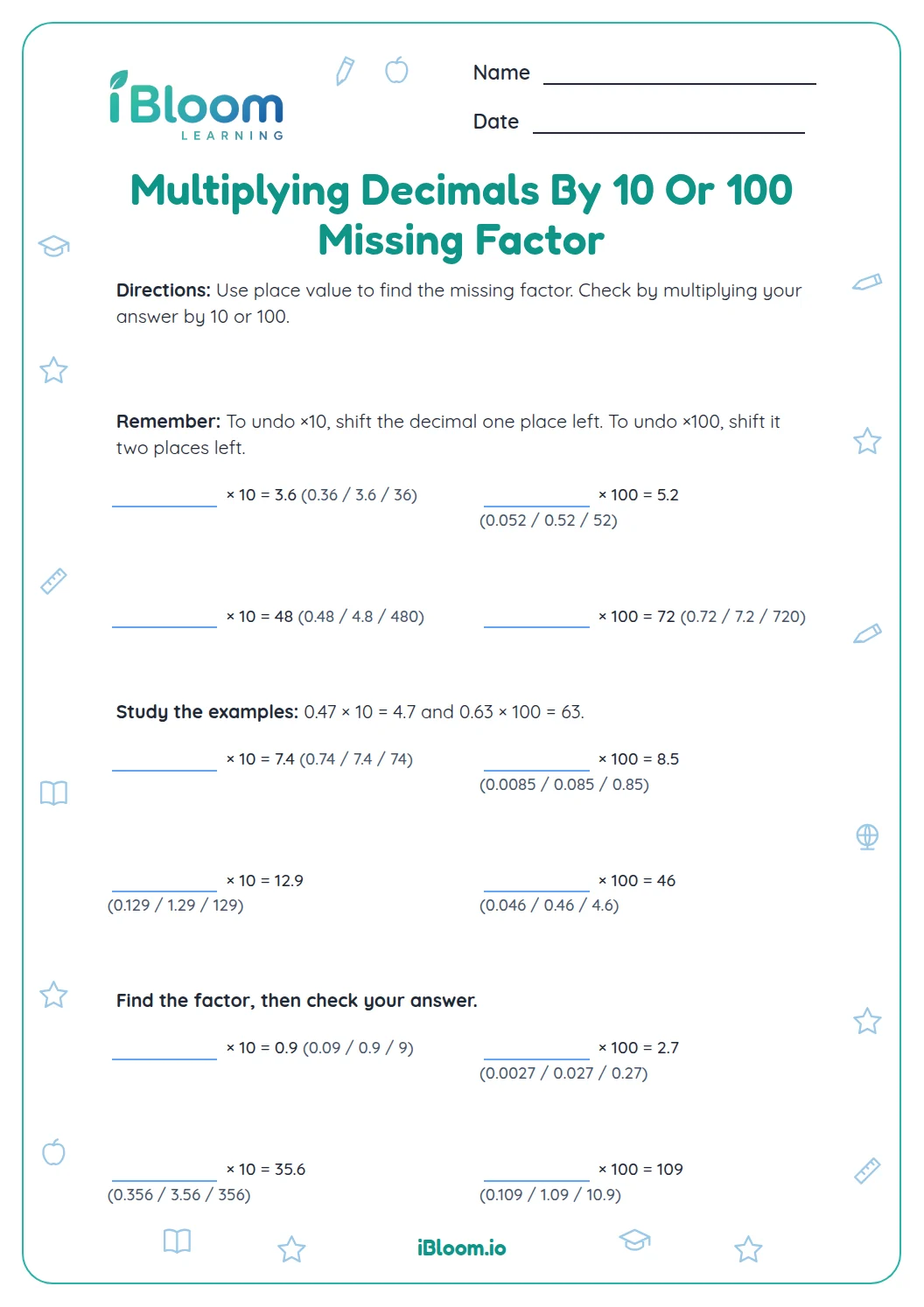
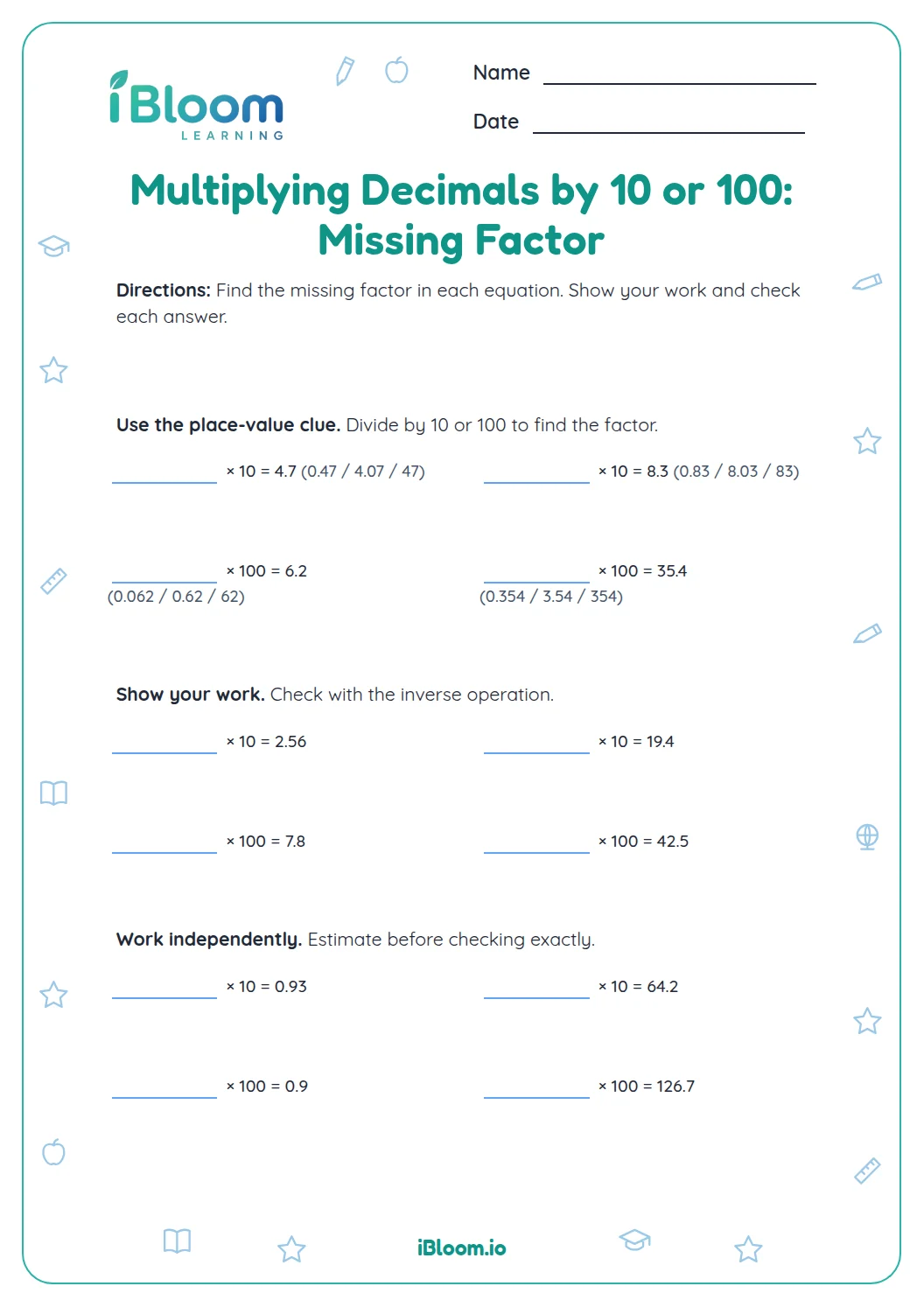
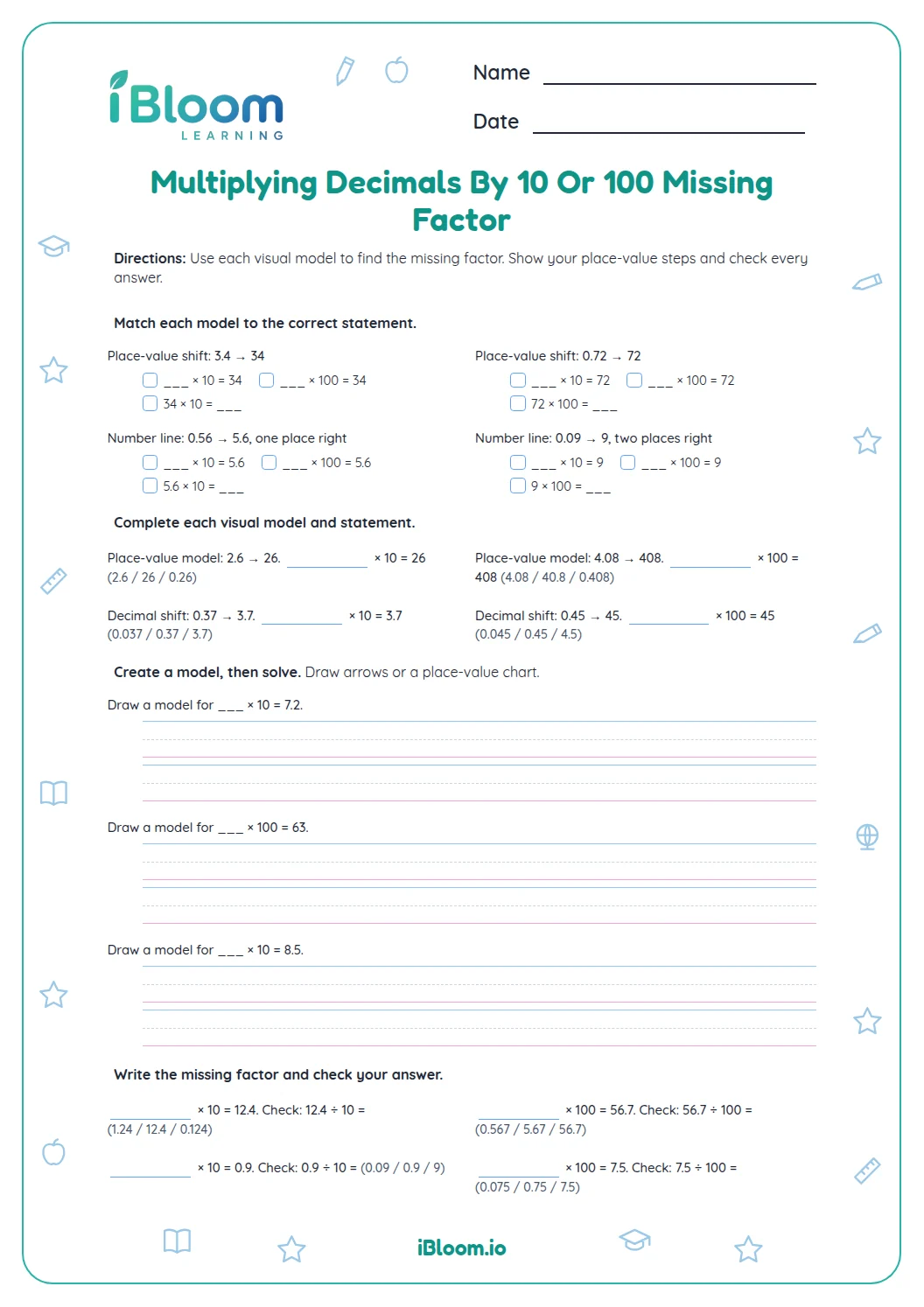
About this worksheet
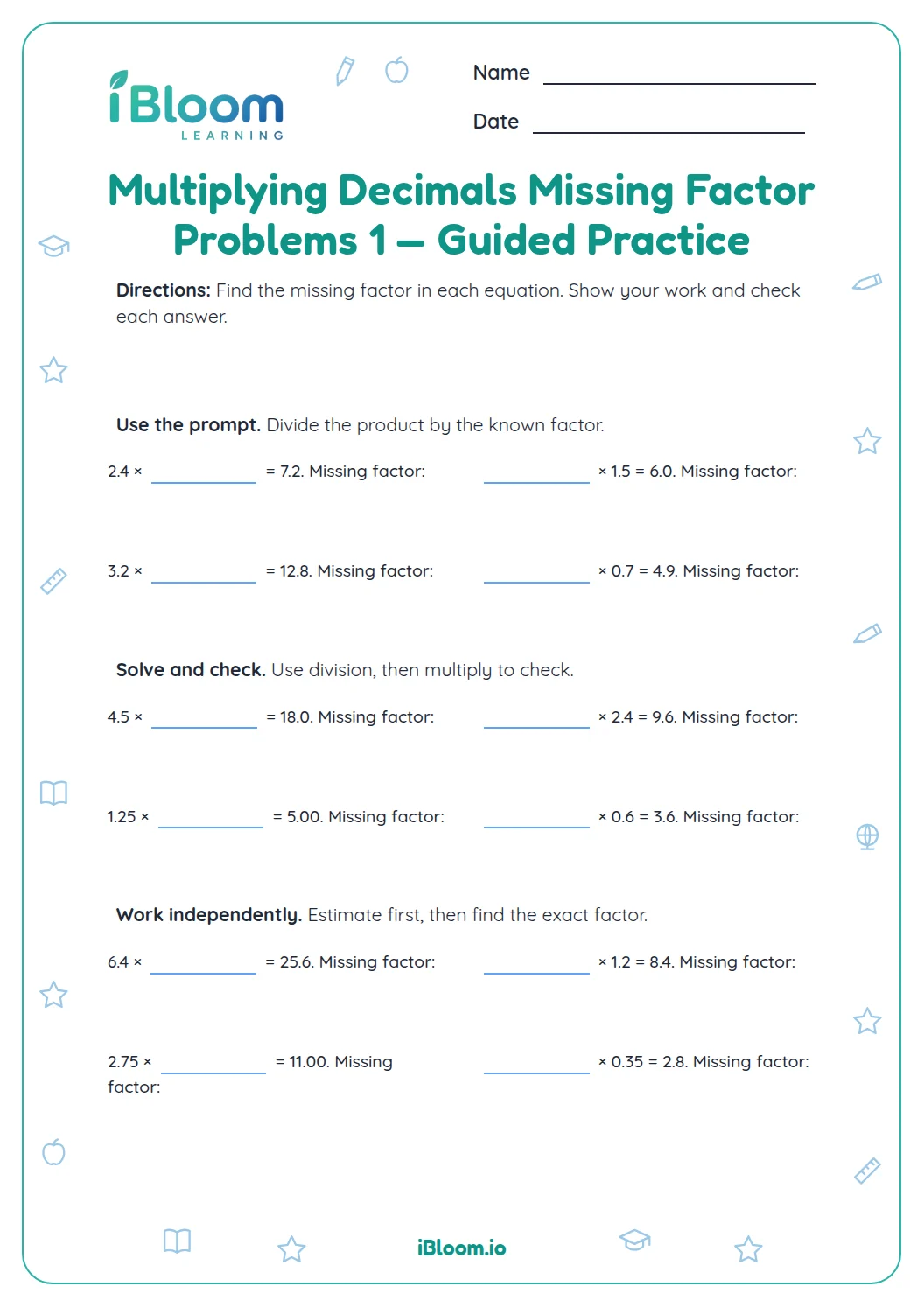
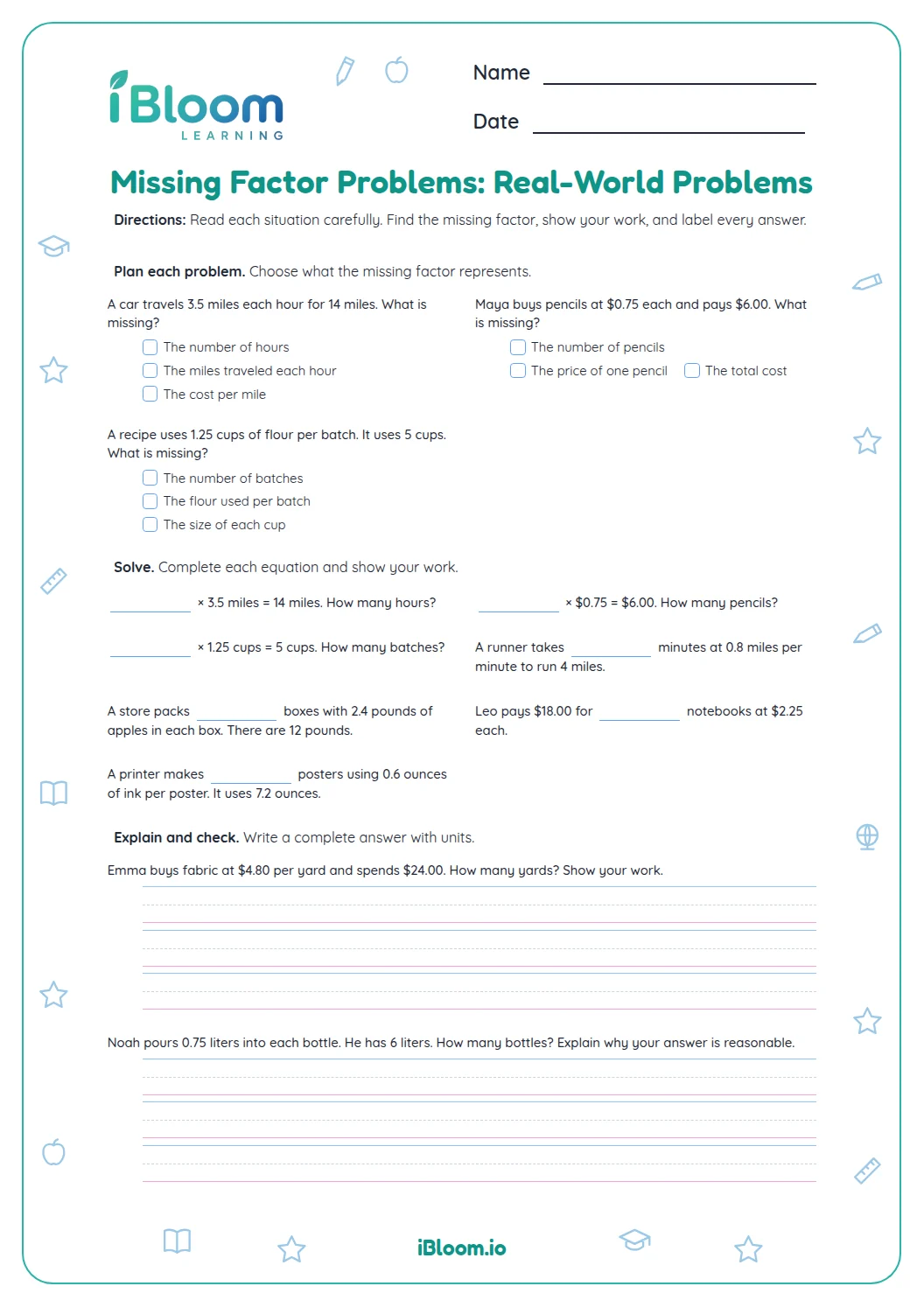
This Grade 6 worksheet builds the missing-factor idea behind decimal multiplication. Children find unknown factors in equations such as 0.4 × ___ = 2.8, then use division to solve practical equal-group situations and multiplication to check. The 16 questions progress from direct equations to contexts, with a separate answer key.
Aligned to 6.NS.B.3 and 6.EE.B.7
How do you solve a missing-factor equation?
A multiplication equation names two factors and their product. To find a missing factor, divide the product by the factor you know, then multiply to check.
For example, in 0.4 × ___ = 2.8, divide 2.8 by 0.4 to get 7. Check that 0.4 × 7 returns 2.8. The six situations in Part C use the same relationship.
- 10.4 × ___ = 2.8
- 22.8 ÷ 0.4 = 7
- 3Check: 0.4 × 7 = 2.8
What does each part practice?
Parts A and B ask for missing factors in equations. Part C translates equal-size groups into a division sentence. Answers stay in a practical range, including terminating decimal factors.
- Part A: find a whole-number factor
- Part B: find whole-number or decimal factors
- Part C: interpret a product as equal groups
How does division connect to the situations?
Each situation gives a total and the amount in one equal group. Dividing the total by the group size finds how many groups there are. For the ribbon question, 0.75 ÷ 0.15 = 5 pieces.
Multiply the group size by the number of groups to check the total.
A useful routine for the page
- 1Circle the factor you know and the product.
- 2Divide the product by the known factor.
- 3Write the quotient in the blank.
- 4Multiply the two factors to check the product.
- 5For a context, name what the quotient counts and include the unit only when asked.
Common mistakes and quick fixes
The mistake
Dividing the known factor by the product.
The fix
Use product ÷ known factor; the missing factor multiplied by the known one must rebuild the product.
The mistake
Placing a decimal point by guesswork.
The fix
Estimate first, then check the multiplication. For 2.8 ÷ 0.4, 7 is sensible because 0.4 × 7 is close to 3.
The mistake
Reporting a quotient without checking it in the original equation.
The fix
Substitute the answer in the blank and multiply.
Common Core alignment
This worksheet practices Grade 6 decimal operations and one-variable equations.
Fluently compute with multi-digit decimals using the standard algorithm for each operation.
On this sheet: Children divide decimal products by known decimal factors and check with multiplication.
Show the official wordingHide the official wording
Fluently add, subtract, multiply, and divide multi-digit decimals using the standard algorithm for each operation.
Solve real-world problems by solving equations of the form x/p = q.
On this sheet: The equal-group contexts can be represented by a one-step division equation with an unknown group count.
Show the official wordingHide the official wording
Solve real-world and mathematical problems by writing and solving equations of the form x + p = q and px = q for cases in which p, q and x are all nonnegative rational numbers.
What to practice next
Make more practice
Further reading
Questions parents and teachers ask
How do you find the missing factor in 0.4 × ___ = 2.8?
Divide the product, 2.8, by the known factor, 0.4. The quotient is 7, so the missing factor is 7. Check it in the original equation: 0.4 × 7 = 2.8. If the product does not match, revisit the division. Then review the original equation.
Why can division help with a multiplication equation?
Division reverses multiplication. If a known factor times an unknown factor makes the product, divide by the known factor to find the other factor. Multiplying the two factors afterward checks that they rebuild the product in the question. This works with decimal factors too.
Should students estimate first?
Yes. A quick estimate helps catch a misplaced decimal point before it becomes a final answer. Then multiplication checks the exact value. For example, a quotient near 7 is reasonable for 2.8 divided by 0.4 because seven groups of 0.4 are close to 3.
Does the worksheet include a key?
Yes. The answer key lists the missing factor for every equation and situation. It is separate from the student questions, so an adult can keep the key aside during practice and use it afterward to check the calculations. The key keeps checking straightforward.
How can I check a decimal quotient?
Multiply the quotient by the divisor and compare the product with the original dividend. For example, 0.75 ÷ 0.15 gives 5; multiplying 5 × 0.15 returns 0.75. This check helps catch a misplaced decimal point or an incorrect number of groups.
What does the worksheet ask students to practice?
Parts A and B have ten equations with a missing factor, including whole-number and decimal answers. Part C has six short equal-group situations. Students divide to find the missing factor and use multiplication to check each result; the separate key lists all 16 answers.