



About this worksheet
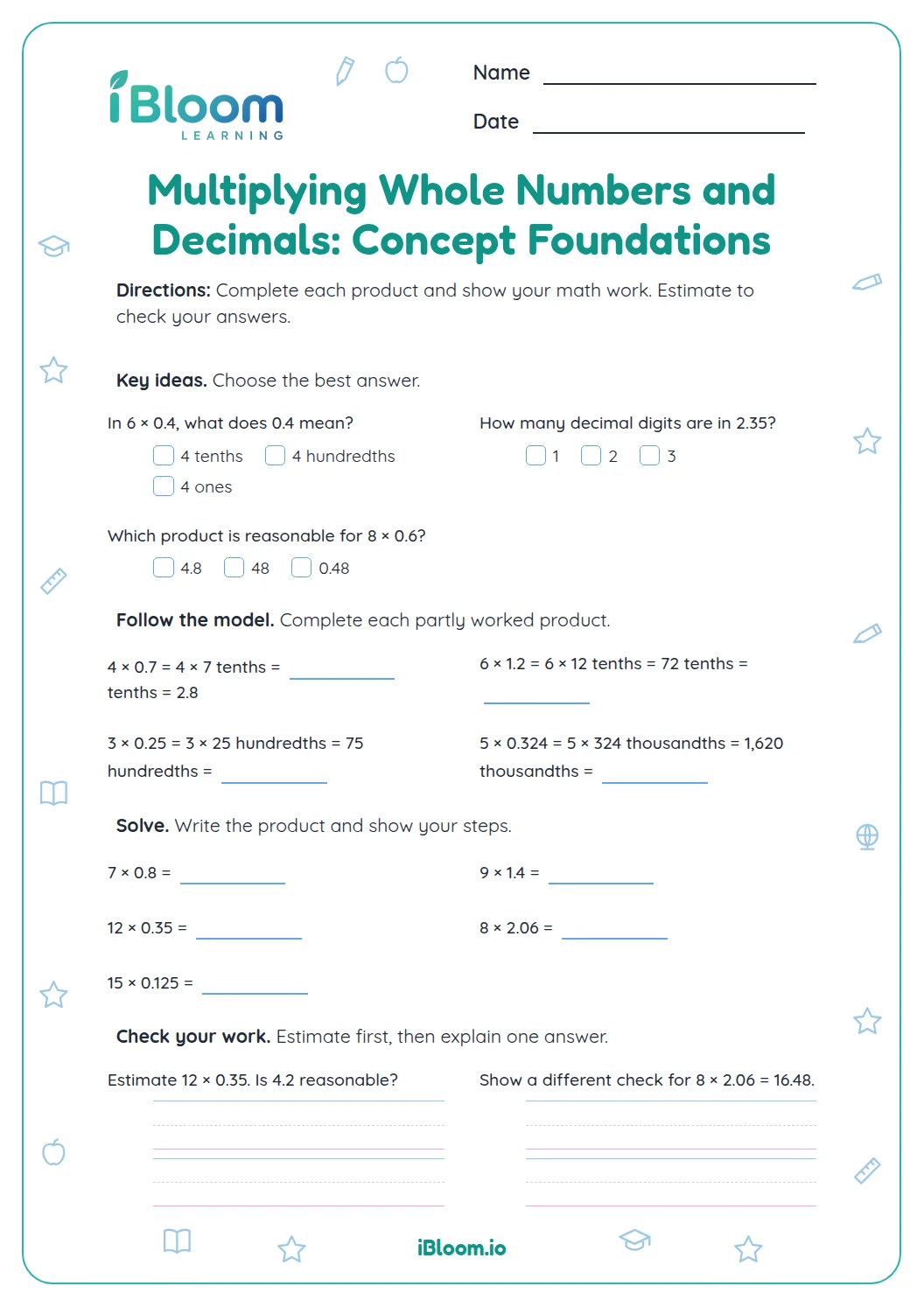
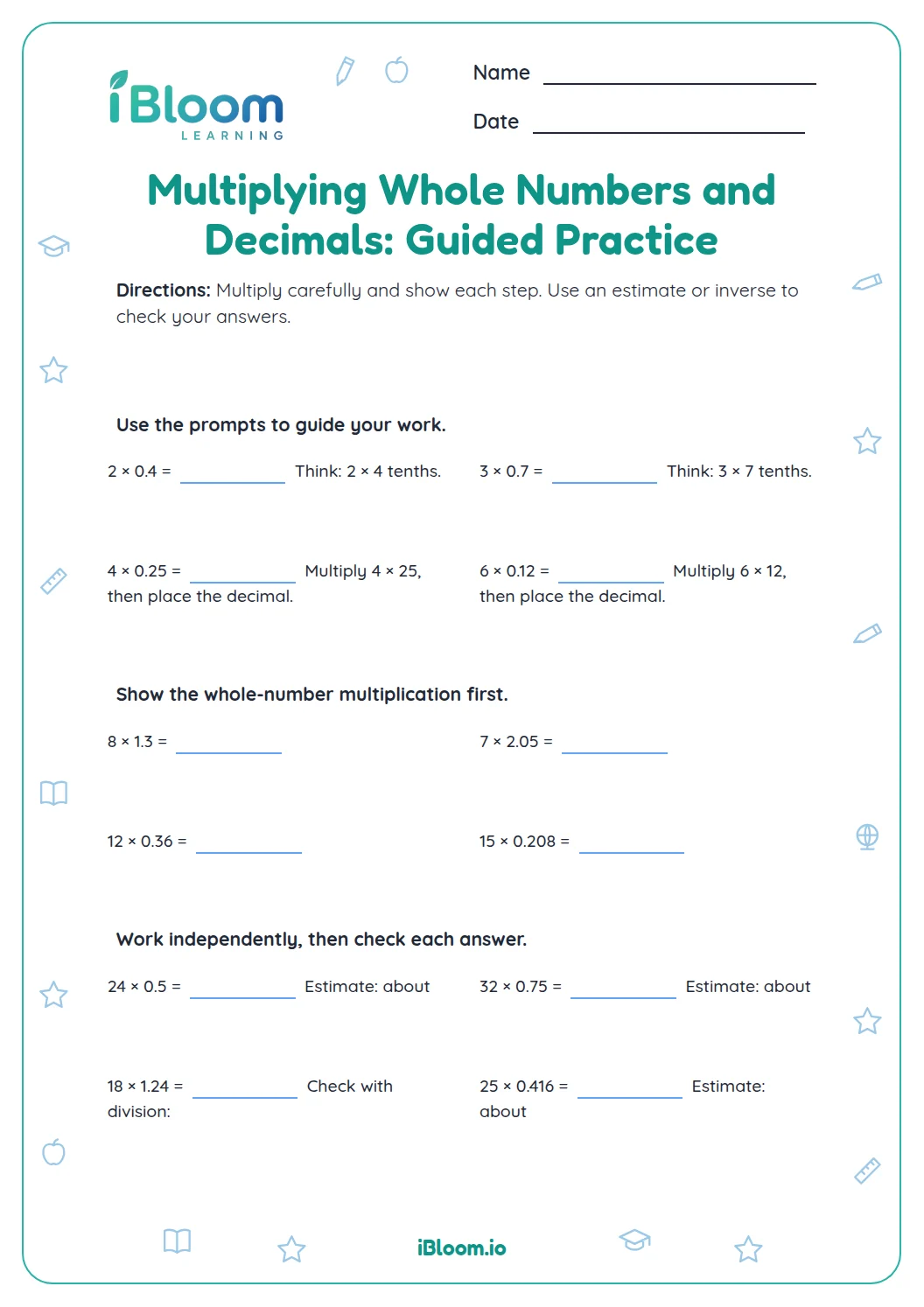
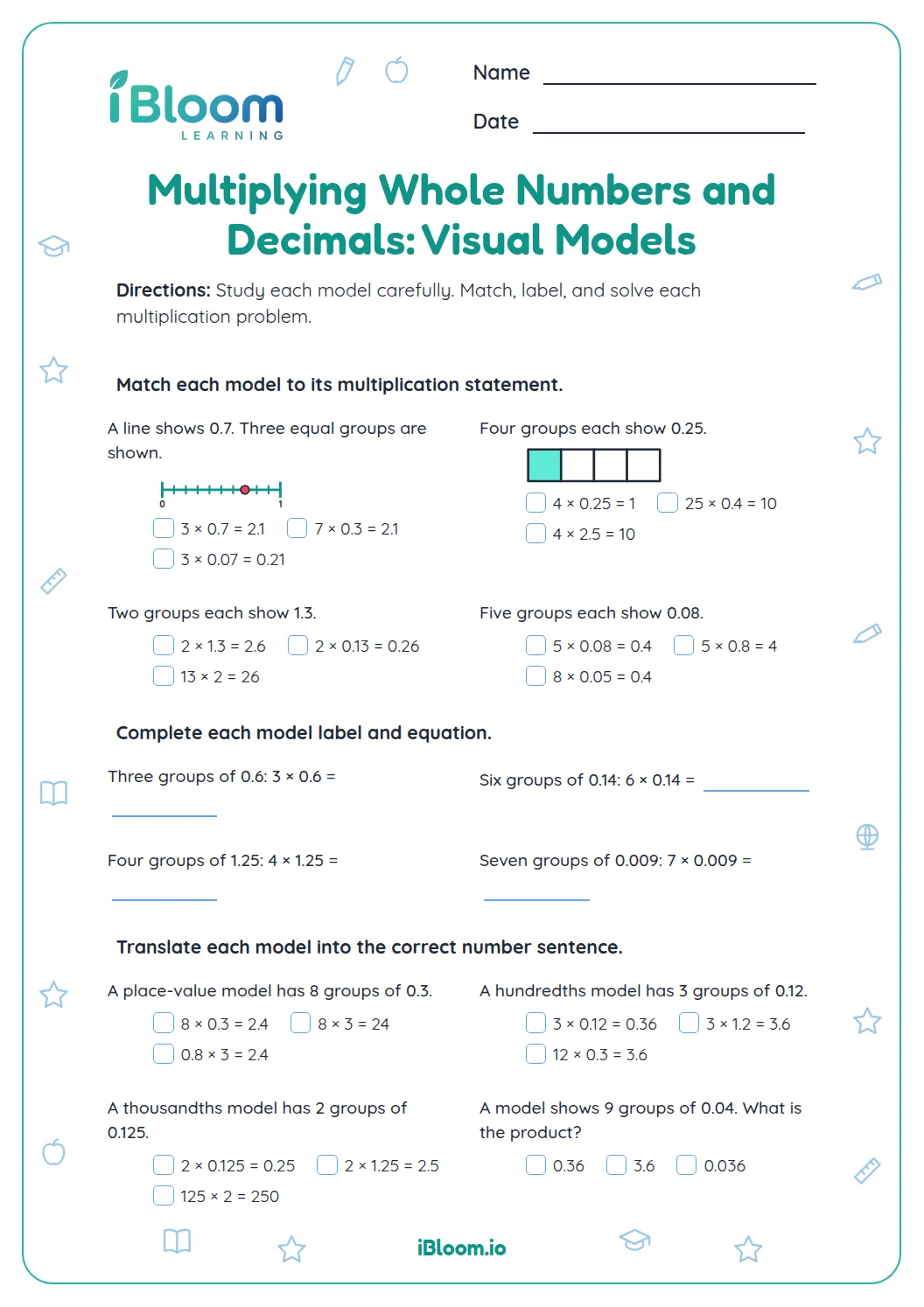
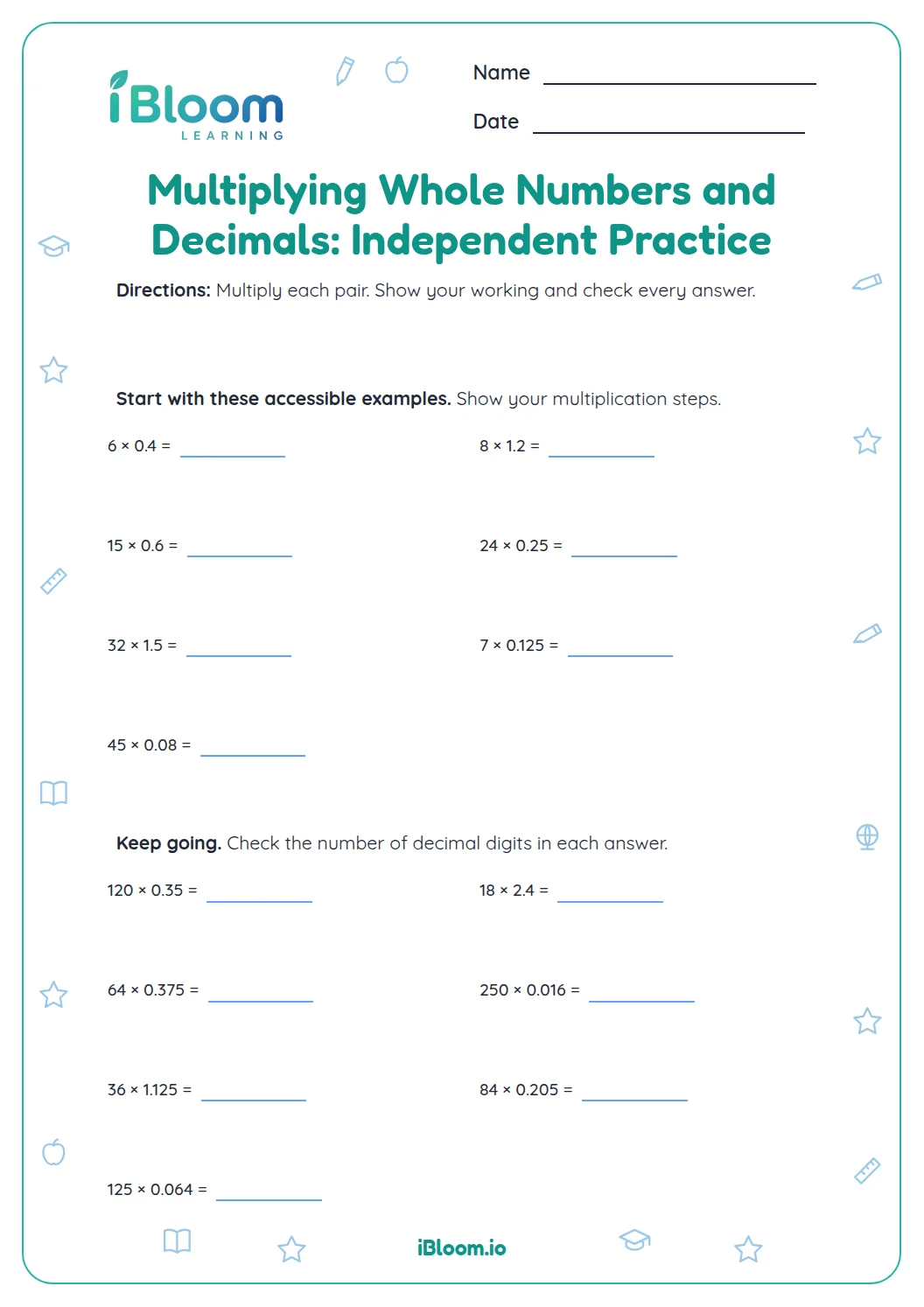
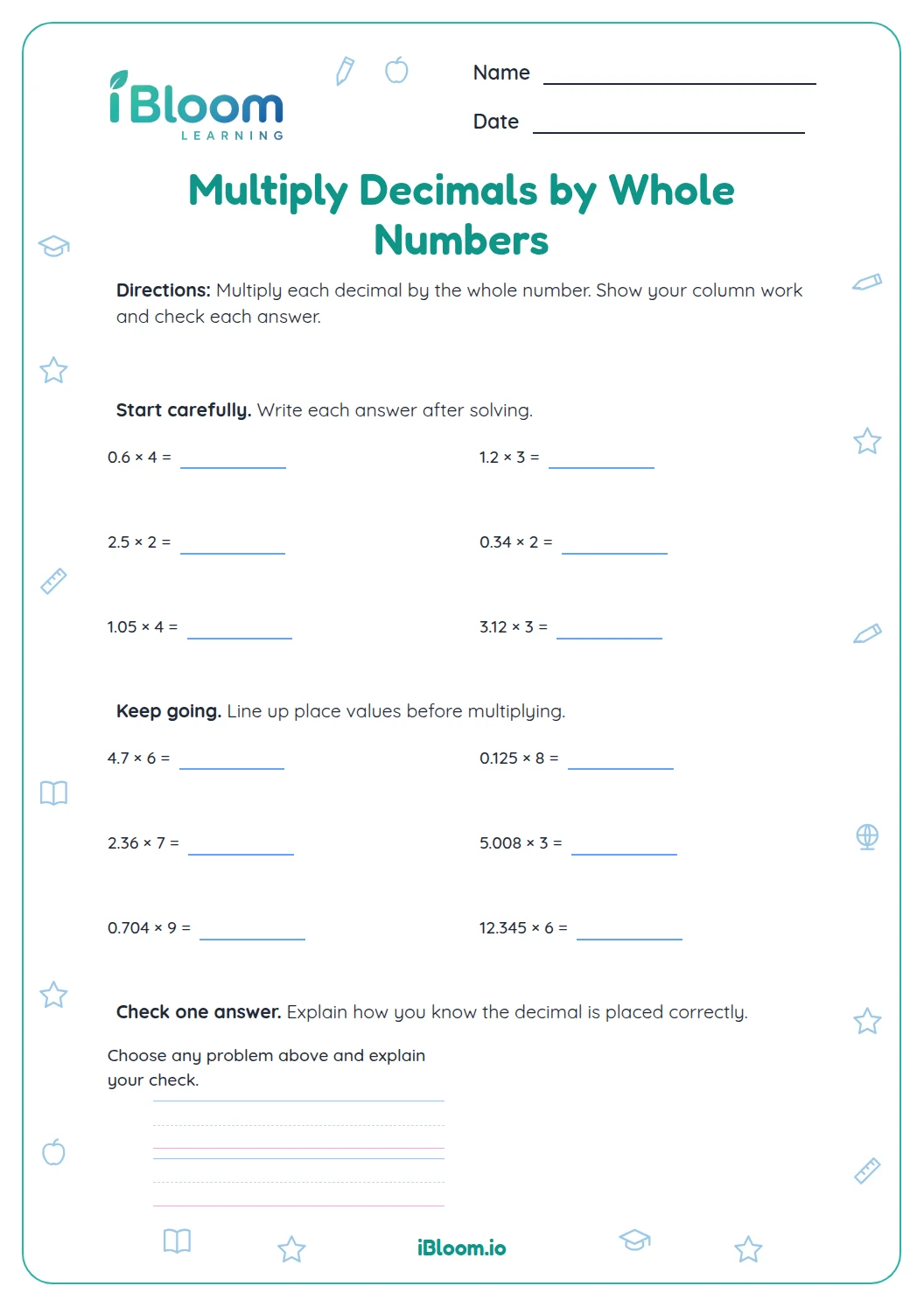
This Grade 6 worksheet gives 16 real-world problems that multiply a decimal by a whole number. Contexts include lengths, money, mass, and capacity, with factors to thousandths and products written with the unit named in each question. Students calculate and record one product per item, then check the separate answer key. The sheet practices CCSS 6.NS.B.3.
Aligned to 6.NS.B.3
How do you set up a decimal multiplication problem?
Each problem describes equal groups, such as several ribbons of the same length. Multiply the amount in one group by the number of groups, then keep the unit from the question.
- 12.4 meters per ribbon × 3 ribbons
- 224 × 3 = 72
- 32.4 has one decimal place, so the product is 7.2
- 4Answer: 7.2 meters
How do you place the decimal in the product?
The questions use decimals with one, two, or three decimal places and whole-number group counts. Money and measurement contexts ask for one product each, with the unit included in the answer.
- Part A: products with tenths and hundredths
- Part B: hundredths and thousandths in practical settings
- Part C: larger whole-number group counts
Why should the answer include a unit?
A number alone does not tell what was measured or purchased. Write dollars for a cost, meters for a length, and kilograms for a mass. When the context uses money, keep the dollar sign in the answer as well.
How to use this worksheet
- 1Underline the amount in one group and the number of groups.
- 2Write the factors in a multiplication equation.
- 3Multiply the digits, then place the decimal point.
- 4Estimate whether the product is a sensible size.
- 5Include the unit or dollar sign in the answer.
Common mistakes and quick fixes
The mistake
Multiplying the digits but forgetting the decimal point.
The fix
Count decimal places in the decimal factor before writing the product.
The mistake
Adding the decimal factor instead of making equal groups.
The fix
Use multiplication because the same amount repeats for each group.
The mistake
Leaving off the unit or dollar sign.
The fix
Reread the context and label the total in matching units.
Common Core alignment
The problems apply decimal computation in familiar measurement and money settings.
Multiply multi-digit decimals using the standard algorithm.
On this sheet: Students multiply decimal amounts by whole-number group counts and check decimal placement.
Show the official wordingHide the official wording
Fluently add, subtract, multiply, and divide multi-digit decimals using the standard algorithm for each operation.
What to practice next
Make more practice
Further reading
Questions parents and teachers ask
How do you know where to put the decimal point?
Multiply the digits first, then count how many places are after the decimal in the decimal factor. Put the decimal in the product so it has that many decimal places. For example, 2.4 × 3 gives 72 tenths, or 7.2.
Why does question 3 use a dollar sign?
The question asks for the total cost of six notebooks priced at $1.25 each. The product is 1.25 × 6 = $7.50. Keeping the dollar sign makes clear that the product is money, not a length or count.
Can the product be greater than the decimal factor?
Yes. Multiplying by a whole number greater than one makes equal groups, so the total is larger. For example, four jars with 0.75 liter each hold 3 liters altogether. An estimate can help confirm the result makes sense.
What units are used in these problems?
The contexts include meters, liters, dollars, miles, kilograms, centimeters, and feet. Read the wording before solving, then use the same unit in the answer. For money, include a dollar sign and cents when needed. The answer key uses the units named in each problem.
Does the answer key include units?
Yes. The key labels measurement totals with the unit from the question and keeps dollar signs for prices. It lists all 16 products so students can check both the multiplication and how they wrote each final answer. Review an estimate, too, to catch decimal placement slips.