







About this worksheet
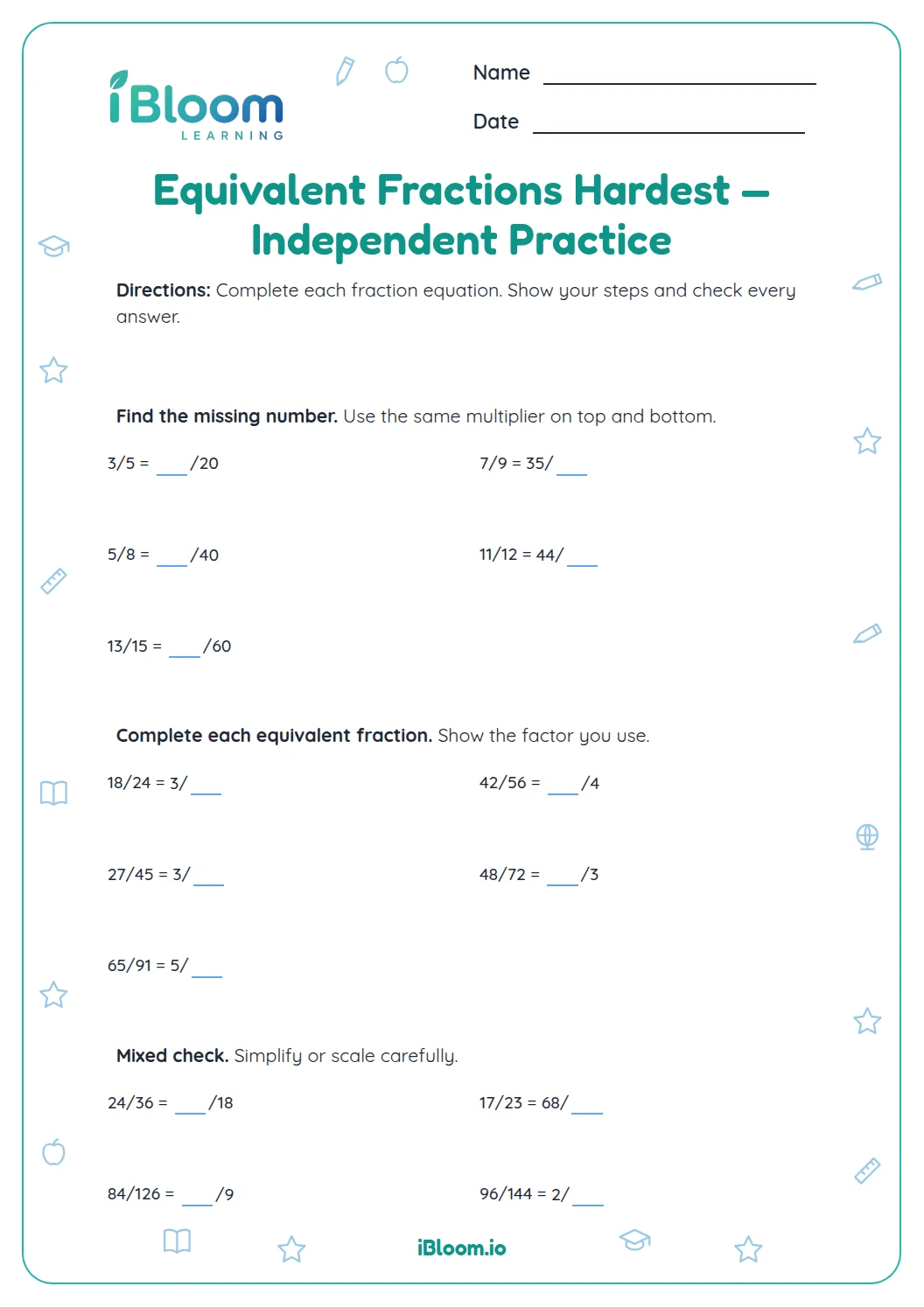
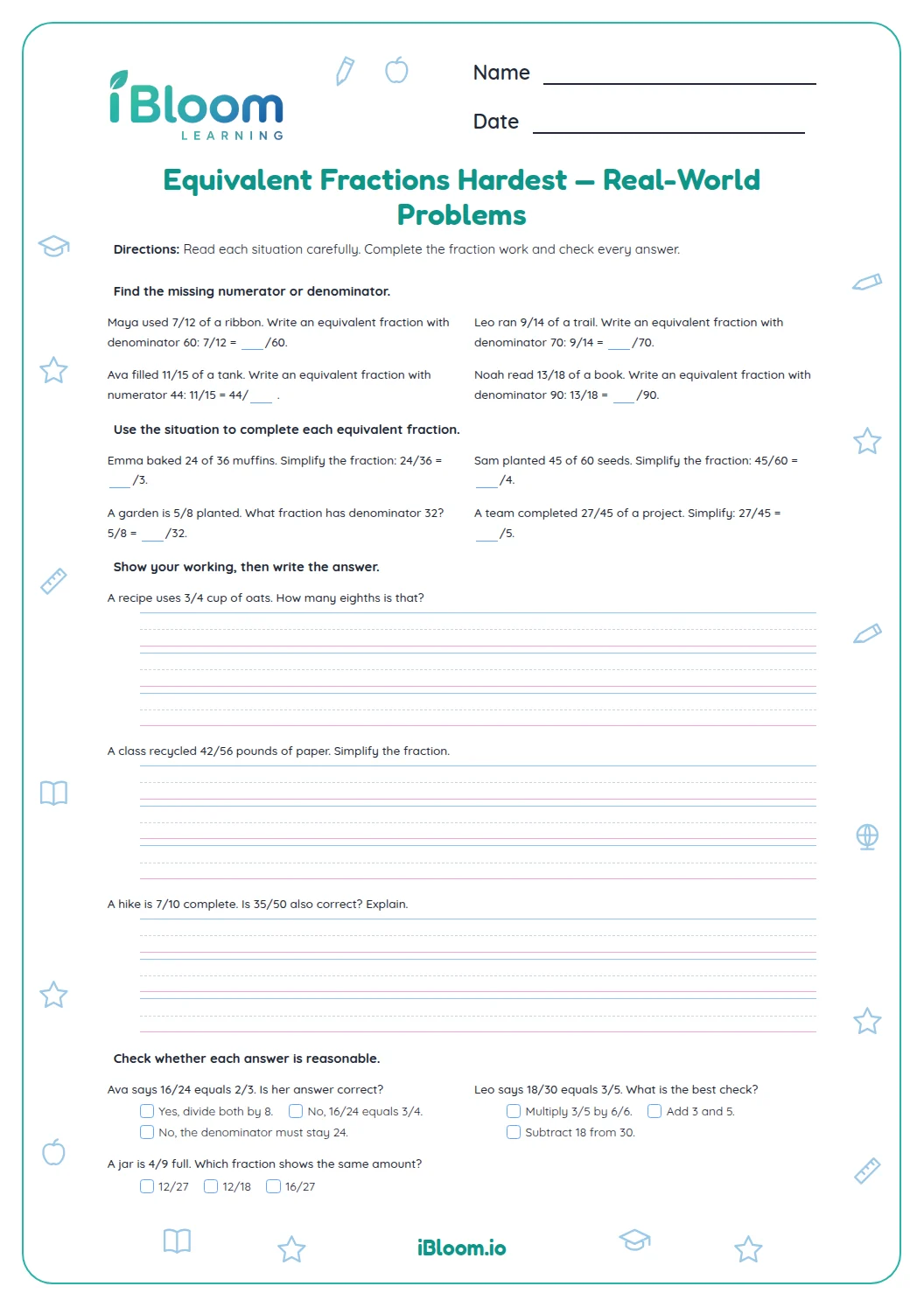
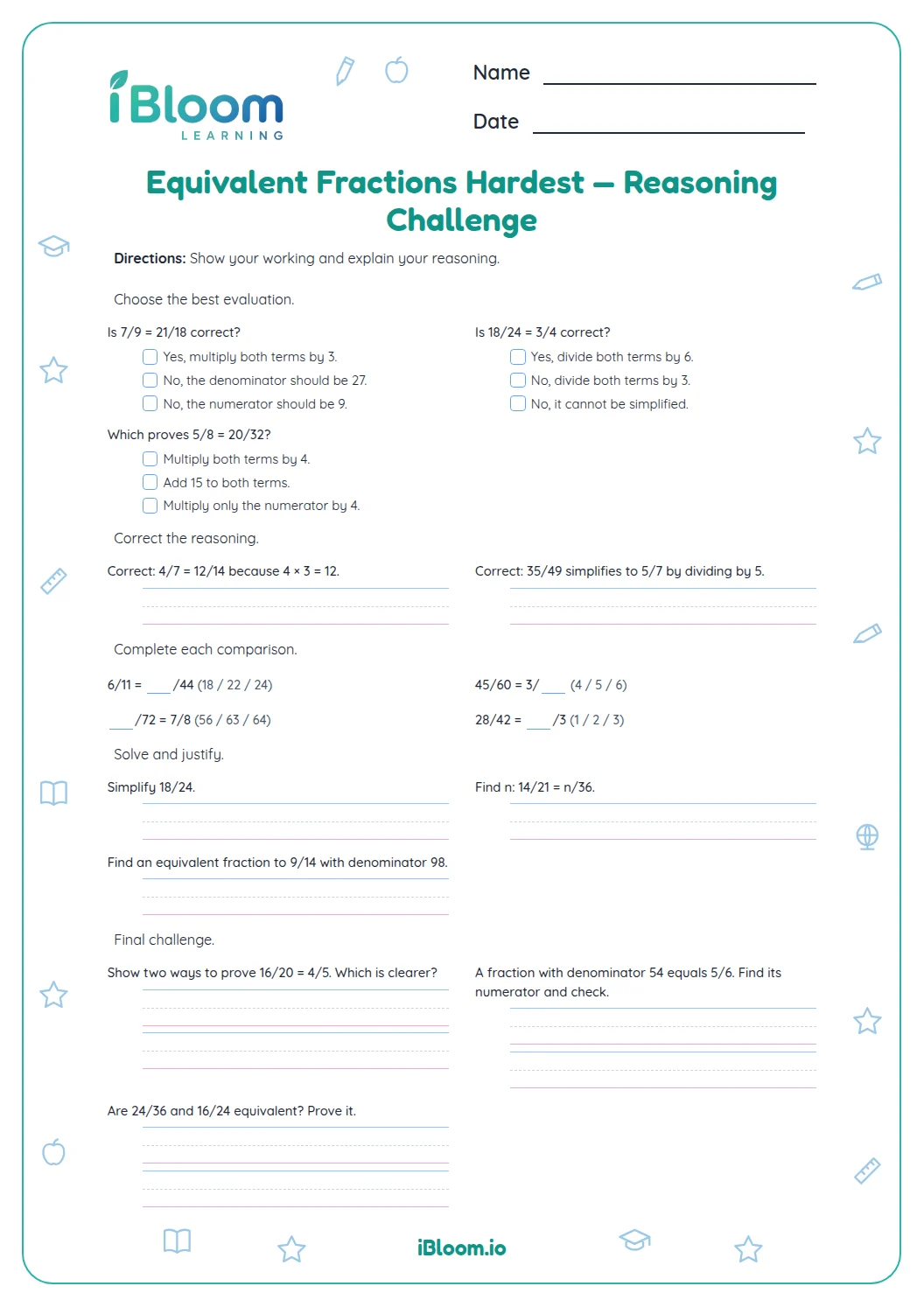
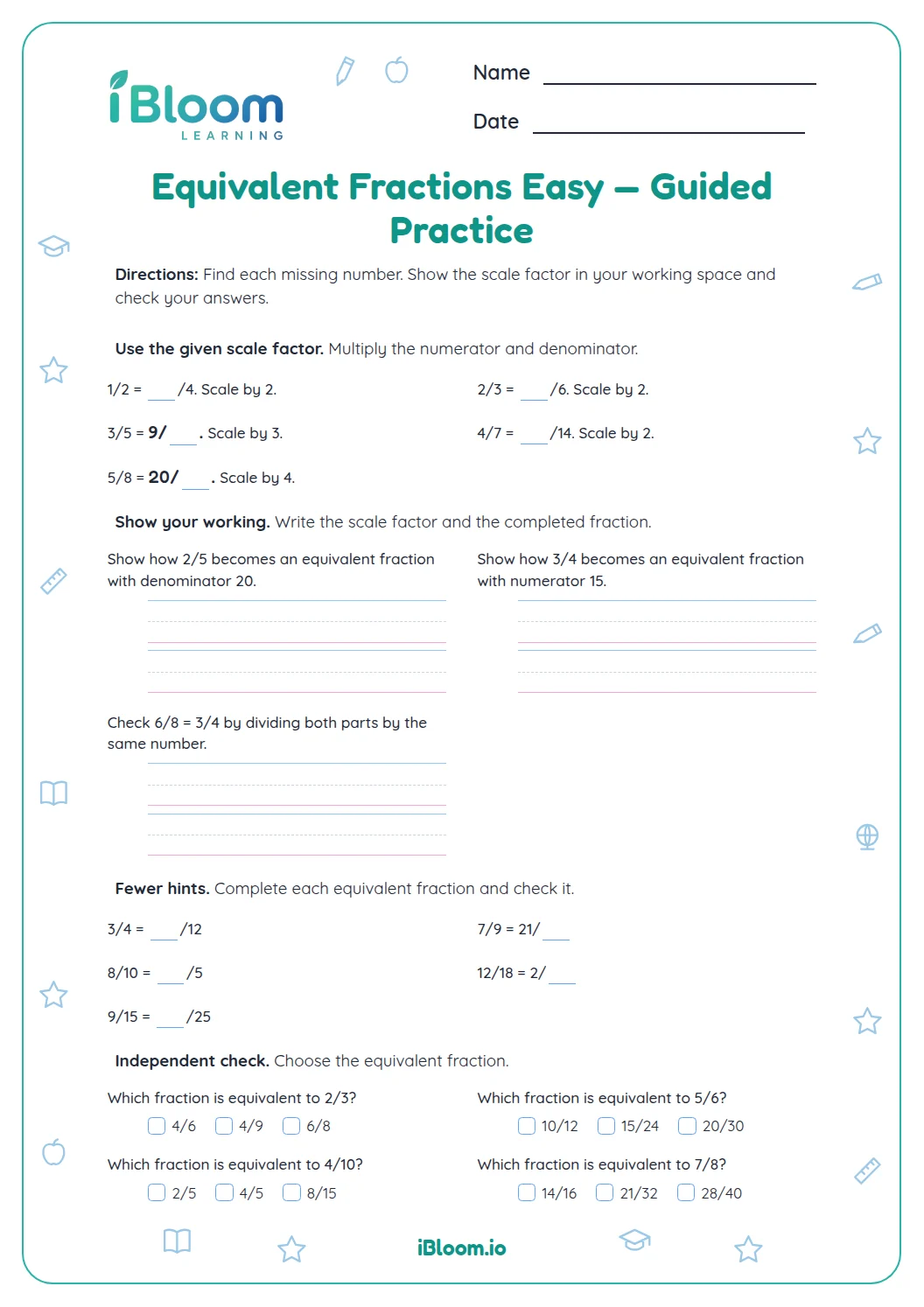
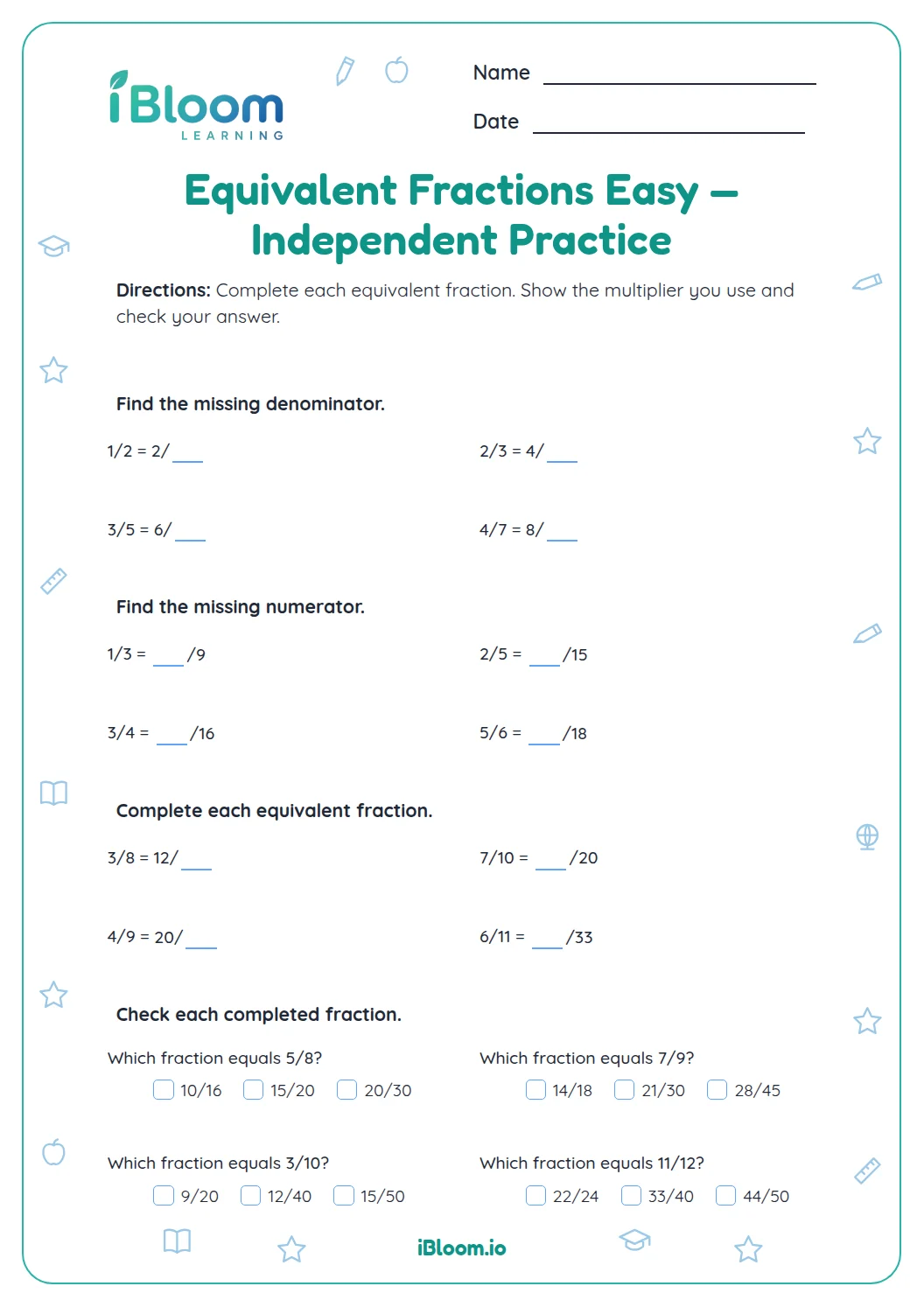
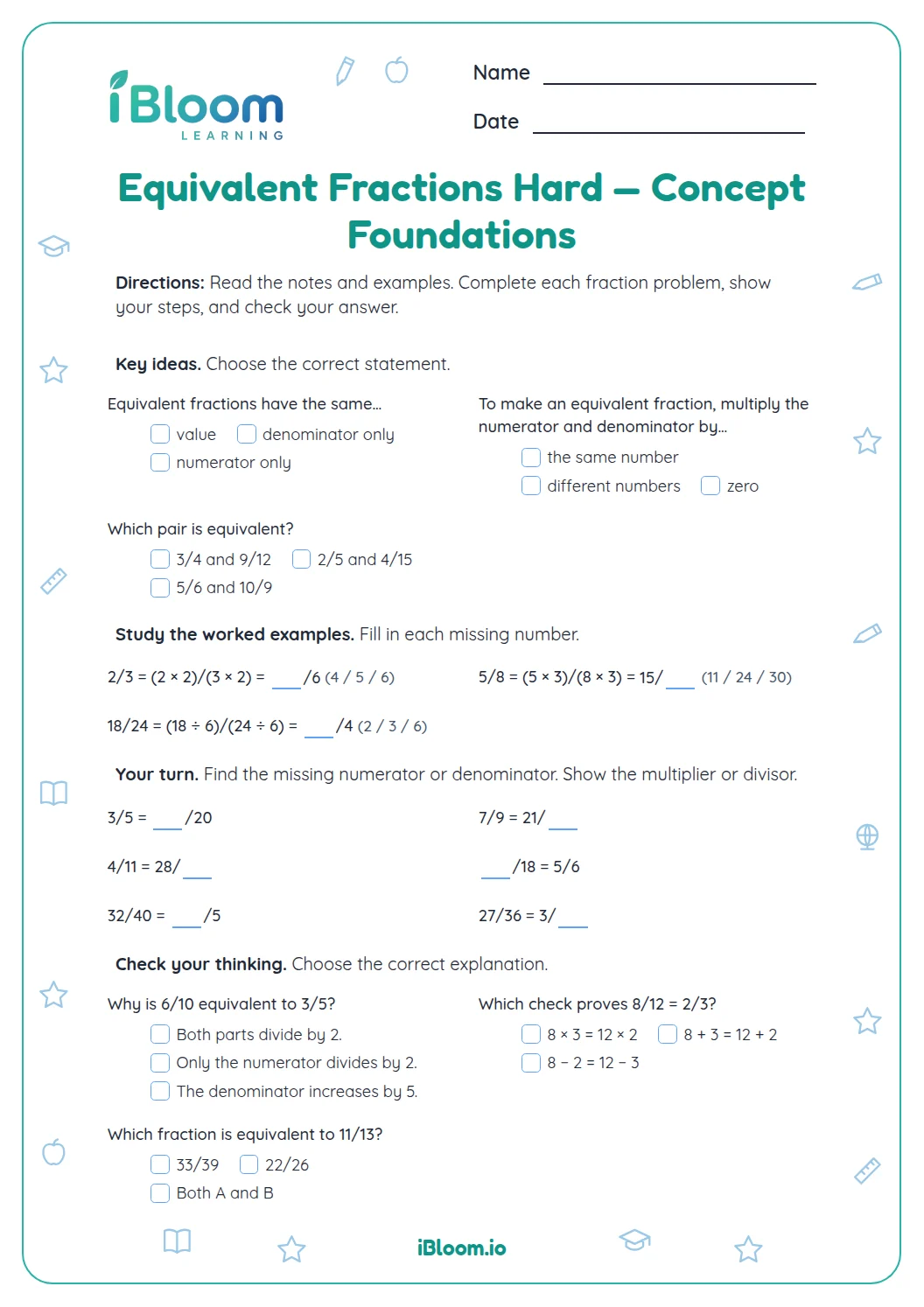
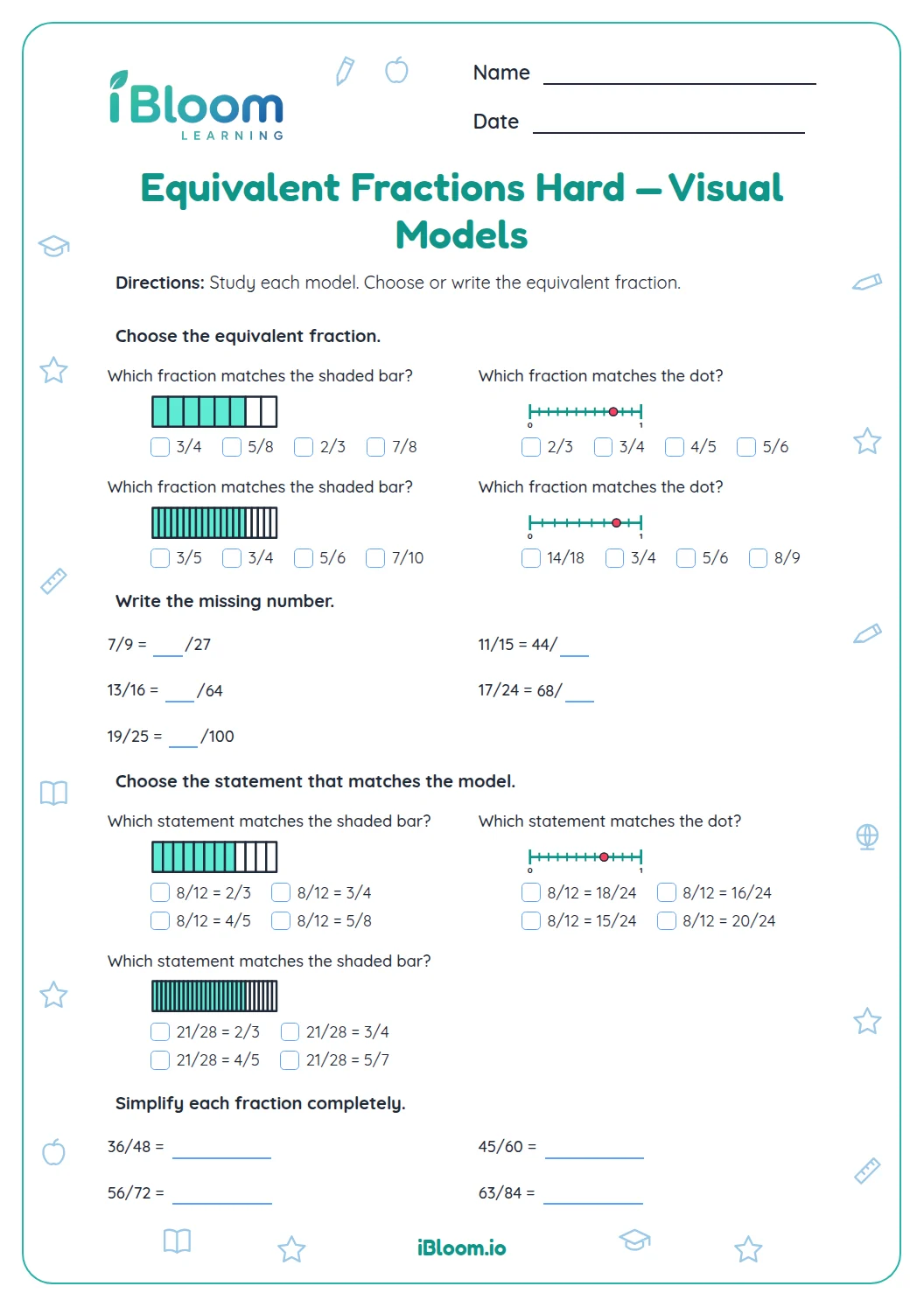
This Grade 6 worksheet builds equivalent fractions by multiplying or dividing the numerator and denominator by the same nonzero factor. Students identify equivalent values, complete missing numerators or denominators, and explain scale factors. A fraction bar introduces equal amounts; the remaining questions use number sentences. The work practices CCSS 4.NF.A.1 through visual models and equivalent-fraction reasoning. The answer key includes brief explanations.
Aligned to 4.NF.A.1
What makes two fractions equivalent?
Equivalent fractions name the same amount even when their numerators and denominators differ. In Question 4, the bar shows 2/4; multiplying both parts by 2 gives the equivalent fraction 4/8.
- 1Question 4: 2/4 = 4/8; both fractions name one half.
How do I find a missing numerator or denominator?
Find the factor that changes the known numerator or denominator, then apply that same factor to the other part. To change 2/3 into a fraction with denominator 12, multiply both parts by 4: 8/12.
How can I check a simplified fraction?
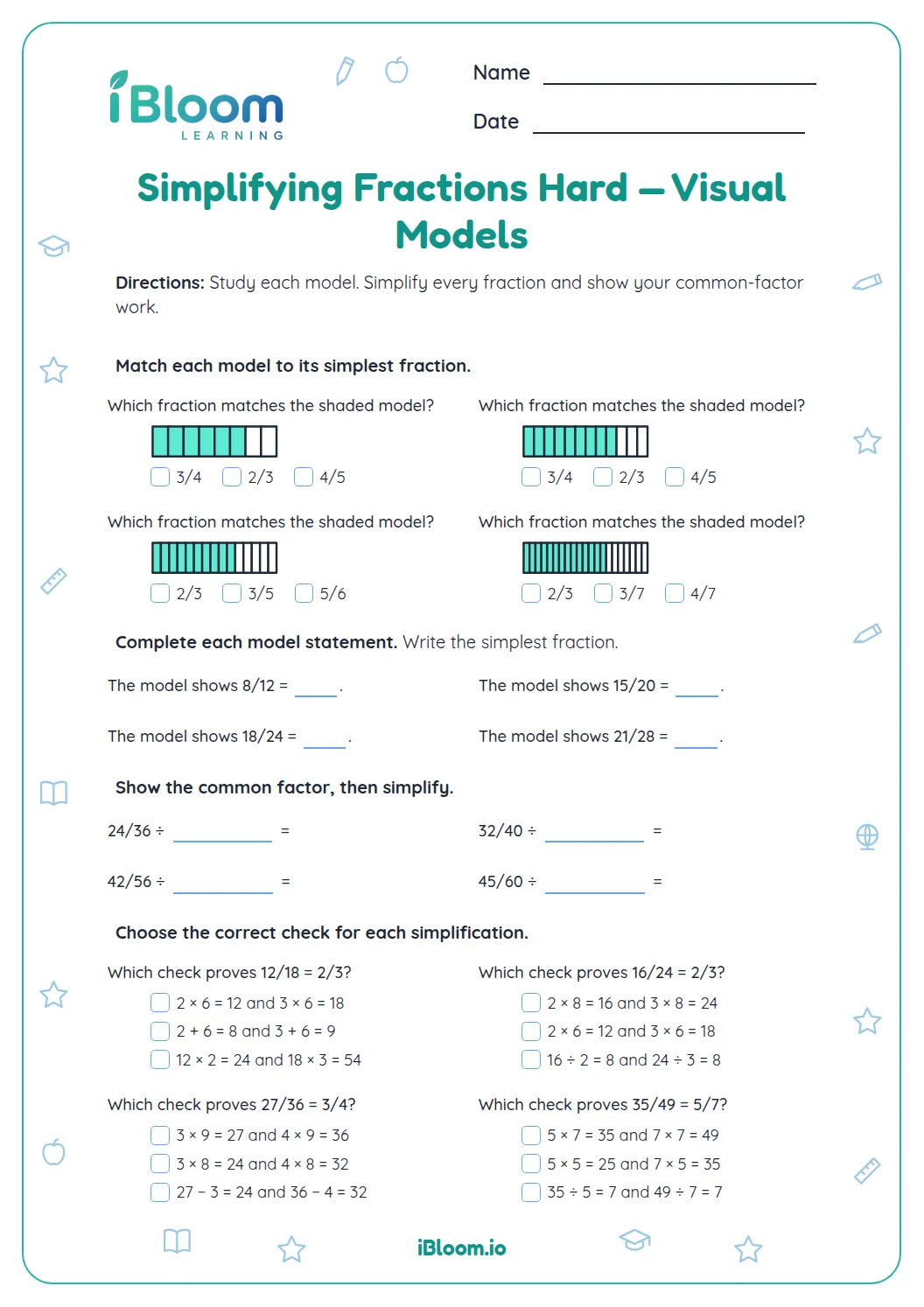
Divide both parts by the same common factor. For 12/16, divide numerator and denominator by 4 to get 3/4. Multiplying back by 4 returns 12/16, which checks the equivalence.
How to use this equivalent-fractions worksheet
- 1Compare the amount represented, not just the numbers in the fraction.
- 2Find the factor that changes the known part.
- 3Apply the same factor to numerator and denominator.
- 4For simplification, divide both parts by the same common factor.
- 5Check by scaling the result back to the original fraction.
Common mistakes and quick fixes
The mistake
Changing only the numerator or denominator
The fix
Apply the same nonzero factor to both parts.
The mistake
Adding the same number to the numerator and denominator
The fix
Equivalent fractions come from multiplying or dividing both parts by a common factor.
The mistake
Stopping before simplifying fully
The fix
Check whether numerator and denominator still share a common factor.
This worksheet gives students a concrete way to practice the skill.
Use visual models and common factors to recognize and generate equivalent fractions.
On this sheet:
Show the official wordingHide the official wording
Explain why a fraction a/b is equivalent to a fraction (n × a)/(n × b) by using visual fraction models, with attention to how the number and size of the parts differ even though the two fractions themselves are the same size. Use this principle to recognize and generate equivalent fractions.
What to practice next
Make more practice
Further reading
Questions parents and teachers ask
Why must I change both parts of a fraction?
A fraction names a ratio of numerator to denominator. Multiplying or dividing only one part changes that ratio. Applying the same nonzero factor to both parts creates another name for the same amount, such as 2/3 and 8/12. That is the central rule on this sheet.
How do I find the missing number in 2/3 = ___/12?
The denominator 3 becomes 12 by multiplying by 4. Multiply the numerator by 4 as well: 2 × 4 = 8. The equivalent fraction is 8/12, which has the same value as 2/3. Both parts changed by the same factor.
Can I add the same number to both parts?
Adding the same number does not generally preserve a fraction’s value. For example, 1/2 is not equal to 2/3. Use the same nonzero multiplier or divisor on numerator and denominator instead. Multiplying or dividing both parts keeps their ratio unchanged. This is why the worksheet uses a common factor instead.
How can I check if 6/10 equals 3/5?
Divide both the numerator and denominator of 6/10 by 2. The result is 3/5, so the fractions are equivalent. You can also multiply 3/5 by 2/2 to return to 6/10. Either direction is a useful check for Question 15. This check works even when simplifying a fraction.
What is a scale factor?
A scale factor is the common number used to multiply or divide both parts of a fraction. In 2/3 = 8/12, the factor is 4. In 12/16 = 3/4, both parts are divided by 4. Questions 13 and 14 ask students to identify this change.