








About this worksheet
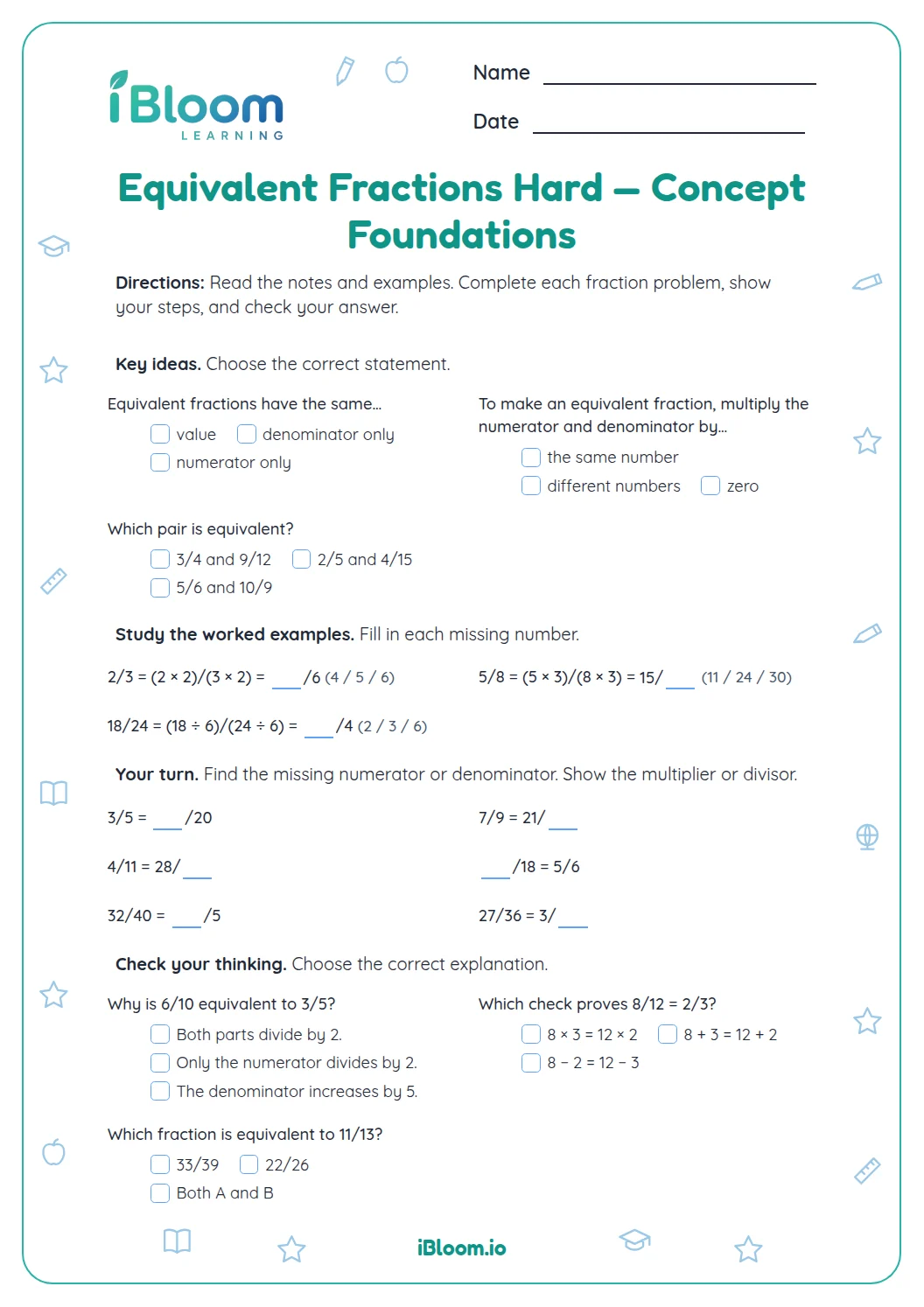
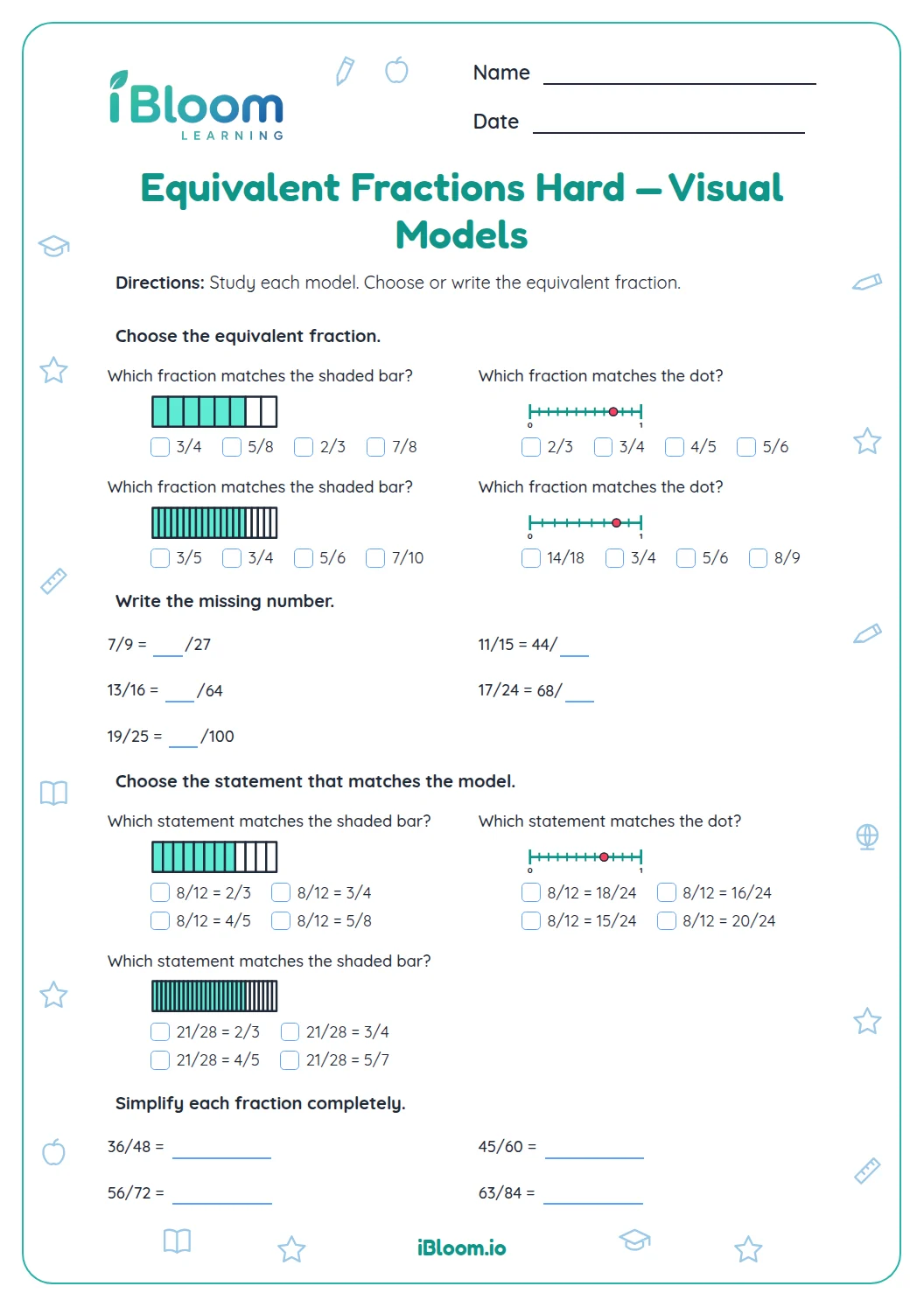
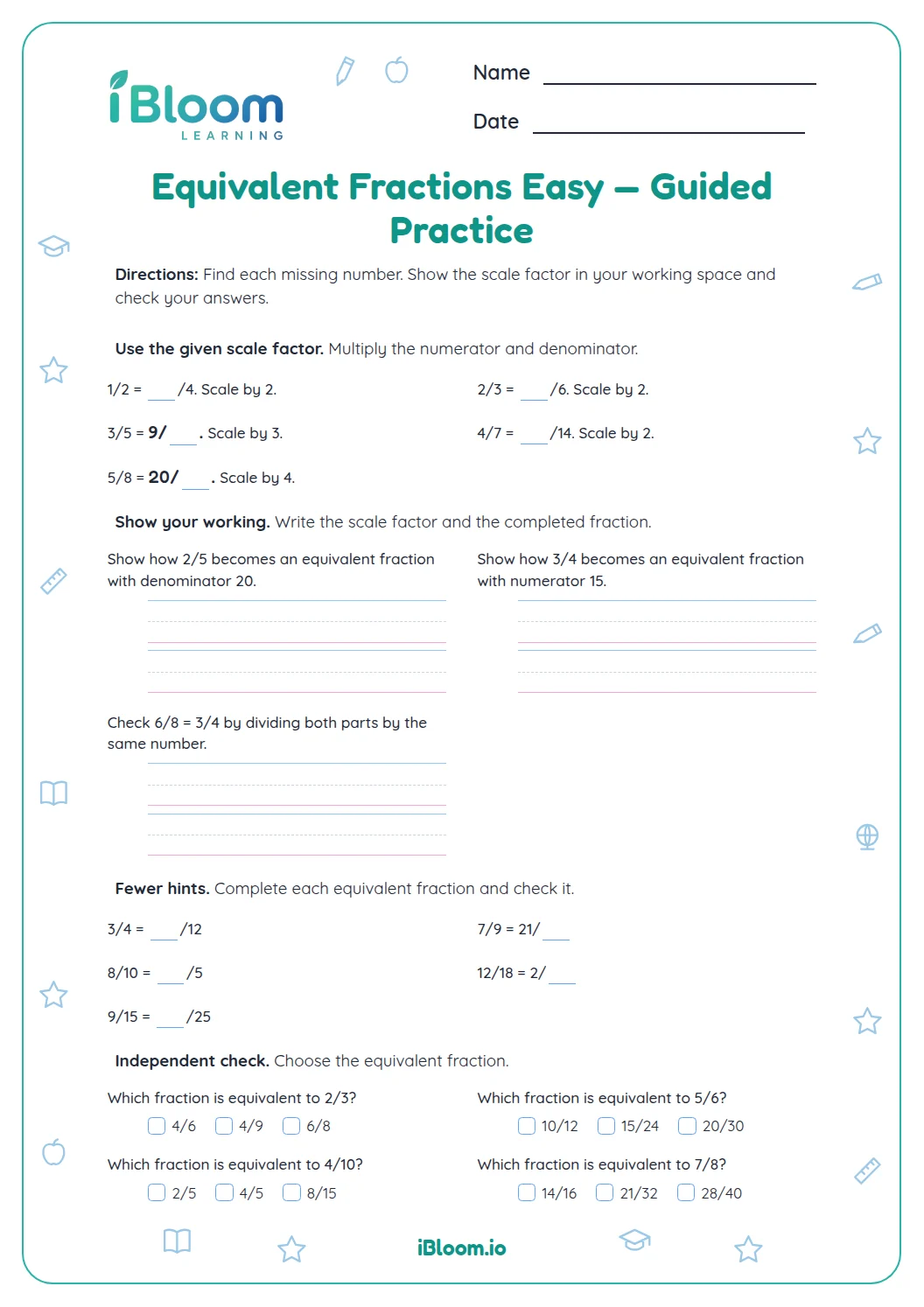
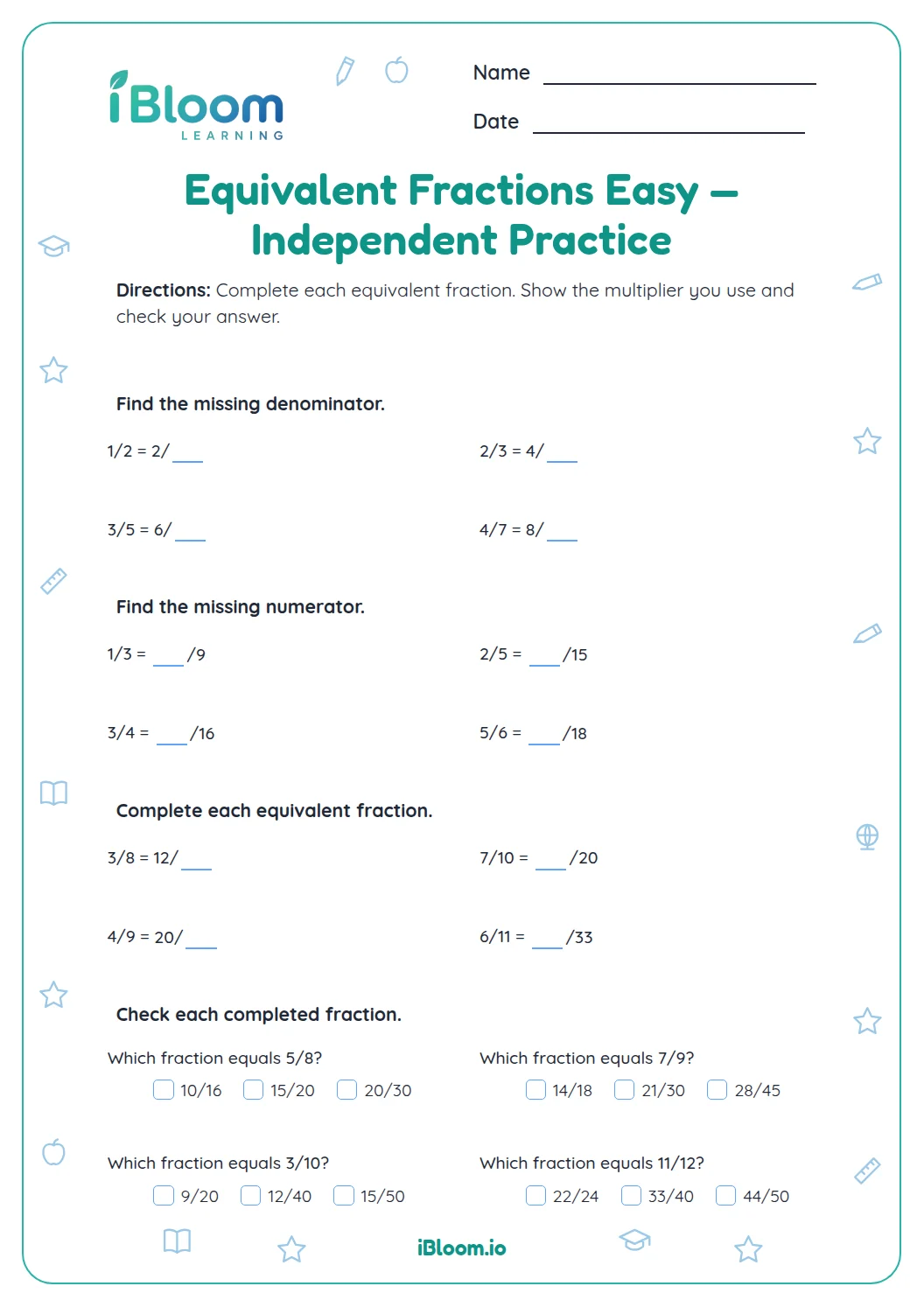
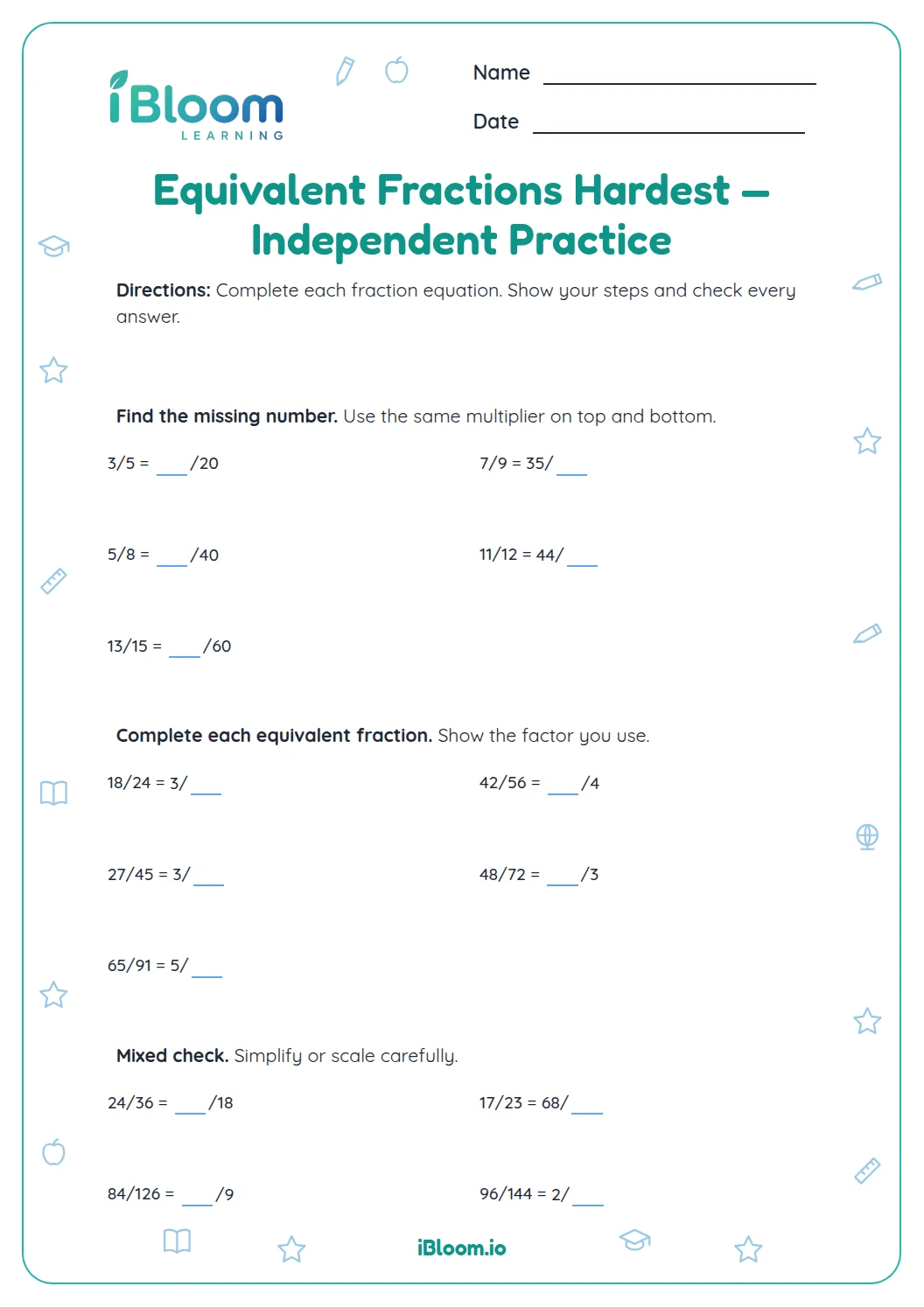
This Grade 6 independent practice sheet focuses on generating and checking equivalent fractions. Children scale both numerator and denominator by the same factor, then test fraction pairs that are equivalent or not equivalent. The 14 questions are arranged in two parts and include a separate answer key. The work practices CCSS 4.NF.A.1 by generating equivalent fractions and recognizing that equivalent fractions have the same size.
Aligned to 4.NF.A.1
How do you generate an equivalent fraction?
Multiply the numerator and denominator by the same number. In question 1, 3/5 becomes 12/20 because both terms are multiplied by 4. The value stays the same because the number and size of the equal parts change together.
- 13/5 = ___/20
- 25 × 4 = 20
- 33 × 4 = 12
- 4So 3/5 = 12/20.
How can you test whether two fractions are equivalent?
Look for one scale factor that changes the first numerator into the second numerator and the first denominator into the second denominator. In 5/12 and 25/60, both terms are multiplied by 5, so the fractions are equivalent. If the factors do not match, the claim is false.
How to use this worksheet
- 1Read the numerator and denominator as a pair.
- 2Find the number that changes the denominator to the target denominator.
- 3Apply that same factor to the numerator.
- 4For a pair or claim, test both terms with one factor.
- 5Check each answer with the answer key.
Common fraction-equivalence slips
The mistake
Adding the same number to the numerator and denominator.
The fix
Use multiplication or division by the same factor; adding does not preserve the fraction value.
The mistake
Multiplying only the numerator.
The fix
Apply the same operation and factor to the denominator.
The mistake
Using different factors for the two terms.
The fix
Write the scale factor beside both terms and verify both products.
Common Core alignment
This worksheet practices the standards below.
Explain and make equivalent fractions with unlike denominators.
On this sheet: Questions generate and identify equivalent fractions, including multiplication by the same factor.
Show the official wordingHide the official wording
Explain why a fraction a/b is equivalent to a fraction (n × a)/(n × b) by using visual fraction models, with attention to how the number and size of the parts differ even though the two fractions themselves are the same size. Use this principle to recognize and generate equivalent fractions.
What to practice next
Make more practice
Further reading
Questions parents and teachers ask
What makes two fractions equivalent?
Two fractions are equivalent when they name the same amount. A useful way to check is to see whether multiplying or dividing the numerator and denominator by the same nonzero number changes one fraction into the other. Writing the scale factor beside both terms makes the check easier to follow.
How do I solve 3/5 = ___/20?
The denominator 5 is multiplied by 4 to become 20, so multiply the numerator 3 by 4 as well. The missing numerator is 12, giving 3/5 = 12/20. This is question 1 in Part A, where every fraction is completed by scaling both terms equally.
Why must the same factor change both terms?
A fraction describes equal parts of a whole. When each part is split into the same number of smaller pieces, the count of pieces and total pieces both scale together, so the amount remains unchanged. Writing the scale factor beside both terms makes the check easier to follow.
How can I tell if 9/14 and 36/56 are equivalent?
Check the factor in both terms. Nine becomes 36 when multiplied by 4, and 14 becomes 56 when multiplied by 4, so the pair is equivalent. Question 10 uses this same-factor check, and the answer is Yes. Both terms change by exactly the same factor.
What is on the answer key?
The separate key lists the missing numerators and gives Yes or No for each fraction pair and student claim. Children can use it to check their scale factors and final answers. It follows the two worksheet pages and is also two pages long.