




About this worksheet
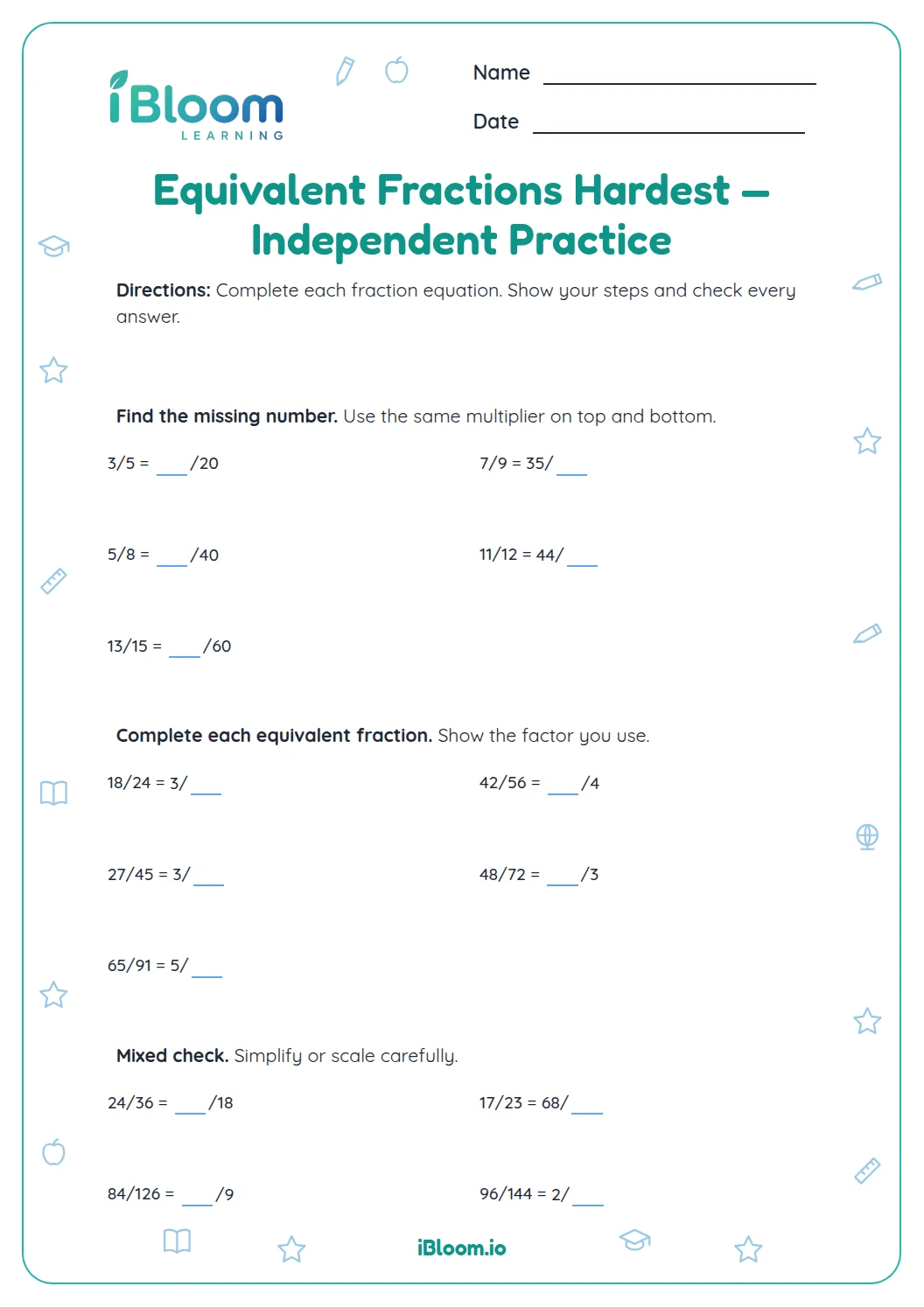
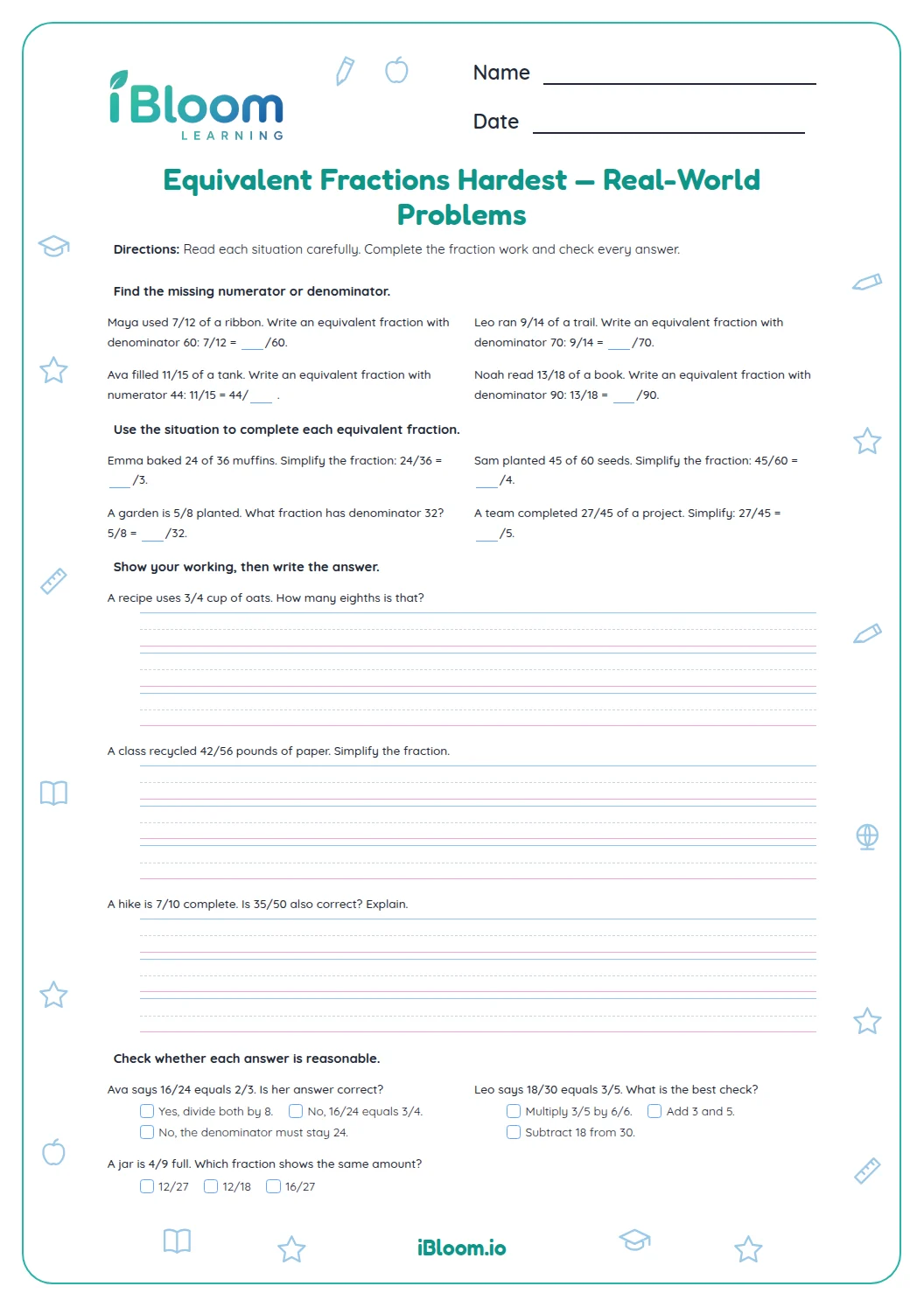
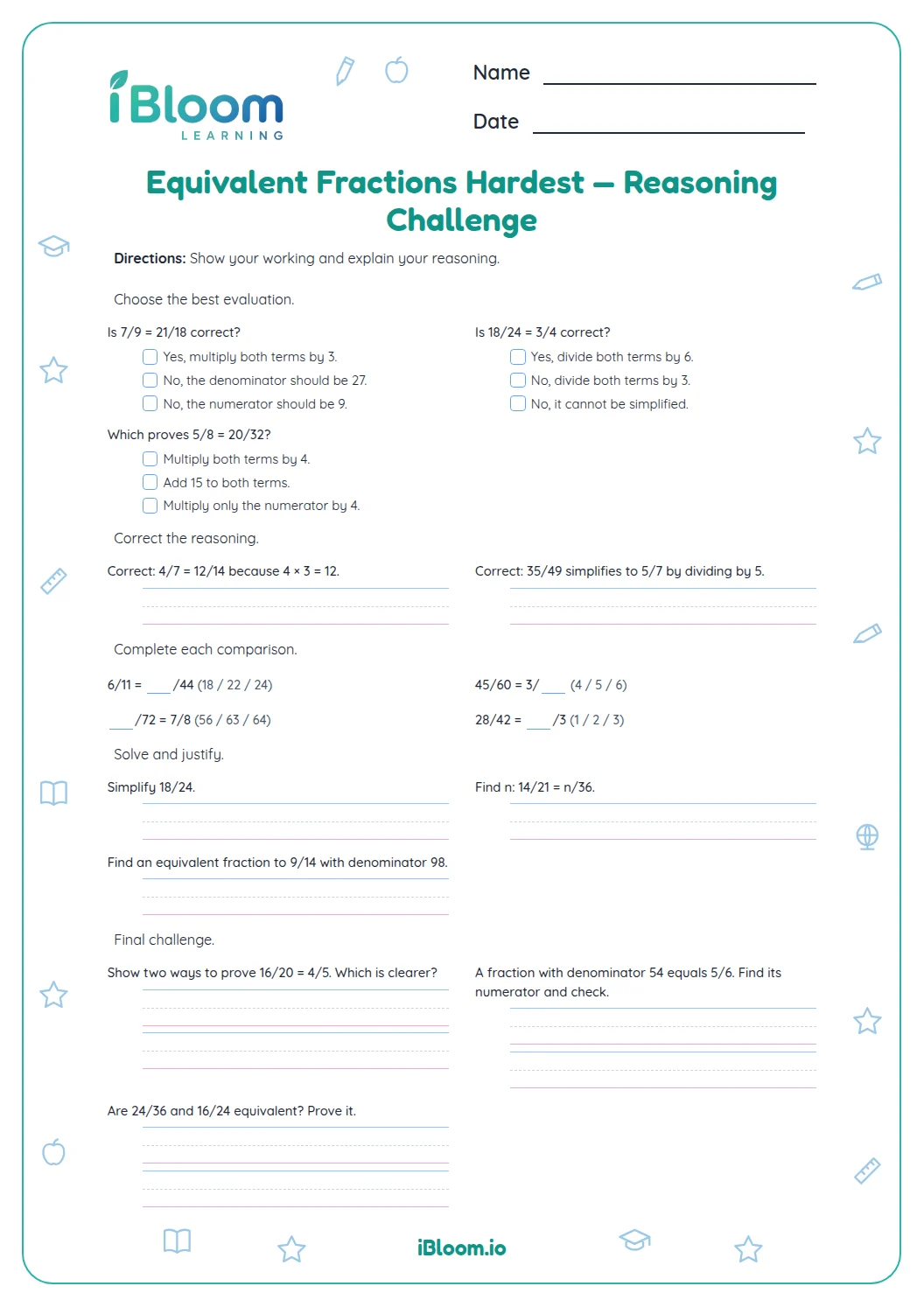
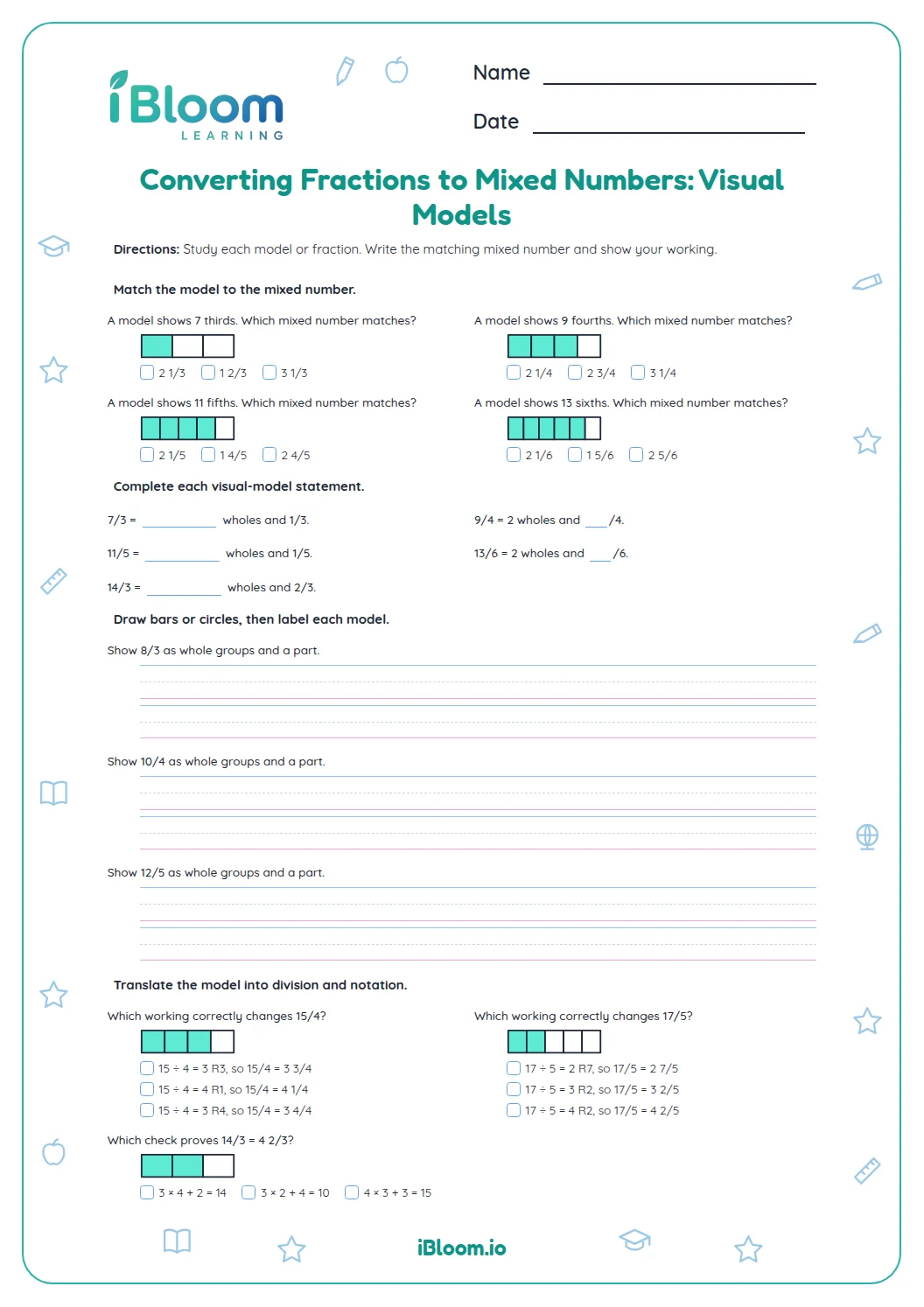
This Grade 6 fractions worksheet keeps the old sheet’s visual-model approach while adding harder equivalent-fraction practice. Students match shaded bars, complete equivalent fractions, find missing numerators or denominators, and read shaded bars and a number line. The three worksheet pages include a separate answer key.
Aligned to 4.NF.A.1
How can a shaded bar show an equivalent fraction?
Question 1 shades 3 of 4 equal parts, so it represents 3/4. The matching choice must name an equal value, not just use a similar numerator or denominator.
How do you complete an equivalent fraction?
For question 5, change 2/3 to a fraction with denominator 12. Since 3 × 4 = 12, multiply the numerator by 4 too: 2 × 4 = 8, so 2/3 = 8/12.
How do models connect to fraction notation?
The final part asks students to read shaded bars and a number line. Count equal parts, note how many are shaded, and write the shaded amount as a fraction.
How to use the worksheet
- 1Read the part heading and direction before starting.
- 2Work through each prompt in order.
- 3Reread a sentence or inspect its model before choosing.
- 4Explain a choice by pointing to its clue.
- 5Use the separate key to check and correct answers.
Common slips and fixes
The mistake
Answering after reading only part of a prompt.
The fix
Reread the full sentence or direction before deciding.
The mistake
Choosing a response that is related but does not fit the exact clue.
The fix
Try the answer in the sentence or compare it with the model.
The mistake
Checking the key before trying the item.
The fix
Make a first attempt, then use the key to find and correct a missed clue.
Curriculum alignment
Use shaded bars and number lines to generate and recognize equivalent fractions.
On this sheet:
Show the official wordingHide the official wording
Explain why a fraction a/b is equivalent to a fraction (n × a)/(n × b) by using visual fraction models, with attention to how the number and size of the parts differ even though the two fractions themselves are the same size. Use this principle to recognize and generate equivalent fractions.
What to practice next
Further reading
Questions parents and teachers ask
What fraction skills does the worksheet practice?
Students identify equivalent fractions in shaded bars, complete missing numerators or denominators, and read fractions from bars and a number line. The questions keep attention on how equal parts can be split differently without changing the whole amount. Count the equal parts again and explain how they keep the same whole.
How do I explain the missing number in 2/3 = ___/12?
The denominator changes from 3 to 12 by multiplying by 4. Multiply the numerator by 4 as well: 2 × 4 = 8. Therefore, 2/3 equals 8/12 because both parts of the fraction were multiplied by the same number. Count the equal parts again and explain how they keep the same whole.
How many questions are included?
There are 16 questions in four parts: four shaded-bar choices, eight fraction conversions, and four questions that read a shaded bar or number line. The answer key shows the correct values for checking. Count the equal parts again and explain how they keep the same whole.
What does the answer key show?
The key marks each correct equivalent-fraction choice, fills each missing numerator or denominator, and records the fractions shown by the models. For example, the bar with 7 of 10 parts shaded represents 7/10. Count the equal parts again and explain how they keep the same whole.
How long does this worksheet take?
Plan about 20 minutes for the three pages. Encourage students to inspect how many equal parts make the whole before choosing or writing a fraction. The answer key can help locate a missed multiplication factor or model count. Count the equal parts again and explain how they keep the same whole.